Tag: Winnsboro Town Council

  • McMeekin wins big in Winnsboro mayor’s race

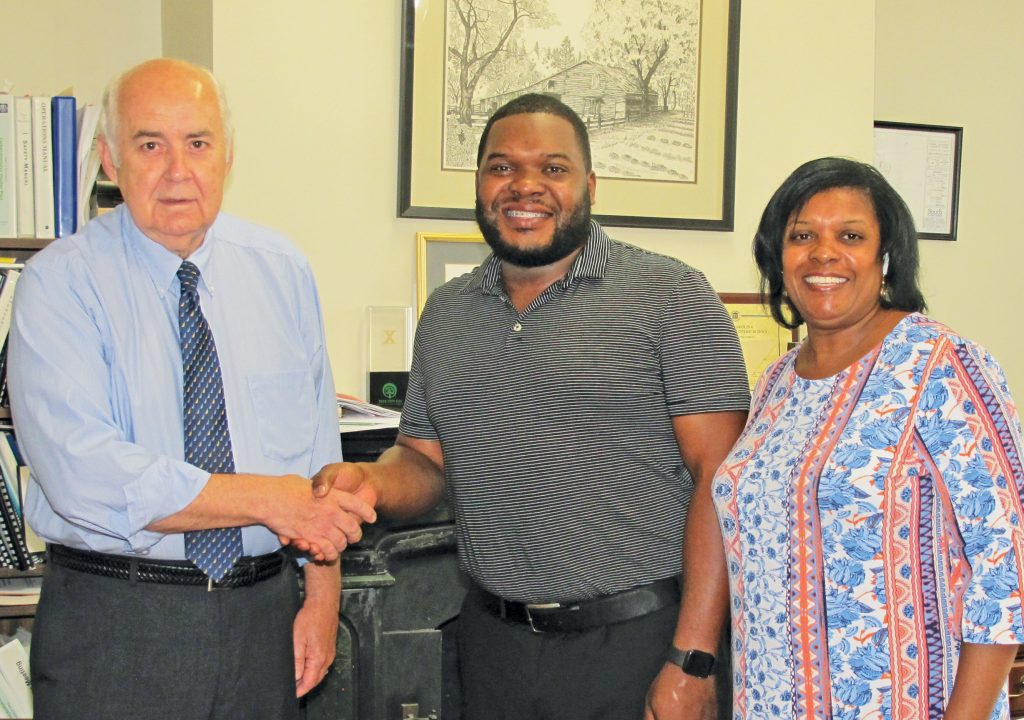
    From left: Bartell (Dist. 2), McMeekin, and Burroughs (Dist. 4). | Photos: Martha Ladd

    WINNSBORO – On a warm, sunny election day in Winnsboro, Town Councilman John McMeekin, with 469 votes, decisively won the mayoral election over Nocola Hemphill who received 265 votes.

    McMeekin took 63.90 percent of the vote. Hemphill took 36.10 percent. McMeekin carried four of the town’s five precincts.

    In the town council race, District 2 councilwoman and incumbent Janice Bartell was unopposed and took 128 votes (99.21 percent.) There was one write-in.

    Political newcomer James Jae Burroughs also ran unopposed to win a first term on town council with 240 votes (97.96 percent.) He will represent District 4, replacing McMeekin on council. There were 5 write-ins for that seat.

    Of the 2,399 registered voters, there were 739 votes cast and an overall 30.80 percent turnout.

    “I’m extremely grateful to the friends who helped me win this election,” McMeekin said following the vote count. “I thank everyone who worked so hard for our campaign – and there were many – and all those who voted for me. It was their work and dedication that won the election.

    “Now I think we’re all ready to move on and get to work on Winnsboro, to implement and restructure. We have a lot to do and I’m very much looking forward to doing all I can to make life better for all the citizens of Winnsboro,” he said.

    For more on the election, see the Thursday edition of The Voice.

  • County discusses moving momument

    WINNSBORO – Efforts to potentially relocate Winnsboro’s Confederate monument is unlikely until at least 2021, according to Fairfield County officials.

    Fairfield County Council discussed, but took no action on a request from the Town of Winnsboro to relocate the town’s Confederate monument from its current location at the Mt. Zion Institute grounds to the Fairfield County museum.

    A confederate monument stands on the edge of the Mt. Zion Institute property. | Barbara Ball

    County leaders cited the S.C. Heritage Act, which prohibits governmental agencies from removing Confederate and other war memorials from public property. A two-thirds vote in the state House and Senate is required to override this requirement.

    “I don’t think there’s any action that can be taken by this council at this time,” said county attorney Tommy Morgan. “The town has brought this to the council’s attention, but there’s nothing that can be done.”

    The Winnsboro monument depicts a Confederate soldier and his rifle atop an obelisk near the corner of Hudson and Zion streets in Winnsboro.

    It was relocated from Congress Street to the school campus in the 1960s after a street widening project in town, according to the S.C. Picture Project, a non-profit that maintains an online database of historically significant landmarks.

    County Administrator Jason Taylor said it was the town that initiated the request to the county to relocate the monument. That request was made following a guest editorial published on June 25, in The Voice by Fairfield County NAACP President Jennifer Jenkins calling for the removal of the monument from the grounds of the former Mount Zion School.

    During the July town council meeting, Winnsboro Mayor Roger Gaddy said the town is merely exploring options.

    “We’re not moving it [right now],” Gaddy said. “We’re just exploring our different options and how to legally apply those options. We’re not going to do anything illegal.”

    Fairfield County Councilman Moses Bell asked if the county’s legislative delegation would be able to request to move the monument.

    Morgan said the delegation lacks that authority. He said the town’s request is contingent upon any potential revisions to the Heritage Act.

    Bills to that effect have been filed in the General Assembly. However, due to the COVID-19 pandemic, a limited number of items are likely to be taken up this year, meaning it will likely be at least 2021 before bills addressing the Heritage Act are taken up, Morgan said.

    Bell said that he’s “very appreciative that the Town of Winnsboro looked at this and saw the harm that it’s doing to the community by the confederate monument being directly in front of where we’re going to have the new administration building.”

    Councilman Douglas Pauley thought moving the monument should be the town’s responsibility, not the county’s.

    “This monument has always been in the Town of Winnsboro’s jurisdiction and they’re responsible for it. I don’t see the need for them to want to give it to us and for us to accept the monument and put it on a piece of county property,” Pauley said. “If the heritage act is approved, they can find a more suitable location that they own instead of it being on a piece of county property.”

    Adopted in 2000, the Heritage Act protects most monuments. In part it reads:

    “No Revolutionary War, War of 1812, Mexican War, War Between the States, Spanish-American War, World War I, World War II, Korean War, Vietnam War, Persian Gulf War, Native American, or African-American History monuments or memorials erected on public property of the State or any of its political subdivisions may be relocated, removed, disturbed, or altered.”

  • Town eyes options for relocating monument

    WINNSBORO – There is currently a law in South Carolina that protects, in part, certain monuments from being removed from public property in the state without a vote by the General Assembly.

    Winnsboro Mayor Roger Gaddy said during town council meeting Tuesday night that the town government does not intend to break that law. Following a lengthy executive session about the legalities of moving the town’s confederate monument, council voted 5-0 to authorize Town Manager Don Wood to explore suitable options for relocating the monument.

    The monument, which sits on the far corner of the Mt. Zion Institute grounds from the former school building, is one of three kinds of monuments that the Heritage Act is designed to protect – those erected for Native Americans, African Americans and war memorials.

    The town’s confederate memorial is a war memorial.

    To be protected by the Act, monuments must also be located in a public area, according to an opinion by S.C. Attorney General Alan Wilson.

    While the issue of the confederate monument has smoldered in some Winnsboro neighborhoods for years, the discussion caught fire last month when the Fairfield County NAACP President Jennifer Jenkins wrote a passionate editorial that appeared on the front page of The Voice, calling for the removal of the monument from the Mt. Zion property – a property that will soon be home to the county offices.

    Jenkins said it would be offensive for county employees to have to go to work there in sight of what many in the community consider a monument to slavery.

    A confederate monument stands on the edge of the Mt. Zion Institute property. | Barbara Ball

    “We’re not moving it [right now],” Gaddy said. “We’re just exploring our different options and how to legally apply those options. We’re not going to do anything illegal,” he said. “I don’t know where we can move it. I don’t know how much it will cost to move it. I don’t know who moves it. I do know we have to get permission from the state legislature to move it. But before I would ask permission from the legislature to do that, I would want to be able to tell them what we’re going to do with it.”

    County Administrator Jason Taylor said in a County Council meeting last month that the county would be glad to help the town government with the expenses of moving the monument to a more suitable location.

    While SC Attorney General Wilson has said he is prepared to defend the constitutionality of the Heritage Act, he has also said the part of the law that requires a two-thirds vote of the General Assembly in both the House and the Senate to remove a protected monument might be found unconstitutional if challenged since the General Assembly passes legislation with a simple majority.

    Gaddy said he doesn’t expect the legislature to take the matter up until they come back into regular session on Jan. 3.

    “There is a lawsuit in the courts now that’s trying to declare the Heritage Act unconstitutional,” Gaddy said. “It may be that they (legislature) may not have an Act to deal with when they come back. So, we’re going to see what avenues we have that are appropriate for us, legally, and to get the information that we need so that whenever the time comes, if we are able to move it, then we’ll have everything ready to go.”

    Gaddy said to get approval from the legislature to move the monument, the county’s legislative delegation would have to request approval of the General Assembly. A two-thirds vote is required for passage.

    As Gaddy was calling for adjournment of the meeting, Councilman Danny Miller interrupted him, saying he wanted to thank the mayor and council for its work on the issue.

    “I want you to know, with this situation, we appreciate you,” Miller said.

    “I appreciate all of our council members,” Gaddy said. “We’re fortunate in Winnsboro to have a good town council. We work together really well. There’s almost never any acrimony. Everything is usually done in a very civil, cordial and professional way.”

    Following the meeting, Miller, one of two African Americans on council, commented that he’s proud of how well the council has worked collaboratively on the issue of the monument and wanted to assure the community that council is working toward a goal.

    “Out of love and care, we’re going to come up with a good solution to this problem. We’ll work together for the good of the whole community,” Miller said.

    Asked when a decision might be reached about what to do with the monument, Councilman Demetrius Chatman, council’s newest member, said council has now put it in the hands of the town administrator to research where the monument should be moved to.

    “We had a really good discussion in executive session. But whatever we decide to do with it, we still have to find out what the legislature is going to do. We’re not going to break the law,” Chatman said.

    Chatman said that council was advised by legal counsel that even though the statue was moved some years back from the center of Congress Street in front of the town clock to its present location, its movement is still governed by the Heritage Act.

    “We can’t move it without approval from the General Assembly,” he said.

  • Winnsboro, Blythewood reach water agreement

    WINNSBORO – After 20 years, a new water agreement is being finalized between the towns of Winnsboro and Blythewood.

    The Winnsboro town council voted Tuesday evening to pass first reading on a new water service agreement with Blythewood. The second and final vote and public hearing on the agreement will be held at the Feb. 18 meeting.

    Blythewood council will take the first of its two votes on the agreement Feb. 24. 

    The initial agreement between the two towns, finalized July 31, 2000, was set to expire July 31, 2020. The continuation of the agreement is an affirmation of a longstanding relationship between the two towns. It was primarily Winnsboro’s water that jumpstarted economic development in Blythewood.

    Until 2000, Blythewood had no public water service. It was that year that the Ballow administration sought to bring economic development to Blythewood with a hotel – the Comfort Inn. To do that, the town needed water. Lots of water. Ballew turned to Columbia but was unable to negotiate an agreement for the city to supply water to Blythewood.

    Winnsboro was the only water supplier at the time who would agree to extend service to Blythewood. With cooperation from Fairfield Electric Cooperative in building a water tower, Winnsboro water made possible the eventual construction of three hotels that currently contribute between $400,000 and $500,000 in hospitality tax revenue annually to the town’s coffers.

    But during 2014, the Blythewood town government soured on Winnsboro water and abruptly gave Winnsboro notice of termination [of the water agreement].

     “Something different is going to have to be developed between now and July of 2020. A new plan for how we relate to Winnsboro or Columbia with regard to potable water supply and storage  is important and emerging – like tomorrow. It’s an issue for the town and council, Blythewood town attorney Jim Meggs said.

    Then-Mayor J. Michael Ross said at a town council retreat that he recommended, “that our next agreement [with Winnsboro] not last for 20 years.”

    Blythewood council signed that notice of termination in April of 2014, effective July of 2016, but the termination never came to fruition since the agreement didn’t actually end until 2020.

    The issue in 2014 was two-fold. A severe state-wide drought two years earlier had drained Winnsboro’s reservoirs until there was not enough water to meet Blythewood’s needs. As a result, Winnsboro Town Manager Don Wood signed an agreement with the City of Columbia to temporarily supplement the Blythewood area’s water supply.

    In addition, Ross said at that time that Blythewood had gotten wind that a private company had offered to purchase the Blythewood arm of the water system from Winnsboro. Winnsboro council members said they never entertained such an offer.

    The resolution was a shock to Winnsboro council members who said it came with no warning.

    Ross told The Voice shortly afterwards that council feared that they could potentially be at the mercy of private industry and its water rates.

    Termination of the agreement, however, automatically triggers the sale of the system at fair market value, and it was at Blythewood’s behest that Columbia made a $1.4 million offer on Nov. 19, 2014 to purchase Blythewood’s system from Winnsboro.

    But the water contract also mandates arbitration in the event of a dispute between the two parties. While Winnsboro hired a mediator to make their case, Blythewood did not, and the deadline to do so passed.

    Winnsboro, meanwhile, initiated steps in September, 2014 to construct a $12 million pipeline that would allow the town to draw as much as 10 million gallons of water per day from the Broad River.  Winnsboro Mayor Roger Gaddy said the Broad River project would make all of Blythewood’s concerns disappear, rendering Blythewood’s move to wriggle out of the agreement moot.

    “Those pumps are now permitted to provide 10 million gallons per day,” Gas, Water and Sewer Director Trip Peake said. Much of that water is earmarked for Fairfield county’s future industrial development.

    “Right now reservoirs are full and over flowing. And if the reservoirs drop in the summer, if there’s no rain, we will still have plenty of water” Peake said.

    In the end, there were few changes to the new contract provided by Winnsboro last month, Blythewood Mayor Bryan Franklin gave the document his blessing.

    “I am confident it will be adopted [by council] on my recommendation,” Franklin wrote to Winnsboro Town Manager Don Wood on Jan. 3.

    The new water contract, agreed to by both Winnsboro and Blythewood, is again a 20-year contract with extensions provided in five year increments.

    The main changes to the agreement are that Winnsboro will pay a higher franchise fee to Blythewood (up from three percent to five percent), Blythewood (in-town and out-of-town) will receive more favorable rates that are in line with Winnsboro’s in-town and out-of town rates, and if the franchise is ended, the Town of Winnsboro is to be paid fair market value. Other features of the contract call for Blythewood to pay for water hydrants that it orders, Winnsboro to pay for hyrants it orders and developers to pay for hydrants they order.

  • Chatman sworn in as Town Councilman

    Demetrius Chatman is congratulated by Winnsboro Town Manager Don Wood after being sworn into office. At right is his mom, Susan Chatman. | Barbara Ball

    WINNSBORO – Political newcomer Demetrius Chatman, 33, was sworn into the Winnsboro Town Council July 2 where he will take the seat for District 3.

    While it’s his first time to hold an elected office, Chatman said he is prepared.

    “I’ve been going to the meetings and talking to people in my district about things they would like to see brought forward,” Chatman said. “I think knowing what my constituents want is the key.”

    A native of Winnsboro, Chatman holds a Bachelor’s degree man holds a Bachelor’s degree in Business Management from South Carolina State University and an MBA from Webster University. He is also a graduate of Leadership Columbia.

    “I love Winnsboro, and that’s why I got into the race, to make things happen,” Chatman said.

    Chatman, a graduate of Fairfield Central High School, currently works at the University as a program manager for Title III, a federal grant program.

  • Winnsboro restaurant suspension upheld

    WINNSBORO – A Winnsboro restaurant that was shut down last month over concerns it was doubling as a nightclub will remain closed until further notice.

    Meantime, a representative of Winnsboro Bar & Grill thinks the town’s decision to suspend her business license was overkill, saying her establishment is simply a restaurant that also serves drinks.

    Beverly Williams, owner of the business, thinks the town should have issued a warning instead of shutting her restaurant down completely.

    “If they had a problem, they could’ve come to us,” Williams said. “We’ve been locked out of our building. We haven’t been able to access any of our things. We’ve lost so much revenue.”

    On April 16, Winnsboro Town Council voted unanimously to uphold the suspension of Winnsboro Bar & Grill’s business license.

    Last Tuesday’s vote followed a public hearing in which Williams stated she never knowingly intended to violate any town rules.

    “We’re just a family business. We offer a full restaurant-bar, but we’re not a bar. We’ve never advertised as a bar. We’re just a family restaurant that has full bar service, that’s just who we are,” Williams said. “We’ve never had any problems in the community. We’ve always served the community, I’ve served many of the people who are in here now.”

    Town police, however, tell a different story.

    Police Chief John Seibles said officers were alerted to the business after discovering social media and radio ads promoting a large party. He said the town lacks resources to police a large party.

    “We have three officers on the street,” Seibles said. “We didn’t think that area of Winnsboro was conducive to this kind of bar, this kind of club.”

    Investigator Michael Carroll with the town’s police department said fliers began circulating that advertised a “new nightlife party spot for Winnsboro.”

    Carroll told council members that a relative of Williams subleased the property to James Randolph, the former owner of Kandyland, a Columbia area strip club the Richland County Sheriff’s Department recently shut down.

    Richland County deputies responded to a shooting death at Kandyland in December 2018, according to media reports. It remains one of four unsolved murders reported last year.

    “We can’t handle a nightlife party spot on Main Street,” Carroll said. “We just don’t have the officers or manpower to handle something Mr. James Randolph has done in the past.”

    Williams countered that Randolph was advertising a private party. She said her business is not a nightclub.

    “We’ve done everything according to what we thought was policy until we were otherwise informed it wasn’t,” she said. “We had no reason to think we were doing anything wrong.”

    In a telephone interview with The Voice, Williams said when she originally obtained her business license in July, the business wasn’t serving alcohol.

    Williams said the restaurant later obtained its liquor license from the S.C. Department of Revenue. She said the town’s decision to suspend her business license was over a mere technicality, one she’s happy to resolve.

    “If we reapply for a business license, it means we’ll have to reapply for all of our other licenses as well,” Williams said. “We can’t just open right back up. We’re trying to figure out how we’ll proceed from here.”

    According to a March 28 police report, Williams stated on her business license application that no alcohol would be sold, and that there wouldn’t be any coin-operated machines on the property.

    Officers, however, observed bottles of liquor inside, as well as a coin operated pool table, the report said.

    “Did you not think there was anything wrong if there was alcohol in the building, coin operated machines, and the business license said there wasn’t supposed to be anything like that in there?” Mayor Roger Gaddy asked during the hearing.

    Williams said the business has communicated with town officials via social media about the coin-operated machines since February, but didn’t address the alcohol bottles.

    “My main concern is the alcohol. Certainly it’s a clear violation of what your business is supposed to have,” Gaddy said. “I think the suspension is appropriate.”

    Gaddy said he’s not opposed to a business that sells alcohol or has a coin-operated machine in its business. He said Winnsboro Bar & Grill is welcome to reapply for a new business license.

    “This does not preclude you applying for other business licenses with the appropriate boxes checked,” Gaddy said. “Unfortunately in this situation, and I’m sorry you’re having to go through that, but clearly there’s a discrepancy.”

  • Chatman elected to WTC

    WINNSBORO – Political newcomer Demetrius Chatman, 33, defeated two-term incumbent Clyde Sanders Tuesday night to win the District 3 seat on the Winnsboro Town Council.

    Voter turnout for the election was low with only 79 (6.46%) of the 1,239 registered voters casting ballots. Debby Stidham, Director of Fairfield County Voter Registration, said.

    Chatman

    Chatman received the lion’s share of the District 3 votes, with 52 votes to Sanders’ 7.

    Unopposed incumbent Danny Miller took all 20 of the votes cast in District 1.

    “I’m excited,” Chatman said after learning of his victory. “I just thank all the people who voted for me and who had the faith and trust to let me serve them.”

    To celebrate, he said he was headed to church services at the United House of Peace where he is a member.

    “I attend every Tuesday and Thursday evening,” Chatman said, “And I’m certainly going tonight.”

    While it’s his first time to hold an elected office, Chatman said he is prepared.

    “I’ve been going to the meetings and talking to people in my district about things they would like to see brought forward,” Chatman said. “I think knowing what my constituents want is the key.”

    A native of Winnsboro, Chatman holds a Bachelor’s degree in Business Management from South Carolina State University and an MBA from Webster University. He is also a graduate of Leadership Columbia.

    “I love Winnsboro, and that’s why I got into the race, to make things happen,” Chatman said.

    Chatman currently works at the University as a program manager for Title III, a federal grant program. A graduate of Fairfield Central High School, Chatman participated in band and student government.

    Miller, who has served 24 years on the Town Council, says this will be his last term.

    “I enjoy working with people and being their voice,” Miller said.

    Growing up in the Zion Hill Section of Winnsboro, Miller said his family roots run deep in the town.

    “I’m just happy to have been part of the team for all these years,” he said. “I’m looking forward to continuing my service to the community.”

  • Town Council election set for April

    WINNSBORO – Two seats in the Town of Winnsboro Town Council race are up for re-election on April 2, and one of those seats is contested.

    Incumbent Clyde Sanders (District 3) is opposed by political newcomer Demetrius Chatman who says he wants to be a leader for progressive change.

    Sanders, who has served two terms on Council, is a lifelong resident of the town. He is well-known locally as a singer/songwriter.

    Sanders and his Reunion Bande frequently perform for local festivals and released a new CD last year titled ‘Tranquil Bay,’ produced for Patman and Robin Records. To promote the CD, Sanders and the band’s bass player, Tim Boulware, were invited to Ocean Drive Beach in Myrtle Beach to perform a song from the CD titled, ‘I Wanna Dance,’ written by Sanders.

    Chatman, 33, also a native of Winnsboro, holds a Bachelor’s degree in Business Management from South Carolina State University and an MBA from Webster University. He currently works at the University as a program manager for Title III, a federal grant program.

    “I graduated from Fairfield Central High School where I was a member of the band and student government. I was into academics,” Chatman said. He is also a graduate of Leadership Columbia.

    “I love Winnsboro and that’s why I need to get in the race and make things happen,” he said.

    Unopposed in District 1, incumbent Danny Miller said he has served the Winnsboro Town Council for 24 years and hopes to serve four more.

    Miller said he feels the secret to his success as a Councilman is his community service.

    “I just enjoy working with people and being their voice. I do it out of love and kindness,” he said.

    Miller grew up in the Zion Hill section of the town, and he said his family roots run deep in Winnsboro.

    But Miller said this is likely his last run.

    “I was first elected when Quay McMaster was mayor and now under Mayor Gaddy,” Miller said. He speaks highly of both. “We have benefitted from a lot of things they’ve done for the town. A lot of good things have been done.”

    “I’m just happy to have been part of the team for all these years,” Miller said.

    The following precinct and polling places will be open on Election Day from 7 a.m. to 7 p.m.

    South Winnsboro Precinct, Community Volunteer Fire Dept., 110 Winter Street

    Winnsboro No. 1 Precinct, Town of Winnsboro Fire Dept., 117 W. Washington Street

    Winnsboro No. 2 Precinct, Town Clock, Washington Street and Congress Street

    Ballots will be certified on Thursday, April 4, at 10 a.m. at the Fairfield County Election Commission.

  • Joint water authority board sets sail

    The new board of the county and town’s joint water/sewer authority met during an organizational meeting to elect officers, discuss incorporation and receive an engineering update. Attending the meeting were C. D. Rhodes, III, clockwise left, attorney with Pope Flynn, who represents the new joint water/sewer authority board; County Administrator Jason Taylor; Deputy County Administrator Davis Anderson; Winnsboro Town Attorney John Fantry; County Economic Development Director Ty Davenport, County Clerk Patti Locklair Davis; Mayor Roger Gaddy; Town Manager Don Wood; Fairfield County resident and engineer Kyle T. Crager, senior project manager of water/wastewater operations for Michel Baker International and County Council Chairman Neal Robinson.

    WINNSBORO – Fairfield County is gathering all the trappings to lure big industry and with it, more jobs.

    It has interstate access, a megasite roughly equidistant between Columbia and Charlotte and a $2 million state grant targeting infrastructure for that site.

    Now the county and town have created a joint water authority – the Fairfield Joint Water and Sewer System – whose mission it is to facilitate infrastructure growth at the I-77 megasite.

    “I’m excited because it just shows growth for the town and the county,” said Fairfield County Council Chairman Neil Robinson. “I was told we were delusional just thinking about this, but I think we’re on the right path.”

    Appointments of a five-member board were made Monday night and board officers were elected. Plans are to meet monthly, with the next meeting scheduled for March 20.

    Winnsboro Mayor Roger Gaddy was named the Authority’s board chairman and Robinson was named vice-chair. Other members include Fairfield County Administrator Jason Taylor (treasurer), Winnsboro Town Manager Don Wood and Fairfield County resident and engineer Kyle Crager, senior project manager of water/wastewater operations for Michel Baker International.

    “We have to address water and sewer issues if we’re going to grow,” Taylor said. “Without water and sewer the county cannot realize its full potential.”

    Talk of forming a water authority has occurred on and off for the past four years, but gained steam in the past year.

    The S.C. Department of Commerce recently pumped $2 million into the megasite, seed money that will fund an engineering study with the ultimate goal of building a wastewater facility at the I-77 megasite.

    To that end, the state requested that an authority be formed.

    Moving forward, the authority said a critical first step involves mapping out existing infrastructure in the county. The board tentatively plans to review those plans at the next meeting.

    “I think it would be important to see all the plans that have been done on the sewer and at the same time work on the water so we’re all up to speed,” Gaddy said. “I think it’s important for us to all be on the same page and prioritize things.”

    Taylor suggested reaching out to other water providers as the authority’s work moves forward.

    Taylor said at this point, merely mapping the size and location of current water and sewer lines is a prerequisite in developing infrastructure at the megasite.

    “With all of these little fractured systems, it’s not necessarily a rational way to provide infrastructure to the county,” Taylor said. “We’re going to start approaching other providers of water and sewer and see if there’s an opportunity to work with them.

  • WTC OKs Teacher Village zoning

    WINNSBORO – A request for R-3 zoning for property for a once controversial Teacher Village, sailed just as smoothly through the second and final reading as it did the first reading.

    Winnsboro Town Council unanimously approved of the rezoning with a 5-0 vote. As during the first reading, there was no discussion except for Councilman John McMeekin assuring those attending that the Planning Commission had thoroughly researched the request before recommending it to Town Council last month.

    No one spoke in support of the rezoning and only one person spoke against it.

    “I am representing my family as adjoining land owners. We have some concerns. What can we do?” Benjamin Clowney asked the council.

    “It seems like the only thing being considered is whether the proposed use meets the R-3 zoning that has been requested, not whether R-3 zoning is appropriate for the area where the subject property lies,” Clowney read from a prepared statement.

    “While the proposed use may meet R-3 zoning, I don’t believe the area is suitable for R-3,” Clowney said. “You’re talking about three or four houses to the acre. It shouldn’t be in that rural location. That is not where it belongs.”

    Mayor Gaddy thanked Clowney for his comments, but no one addressed the information he presented.

    The request is to rezone 22 acres behind the district office from C-2 Commercial to R-3 Residential. The project is expected to cost $3.6 million.

    School Superintendent Dr. J. R. Green said the District plans to give the property to the Fairfield County Education Foundation who will, in turn, turn it over to the developer who will own it and rent out the homes, but only to teachers in the district and to law enforcement and first responders, according to Sue Rex, Chair of the Education Foundation.

    The district is asking for a multi-county business park agreement and a seven-year $600,000 property tax abatement for the developer. Both require County Council approval.