BLYTHEWOOD (Sept. 21, 2016) – Blythewood High School will celebrate the 10th anniversary of the Bengals’ remarkable class 3A state championship run this Friday during halftime of the Blythewood’s homecoming football game against River Bluff.
Jeff Scott, head coach of the 2006 team and now co-offensive coordinator at Clemson, will be on hand to welcome back former players and join them for dinner in the school cafeteria prior to the game.
The Bengals captured the 3A title in their first year of varsity play, the first team in the state to do so. After dropping their opening game in 2006 to Ridge View (21-13), they went on an amazing 14-game winning streak en route to the crown.
Grady Phillips with the last load of granite to leave his shop.
WINNSBORO (Sept. 16, 2016) – After 83 years in business, Phillips Granite Company has decided to partner with Gulden Monuments of York County. The granite company has been in the family for three generations and was the last monument manufacturer in South Carolina.
“My grandfather moved here in 1933 and started his own granite business and saw it as an opportunity,” manager Grady Phillips said. “I learned (the business) from my father who engaged in the business all his life, and we worked side by side for three decades together.”
Phillips said he has known the owners of Gulden Monuments for many years and has always thought highly of them.
“Now it’s time to finish up the remaining manufacturing orders and move onto the next chapter,” Phillips said. “That’s just the economics in the way of business these days. I didn’t have a successor in my family that wanted to continue the business. Now the business will be able to continue after I retire, and hopefully after I die.”
Phillips said this merger will have little outward change for the public, however. The business will stay in the same location and clients will still come to the office to place their orders. The only major change is that Phillips Granite will be working strictly in sales and services, not in manufacturing.
“You’ll see the same two ladies at the front, and you’ll still see me there. I’ll still be a manager of the granite company,” Phillips said. “We are very blessed and I thank the Lord every day that we have been able to do this for 83 years. We’re still in business and we appreciate all the support from the community.”
WINNSBORO (Sept. 14, 2016) – A Winnsboro man was arrested and charged with murder earlier this month after a domestic dispute spiraled out of control, leaving one man dead.
The Fairfield County Sheriff’s Office said Cornelius Laderrick Alston, 39, was arrested on Sept. 3, not far from the home in the 1700 block of Smalls Chapel Road where 44-year-old Marvin Dejon Young lay dead, the victim of a stab wound.
According to the incident report, Alston’s 15-year-old son told investigators that he and his father had been out all day and had returned to his mother’s home at 1726 Smalls Chapel Road at approximately 5:30 p.m. on Sept. 3. Once there, Alston and the juvenile’s mother got into a verbal argument that quickly escalated and became physical. The argument intensified, with both Alston and the juvenile’s mother going out into the front yard and flattening the tires on each other’s cars.
The juvenile’s mother sprayed Alston in the face with a shot of pepper spray and eventually drew a pocket knife to force Alston to leave the home. Young, of 59 N. Wisteria Lane, soon became involved in the altercation and, according to the report, leapt onto the top of Alston’s car, shattering the windshield.
Once back inside the house, Alston reportedly snuck up behind Young and stabbed him in the lower left side of his back. Fairfield County Coroner Barkley Ramsey, who pronounced Young dead at the scene, said Alston had used a large kitchen knife to stab Young through both lungs. The wound cut through Young’s aorta, Ramsey said, and Young rapidly bled out internally.
According to the report, Alston’s son told investigators that after Young had been stabbed, the victim collapsed onto the floor. The juvenile placed a towel underneath Young and began chest compressions while the juvenile’s mother attempted mouth-to-mouth resuscitation. Alston fled the scene, the juvenile said, right after Young collapsed from the wound.
Deputies arrived at the scene just after 6 p.m. As they turned onto Smalls Chapel Road, they spotted Alston sitting on top of his car at the end of the road, trying to flag the officers down. After securing the scene, and after investigators had arrived, deputies returned to the end of Smalls Chapel Road to find Alston still there waiting for them.
Alston, of 470 A Pine St., was arrested and charged with murder. At press time he was still being held at the Fairfield County Detention Center.
WINNSBORO (Sept. 15, 2016) – During Monday’s County Council meeting, County Administrator Jason Taylor called members’ attention to a request for action to engage the services of Parker Poe Consulting, LLC for assistance with legal matters relating to Fairfield Memorial Hospital. The issue had been sent forward to Council by the Administration and Finance Committee on Sept. 7.
At that meeting, attended by Parker Poe attorney Ray Jones and Milton Pope who is on retainer to the County, Taylor reviewed with Committee members Marion Robinson and Carolyn Robinson (Mary Lynn Kinley was not present) the situation – that the hospital is looking to partner with someone who would come in and take over Fairfield Memorial’s services.
“It appears that the hospital is leaning on us to work up and develop a contract with this third party partner,” Taylor said. “Initially, we had the concept that they were going to take the lead on this, but they asked us where we were in the process. In order for us to move forward, and even if we continue to work with the hospital, which obviously we have to do, I think we need to know what we expect for the millions of dollars the County may contribute toward this new plan.”
Taylor said that since Council members are not health care experts, they might need to make sure they get this right, legally. He suggested that Council probably does need to hire someone to assist in the legal process.
“There are things we think we know, but there are probably a lot of questions that we aren’t going to know to ask because, again, we are not experts in health care,” Taylor said.
Turning to the County Association for guidance, Taylor said they advised looking at how this same kind of thing has unfolded in other areas – Barnwell being an example.
“I talked to Pickens Williams in Barnwell about their situation,” Taylor said, “and I talked to several legal firms besides Parker Poe.”
Marion Robinson (District 5) had questions.
“I guess I’m a little confused. Why, all of a sudden, is this a County contract deal instead of a hospital contract deal,” Robinson asked.
“I don’t know,” Carolyn Robinson (District 2) said. “It is just the perception of what came down and the information that was passed to us last week when we met. Regardless of what they’re (hospital) doing, we still have to be totally responsible for protecting the interest of the citizens and protecting their funds and going forward and doing the best we can.”
The committee voted 2-0 to send the issue forward to Council for discussion.
But a sticking point with some Council members is the fact that Parker Poe’s legal and consultation services will come to more than $25,000, above what is allowed to be approved by the Administrator. According to the County’s Procurement Code, any amount above $25,000 must be subject to sealed bid.
When the item came up for discussion on Council’s agenda Monday evening, Taylor said new information had come to light. He suggested that before taking action to engage the services of Parker Poe, that Council discuss it further in executive session.
While Council did not take a vote on the issue following executive session, Councilman Billy Smith (District 7) said after the meeting he was glad Council held off and discussed the issue further.
“I do think we need to procure legal services in regard to the hospital and continuing to provide health care in Fairfield County,” Smith said. “And we need to go through proper procurement procedures in doing that.”
RIDGEWAY (Sept. 15, 2016) – Confusion over Ridgeway’s zoning ordinance continued to plague Town Council last week as a motion on second reading to amend that ordinance to rezone .82 acres at the fork of highways 21 and 34 failed to carry. Instead, Council opted to table the amendment and consult an attorney.
“Our citizens feel like we don’t know what we’re doing up here,” Councilman Donald Prioleau said after the vote on second reading fell 1-3. Councilman Heath Cookendorfer was the only affirmative vote at the Sept. 8 meeting.
Prioleau was one of three Council members to vote in favor of first reading of the zoning ordinance amendment during Council’s Aug. 11 meeting. That vote stirred controversy in the face of a petition in opposition to the zoning change, presented to Council prior to the Aug. 11 meeting.
That petition, according to Councilwoman Angela Harrison, represents an official protest, in light of which a three-fourths vote of Council is required to pass a zoning change. While the S.C. Municipal Association last month told The Voice that three-fourths of a five-member council is four, during the Aug. 11 meeting Council was unclear on the mathematics.
Ridgeway business owner Russ Brown, a former Ridgeway resident and former member of Town Council, owns the lot in question and is seeking a zoning change from residential to commercial. Brown, who has plans to construct a small office building on the lot, told Council last month that any protest of his request should have come before the Planning and Zoning Commission at their July 12 public hearing on the matter. The Commission voted to recommend Brown’s request on a 5-2 vote.
And while Sara Robertson, a nearby resident, presented Council with the petition – which she said included the signatures of 50 people opposed to the zoning change – before the Aug. 11 meeting, an official letter of protest was not submitted to the Town until Aug. 12, a day after first reading passed on a 3-2 vote.
As Council began discussion last week prior to second reading, Harrison again cited the protest rule requiring a three-fourths vote.
“The protest rule is for the Planning and Zoning Committee to hear,” Cookendorfer said. “It’s not for the Council. The Council does not have a hearing. At this point and time, if there’s still any question of legality or illegality, anyone who opposes it and is on the letter of protest, can at this point and time seek legal advisement and file a case with the civil court.”
Harrison disagreed and said that the protest was of a decision that Council was making.
In a memo to Council reviewing the process, Zoning Administrator Patty Cronin-Cookendorfer wrote that the Planning and Zoning Commission had correctly followed the Town’s ordinance. Furthermore, she wrote, any protest can only be made by owners of lots “contiguous to the area in question,” according to the Town’s ordinance. Brown’s property, she noted, has only one contiguous lot “according to the legal definition.”
That lot is owned by Robert Johnson, a signatory of the protest.
Cronin-Cookendorfer also wrote in her memo that, after discussing the matter with the County Zoning Administrator, a three-fourths vote on a five-member council is three.
“You’re telling me three-fourths of five is three and the Municipal Association says it’s four,” Harrison said during the Sept. 8 discussion. “And we’re not listening to our citizens at all. I don’t want to debate this issue. I think it’s fair to our constituency that we at least get legal advice and table it until we get advice.”
After second reading failed, Council agreed to authorize Mayor Charlene Herring to consult Danny Crowe, an attorney she said was recommended to her by the Municipal Association.
“I’m for that (seeking legal advice),” Prioleau said. “Before, I voted for it. The decision I made, I don’t think was wrong. I’m for rezoning, but I don’t want our citizens to feel like we’re not doing our job.”
Herring said she was not sure how much an attorney would cost the Town to review and interpret its own laws.
BLYTHEWOOD (Sept. 15, 2016) – A man armed with a handgun held up the IGA grocery store at 135-B Blythewood Road Sunday night, making away with an undisclosed amount of cash.
According to an incident report from the Richland County Sheriff’s Department, the suspect, described as a black male in his late 30s to early 40s, approximately 5-feet-8, 235 pounds, approached the manager and an employee just outside the store at 9:39 p.m. The suspect ordered the two back inside the store where he ordered a cashier to hand over her cell phone. The suspect then ordered the manager and employees at gunpoint into the office behind the customer service desk, where he demanded that the manager open the safe.
The suspect cleaned out the safe, stuffing cash into a bag provided by the manager, and ordered everyone to lay on the floor. The suspect then fled the scene on foot. According to the report, it is suspected that the suspect was picked up nearby by an unknown vehicle.
The Voice asked the Sheriff’s Department for details on the amount of money stolen from the IGA, but were told by Lt. Curtis Wilson, “We don’t release the amount.”
Thank you Thomas Jefferson for your amazing contributions to these United States of America. You gave us the dumbwaiters, the hideaway bed, the pedometer, the revolving bookstand, the Declaration of Independence (eternal thanks and admiration for this little gem) and last but not least, macaroni and cheese. Rumor has it that Jefferson actually served macaroni and cheese at the White House state dinner in 1802.
The Monticello recipe for macaroni and cheese is basic at best. Still, it’s a far cry from the boxes of macaroni and cheese powder that we all cherish as a guilty pleasures. Today we are thinking outside the little blue box and putting inventive twists on this comfort food classic, taking it out of dorm rooms and school cafeterias and serving Macaroni ‘n Cheese in fine restaurants, gourmet clubs and family dinners, just as Thomas Jefferson intended.
Macaroni Pie
The Original Monticello Cookbook
Boil as much macaroni as will fill your dish in milk and water, until quite tender; drain it on a sieve. Sprinkle a little salt over it, put a layer in your dish, then cheese and butter as in polenta and bake in the same manner.
Nutritional yeast is a healthy product made from inactive yeast and beet molasses. It has a cheesy, umami-like flavor that serves as a fine substitute for cheese in vegetarian dishes. You can find it in the health food section of many grocery stores.
You won’t miss the cheese in this creamy, “cheesy” Vegan Mac ‘n Cheese.
Vegan Cauliflower Mac ‘n Cheese
Yield: 4 main dish servings
4 cups elbow macaroni
1 large head of cauliflower, chopped
2 large carrots, peeled and chopped
½ cup nutritional yeast
1/3 cup nutritional yeast
1/3 cup water
1 Tablespoon freshly squeezed lemon juice
½ teaspoon onion powder
½ teaspoon garlic powder
1 ½ teaspoon garlic powder
½ teaspoon freshly ground black pepper
Vegan Parmesan Cheese (optional)
Cook pasta according to package directions, drain, and set aside.
Fill a large pot with water, and bring to a boil. Add in the chopped cauliflower and carrots. Cook for 10-15 minutes, or until softened. Drain and place in the bowl of a food processor fitted with a steel blade. Process on high until smooth. Add the oil, water, lemon juice, nutritional yeast, onion powder, garlic powder, salt and pepper. Process until smooth.
Add the processed “cheese” sauce to the pasta and mix well.
Serve immediately with a sprinkle of vegan Parmesan cheese, if desired.
What happens when two great American classics combine? Pure magic. That’s what.
Some have called this the best of America, in a bowl.
Buffalo Chicken Macaroni and Cheese
Yield: 4 servings
1 (25.5-oz.) package frozen popcorn chicken (I used Tyson Anytizers)
8 oz. cavatappi
1 cup whole milk
1 Tablespoon cornstarch
1 Tablespoon butter
¾ cup plus ¼ cup shredded cheddar cheese
salt, to taste (I don’t use much)
Freshly ground black pepper, to taste
½ cup of hot buffalo wing sauce (I used Frank’s Red Hot), more if you like
½ cup blue cheese crumbles
Cook the chicken according to package direction. Cook the cavatappi according to package directions.
While the chicken and pasta are cooking, make the cheese sauce. In a small saucepan, whisk together the cold milk and cornstarch. Set the pot over medium low heat and slowly bring the milk mixture to a boil; reduce the heat to a simmer immediately and stir in the butter. When the sauce is hot enough to coat the back of a spoon, remove from the heat and slowly stir in ¾ cup of cheddar cheese; stir until the cheese has melted and the mixture is silky smooth and well blended.
Remove the cooked chicken from the oven and immediately toss with the hot buffalo wing sauce.
Place the cooked, drained pasta in a large bowl; pour the cheese sauce over it and stir to combine. Stir in the remaining ¼ cup of shredded cheddar cheese. Sprinkle with the blue cheese.
Serve immediately with a serving of Buffalo Chicken.
I love horseradish. I love bacon and I love Mac ‘n Cheese. So I combined the three and prepared them in the most decadent and indulgent way I could devise. Better save this one for special occasions.
Horseradish Cheddar and Bacon Mac ‘n Cheese ready for the oven; just 30 minutes away from the ultimate cheesy indulgence.
Horseradish Cheddar and Bacon Mac ‘n cheese
Yield: 8 servings
½ pound of bacon
1 pound of orecchiette
2 Tablespoons of butter
2 Tablespoons of bacon fat (reserved from the cooked bacon)
¼ cup flour
2 ½ cups whole milk
2 cups shredded sharp cheddar cheese, divided
2 cups shredded horseradish cheddar (from the deli), divided
Salt and Pepper to taste
Preheat the oven to 350°F. Spray a 2-quart casserole dish with non-stick spray and set aside.
Line a baking sheet with foil and top the foil with a cooling rack. Arrange the bacon on the rack, side by side. Bake for 15-20 minutes or until crisp. Reserve 2 Tablespoons of the bacon fat from the pan. Crumble the bacon and set aside.
Cook the pasta until it is just under al dente and set aside.
While the bacon and pasta are cooking make the cheese sauce. In a large saucepan set over medium heat, add the butter and bacon fat. When the butter has melted, whisk in the flour and cook the roux for at least 1 minute but not more than 2. Lower the heat to medium low and slowly whisk in the milk. Heat until the mixture comes to a slow boil and is thick.
Remove from the heat and slowly stir in 1½ cups of the cheddar cheese and 1½ cups of the horseradish cheddar cheese. Stir until the cheese has melted and the sauce is smooth. Take care not to add the cheese all at once or the sauce may seize. Stir in ½ cup of the crumbled bacon. Taste and adjust seasoning.
Add the pasta to the pan with the sauce and stir to completely combine. Transfer the mixture to the prepared casserole dish. Top with the remaining cheese and bacon. Bake for 30 minutes. Let cool for 10 minutes before serving.
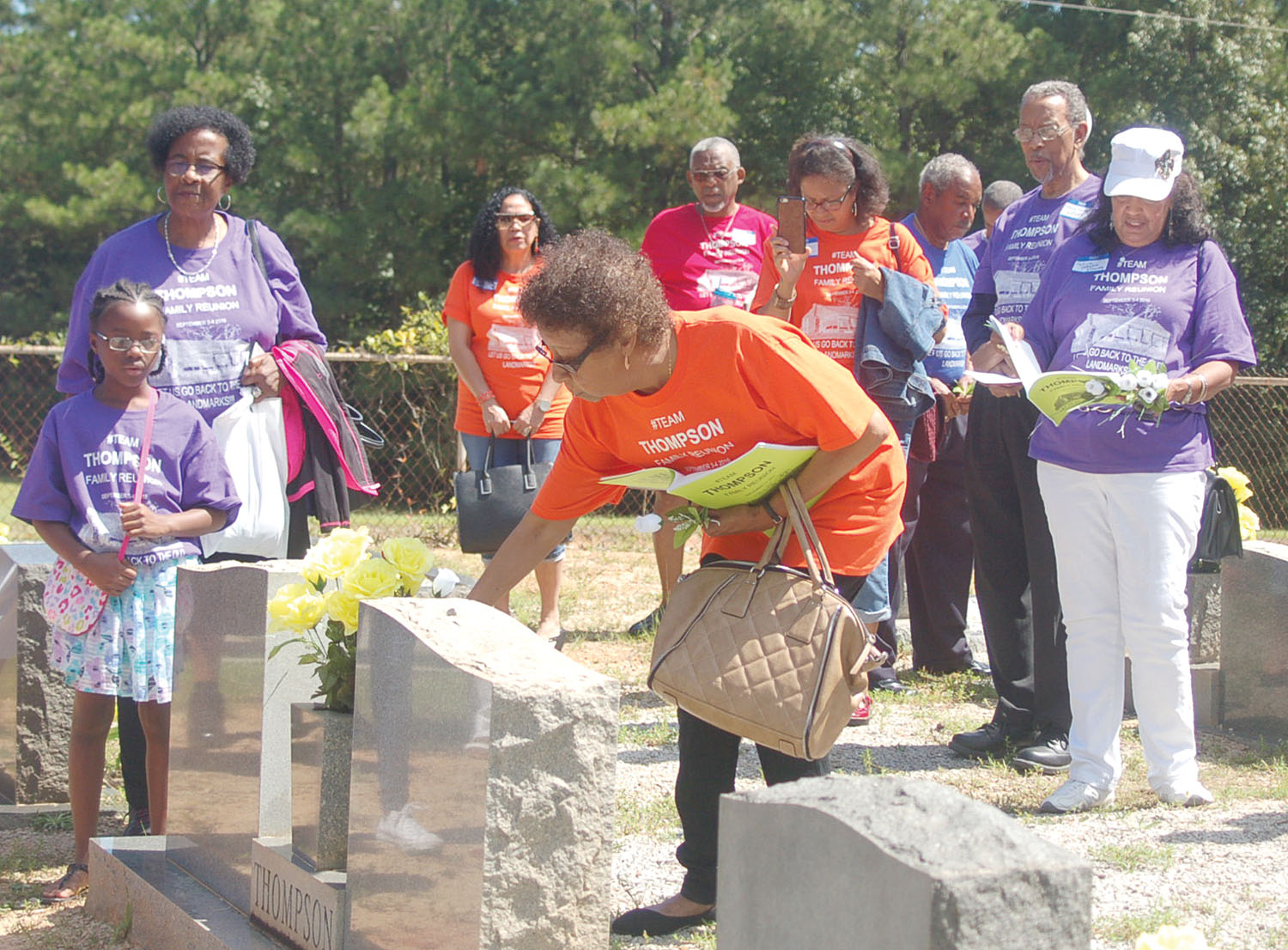
Nancy Juanita Thompson, named for her grandmother and Thompson family matriarch, Nancy Thompson, places flowers on the grave of her father, Ed Brice Thompson (one of Nancy’s sons) last weekend during the first reunion of the Thompson descendants in Blair. (Photo/Barbara Ball)
BLAIR (Sept. 9, 2016) – In 1886, Bun and Nancy Thompson married and started a life together in Blair. Last week, more than 100 descendants of the couple’s 12 children gathered together in Blair for the first ever Bun and Nancy Thompson Family Reunion.
Thompson and his wife were hard working and cared for the community, according to a reunion document prepared by one of their granddaughters, Emily Thompson Haley of Blythewood. Determined to make a name for themselves in the segregated Southern community, the two newlyweds taught themselves to read and write. Both worked as share croppers for Jimmy Frazier Sr. until Bun Thompson was able to buy 300 acres of land from Frazier to start his own farm. Thompson was the first African-American in Fairfield County to own land, Haley said.
Nancy Thompson made a name for herself in her own right, playing a prominent role in the Blair community as the local midwife.
“They referred to her as the Florence Nightingale of her time. She would get on her horse and ride to deliver babies and provide medical services to the ill. Most of it free of charge,” Sherry Fears, the family historian, said.
The Thompsons diligently gave back to the community, whether it was helping the ill for free or giving food to the less fortunate and selling supplies on the open market, Fears said. Nancy Thompson organized the Women’s Humble Burial Aid Society in Fairfield County to ensure families in the community had enough money for a proper funeral for their loved ones. Her husband mortgaged his house and land to build Blair’s Gethsemane Baptist Church.
“My great-grandfather [Bun] helped build that church,” Fears said. So it was fitting that the descendants of Bun and Nancy Thompson first gathered at the Gethsemane Baptist Church where the foundation of the community met the cornerstones of the family’s bloodline.
Following Bun Thompson’s legacy as someone who broke boundaries and strove to be a wholesome and righteous man, one of the Thompson’s grandchildren, Herman Young, also became a pillar of the Fairfield community. He became the first African-American Sheriff of Fairfield County and served for 22 years. Upon his retirement, Gov. Nikki Haley bestowed upon Sheriff Young the highest honor that can be presented by the Governor’s Office: The Order of the Palmetto.
The descendants of this prominent family, known for their generosity to their community, celebrated their achievements and historical breakthroughs during the three-day reunion. It began with a Sunday church service at Gethsemane Baptist Church followed by a visit to the family cemetery adjacent to the church to remember Bun, Nancy and other family members who are buried there. They then embarked on a tour of the Thompson homestead in Blair and spent the afternoon at a cookout on Weston Lake in Columbia where they enjoyed lots of good food and entertainment by a James Brown impersonator.
The Thompson relatives spent Sunday in high spirits as they learned more about their own history and built bonds to last a lifetime. The next reunion is planned for 2018.
WINNSBORO (Sept. 8, 2016) – Town Council gave final reading Tuesday night on an ordinance that will allow the Town to borrow up to $6 million to make improvements to their utility system.
According to the ordinance, the funds will provide for the rehabilitation of Winnsboro’s wastewater treatment plant and related sewer improvements; construction, replacement and rehabilitation of electric distribution lines and substation breakers; and construction and extension of natural gas lines and “cathodic improvements.”
“Cathodic improvements,” Town Manager Don Wood explained after a meeting last month, essentially means the grounding of natural gas lines to prevent electrical discharges into the lines. The replacement of some of the Town’s power lines, Wood said, was necessary because some of those lines are undersized by modern standards.
“They were OK when we put them (the lines) in,” Wood said last month, “but we have more people on the system now and people use more electricity now.”
“Most small towns our size, their infrastructure – water, sewer – most of the stuff under the ground has been there for quite some time, for years we’ve been doing a lot of patchwork,” Gaddy told colleagues at last June’s intergovernmental meeting. “Hopefully (with the bond) we can do larger stretches of infrastructure and get it to where it’s up to snuff and we don’t have as much problems with it – not that we’re always putting out fires, but as everything else, including me, its aging and wearing out.”
The infrastructure improvements come ahead of the Town’s other major project – running a raw water line from the Broad River to the reservoir. That project, which is estimated to cost approximately $13 million, is expected to bring between 8 and 10 million gallons of water a day into Winnsboro’s system.
Margaret Pope, of the Pope Zeigler Law Firm, said one of the objectives of taking on the $6 million debt before tackling the Broad River line project was to get a better rating from the State Revolving Fund (SRF) when it came time to borrow the $13 million.
“If we get a good rating, then it will help us demonstrably on how much money the SRF requires,” Pope said.
Typically, Pope said, the Fund requires a borrower to deposit one year’s worth of debt service into a reserve fund.
“It has to sit there. It’s a rainy day fund in case you can’t pay,” Pope said. “We have convinced (the SRF) that if we get a good enough rating to waive that. That’s a huge savings. This (the Broad River project) is the big issue, so we kind of strategized that.”
Capital Expenditures
Council also gave the OK Tuesday to a total of $5,600 in capital expenditures for the Water Department. That total will cover a nitrate/TDS field monitor ($3,800), which Wood said would monitor the breakdown monochloramine in the water system; a computer for the wastewater lab ($1,400); and a leaf blower ($400) for cleaning grounds along pump stations.
After reworking the original concept and a project re-bid, ground was finally broken last week on Blythewood’s shell building. Digging in at Doko Meadows last Wednesday are: Larry Griffin, Town Councilman; Ed Parler, Economic Development Consultant; Bill Hart, CEO Fairfield Electric Cooperative; Blythewood Mayor J. Michael Ross; Town Councilmen Eddie Baughman and Malcolm Gordge and Kevin Key, Lyn/Rich Contracting Co., Inc. (Photo/Barbara Ball)
BLYTHEWOOD (Sept. 8, 2016) – After several stops and starts and adjustments to the overall plan, Blythewood’s spec building on the grounds of Doko Meadows Park is at last on its way to becoming a reality.
“It’s for real this time,” Ed Parler, the Town’s Economic Development consultant, told The Voice last week, just days after a ground-breaking ceremony at the site. “We’ve awarded the contract, and construction should begin in the next seven to 10 days.”
The Town announced the winning bid on the project last month after Lyn-Rich Contracting Co., Inc. of West Columbia submitted a base bid of $379,850. With options, which Town Council voted to accept, the Lyn-Rich bid came to $388,100. Those options include walkways and special fire protection equipment.
The August bids were the second round of bids on the project. Council put the construction out for bid a second time after bids opened last June came in ranging from $524,000 to $761,455 – all well over the $410,000 budget for the project.
The June bids forced Council and architect Ralph Walden to rethink the scope of the spec building.
“We had the specs beyond a shell,” Walden said in July, “and that proved to be the wrong direction. We had wiring, 800 amps for a kitchen, HVAC and a slab. The plan was to give the end-user a little more for his money.”
Specifications for the second round of bids included only rough plumbing and eliminated the HVAC unit. Also eliminated were interior doors and ceiling tiles, connection to water and sewer and all walkways. Finished siding was substituted for primed siding and paint. Specifications were changed for deck and rail materials, windows, doors and shingles.
The spec – or “shell” – building is itself a scaled-down version of a plan three years ago for the Town to build a restaurant in the park, utilizing grant money from the Fairfield Electric Co-Op and a $1 million loan from Santee Cooper. That plan called for the Town to construct a restaurant and lease the facility out. But a newly elected Town Council balked at that idea.
“The new Council had questions about the Town being in the restaurant business and carrying all that debt,” Parler said. “So we scaled down the project. Rather than doing a fully fitted out building, we would construct a shell. Hopefully, by the first of the year we will be able to sell it and have the owner finish it out.”
And while there are certain restrictions on what kind of business could set up shop in a building located in a publicly owned park, Parler said the likelihood is high that it would be a restaurant after all. The building could also serve as an office building, Parler said.
Fairfield Electric Co-Op has been instrumental in making the shell building a reality, Parler said. A 2013 economic development grant from the Co-Op netted the Town $240,714, and a year later the Co-Op pitched in another $216,167, for a total of $456,881, Parler said.
Last month, Town Administrator Gary Parker told Council that the Town still holds $325,916 of the original $456,881 utility grant from Fairfield Electric Co-Op. The balance of the costs of the shell building, Parker said, can probably be taken from Hospitality Tax revenue.
Parler said the Town’s intent is to recover those funds with the sale of the shell building.
Construction is slated to begin any day now, Parler said, and should be wrapped up in approximately 150 days. The Town will begin marketing the building for sale in November.