WINNSBORO – Fairfield County Schools Superintendent Dr. J.R.
Green has announced that he will retire at some point during the next school
year.
He made the announcement Wednesday evening.
Green
Green has served the Fairfield County School District for 11
years. During his tenure, he guided the construction of a new career center and
launched a dual enrollment for high school students that would allow them to
graduate high school with an associate’s degree from Midlands Tech.
“I’m at the point now where I have done with what I’ve been
charged with doing here,” Green told WLTX-TV news.
He said he will stay here long enough to help the district
through the transition to a new superintendent. He said he is writing a book
and plans to do some consulting with other districts.
J.R. Green, superintendent of Fairfield schools, for years has sidestepped questions about his salary and his spending of public money. When he thought the local newspaper was too critical of his district, he started the taxpayer-funded Fairfield Post. | Michael Smith
Costly travel, hefty compensation, lack of accountability uncovered
WINNSBORO — J.R. Green seethed with anger as he read an
article in his local newspaper. The school district he leads was on winter
break, but Green couldn’t stop fuming over the words on the page before him.
The Voice of Fairfield County reported that Green’s district had failed to meet certain state academic benchmarks. The article cited statistics to prove it.
Bristling at the critique, the superintendent fired off an
email to his principals and school board. The missive, titled “False, Biased,
and Misleading Reporting,” blasted the paper and accused its reporter of
“marginalizing our students, staff, and system.”
“I want you to share this reporting with your staff so they
understand the hostile media environment we face,” Green wrote that night in
December 2018.
The fiery dispatch is emblematic of Green’s approach to
uncomfortable questions and criticism during his nine years leading this
high-poverty Midlands district of roughly 2,000 students.
In public forums, he has sidestepped questions about his
taxpayer-funded salary and other points of contention. For years, he has
rebuffed attempts to reveal how he spends thousands of dollars in public money.
It’s one striking example of how easily government officials
in South Carolina can shield information from the public. In its investigative
series Uncovered, The Post and Courier is partnering with local newspapers to
help shine a light on questionable conduct, and hold the powerful to account in
areas with few watchdogs.
Across South Carolina, particularly in rural communities
that have become news deserts, officials are less likely to be pressed on their
decisions, and more prone to set the public agenda themselves.
Largely thanks to tax revenue from a local nuclear power
plant, Fairfield schools collect more money per student than any other district
in the state.
Year after year, top school district officials use a hefty
chunk of the money for travel to pricey conferences at tourist resorts across
South Carolina and the country, the newspapers found.
Between 2017 and 2020, Green’s office and Fairfield’s seven
board members charged taxpayers for trips just about every month during the
school calendar. That included dozens of trips to conferences at waterfront
resorts in Charleston, Myrtle Beach and Hilton Head.
The annual bill for those and other trips? Nearly $50,000 —
enough money to cover the salary of an additional classroom instructor.
At the same time, the board has extended Green fat bonuses,
contingent upon Green receiving passing grades in thin annual evaluations that
lack measurable goals.
The one-page forms are filled out anonymously by board
members and leave little room for comments or discussion — less rigorous than
some first grade report cards.
That’s contributed to a vacuum of accountability in
Fairfield, a community that does not have a daily newspaper.
The Voice publishes weekly, holding the district to account
when student performance dips, or when top officials attempt to obscure their
public spending. Green views that reporting – on scores, his evaluation and
spending and his failure to disclose an out-of-state, overnight
school-sponsored trip to the board – as an attack on the district.
In response, Green has warned district employees against
speaking to The Voice, directing them, for the last two years, to send any
information for The Voice (student achievements, honors, etc.) to the school’s
human resources department for approval to be forwarded to The Voice. That
information never gets forwarded. Then, Green took the matter a step further:
He started the district’s own publication.
The Fairfield Post is distributed weekly around the county,
often filled with campaign advertisements or columns penned by politicians.
“The Post is an opportunity to really lift up the good
things that are happening,” Green said.
Taxpayers underwrite the costs, to the tune of $27,000 a year.
Fairfield schools Superintendent J.R. Green (right) celebrates after being named Superintendent of the Year by the S.C. Association of School Administrators. | Photo: Joe Seibles
Green, whom the S.C. Association of School Administrators named the 2021 S.C. Superintendent of the Year, did agree to speak with The Post and Courier. He then conducted a lengthy discussion of the newspaper’s collaboration with The Voice at a May 11 school board meeting.
When reporters arrived, he asked them to leave, citing the
district’s social distancing rules in response to the COVID-19 pandemic.
Still, a livestream broadcast Green’s remarks to the board — a defiant rant that stretched nearly 40 minutes. He fiercely defended the district’s spending of taxpayer money. He roundly criticized the state’s education statistics, which he described as an incomplete picture of the district’s progress with students.
Green also accused a reporter of questioning him because he
is Black, describing this and other reporting by The Post and Courier as a
suspicious effort to target people of color.
In other conversations with a reporter, Green stressed one
point above all: He despises and distrusts The Voice. When asked to cite
examples of the newspaper’s reporting, Green pointed to what he insists was a
demeaning tweet sent by a Voice freelancer in 2019, months after he had cut
ties with the newspaper. Otherwise, he only spoke generally about coverage he
described as negative.
“I have confessed in (church) that there is animosity in my heart,” he said about the newspaper and its publisher. “I have to pray that the Lord removes it.”
Fairfield County School District Superintendent J.R. Green. The Voice/Provided
‘Change the culture’
Green didn’t always quarrel with the local newspaper.
Green carries three degrees, as well as a doctorate in education
leadership from the University of South Carolina. As a principal and assistant
superintendent in Chesterfield County, he helped a high school bring up its
grades on its state report card, and hit its year-over-year targets for
improving student performance.
Meanwhile, Fairfield schools were rocked by extreme turnover
in the district’s top position. Before Green arrived, Fairfield cycled through
12 superintendents in 20 years amid a period of dysfunction among the board.
Local residents called the district South Carolina’s “graveyard for
superintendents.”
The surrounding community also faced disruptions.
Once-bustling Winnsboro, the county seat, hosted the headquarters of Uniroyal
Tire Company. But the town lost businesses, jobs and eventually its hospital
after the construction of Interstate 77 bypassed the community in the 1970s.
The surrounding countryside remains largely rural, dotted with rolling pastures
and horse and cattle farms.
Fairfield’s teachers and administrators educate a student
body where school officials say nearly 90 percent of the children qualify for
free or reduced lunch.
Green vowed to “change the culture” in an area that needed
help. He stressed teamwork and an open relationship with the community. He has
maintained a visible presence, regularly making appearances in front of
television cameras for local news programs.
But eventually, some of those promises were tested as
Green’s decision-making came under tighter scrutiny.
First, board members questioned why more than two dozen
out-of-state and overnight trips were planned for student groups in 2015,
including travel to New York City, Puerto Rico and the Bahamas. Board members
questioned how much those trips would cost taxpayers. Green said he didn’t
know. The board authorized the trips anyway.
Some board members also pressed Green on his use of the
superintendent’s fund, roughly $42,000 in taxpayer money. Green has broad
discretion to spend the money each year as he chooses.
Green said he’d only share the information if the board
voted to ask for it. Another board member at the time, Paula Hartman, pressed
further.
Paula Hartman said she was one of only a few Fairfield County School District board members who ever questioned the superintendent’s spending and performance. | Photo: Michael Smith
“Does that mean that you won’t give us that information?” Hartman asked.
“That means if the board directs me to provide it, I will,”
Green said.
Beth Reid, then the board’s chair, suggested Hartman submit
an inquiry under the S.C. Freedom of Information Act.
“If a person from the audience asked for that information,
could they get it?” Hartman asked.
“Yes,” Reid answered.
“Then why can’t I?” Hartman asked.
A lack of access
The state’s open records law is supposed to allow for the
free flow of public information, so any media outlet or citizen can easily see
how their government is operating and spending the public’s money.
But the FOIA law is riddled with loopholes that officials
can exploit to shield unsavory information from public view.
After a 2017 amendment to the
law, government agencies — for the first time — were allowed
to charge residents and news outlets for costs that officials associate with
retrieving or redacting documents.
But with vague guidelines, the amounts calculated by the
government can far surpass what the average citizen can afford — hundreds, even
thousands, of dollars.
At the same time, officials may freely ignore direct
questions from citizens. Instead, they can insist that information only be
released if requested under FOIA. That way, they keep public information in the
dark for weeks, or even months.
The flaws in the system present major roadblocks for
cash-strapped local newspapers around the state, including The Voice of
Fairfield County.
After lashing out at the newspaper’s coverage of the
district’s student performance in 2018, Green has not agreed to an interview
with the newspaper in more than two years, and has blocked other attempts by
the newspaper to gain information for stories that highlight the schools.
The end result is dwindling accountability, and an
environment that limits the local newspaper’s ability to carry out its First
Amendment duties, said Lynn Teague, vice president of the South Carolina League
of Women Voters.
“It sounds totally unacceptable,” Teague said. “If I were a
taxpayer in Fairfield, I would find it unacceptable.”
Green said The Voice is at fault for its poor relationship
with him. He pointed to a 2019, incident that occurred long after he broke off
communication with The Voice over reports on the school’s test scores.
Green took the remark as a slight that suggested the
Fairfield teacher did not earn her recognition. “Simply despicable!!” he
tweeted at the time.
The Voice’s publisher responded, “FCSD is rightfully proud
of her accomplishment, as is all of Fairfield County.”
But Green told his employees that he does not trust The Voice — and that they should not either.
Fairfield schools superintendent J.R. Green. | Michael Smith
A steep fee
In 2019, The Voice requested access to records documenting
two years of Green’s discretionary spending — an issue that had continued to
divide members of the board.
After waiting 10 business days to respond, the maximum allowed under state law, Green insisted the information would cost $338. The Voice couldn’t afford to pay.
State law allows governments to waive fees and release
public information for free, so The Voice asked Green to reconsider.
He waited another two weeks, then refused. He also rejected
the newspaper’s requests to inspect the records in person, something reporters
often do to avoid the costs of copying documents.
Asked about the matter by The Post and Courier, Green said
he’s merely doing what the law allows him to do.
The Voice has a team of freelancers and one full-time editor
and the publisher, who declines a salary. The publisher also supplements a
roughly $150,000 annual budget by occasionally paying for rent and other
expenses out of her own pocket.
Ultimately, The Voice dropped its request.
The newspaper agreed to partner with The Post and Courier on
this article, in part, in an effort to obtain Green’s spending records —
originally sought nearly two years ago.
When The Post and Courier sent its own request, for travel
expenses from 2017-20, Green agreed to turn them over without a charge.
No discussion
The records show a steady drip of travel expenses for Green
and his assistant. There’s also a bulk of purchases related to a Bow Tie Club
trip (for the district’s teenage boys), led by Green, to Louisville, Ky., in
2019. While board approval is required for trips costing over $600, overnight
trips and out-of-state trips, Green did not ask the board to approve the
Louisville trip in advance, as is required for all three travel criteria. When
later asked about the trip’s expenses at a board meeting, Green said he
couldn’t recall details.
The actual cost to taxpayers? More than $10,100. That
included lodging at the downtown Marriott; a $3,850 tour bus for students; and
more than $700 in charges at the Louisville Slugger Museum, the Muhammad Ali
Center and the world-famous Churchill Downs horse racing track, home of the
Kentucky Derby. Green told The Post and Courier those expenses only covered
costs of admission.
Hartman, one of the board members, unsuccessfully sought
details about that trip. Green also rebuffed her attempts to learn how much he
earns each year.
“We never got any information we wanted,” Hartman said.
But when Hartman asked him how much money he made, Green
said he didn’t know.
Now, Green’s salary has ballooned to more than $192,000. No
superintendent of such a small district in South Carolina makes more, according
to the most recent data from the state. Including his retirement benefits, his
overall taxpayer-funded compensation is above $225,000.
Green told The Post and Courier he has agreed to freeze his
benefits package at its current level.
“That’s what my spirit led me to do,” he said.
Pricey trips
Other records obtained by The Post and Courier show even
more expenses — these charged by Fairfield’s seven board members for their
travel.
In just over three years, board members charged taxpayers
more than $123,000 in expenses for travel to conferences, including $52,900 in
out-of-state travel.
It also included nearly 70 trips to waterfront resorts in
Charleston, Myrtle Beach and Hilton Head. During school years, one or more
school board members attended a conference just about every month, the records
show.
The board’s travel between 2017-19 averaged $41,200 a year.
By comparison, in the last full fiscal year before the pandemic, the board of
Greenville schools spent less than $37,000 on travel. That board oversees the
largest district in South Carolina. And it has 12 members, five more than
Fairfield.
Fairfield board members disclosed their trips in reports
provided during regular meetings. But they had little to add to inquiries from
The Post and Courier. Most did not respond to phone messages and emailed
questions about their travel.
Fairfield County School Board Chairman Henry Miller defended the district’s contract with J.R. Green, saying the superintendent has been worth every penny given the instability that preceded him. | Michael Smith
The board’s chair, Henry Miller, has charged the most in recent years — more than $31,500, records show. He did not return voicemails, but defended the travel in a written response.
“Investing in training and professional development is a
vital component to becoming a more effective school board member,” he said.
Another sitting board member, Sylvia Harrison, spent more
than $27,000, records show. She also briefly defended her travel. But after
learning the newspaper was partnering with The Voice, Harrison said she wasn’t
interested in a reporter’s questions.
“This is what you all do,” Harrison said. “It didn’t work
for (The Voice) and it’s not going to work for you.”
Few comments
Green is supposed to receive more scrutiny during his annual
evaluations from the board. But year after year he glides through the process,
often without being pressed publicly on any aspect of his performance.
The board conducts its year-end discussions with Green
behind closed doors. Then, board members submit one-page rubrics with
benchmarks as vague as “community engagement.” The evaluations do not point to
any measurable goals.
Board members do not have to sign their names, nor are they
required to offer specific comments on how well the superintendent stacked up.
Some leave no comments at all.
By comparison, Fairfield’s neighbor in Richland County
School District Two, board members there evaluate their superintendent with
six-page forms using far more detailed metrics.
State Representative Annie McDaniel, who sat on the school
board from 2000-18, said Fairfield used to use a similar process. But some time
during Green’s tenure the board pushed for a change.
“We went to a one-pager,” McDaniel said. “I wasn’t a fan of it, even though I thought that Dr. Green was doing some good things in the district,” she added.
Meanwhile, though the state has adjusted its metrics,
Fairfield schools have about the same overall ‘average’ rating as when Green
took the helm eight years ago.
In an interview, Green defended the district’s work with
students and stressed that top officials continue to make changes. Most
recently, after poor ratings in 2019, Green replaced the middle school
principal.
“I’m never satisfied,” he said. “We recognize that we still
have progress to be made.”
‘Negative’ coverage
Ultimately, it was the low ratings for Fairfield Middle
School, and other middling district metrics, that were the subject of The Voice
article in 2018 that set Green off.
He blasted the publication in his email to principals and
other staff. Two months later, he took the matter a step further: He started
Fairfield school district’s own newspaper, The Fairfield Post.
The newspaper features bylines from students. But with
articles on community events and local elections, its coverage stretches well
beyond the walls of Fairfield schools.
As Green puts it, “Anyone can submit a story.”
Local politicians regularly oblige. An early issue included
a half-page editorial on education policy, written by state Sen. Mike Fanning.
Another edition contained an unsigned feature on Green, after he received a special
recognition from USC.
Throughout 2020, inside pages were filled with campaign
advertisements and other content submitted by McDaniel, Winnsboro Mayor John
McMeekin and Fairfield school board candidates.
Sen. Greg Hembree, the state senate education chair, told
The Post and Courier that Green has waded into murky ethical territory, where
the public underwrites a news publication with little ability to keep it from
becoming a “propaganda arm” of the district.
Green told The Post and Courier he has no editorial control
over the newspaper. He only reads and encourages the publication. Politicians
pay for their advertising space, Green said.
Not everyone is convinced The Fairfield Post is a good idea.
Teague, with the League of Women Voters, said she’s not sure
the arrangement is legal.
“The paper is a public resource, and it is being used for
campaign purposes,” she said.
Green insists he did not start The Post to compete with The
Voice.
“I’m not stopping them from writing anything,” he said, but
neither is any information allowed to be released from the district to The
Voice.
Harrison, the board member, also defended The Post while
railing against coverage in The Voice.
She told The Post and Courier, “If it’s not positive, I
don’t read it.”
After hanging up on a reporter, Harrison took to Facebook
that evening to alert her followers about what she described as the latest
example of biased news reporting. She insisted she had no intention of reading
this article.
Besides, she added, “We have our own newspaper.”
Until Green shut off all communications with The Voice in 2018, it regularly printed feel-good features about the district’s students, teachers and school activities. This photo illustrated a front-page feature story about the school’s second cohort of STEM graduates flying to Spain for a weeklong trip as part of the STEM program. | Contributed
Joseph Cranney
Joseph Cranney is an investigative reporter in Columbia, with a focus on government corruption and injustices in the criminal legal system. He can be reached securely by Proton mail at jcranney@prontonmail.com or on Signal at 215-285-9083.
Avery Wilks
Avery G. Wilks is an investigative reporter based in Columbia. The USC Honors College graduate was named the 2018 S.C. Journalist of the Year for his reporting on South Carolina’s nuclear fiasco and abuses within the state’s electric cooperatives.
Barbara Ball
Barbara Ball is the publisher of The Voice of Fairfield
County and The Voice of Blythewood. Ball received the South Carolina Press
Association’s Jay Bender Award for Assertive Journalism in 2018 and 2019. She
can be reached at barbara@blythewoodonline.com.
COLUMBIA – Fairfield County School District Superintendent,
Dr. J.R. Green, has been named the 2021 South Carolina Superintendent of the
Year by the South Carolina Association of School Administrators (SCASA).
“I have had the pleasure of working with Dr. Green as a
school board member and as a parent,” said Fairfield County School Board Chair
William Frick. “Dr. Green talked about having a ‘culture change’ in the
Fairfield County School District…Our students graduate with two years of
college as they graduate from high school, overall test scores are improving,
and financially we are operating with a balanced budget.” Mr. Frick continued,
“While he did not accomplish any of these things on his own, none of it would
have happened without Dr. J.R. Green and a culture change.”
Dr. Green is an active member of the SCASA Superintendents’
Affiliate, and he currently serves as a member of the South Carolina State
Board of Education. His school district is home to 2,600 students; in which
nearly 90% of the students qualify for free or reduced-price meals.
Elizabeth “Beth” A. Phibbs, Executive Director of SCASA,
states, “Dr. Green has been and continues to be a stabilizing force in the
Fairfield County School District. Under his leadership, the district has
expanded and strengthened programs and opportunities for their students. By
working closely with the community, he has established partnerships which
directly benefit the students of Fairfield County, and we are delighted to
honor him as the 2021 South Carolina Superintendent of the Year.”
Finalists for the award included Dr. William “Bill” James,
Lexington School District Two and Dr. Neil Vincent, Florence School District
Two. Candidates participated in an application and interview process conducted
by a team of South Carolina business, education, and community leaders.
COLUMBIA – Public education isn’t the most profitable profession in South Carolina.
For a select few, however, the field can be quite lucrative.
In a state where the governor earns $106,078 a year and agency heads like the state superintendent of education make $92,007, many district level school superintendents rake in two to three times that amount.
That’s the case in Fairfield and Richland counties, where superintendents take home considerably more compensation than state agency heads accountable to 5 million South Carolina residents.
Throw in generous retirement plans, copious car allowances, travel and other high end perks, and total superintendent annual compensation pushes well past $200,000. For Fairfield Superintendent Dr. J. R. Green, with responsibility for eight schools, it’s in the neighborhood of $225,000. For Richland Two Superintendent Dr. Baron Davis, with the responsibility of 32 schools, the pay and benefits bring in about $260,000.
And it’s all subsidized with taxpayer money.
Meantime, teacher pay has continued to lag.
In 2018, Fairfield County School District teachers averaged $49,288 and Richland Two teachers averaged $51,802, South Carolina district report cards state.
Teachers’ salaries in both districts fall well short of the national average of $58,950, according to figures from U.S. Department of Education.
Swelling superintendent pay has become a nationwide trend, with some superintendents being paid close to $400,000, according to a January 2019 report by the American Association of School Administrators, or AASA.
Salary Rises, Attendance Falls
“Often times the superintendent is the highest paid member in the community,” Noelle Ellerson, an associate executive director with AASA, said in a video on the group’s website.
Since 2012, salaries of superintendents in the Midlands have risen considerably faster than student growth.
Green has seen his base salary climb 23 percent since 2012, rising from $140,000 to $182,287, contract documents show. In the same period, the district’s student population has dropped 15 percent, decreasing from 3,108 to 2,641, according to South Carolina school report cards.
Richland Two’s student population has increased since 2012, but at a notably slower rate than superintendent salaries, public records show.
Davis’ starting base pay was $186,312, according to his initial superintendent contract dated July 25, 2016. He now earns $191,904. The pay increase is more than double the Richland Two student enrollment growth of 9.85 percent (25,964 to 28,503) in the same period.
Davis’ contract says as of July 1, 2018, he was entitled to annual salary increases equal to the “average rate of percentage increase” that the district’s certified employees receive.
The board awarded him a 2.5 percent increase in September 2018.
Green is among the highest paid superintendents nationwide for districts of Fairfield’s size, according to the AASA report. His base salary of $182,287 is well above the AASA median of $167,444 for male superintendents in districts with 2,500 to 9,999 students. But Fairfield’s 2,641 student population is near the bottom of that AASA range of student enrollment.
Green’s pay is closer to the 75th percentile of education chiefs who make at least $193,000, according to the AASA report.
Davis’ base salary technically falls below the median for large districts based on AASA findings. However, the AASA classifies any district with more than 25,000 students as large, lumping Richland Two, at 28,503 students, with the nation’s largest districts, many of which have between 100,000 and 1 million students. These upper echelon districts pay between $340,000 and $400,000 a year, according to U.S. Department of Education figures.
According to a March, 2018, report in the New York Daily News, the New York City school district, the nation’s largest, pays its superintendent $353,000, about $100,000 more than Davis is paid. In South Carolina, the state’s largest three districts – Greenville (75,471 students) Charleston (48,937) and Horry (44,669) – are substantially larger than Richland Two and pay their superintendents around $225,000 a year in base pay, according to S.C. Ethics Commission filings.
Defending Supers’ Pay
William Frick, chairman of the Fairfield County school board of trustees, said Green is fairly compensated. He said Green brings a long list of qualifications to Fairfield County.
“[Superintendents] are paid well, but they have a difficult job to do,” Frick said. “They are compensated accordingly.”
Richland Two board chair Amelia McKie couldn’t be reached for comment about Davis’ compensation package. However, in a Sept. 15, 2018 letter summarizing Davis’ performance, McKie spoke very highly of him.
“You have done an excellent job developing the District’s culture and creating the expectation that the District and all of our schools will be ‘premier,’” McKie wrote. “You exhibit excellence at all times, and we would like to see all departments throughout the District reflect your commitment to excellence, professionalism and customer service.”
Evaluating Green
The board voted on Dec. 18 to extend Green’s contract to 2024. Board member Paula Hartman raised concerns about extending it so far into the future.
“I really don’t understand the reasoning – not saying there are any objections – but most districts have three-year contracts,” Hartman said. “I don’t understand why we continue to keep it at six years.”
Frick said prior to hiring Green, the district has had a history of struggling to retain superintendents.
“I’m happy that we have the opportunity to have an amendment to extend it out one more year. I’m glad we can essentially tie him down for another year,” Frick said.
Green said he views the board’s extending of his contract as an affirmation of his performance.
“When the board says it wants to extend my contract, that says you’re interested in having me for the long haul,” Green said.
The superintendent went on to say that a year ago, he put a letter into his file saying that regardless what the board did, his salary should remain the same.
“I felt that I was fairly compensated,” Green said. “I wanted the focus at this point to be on salaries of the staff.”
However, Green’s contract states that he is automatically entitled to salary and benefit increases every time his contract is extended, provided he receives at least a “satisfactory” rating on his performance evaluations.
The superintendent evaluation form the Fairfield board of trustees currently uses, and which contains only five two-word categories to be evaluated, doesn’t feature “satisfactory” as a rating, but instead uses “needs improvement,” “proficient” and “exemplary.”
In December 2018, Fairfield board members rated Green as “exemplary” in almost every category. One board member rated Green as proficient in Leadership and Learning Environment, but exemplary in the others.
“I enjoy working with Dr. Green,” one board member wrote. “We need make it harder [sic], going too good!”
Green’s raises started at 3 percent in 2013, increased to 4 percent in 2014, and rose to 5 percent in 2015, documents show.
Green can now receive an automatic 5 percent pay increase every year forward so long as he receives at least a “satisfactory” rating, according to his contract.
Neither his salary or benefits are tied to student performance, test scores or enrollment.
R2 Evaluations Mixed
Davis’ second contract, a three-year contract, took effect July 1, 2017 and expires June 30, 2020. In September 2018, after his most recent annual review, Davis’ contract was extended a year to 2021 to keep it at three years. Davis received generally positive reviews during his evaluation.
Collectively, the board gave Davis a score of 142 out of 150 possible points, earning him a “distinguished” rating, the highest rating possible.
Two board members opted to submit individual evaluations.
Board member James Manning gave Davis a perfect score of 150, according to district documents obtained through the S.C. Freedom of Information Act.
Board member Lindsay Agostini was more critical.
Her individual evaluation marked Davis down in several areas, characterizing him as defensive, antagonistic and expressing “difficulty recognizing a problem or concern with constructive criticism,” evaluation forms state.
One area of defensiveness Agostini raised involved a disagreement over the elimination of keyboarding as a class.
Agostini also said Davis gave “antagonistic responses” during a bond referendum presentation at an event sponsored by the Bethel-Hanberry Alumni Association.
“The following day, prior to the start of executive session on August 28, 2018, the superintendent acknowledged and apologized to the board for his actions,” the evaluation stated.
Benefits Boost Pay
Superintendent compensation extends well beyond base salary.
In Fairfield, Green’s original contract called for the district to provide an annual annuity contribution equal to 4 percent of his salary, which in 2012 amounted to $5,600.
In 2014-2015, the board amended Green’s contract to increase the annuity contribution to 8 percent. Now it automatically increases 2 percent every year the contract remains in effect.
Today the district pumps $29,165 per year into Green’s annuity, documents state.
Besides the usual perks of paying for moving expenses, other benefits include $100,000 of term life insurance, free cell phone use and free use of an automobile that’s fully maintained by the district. The invoice for the last full maintenance on his automobile last fall came to $1,800 according to district records.
The district also pays Green’s car insurance, and he receives two weeks of paid vacation on top of legal holidays and other school holidays. The district also paid for his professional memberships into the AASA, the South Carolina Association of School Administrators (SCASA) and other professional groups and local service clubs.
In the event the board terminates the contract, Green is entitled to 18 months pay which would currently come to about $275,000.
R2 Benefits Add Up
In addition to Davis’ base salary of $192,104, the district makes an annual retirement contribution of $43,261 on Davis’ behalf. The district also pitches in $6,717 in annual annuity payments calculated at a rate of 3.5 percent of his annual salary based on a “satisfactory” evaluation, documents state.
Davis essentially doesn’t pay for travel. Richland Two covers $18,000 a year in travel payments for Davis, covering commutes to virtually anywhere in the Midlands, essentially backfilling his take home pay with compensation not available to most other employees.
Davis can also request reimbursement from the district for travel outside the Midlands or out of state if it’s for reasons benefiting the district.
Other perks include $760 in payments for a $250,000 term life insurance policy and $768 for cell phone use, both funded annually by the district.
Counting these benefits, Davis’ total compensation is in excess of $261,000.
Beyond that, Davis receives other perks – 20 vacation days per year, plus legal and other holidays recognized by the district. He’s also entitled to receive pay for unused sick leave, annual leave and vacation days in an amount that’s “consistent with Board policy.”
In addition, the district pays for Davis’ memberships in the AASA, SCASA, the Rotary Club, “and any other reasonable and customary professional group memberships for which the Superintendent believes is necessary to maintain and improve his professional skills.”
Davis’ contract has been amended twice.
In July 2017, his monthly automobile allowance increased by $1,500 a year.
A year later, Davis’ salary increased to its current figure. His annuity contribution also rose from 1.5 percent to 3.5 percent of his annual salary, and this September it will increase again to 6 percent.
Salary, Benefits and Ethics
Documents showing the salaries and compensation of Green and Davis were obtained through S.C. Freedom of Information Act requests.
In requesting the documents, The Voice asked not only for both superintendents’ salaries, but also their contracts, any amendments, and documents listing total compensation, including retirement benefits, vehicle allowances and other supplemental income backfilling personal expenses a typical person would ordinarily incur.
Green’s contract has been amended six times in seven years (since 2012), most recently in December 2018. Dr. Davis’ contract has been amended twice during his nearly three-year tenure.
S.C. superintendent salaries are available for public inspection on the S.C. Ethics Commission’s website.
State law requires superintendents to file annual Statements of Economic Interest, or SEI, forms. The forms are supposed to document the “source, type, and amount or value of income received from a governmental entity by the filer or a member of the filer’s immediate family,” according to the ethics commission website.
Citing state law, an ethics commission spokesperson further defined “income” as “anything of value received, which must be reported on a form used by the Internal Revenue Service for the reporting or disclosure of income received by an individual or a business.
“Income does not, however, include retirement, annuity, pension, IRA, disability, or deferred compensation payments received by the filer or filer’s immediate family member,” the law states.
Some superintendents are thorough in their filings.
Burke Royster, the superintendent of Greenville County Schools, and one of the highest paid education chiefs in the state, reported his $247,000 salary and several benefits on his SEI form.
Other superintendents, however, don’t report their total compensation to the ethics commission.
On his SEI forms, Green only reported his base salary from year to year. He didn’t list any annuity payments, his district-provided automobile or other perks.
Davis listed his travel compensation, but nothing relative to retirement payments.
WINNSBORO – Fairfield County school board members voted to extend Superintendent Dr. J.R. Green’s contract another year, but individual evaluations remain shrouded in secrecy.
The district, which has a $43 million budget and whose millage is more than half of a typical property tax bill, released only four evaluations from the seven-member board.
In addition, the forms that were released were anonymously written, making it impossible to determine how individual board members rated Green.
On Dec. 18, board members voted 4-1 to extend Green’s contract by one year to 2024. Paula Hartman voted in opposition.
The Voice requested individual evaluations the following day through the S.C. Freedom of Information Act, but the district didn’t provide the documents – consisting of four pages and a cover sheet – until Monday, Jan. 7.
Public bodies have 10 business days to respond to FOIA requests, according to state law.
Jay Bender, a media law attorney with the S.C. Press Association, of which The Voice is a member, said taxpayers are entitled to know precisely how school boards evaluate the superintendent.
“If the board members are evaluating the superintendent anonymously, that doesn’t seem like much of an evaluation to me,” Bender said. “If they’ve structured a process where the evaluations are all anonymous, it seems to me that that’s worthless.”
Board chairman William Frick couldn’t be reached for comment late Tuesday to address why only four evaluations were released or why they were conducted anonymously.
What the evaluations said
Three of the four evaluations give Green an “exemplary” rating in each of five categories: Community Engagement, Student Achievement, Leadership, Learning Environment and Fiscal Management.
The fourth form gave Green a “proficient” rating in Leadership and Learning Environment, and exemplary in the other three categories.
None of the evaluations released to The Voice gave Green a “needs improvement” ranking in any category.
Only two evaluations include written comments.
One board member praised Green for his “excellent fiscal management” and “continued improvements” in student achievement.
“I enjoy working with Dr. Green,” another board member wrote. “We need make it harder [sic], going too good!”
The glowing comments align with what a majority of board members stated publicly at the December board meeting.
“I’m glad we can essentially tie him down one additional year,” Frick said.
Board member Henry Miller said that Green is a heavily recruited superintendent, claiming that Richland One previously was interested in hiring him.
“They were definitely wanting him to leave us,” Miller said. “I’m just glad we have him. He’s a hot commodity all over the state.”
Hartman, who cast the lone dissenting vote, didn’t think extending Green’s contract was necessary. She said three-year contracts are standard in most school districts.
“I don’t think whether it’s three years or six years, it’s telling someone that we don’t want them,” Hartman said. “I don’t understand why we continue to keep it at six years.”
Frick said maintaining continuity with the superintendent is critical.
“We had a slight history in this district of superintendents not necessarily staying,” he said. “That was I believe a serious destabilizing effect on the community.”
Superintendent’s salary
Green said the contract extension is important to him because he interprets it as a vote of confidence from the board. He added that he has not asked for a salary increase.
That prompted Hartman to ask Green to publicly state his salary, but Green stated that he didn’t know it.
In response to The Voice’s FOIA request, the district listed Green’s annual salary at $182,287. His current annuity contribution is $29,165, documents state.
Green’s salary ranks toward the high end of Midlands area school districts, according The State newspaper’s online salary database.
Richland One Superintendent Craig Witherspoon makes the most at $222,895.29, followed by Lexington One Superintendent Gregory Little at $204,373.
Dr. Baron Davis, superintendent of Richland Two, makes $193,903, followed by Green, according to the database.
Christina Melton, superintendent of Lexington-Richland 5, follows at $175,000. The superintendents of Lexington 2, 3, and 4 make less than $169,000, the database states.
WINNSBORO – Instead of attacking school report cards, the Fairfield County School District leaders should be tackling ways to improve student achievement, according to a leading state education official.
“Rather than complaining about the system, the best thing we can do is think about how we can improve the outcomes for kids,” said Melanie Barton, executive director of the S.C. Education Oversight Commission, which develops the annual report cards with the S.C. Department of Education.
In a telephone interview Friday, Barton said report cards are designed to help identify how schools can improve, not to punish or embarrass them.
“What I would tell board members is spend your energy focusing on where we can improve,” she said. “Not every school can be excellent. That just defies common logic.”
Barton’s remarks came three days after the Fairfield school board members and staff blasted the report card methodology, calling them unfair and punitive.
Dr. J.R. Green, district superintendent, disputed what he termed as a “forced distribution,” meaning a percentage of schools will always be rated unsatisfactory, regardless of performance.
“It creates a model where one school doesn’t want to help another,” Green said. “I have a problem with a system when you have to have winners and you have to have losers.”
Barton said Green’s assertions erroneously portray the purpose of the report cards.
“To think of it as a competition, I just don’t see educators doing that,” she said. “If they do, they’re not serving children.”
School districts sound off
Fairfield County is not alone in voicing frustration over the report cards. Other superintendents have voiced concerns as well, said Ryan Brown, spokesman for the S.C. Department of Education.
Brown deferred comment on report card methodology to the EOC, but he noted the Department of Education has some concerns of its own regarding the updated report cards.
One issue, he said, is that standardized tests comprise 90 percent of an elementary school’s report card score, while the ratio is less for high school ratings.
He said the Department of Education and other stakeholders hope to hash out any differences at a meeting next month. The meeting is slated for Jan. 28, and any revisions need to be finished by March 1 for U.S. Department of Education signoff.
The new report cards were rolled out Nov. 29 following a two-week delay due to errors in reporting from a vendor, a Department of Education news release said.
The report cards maintain previous ratings of Excellent, Good, Average, Below Average, and Unsatisfactory. What’s new is that only certain percentages of schools fit into each category.
In 2017-2018, only the top 15 percent of schools were rated Excellent. The next 20 percent of schools were considered Good, while the middle 35 percent of schools were classified as Average.
Below Average schools made up 20 percent while the bottom 10 percent were automatically rated Unsatisfactory. There were 116 schools that fit into this category.
No Fairfield County school was rated Unsatisfactory. Two schools – Fairfield Elementary and Fairfield Middle – were rated Below Average. While Fairfield Central High School was rated Below Average in Academic Achievement and Prepared for Success, the Good rating for Graduation rate, Average rating for College and Career Readiness and Excellent rating for School Quality (subjective ratings by students, parents and teachers concerning such areas as school safety)brought the overall average for the school to Average.
At Tuesday’s board meeting, Green likened the state report card system to “The Hunger Games,” a science fiction movie about a dystopian future in which teenagers fight to the death on live television.
“This system has negatively impacted all kinds of districts with all kinds of populations,” Green said. “It creates a ‘Hunger Games’ mentality. Everyone is scrambling to the top and to reach the top.”
Board chairman William Frick described the report cards as “rigging the game,” saying 30 percent of schools in the state are destined to score either Below Average or Unsatisfactory.
“We’re rigging the game by saying 30 percent of the schools, 30 percent of the teachers, 30 percent of our students have to be below average or unsatisfactory,” Frick said. “I just don’t understand it. I, for the life of me, don’t understand why we want to continue to say our schools are bad in South Carolina.”
Board member Carl Jackson was more blunt.
“It’s almost as though somebody’s getting a kickback to make this thing look bad,” Jackson said.
Comparing area high schools
Earlier at the Dec. 19 meeting, Dr. Claudia Avery, deputy superintendent of academics for Fairfield County schools, detailed report card highlights for the board.
Green interjected several times during the presentation to express his disapproval of various aspects of the report card system.
“All schools can’t experience growth,” Green said. “Even if everyone does a good job of moving kids, everyone can’t receive positive points.”
Barton said the purpose of the report cards is to identify schools that are struggling, and to develop ways to help them improve. For that to occur, she said, report cards need to be transparent and frank.
“The point of the system is to identify what we’re doing well and what we’re not, and get the resources needed to change it,” Barton said. “We’re not where we need to be in the state.”
In her presentation, Avery said the district exceeded the state average in graduation rate (86.2 percent vs. 81 percent). She also noted the district’s percent of English Learners making progress toward proficiency (57.7 percent) outpaced the state (48.6 percent).
In addition, Avery said the district was represented well on student survey questions.
Nearly 89 percent of parents agreed or strongly agreed that their child feels safe at school. Another 78.4 percent thought school staff prevents or stops bullying.
Report card data, however, reported several noteworthy statistics in the report card’s “unsafe incident” table.
For example, the district reported seven incidents of “sexual assault (not rape).” There were also eight incidents of “physical attack without weapon,” and 45 threats of physical violence to Fairfield Central High School students, report cards state.
Academically, Fairfield County still lagged behind the state in several key areas.
Only 27 percent of students (303 of 1,121) met or exceeded criteria on SC Ready-English/Language Arts. Statewide, the figure was 41.7 percent. On math, only 31.2 percent of Fairfield students met or exceeded the criteria compared to 44.6 percent at the state level.
Fairfield also trailed the state in SCPASS Science and SCPASS Social Studies, as well as in end of course tests for Biology and U.S. History and Constitution.
WINNSBORO – They came to tout their successes as governmental agencies.
But an emerging kerfuffle over the distribution of property tax revenues quickly became the focal point at a Fairfield County intergovernmental meeting Monday.
At the previous week’s council meeting, Councilman Jimmy Ray Douglas publicly called out the Fairfield County School District, saying that the district had improperly collected more than $11 million in tax revenues.
Douglas said inflated millage rates attributed to the school district overages. He noted that the windfall is on par with the $11.5 million price tag associated with renovating the old Mt. Zion institute to serve as a new Fairfield County Administration building.
“Fairfield County can’t support and pay for the new office complex at Mt. Zion if we can’t control the extra money the school system has been taking from the county funds,” he said. “Since 2012, someone in the school system has secured $11,198,389.90 over the 9.9 school debt millage they should have received.”
District superintendent Dr. J.R. Green vehemently denied any improper tax collections. Green spent about 10 minutes Monday refuting Douglas’ claim.
“The suggestion the school district is taking the county’s money is not grounded in fact,” he said. “When you start making suggestions that people are doing things illegal or unethical, that challenges and ques tions someone’s integrity.”
Other county officials were reluctant to weigh in. County Administrator Jason Taylor deferred comment to Council Chairman Billy Smith. Smith said he understood why Dr. Green defended the district’s position, but stopped short of staking a position on Douglas’ claims.
“It’s not an issue council is discussing or addressing in any way. It’s just an issue that a councilman raised,” Smith said. “I don’t see anything happening next unless Mr. Douglas develops a compelling argument to get enough people behind him for us to move forward.”
Douglas said the windfall is the result of a series of millage errors dating to at least 2012.
A year later it leaped to 32 mils, where it remained for two years. Those are the years following a school board vote to issue a $20 million bond to build a new career center.
At the time, the bond included $15.6 million for the career center, with the rest reserved for miscellaneous facility and equipment needs.
Originally the bond called for an increase to 34 mils, but in actuality it only rose from 9.9 mils to 32 mils. Millage then trickled to 23.6 mils in 2015, and then 20.6 mils in subsequent years, according to county tax documents.
Green said the district was able to issue the bond without a referendum because it met criteria that said local governments are allowed to issue bonds up to 8 percent of the assessed value of all taxable property in the county.
He also said the debt would be retired in 2025. Debt service would revert to 9.9 mills at that time.
In a telephone interview Monday, Green said it was always the district’s intent for debt service millage to gradually reduce until the debt is retired.
The Voice reported in 2013 that the debt service millage would increase for two years before dropping back down.
“It [millage] is down further than we thought it would come down,” Green said. “It’s not as if you can pay for the career center in two years.”
Douglas, however, maintains the district is reaping a windfall.
In an interview with The Voice, Douglas said he was informed by the county treasurer’s office that the district has received $175,000 in the past month alone from the county. He wrote in a memo to Taylor, the county administrator, that he thinks the district isn’t allowed to raise millage.
“State law gives the school system the right to increase millage by 3 mils each year or the cost of living increase, whichever is the least amount,” the note reads. “The millage cannot be increased at a larger amount without the Fairfield County Council’s approval.”
Green said Douglas is conflating operating millage and debt service millage. He noted the 3 percent rule Douglas cited refers to operating millage, not debt service millage.
“People are conflating two things that aren’t the same,” Green said.
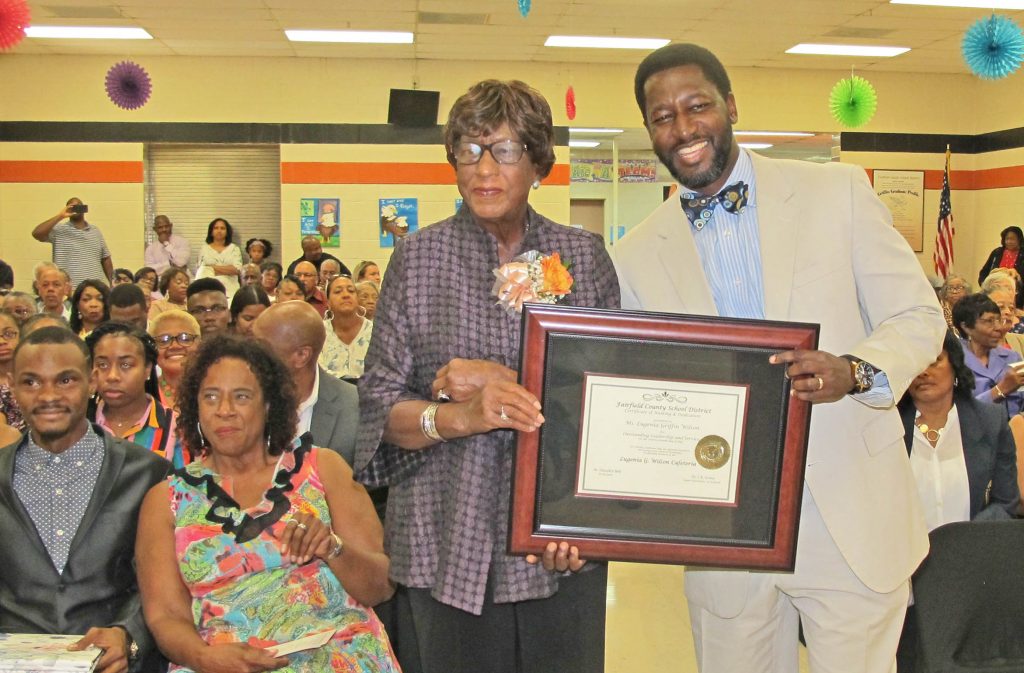
BLAIR – More than a hundred people gathered on Friday in the McCrorey-Liston Cafeteria to honor Eugenia G. Wilson for her years of service in the school’s cafeteria.
School Principal Chandra Bell said Wilson “was the matriarch of the school.” She also recalled Wilson’s oft-repeated mantra – “It’s all about the children.”
Many of those children, now adults, returned on Friday to witness the naming of the cafeteria for Wilson who began her career as a Food Service worker at the school in 1966 and retired forty years later as the cafeteria’s supervisor. By all accounts, she was beloved beyond measure by the children she fed and by those she worked with at the school.
Eugenia Wilson accepts a plaque from Superintendent Dr. J.R. Green, recognizing the naming of the cafeteria after her. | Barbara Ball
In 1979, Wilson received a certification of completion from the National Institute for the Food Service Industry. She also received continuing education credits through Midlands Technical College, Johnson and Wales University and the University of South Carolina. In 1995, she was named Fairfield County Food Service Manager of the Year.
Bell said Wilson was known for making sure that the students had wholesome, balanced meals, and the students loved the delicious meals she prepared for them.
“But the students were not the only ones who loved her meals,” Bell said. “About noon, people from all over Fairfield County would start coming through the front door headed to the cafeteria – from VC Summer, from the doctors’ office down the road, our maintenance crew, lined up!”
Former student Rodney Gibson, like other speakers, recalled “the wonderful food Mrs. Wilson prepared for us – nice warm, creamy grits and fried chicken. But what I remember even more,” he said turning to Wilson, “was your beautiful, kind smile and humble behavior that you showed us and instilled in us,” Gibson said.
“The pride she took in her cafeteria work was truly inspiring,” Sandra Conyers, a longtime teacher at the school, said. “I was constantly impressed with her work ethic. Her output was one of a kind. My room was right across the hall from the cafeteria, so you can imagine the wonderful aromas that seeped into my classroom about 10:30 or 11 every morning. No matter what Ms. Wilson and her staff prepared, it was always tasty, especially at holidays – fried chicken, macaroni and cheese, peach cobbler,” Conyers said. “She never disappointed.”
Wilson’s nephew, Brandon Henderson, now a college sophomore, recalled his first day of kindergarten at McCrorey-Liston.
“I knew that my Auntie ran that cafeteria back there,” Henderson said, smiling. “During Martin Luther King month in February, she would set up a table for everybody to sit at who had a birthday that month. She made sure I was at the front of the table…and that I had four chicken wings.”
The audience laughed.
Wilson’s daughter, Leslie, recalled her mother’s dedication to her work in the cafeteria, her co-workers and to the children she cooked for.
“She left the house at 5 in the morning, left us still in bed to be at work on time,” Leslie Wilson said. She said her mother and the other cafeteria ladies, also dedicated, arrived at the school before dark and didn’t leave until the end of the school day. It was a time when school meals were prepared from scratch.
“I have always been proud that my mom was a cafeteria worker,” Wilson said.
“Mom began cooking at the age of eight. She was the youngest girl of nine children. The others were working in the cotton fields, so as soon as Mom was old enough she was put in the kitchen cooking meals for the family,” Leslie Wilson said.
Wilson grew up in Blair and, as a teenager, boarded with families in Winnsboro so she could attend Fairfield High School. After high school, she met Aaron Wilson. They were married for 30 years until his death in 1980.
“Mom always cooked for the love of it. She didn’t want you messin’ with her pots and pans. And if she tells you this is the way she wants it done, then that’s the way she wants it done,” Leslie Wilson said, laughing. “My sister and I were not allowed to cook anything growing up except cornbread and biscuits because Mom said she didn’t have enough food to waste. I guess she didn’t think we could mess up cornbread and biscuits,” she said.
Leslie Wilson said her mother’s contribution was one of the things that made the school special and recalled her own glory days at McCrory-Liston.
“Later in life when I’d say there were only 60 students in my graduating class. They’d say, ‘Great!’ and I’d say, ‘Yeah, it was a small, private school,’” she said as the audience laughed and applauded. “Because that’s what it seemed like.”
After family members took turns speaking and presenting flowers to Wilson, Superintendent Dr. J. R. Green announced that a special plaque emblazoned with ‘The Eugenia G. Wilson Cafeteria’ would be attached to the wall next to a door into the cafeteria. He also presented Wilson with a scrapbook with messages from former students and memorabilia from Wilson’s years at the school.
Wilson then thanked the audience for their attendance and shared several stories from her years at the school – some poignant, others funny and all heartwarming.
“I loved the time I worked here at McCrorey-Liston. I loved cooking. I loved my work in the cafeteria, and I loved the children. Everything I did was for them,” Wilson said. “It was all about the children.”
WINNSBORO – Once again questions over compensation arose during the Fairfield County School District board meeting.
And once again, discussions got thorny at times.
For nearly 40 minutes, board member Annie McDaniel sparred with Superintendent Dr. J.R. Green and board chairman William Frick over district salaries during the July meeting.
At one point, McDaniel, who is running for the District 41 Representative in the State House, suggested board recordings of prior discussions had been removed from the district’s website.
“Normally we have a tape that reflects the full conversation,” McDaniel said. “For some reason, I didn’t see that tape on there today.”
“Are you insinuating I’m part of some conspiracy now, Ms. McDaniel?” Frick replied.
At issue was a motion approved during the June 5 meeting that directed Green to develop options in which every employee makes at least $20,000 a year.
As of Sunday, video of the meeting was viewable on the district’s website. And on that video, the motion the board approved instructed Green to present options that result in every employee making $20,000 a year.
McDaniel pressed Green for other options at the July meeting. She grew frustrated over Green’s and Frick’s responses that Green was carrying out the board’s instructions to the letter of the law.
McDaniel also said she hoped to vote to increase salaries that night. Board members said Green’s plan was presented for information only, and no votes were taken.
“The concern was the sensitivity and the compassion for people making $13,000, $14,000 a year,” McDaniel said. “Whether I asked for a horse ride, a donkey or a monkey jumping upside down, for you guys not to take this seriously, I can’t even come up with the word for it.”
“The board directed me to present an option, so I presented an option,” Green replied. “I told you from my professional expertise the only way I can do it is to increase the hourly rate.”
Frick agreed.
“That was the motion. It was voted upon,” Frick said. “I asked Ms. McDaniel to clarify. The motion was to bring back options to make sure no employees make less than $20,000 a year.”
Green’s proposal increases starting hourly wages from $10.67 to $15.45 for Salary Class 1010 employees, which includes bus monitors, food service/cafeteria operators and safety officers.
Class 1020 employees, including custodians, wouldn’t receive raises. They earn $11.67 an hour with zero years of experience.
Green said the disparity is due to days worked. Class 1010 employees work 190 days while Class 1020 employees work 250 days, which is why Class 1010 employees earn less, he said.
Because of the disparity, Green and other board members instead supported a comprehensive overhaul of the district’s salary schedule.
“The only way you can ensure that there is no employee in the district that makes less than $20,000 is to increase the hourly rate,” Green said. “It is not feasible to say we’re going to have every employee work 245 or 260 days. The question would be what they would do for the 245 or 260 days.”
Board members Sylvia Harrison and Henry Miller chimed in, both expressing support for a comprehensive salary overhaul.
“I want to see Dr. Green bring an option back where everybody is considered to get a raise,” Harrison said. “I do like the fact that the support staff need a bigger raise, but I’d like to see an option for everybody because they all deserve a raise.”
McDaniel opposed waiting for a comprehensive salary, saying it would be too time-intensive when employees are struggling to make ends meet.
“Are we going to just leave this tonight, or are we going to wait two years down the road after we get a salary study, which is a waste of money?” she said. “We’re talking about people making $13,000, $14,000 a year. That is awful.”
WINNSBORO – It’s rare when a major school budget measure passes by a 2-1 vote, but that’s exactly what happened at a recent board meeting.
On June 5, the Fairfield County Board of Trustees voted 2-1 on a motion directing Superintendent Dr. J.R. Green to develop options in which no district employee makes less than $20,000 per year.
Trustees Annie McDaniel and Paula Hartman voted for the motion that McDaniel introduced. Board Chairman William Frick voted against, and the remaining trustees abstained.
Trustee Carl Jackson said the vote happened so quickly, he didn’t realized what had happened until it was too late.
Jackson said he wasn’t opposed to McDaniel’s motion, but also expressed concern about micromanaging the superintendent.
“I’m a little disillusioned here. We as a board can say to the superintendent what we want him to do with that salary range,” Jackson said. “I don’t have a problem with that. Let him bring what he’s going to bring and we’ll deal with it. Let the superintendent do his job.”
Following the vote and further discussion, the board also adopted third and final reading of the 2018-2019 budget by a 6-1 vote, with Hartman opposing.
Included in the $41.27 million budget are step increases and a 2 percent, across the board salary bump for all employees.
At second reading, board members also voted to increase the annual band supplement by $10,000, as well as $1,500 increases for the boys’ and girls’ basketball coaches. Those supplements remained in the final version.
The band stipend will be disbursed among all individuals who work in the band program, Green said.
There is no tax increase in the budget, with millage remaining constant at 203.1 mills.
Green, though, hinted that a millage increase might be required if the board enacted a measure to increase every employees’ salaries to at least $20,000.
“I will bring back what you want me to bring back, even if it means a millage increase,” he said.
The salary debate was a continuation of a heated discussion that first arose during the May board meeting.
McDaniel, who is running for the House District 41 seat, pressed fellow school board members for details concerning unclassified worker salaries.
Specifically, she wanted to know what an annual salary would be for various hourly employees, cafeteria workers in particular.
Green said it was too difficult to provide an exact number, saying it depends on how many hours worked. McDaniel kept pressing.
“I’m not understanding why it’s heartburn to have the conversation,” McDaniel said.
Kevin Robinson, the district’s finance director, said school cafeteria worker salaries and can’t be easily annualized because they work varying numbers of hours.
“Food service workers do not all work the same number of hours per day because it’s based on that school,” Robinson said. “All of the annual salaries are going to be different for the food service workers based on the fact they do work a different number of hours.”
Green added some cafeteria workers work during the summer while others don’t.
“There’s a variation there as well,” he said.
As was the case at second reading, frustration eventually entered into the budget discussions.
“You can’t pick one salary and say that’s not a fair salary,” Frick said. “That’s the issue I had last time. I’m seeing you trying to make a point.”
“We need to look at this and if this is what we want it to be,” McDaniel snapped back. “Come on, $13,000 to $14,000 a year? That is not a livable salary.”
Hartman, who supported McDaniel in voting against the budget at second reading, voiced some of the same concerns.
“The richer get richer and the poorer gets poorer,” she said.
$5.4 million deficit expected
In related budget matters, the board also approved a tax anticipation note (TAN) not to exceed $5.4 million.
A TAN is a short-term loan to help the district cover temporary budget shortfalls until sufficient tax revenues become available in January 2019.
According to board documents, a shortfall is expected to begin on or about Sept. 22 and continue through late January 2019. The total projected shortfall amount is $5,346,850.
The loan’s interest rate was not stated.
Board Chairman William Frick, a longtime critic of the board’s habit of issuing millions of dollars of TANS each year, voiced frustration over needing to vote for the note.
“Is there going to be a year where I’m not going to have to vote on one of these things?” Frick asked. “I understand the reasoning behind this, but I would like to see a day when I don’t have to vote on this.”
The board signed a $5 million TAN in 2017, district documents state.
Tax bills are due Jan. 15, 2019, which is when the district anticipates receiving the needed tax revenues sufficient to cover expenses.