Tag: slider

  • Golf Club of SC in foreclosure

    Crickentree residents fear plan to replace entire golf course with 450 homes

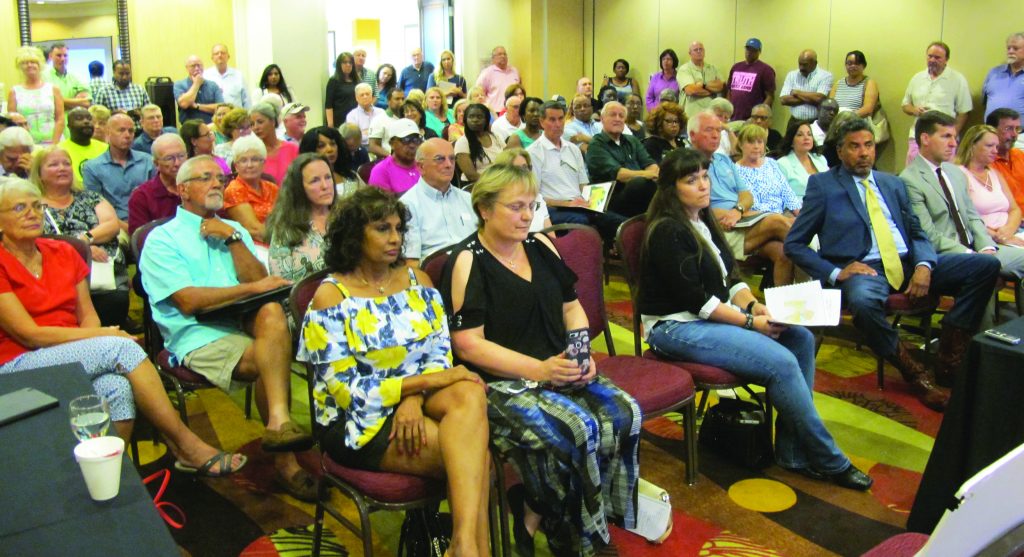
    Crickentree residents heard E-Capitol’s presentation on Monday. | Barbara Ball

    BLYTHEWOOD – After years of struggling financially, the Golf Club of South Carolina closed last week. The Club is entered off Langford Road and much of the golf course borders the Crickentree subdivision, which is accessed off Kelly Mill Road. One side of the golf course is the back yard to many of the 145 expensive, uniquely-designed Crickentree homes that boast large lots, some up to two acres in size.

    A Texas investment company, E-Capitol, which holds the note and mortgage on the golf course property, initiated foreclosure proceedings on the course in March. Once the foreclosure is complete, E-Capital expects to purchase the course and build about 450 homes on it.

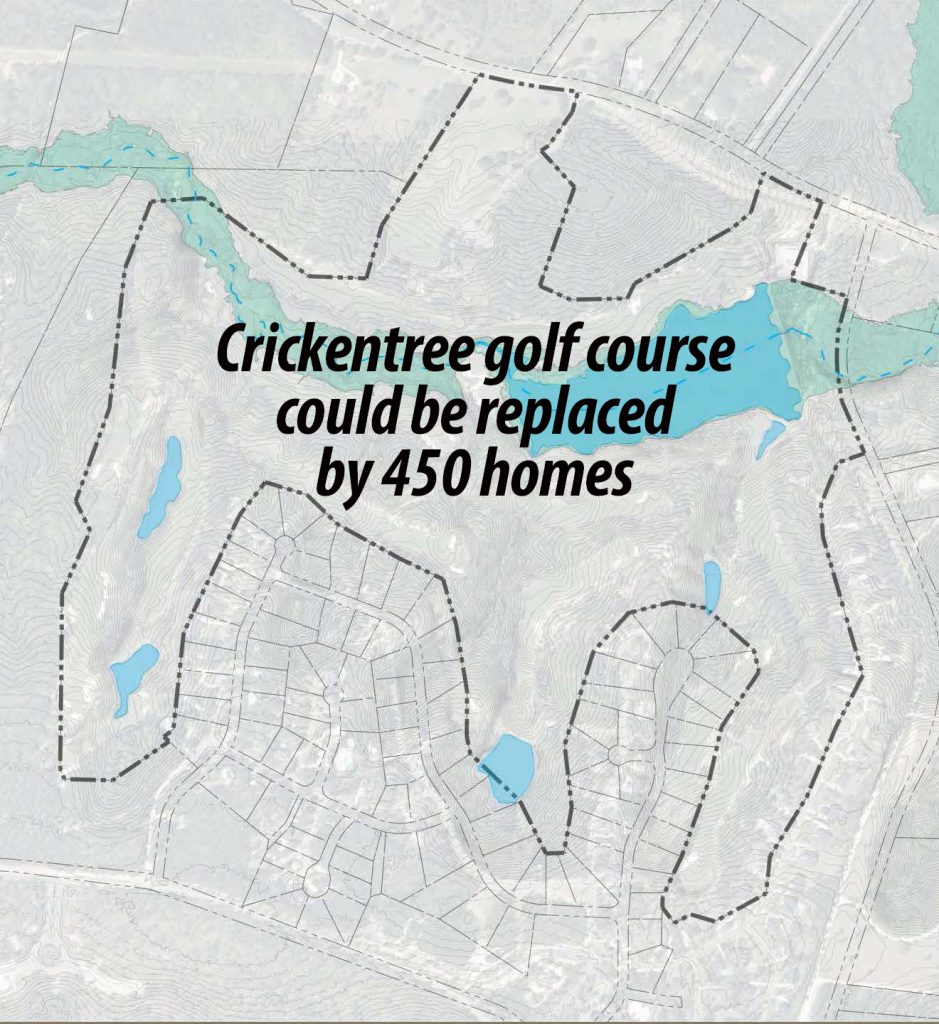
    450 homes could replace Crickentree Golf Course.

    This is not sitting well with the 75 or so Crickentree residents who showed up at the Hilton Garden Inn on Farrow Road Monday night to hear E-Capitol’s attorney Jake Barker, with Gaybill, Lansche and Vinzanti, explain his client’s plans for the golf course

    property if they, indeed, become the purchasers.

    “Once my client owns the property, they will pivot from the foreclosure process to the development process,” Barker said. “They will sell the property to a developer who will then develop it.”

    But Barker was careful to explain that the golf course will be developed as residential property, not a golf course. To make that transition would require a rezoning from the current TROS (Traditional Recreational Open Space) zoning classification to a residential zoning classification.

    That rezoning is where the residents feel they have a foothold to stop the development of hundreds of homes on small lots in their backyards.

    The TROS zoning classification dates back to 2007 when the planning commission added a zoning classification to the Richland County land use plan to protect golf course communities throughout Richland County from becoming the victims of rampant residential development.

    The question is, now, will county council vote to change the zoning to protect E-Capitol’s investment and satisfy the developer or keep the current zoning in place to protect the Crickentree property owners’ investments and quality of life they say they moved there for.

    “Before the rezoning process begins,” Barker told the homeowners gathered at the Hilton Garden Inn, “we want to get feedback from the Crickentree neighborhood as to what you would like to see. The golf course was not meeting its obligations and could not continue on,” Barker said. “I understand none of this is ideal for you, but we want to have a discussion with you. We want to work with you.” Barker said.

    The course, outlined in black, is partially bordered by Crickentree subdivision.

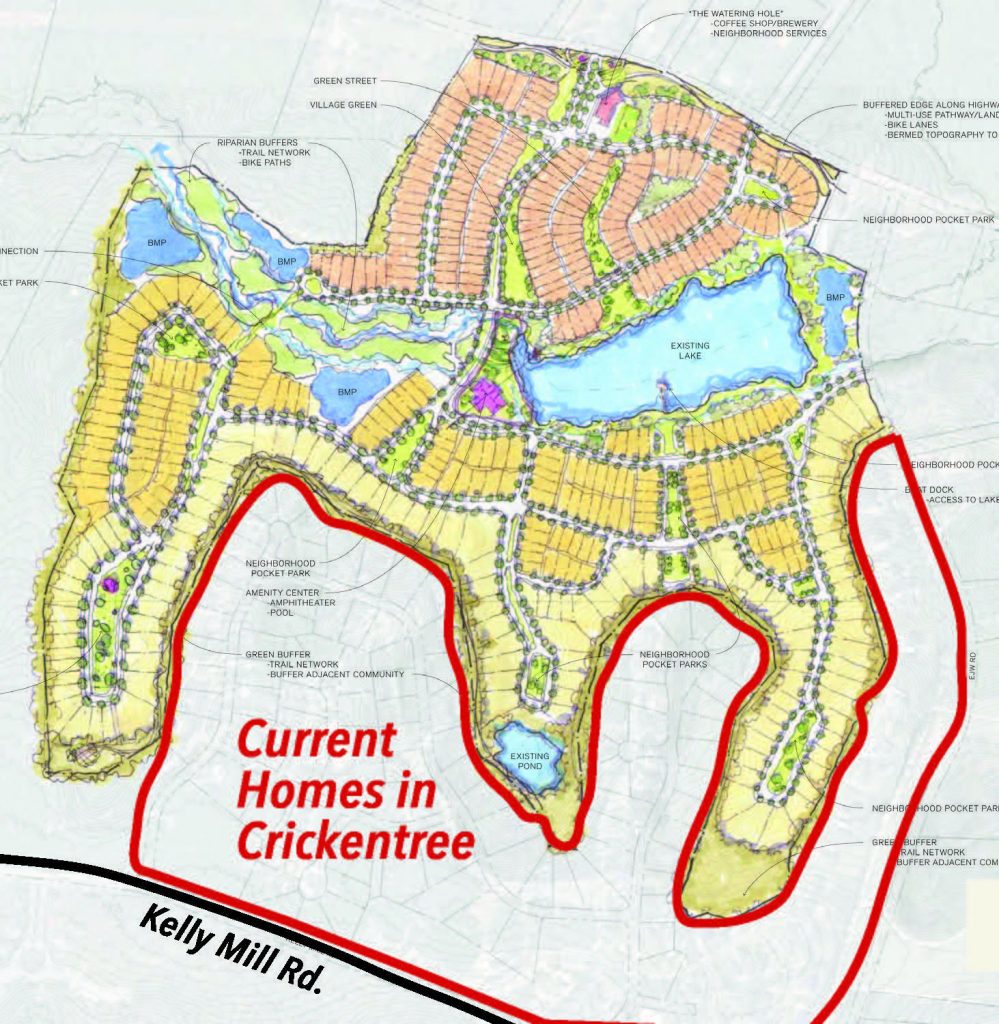
    While the anxious crowd of homeowners vowed to fight any rezoning effort that would result in smaller lots and a crowding of hundreds of homes onto the golf course, as the hour-long meeting continued, Barker suggested the possibility of building fewer homes on larger lots with a buffer as wide as 100 feet separating the golf course homes from the current homes.

    “That’s all possible,” Barker said. “These drawings are our initial, conceptual plans to develop it. We want feedback. We want to hear from you,” Barker insisted.

    Asked about the pricing and size of the homes that would be built on the golf course, an engineer representing E-Capitol’s interest said he didn’t know. He said that would be determined by the eventual developer.

    Barker said there is no timetable for the actual foreclosure and purchase of the golf course, but that it would take place in Richland County circuit court, and had been referred to Judge Strickland, the master of equity for Richland County.

    “Once the foreclosure process is finished,” Barker said, “the property will be sold at auction, and any third parties can come and bid at that sale.”

  • Blair’s Hodges is global hero

    THAILAND – A Blair favorite son, Major Charles (Charlie) Hodges, has been in the news around the world the last two weeks, and for good reason.  As the U. S. Mission commander for the 353rd Special Operations unit for the Air force, Hodges served as commander in the daring, seemingly impossible, but totally successful rescue of 12 young soccer players from deep within the bowels of a water filled cave in Thailand last week.

    Hodges’ friends, family and strangers in Fairfield County have followed the news of the boys’ rescue and Hodges’ and the other rescuers’ fete on every major news outlet in the country, albeit in the world.

    The Richard Winn graduate has been interviewed on Good Morning America, CBS This Morning, the Today Show and was the subject of stories in the New York Times, Post and Courier and other local, state, national and worldwide news sources.

    While The Voice was not able to talk with Hodges, here are some excerpts from his interviews.

    Today Show: “I felt like I was being optimistic when I told the governor of Chiang Rai that, in my mind, the potential chance of success was anywhere from 60 – 70%, we were fully expecting casualties.”

    “We knew that if we acted soon, we had the potential to rescue them, but we didn’t have the option to wait.”

    CBS This Morning: “We also understood, though, we didn’t have the option to not attempt this…even though the odds seemed impossible. What I’ve always been taught is to take risks and be bold when the situation calls for it, and this situation absolutely did.”

    “We’re not trained to do cave dive rescue missions, so at the end of the day you just have to rely on the training that you’re given, how we approach problems methodically and logically, try to push away any emotion and look at it from the lens of ‘what are the circumstances and what do we absolutely need to do to make this a success.’”

    “It took every single one of us, putting our heads together and pushing aside any sort of political or cultural differences, and doing our best to find a solution to do this. What I take away from this is how much can be accomplished from teamwork, because it was pretty impressive seeing all those entities working together.”

    New York Times: “I don’t know of any other rescue that put the rescuer and the rescuee in so much danger over a prolonged period of time, unless it is something along the lines of firefighters going into the World Trade Center knowing that the building is on fire and is going to collapse.”


    Interview and article links:

    SC man who helped in Thai soccer team rescue has a proud former teacher back home (WIS TV)Citadel graduate involved in Thai cave rescue describes dramatic operation (Post & Courier) US Mission Commander reacts to successful Thai rescue (Good Morning America) ‘We were fully expecting casualties’: Thai soccer team rescuers describe harrowing mission (Today Show)Air Force commander describes Thai rescue (CBS This Morning)‘Still Can’t Believe It Worked’: The Story of the Thailand Cave Rescue (The New York Times)

  • CPA: Visitor Center funds funneled to Chamber

    BLYTHEWOOD – After reviewing The Greater Blythewood Chamber of Commerce’s financial documents that were requested by council for fiscal year 2017-18, a certified public accountant concluded that the documents were “confusing, lacking in detail and sometimes impossible to follow and understand.”

    He also concluded that much of the $18,500 accommodation tax (A-tax) money council awarded to the chamber in June, 2017, to pay for a dedicated visitor center employee, was not spent on that employee. Instead, it was funneled directly to the chamber to pay one quarter of the chamber’s annual operating expenses, an unauthorized use of A-tax money, according to the CPA, and an arrangement the council never agreed to when it allowed the chamber to take over the management of the visitor center in June 2017 and awarded the chamber the funds for a visitor center employee.

    Those documents were acquired by The Voice from members of Town Council after the chamber’s executive director, Mike Switzer, turned them over to council on June 13, more than a month after council requested them. The documents included several untitled, undated budget reports along with others with partial dates. Many of the entries on budget ‘actuals’ do not match annual profit and loss statements for the same time period.

    Former Town Councilman Bob Massa, a CPA and former treasurer for the Blythewood Chamber, said the financials that were presented to council and passed on to The Voice do not meet professional accounting standards even though the chamber’s May 31, 2018 actuals reflect $2,730 for ‘professional account fees.’

    When council allowed the chamber to take over management of the visitor center in June 2017, it gave A-tax funding for a dedicated employee for the chamber, but did not approve that A-tax money for the chamber’s operating expenses as part of the arrangement.

    However, a report in the chamber’s financial documents, titled ‘Visitor’s Center Report: January 2018”, showed that during the first six months, after being awarded the $18,500 for a visitor center employee, the chamber charged one quarter of its operating expenses to the visitor center’s $18,500, producing an artificial deficit of $4,885 for the first half of the fiscal year and projecting an artificial deficit of $2,758 for the upcoming second half of the fiscal year.

    Switzer presented that report to council and, with no discussion as to why a quarter of the chamber’s operating expenses had been charged to the visitor center, which is, according to Massa, an unauthorized use of A-tax funds, voted to give the chamber another $7,643, the full amount of both artificial ‘deficits.’

    Massa also pointed out that at least some of the chamber’s operating expenses charged to the visitor center appeared to be inflated, thus artificially increasing the amount of the deficit. One example is a $626 charge for one-fourth of the chamber’s annual insurance cost which, multiplied by four, comes to $2,504 total for the year. But the chamber’s profit and loss statement and the actuals of a budget for that same time period listed the chamber’s annual insurance costs at $1,491.72, not $2,504. Council did not question the difference before voting to give the $7,643 to the chamber.

    “It’s difficult to tell what is going on with the chamber‘s and visitor center’s revenue and expenses from these documents. It’s a mess,” Massa said.

    While members of the audience at the June 25 council meeting questioned and criticized the chamber’s financials, council, without asking any questions about the requested financial documents, voted 4-0 to award another $9,250 to the chamber for the visitor center for the next six months, even though it also voted to discontinue all funding for the visitor center as of Dec. 31, 2018. Council did not outline any expectations for the visitor center operations or how the $9,250 is to be spent.

    “The A-tax money is intended to be used to promote tourism to the town, to bring visitors,” Massa said. He said it can also be used to pay an employee for a visitor center or to fund events, such as The Big Grab, that have the potential to bring visitors to Blythewood.

    “Council has a fiduciary responsibility to the residents. A-tax money is for specific things. It is not for funding the chamber’s operating expenses, but it would appear that it is being laundered through the visitor center to do just that.”

    $17,500 Grant

    A state official also had concerns about an economic development grant council awards each year to the Greater Blythewood Chamber, a practice that Massa said should be frowned upon by the residents since it does not appear to meet the criteria for a grant. This year, council’s grant to the chamber is $17,500, a $2,500 increase over last year’s award.

    “Who else is eligible to receive this grant? It’s not a grant if only one entity is eligible to apply and receive it,” the official, who asked not to be identified, said. “Grants must have criteria to which an entity has to adhere to and meet in order to apply and receive funds. Public funds must be spent for a public purpose. A service must be provided in exchange for these funds. The grant has to be open to anyone who meets the criteria. Businesses in the town could apply for this grant. There should be an expectation on the town’s part that there is a return on that investment. A contract is involved when a grant is awarded,” the official said.

    But the only ‘contract’ for the grant between the town and the chamber is a letter stating that the chamber must provide the town a $2,500 premier sponsorship and that Ed Parler, the town’s appointee to the Chamber board, must have a vote on the board.

    The state official said that is not a return on the town’s investment of $17,500.

    Other inconsistences in the chamber’s financial bookkeeping and reporting has to do with the A-tax funds awarded to the chamber by council for events organized by the chamber. For the last three years, council has funded the chamber with A-tax funds to organize The Big Grab in September, a glorified yard sale that includes Blythewood, Ridgeway and Winnsboro.  Last year, the Chamber also received A-tax funds to organize the community’s Solar Eclipse event.

    But Switzer’s reports on the chamber’s revenue and expenses for the two events came up short on transparency. Of the $8,750 A-tax award for The Big Grab, the chamber staff paid themselves $4,618 on top of their chamber salaries. Of the  $12,750 A-tax award for the Solar Eclipse event, the chamber staff paid themselves $7,475.25. This was compensation in addition to what the staff is regularly paid by the chamber for chamber activities.

    After each event, the chamber is required to submit a report to the A-tax committee on its revenue and expenses for the event.  Those reports, with few details, led to questions of how the money was actually spent.

    Solar Eclipse reports

    Switzer reported to the A-tax Committee that its total revenue for the Eclipse event (A-tax and other sources) came to $19,455.94. However, the annual profit and loss statement he presented to council for 2017-18 and the budget/actual for the year listed total revenue for the Eclipse at $24,625.98, a difference of $5,170.04.

    Switzer reported to the A-tax committee that the chamber’s total Eclipse expenses were $20,838.03.

    The chamber’s profit and loss statement for 2017-18 and the budget actual for 2017-18 showed expenses of $22,565.79, for a difference of $1,727.76.

    Big Grab reports

    While both the A-tax report and the profit and loss and budget/actual for 2017-18 Solar Eclipse revenue matched at $13.547.00, expenses for the event were off on the same reports. Switzer’s final report to the A-tax committee reported expenses of $12,114.23. His profit and loss for 2017-18 and the budget/actual for the year listed Big Grab expenses as $7,402.12; a difference of $4,712.11.

    In other reports for the events, there is little information about revenue and expenses for what Switzer said were lucrative t-shirt sales, vendor sales, sponsorships and other areas of revenue.

    “The chamber needs to explain these discrepancies,” Massa said. “They are playing fast and loose with numbers and the council is apparently going right along with them. When you’re making decisions to dole out town money, you’re accountable to know what the numbers really are.”

    Other financial reporting

    The reporting of the chamber’s total operating revenue and expenses also vary from one document to another for the same time period in documents presented to council. The last documents were presented on June 22, 2018 prior to the June 25 council meeting where council voted to extend funding to the chamber for the visitor center in the amount of $9,250 through Dec. 31, 2018.

    The total revenue listed under ‘actuals’ dated May 31, 2018 is $92,806.05. Total revenue listed on the chamber’s profit and lost statement for May 31, 2018 is $133,442.10, a difference of $40,636.05.

    The total operating expenses listed under ‘actuals’ dated May 31, 2018 is $114,639.52, Total operating expenses listed on the chamber’s profit and lost statement for May 31, 2018 is $86,907.35, a difference of $27,732.17.

    While the total revenue for the visitor center is reported on the May 31, 2018 actuals and on the May 31, 2018 profit and loss statement to be $40,616.05. It jumps to $67,342.76 on the June 22, 2018 profit and loss statement even though there appears to be no income activity for the visitor center in those 22 days.

    Total visitor center expenses are listed at $8,157.31 on the ‘actuals’  and the profit and loss statement for May 31, 2018, but they jump to $30,842.07 on the June 22, 2018 profit and loss statement, again, with no significant expenses documented for those 22 days.

    For his part, Switzer has maintained that the chamber is above board financially and that council has long approved of how the chamber has conducted its business and spent its money.

    “I just want to say thank you to the council for the vote of confidence with the increases that you’ve proposed for the upcoming budget,” Switzer said at a May 2018 budget workshop. “We appreciate your vote of confidence in the work that we’re doing and we’re looking forward to continuing to grow that work.”

    “Despite the very misleading and sometimes often outright false statements that were put out there, we are completely  of the upmost integrity at the chamber, and I think a good testament to that is that the town has had a representative on our board for many years,” Switzer said. He said the mayor, himself, had served as that representative for a year before Ed Parler, the town’s economic development consultant, took the role.

    “He (Parler) attended every single board meeting where our treasurer’s report is given out and all our financials are laid out,” Switzer said. “The $4,500 increase [$2,500 to the chamber and $2,000 to the visitor center] that you have in the budget for us will cover three-quarters of our rent increase of $6,000,” Switzer said.

    The chamber rents space for $24,000 a year in a building in McNulty Plaza that Mayor J. Michael Ross and a partner own. According to chamber documents acquired by The Voice, annual rent for the chamber was $600 in 2015/16, increased to $12,000 in 2016/17 and $18,000 in 2017/18. The increase of $6,000 will bring the annual rental fee for the chamber to $24,000. Ross said that increase went into effect July 1.

    On Wednesday, shortly after The Voice went to press, Switzer was to appear before the A-tax committee to request $10,000 in funding to organize and manage the next Big Grab event to be held in September.
  • Man busted for ‘shake & bake’ meth lab

    WINNSBORO – A Winnsboro man was arrested after Fairfield County Sheriff’s deputies discovered he was manufacturing methamphetamine in the back seat of a car in the Bi-Lo parking lot.

    Sanders

    Bradley Alson Sanders, 48, was charged with using a motor vehicle without consent to manufacture methamphetamine in what deputies described as a ‘shake and bake’ lab.

    Sheriff’s deputies said they were notified a little after 1 p.m. on Tuesday that a man wearing a blue button up shirt and carrying a blue book bag had been seen in the Bi-Lo grocery store parking lot for “a couple of weeks” and was “going to people’s cars.” The report said the suspect was also seen in the back seat area of a Bi-Lo employee’s car without permission.

    The suspect was identified by the employee, the report stated. The incident report also stated that officers were familiar with Alston from previous methamphetamine related drug charges.

    When a deputy arrived at the Bi-Lo parking lot, he was told the suspect had been seen walking into the woods after the Bi-Lo employee told the suspect he had been reported to law enforcement. While looking for the suspect, the officer called for backup, then returned to the parking lot to find what he determined was an active meth lab in the back seat of the car.

    The county’s narcotics unit as well as the South Carolina Law Enforcement Division (SLED) arrived and a methamphetamine cleanup crew was brought in to collect, remove and clean up the mobile lab area.

    In the meantime, sheriff’s deputies located Sanders in the wooded area off of Columbia Road near Bi-Lo. Deputies reported Sanders’ book bag and several syringes (needles) that were located in the area and believed to be associated with Sanders, were turned over to the narcotics investigators.

    Sanders was arrested and warrants were obtained for manufacturing methamphetamine 3rd offense, manufacturing methamphetamine 3rd offense within one-half mile of a school and use of a vehicle without permission (unlawful use).

    Bond information was not available to The Voice at press time.


    Related: Sheriff investigates meth lab at Bi-Lo

  • Council offers FMH $1.6M

    WINNSBORO – Fairfield Memorial Hospital has accepted Fairfield County’s offer of $1.3 million to buy three parcels, with an option to acquire a fourth for an additional $285,000.

    The vote came at the end of a special meeting of the hospital’s board of trustees Tuesday, one day after Fairfield County Council approved presenting the deal to the board.

    Hospital board members were very complimentary of the county’s work in assembling the proposed deal.

    “They really did a good job to pull this off in a timely manner like they did,” said board member James McGraw. “Hats off to Fairfield County.”

    Board member Randy Bright agreed.

    “That’s a continuation of the great job they did working with the state, Providence [Health] and us in pulling Providence into here so that we have a continuation of medical care in the county,” Bright said. “This council has done a great job in moving us forward.”

    The motion the hospital board approved states the hospital “agrees to accept the county’s draft offer, including purchase price, pending legal review by the hospital’s attorneys.”

    Billy Smith, chairman of Fairfield County Council, was pleased to see such a quick turnaround.

    Smith noted the council thought it was important to release details of the deal after first reading, even though deals of this nature are typically kept confidential until third reading.

    “It is a big deal and a big number,” Smith said. “We wanted folks to look at that and give any feedback.”

    Fairfield County is offering $1.3 million to buy three parcels from Fairfield Memorial Hospital, with an option to buy a fourth for $285,000, according to a proposed contract the county released Monday.

    Two parcels consist of medical office buildings. Portables occupy the third parcel, though Smith said the county was interest in that piece of property to improve access to the office buildings.

    The property with the option is the rehabilitation center.

    Smith has said the intent behind purchasing the properties is to preserve the general practitioner offices and rehabilitation center. He still hopes a private provider can step in and operate the rehab center.

    “The purpose was not to be a real estate baron,” Smith said. “It’s to provide services in the county. We’re hoping we can get a user in there, a good provider for the citizens.”

    At Monday night’s council meeting, the council approved a motion authorizing Smith to present terms of the deal to the hospital.

    The council also approved first reading of an ordinance authorizing the purchase of hospital property “for public use or other uses deemed fit by the council and other related matters,” according to the measure approved Monday night.

    Two more readings, as well as acceptance by the hospital, are required to finalize the deal.

    Terms of the deal have been hashed out over the past several months in executive session. Monday night’s presentation of the proposed contract was the first public disclosure of the deal.

    Both votes were unanimous. Council members Mikel Trapp and Douglas Pauley were absent.

    Fairfield County has been discussing for months the possible purchase of property from Fairfield Memorial Hospital, which has been struggling financially. The hospital is in the process of closing.

    In addition to listing a purchase price and option, the proposed deal also contains a stipulation that the county pay $250,000 to Fairfield Memorial Hospital within 10 days of execution of the agreement.

    Funds would be credited toward the purchase price and used by the hospital to cover day-to-day operational expenses, the document states.

    Fairfield County would pay an additional $10,000 upfront, with the money going into an escrow account. The county would pay the remaining balance to the hospital by the closing date, though that date isn’t specified in the proposed document.

    In May, Fairfield County voted to begin negotiations with the hospital to purchase some of its properties. At the time the parcels appraised for about $1.6 million, and $1.9 million with the rehab center included, Smith said.

    County Council approved a memorandum of understanding a month later. In that document, the council voted to purchase some or all of the property. It added a stipulation that a $400,000 lien against the hospital be satisfied before any sale could take place.

  • RW vote may have violated FOIA

    RIDGEWAY – A recent vote authorizing Ridgeway Police Chief Christopher Culp to take school resource officer refresher courses may have violated state open meeting laws because the public never received notice of the impending vote, according to Freedom of Information Act experts.

    At its July 12 meeting, the Ridgeway Town Council voted 3-0 for Culp to receive SRO recertification training. Council members Rufus Jones and Angela Harrison were absent.

    Councilman Don Prioleau introduced the motion, which authorizes Culp to receive the training either through a police major at the Columbia Police Department or the S.C. Criminal Justice Academy.

    Ridgeway would incur no cost through Columbia police, Priolieau said.

    The council’s vote may not have been legal, though, because the agenda didn’t list any items concerning SRO training.

    Bill Rogers, Executive Director of the S.C. Press Association, called the vote “sneaky” because the SRO training issue was never publicized in advance.

    “It’s a sneaky move to slip something by without the public knowing about it,” Rogers said. “And the council might have voted differently if it was on the agenda and the two council members [who missed the meeting] were present.”

    In 2015, the state Supreme Court ruled that meeting agendas, once posted, cannot be amended without an additional 24-hour notice to the public.

    This provision can only be suspended in two circumstances, according to the S.C. Municipal Association:

    • A two-thirds vote of members present and voting
    • A finding that an emergency or exigent circumstance exists.

    “An exigent circumstances would be considered an urgent or time-sensitive issue,” the municipal association website states.

    Council members didn’t vote at all to amend the agenda and there was no indication from council that sending Culp to receive SRO training constituted an urgent or time sensitive issue.

    For information only?

    Prioleau made his motion during the “Police Report” portion of the meeting, typically reserved for information-only items about arrest statistics and day-to-day police activity.

    Mayor Heath Cookendorfer said Prioleau’s motion during the “Police Report” segment was unprecedented.

    “I don’t mind seconding the motion to send him [Culp] to SRO training, but we’ve never approved the Police Report before,” Cookendorfer said. “We’ve always used it as ‘for information.’”

    Prior to the motion, Cookendorfer also wouldn’t allow an NAACP representative to speak during the first public comments session, saying that period is reserved only for agenda (action) items.

    Remarks about non-agenda items, he said, are reserved for the second public comments section, which occurs toward the end of the meeting, which is when the NAACP representative spoke.

    Culp escaped an effort to fire him during the June council meeting.

    Instead, council members voted to work with Culp in addressing complaints against him.

    Among the complaints was an assertion that Culp, who is not certified to work as an SRO, spends a disproportionate time doubling as a de facto SRO at Geiger Elementary School at the expense of policing the town, according to public records.

    State law states that SRO’s “have a primary duty the responsibility to act as a law enforcement officer, advisor and teacher for that school district.”

    A common problem

    As recently as June 28, the S.C. Attorney General’s Office opined that the Town of Mount Pleasant likely violated FOIA over a recent vote that resembled how the Ridgeway vote was conducted.

    The Mount Pleasant council discussed a lawsuit settlement agreement in executive session. No votes were initially taken, prompting numerous residents in attendance to leave.

    Later, though, the council held another executive session to discuss items other than the litigation.

    After the closed door meeting, the Mount Pleasant council voted to approve the lawsuit settlement without the required two-thirds vote to amend the agenda. That action likely violated FOIA, the attorney general’s office said.

    “It does not appear that either a two-thirds vote to take up the settlement again at the end of the meeting was taken,” the opinion, written by Solicitor General Robert D. Cook, said.

    “Nor was there a determination by Council that this was an emergency situation or exigent circumstance, thereby allowing a bypass of the two-thirds requirement of [state law] for amendment of the agenda,” the opinion continues.

    Jay Bender, an attorney with the press association, noted that in Mount Pleasant’s case, several council members didn’t participate in the executive session, and earlier votes resulted in 4-4 or 4-3 margins.

    In Ridgeway, two council members missed the vote altogether. And neither council voted to amend the agenda before voting. “Given the division on [the Mount Pleasant council], it seems unlikely that a motion to amend the agenda a second time to bring the settlement agreement for a vote could have obtained the necessary two-thirds vote,” Bender wrote in a recent op-ed piece that appears on page 2 of The Voice (read here).

    “Those who believe in open government in South Carolina should say thanks to Mr. Cook for this thoughtful and well-reasoned opinion,” Bender said.

    Prioleau backs Culp

    At Thursday’s meeting in Ridgeway, Prioleau vigorously supported sending Culp to receive SRO training, and criticized some council members and media reports for publicizing community complaints aimed at the chief.

    Documents The Voice obtained through a public records request show that at least 15 formal complaints had been filed against Culp in the previous 12 months. Culp was hired in 2016.

    Prioleau stated as many or more emails complimentary of the chief were submitted to the town over a six-day period. He hand delivered those emails to The Voice’s office and called for their publication.

    “This young man has been working here right at two years. We’ve had nothing but good reports for him,” Prioleau said. “The 5 percent, the negative stuff, makes us all looks so bad.”

    The emails delivered to The Voice, state Culp exudes professionalism and sensitivity. Some were anonymous, though most were attributed to an author or authors.

    “I am writing to express my salutation, appreciation and gratitude to Chief Culp for his concerted effort and endeavors in maintaining the stability and order in the Town of Ridgeway, especially working in a risky environment because he doesn’t have an officer to back him up,” one writer stated.

    Another writer stated Culp came to her aid when her vehicle broke down.

    “I want to compliment Deputy Culp, who came to my assistance when my truck had stopped alongside Highway 34 a few miles past the town of Ridgeway,” the email said.

    Several emails criticized council members over how Culp has been treated. At least one letter suggested criticisms of the chief were racially motivated.

    Priolieau became defensive to questions about his SRO training request.

    Councilman Dan Martin noted the Fairfield County Board of Trustees recently approved funding for five SROs, including one at Geiger Elementary.

    “The funds are all there for the county to hire new five new SRO officers. I feel pretty sure that they’ll have those officers in place,” Martin said. “I have a hard time thinking that they’re not going to find them for all five schools.”

    Martin also asked how long Culp would be absent if he attended the training. Prioleau answered by saying one to two weeks, and that the sheriff’s office would patrol Ridgeway in the interim.

    “I can’t believe we’re going down this road, I’m getting really upset over this,” Prioleau said. “The man has had his training, all he needs is a refresher course.”

    However, Prioleau did not present any documentation that Culp had ever been certified as an SRO officer.

    Martin also asked for a more detailed breakdown of Culp’s day-to-day activities. He said the monthly police report in its current form is vague.

    “How much time is he assisting other entities … as opposed to what he’s doing here?” Martin asked. “I’m just asking a simple question. How much time on average do you think he spends a month assisting these other entities (such as the Department of Natural Resources)? We don’t know what he did or anything.”

    Prioleau said it’s common for police agencies to provide mutual assistance. He said the lack of specificity in the monthly report was to not bog the chief down with excessive paperwork.

  • Bond denied for man who beat teen

    JENKINSVILLE – A Jenkinsville man was charged with assault & battery 3rd degree, assault & battery 2nd degree, burglary, violation of court order of protection (two charges), domestic violence 3rd degree after allegedly using a set of brass knuckles to beat a 15-year old male in the face and assaulting the teen’s mother and grandfather at their home.

    Smalls

    Ervin Smalls, II, 31, was arrested on July 2, 2018 for the assaults that occurred at about 9 p.m. on June 10, at a home on State Highway 215 in Jenkinsville.


    When officers arrived at the home, they found the teen victim, reportedly beaten by the offender, with multiple lacerations and injuries to the face, head area and upper body. A Sheriff’s spokesperson reported that Smalls was a former boyfriend of the teen’s mother and was under a restraining order.

    When Fairfield County Sheriff’s deputies attempted to speak with the teen to ask what happened, he was unable to compose himself and could only say, “Please don’t let me die,” the incident report stated.

    The Fairfield County Emergency Medical Service arrived and, after treating the victim, spoke with his mother. She stated that after she finished washing her car in the front yard, she went inside to take a shower. She reported hearing a loud commotion in the front of the house. She said she got dressed and came into the front room where she found her son lying in the floor covered in blood and the offender assaulting her father wearing black brass knuckles, the report states.

    The woman said she then ran back to her bedroom, found a razorblade and attempted to cut the assailant, but cut herself with the blade instead. She then ran to the front porch where she found a screwdriver and began attacking the offender to get him off her dad, she stated in the report.  She then used her cell phone to call 911.

    The woman stated that when she was making the call for help, the attacker began chasing her. He reportedly caught her at the back door and after allegedly throwing her out the door, ran into a nearby woods.

    The woman told officers she heard two or three shots fired, but was unable to determine if they were fired by the assailant.

    Smalls was arrested 12 days later and taken to the Fairfield County Detention Center. He was later denied bond.

  • Pediatric clinic eyes Blythewood

    BLYTHEWOOD – The Board of Architectural Review (BAR) is expected to hear a request Monday evening for a certificate of occupancy for a pediatric and adolescent clinic.

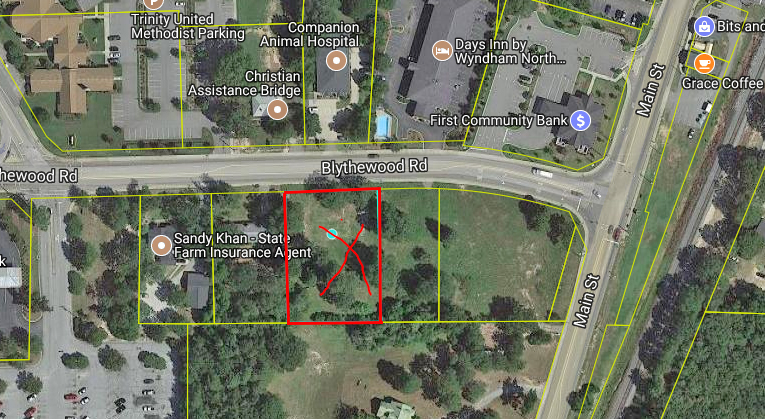
    The proposed 5,408 square foot building is to be constructed on a vacant parcel at 121 Blythewood Road, across from Companion Animal Hospital.

    Cohn construction has posted a sign on the property and The Voice has been told that HB Engineering of Lexington will do the engineering for the construction.

    In 2015, the BAR gave conditional approval for a COA to a pediatrician for a 6,500 square foot medical building on the same location. That approval was conditional on plans for lighting, landscape and signage being presented and approved. But that approval never materialized because the applicant never came back to the BAR.

    The BAR meeting will be held at 6 p.m., Monday, July 16 at The Manor.

    Location proposed for pediatric clinic on Blythewood Road.
  • Artist memorializes Shaggin’ in the Street

    Interpretive artist Trahern Cook painted photo during Shaggin’ in the Street. | Photos: Darlene Embleton

    WINNSBORO – What started as a commissioned painting to commemorate the Shaggin’ in the Street festival for those attending a Winnsboro High School class reunion, may turn out to be a memento for residents and a souvenir marketing opportunity for The Fairfield County Chamber of Commerce.

    For Gail Stevenson Lyles, a member of the Winnsboro High School class of ’73, the class reunion was gearing up to be special this year. It fell on the day after the town’s annual Shaggin’ in the Street festival. Both events are near and dear to Lyles’ heart – after all, her husband, Jamie, plays in the Reunion Bande which would be on stage at the festival again this year. So Lyles wanted to combine the two events for the enjoyment of reunion attendees.

    To make it a weekend to remember for her classmates, Lyles commissioned local interpretive artist, Trahern Cook, to capture the moment on canvas as the reunion attendees and others danced the night away in the street in front of the town clock. She planned to auction the painting at the end of the evening to pay Trahern’s $300 fee.

    Set up in the middle of the festivities, Cook’s commission turned out to be a major attraction during the evening as he worked at his easel, deftly wielding his brushes in the dark to capture the images of the festival – the clock, the colors and the movement and attitudes of the festival goers as they shagged the night away with abandon.

    While the auction was scratched as a sudden rain storm, complete with lightening and strong winds, washed the festival off the streets an hour before it was scheduled to end, Lyles said she was still able to take bids for the completed painting. It was purchased by Michael Talbert and gifted to Patti Estes who titled it, “Shaggin in the ‘boro.”

    “I was the lucky recipient of this wonderful painting,” Estes enthused. She said she anticipates it becoming a family heirloom. “I know all three of my children would love to have it because they all grew up in Winnsboro and graduated from Richard Winn Academy.”

    For Lyles, it was a night to remember.

    “We were excited to see that so many of our classmates attended the festival,” Lyles said. “And the wonderful people of Winnsboro voluntarily chipped in $200 toward the cost to have Trahern join us and create this painting of our beloved home town festival.” Lyles said.

    As it turned out, the painting that depicts Winnsboro in all its festive glory is going to have a double life. Plans are in the works for it to be shared by the Fairfield County Chamber of Commerce with the community and visitors to the town.

    “We bought the reproduction rights to the painting,” Chamber Director Terry Vickers said.  “And we’re looking forward to reproducing the image on post cards, note cards, posters, cookbooks and even T-shirts that we plan to market,” Vickers said. “Keep an eye out for these great gift ideas coming, we hope, before the holidays. And what great souvenirs for our visitors to take back home with them as reminders of their trip to our town!”

    Indeed, the special night Lyles pulled together for her classmates may now live on for years in the Chamber’s marketed items.

    “I am so thrilled about the way it all turned out,” Lyles said. “And I can’t wait to see our beautiful Winnsboro festival emblazoned on T-shirts and posters.”

    The Fairfield County Chamber of Commerce is making plans to market the image on souvenirs.
  • County ups fees on dumping, loose pets

    WINNSBORO – Fairfield County is one vote away from imposing higher fees for some animal control and dumping services.

    But as county officials note, the extra charges are user fees, meaning only people using those services will pay more money.

    At Monday night’s meeting, council members voted unanimously on second reading of the revised fee schedule, which requires a third reading to become law.

    County Administrator Jason Taylor said the fees are part of a broader effort to streamline the county’s fee system for simplicity.

    “We have tried to restructure how we do fees in general as far as the way they’re included in our budget,” Taylor said. “It also makes it easier to understand if they’re all in one place.”

    As it relates to animal control and dumping services fees, Taylor noted they were strictly user fees to offset costs of providing county services.

    “They’re not blanket fees, they’re not fees charged to everyone,” he said. “They’re only fees charged to those who use those services.”

    According to the proposed ordinance, animal owners would be assessed $25 anytime Fairfield County Animal Control is called to lasso their loose pet. Revenues collected would cover the cost of animal control officer response, the ordinance states.

    Commercial and non-residential haulers are also targeted in the second fee structure.

    Taylor said there’s been an uptick in commercial haulers using the county’s wood chipping facility, prompting the new fee.

    “We have a lot of commercial people who are coming in dumping. We think they should pay,” he said. “They are making money off the service that we provide, so it’s fair for them to have to pay a fee.”

    Fees proposed in the ordinance use the following structure:

    • Permit fee | $15 (required annually),
    • Single axle truck load | $20 per load,
    • Dump truck or single axle truck with trailer | $30 per load,
    • Tandem dump truck or larger | $40 per load.

    Revenues from the dumping fee “shall be used for the cost associated with the disposal of some of the solid waste collected at its waste collection sites in Fairfield County,” according to the ordinance.

    Only one person spoke during a public hearing that preceded the vote.

    Randy Bright of Ridgeway pressed council members to provide specifics of the fee, as well as the justification for it.

    “Anytime you hear new fees, new taxes, you get a little leery and you become very inquisitive because that impacts our lives as much as anything when the government or anybody takes money away from us,” Bright said. “Who does that impact the most? Those who can afford it the least, the lower income.”

    Councilman Cornelius Robinson asked about recreation fees.

    Though not part of the ordinance approved Monday night, Robinson said the recreation rental fee deserves a second look.

    “My concern is … you have some citizens who want to utilize recreation for actual recreation,” he said. “Some are concerned the fee isn’t high enough due to tying up the ability to play basketball.”

    Council Chairman Billy Smith said he thought the $25 per hour fee was fair.

    “I wouldn’t disagree with the assessment personally,” Smith said.

    Robinson said he’d still like to revisit recreation rental fees.

    “I know we still are in the beginning stages of revamping our [recreation] department, which is better than it was, I would say,” Robinson said. “It’s just something we should think about down the road.”

    In related business, the council approved a companion ordinance that amends the budget and authorizes the supplemental appropriation of funds.

    Taylor said the ordinance essentially adds the loose animal and wood chipping fees into the budget as revenues and expenditures. That ordinance also passed unanimously.