WINNSBORO – The Fairfield County Council on Aging currently delivers meals to 190 senior citizens throughout Fairfield County every week, and more are waiting to receive the service. But without additional volunteers to deliver those meals, it’s impossible to add more routes and more recipients to the program, according to Angela Connor, Executive Director of the county’s Council on Aging.
“We’re touching lives one meal at a time,” explained MaryCathryn Wilson, the agency’s Volunteer Coordinator, “but we need help. Currently, even our staff is serving routes in the Winnsboro area due to a critical lack of volunteers,” Wilson explained.
Many of the seniors in the program are homebound and live alone, often in isolated areas.
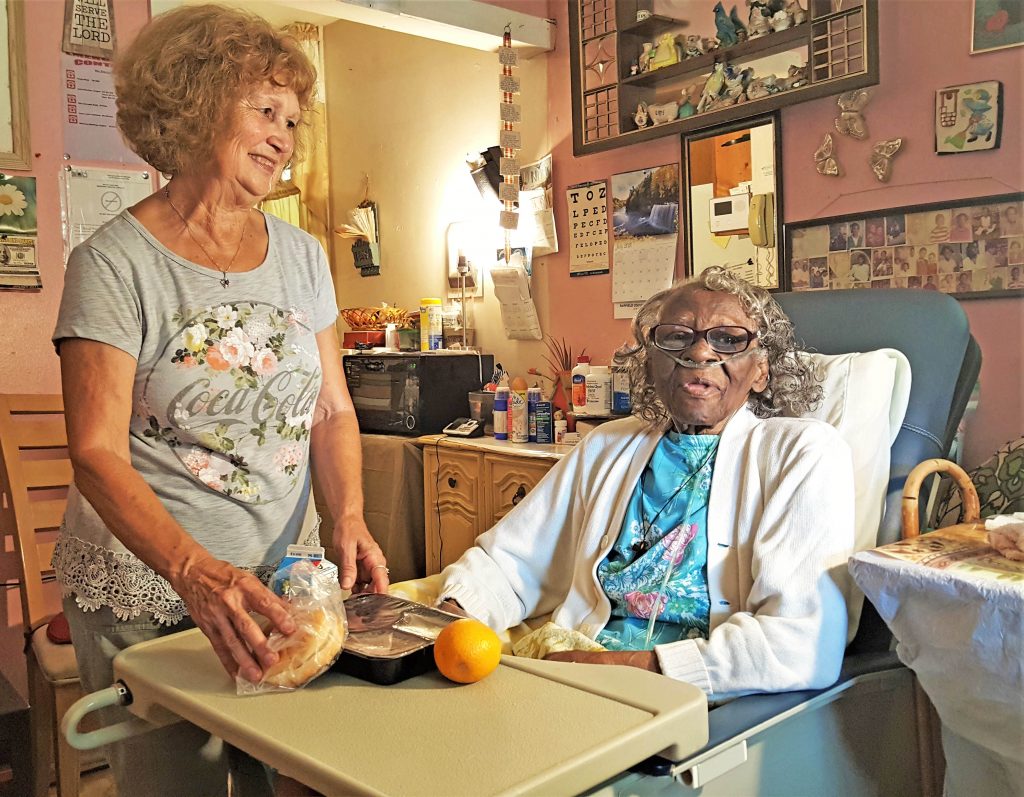
Linda Branham delivers a meal to 92 year-old Rosalee Peay. | Darlene Embleton
“It’s not unusual for our volunteer to be the only person they see in a day,” said Conner. “This daily contact is a large component of what the program is all about.”
Good nutrition is the key, though. The meals provided to seniors in the program are nutritionally balanced to meet the 1/3 recommended daily allowance (RDI) for seniors.
The volunteers help to improve the quality of life for older adults by providing them with services that allow them to remain independent and in their own homes for as long as possible.
The home-delivered meals program receives funding from a number of sources – the federal government, the state, Fairfield County as well as private donors. Participants who receive meals may also donate toward the cost of their own meals, but it is not required. All contributions received through the home delivered meals program remain in the program and are used to sustain it.
The volunteers deliver both hot and frozen meals, depending on the location of the recipients.
“Strict regulations regarding food safety temperatures determine where the hot meals can be delivered,” Connor said. “We are currently running 10 hot meal routes in Winnsboro, Ridgeway and the Lebanon area.”
Frozen meals are delivered to outlying areas once a week in boxes of five meals with supplements.
The volunteers come from all walks of life.
“We have 3 families who home school their children and use this as their service project,” Wilson said.
Ridgeway residents Linda and Rodger Branham have been volunteering for years.
Routes typically take just 45 minutes to one hour to complete and are picked up from the Winnsboro Senior Center at 210 E Washington Street at 10:45 a.m. Ridgeway has some other arrangements for pick-up.
“Volunteers can deliver as often as they like or as little as they can,” Connor explained. “We know that everyone’s time is stretched thin these days, therefore we have availability for volunteering from one hour a month to one hour a day. Our Volunteer Coordinator will work with each volunteer to help make the schedule as suitable as possible. “
Helping seniors be able to stay in their own home for as long as possible is a wonderful way to give back to others in our community.
Volunteers need to be at least 18 years of age and have their own transportation. Those who would like more information about volunteering to serve the meals, can contact MaryCathryn Wilson at 803-635-3015.
WINNSBORO – A sixth judicial circuit court judge has ordered a Fairfield man charged with killing his parents to be released from a state mental hospital and treated on an outpatient basis.
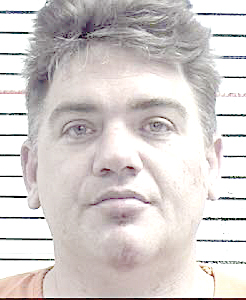
Matthew Richard Mahorsky
Matthew Richard Mahorsky, who was found not guilty by reason of insanity in the shooting deaths, will be sent to a residential care facility in Piedmont, S.C. where he will be treated and supervised by the Piedmont Mental Health Center, the S.C. Department of Mental Health Not Guilty by Reason of Insanity Outpatient Clinic (NGRI Outpatient Clinic), and the Department of Probation Parole and Pardon Services.
Mahorsky, 45, has been housed in a high security wing of the G. Werber Bryan Psychiatric Hospital in Columbia since the trial concluded in October 2017, according to prosecutors. He appeared in court June 28 for a hearing to decide whether to ease restrictions on his confinement.
Judge Brian Gibbons’ order for outpatient treatment was handed down on Monday, July 30. Mahorsky will remain at the current forensic inpatient facility until a bed becomes available at Gregory’s, according to the order.
The S.C. Department of Mental Health had asked Gibbons during the June 28 hearing to remove some restrictions on Mahorsky’s confinement. Solicitors and the Fairfield County Sheriff’s Office, however, vehemently objected to the Department of Mental Health’s request.
“They were recommending less restrictive measures on him as far as their treatment,” said Riley Maxwell, an assistant solicitor with the 6th Judicial Circuit. “We objected to that, we want him to remain where he is. He is behind a locked fence door. He is secure now.”
But DMH representatives declined to comment about the June 28 hearing, citing patient privacy laws.
A spokesman said, generally speaking, discharge hearings follow an intensive process that requires approval from a DMH review board, which then makes a recommendation to an agency deputy director, who must request a hearing if they believe one is warranted.
If so, it’s up to a judge to determine whether or not the patient should be released, said Mark Binkley with DMH.
“The Court may and usually does impose conditions when discharging an individual found [not guilty by reason of insanity],” Binkley said in an email. “The court’s jurisdiction over the defendant continues for as long as the defendant could have been incarcerated.”
Terms and conditions of Mahorsky’s outpatient treatment include strict compliance with keeping scheduled appointments, participation in scheduled activities and the taking of all medications.
Mahorsky must continue to live in a residence approved by his treatment staff and the Department of Probation, Parole and Pardon Services. Should Mahorsky at some point in the future establish residence in a county other than Greenville, responsibility for follow-up care, treatment and monitoring will be transferred to the mental health center and office of the Department of Probation, Parole and Pardon Services which serve Mahorsky’s new county of residence, according to Judge Gibbons’ order.
BLYTHEWOOD – Blythewood Mayor J. Michael Ross announced via email on Wednesday, July 25 that the 2018 Big Grab is on for Sept. 7 and 8, and that the Town would be organizing and funding the event this year since two vendors, the Greater Blythewood Chamber of Commerce and merchant Teresa McKenrick, had backed off their requests to manage the Blythewood section of the event after the council said it would only fund them for the actual costs of the event.
“Phil Frye, as chair of the chamber’s Big Grab committee, called me around noon today [July 25] and informed me of the [chamber] board’s decision to decline the town’s offer of $5,000 to organize this year’s Big Grab. Our staff, under the direction of Events Coordinator, Steve Hasterok, looks forward to this challenge and being ready Sept 7 for the 2018 Big Grab!” Ross stated in his email.
About 9 o’clock the next morning, however, Mike Switzer, Executive Director of the Chamber sent out an email he said was a ‘Big Grab Joint Press Release from the Town and Chamber,’ stating that he and the town (not council) had reached an agreement to jointly support the Blythewood section of the Big Grab. The email stated that the Chamber would continue to manage the Blythewood Big Grab web page and Facebook page, and continue to coordinate vendor sites as it did last year. For information about security, trash and portable restrooms, however, questions were directed to Steve Hasterok, Director of the town’s conference center and events, at 803-754-0501.
The Voice had not received the ‘joint press release’ from the Town Hall at press time.
The question of who would manage the 2018 Big Grab became an issue at the July 23 town council meeting. That ended without a decision being made as to who would be heading up this year’s Big Grab. Two applicants asked for $10,000 in A-Tax funding, but both presented much larger budgets. Merchant Theresa McKenrick’s budget came to $15,000 and Greater Blythewood Chamber of Commerce Executive Director Mike Switzer’s budget came in at $14,500. Both wanted to use the park for vendor setup, sell sponsorships to raise extra money and pay salaries for staffing – McKenrick, up to $4,000 and Switzer, $5,000.
Merchants had been vocal that they did not want vendors in the park, which they said hurt the sales in the town’s brick and mortar businesses; they did not want to have to pay sponsorship fees of $75 each and they objected to A-Tax funds going to pay thousands of dollars for salaries for the organizer’s staffs.
After council listened to both parties and other merchants, Ross offered $5,000 to cover actual expenses, with no allocation from A-Tax funds for staff salaries. McKenrick turned the offer down at the meeting, saying she would not run it without paid staff. After taking the option to the chamber board for a vote, Frye notified Town Hall on July 25 that the chamber, too, was turning down the offer.
“The Town of Blythewood is always sensitive to the needs of local merchants, businesses and individuals,” Ross stated in his email. “We recognize the desire to return The Big Grab to the way it was before, to have it ‘get back to its roots,’ to be a family friendly event that highlights small businesses and individuals selling items in a true ‘yard sale’ environment,” Ross wrote.
Ross stated that Doko Park would not be open to vendors during The Big Grab event this year. Instead, vendors will be encouraged to find spaces around the town and in empty lots where they can set up shop as they did during the first years of The Big Grab. Some of the merchants, including Blythewood Consignment, Bits and Pieces and Sweet Pea’s Ice Cream Parler, have offered vendors the opportunity to set up on their lots at no charge by calling ahead to reserve the spot. Others may charge nominal fees.
Ross assured merchants and vendors that town hall would pay the costs of whatever is needed to make the event safe, enjoyable and successful such as arranging for sheriff’s deputies for traffic control, trash receptacles and portable restroom facilities along Main Street and other areas where they are needed.
“We want to highlight the wonderful community that we have here,” Ross wrote. He referred questions to Hasterok at 803-754-0501 or at hasteroks@townofblythewoodsc.gov.
BLYTHEWOOD – Two football stadiums, a fine arts center and facility upgrades at several schools are among the taxpayer-funded initiatives Richland 2 voters will decide in a November referendum.
Richland 2 school board members, though, aren’t prepared to dive into a proposed $20 million aquatic center just yet.
On July 24, the board voted 6-1 to place $468.4 million worth projects on the November ballot. Board member Lindsay Agostini voted against the measure.
If approved, school district millage would increase about 10 mils, with the typical homeowner paying an extra $65 a year in taxes, said Harry Miley, the district’s chief financial officer.
Miley said the average Richland 2 home is valued at $167,000, the metric he used to define a typical homeowner.
Board member Cheryl Caution-Parker said it’s been 10 years since Richland 2 last passed a bond referendum.
“We always do what we say we’re going to do with the funds. There’s never been any question, there’s never been any doubt,” Caution-Parker said. “When we go for a bond referendum, it’s not spur of the moment. It takes a lot of time and effort.”
Before the vote, Agostini said she supported everything in the bond referendum, but also pressed for the inclusion of a $20 million aquatic center. She said swimming is a needed skill for Richland 2 students, referencing two recent drownings.
Agostini also said the Blythewood and Spring Valley high school swim teams lacked proper facilities to hold region swim meets.
“We just don’t have the facilities,” she said. “I would like to see a pool included in a referendum.”
Other board members were sympathetic, but also noted that upgrading existing facilities and making schools more safe were higher priorities. They also questioned whether voters would buy into an aquatic center with $468.4 million in projects already bundled into the referendum.
“It would just be absolutely wonderful to have an aquatic center here in Richland 2,” Caution-Parker said. “However, I think we need to do a complete study. We need to pick a site. We need to have partnerships. We need to have the plan completely in place to present to the community.”
Aquatic centers elsewhere in South Carolina, such as in Greenville, Myrtle Beach and North Myrtle Beach, are largely functions of county or municipal governments, according to the aquatic centers’ websites.
Other aquatic centers in which a school district is involved typically share costs with other government entities.
For example, the York County Aquatic Center is a joint venture between Rock Hill area YMCAs and local schools, according to the Rock Hill & Fort Mill Visitor’s Bureau.
The City of North Charleston and Dorchester 2 are joining forces to build a $20 million center, with Dorchester 2’s portion amounting to about $7.5 million, according to media reports.
The ballot measure that Richland 2 board members approved actually contains two separate questions, according to the school district’s website.
The first asks voters for permission to issue bonds totaling $381.95 million. Items covered under the bond issue include:
Safety improvements at all schools
Buying new buses and enhancing security in existing buses.
Replacement schools for Bethel-Hanberry Elementary, Forest Lake Elementary and Center for Knowledge North
Replacement school for E.L. Wright Middle, with renovations to the three-story existing building
Technology infrastructure improvements
Miscellaneous costs, including improvements to academic learning spaces, other unspecified improvements, and costs of land, engineering fees, and legal costs.
The second question is for a bond issue totaling $86.45 million. It includes:
Athletic facility upgrades at Richland Northeast and Ridge View high schools, including football stadium upgrades.
Miscellaneous costs, including improvements to academic learning spaces, other unspecified improvements, and costs of land, engineering fees, and legal costs.
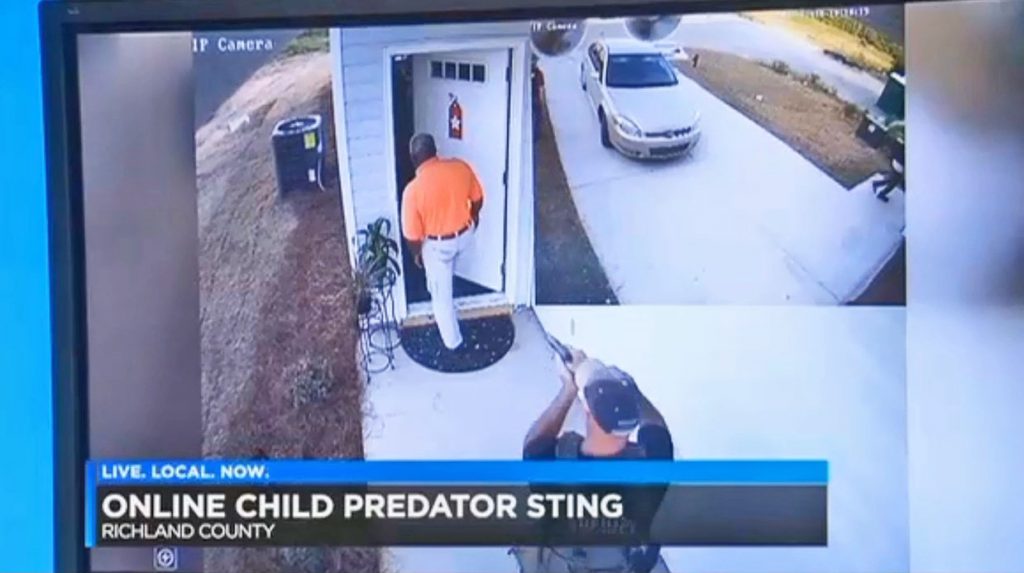
Police video shows arrest during online sexual predator sting. | WISTV.com
COLUMBIA – A Fairfield man was one of 38 arrested during what authorities are calling the most successful four-day online sexual predator sting in South Carolina.
Wendell Irby, 61, of Winnsboro was arrested July 11 in Columbia after he propositioned an undercover law enforcement officer for sex, according to a Richland County Sheriff’s deputy’s incident report. Irby paid $80 for sexual services and was arrested when he showed up at the agreed upon incident location, the report stated.
The Sheriff’s Department led the statewide sting that included the U.S. Attorney’s office, the U.S. Secret Service, the S.C. Attorney General’s office and other state and federal agencies.
The internet sting involved deputies posing as 13-year-old girls having conversations with adult men, Richland County Sheriff Leon Lott said.
“We made like we were that 13 or 14-year-old girl,” Lott said. ”Unfortunately for the men, they didn’t meet that young girl. They met us, law enforcement.
“All of us came together during this four-day period of time [June 10-14] with one mission, and that mission was to get these monsters off the streets,” Lott said.
The men were caught on police video as they drove up to a house, walked to the door and knocked. In most cases the men can be seen in the video being arrested as they start to enter the house where the sting was being conducted.
Lott said 12 men were arrested when they showed up at the location of the sting in anticipation of meeting the 13-year-old. An additional six people were arrested based on information gathered during the sting. He said 15 ‘johns’ were arrested along with five prostitutes.
The public index for Richland County listed June 11, 2018 arrest as Irby’s first, and he was released on a personal recognizance bond of $465. However, an article in The Voice dated Dec. 21, 2012, stated that Irby, the Fairfield County Tax Assessor, at the time, was arrested in a motel room on Two Notch Road on Dec. 13, 2012 for soliciting prostitution. The incident, the article states, was part of a two-day sting operation being conducted by the Richland County Sheriff’s Department. Irby was one of seven individuals lured to the motel with a bogus ad on the web site Backpage.com, a site used to advertise adult services, the article states.
A Fairfield County spokesperson said Irby was terminated by the County on Dec. 19 following the arrest and investigation.
Maria Yturia, a spokesperson for the Richland County Sheriff’s Department, said there is no record of the 2013 arrest.
Keith Loner of Blythewood and his daughter, Ashley York, take time out from shopping a previous Big Grab in downtown Blythewood to rest on a sale couch set along Highway 21. | Barbara Ball
BLYTHEWOOD – When two separate applicants appeared before the Town government’s Accommodation Tax (A-Tax) committee last week to vie for $10,000 the town council has allocated for someone to manage this year’s Big Grab yard sale, the tense, hour-long meeting erupted into a shouting match between the two applicants and their supporters until frustrated committee member Ken Shettles called a halt to the ruckus with a motion to recommend that council reduce its allocation for the event to $5,000 and also make the decision as to which group will be awarded the money.
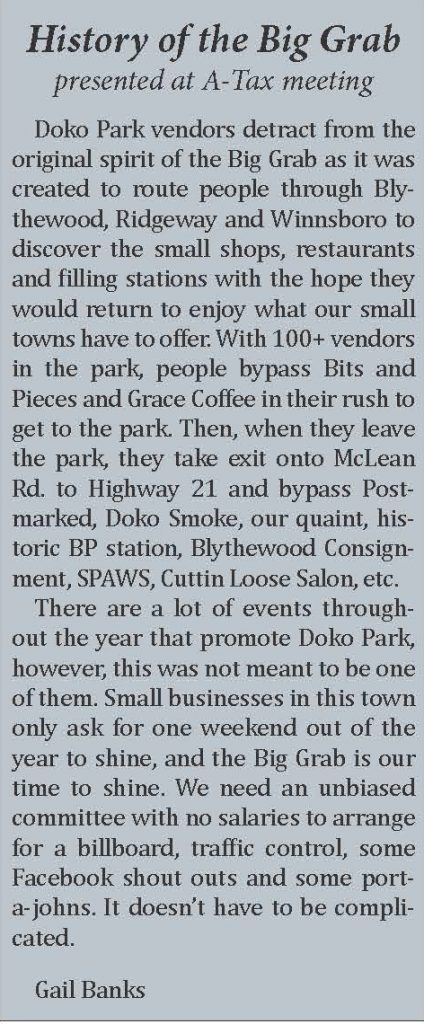
History of the Big Grab, presented at A-Tax meeting
The two applicants, Mike Switzer, Executive Director of the Greater Blythewood Chamber of Commerce and Theresa McKendrick, owner of Postmarked 29016, a gift shop on McNulty Road, each made a case as to why he/she should be awarded the $10,000.
One committee member described the tug of war as a battle for the money.
“Oh, no,” Switzer said. “It’s not a battle at all. We’re totally fine if this group of volunteers would like to take it over.”
“So you’re withdrawing? Is that what you’re saying?” Shettles asked.
“No, that’s up to the committee,” Switzer said, but reminded the committee that this would be the chamber’s third year to oversee the Big Grab if awarded the money.
According to the chamber’s records, it made a profit from last year’s Big Grab, but how much is not clear. The Chamber did not turned over to the A-Tax committee a detailed listing of vendor fees and sponsorship sales for last year’s Big Grab, just a total number for each. One report showed a total Big Grab profit of $1,432.77, while other numbers indicated a possible profit of as much as $6,144.88.
The A-tax applications submitted by Switzer and McKendrick were similar.
Switzer’s application called for Big Grab to continue as a megasite in Doko Park as it did last year under the chamber’s direction. He listed project costs for the September, 2018 event at $10,000 but the revenue and expenses sections of the application each add up to $14,500, not $10,000.
Total revenue sources include $10,000 (A-tax funds), $3000 (sponsorships) and $1,500 (food and vendor sales). A proposed total of $14,500 in expenditures includes $2,240 (park rental for 28 hours), $2,560 (Sheriff’s Deputies), $800 (portable restrooms and trash bins) $500 (misc. supplies), $400 (ROTC), $5,000 (payments to chamber and visitor center staff) and $3,000 (advertising/marketing).
While McKendrick likened the Chamber’s Big Grab in the park to a flea market atmosphere, she, too, proposed locating vendors in the park but also in the town center.
McKendrick’s revenue sources mirrored Switzer’s at $14,500, but her proposed expenditures of $15,000 included up to $3,000 (park rental), up to $4,000 (municipal and county resources), up to $4,000 (administrative/event planner) and $4000 (marketing/promotions).
McKendrick justified payments of up to $4,000 for her staff as covering an event planner and “other support staff. If we have to hire day-of-event staff, then we would have that money available. We hope to hire a social media person and may have to pay to play if we hire social media influencers. We would pay them to post,” she explained.
While McKendrick said she was speaking on behalf of the owners of the town’s consignment stores, Bits and Pieces and Blythewood Consignment, neither of the stores’ owners were happy with Switzer’s or McKendrick’s proposals.
“Let’s start from the beginning,” Liz Humphries, owner of Blythewood Consignment said. “This is about a big yard sale, a glorified selling of junk. I don’t think we need to spend all this money. I think we all need to get together and volunteer for our community.”
Joe Benini, co-owner of Bits and Pieces agreed.
“The first Big Grab was awesome and easy,” Benini said. “Then the chamber took over and the next thing I know, it’s now a $15,000 budget, for what? My wife and I had to pay $50 just to be a sponsor. I paid for all my stuff, posters, etc. and posted the map that was in The Voice on our door,” he said.
“Let the local people make the money,” Humphries said. “The Big Grab started as a way to get people in to our brick and mortar [stores]. The park has nothing to do with my store except that it’s a huge competition. My sales dropped in half last year because everyone was at the park. I’m just here to protect my business,” Humphries said. “I’m all about people selling their junk. But I don’t think people should get paid to do this. If you love Blythewood, you need to volunteer and not expect to get paid.”
Susan DeMarco, who owns Sweet Pea’s Ice Cream Parlor, is a member of the Chamber and sits on the A-tax committee, agreed.
“We can tag each other on Facebook and say, ‘We’re all merchants in Blythewood and we’re all excited about the Big Grab.’ It’s going to happen no matter what we decide today. It’s on. It’s on. What you put in to it is what you get out of it,” DeMarco said. “If we spend a bunch of money, we aren’t changing the Big Grab. All we’re doing is having a power struggle between two parties.”
“We thought we were doing a good job,” Switzer said, defending the chamber’s management of the Big Grab. “We reached out to all the merchants. We thought we were working out solutions to try to help them because we’re all about businesses succeeding and thriving in this community. As for as being paid to run the event, we cover that cost with sponsorships and vendor fees.”
“But you’re still holding it in the park,” said Gail Banks, a vendor at Blythewood Consignment. ”You’re not getting it.”
“And last year the park looked like a disaster relief area,” committee member Kris White said.
“No matter what we do today, we aren’t going to come to a conclusion,” Shettles said. “Our committee only makes recommendations to council, and these arguments need to be in front of council. We could go on here for hours.”
With Shettle’s motion on the table, DeMarco offered a second motion recommending that no organizer would get any money for the event, but that the town would foot the bills for hard expenses like sheriff’s deputies, trash receptacles, portable restrooms, etc.
“People have to stop asking the merchants for sponsorships,” DeMarco said. “I don’t want to give A-tax money to someone to run the event and who then comes to ask me for more money to sponsor it.”
The committee voted 3-0, with DeMarco abstaining, to pass Shettle’s motion.
The Big Grab 50-mile community yard sale is set for Friday and Saturday, September 7 and 8, and will include Blythewood, Ridgeway and Winnsboro.
Applicants offered $5K; Mayor: Take it or leave it
BLYTHEWOOD – After the Accommodation Tax (A-Tax) committee passed last week on choosing one of two applicants (the Greater Blythewood Chamber and shop owner Theresa McKendrick) to receive $10,000 in A-Tax funds to run the Blythewood portion of this year’s Big Grab event, council was left to make the choice with the only recommendation from the A-Tax committee being that it limit funding for the event to $5,000.
Rich McKendrick, who addressed council Monday night on behalf of his wife, Theresa, criticized merchants who, he said, supported her to apply for the A-tax funds to spearhead the Big Grab, but on the day of the A-tax committee meeting did not support her application. Those business connections, however, said that when they found out McKendrick’s application included $4,000 in staff pay, the assignment of vendors to the park and the sale of sponsorships – expenses they said they opposed from the get go – they could not support it.
Those merchants said they were looking for an alternative to the chamber’s Big Grab megasite of vendors in the park last year that took much of their Big Grab business out of the town where it was originally designed to go. They also expressed their opposition to having to pay for sponsorships and for the A-tax money going to pay for thousands of dollars for staff pay.
Kitty Kelly, office manager for the chamber, told council that the chamber did not receive any of its staff pay from A-Tax funds.
“I don’t know where that’s coming from,” Kelly said.
“Kitty, on the application you filled out for A-Tax funds, you designated ‘Blythewood chamber/visitor center staff, $5,000.’ That’s what your organization asked the A-Tax committee for to pay the chamber’s staff…$5,000 to administer the Big Grab,” Ross said, holding up the chamber’s application.
“It’s $5,000 just to rent the park and pay Richland County (sheriff’s deputies),” Kelly said.
As Switzer approached the podium, Ross told Kelly, “I think you need to let Mr. Switzer explain this.”
“Yes, there are staff costs involved. Sponsorship and vendor fees have covered our staff costs,” Switzer said.
However, the chamber’s application for A-Tax funds for this year and past years clearly listed staff salaries as coming out of A-Tax funds. Further, while the chamber’s application listed its Big Grab budget at $10,000, the budget was actually $14,500. McKendrick’s budget was $15,000.
Ross said council wanted to cover all the essential expenses for putting on the Big Grab – sheriff’s deputies, port-a-johns, marketing, etc. – with the caveat that council would receive receipts for those expenses. He said he felt the $5,000 would cover those expenses.
“We’re not fools,” Ross said. “If we don’t give a dime to this, the Big Grab will happen and the vendors will set up in town and the businesses will do well.” He also suggested that the town could take over running the event but said he didn’t want to take an opportunity away from organizations that want to do it the right way.
“We don’t want to bring people into our park to take them away from the businesses,” Ross said.
Councilman Brian Franklin, however, ignoring merchant’s claims that the park vendors drastically reduce their business on Big Grab weekend, suggested still having as many as 50 vendors in the park.
Mayor J. Michael Ross first offered the $5,000 for management of the event to McKendrick who declined, saying she would not run it without staff pay ($4,000) and allocations for other things such as rental for the park.
Ross then offered the $5,000 to the chamber. Switzer said he was not turning the offer down but said the application was for $10,000 and that’s what he needed.
The mayor countered that the option was take it or leave it. Switzer left the room and did not return.
Council voted 4-1 to fund the chamber with the $5,000 if the chamber wanted to accept that amount and limit park vendors to 50. Councilman Eddie Baughman voted against. Otherwise, Ross said, the town would take over the Big Grab.
The chamber was to notify town hall of its decision by 5 p.m., Wednesday, Aug. 25. That decision had not been made before The Voice went to press on Wednesday.
WINNSBORO – Fairfield County is looking to tap into the water and sewer business.
The county, though, says it’s merely looking to work with other water providers, such as the Jenkinsville Water Company, and has no plans to force the JWC and other water companies into any agreements.
At its regular meeting Monday, County Council voted unanimously on a resolution authorizing it to proceed with creating a joint water and sewer system.
“It doesn’t immediately affect the water companies that are in the county,” County Administrator Jason Taylor said in response to a question from Councilman Mikel Trapp.
“What it does is it sets up the framework that the county can provide water and sewer services,” Taylor continued. “We can work with these companies. Once we get into the creation of it, we’ll look at various engineering.”
Taylor said toward that end, the resolution references a memorandum of understanding the county recently reached with the Town of Winnsboro, the county’s largest water provider.
State law authorizes two or more cities or counties to develop a joint water and sewer system. In the case of Fairfield County and Winnsboro, it would be called the Fairfield Joint Water and Sewer System.
According to the resolution, the commission would start with at least seven members. If additional partners join the commission, Fairfield County and Winnsboro would maintain equal membership and represent a majority of votes on the commission.
The county and town would be empowered to appoint commissioners by resolution. In the event of a disagreement over an appointee, “the decision shall be resolved by the flip of a coin,” the resolution states.
“There’s a lot of ability now with this new ordinance to reach out to the individual companies and offer to assist them or work with them in providing water services more comprehensively than in the past,” Taylor said. “It doesn’t force anything upon anybody. It gives us the ability to move forward and provide water and sewer services.”
Monday ’s vote follows a discussion of the agreement the county’s public works committee held last Thursday. At that meeting, Taylor said the purpose of the agreement is to establish a foundation that would allow the county and town to solicit grant money to help subsidize startup costs.
“This is just to set up the legal framework so we can have an authority that has the authority to execute these kinds of agreements and then accept money,” Taylor said.
In related business, the council also approved a new sewage disposal agreement with the Town of Great Falls, replacing the previous one county officials say was never entirely fulfilled.
Per the agreement, the county agrees to purchase 250,000 gallons of sewage capacity for $517,000. Plus the county pledged to spend $52,800 in engineering services for a new sewer line.
Taylor said Great Falls and the county previously had an agreement to provide sewer services in the Mitford area in the vicinity of I-77 and S.C. 200.
“It was anticipated there was going to be a lot of development in that area so we wanted to bring in sewer [services] to facilitate that development,” Taylor said. “Unfortunately the growth in that area never occurred. It never was fully realized. Great Falls took essentially a big hit on this thing because they only got like 11 customers.”
The $517,000 spent on added sewer capacity covers about $234,000 in costs that Great Falls incurred in providing sewer services, and buys out $230,000 that Taylor said the county should have paid the town, but never did.
WINNSBORO – Chances are good you won’t go to jail for abusing animals in Fairfield County.
Time after time, persons charged with animal abuse-related offenses were allowed to plea for reduced punishment and received probation. Even felony charges were typically plea-bargained to misdemeanors. Many times, charges were dropped altogether, according to court documents.
In some instances, offenders were more likely to spend time behind bars for nonviolent offenses, such as trespassing, open container of alcohol or gambling violations, documents show.
Further, the Fairfield County Public Index lists jail sentences for at least two defendants for the offense of “dogs running at large.”
Two others charged in grisly animal abuse cases – one in which a cat was methodically tortured and killed and another in which a dog was dragged – served no time in prison after their trials.
Sixth Circuit Solicitor Randy Newman Jr. couldn’t be reached for comment.
County Council Chairman Billy Smith said he thinks the problem rests primarily with enforcement.
“I don’t think the problem has been so much the laws in place. I think the laws in place are sufficient to prosecute the cases,” Smith said. “Why those cases are allowed to be pled is something I wish I knew the answer to.”
By the numbers
A review of the County Public Index, a database that lists criminal cases filed in the County, found at least 13 animal-related abuse or neglect cases adjudicated since 2015.
The review included cases handled by the Sheriff’s Office and the Town of Winnsboro Police Department. It didn’t include pending animal abuse cases, nor did it include incidents that didn’t result in criminal charges.
Four animal abuse cases, all of which were deposed in 2016, were nolle prossed, or non-criminal disposition of a criminal case, as defined by S.C. Judicial Department.
Court records list indictments for all four defendants.
Indictments are court documents stating that there is sufficient evidence present for a criminal case to move forward.
But the cases do not move forward. They are settled with little punishment.
In perhaps the most glaring example of leniency granted to an animal abuser, a Ridgeway man facing up to five years in prison for torturing and killing a cat received probation in 2017.
The solicitor allowed the case to be pled and the court sentenced then 18-year-old Christopher Pauley of Ridgeway to three years, suspended to three years of probation. The penalty was inclusive of a second charge of intimidation later plea bargained to assault and battery, second degree, court records show.
Pauley did, however, spend several months behind bars before his trial.
Court records state he was arrested Dec. 27, 2016 on the animal abuse charge and posted $5,000 bond on Feb. 27, 2017.
On March 14, 2017, he was charged with intimidation of court officials, jurors, or witnesses, and jailed again until the June 1 trial date, court records show.
At Pauley’s sentencing hearing, the prosecution said that according to a witness, Pauley said he beat the cat, set it on fire and hung it from a tree in a garbage bag over the span of several days.
That witness did not appear in court.
“To be accurate, the officer found a black trash bag with maggots and fur inside. She also found a lighter and an ax with fur on the blade,” assistant solicitor Croom Hunter told the court.
State law defines the felony offense of animal cruelty as when a person, “tortures, torments, needlessly mutilates, cruelly kills, or inflicts excessive or repeated unnecessary pain or suffering upon an animal or by omission or commission causes these acts to be done.”
A person convicted of this offense, “must be punished by imprisonment of not less than one hundred eighty days and not to exceed five years and by a fine of five thousand dollars,” the law states.
Despite what’s written in state law, Pauley was still allowed to plead to the lesser misdemeanor charge of ill treatment of animals, even with prior conviction in his record.
More mercy for abusers
Pauley’s case, though one of the most graphic, isn’t unique in terms of animal cruelty offenders receiving plea agreements
Smith claimed he shot the dog because he thought it was the same animal that had attacked his mother’s dog, but no evidence of that was ever presented in court.
One of the last photos of the Alexander pit bull. The dog, approximately 3- to 4-years old according to Animal Control estimates, was malnourished and emaciated beyond recovery and later euthanized by the County. (Fairfield County Photo)
According to police records, witnesses said Huskey dragged a nine-month-old dog for about a mile on the highway behind his Dodge Ram pickup truck Dec. 13, 2015. Huskey pleaded guilty in July 2016. He was sentenced to 90 days, suspended to three years of probation, which expires 12 months from now.
These cases and others like them resulted in penalties often far less severe than non-violent offenses.
Court records list a 10-day jail term for a Winnsboro woman pleading guilty in 2017 to a “dogs running at large” violation.
The same “dogs running at large” offense fetched a 15-day sentence or fine for a Winnsboro man found guilty in a July 2017 bench trial, documents state.
In 2015, a Rebecca Boulware, 52, of Chester, was sentenced to 30 days with credit for time served on a charge of gambling/unlawful possession/operation of slot, video, vending machine or gambling device, according to Fairfield County court records.
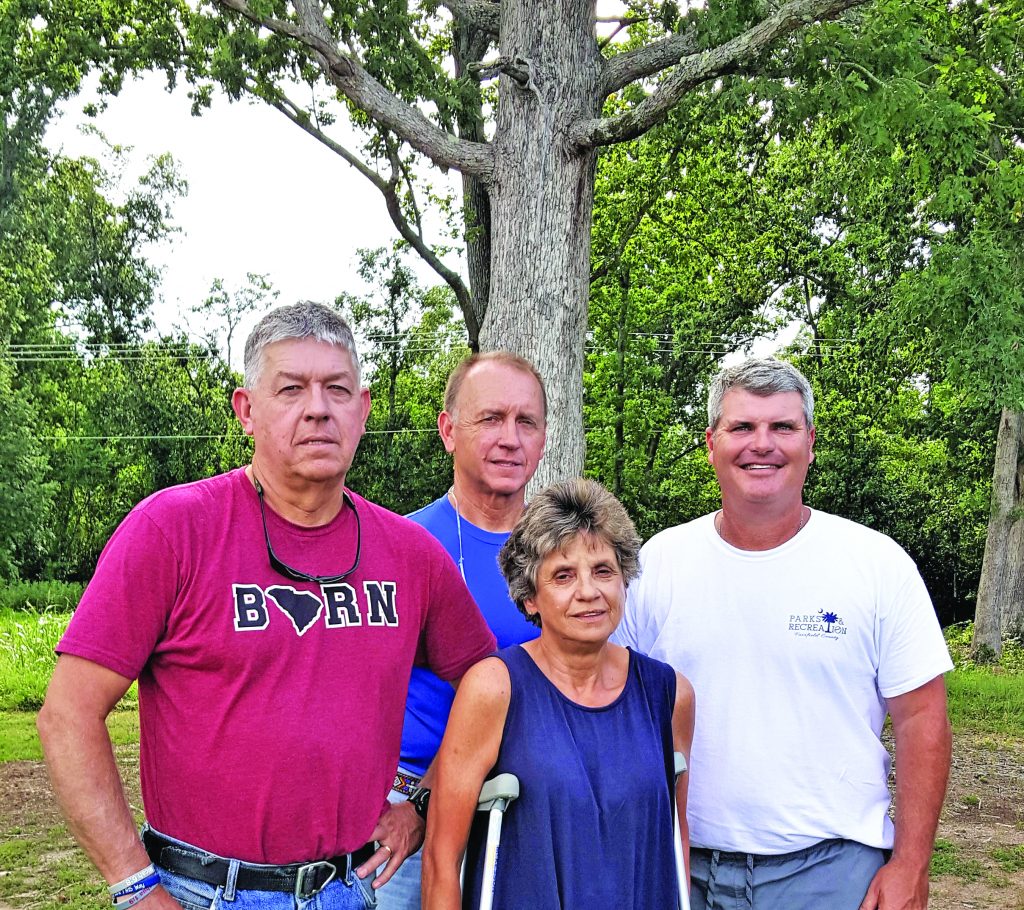
Heyward Mattox, left, Jeff Mattox, back center, Dee Mattox, front center, and Russell Price. | Darlene Embleton
WINNSBORO – July 19, 1993. Winnsboro resident, Dee Mattox recalled that day 25 years ago when lightning struck twice in the same place.
“I remember it vividly,” Mattox recalled, “even the smell of burnt flesh. My family and I were attending an All Star Little League game at Drawdy Park being played between Winnsboro and Mullins. The game had to be called because a violent thunderstorm had moved in.”
According to a story printed in the Herald Independent, witnesses reported that a flash of lightening hit a large oak tree near a car belonging to the Gasque family from Mullins. Dale Gasque, his wife and daughter Amy were sitting in the car at the time.
“We heard a loud noise when the lightning hit,” a witness who asked not to be identified, was quoted in the news article. “I think the three in the car were scared when the lightning hit so close, so they got out of their car.”
Heyward and Dee Mattox and their son, 11-year-old Jae, were sitting in their car not far away when they saw the lightning strike.
“My first memory after the initial strike is seeing Russell Price run over to the car to check on the family parked beneath the tree,” Jae recalled in a Facebook post last Thursday, the anniversary of the strike.
Mattox said some who were at the park reported that Gasque, who was outside of his family’s vehicle surveying the situation, commented that he was safe because lightning never strikes the same spot twice.
Just minutes later, the second lightning strike hit a tree in the same area.
Already a nurse of 15 years, Dee jumped from her car and ran to the scene.
“They were all unconscious,” Dee recalled. “But I could smell the burned flesh and Dale’s skin was blue and purple. He was not breathing and he had no pulse. I immediately started CPR,” recalled Mattox, who was also an American Heart Basic Life Support Instructor then and now.
Right there in the pouring down rain, with lightning and thunder still rampant, Mattox is credited with saving Gasque’s life.
“There were many heroes that day and it would never have worked without everyone working together,” Mattox said. “Jeff Wade (a SC Highway Patrol Trooper) assisted with the CPR. Jeff Mattox took care of the other members of the family, someone called 911, Russell Price and many of the men there carried Dale to a place where we could do more effective CPR. Many people in their own way were heroes that day. I do believe God put us all there for a reason,” Mattox said. “It was 15 or 20 minutes before the ambulance came but it felt like forever.”
The Herald reported that the other occupants of the car, Beverly Gasque and her daughter Anna, regained consciousness and were driven to the hospital by Jeff Mattox. In a Facebook post, Jeff said he remembers that their shoes were smoking. Beverly Gasque, responded that, indeed, she still has the tennis shoes with the insides melted and holes burned in them.
Dale Gasque survived the ordeal, as did the whole family.
“We actually stayed in touch with them over the years,” Dee said. “I understand their daughter Anna became a nurse as a result of being influenced by the event.”
Anna Gasque Johnson said she felt her family was blessed with a true miracle that day in Dee Mattox and that she (Mattox) was the reason she and her brother, Luke, still had a daddy and her children had a Papa.
As fate would have it, sons from both families, Jae Mattox and Luke Gasque, attended the Citadel at the same time. Dale and Beverly Gasque still live in Mullins, SC, and now have three grandchildren.
“God works in mysterious ways,” Mattox said. “I recently got a text from Anna Gasque Johnson, that she was able to ‘pay it forward’ when she performed CPR on a stranger at a Clemson ball game.”
Mattox said she encourages everyone to take a day to learn CPR.
“It works,” she said. “I don’t think there would be anything worse than to stand by and watch someone die who could have been saved. And that someone may be someone you love. God put us here to take care of each other.”
And that is exactly what she and others did 25 years ago, in the pouring rain and violent lightning at Drawdy Park.