Tag: slider

  • Thefts in Blythewood increasing

    BLYTHEWOOD – On the same night that a Blythewood Exxon service station on Blythewood Road was robbed at gunpoint last week (Blythewood gas station robbed at gunpoint, Sept. 27 issue of The Voice), a resident on Blythewood road reported that her 2018 Thor Freedom RV was stolen from her yard, and that thieves had also ransacked and stolen items in her 2017 Ford Expedition that was parked at the home.

    The resident told Richland County Sheriff’s deputies that the Ford Expedition was unlocked and that it contained the only key to the RV. She said that key was apparently used to drive the RV away.

    According to the incident report, the resident stated that when she woke up that morning, she noticed that the RV was missing and that the glove box and center console of the Ford Expedition were open and appeared to have been “gone through.” Her wallet with miscellaneous debit and credit cards were also missing from the vehicle, the incident report stated.

    Three nights earlier, on Sept. 18, five residents of Blythewood’s Dawson’s Pond neighborhood also reported thefts during the night from their unlocked vehicles.

    At press time, the Richland County Sheriff’s Department had not provided more information on any of these incidents other than the number of the incidents and that the vehicles were unlocked.

    “We have experienced some auto break-ins in the Dawson’s Pond community. This trend is going on nationwide and we truly need the communities to help us with the issue,” Richland County Sheriff’s Deputy Danny Brown told The Voice.

    “People are leaving their cars unlocked with items in plain view inside. We want citizens to please lock your vehicles up, remove anything from the interior compartment. The vehicle should look empty if anyone walks up to it. Don’t tempt the bad guys,” Brown said. “They are going driveway to driveway late in the evening or early morning pulling on door handles to see if they are unlocked,” Brown said.

    Brown urged neighbors, “If you see something please say something.”

  • Teacher Village to cost $3.6M

    WINNSBORO – A housing project proposed by the Fairfield County school district aims to keep teachers – along with their salaries – within Fairfield County.

    But for the plan to move forward, school officials say the county must also pitch in with tax incentives.

    Dubbed a “teacher village,” the approximately $3.6 million project is designed to build at least 30 homes off U.S. 321 Bypass, on 22 acres behind the district administration building.

    The purpose is to attract and retain high quality teachers by providing housing that’s affordable and attractive, said Sue Rex, chairwoman of the Fairfield County Education Foundation.

    “We have a major teacher shortage in our state, and especially in the rural districts,” Rex said during a presentation at the Sept. 19 school board meeting. “It’s far to drive to the school districts, and there are not a lot of affordable, attractive housing arrangements available.”

    No votes were taken on the teacher village.

    According to the plan, an investment company would front $3 million of the required revenue. The remaining $600,000 would come from seven-year tax abatements requested of the school district and county.

    When asked why abating county taxes for a school district project is necessary, Superintendent Dr. J.R. Green noted the district doesn’t receive any tax revenues from fee in lieu of tax agreement the county creates to attract industry.

    It’s only fair, he said, that the county contribute.

    “The school district can’t do it all,” Green said. “It needs to be done in conjunction with the county.”

    Green said he’s spoken to several council members individually, and that they’re supportive of the idea. He declined to name them.

    In exchange for the investment firm providing capital, the school district would also deed the 22 acres to the developer. The land coupled with the tax abatements would be the school district’s only liabilities, Green said.

    Thirty homes would be built on half of the parcel, with 30 to 40 additional homes possible on the other 11 acres.

    If only half the property is developed, the undeveloped half would consist of nature trails and green space, Rex said.

    Should the plan moves forward, teachers would be given first priority in the village, where rent would range from $600 to $900 a month.

    District office staff would come next, followed potentially by Fairfield County first responders.

    Homes would feature two, three and four bedrooms, and be between 1,200 and 1,700 square feet, Green said.

    “We’re talking about granite countertops, we’re talking about wood floors,” he said. “We’re talking about very nice homes our staff would be very excited about living in. This takes it to another level.”

    Board members, including Henry Miller, were generally in favor of the teacher village. Miller said Fairfield County’s population has been stagnant for years, but thinks the village could be a catalyst for growth.

    “We have to step outside of the box. I ask, how can Lexington land all these different jobs? Its recruitment, it’s a competition,” Miller said. “Nobody is going to give you anything, you’ve got to go out and snatch it.”

    Board Chairman William Frick said other school districts are pursuing teacher villages, though he said Fairfield’s is the most ambitious.

    Frick noted that Dillon County is doing something similar with duplexes, while Allendale County is providing dorm spaces for teachers at USC Salkehatchie.

    “I’m not talking about fancy dorm rooms at [the University of South] Carolina. I’m talking about teeny, little twin beds, and they’re charging those people $500 a month and they’re filled,” Frick said of the USC Salkehatchie rooms.

    “Dillon County is investing in duplexes and they’re getting people there,” Frick continued. “I think it’s something a lot more school districts are going to get involved in.”

    Not every board member was sold, however.

    Board member Paula Hartman wanted to know what happens if homes aren’t built for educators as advertised.

    Frick and Green said language could be written into the deed in which the property would revert to the district if homes weren’t built, though Green acknowledged that solution isn’t a certainty.

    “That’s something that we would have to continue to negotiate,” Green said. “Once we transfer land, they understand what our motivations are, which are to provide housing for our staff members as well as first responders.”

    Frick viewed the project as a traditional economic development deal.

    “I think that’s how economic development works,” Frick said. “They draw up fee in lieu of [tax] agreements and tax abatements to draw people there. This is simply an economic development project, it appears, to me.”

    Hartman raised additional concerns about setting a precedent for future developers. She also worried the tax abatement would negatively impact the district and county.

    “There is a risk to the children because the money is not going to be there,” she said. “I don’t see how the school board can do that, or the county for that matter.”

    Green said aside from the 22 acres, the district has virtually nothing to lose.

    “Right now we aren’t collecting any taxes because there are no properties,” he said. “We are not foregoing anything that we are currently receiving.”

  • JWC head rebukes water authority

    JENKINSVILLE – It was another brief meeting of the Jenkinsville Water Company, but what was said afterwards is making waves.

    In a brief interview with The Voice following Monday’s meeting, JWC president Greg Ginyard voiced strong disapproval of a proposed water merger between the Town of Winnsboro and Fairfield County.

    “Why would we pay somebody to join a water authority when they don’t give us any information about it?” Ginyard said, walking to his car. “They ain’t told us what it’s going to be about, what it’s going to be. Nothing.”

    Billy Smith, chairman of Fairfield County Council, said the proposed water and sewer authority would primarily include the Town of Winnsboro and the county. There are no plans to absorb other water companies, including the JWC, Smith said.

    “The water authority doesn’t involve Jenkinsville,” he said. “As contemplated, right now it’s between Winnsboro and Fairfield County.”

    Smith acknowledged that generally speaking, a broader consolidation of water providers into one system could help lower water and sewer rates.

    But the chief motivation behind the current authority plan is to enhance the existing water and sewer system, he said.

    “You can pull your resources together and do more,” Smith said.

    At its July 23 meeting, the Fairfield County Council voted unanimously on a resolution authorizing the county to proceed with creating a joint water and sewer system. Ginyard attended the meeting.

    The resolution authorizes the county “to join with other political subdivisions in the joint system; and other matters related thereto.”

    Ginyard expressed skepticism about the water authority concept.

    “They said they wanted ‘X’ amount of dollars for you to join a water authority, but they [haven’t said] what it’s going do for you, how it’s going to help, what it’s going to do or anything else.”

    Smith said the authority wouldn’t generate any financial obligations on non-participants.

    “This is just the start,” he said. “This is going to be a decade-long endeavor.”

    As for transparency, the JWC has been dogged by that issue through the years.

    In April, after a lengthy executive session, the JWC board voted to accept “Item A,” “Item B” and “Item C” without defining what those items involved.

    After a lack of a quorum forced the JWC to cancel its August meeting, departing board members refused to release the agenda to the media, saying only Ginyard has that authority. Ginyard was among the board members absent from the August meeting.

    The JWC is also a defendant in a pending lawsuit that alleges violations of the state’s Freedom of Information Act, or FOIA.

  • PC, BAR approve COA for hotel

    Hilton Home 2 Suites coming to Blythewood.

    BLYTHEWOOD – Third time was the charm for representatives of the Hilton Home 2 Suites who appeared before the Planning Commission Monday night requesting approval of a site plan for a four-story, 88-bed hotel they hope to construct on a 1.93 acre lot between I-77 and San Jose’s restaurant.

    While serious concern was expressed by commissioners about the hotel’s lack of a direct access to Creech Road and the traffic impact the hotel would generate in an already traffic-challenged intersection at Creech and Blythewood Roads, the plan was approved 4 – 1 with Commissioner Marcus Taylor voting against.

    Ed Parler, Blythewood’s economic development consultant, spoke up for the project saying it fits with the overall plan for the town.

    “The hotel is the highest and best use for this piece of property,” Parler said. “There are no property taxes [in Blythewood], so bringing hospitality taxes, accommodation and sales taxes and state share value revenue means it will be the highest economic benefit for Blythewood.”

    Parler further cited the traffic study that was initially requested by the Planning Commission and initiated by engineer Roger Dyar on behalf of Carter Engineering, as of low significance.

    Based on the review of the site and Dyar’s analysis, he concluded that: the site will produce 496 additional trips per day; that the overall effects on the peak hour traffic flow would be minimal and that traffic flow should be acceptable at the proposed access point onto Creech Road.  At this location, all exiting traffic will make a right turn and then make a u-turn at some point to the south on Creech Road.

    The study also recommended that a triangular island be constructed at the access point onto Creech Road to force all exits to be right turns.

    Dyar said the details of this design will be handled by the site civil engineer and will need to comply with SCDOT Access and Roadside Management Standards and Highway Design Manual standards.

    “I think Paragon [the hotel’s parent company] has done everything they could to make the intersection as good as they can,” civil engineer Jeff Carter of Georgia-based Carter Engineering Consultants said.

    Tome Morgan, the project architect, said he expects construction to take 9 to 14 months.

    Paragon hotel company owner Ricky Patel said the hotel will create 16 full time jobs and six part time jobs.

    Immediately following the Planning Commission meeting, the Blythewood Architectural Board (BAR) met to consider a request from the hotel’s representatives for a Certificate of Appropriateness.

    Morgan displayed the elevation plans for the project and discussed material selections with the Board.

    Morgan said the two prototype renderings of a modern design that Home 2 used elsewhere are stark and use hardy board architecture.

    “I did not think they would be well received in a place like Blythewood where citizens care about architecture,” Morgan said. “Instead, we have designed a building covered with Cherokee moss town brick with a pewter colored mortar, hardy board and hardy shake shingles with dark bronze colored metal around the windows,” Morgan explained. “The rich colors create a three-tier approach as opposed to the modern look.”

    A feature that seemed to please the commission is a fence between the hotel and the interstate made with brick columns and wrought iron connecting sections.

    While Blythewood’s architectural advisor Ralph Walden said the building was well designed with nice features and more interest than the two neighboring buildings, he suggested replacing the hardy plank shakes with a darker brick than the moss town brick.

    The motion to approve a COA with changing the hardy shakes to a darker accent brink and to bring the brick up to the top of the first floor passed unanimously.

    Town Administrator Brian Cook explained that the approval would be conditioned by staff approval of a final landscaping plan and any required engineering specifics, the inclusion of a fence along the I-77 ramp and Blythewood Road, signage options and by subsequent approval of SCDOT, SCDHEC and Richland County, water/sewer provider and any other applicable reviewing entity.

  • Blythewood gas station robbed at gunpoint

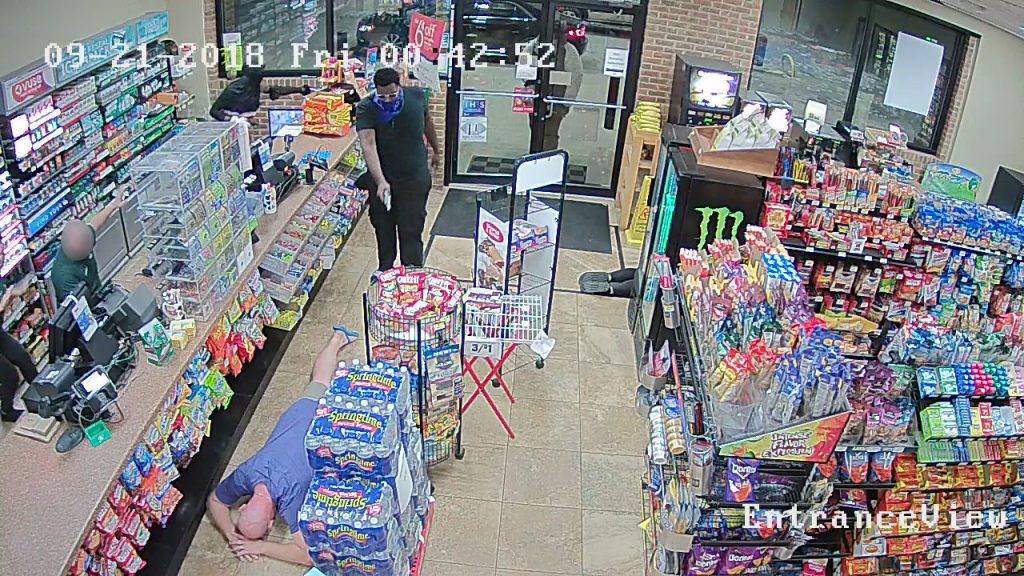
    Four robbers fired shots and threatened employees during Sharpe Shoppe heist on Blythewood Road. | Store Surveillance

    BLYTHEWOOD – Richland County deputies are looking for four suspects who robbed a service station in Blythewood at gunpoint last week.

    The incident took place early Friday morning, Sept. 21, at the Exxon service station located at 230 Blythewood Road at about 12:30 a.m.

    Surveillance video from the station shows the four suspects enter the store and rob it at gunpoint.

    “They burst into the store, fired a handgun into the ceiling, and one jumped the counter and took money from the cash register,” said station owner Larry Sharpe, Sr. “They tried to rob the safe, but couldn’t.”

    Sharpe said there were five or six customers in the store at the time who were forced to lay down on the floor during the robbery. Two of those customers were also robbed, Sharpe said.

    One of the suspects also fired a second shot into the ceiling as the four fled the scene.

    Anyone with any information about the robbery or the identity of the suspects is urged to contact Crimestoppers by calling 1-888-CRIME-SC (888-274-6372) or visiting www.midlandscrimestoppers.com and emailing a tip. Your identity will be kept anonymous, and if your tip leads to an arrest, you could be eligible for a cash reward of up to $1,000

  • Admin details aired in forum

    WINNSBORO – If people left a recent Mt. Zion Institute forum with reservations, it wasn’t due to a lack of information about the proposed project.

    Fairfield County Council members, staff and the developer spent two hours Thursday evening addressing residents’ questions about the project during a forum at Midlands Tech-Fairfield Campus.

    If built, the $11.5 million project would repurpose the Mt. Zion property into a new county administration building. It would stand three stories tall and span 45,000 square feet, more than double the current 21,000-square-foot structure. The total cost to the county would be about $8 million over seven years.

    “We’d like this to be the first of many revitalization efforts in Winnsboro and Fairfield County,” said Rory Dowling with 1st & Main, a Raleigh, North Carolina firm working with the county on the project.

    If approved, construction could start as soon as April 2019 and be completed by summer 2020.

    “I think it’s going to be a fantastic asset once it’s completed,” Dowling said. “We hope to have this agreement in place shortly.”

    Earlier this month, council voted to approve second read ing of the project following an executive session discussion.

    “If you really and truly want growth, there’s going to be changes. Folks say they want it, but some of them pull back on it a little bit,” said Council Chairman Billy Smith. “You’ve got to have a little vision to make it grow; things don’t happen on their own.”

    Sixty-four questions – all submitted by only 12 people – were answered at Thursday night’s forum.

    An informal drop-in meeting, which included renderings of the proposed project, preceded the forum.

    One by one, county staff drew citizen questions from a fish bowl. Questions ranged from the cost of renovating the existing county building to what will happen to it if a new building is constructed.

    In response to one question, Dowling pledged that 1st & Main wouldn’t build multi-family housing on the site should the county building project fall through.

    County leaders said a deed restriction prohibiting multi-family housing could be built into the contract. The property itself isn’t zoned for that, either.

    “Our zoning doesn’t allow for it to be used for multi-family and we would never use it for that,” County Administrator Jason Taylor said. “Our only use would be as an administration building.”

    Council members, some of whom have remained silent about Mt. Zion, spoke up at Thursday’s meeting.

    Councilman Cornelius Robinson expressed concerns about the fate of a monument at the Mt. Zion property, but also voiced optimism for the project’s potential.

    “It would just add value to the neighborhood,” Robinson said, comparing the project’s potential to a similar one that helped revitalize Greer.

    Councilman Dan Ruff, who’s abstained from previous votes while searching for more information, said he’s also interested in the monument.

    “I would like to address this in some form,” he said.

    Ruff and other council members said there’s no Plan B for the property if an administration building isn’t built there.

    “If we can’t make this happen, nothing is ever going to happen on that property, so you might as well tear it down,” Ruff said. “Folks need to consider that as well, what might happen after demolition.”

    A big point of discussion revolved around money.

    Responding to a question about alternate options, County Administrator Jason Taylor said renovating the existing administration building would be north of $8.5 million.

    About half of the cost would come from housing county staff at a temporary facility during renovations. It would also cost several hundred thousand dollars in additional taxpayer money to solicit bids, county officials said.

    Although Mt. Zion would appear more costly at $11.5 million, a majority of that amount would be paid for with tax credits. The remaining $3 million to $4 million would come from lease payments stretched out seven years.

    “We’re essentially getting an $11-$12 million dollar project for $8 million,” Taylor said.

    Council members fielded several questions about the potential of default, either by the county or 1st & Main. Smith said the larger issue would be the cost of inaction.

    “I don’t think default is an option. The biggest problem isn’t what’s going to happen to this property, it’s where in the heck are these people going to work?” Smith said. “I don’t think they want to work on the street. I don’t care if we have one employee, they have to have a place to work.”

    Council discussed finalizing the project in executive session Monday night during the council meeting, but the third and final vote isn’t expected for at least another two weeks.

  • Doko Depot sale held up by deed issue

    BLYTHEWOOD – After a year of planning, a year of construction, a year of searching for and finding a buyer, the Town of Blythewood has spent almost another year waiting to close the sale of the Doko Depot. And the wait is not over.

    Mayor J. Michael Ross announced at Monday night’s Town Council meeting that further delays are expected in the closing of the Town of Blythewood’s contract for the sale of the property.

    The sale has been plagued with delays since shortly after the contract was signed in January. The latest delay is the result of discovering defects in title in some of the land the Depot sits on.

    Ross said those defects related to the donation of the property to the Town years earlier.

    “We are in the process of remedying those issues,” Ross told The Voice in August.

    A portion of the land under contract was originally conveyed to the Blythewood Volunteer Fire Department by Charles W. Proctor in 1971, Ross said. In his deed, Proctor reserved a reversion of title if the property ceased to be used for fire department or other community uses.

    The same parcel was conveyed to the Town after the volunteer service was discontinued but it was still subject to the reservation by Proctor. Proctor passed away in 1976 leaving no children. His wife died shortly thereafter.

    Not knowing about the title issue at the time, Council voted last December to authorize Ross to sign a sales contract with Columbia realtor Wheeler & Wheeler to purchase the property. Last April, Don Russo told The Voice that his company, Freeway Music, was negotiating a contract to lease part of the building from Wheeler & Wheeler who was in the process of purchasing the building from the Town.

    It was also announced that a popular Lexington restaurant is planning to lease the other part of the building.

    Ross said Council learned that the Town’s sale of the former Proctor land (to Wheeler & Wheeler) for uses unrelated to fire department or other community use could cause a reversion in title.

    To keep from jeopardizing the closing while the legalities are being worked out to prevent a reversion of title, Council passed a resolution Monday evening approving the extension of inspection periods for the contract of purchase and sale of the Doko Depot property and authorizing the mayor to execute contract documents pertaining to such extensions.

    Ross said the resolution is provided as a procedural step towards a final closing on the Doko Depot property.

    “I don’t expect this last delay to last more than 60 to 90 days and then, I hope, we can close the deal,” Ross told The Voice following Monday night’s meeting.

  • Fairfield cruelty law not updated for 11 years

    WINNSBORO – It’s perfectly legal to abandon hunting dogs in South Carolina.

    It’s also technically legal to kill a dog when it is threatening or causing personal property damage.

    And perhaps most troubling to animal rights advocates, state law doesn’t automatically ban convicted animal abusers from owning pets in the future.

    These deficiencies and others in state and local laws help explain South Carolina’s poor ratings in a pair of national reports that rate how well the state regulates animal cruelty.

    Two reports – one by the Animal Legal Defense Fund and the other by the Humane Society of the United States – rank South Carolina in the bottom tier when it comes to protecting pets.

    Deborah Richelle, former president of the Hoof and Paw Benevolent Society, a Blythewood-based organization that has been lobbying for stronger animal abuse laws, isn’t surprised.

    “We’ve been trying locally for the past four years to get something done about their ordinance, because it is so antiquated,” Richelle said.

    It’s been nearly 11 years since Fairfield County last updated its animal control laws, according to the Fairfield County government website.

    The animal cruelty and abandonment provisions are codified in Ordinance 321, the website states. Enacted in October 2007, the law essentially mirrors state law at the time.

    Animal cruelty provisions are limited to two paragraphs. Four more paragraphs are devoted to animal abandonment.

    For years, Hoof and Paw have been lobbying Fairfield County to update the 2007 law, and are currently working to draft a new one.

    In June, the county presented an early draft of a revised ordinance to the Town of Winnsboro, which dismissed it as excessive. Progress since then has slowed.

    Three months later, the ordinance still hasn’t received a vote

    Council Chairman Billy Smith said his preference remains with increasing enforcement, not legislation, though he does hope some revisions can receive a council vote sometime this fall.

    “I think law enforcement is doing their job,” Smith said. “I just don’t think the follow through has occurred on the prosecutorial level.”

    Smith added that he’s open to toughening laws relating to tethering of animals, but doesn’t support automatic bans on pet ownership for offenders. Nor does he support granting civil immunity to veterinarians who report suspected animal abuse.

    Advocates look to Aiken

    As Fairfield County continues working on its animal control ordinance, Hoof and Paw representatives think the county needs better laws, pointing to communities such as Rock Hill and Aiken as examples.

    Both cities have revamped their animal cruelty laws. Aiken most recently adopted new standards relating to tethering in March, said Tim O’Briant, city spokesman.

    Aiken’s ordinance says animals can only be tethered for a maximum of 13 hours. The tethering cap shrinks to 15 minutes during severe weather.

    The law also includes new regulations regarding animals locked inside motor vehicles during extreme heat or cold.

    “This was added to provide more definable criteria for our Public Safety to have when addressing these situations,” Aiken City Manager Stuart Bedenbaugh said in a memo.

    Kathy Faulk, community outreach director for Hoof and Paw, and a Fairfield County resident, thinks the county should adopt similar regulations, but expressed concern about slow progress.

    “I’ve begun to feel this has landed on deaf ears,” Faulk said. “The sheriff is doing better about bringing charges, but it gets to the solicitor’s office and it’s pled.”

    Recently, Hoof and Paw adopted a list of bullet points it thinks should be incorporated into any revised ordinance.

    Leading the list are tighter restrictions on tethering. Hoof and Paw recommends capping tethering to four hours, which is shorter than the City of Aiken limit, but also matches Aiken County’s law.

    Other wish list items include:

    • Require all dogs and cats to have proof of rabies vaccination and be registered with the county.
    • Greater punishment for animal abuse and neglect
    • Law enforcement and solicitors need to be committed to punishing animal abusers appropriately.

    Richelle, the former Hoof and Paw president, said in the end there must be accountability for offenders.

    “If you know somebody and you’ve done something bad to an animal, nine times out of 10 you can get out of it,” she said.

    Chicken and the egg

    Another reason for the state’s weak animal cruelty laws boils down to ownership of the issue.

    State lawmakers often punt animal cruelty legislation to local governments, viewing the issue as a local matter.

    But local leaders, including Smith, the Fairfield County chairman, think the state should take the lead.

    “I’m trying to take a step forward, but not necessarily a leap or jump,” Smith said. “That would be my preference.”

    Rep. Bill Taylor, R-Aiken, who’s previously filed bills to strengthen animal cruelty laws, said some lawmakers are adamantly opposed to stricter regulations of any kind, including an anti-tethering bill that died in the last session.

    Other legislators, he said, hunt in their private time and view hunting dogs as property instead of companions.

    “They come at it from a different perspective than those who own dogs as pets,” Taylor said. “They tend to look at things differently.”

    “I don’t know the exact source of all the problems with that [tethering] bill, but there were clearly people who didn’t want it to move forward,” Taylor added. “There were people in leadership positions who wanted that bill derailed.”

    Richelle agreed.

    “They just don’t pay attention to us,” she said. “It’s like ‘this is what grandpa did, so we’ll keep doing what grandpa did.’”

    South Carolina’s deference to hunting is evident in the state’s existing animal abandonment law.

    Animal abandonment carries a fine of $200 to $500 and up to 30 days in prison. Fairfield County’s ordinance stipulates that cases must be tried in magistrate court.

    The penalty for animal abandonment doesn’t apply to owners of hunting dogs, however. Hunting dogs are specifically exempt from the statute, which says animals should be provided with adequate food, water and shelter.

    Weak laws and loopholes

    South Carolina cruelty falls under Section 47 of state law and includes three basic offenses – ill treatment of animals (misdemeanor), ill treatment of animals (felony) and animal abandonment.

    But lines are blurred between what distinguishes felonies and misdemeanors.

    Generally speaking, animal cruelty cases resulting in death qualify as felonies. Torture, mutilation or inflicting “unnecessary pain or suffering” are additional conditions listed in the law for felony charges.

    The misdemeanor ill treatment charge is more vague, merely stating that anyone who “overloads, overdrives, overworks, or ill-treats an animal, deprives an animal of necessary sustenance or shelter, or inflicts unnecessary pain or suffering” is guilty of a misdemeanor.

    A felony conviction carries up to five years in prison and a $5,000 fine, though virtually none of the Fairfield County cases reviewed by The Voice since at least 2013 have resulted in the maximum penalty.

    The last known case regionally when a defendant received the maximum penalty was in December 2017, when a Columbia man was convicted of setting a dog on fire in Richland County.

    More loopholes and ambiguities exist elsewhere in state law.

    For example, killing a dog that’s identifiable carries a fine of $500 to $1,000 and between 30 days and six month in prison.

    It’s a stronger penalty than the misdemeanor ill treatment of animals charge, but weaker than the felony.

    Penalties, however, don’t apply “to the killing of a dog threatening to cause or causing personal injury or property damage,” the law states.

    S.C. ranks low in reports

    The Animal Legal Defense Fund’s 2017 report ranked South Carolina 39th among 56 states and U.S. territories surveyed, placing the state in the bottom tier.

    South Carolina ranked 38th in 2016.

    “ALDF’s goals in these ongoing reviews are to continue to shed light on the important issue of animal protection, to compare and contrast the differences and similarities in these jurisdictions and to garner support for strengthening and enforcing animal protection laws throughout this country,” the report states.

    In a separate report by the Humane Society of the United States, South Carolina ranked tied for 43rd with Wyoming, placing both states just outside the bottom five states.

    The Humane Society report did note that in 2017, South Carolina “severely restricted the keeping of big cats, bears, and great apes.” Otherwise, the state’s ranking could have been even lower.

    South Carolina’s lackluster showings are consistent with findings of an investigation by The Voice, which found that virtually none of the 15 cases prosecuted since 2015 ended in jail time for offenders.

    Most cases were either plea bargained, resulting in probation, or dismissed outright, court records show.

    “Perpetrators of the most unthinkable violence against animals deserve more than a slap on the wrist,” Lora Dunn, director of the Animal Legal Defense Fund, stated in a news release. “Sadly, many cruelty cases go undetected, hidden from view.”

    Building better laws

    So what traits exist in strict animal cruelty laws?

    The top five states – Illinois, Oregon, California, Maine and Rhode Island – generally ranked high in the following categories identified by the Animal Legal Defense Fund:

    • Adequate definitions/standards of basic care
    • Increased penalties for repeat offenders
    • Courts may order forfeiture of abused animals
    • Mandatory forfeiture of animals upon conviction
    • Mandatory reporting of suspected cruelty by veterinarians
    • Mental health evaluations/counseling for offenders
    • Broad range of felonies for abandonment, neglect and abuse.

    States that ranked poorly lacked many of these protections.

    Kentucky, which finished dead last in the report, actually prohibits veterinarians from reporting suspected animal abuse.

    Most low ranking states do not mandate the surrender of abused animals, and penalties do not increase for repeat offenders.

    South Carolina does give veterinarians immunity from civil litigation when they provide emergency care to an abused animal. But state law does not grant civil immunity for reporting cases of abuse.

    The state also doesn’t require convicted animal abusers to surrender their animals, though judges can set that condition. And they have.

    In sentencing Billy Ray Huskey, 51, of Great Falls, for dragging a dog with his pickup truck in July 2016, Circuit Judge Brian Gibbons banned Huskey from owning a dog during his probation period.

    A year later, Judge Gibbons issued a similar order against Christopher Pauley of Ridgeway, who was charged with torturing and killing a cat. He was sentenced to 90 days, suspended to three years probation.

  • Brandon Wilds called up by Jaguars

    Brandon Wilds (22) showing a glimpse of what made him a star at Blythewood and the University of South Carolina.

    JACKSONVILLE, FL – Leonard Fournette was a stellar collegiate football talent at LSU and was the fourth overall pick by the Jacksonville Jaguars in the 2017 draft. However, Fournette went down with a strained hamstring in the opening week of the 2018 season, and this opened the door for Blythewood native Brandon Wilds to be activated from the Jaguars’ practice squad.

    Wilds, a former PrepStar All-American and North-South All-star, was a running back for the Bengals from 2007 until he graduated in 2011, and he had superb career at Blythewood. As a junior, he became the first player in school history to accumulate 1,000 rushing yards in a single season. He finished his junior year with 1,551 yards and 20 touchdowns.

    He followed his stellar junior season with another strong season the following year. Wilds tallied 881 yards and eight touchdowns in his senior year. After his Blythewood career was said and done, he had racked up 500 carries for 2,700 yards and 29 touchdowns.

    He was ranked a three-star prospect and the 29th best player in the state by Rivals.com coming out of high school. Scout.com slated Wilds as the 115th running back in the country and also named him as a three-star prospect.

    East Carolina, Illinois, Arkansas and Maryland were among the major universities that showed interest in recruiting the tough running back. Eventually, Wilds elected to take his talents to the University of South Carolina and play for Steve Spurrier.

    Wilds was listed as the fifth running back on the Gamecocks’ roster heading into his freshman season in 2011, but team injuries allowed him to make an immediate impact. He started five games as a true-freshman and ran for over 147 yards against the University of Tennessee, 120 against Florida and hung 109 on the Citadel. His 486 rushing yards in his freshman season were good enough for the third highest total on the team.

    A high-ankle sprain led to Wilds being red-shirted in 2012. He kicked off the 2013 season by earning the Joe Morrison Offensive Player of the Spring at the Garnet and Black game. Despite the positive spring performance in sophomore year, he had to fight through injuries most of the 2013 season and only started two games.

    Wilds had a much better season in 2014, finishing second on the team in total rushing with 570 yards on 106 carries with four starts in 12 appearances. He had a 24-yard, game-winning touchdown that season to knock off the number-six ranked Georgia Bulldogs, and, in a game against Auburn, he became the 42nd Gamecock to ever amass 1,000 total rushing. His 143-yard performance against Tennessee that year turned out to be a career-high, and he also had a career-long 70-yard touchdown in the same game.

    The 2015 season was a big one for Wilds. He led the team in rushing in his senior year with 567 yards in nine starts and was invited to play in the National Football League’s Player’s Association Collegiate Bowl. He finished his Gamecock career as the 20th leading rusher in school history with 1,844 yards and piled up seven 100-yard rushing games.

    Wilds was not selected in the 2016 NFL Draft, but quickly signed a free agent deal with the Atlanta Falcons. He had 26 yards on 10 carries and one touchdown in his NFL preseason debut against the Washington Redskins. The following week against the Cleveland Browns, he had 49 yards on eight carries and a 32-yard touchdown. Shortly after the Browns game, Wilds was waived by the Falcons.

    After his release from the Falcons, he signed to the New York Jets practice squad and got his first shot of regular season action in late 2016. His first regular season game was against the San Francisco 49ers in December, and he had four yards on two carries. He played again a couple of weeks later in a loss to the New England Patriots, but was waived the following offseason.

    Wilds had a short stint with the Cleveland Browns after his Jets’ tenure, but injuries prevented him from seeing any playing time. He signed to Jaguars practice squad on Oct. 9, 2017. He will wear no. 34 for Jacksonville.

  • Green, Douglas spar over millage

    WINNSBORO – They came to tout their successes as governmental agencies.

    But an emerging kerfuffle over the distribution of property tax revenues quickly became the focal point at a Fairfield County intergovernmental meeting Monday.

    At the previous week’s council meeting, Councilman Jimmy Ray Douglas publicly called out the Fairfield County School District, saying that the district had improperly collected more than $11 million in tax revenues.

    Douglas said inflated millage rates attributed to the school district overages. He noted that the windfall is on par with the $11.5 million price tag associated with renovating the old Mt. Zion institute to serve as a new Fairfield County Administration building.

    “Fairfield County can’t support and pay for the new office complex at Mt. Zion if we can’t control the extra money the school system has been taking from the county funds,” he said. “Since 2012, someone in the school system has secured $11,198,389.90 over the 9.9 school debt millage they should have received.”

    District superintendent Dr. J.R. Green vehemently denied any improper tax collections. Green spent about 10 minutes Monday refuting Douglas’ claim.

    “The suggestion the school district is taking the county’s money is not grounded in fact,” he said. “When you start making suggestions that people are doing things illegal or unethical, that challenges and ques tions someone’s integrity.”

    Other county officials were reluctant to weigh in. County Administrator Jason Taylor deferred comment to Council Chairman Billy Smith. Smith said he understood why Dr. Green defended the district’s position, but stopped short of staking a position on Douglas’ claims.

    “It’s not an issue council is discussing or addressing in any way. It’s just an issue that a councilman raised,” Smith said. “I don’t see anything happening next unless Mr. Douglas develops a compelling argument to get enough people behind him for us to move forward.”

    Douglas said the windfall is the result of a series of millage errors dating to at least 2012.

    A year later it leaped to 32 mils, where it remained for two years. Those are the years following a school board vote to issue a $20 million bond to build a new career center.

    At the time, the bond included $15.6 million for the career center, with the rest reserved for miscellaneous facility and equipment needs.

    Originally the bond called for an increase to 34 mils, but in actuality it only rose from 9.9 mils to 32 mils. Millage then trickled to 23.6 mils in 2015, and then 20.6 mils in subsequent years, according to county tax documents.

    Green said the district was able to issue the bond without a referendum because it met criteria that said local governments are allowed to issue bonds up to 8 percent of the assessed value of all taxable property in the county.

    He also said the debt would be retired in 2025. Debt service would revert to 9.9 mills at that time.

    In a telephone interview Monday, Green said it was always the district’s intent for debt service millage to gradually reduce until the debt is retired.

    The Voice reported in 2013 that the debt service millage would increase for two years before dropping back down.

    “It [millage] is down further than we thought it would come down,” Green said. “It’s not as if you can pay for the career center in two years.”

    Douglas, however, maintains the district is reaping a windfall.

    In an interview with The Voice, Douglas said he was informed by the county treasurer’s office that the district has received $175,000 in the past month alone from the county. He wrote in a memo to Taylor, the county administrator, that he thinks the district isn’t allowed to raise millage.

    “State law gives the school system the right to increase millage by 3 mils each year or the cost of living increase, whichever is the least amount,” the note reads. “The millage cannot be increased at a larger amount without the Fairfield County Council’s approval.”

    Green said Douglas is conflating operating millage and debt service millage. He noted the 3 percent rule Douglas cited refers to operating millage, not debt service millage.

    “People are conflating two things that aren’t the same,” Green said.