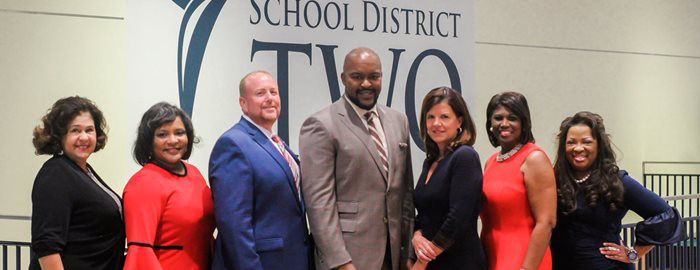
WINNSBORO – Fairfield County school board members voted to extend Superintendent Dr. J.R. Green’s contract another year, but individual evaluations remain shrouded in secrecy.
The district, which has a $43 million budget and whose millage is more than half of a typical property tax bill, released only four evaluations from the seven-member board.
In addition, the forms that were released were anonymously written, making it impossible to determine how individual board members rated Green.
On Dec. 18, board members voted 4-1 to extend Green’s contract by one year to 2024. Paula Hartman voted in opposition.
The Voice requested individual evaluations the following day through the S.C. Freedom of Information Act, but the district didn’t provide the documents – consisting of four pages and a cover sheet – until Monday, Jan. 7.
Public bodies have 10 business days to respond to FOIA requests, according to state law.
Jay Bender, a media law attorney with the S.C. Press Association, of which The Voice is a member, said taxpayers are entitled to know precisely how school boards evaluate the superintendent.
“If the board members are evaluating the superintendent anonymously, that doesn’t seem like much of an evaluation to me,” Bender said. “If they’ve structured a process where the evaluations are all anonymous, it seems to me that that’s worthless.”
Board chairman William Frick couldn’t be reached for comment late Tuesday to address why only four evaluations were released or why they were conducted anonymously.
What the evaluations said
Three of the four evaluations give Green an “exemplary” rating in each of five categories: Community Engagement, Student Achievement, Leadership, Learning Environment and Fiscal Management.
The fourth form gave Green a “proficient” rating in Leadership and Learning Environment, and exemplary in the other three categories.
None of the evaluations released to The Voice gave Green a “needs improvement” ranking in any category.
Only two evaluations include written comments.
One board member praised Green for his “excellent fiscal management” and “continued improvements” in student achievement.
“I enjoy working with Dr. Green,” another board member wrote. “We need make it harder [sic], going too good!”
The glowing comments align with what a majority of board members stated publicly at the December board meeting.
“I’m glad we can essentially tie him down one additional year,” Frick said.
Board member Henry Miller said that Green is a heavily recruited superintendent, claiming that Richland One previously was interested in hiring him.
“They were definitely wanting him to leave us,” Miller said. “I’m just glad we have him. He’s a hot commodity all over the state.”
Hartman, who cast the lone dissenting vote, didn’t think extending Green’s contract was necessary. She said three-year contracts are standard in most school districts.
“I don’t think whether it’s three years or six years, it’s telling someone that we don’t want them,” Hartman said. “I don’t understand why we continue to keep it at six years.”
Frick said maintaining continuity with the superintendent is critical.
“We had a slight history in this district of superintendents not necessarily staying,” he said. “That was I believe a serious destabilizing effect on the community.”
Superintendent’s salary
Green said the contract extension is important to him because he interprets it as a vote of confidence from the board. He added that he has not asked for a salary increase.
That prompted Hartman to ask Green to publicly state his salary, but Green stated that he didn’t know it.
In response to The Voice’s FOIA request, the district listed Green’s annual salary at $182,287. His current annuity contribution is $29,165, documents state.
Green’s salary ranks toward the high end of Midlands area school districts, according The State newspaper’s online salary database.
Richland One Superintendent Craig Witherspoon makes the most at $222,895.29, followed by Lexington One Superintendent Gregory Little at $204,373.
Dr. Baron Davis, superintendent of Richland Two, makes $193,903, followed by Green, according to the database.
Christina Melton, superintendent of Lexington-Richland 5, follows at $175,000. The superintendents of Lexington 2, 3, and 4 make less than $169,000, the database states.
Greg Huegel leaps in the arms of a teammate after Monday’s championship game. | Ben Margot/AP
SANTA CLARA, CA – The college football world sat back in amazement on Monday night as the Clemson Tigers picked apart the mighty Alabama Crimson Tide. The Tigers brought home their second National Title in the last three seasons with a 44-16 win, and there were two former Bengals present for the program-defining victory.
Huegel
Huegel joined the Tigers as a walk-on and is still the only player in Clemson history to earn All-American honors while not on scholarship. He was voted Second-Team All-American by Sports Illustrated in 2015, first-team freshman All-American by USA today and nailed 27 of his 32 field goal attempts in 2015.
He also set a school single-season record for points scored in a season with 138. He was a Lou Groza award semi-finalist during the 2016 national championship run and broke another Clemson single season record with 71 successful extra point conversions.
Greg Huegel (92) | Richard Shiro/AP
A torn ACL robbed Huegel of the 2017 season, but he made a furious return in 2018. He went 68-68 on regular season extra point attempts and earned Honorable Mention on the All-ACC team. Huegel became only the sixth player in school history to score at least 300 points and broke Chandler Catanazaro’s record of 203 successful point-after attempts.
Huegel held the record for most field goals made in a game in Blythewood history with three until Miles Heitman tied his record in October.
Williams
Graduate linebacker Jalen Williams and senior place kicker Greg Huegel added their second championship rings to their collections with the rout. Williams and Huegel’s places were forever etched in history after the blowout win. The 2018-2019 Tigers were the first Football Bowl Sub-Division team to go 15-0 since the Penn Quakers in 1897.
Williams recorded 186 tackles in his Bengals career, 18 tackles for a loss, an interception, six forced fumbles and six fumble recoveries. He was the 29th ranked player in South Carolina by ESPN when he came out of Blythewood and was named MVP of North-South All-Star game.
Jalen Williams (30) | Kim Klement-USA TODAY Sports
Williams recorded his first sack against Miami in 2015 and went on to finish the 2015 season with 15 tackles, 2.5 tackles for loss and two sacks. He earned his Psychology degree in 2017, and finished his Clemson career with 77 total tackles, 6.5 tackles for loss and three sacks. He also picked off two passes, including one this season against No. 16 NC State.
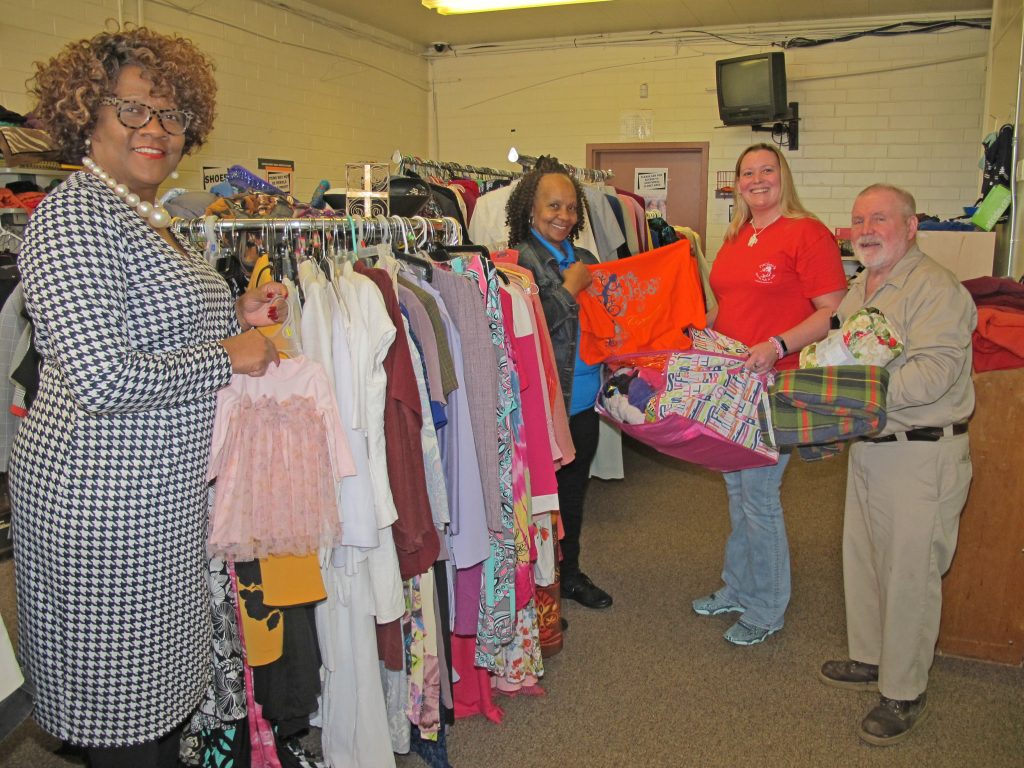
Belva Belton, left, and Sandra Cammon, who operate Closet to Closet, receive donations from Leah Branham and her dad Eddie, located at the Learning Center. | Barbara Ball
WINNSBORO – A Ridgeway woman is being heralded as an inspiration for her enduring work to provide resources and support to local students and families in need through Closet to Closet, a program supplying a variety of gently used school uniforms, clothing and shoes for the family, bedding and other household items.
Belva Bush Belton, the registrar and attendance supervisor at Fairfield County School District, initiated the program four years ago when a state law was passed requiring school districts to provide a liaison to identify students experiencing homelessness. Belton and volunteer Sandra Cammon, a bus driver for the school district, operate the Closet, located in the Learning Center at 250 Roosevelt Street (behind the former Fairfield High School).
While the Closet initially served only homeless students, Belton has since opened it to all families in the community who are in need, especially those who are victims of house fires and other crisis events.
During the last four years, Belton has worked tirelessly to reach out to students and families within that scope, but more recently her actions have far surpassed just identifying the need.
“I guess you could say I go above and beyond, but really I do what I know is needed,” Belton stated.
Each year at the start of the new school year, Belton is tasked with identifying any students who qualify as “in need”. Those needs, she said, may include a lack of transportation to or from school, assistance with covering fees for field trips or school supplies, or even purchasing school pictures. Others, she said, may have far greater needs.
“Through the years I have learned that helping students with just their school needs was not nearly enough,” Belton stated.
Belton said she has found that the families of many of the students need food and housing. Most, she said, are in a “doubled-up” situation, where families are living with other families in a home that is not their own, such as a mother and her children moving in with the grandmother. Others, she said, were without any home at all.
“Occasionally, I find families who are living in a vehicle. That’s when I start making emergency calls and get them in a hotel and connect them with groups for food and clothing,” she stated.
Having grown up in Fairfield County herself, Belton said her greatest strength is her connection with the community. She said those connections make resources far more accessible.
In 2011, Belton was awarded the WIS/Mungo Homes Community Builders award after she successfully turned an unused room in the Learning Center into a thrift-type store for her families. Operating every Wednesday, the store, through continuous donations from the community, has grown to now include furniture.
Other organizations have set up an Angel Tree program in which Belton’s students or families can be adopted anonymously by local residents who provide them with Christmas gifts.
That support, Belton said, has helped her continue her efforts year after year. During the 2017-2018 school year, she assisted 114 families. For the 2018-2019 year, she has already helped 104 families with five months still left on the school year.
“It gets tough at times, when the numbers are so high, but when the community joins me in supporting these families, it just reignites my motivation,” she stated.
“It would be impossible for me to do what I do without help. Area businesses, churches, civic organizations and families in the community have helped me in a big way.”
Still, she said her work is never done.
At the end of the school year, Belton will begin contacting those families on her list to determine if they can be removed from her program. It can be the most rewarding time of the year for her, she said, but it can be one of the hardest as she sees some families continuing to struggle with their same vices.
That is where she has laid plans for the second chapter of her work. Even though retirement for her is still years down the road, Belton said she hopes, after retirement, to continue this work by creating a long-term “transitional housing” facility within the area.
“There are some families who find themselves in a tough situation more than once because they have never been taught how to handle finances, or they return to the same temptations that put them in a bad position in the first place. With transitional housing, I would be better able to control their surroundings and prepare them for success,” Belton stated.
Belton said she plans, after her retirement, to seek out grants that would make her transitional housing dream a reality.
“This work is my passion. It has been the most rewarding job I have ever had, and I certainly do not intend on stopping any time soon,” she said.
The Closet is open each Wednesday from 9 – 11:30 AM but also opens up by appointment for those who may be in immediate need. For more information contact Belva Bush Belton at Fairfield County School District Office (803)635-4607.
After missing a recent payment deadline, the Richland Two school board chair now owes nearly $52,000 in fines to the South Carolina Ethics Commission, an agency spokesperson confirmed.
McKie
In July 2018, the commission fined McKie $41,000 as part of an eight-count complaint that said she failed to file quarterly campaign disclosure reports.
McKie was ordered to pay the first $20,000 by New Year’s Eve. She missed that deadline, meaning the total fine increases to $51,750, according to the complaint.
“No payments were made prior to 12/31/18 and the fine amount for that particular order reverts as outlined in the order,” an ethics commission representative said via email.
Attempts to reach McKie have been unsuccessful.
In 2015, the ethics commission partnered with the S.C. Department of Revenue to increase ethics debt collection efforts through the DOR’s Setoff Debt Governmental Enterprise Accounts Receivable, or GEAR, collection programs.
Debtors who have reached “bad debt status” are referred to the Department of Revenue, according to the Ethics Commission website.
The Department of Revenue is authorized to garnish wages and tax refunds, or also impose liens to satisfy debts.
The Richland Two school board’s next meeting is scheduled for Tuesday, Jan. 8 at the Richland Two Institute of Innovation at 763 Fashion Drive, Columbia.
An agenda says the board will meet in executive session at 5:30, with the business meeting commencing at 6:30 p.m.
Lobbyist Income Report Doesn’t Match SEI Filing, Investigation Reels in 19 More Late Filings
Richland Two School Board memberes include Cheryl Caution-Parker, left, Chairwoman Amelia McKie, Jim Manning, James Shadd III, Lindsay Agostini, Monica Elkins-Johnson and new member Teresa Holmes. | Richland Two Website
BLYTHEWOOD – As the deadline to pay a hefty ethics fine nears, more questions are arising over reports filed by Amelia McKie, chairwoman of the Richland Two Board of Trustees.
Meantime, more previously unfiled ethics forms have been submitted by another Richland Two board member following an investigation by The Voice of campaign finance violations, according to public records.
The latest issues involving McKie revolve around lobbying activity reported on her 2015 and 2016 Statements of Economic Interest, or SEI, forms.
McKie’s SEI form for 2016 doesn’t list any lobbying activity or income.
However, on her Individual Lobbyist report, McKie reported earning $13,562.50 as a lobbyist for the S.C. Association of Developing Colleges, or SCADC, between Jan. 1, 2016 and May 31, 2016,
Her 2015 forms don’t match either.
In 2015, McKie reported $15,000 in lobbying income from the SCADC on her economic interest form. But her lobbyist report lists a year-to-date number of $27,125.
In addition, $2,000 in lobbying income from the Coalition for Access to Healthcare appears on her individual lobbyist report, but not her SEI form.
McKie couldn’t be reached for comment.
In response to inquiries from The Voice, McKie filed previously missing SEI forms for 2015-2018 on Dec. 4, according to Ethics Commission records.
As of Friday, Dec. 28, she still hadn’t filed quarterly campaign disclosure reports since early 2015, ethics records show.
The commission has already fined McKie $41,000 as part of an eight-count complaint alleging unreported campaign contributions dating back to 2015.
She had until Dec. 31 to pay the first $20,000. If she misses that deadline, the fine increases to $51,700. That information was not available to The Voice at press time.
In related news, board member Monica Elkins-Johnson filed a slew of outstanding quarterly campaign finance reports and amendments on Thursday, Dec. 27, nearly two months after the Nov. 6 general election, according to the S.C. Ethics Commission online database.
Elkins-Johnson joins fellow board members Teresa Holmes, Cheryl Caution-Parker and McKie among those who filed missing ethics forms only after being contacted by The Voice.
The Richland Two school board plays a direct role in developing the district’s annual budget, which for the 2017-2018 fiscal year totaled $273.9 million, according to the school district website.
Because Richland Two board members are entrusted with spending millions of dollars in taxpayer money, greater scrutiny of their ethics filings is appropriate, said Jay Bender, a media law attorney representing the S.C. Press Association.
“You have all these people who take office who pay no attention what the requirements are, and that’s unfortunate,” Bender said.
Since The Voice’s investigation began in early December, Richland Two candidates have rushed to file at least 19 tardy ethics forms, detailing previously unreported campaign contributions, income sources and potential conflicts of interest.
Here’s a breakdown of each board member’s campaign contributions and statements of economic interest, when available, for recent election cycles.
Amelia McKie
On her 2018 SEI form, McKie reported $15,000 in income from lobbying activity for NextEra, a Florida-based energy company that recruited people to lobby the state to sell Santee Cooper, ethics forms state.
She performed additional consulting work for Infusion and LHI, though ethics forms don’t list income from those sources.
In addition to lobbying activity, McKie reported $9,600 in annual income from her position as school board chair.
McKie’s most recent quarterly campaign disclosure report was filed Jan. 10, 2015, ethic filings show.
She filed two amendments, one on Jan. 11, 2015 and the other Feb. 10, 2015.
Her Jan. 10, 2015 disclosure form, filed two months after the Nov. 4, 2014 general election, reported $10,861.95 in total contributions. She spent $9,524.41, leaving $1,337.54 cash on hand.
One contribution, a $1,000 donation from the Lou-Von Family Foundation in Sumter, was returned at the donor’s request, ethics forms state.
Though nearly four years old, an amendment McKie filed to her campaign disclosure reports in February 2015 raises additional questions.
In that filing, McKie lists 889.5 miles driven by various Columbia vendors for Get Out the Vote-related work, totaling $498.72 in mileage expenses at 56 cents a mile. The expenses were incurred on four dates in 2014: Nov. 3, Nov. 21, Dec. 11 and Dec. 22.
It is unclear from the forms what would require driving 890 miles in four days – roughly 222.5 miles per day – in the Columbia area.
James Shadd III
Board member James Shadd III has experienced issues with his ethics forms since 2014, when the ethics commission fined him $13,000 for failing to file several quarterly campaign disclosure reports, documents state.
The complaint has since been resolved, according to the ethics commission website. More recently, Shadd III hasn’t filed quarterly campaign disclosure or SEI reports since October 2016, according to ethics filings.
The absent filings only pertain to his school board seat. Quarterly reports for his 2014 solicitor’s office bid are available for public inspection.
Shadd III couldn’t be reached for comment.
In 2016, the last year Shadd III filed an SEI form, he only listed his school board trustee position, but not his income. He didn’t report any lobbying activity or any other potential conflicts of interest.
Shadd III filed three campaign disclosure reports in 2016, all on Oct. 31 of that year, which included his initial report, October quarterly report and his pre-election report.
He reported $10,375 in contributions for the election cycle, mostly from attorneys, physicians and other individual professionals. He spent $7,244.88.
Monica Elkins-Johnson
In all, Elkins-Johnson filed 14 previously missing quarterly campaign disclosure forms last week on Dec. 27, 2018, some of them dating back to 2016, according to ethics records.
One of the filings was a final campaign disclosure report for her 2016 campaign.
The report listed $12,860.52 in total contributions, most of which came from personal funds ($7,341). Most other contributions came from individual donors, filings show.
Elkins’ SEI forms have been filed on time most years. Her 2018 SEI report only listed $9,600 in income for her school board seat.
Teresa Holmes
Most of Holmes’ campaign contributions before the 2018 election come from personal funds.
For the 2018 election cycle, she reported $3,683.94 in contributions, of which $3,183 came from her personally, ethics records show.
The remaining $500 consisted of a donation from Sam Green, whose occupation is listed in ethics records as bishop of the 7th Episcopal District.
After the election, Holmes filed two amendments on Dec. 10 and Dec. 12, respectively amending her pre-election and initial reports to include additional contributions and expenditures.
As before, contributions mainly consisted of personal loans and small, individual donations.
Like McKie, Holmes filed her 2018 SEI forms after she was informed by The Voice that they had not been filed.
On her SEI form, Holmes reported $83,000 in personal income from the Fairfield County School District. She’s an assistant administrator and guidance counselor at the Fairfield Career and Technology Center, the Richland Two website states.
Cheryl Caution-Parker
Caution-Parker filed her four 2018 quarterly campaign disclosure reports on Dec. 17, shortly after The Voice contacted her that the forms hadn’t been filed prior to the Nov. 6 election.
Caution-Parker previously told The Voice that she had correctly entered the information, but didn’t complete the submission process because she failed to click the “File” button.
Her October 2018 pre-election report listed $5,150 in contributions and $5,129 in expenditures. She reported two contributions from developers: M.B. Kahn Construction Co., $1,000; and Stevens & Wilkinson, $250.
Caution-Parker spent the bulk of her funds on billboard advertising and campaign signs.
James Manning
Manning filed his quarterly campaign disclosure and SEI forms on time.
While it was previously reported that these fillings were late, most of his campaign disclosure reports are associated with the 2014 election cycle. Only a pre-election report filed Oct. 28, 2018 is associated with the 2018 election cycle, records state.
Manning said that’s because he announced his intentions to seek re-election late in the election cycle, which explains why his other quarterly reports are linked to 2014.
For the 2014 election cycle, Manning reported $9,198.76 in total contributions.
Manning reported an additional $7,775 in contributions for 2018. Notable donations for the most recent election cycle include: M.B. Kahn Construction, Co., $1,000; Brownstone Construction Group, LLC, $1,000; Darrell Campbell, construction, $500; and Grayson Thompson, architect, $300.
Manning reported $118,737 in personal income from working in state government. He works for the S.C. Public Employee Benefits Authority as a risk and compliance manager, according to the state’s online salary database.
Manning reported additional family income of $69,289, also from state government, and his $9,600 school board salary.
Lindsay Agostini
Besides Manning, Agostini was the only other current board member to file all her Campaign Disclosure and SEI forms on time. As reported previously in The Voice, Agostini hasn’t been required to file quarterly campaign disclosure reports since March 24, 2017, when according to ethics records, she submitted a final report.
Office holders may file final reports only after he or she closes their campaign account, which is what Agostini did, according to the Ethics Commission.
To qualify for this exemption, a candidate must have a zero balance and no outstanding campaign debts, according to the Ethics Commission websit, which Agostini met.
When her campaign accounts were open, Agostini was one of the school board’s top fundraisers. Her final report listed $22,947 in total contributions for the 2016 election cycle.
Contributions mainly came from attorneys, physicians and other business professionals. She spent the bulk of her funds on mailers and signage, records show.
On her 2018 SEI form, Agostini reported board member pay of $9,600 and various food and gas reimbursements totaling $1,146.89.
Under personal income, she listed Agostini and Associates as the source and event planner/swim lessons under the type. A dollar amount was not specified.
Agostini also listed 11 sources of family income, which include DaVinci Financial Designs, LPL, Midland Insurance, The Members Club, Washington & Lee University, Pomona College and other entities.
Craig Plank
Craig Plank, who did not win re-election to the board in November, but has filed all his forms on time during his time on the board, reported $13,090 in contributions this past election cycle, which included $2,100 from personal funds. He spent $9,483.85, mostly on advertising and direct mailing, records state.
Most of Plank’s donors consisted of individual business professionals, including several insurance agents.
Plank reported several contributions from developers: SC Builders PAC, $250; Stevens & Wilkinson SC, Inc., $250; Covert Homes, LLC, $250; LCK, LLC, $500; and M.B. Kahn Construction Co., $1,000.
On his 2018 SEI form, Plank reported a $12,000 stipend from the district.
Plank also reported receiving unspecified income from four sources: WIS TV, family income; State Farm Insurance Co., personal income; Millie Lewis of Columbia, personal income; and NFIP, personal income.
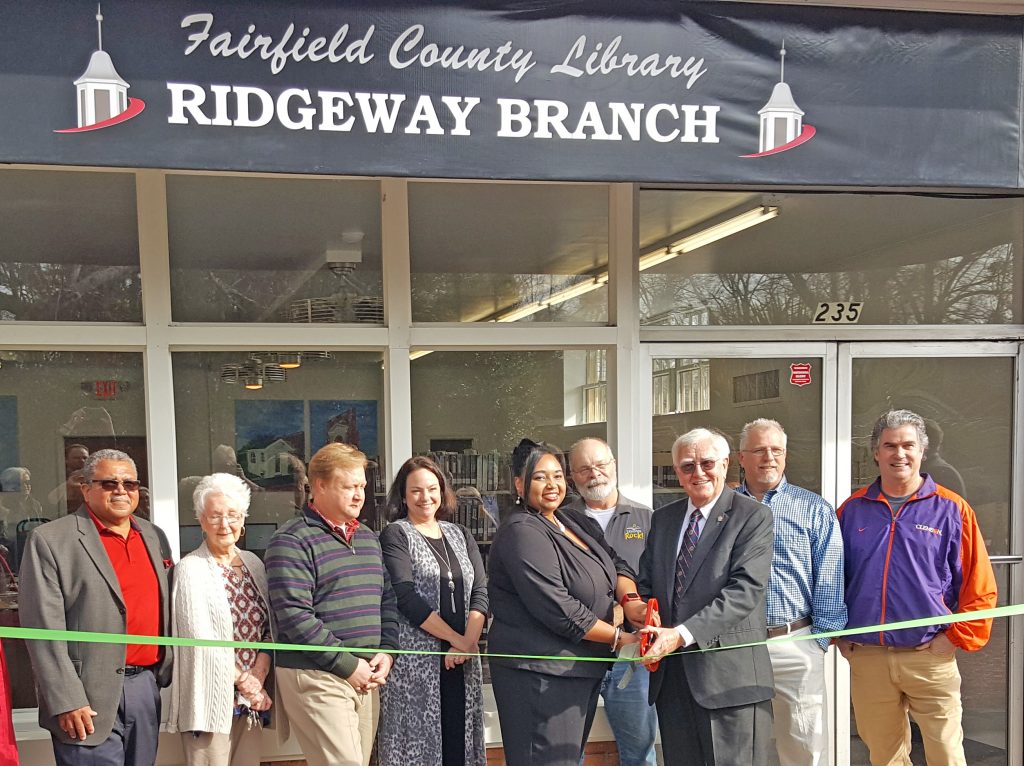
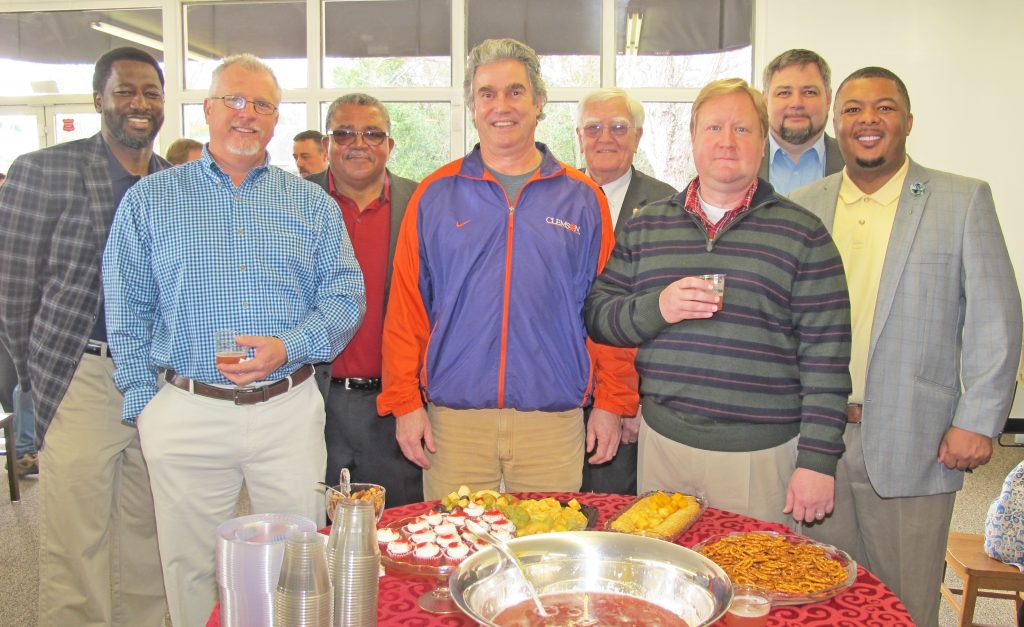
County Councilman Moses Bell, Board Member Polly Phillips, County Administrator Jason Taylor, Circulation Manager Beth Bonds, Branch Manager, Chrishonda Gaither, Assistant Library Administrator Mike Poole, Board Chairman Paul Dove, Town Councilman Dan Martin and former County Councilman Dan Ruff | Darlene Embleton
RIDGEWAY – A new Ridgeway branch of the Fairfield County Library opened on Wednesday with a ribbon cutting and open house hosted by the Friends of the Library at the new 235 S. Palmer Street location. According to Fairfield County officials, the location will serve the community until a more permanent location can be found at a later date.
Superintendent Dr. J.R. Green, Town Councilman Dan Martin, County Councilman Moses Bell, former County Councilman Dan Ruff, Board Chair Paul Dove, County Administrator Jason Taylor, Chamber Director Chris Stephenson and County Councilman Neil Robinson.
“This new branch, is nearly twice the size of the prior Ridgeway location and can accommodate nearly twice the number of books and computers,” said Fairfield County Library Director Eric Robinson. “Our services include resources duplicating those at our main library. We can provide access to SCLENDS, a 20-library consortium that shares books through a lending program (accessed at fairfieldcountylibrary.com), on-site printing, copying and scanning,” Robinson said. Color printing is not yet available at the branch.
There will be seven computers for accessing library resources. Four offer Microsoft Office and three have internet access. Wi-Fi is available.
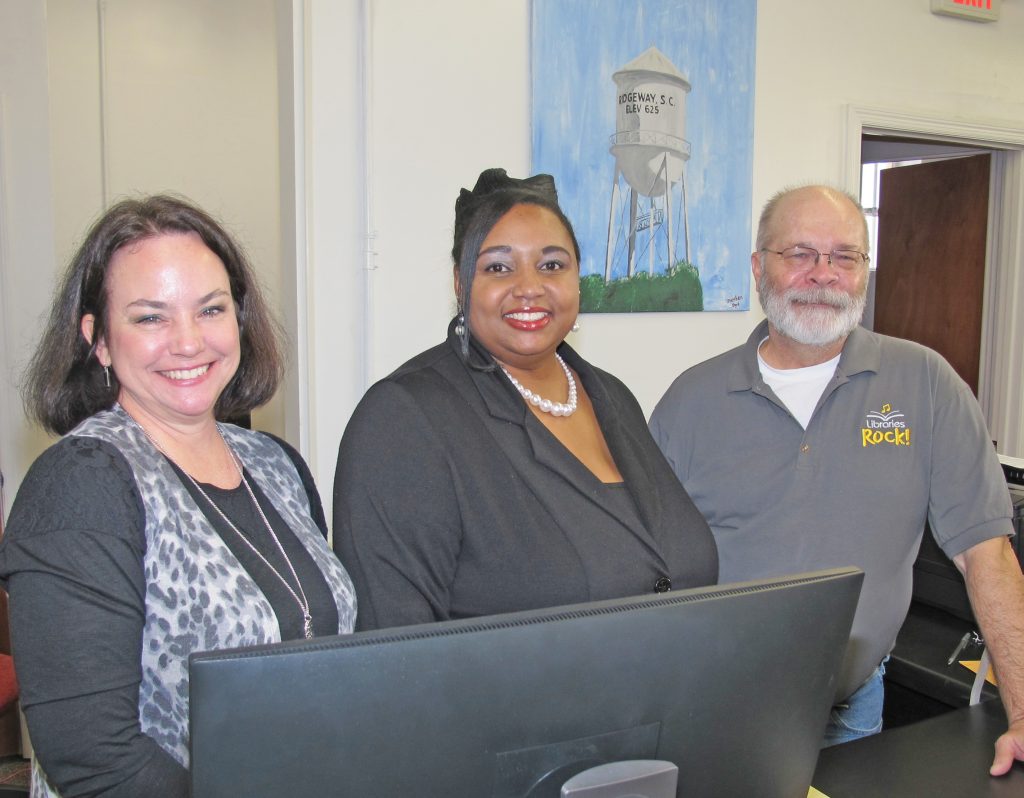
Circulation Manager Beth Bonds, left, Branch Manager Chrishonda Gaither and Assistant Library Administrator Mike Poole. | Barbara Ball
Chrishonda Gaither will be the Branch Manager for Ridgeway. Branch hours will be Monday and Wednesday from 9 am to 1 pm and Tuesday and Thursday from 2 to 6 pm. The Bookmobile will continue to serve Ridgeway on an as-needed basis.
“The Library Board would like to thank Fairfield County for the refurbishing and getting us up and running,” Robinson said. “We would also like to thank the Ridgeway Town Council and former County Councilman Dan Ruff for helping us secure this site. We are very happy to once again be able to conveniently serve the people in the Ridgeway community.”
The new location has on-site parking. For more information, call 803-337-2068 or fax 803-337-0529.
WINNSBORO – A major talking point Fairfield County education leaders have been making about the 2018 state report cards is that no Fairfield school rated Unsatisfactory.
“We were competitive,” said Dr. J.R. Green, district superintendent, said of the results at a recent Board of Trustees meeting. “Virtually every district that adjoins Fairfield County had at least one unsatisfactory school.”
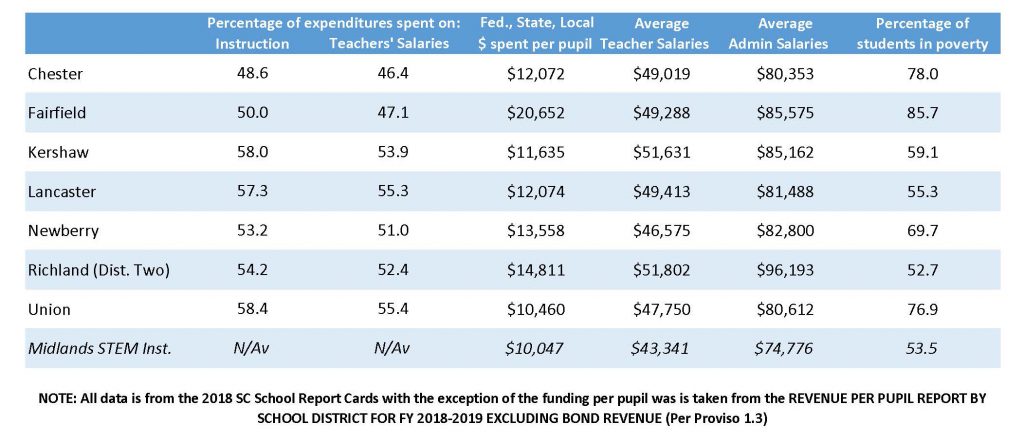
That ratio is actually closer to 50-50 for the six surrounding districts, with three districts reporting no Unsatisfactory schools and three others reporting at least one Unsatisfactory school. Union, Newberry and Lancaster counties didn’t report any Unsatisfactory schools, according to report card data. Chester, Kershaw and Richland Two reported at least one Unsatisfactory school.
Additionally, Green’s comparison includes some districts substantially larger than Fairfield County, which has seven schools, excluding the state-run Midlands Stem Institute which has two schools.
Chester has 13, Newberry has 14, Kershaw has 18 and Lancaster has 20. Richland Two is the largest adjoining district with 32 schools.
Fairfield
With the highest federal, state and local funding per pupil ($20,652), the highest percentage of students in poverty and the smallest average number of students per teacher ratio, Fairfield County had one school rated as Excellent, and another received a Good rating on the 2018 SC school report card. Three others were rated Average and two were rated Below Average. None were Unsatisfactory, the lowest rating.
Here’s a breakdown of how each school performed:
Fairfield Magnet School for Math & Science (Excellent)
Kelly Miller Elementary (Good)
McCrorey-Liston Elementary (Average)
Geiger Elementary (Average)
Fairfield Central High School (Average)
Fairfield Middle (Below Average)
Fairfield Elementary (Below Average)
Chester
Chester, with the highest average student to teacher ratio (25.4 students per teacher), second highest percent of students in poverty (78.0) and third lowest average teacher salary ($49,018), struggled the most among the seven districts. Chester had one Excellent school, three Average schools, six Below Average schools and three schools receiving the state’s lowest rating of Unsatisfactory.
Kershaw
Aside from reporting one Unsatisfactory school, Kershaw’s 18 schools performed well, with five schools earning Good ratings, nine rated Average and three rated Below Average.
Lancaster
In Lancaster County, eight schools scored either Excellent or Good. Seven were rated Average and five received a rating of Below Average. Lancaster had no Unsatisfactory schools.
Newberry
Newberry County, with the lowest average pay for teachers ($46,575) of the seven districts, and the fourth highest percentage of students in poverty (69.7), reported three schools with Excellent ratings, five schools with a Good ranking, five schools with an Average rating and only one school with a Below Average rating, report card data shows. Newberry had no Unsatisfactory ratings.
Richland Two
In Richland Two, about one-third of schools (11) scored Good or Excellent on the report cards. Of the nine Blythewood area Richland Two schools, six were among the 11 top schools:
Langford Elementary (Excellent)
Round Top Elementary (Excellent)
School for Knowledge Elementary – housed in Muller Road Middle (Excellent)
Bethel-Hanberry Elementary (Good)
Sandlapper Elementary (Good)
Blythewood High (Good)
Westwood High, Blythewood Middle and Muller Road Middle (grades 6 – 8) schools received an Average rating,
The Center for Achievement elementary magnet school housed in the Kelly Mill Middle school, is the only Blythewood area school to receive an Unsatisfactory rating. Two other Richland Two schools also received Unsatisfactory ratings.
Union
Union County, which has eight schools, reported one Excellent school, six Average schools and one Below Average school. Union has the third highest percentage of students in poverty (76.9) and allocates the highest percentage (55.4) of its expenditures to teacher salaries which, at an average of $47,750, are the second lowest of the seven districts.
Midlands Stem Institute
The report cards list the Midlands Stem Institute, or MSI, of Winnsboro under the S.C. Public Charter School District. The state issued two report cards for the K-8 school – one for elementary grades and one for middle school grades:
MSI, elementary (Below Average)
MSI, middle (Average)
The school added ninth grade last fall which was not included in the 2018 ratings. MSI receives $10,047 in federal, state and local funding per pupil, about half the amount the Fairfield District receives and the least of any of the other seven comparison districts.
Comparing the seven districts
In 2018, the state revamped the report cards into two main categories: Academics and School Environment. There are six subcategories under Academics and four under School Environment.
At the Dec. 18 school board meeting, Green stated that the new report cards create a “forced distribution” of schools.
According to the model, only the top 15 percent of schools are rated Excellent. The next 20 percent receive a Good rating, while the middle 35 percent receive Average ratings.
Below Average schools make up the next 20 percent while the bottom 10 percent are Unsatisfactory.
“This system has negatively impacted all kinds of districts with all kinds of populations,” Green said at the meeting. “It creates a ‘Hunger Games’ mentality. Everyone is scrambling to the top and to reach the top.”
Class sizes
Fairfield County’s student to teacher ratio of 16.9 to 1 is the smallest [number of students per teacher] ratio compared to the six districts surrounding Fairfield.
Richland Two has the next lowest ratio at 19.7 to 1. Chester has the highest at 25.4 to 1.
Teacher Retention
Statistically speaking, teacher retention appears to be an issue for Fairfield, according to report card data.
Fairfield’s percentage of teachers on continuing contract is lowest (63.2 percent) of the seven districts. The six surrounding districts range between 75 percent and 81.6 percent, with Union County leading the pack even though it has the third highest percentage of students in poverty and the second lowest average teacher salaries according to report card data.
Fairfield falls in the middle in average teacher salaries at $49,288. Richland Two leads at $51,802, followed by Kershaw at $51,631.
Newberry trailed all seven at $46,575 despite its schools receiving comparatively high ratings.
Other average salaries by district include: Union, $47,750; Chester, $49,019; and Lancaster, $49,413.
BLYTHEWOOD—Administrators are making more and teachers are making less in the Richland Two School District.
In 2017-18, the average teacher salaries dropped from $52,092 to $51,802, while average administrator salaries rose from $95,003 to $96,193, the South Carolina Department of Education Report Card data shows.
A similar trend occurred in Fairfield County School District.
In 2017-2018, average administrator salaries were $85,575, up from $84,833 the year before, according to report card data.
Average Fairfield County School District teacher salaries, however, declined from last year, falling from $49,504 to $49,288.
At the Dec. 18 Fairfield County School District meeting, Dr. J.R. Green, superintendent of Fairfield County schools, said in the past year he’s forgone receiving a pay raise.
However, when board member Paula Hartman asked Green to state his salary, Green said he didn’t know the figure. The Voice has filed a Freedom of Information Act request for that information.
In Fairfield County, the inverse relationship between administrator and teacher pay comes as district leaders continue pressing for the creation of a Teacher Village, a proposed subdivision catering to educators.
Affordable housing, they say, is key to recruiting and retaining teachers.
“People who live in a home are going to stay longer than in an apartment,” said Dr. Sue Rex, chairwoman of the Fairfield education foundation, which is working with the district on the Teacher Village project.
Fairfield County lags behind Richland Two in most teacher retention categories.
Richland Two reported 86 percent of teachers returning from the previous year, compared to 82.6 percent in Fairfield. Richland Two (86.6 percent) also leads Fairfield (81.3 percent) in teachers returning – three year average, according to report card data.
Finally, only 63.2 percent of Fairfield teachers are on a continuing contract, compared to 75 percent in Richland Two.
At the Fairfield County School District’s October meeting, the board voted to appropriate $1 million from its $3.5 million surplus for salaries.
However, the money won’t be budgeted until 2018-2019 and it includes all district employees, not just teachers. The remaining $2.5 million was earmarked to fund facility needs.
WINNSBORO – Instead of attacking school report cards, the Fairfield County School District leaders should be tackling ways to improve student achievement, according to a leading state education official.
“Rather than complaining about the system, the best thing we can do is think about how we can improve the outcomes for kids,” said Melanie Barton, executive director of the S.C. Education Oversight Commission, which develops the annual report cards with the S.C. Department of Education.
In a telephone interview Friday, Barton said report cards are designed to help identify how schools can improve, not to punish or embarrass them.
“What I would tell board members is spend your energy focusing on where we can improve,” she said. “Not every school can be excellent. That just defies common logic.”
Barton’s remarks came three days after the Fairfield school board members and staff blasted the report card methodology, calling them unfair and punitive.
Dr. J.R. Green, district superintendent, disputed what he termed as a “forced distribution,” meaning a percentage of schools will always be rated unsatisfactory, regardless of performance.
“It creates a model where one school doesn’t want to help another,” Green said. “I have a problem with a system when you have to have winners and you have to have losers.”
Barton said Green’s assertions erroneously portray the purpose of the report cards.
“To think of it as a competition, I just don’t see educators doing that,” she said. “If they do, they’re not serving children.”
School districts sound off
Fairfield County is not alone in voicing frustration over the report cards. Other superintendents have voiced concerns as well, said Ryan Brown, spokesman for the S.C. Department of Education.
Brown deferred comment on report card methodology to the EOC, but he noted the Department of Education has some concerns of its own regarding the updated report cards.
One issue, he said, is that standardized tests comprise 90 percent of an elementary school’s report card score, while the ratio is less for high school ratings.
He said the Department of Education and other stakeholders hope to hash out any differences at a meeting next month. The meeting is slated for Jan. 28, and any revisions need to be finished by March 1 for U.S. Department of Education signoff.
The new report cards were rolled out Nov. 29 following a two-week delay due to errors in reporting from a vendor, a Department of Education news release said.
The report cards maintain previous ratings of Excellent, Good, Average, Below Average, and Unsatisfactory. What’s new is that only certain percentages of schools fit into each category.
In 2017-2018, only the top 15 percent of schools were rated Excellent. The next 20 percent of schools were considered Good, while the middle 35 percent of schools were classified as Average.
Below Average schools made up 20 percent while the bottom 10 percent were automatically rated Unsatisfactory. There were 116 schools that fit into this category.
No Fairfield County school was rated Unsatisfactory. Two schools – Fairfield Elementary and Fairfield Middle – were rated Below Average. While Fairfield Central High School was rated Below Average in Academic Achievement and Prepared for Success, the Good rating for Graduation rate, Average rating for College and Career Readiness and Excellent rating for School Quality (subjective ratings by students, parents and teachers concerning such areas as school safety)brought the overall average for the school to Average.
At Tuesday’s board meeting, Green likened the state report card system to “The Hunger Games,” a science fiction movie about a dystopian future in which teenagers fight to the death on live television.
“This system has negatively impacted all kinds of districts with all kinds of populations,” Green said. “It creates a ‘Hunger Games’ mentality. Everyone is scrambling to the top and to reach the top.”
Board chairman William Frick described the report cards as “rigging the game,” saying 30 percent of schools in the state are destined to score either Below Average or Unsatisfactory.
“We’re rigging the game by saying 30 percent of the schools, 30 percent of the teachers, 30 percent of our students have to be below average or unsatisfactory,” Frick said. “I just don’t understand it. I, for the life of me, don’t understand why we want to continue to say our schools are bad in South Carolina.”
Board member Carl Jackson was more blunt.
“It’s almost as though somebody’s getting a kickback to make this thing look bad,” Jackson said.
Comparing area high schools
Earlier at the Dec. 19 meeting, Dr. Claudia Avery, deputy superintendent of academics for Fairfield County schools, detailed report card highlights for the board.
Green interjected several times during the presentation to express his disapproval of various aspects of the report card system.
“All schools can’t experience growth,” Green said. “Even if everyone does a good job of moving kids, everyone can’t receive positive points.”
Barton said the purpose of the report cards is to identify schools that are struggling, and to develop ways to help them improve. For that to occur, she said, report cards need to be transparent and frank.
“The point of the system is to identify what we’re doing well and what we’re not, and get the resources needed to change it,” Barton said. “We’re not where we need to be in the state.”
In her presentation, Avery said the district exceeded the state average in graduation rate (86.2 percent vs. 81 percent). She also noted the district’s percent of English Learners making progress toward proficiency (57.7 percent) outpaced the state (48.6 percent).
In addition, Avery said the district was represented well on student survey questions.
Nearly 89 percent of parents agreed or strongly agreed that their child feels safe at school. Another 78.4 percent thought school staff prevents or stops bullying.
Report card data, however, reported several noteworthy statistics in the report card’s “unsafe incident” table.
For example, the district reported seven incidents of “sexual assault (not rape).” There were also eight incidents of “physical attack without weapon,” and 45 threats of physical violence to Fairfield Central High School students, report cards state.
Academically, Fairfield County still lagged behind the state in several key areas.
Only 27 percent of students (303 of 1,121) met or exceeded criteria on SC Ready-English/Language Arts. Statewide, the figure was 41.7 percent. On math, only 31.2 percent of Fairfield students met or exceeded the criteria compared to 44.6 percent at the state level.
Fairfield also trailed the state in SCPASS Science and SCPASS Social Studies, as well as in end of course tests for Biology and U.S. History and Constitution.
BLYTHEWOOD – The Blythewood Town Council is hoping to reprioritize some road improvement projects set for development in the near future under Richland County’s Penny Sales Tax program.
During the Dec. 18 council meeting, Mayor J. Michael Ross opened a discussion on the Penny Tax-funded road projects, which included a debated traffic circle proposed on Blythewood Road adjacent to the entrance of Cobblestone Park.
Specifically, council discussed reprioritizing the current first four of the Blythewood Penny Tax projects:
the traffic circle and widening of Blythewood Road on west side of I-77
Widening of Blythewood Road on east side of I-77
Improvements on McNulty Road
Extending Creech Road to Main Street (parallel to Blythewood Road)
Ross suggested moving McNulty Road (3) up to the second slot, moving the Creech Road extension (4) up to the third slot, and moving the widening of the east side of Blythewood Road (2) back to the fourth slot.
Council is expected to vote by resolution at the January meeting to confirm these changes.
The Creech Road Extension would begin at the cul de sac on the end of Creech Road near the Holiday Inn Express and run parallel to Blythewood Road, tying in to Main Street (Hwy. 21) somewhere yet to be determined between St. Mark’s Church and Blythewood High School.
“We (the council) believe that if we could get a Creech Road extension that would empty onto Hwy. 21, that would relieve a lot of the traffic stress and problems we are having in that area,” Ross stated.
Council member Malcolm Gordge said the prioritized list discussion had come up at the last council retreat, with the decision to table the item until council could meet with one of the engineers on the projects. That meeting, Gordge said, might happen as early as the Thursday after the Council meeting. Gordge said the meeting would allow the council to review traffic studies and have an updated discussion to see where SCDOT is and make them aware of the council’s proposed changes to the list.