Tag: slider

  • Winnsboro man dies in hit and run

    FAIRFIELD COUNTY – A Winnsboro man died when he was struck by a vehicle in the 9400 block of Monticello Road Wednesday morning.

    Roderick D’Wayne Anderson, 24, was struck at approximately 4 a.m., Wednesday, by a vehicle while he was walking along the roadway. Anderson died at the scene. The cause of death was due to blunt trauma of the head and torso, according to Richland County Coroner Gary Watts.

    The Richland County Coroner’s Office and the SC Highway Patrol are investigating the incident.

    The vehicle that struck Anderson left the scene.  Anyone with information regarding this incident, is asked to notify the S.C. Highway Patrol or call Crimestoppers at 888-CRIME-SC (888-274-6372).

  • R3 zoning sought for Teacher Village

    WINNSBORO – Fairfield County education leaders have amended a rezoning request for the proposed “Teacher Village” from PD-R, Planned Development-Residential to strictly residential.

    The change in zoning plans was presented last week to the Winnsboro Planning Commission, a week after a previously scheduled meeting was canceled to give the Fairfield County School District more time to assemble the required planning documents.

    Now the district is requesting an R3 zone, which permits three homes per acre and would allow for cluster housing on 22 acres behind the district office off U.S. 321 Bypass.

    The planning commission took no action on the Teacher Village at a meeting last week, but did vote to accept the district’s application package.

    Speaking in public comment, Winnsboro resident Shirley Green, a member of the Fairfield County Education Foundation, said the rezoning should be approved.

    “This rezoning is a large step for the Fairfield County School District Education Foundation, and a giant step for the Town of Winnsboro to infuse our community with housing to attract teachers, first responders and their families,” Green said.

    The R3 zone is a strictly residential zone, allowing only residential uses, whereas the PD-R allows a limited amount of non-residential structures as secondary uses, according to town planning documents.

    A preliminary site plan for the development does not subdivide the Teacher Village into individual lots. Rather, the entire development consists of one lot, planning documents show.

    R3 also has less strict design standards than other residential zones, allowing for reduced spacing between buildings – 25 feet, front to front; 20 feet, front to side; and four feet, side to side – than R1 or R2 zones.

    It also only requires only 20 percent of open space, as opposed to 35 percent for R1 and 25 percent for R2.

    Yard sizes are also significantly less, planning documents state.

    Required rights of way in an R3 zone are 6,000 square feet for the first home and 2,500 square feet for each additional dwelling unit. An R1 zone requires 6,000 square feet for all units. In an R3 zone, the minimum square footage is 10,000.

    Fairfield County educated leaders have touted the Teacher Village as vital in recruiting and retaining teachers.

    Billy Castles, Director of the Town of Winnsboro Building and Zoning Department, has set a workshop for the Planning Commissioners to discuss the preliminary site plan at 4 p.m., Thursday, Jan. 24, at the Old Armory, 307 Park Street, Winnsboro.

  • Public puts pressure on R2 chair

    Board Opens Door for Removal of Members from Office

    COLUMBIA – Calls for the resignation of Richland Two school board chair Amelia McKie grew Tuesday night, with a fellow board member joining in those calls.

    Meantime, two other board members are suggesting publicity of missing school board ethics forms has been “racially motivated.”

    During the Board and Superintendent Comments portion of Tuesday’s board meeting, board member Lindsay Agostini publicly called for McKie to step down as chair.

    Agostini said McKie has been evasive and dishonest in addressing unfiled ethics reports and subsequent fines from the state.

    “After being informed by media of missing documents which took over a month for the chair to complete, she has taken no ownership of any wrongdoing,” Agostini said. “As you try to straighten things up for you and your family, I at a minimum ask that you step down as chair. A premier district deserves a premier board.”

    In prepared remarks, McKie apologized later in the meeting for not filing her ethics forms. She said her forms are now current, and that she’s working with legal counsel to address nearly $52,000 in fines she owes the S.C. Ethics Commission.

    “I am responsible and I am not running from those problems,” she said in prepared remarks.

    McKie went on to state she’s faced numerous personal attacks since her ethics problems came to light.

    “I have a problem that my character is maligned. Everything that I have said has been accurate at the time. My filings are accurate with the commission,” she added. “Not necessarily everything you have read or seen is accurate. I will not have my character maligned when there are two sides to a story.”

    McKie’s statement didn’t address whether or not she planned to resign.

    After the meeting, she declined to comment, deferring The Voice to her prepared statement.

    Board members float race issues

    At the Jan. 8 meeting, Board member Teresa Holmes thanked The Voice for its news coverage of missing ethics forms, including her own.

    “I’m brand new to this, I had no idea,” Holmes said. “I’m glad that you actually did the story. Nobody tells you these things when you’re running.”

    But at the Tuesday night meeting, Holmes did an about face, questioning the accuracy of the news reports about ethics issues, hinting race factored into it.

    “All of the stuff you saw in the paper wasn’t necessarily factual,” Holmes said. “Some of it was racially motivated, I really do believe that.”

    When asked after the meeting what specifically was reported incorrectly, Holmes would not comment.

    Board member Monica Elkins-Johnson challenged the accuracy of news reports as well, but also could not say what was incorrect.

    “I hope that we will not judge people on their skin tone, on mistakes, on their actions,” Elkins-Johnson said. “Give people an opportunity to prove themselves. People don’t know what’s going on in your household. Sometimes the media doesn’t always report things accurately.”

    Stephen Gilchrist, a board member with the Richland Two Black Parents Association, said following state ethics laws is not about race.

    “It’s not a racial issue from our perspective,” Gilchrist said. “This is about ethics issues Ms. McKie is dealing with, and of course the board in Richland 2.”

    Similar messaging appears on the association’s website and Facebook page.

    “Ethics is not synonymous with race! Let’s not draw that association,” the group’s Facebook page states. “When an issue is about personal ethics, let’s not attempt to draw parallels to our turbulent socio-politically, charged racial climate. Wrong is wrong and right is simply right!”

    Jay Bender, an attorney with the S.C. Press Association, of which The Voice is a member, noted that in 2012 about 250 Republican candidates for state office were booted off the ballot for not properly filing ethics forms.

    Most of the candidates were white, Bender said.

    “Ethics problems in South Carolina appear to be as neutral as anything,” he said. “The threshold is are you a public official, not whether you are white or black.”

    The Ethics Commission’s debtor list, a running public list of individuals with unpaid ethics fines, also consists of a clear mix of black and white candidates and lobbyists.

    More resignation calls

    Richland Two parent Rhonda Meisner once again asked McKie to resign during public comments. She also asked McKie to return any public money she’s received as a board member.

    “I know that is not a very nice message, but that is a message that needs to be addressed in my opinion,” Meisner said.

    Columbia resident Gus Philpott called for McKie’s resignation as well.

    “In view of the $52,000 amount of her fines from the ethics commission, I request that she immediately and voluntarily step down from the board,” Philpott said. “If she fails to step down, I believe that the board must remove her.

    “Matters of ethics are definitely not a distraction,” Philpott added. “This is an ethical issue, please address it now.”

    Calling McKie a “doer,” Innocent Ntiasagwe spoke in support of the board chair.

    “It’s good for us to pay attention to look at the good in the work that we do, not just some innuendos that may arise every now and then,” Ntiasagwe said. “Some people only look back and see what is wrong and don’t offer solutions.”

    In June 2018, the ethics commission fined McKie $41,000 in connection with multiple violations of not filing campaign disclosure reports.

    McKie was ordered to pay $21,000 by Dec. 31, 2018. When she didn’t, the fine jumped to $51,750, agency records state.

    Board proposes policy change

    Almost unnoticed, the district unveiled proposed revisions to a board policy relating to the election of officers, such as chairperson, vice-chair and secretary.

    According to the proposed change, a supermajority can vote to remove a Board officer from his or her office, which would require five votes.

    “In such a case, or in any case where there is a vacancy in a board office, the board may as soon as practical elect a member to fill the vacated office for the remainder of the term,” the revision states.

    If enacted, the board under the policy could strip a board member of their office position, but not their board seat.

    “I’m saddened that we had to revise this policy, but I’m grateful for those who’ve worked expeditiously to get this to us tonight,” Agostini said.

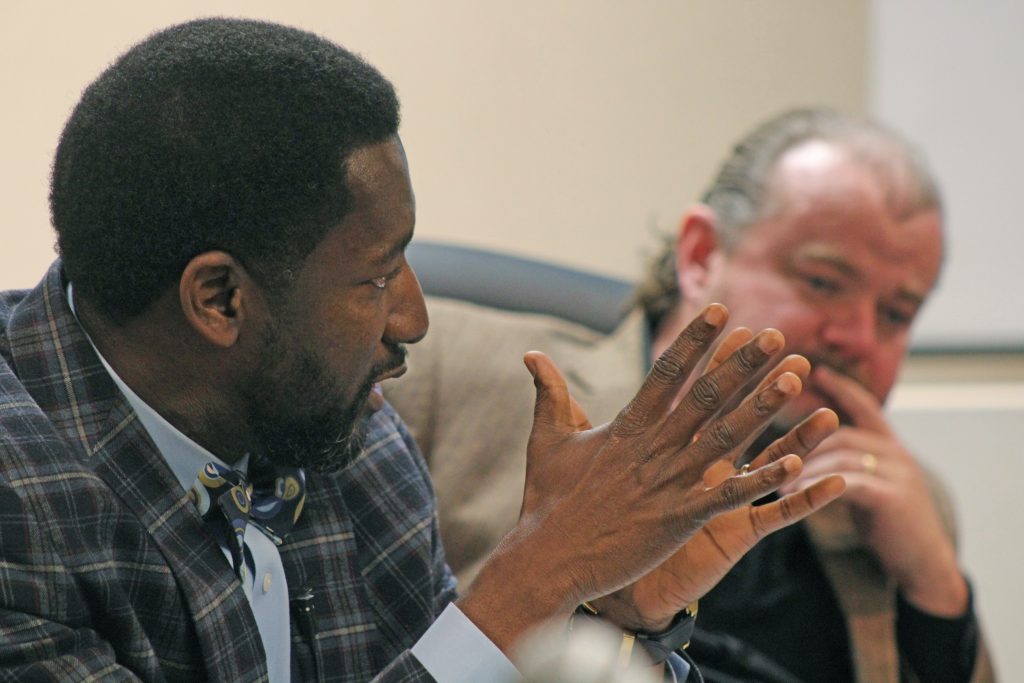
    Board member James Manning said the purpose of the policy is to address edge cases. He cautioned against using it for political purposes.

    “It gives us an opportunity should the need arise for us to address potential issues,” Manning said. “It really has to be a high bar for cause.”

    No votes were taken on the policy Tuesday night. That would likely occur at the next meeting scheduled for Feb. 12.

    The policy proposal comes in response to an investigation by The Voice into McKie and other board members with previously unfiled ethics forms. Six of seven board members either filed late or failed to file.

    Manning, previously believed to have filed his forms, told The Voice on Tuesday that he was recently fined $200 for two late filings. That information, Manning told The Voice, was only released by the Commission last week.

    He said the ethics commission reviewed all board members’ ethics filings after The Voice’s reports, and that he has since paid the fine.

    Other board members filed missing forms in December and January following reports in The Voice, public records show.


  • Ridgeway plans new downtown restrooms

    RIDGEWAY – The town of Ridgeway began advertising for bids this week for the construction of four public restrooms downtown behind the old town hall building, putting into motion a plan that has been two years in the making.

    The plans approved Thursday night during a special called meeting will allow for two restrooms each for men and women, with one of each designated for handicap access.

    At the Jan. 10 meeting, Councilman Rufus Jones said the plans could be reduced, if budgeting required, to allow for just two restrooms – one each for men and women. Both restrooms would also be compliant with the Americans with Disabilities Act.

    During preliminary discussions on the project last year, the county council had made conditional offerings to the Ridgeway council to assist with the construction of the restrooms if the town purchased the plans and materials. Councilwoman Angela Harrison brought up those offerings during the restroom discussions, questioning why it was still going out for bid. Cookendorfer said the town would still need to move forward with a bid process before it could consider any offers.

    “We don’t even know that this is something that is, first of all, feasible for the town to afford. I think we need to figure out what this is going to cost us and then we can go back to the county and ask what they can offer us – be it labor, additional funding or whatever,” Cookendorfer stated.

    Jones said that it would be a typical offer from the county to allow the town use of inmates from the local detention center for construction work. Cookendorfer said that would be information Jones could take back in his conversations with the project’s contractor for a discussion on the final cost to the town.

    The bids will be opened publicly at a future town council meeting.

    Water Tank Project Overruns

    The council also discussed Jones’ concerns over the water tank project located at the Geiger Elementary School that Cookendorfer said will be further fodder for the need of a town attorney.

    Jones said he found many things wrong with a contract pertaining to the work on the water tank project, and requested the panel enter into executive session to further discuss the matter. That request was denied, however, because the item was not designated on the meeting’s agenda as an executive session item.

    “All I know is the amount of money that we allocated for the tank project, and the things that I’ve seen, were overrun, are incorrect and were done improperly without going through the town,” Jones stated.

    He described one of the discrepancies as a change order in the amount of $16,400 that he said was never brought before the town council for approval before moving forward.

    Jones alleged that change order was the result of the engineer making incorrect measurements for the amount of pipe needed for the project, and he said that was something the town should not be legally responsible for.

    “The engineer misread the amount of pipe, the contractor put it in, and we never should have signed it. The change order is not correct, and the engineer owes it for missing it (the measurement),” Jones stated.

    The item was ultimately tabled by council at the recommendation of Cookendorfer to allow for further information to be brought forward at council’s regular meeting next month.

  • Friends of Library honor Dr. Clyde McCants

    Dr. Clyde McCants, center, receives the Lifetime Membership Award with Hannah Phillips, former Library Director Sara McMaster, Library Director Eric Robinson, and FOL President Michelle Taylor.

    WINNSBORO – “It has been a beautiful friendship for me and a life of service to the Fairfield County Library,” Sarah McMaster, former director of the Fairfield County Library, said as she and Library Director Eric Robinson presented a Life Membership Award and other mementos to Winnsboro resident Dr. Clyde T. McCants during the Friends of the Library’s annual meeting on Sunday.

    “Dr McCants visited the Library when he first came to Winnsboro and has provided his time, talents and financial support ever since,” McMaster said.  “Dr Clyde has donated books and CDs from his own personal collections and provided the financial support that has allowed us to purchase a stellar collection of art and music books.  He has been involved in everything from book sales to our very well received music related programs. I was not very much into opera, but he converted me,” McMaster quipped, as a round of laughter erupted from the crowd.

    A retired teacher, McCants is a pastor and has authored four books relating to music and is currently working on his fifth.

    With nearly 50 Friends of the Library in attendance, FOL President Michelle Taylor opened the program announcing that, “We are now a 501C(3) organization,” which, she explained, will allow donations to be considered tax deductible.

    “We are also a part of Amazon Smile so please use this when you make online purchases,” Taylor added.

    Taylor said a goal for the Friends for this year is to replace the Book Drop.

    “We currently have $445 dollars toward the project, and we need $2000,” she said.  “In our effort to go green, we are moving our newsletter distribution to an email where possible, and we are changing our membership schedule to the calendar year to make it easier to keep track of when a membership is due,” Taylor said.

    The evening’s speaker was Hannah Phillips, 90, a lifelong resident of Fairfield County who took the evening’s patrons on an eclectic journey of Fairfield County through trivia – from the time that Scotch-Irish settled Fairfield County to when Richard Winn surveyed it and steam engines watered in White Oak.

    Wine and cheese refreshments were served.

  • U-Pick-Em win comes just in time

    Heyward Trapp and his mom, Doris Trapp, hold the two $100 bills that Trapp won in The Voice’s annual U Pick ‘Em College Bowl contest. | Barbara Ball

    BLYTHEWOOD – When Blythewood resident Heyward Trapp received a phone call informing him that he had won $200 in The Voice’s U Pick ‘Em College Bowl context, Trapp said the timing couldn’t have been better.

    “My furnace broke recently and the bill for fixing it is about $150.” Trapp said. “That’s great, just in time,” he said, transmitting a broad smile over the phone. “What luck!”

    But after picking the wrong team in the first three bowls that included his beloved Gamecocks, Trapp, 51, said he began to doubt his gaming skills.

    “I thought…this is not good,” he recalled with a laugh. “Then Iowa was up. I looked at the card and wondered why I picked Iowa. Then, they won! Things were looking better. Then there were some high-scoring wins by a couple of teams that were expected to lose. I got those.”

    After Trapp picked several straight winners, Georgia (Trapp’s pick) lost. But even without the Bulldogs’ help, Trapp had already locked in the win. And he almost nailed the tie breaker, missing it by only one point. The total score for the national championship game was 60 and Trapp guessed 59. But he didn’t need it to win.

    While Charles Harrison of Winnsboro also picked 12 bowls correctly, he lost his chance to split the jackpot because he failed to submit a tie breaker score which is required.

    Trapp said he has entered the contest every year and kept hoping every year he would win.

    “This was my lucky year, I guess,” he said with an expression of happy surprise as the money was presented to him at his home.

    But Trapp’s easy grin and optimistic outlook belie his difficult circumstances.

    Since sustaining a spinal cord injury 15 years ago while working as a backhoe operator during construction of Blythewood High School, Trapp has been dependent on the use of either a cane or wheelchair for mobility.

    Now on disability, Trapp lives with his mom, Doris Trapp, in rural Blythewood in a home he purchased following the accident. The home sits on Doris’ family land.

    “My mom grew up right here on this road, and I also grew up in Blythewood,” Trapp said. “I love it out here. This house is small, but it’s comfortable,” he said, looking around the tidy living room.

    While his world is largely limited to his home now because of his injury, Trapp’s goal is continued independence. He tries to stay active, he said, using his cane instead of the wheelchair as often as possible. And he is quick to celebrate what’s good in his life.

    “I was told I would be in a wheelchair in five years. But I’m not,” he said. “I try to get out every day and walk out to the mail box to get the mail. To a lot of people, that’s nothing. But to me, it’s a big deal.”

    But the mail box is at the bottom of a slope of ground which makes the maneuver tricky with a cane and impossible in a wheelchair.

    To facilitate his daily round trip for the mail, Trapp said he’s been scanning the classifieds recently for a good used, reasonably priced golf cart.

    “That would make it a lot easier for me to get out and around, to go to the mailbox,” Trapp said. “It would make a big difference.”

    Posing for a photo on the front porch of his home, Trapp and his mom each held up one of the two $100 bills he was presented. After the photo shoot and before going back into the house, Trapp paused, scanning the surrounding rural area from the porch. Perhaps buoyed by the unexpected win or maybe it was his seemingly unwavering optimism, Trapp once again reflected on the good side of his life.

    “It’s really nice out here,” he said. “I love it.”

  • R2 keeps ethics debate behind closed doors

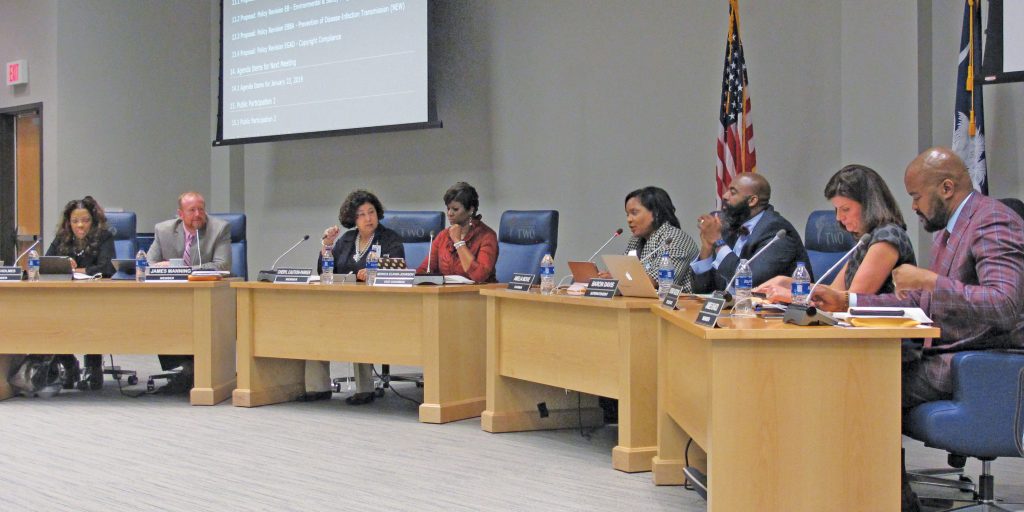
    Richland Two school board members, from left: Teresa Holmes, James Manning, Cheryl Caution-Parker, Monica Elkins-Johnson, Amelia McKie, Superintendent Dr. Barron Davis, Lindsey Agostini and James Shadd III. | Barbara Ball

    COLUMBIA – Despite some members dismissing an ongoing ethics flap as merely a distraction at a meeting last week, the Richland Two school board spent 90 minutes behind closed doors Tuesday night discussing that topic.

    At a special meeting, the board immediately retreated into executive session to receive “legal advice regarding Ethics Act issues.”

    No action was taken after the executive session – some of which was audible in the hallway – and the board promptly voted to adjourn.

    When pressed by The Voice about whether the executive session pertained to an individual member or the entire board, board chairwoman Amelia McKie wouldn’t say.

    “I can’t clarify that any more than what was said in the motion,” McKie said.

    Jay Bender, an attorney with the S.C. Press Association, of which The Voice is a member, said if the board discussed individual members’ ethics issues behind closed doors, the discussion would violate state law.

    “I don’t see any legitimate reason to get advice unless it’s regarding other board members,” Bender said. “If it’s regarding board members with individual ethics problems, I don’t think they can discuss any punishments that may be meted out.”

    During executive session some board member conversations were discernable in the hallway beyond the closed doors to the boardroom.

    Those conversations seemed to focus on violations of individual board members, which Bender said is not permitted under the S.C. Freedom of Information Act.

    The session appeared to become heated at times.

    Board member James Manning, one of two sitting board members with no previously missing ethics forms, wouldn’t comment on the specifics of what was discussed.

    “There was nothing to take action on. It was all just legal counsel,” Manning said.

    Manning noted the issue of ethics is likely to arise at a future board meeting.

    “I would keep an eye on the agenda,” he said.

    That was difficult to do with Tuesday’s meeting agenda, which was buried among four unrelated press releases in an email titled, “Dear reporters and editors, please find attached four news releases from Richland Two…” with no mention of the agenda or the special called board meeting in the body of the email. The agenda also did not appear on the school’s board docs.

    In recent weeks, several board members have come under scrutiny for failing to file various ethics forms required by state law.

    Richland Two parent Rhonda Meisner called upon those board members to resign. At the Jan. 9 meeting, Meisner stated during public input that state law prohibits members from being sworn into office if they haven’t filed Statements of Economic Interest (SEI) forms.

    In the 2018 election, board members James Shadd III, Cheryl Caution-Parker, Monica Elkins-Johnson, Teresa Holmes and McKie failed to file either SEI forms or quarterly campaign disclosure reports by deadlines set in state law, according to the State Ethics Commission.

    Those board members have since filed their forms following a series of investigative reports by The Voice.

    McKie, however, has garnered the most attention.

    In July 2018, the ethics commission fined her $41,000 for failing to file multiple quarterly campaign reports between 2015 and 2018. Those forms were not filed until last week, the ethics commission website states.

    The fine zoomed to $51,750 after McKie failed to pay the first $21,000 of the original $41,000 fine on Dec. 31, 2018.

    In all, McKie filed 16 forms on Jan. 9, 2019, including her 2019 SEI form that isn’t due until March 30. Also on Jan. 9, she filed her first quarterly campaign report of 2019, which was due Jan. 10.

    After the Jan. 8 board meeting, McKie said she planned to issue a press release addressing the ethics issues, but no statement had been released as of press time.

    The status of McKie’s fine remained unclear, however, as the ethics commission, as of Tuesday, listed her outstanding debt at $41,000, the original fine amount, instead of the $51,750, according to the agency’s debtor’s list.


    Barbara Ball contributed to this story.

  • Financials: JWC operating at a loss

    JENKINSVILLE – In person, the Jenkinsville Water Company annual meeting was orderly and efficient, concluding in about 30 minutes and lacking the discord of previous meetings.

    On paper, though, the water company continues to operate at a loss.

    In financial documents distributed at last week’s annual meeting, the water company reported a net operating loss of $21,537 for the fiscal year ending Dec. 31, 2018.

    The water company has reported an operating loss for at least six of the past seven years, according to federal tax returns.

    For 2018, the JWC reported $484,853 in total operating income against $506,390 in operating expenses on its profit and loss statement.

    Figures provided in the document couldn’t be independently verified because the water company’s Form 990 tax returns for 2017 and 2018 were not available for public inspection as of press time.

    JWC president Greg Ginyard insisted that the water company is not operating at a deficit. He attributed the net operating loss to depreciation expenses, which totaled $96,232, according to JWC documents.

    “It’s not a deficit. We’ve had no tax problems,” Ginyard said. “What you saw on the loss was depreciation.”

    Depreciation alone, however, doesn’t fully account for operating losses the JWC has reported in previous years.

    In 2017, the water company reported an operating loss of $107,135 with $93,217 listed for depreciation, depletion and amortization, which still leaves a deficit of $13,918.

    The same was true in 2016, when the JWC reported a net operating loss of $128,783, but depreciation, depletion and amortization accounted for only $93,605, which would still leave a deficit of $35,178, according to tax records.

    Additionally, the water company is continuing to repay loans to the U.S. Department of Agriculture.

    In 2018, rural development loan interest payments accounted for $67,554, the water company’s third greatest individual expense, according to JWC financials.

    Long-term liabilities from USDA loans total $583,590, documents state.

    Fairfield County Councilwoman Bertha Goins, who attended last week’s meeting, said the water company’s financial picture further illustrates why she thinks the county needs a central water authority.

    Fairfield County and the Town of Winnsboro for months have been negotiating the formation of a water authority. Ginyard previously told The Voice he doesn’t support a water authority.

    “We need a regional water service,” Goins said. “With discrepancies over finances and lawsuits, that’s one of the main reasons why.”

    Ginyard says all is well

    At last week’s meeting, Ginyard voiced optimism that the JWC has weaned itself off purchasing water from the Mid County Water Company.

    Previously, the S.C. Department of Health and Environmental Control required the JWC to purchase outside water because it lacked capacity to be self-sufficient, especially in cases of emergency.

    In 2017, the JWC borrowed $800,000 from Co-Bank with the intent to pay for water system upgrades. Terms of the loan weren’t specified in JWC financials.

    Last summer the water company tapped Barwick Plumbing Company LLC to install a new well, awarding a $654,000 contract to the Sumter County firm.

    Mid County water purchases have steadily declined since 2016, falling from $97,539 to $26,623, according to financials provided by the JWC.

    Ginyard said the well is already bearing fruit, saying it’s already producing 400 gallons of water per minute. He estimates once fully operational, the well will produce 140,000 gallons per day.

    “When we put this well in operation, it’s going to be rally great,” Ginyard said. “It’s going to create a savings for us because electricity bills will go down around us. They won’t have to produce as much as they normally do.”

    Still, Ginyard told members the water company is still contractually required to purchase 100,000 gallons of water from Mid County, whether the JWC uses it or not.

    Ginyard also said Mid County imposed three rate increases last year, which he said the JWC absorbed. He told members the contract has no sunset clause, but remained hopeful it could be renegotiated.

    “We’re not using any Mid County water, but we’re paying for 100,000 gallons whether we use it or not,” he said.

  • District budgets $5K bonus for teachers

    Dr. Green and William Frick

    WINNSBORO – Hoping it will help recruit and retain teachers, the Fairfield County School District plans to dole out annual bonuses – $5,000 for educators and $3,000 for district and school staff.

    At its monthly meeting Tuesday night, the board voted 5-1 to award the bonuses. Board member Paula Hartman voted against the measure.

    Hartman said she’s not against bonuses, but felt caught off guard by the bonus proposal. She noted the district previously discussed using surplus funds to commission a salary study.

    “I’ve asked for salaries every year I’ve been on the board, and they don’t give it,” she said.

    At $49,288, Fairfield County’s average annual teacher salary ranks 37th out of 82 districts in South Carolina, according to state report card data.

    Richland 2 ranks sixth at $51,802. Lexington 5-Richland leads at $55,023, while Florence 4 is last at $43,087, report card data shows.

    Hartman also expressed reservations about budgeting money that doesn’t exist yet.

    “I thought this was going to come up in the budget. I didn’t think this was going to come up now,” Hartman said. “I feel like it would be more of an incentive for employees who’ve been here three years and have a commitment. That might keep them here.”

    It will cost the district $2.8 million to fully fund bonuses for 2019. Bonuses would be available to any existing full-time employee, no matter the length of employment, as well as future full-time hires, district officials said.

    The first $1 million comes from a surplus carried over from last calendar year, money Superintendent Dr. Jr. Green has previously stated would be applied to boosting teacher pay.

    Green said during the meeting that the general fund would increase by $1.8 million to cover the rest.

    “I am hoping this inspires people who aren’t part of Fairfield County to be inspired to join Fairfield County,” Green said.

    Board chairman William Frick said after the meeting that the source of the $1.8 million comes from presently unbudgeted surplus funds the district anticipates receiving.

    “There is a forecast that next fiscal year we’ll have an additional $2 million that can be rolled over instead of allocating it toward capital projects as we’ve done,” Frick said. “The idea is to take that entire $2 million to fund this.”

    There are no tenure requirements for the bonuses; Green said he plans to make them an annual perk. He said this is an annual program, adding it would take a major economic downturn to cut bonuses, a downturn he thought was unlikely.

    All employees would be eligible, including district office administrators, though board members said they don’t know if Green would qualify for a bonus since he’s a contract employee.

    If Dr. Green did receive a $3,000 bonus, it would bump his annual salary from $182,287 to $185,287.

    Green also has an annuity contribution of $29,165, though district officials still can’t say whether the annuity is paid from the district budget or by Green personally. The Voice filed a public records request for that information on Dec. 19, 2018, and is still waiting for clarification.

    District officials said Tuesday that a bonus is better than a conventional salary increase because the district and employees aren’t required to contribute a percentage into retirement funds for bonuses.

    However, the federal government taxes most bonuses at 22 percent, according to the Internal Revenue Service.

    That means a school district employee receiving a $5,000 bonus would take home $3,900 after federal taxes. A $3,000 bonus translates to $2,340 after federal taxes.

  • R2 ethics flap prompts call for resignations

    McKie’s Ethics Fine Increases to $51K+
    R2 parent Rhonda Meisner, left, addresses Board Chair Amelia McKie and calls for her resignation. | Michael Smith

    BLYTHEWOOD – Amelia McKie didn’t respond to a public call for her resignation Tuesday in the first Richland Two school board meeting of the year amid mounting ethics fines for the board chair.

    After missing a recent payment deadline, McKie now owes nearly $52,000 to the South Carolina Ethics Commission, an agency spokesperson confirmed last week.

    In July 2018, the commission fined McKie $41,000 as part of an eight-count complaint that said she failed to file quarterly campaign disclosure reports.

    McKie was ordered to pay the first $20,000 by New Year’s Eve. She missed that deadline, meaning the total fine increases to $51,750, according to the complaint.

    “No payments were made prior to Dec. 31, 2018 and the fine amount for that particular order reverts as outlined in the order,” an ethics commission representative said via email.

    Richland Two parent Rhonda Meisner called for McKie’s resignation while speaking during the second public comment period at Tuesday night’s meeting.

    “I would respectfully request that you resign from the school board,” Meisner said from the lectern. “I think that as a person you’re a very nice person, you’re very sweet, but unfortunately you put the community at risk in my opinion.”

    Meisner pointed to state law, which says candidates who’ve not filed Statements of Economic Interest, or SEI, forms cannot be legally seated until they do.

    Section 8-13-1110 of state law says no public official “may take the oath of office or enter upon his official responsibilities” unless an SEI form is filed.

    State law also says SEI forms must be filed by March 30 each year.

    Board members with previously unfiled SEI forms include James Shadd III, Teresa Holmes and McKie. All have since filed SEI reports following investigative reports by The Voice.

    Holmes and McKie filed their missing SEI forms shortly after The Voice contacted them on Dec. 4, according to the ethics commission’s online database. Shadd III filed his 2017 and 2018 forms on Jan. 7, 2019.

    Meisner said any recent past votes taken by those board members should be invalidated because SEI forms hadn’t been filed when they were sworn in.

    “There are others of you on the board that are in the same situation,” she said. “I would ask that you look at your situation and resign.”

    Board members respond

    Board member Lindsay Agostini, during comments by board members, said, “My integrity and my character are very important to me.” She noted that The Voice’s investigation made it clear that she and James Manning were the only two sitting board members who had filed all their eithics forms on time. Agostini ended her comment saying, “A premier district deserves a premier board.”

    Other Richland Two board members didn’t directly address Meisner’s comments or missing ethics filings listed in public records during the business portion of Tuesday’s meeting.

    However, several made veiled comments from the dais amid the ethics filing fallout. At least two made references to “special interest” groups or attempts to “undermine the district.”

    In a prepared statement, McKie thanked teachers and district staff, encouraging them to “stay the course regardless of the slings and arrows that come your way.”

    “We don’t need to let side things distract us,” board member Teresa Holmes said. “We’re here for the business of educating children. That’s what I’m here for.”

    After the meeting, Holmes declined to comment on McKie or Meisner’s call for board member resignations. She did, however, address what happened with her own 2018 SEI form.

    “I’m brand new to this, I had no idea,” Holmes said. “I’m glad that you actually did the story. Nobody tells you these things when you’re running.”

    Holmes’ 2019 SEI form has already been filed, according to the ethics commission website.

    Others, including board members Monica Elkins-Johnson and Cheryl Caution-Parker, had previously missing quarterly campaign reports. Those reports were filed in December, ethics filings state.

    McKie’s ethics record, though, has the most gaps.

    As of Wednesday morning, McKie still hadn’t filed a campaign disclosure report since here last one in January 2015, according to the ethics commission database.

    An investigation by The Voice also found inconsistencies in her SEI and lobbyist forms, which listed different amounts of income in 2015 and 2016.

    McKie said she soon plans to issue a statement addressing the ethics filings.

    “I’ve been working with the ethics commission to clear up some things that haven’t been accurate, and I’m going to issue a press release about that,” she said.

    If McKie’s fines go unpaid and unresolved, the ethics commission has strategies it can employ to collect.

    In 2015, the commission partnered with the S.C. Department of Revenue to increase ethics debt collection efforts through the DOR’s Setoff Debt Governmental Enterprise Accounts Receivable, or GEAR, collection programs.

    Debtors who have reached “bad debt status” are referred to the Department of Revenue, according to the Ethics Commission website.

    The Department of Revenue is authorized to garnish wages and tax refunds, or also impose liens to satisfy debts.

    Richland 2 board members are responsible for a $273.9 million annual budget.

    In 2017, school district millage accounted for more than two-thirds of a typical Richland 2 property tax bill, according to a report by the S.C. Association of Counties.