Tag: slider

  • Crickentree flies past first hurdle, 7-1

    COLUMBIA – Crickentree residents appeared before the Richland County Planning Commission on Monday to protest the rezoning of the failed Golf Course of South Carolina from Traditional Residential Open Spaces (TROS) to medium density residential use (RS-MD). The golf course shares a border with Crickentree.

    After hearing from 13 of approximately 75 Crickentree residents in attendance, the Commission voted 7-1, against the County planning staff’s recommendation for the Commission to approve the rezoning.

    But the win is only the first step in the residents’ effort to defeat the rezoning bid. The Commission’s recommendation of disapproval now goes to County Council which will hold three readings (votes) on the issue.

    Foreclosure

    Foreclosed on last August, the golf course property is now owned by Texas investment firm E-Capital.  At issue is whether council will leave the TROS zoning and the rural environment of Crickentree in place or replace it with a zoning classification (RD-MS) that county staff says complies with the county’s comprehensive land use plan and that allows up to 600 or so homes to be built on 8,500 square foot lots.

    Residents argue that while the proposed medium density zoning might comply with the comp plan, medium density and its uses are not consistent with that of the established and proposed developments of adjacent and nearby subdivisions.

    The TROS ordinance was passed by Council in 2007 when golf courses in Richland County began to struggle financially, and developers were eying them for residential development. The purpose of TROS, according to the ordinance, was to ensure “the preservation of conservation, recreation, and/or open space; and to lessen the diminution of property values from the loss of open space commonly provided for in a community; and to provide opportunities for improved public and/or private recreation activities; and to provide for a community-wide network of open space, buffer zones and recreation spaces.”

    For those reasons, residents speaking on Monday asked Commissioners to leave the TROS zoning in place.

    Attorney Robert Fuller, representing E-Capital, laid out a plan for the property to be developed under medium density zoning, but promised that no more than 237 homes would be built, not the 600 or so allowable under that zoning classification. He also promised there would be a 150-foot tree and landscape buffer separating the proposed new homes from the large-lot Crickentree.

    Fuller said of the 237 homes, only 90 would be built on 8,500 square foot (medium density) lots and that the remaining 140 would be built on 12,000 square-foot (low density) lots.

    Commissioner Heather Cairns interrupted Fuller’s presentation to clarify what she said was the commissioners’ responsibility in considering the request.

    “I want to remind us [commissioners] that while a plan is being given to us [by Fuller], that [plan] is not what we are to consider,” Cairns said. “What we are [to consider] is, ‘Should 186 acres be rezoned into something that’s allowing 8,500 square-foot lots over its entire existence?’”

    She said the Commission cannot approve zoning based on a promised development plan.

    “I appreciate the drawings,” Cairns said to Fuller. “but that is not something we can even decide.”

    Plans and Promises

    Residents addressing the Commission agreed.

    “Proposed and planned are the key words,” resident Carol Lucas said. “We can’t bind them [to those limitations]. A developer could purchase the property and build [more] homes. “

    “The promises made to the community [by the land owner] are not enforceable by the county,” Deborah Real reminded Commissioners.

    Resident Russell St. Marie challenged Fuller’s promise for how the property would be developed.

    “E-Capital is on record that they have no intention of developing this property,” St. Louis said. “They merely want to change the zoning and sell it to a developer.”

    Resident Iris St. Marie said that when she and her husband purchased their golf course lot in Crickentree, the 2015 comprehensive land use plan presented a very different 20-year future.

    “It likened TROS to conservation. Subdivisions that were planned for commercial or residential development were discouraged in TROS,” St. Marie said.

    Arguing for TROS

    Many of the residents claimed that the current TROS ordinance indicates that the County wants the land to remain as recreational, open space, that TROS is a protective ordinance.

    Resident Michelle Kelly went further, saying that TROS was meant to protect the property owners and surrounding property values.

    Iris St. Marie referenced an article that she said quoted the County’s zoning director Geonard Price as saying: “The intent for TROS was not to include developable land, but to protect the golf course within the community.”

    Commissioner David Tuttle disagreed, saying that he was in the room when TROS was being worked out. He said prior to TROS, if a golf course was no longer used for a golf course, it automatically reverted to the underlying (previous) zoning without going through a notification or rezoning process.

    “The protection implemented by TROS was to create a barrier whereby you have to go through certain notification and rezoning steps to rezone,” Tuttle said. “It was never meant to be a permanent zoning.”

    “So was TROS designed to protect golf courses?” Commission Chairman Stephen Gilchrist asked Price.

    After a pause, Price responded, “I’m unable to answer that.”

    Gilchrist later asked Price if TROS was designed to protect open space.

    “Yes, according to the purpose statement [of the TROS ordinance],” Price said, quoting from the statement, “…in order to insure preservation of conservation, recreation and open space.”

    Cairns also clarified that TROS pertains to golf courses with a neighborhood component, not to golf courses in general. While Cairns said she could support some level of residential zoning for the golf course, she could not support the level of medium density.

    “When other people’s property that you reap benefit from changes, it’s a bad day,” Cairns said.

    Commissioner David Tuttle made a motion to approve the requested zoning, but that motion died for lack of a second.  Commissioner Beverly Frierson then made a motion to recommend that Council disapprove the requested RS-MD zoning. That motion passed 7-1 with Tuttle voting against.

    The next meeting is a public hearing before County Council set for April 23 in County Council chambers at 2020 Hampton Street. That is the only meeting where residents will be allowed to address the issue.

  • Police shut down planned nightclub


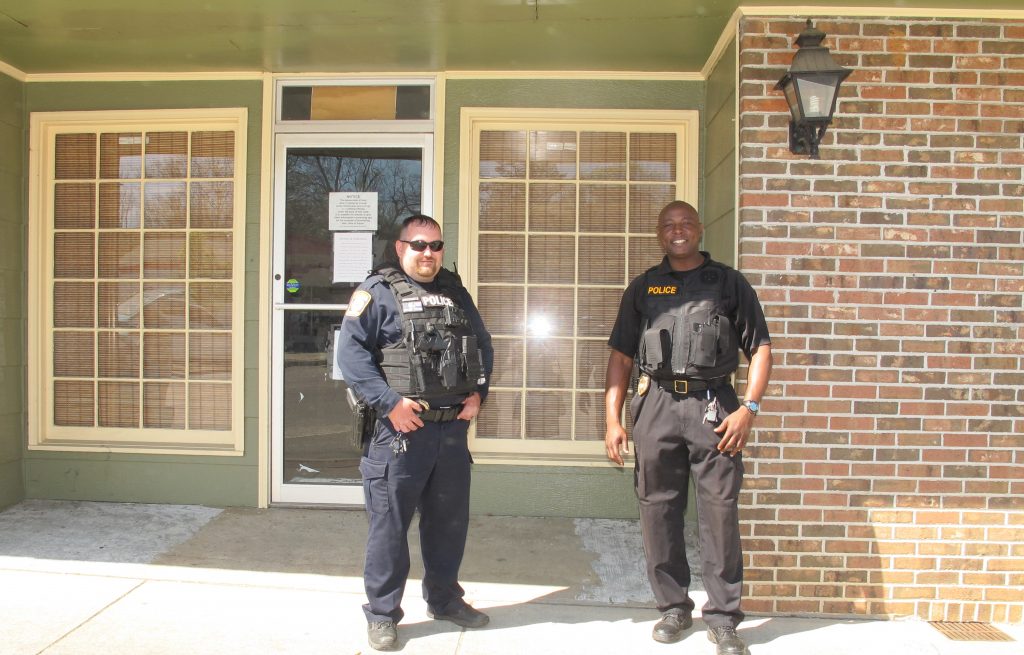
    Officer Adam Bailey and Captain John Durham stand guard as the restaurant is secured. | Photos: Barbara Ball

    WINNSBORO — It could be last call for a Winnsboro restaurant that apparently had plans to operate as a nightclub, according to police records.

    Town police have temporarily shut down Winnsboro Bar and Grill, in the 100 block of North Congress Street, which previously operated as a barbecue restaurant.

    More recently, though, the business started promoting a large nighttime grand opening party, prompting citizen complaints to police, said Winnsboro Police Chief John Seibles.

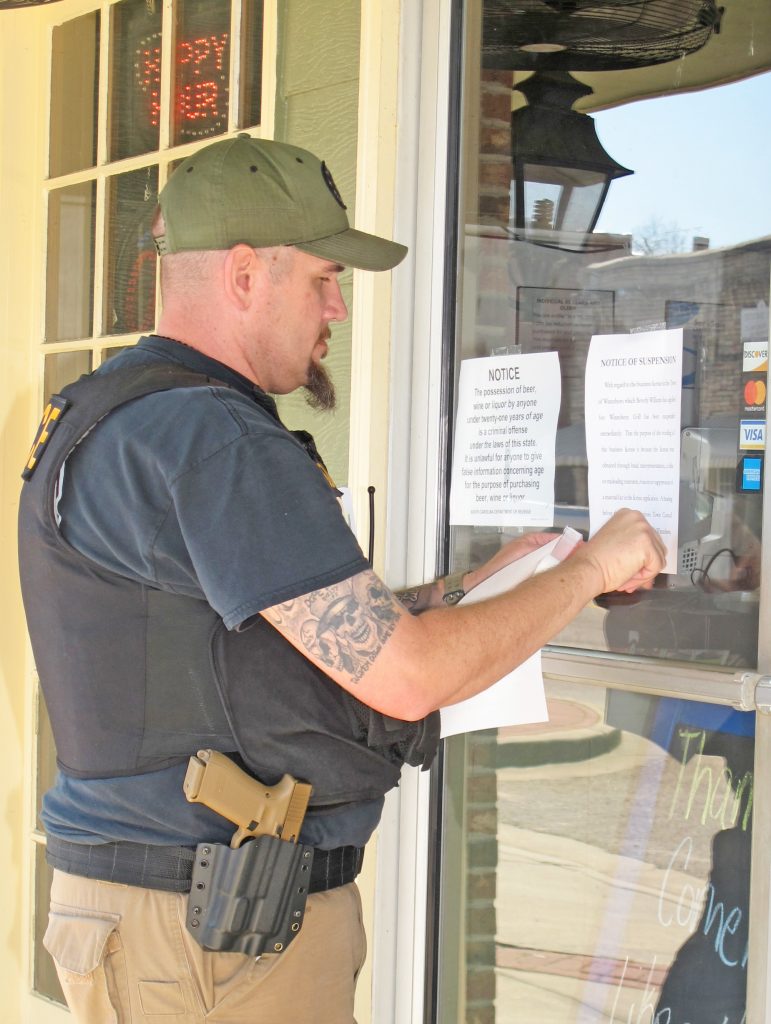
    WDPS Investigator Michael Carroll posts a notice of suspension on the front door of the former Winnsboro Bar & Grill in downtown Winnsboro

    “When the community is concerned about something, naturally I’m already concerned,” he said.

    Seibles said the department also learned of the party plans through social media, leading police on Friday to respond to the business. A notice of suspension was placed on the door Friday morning.

    “The purpose of the voiding of the business license is because the license was obtained through fraud, misrepresentation, a false or misleading statement, evasion or suppression of a material fact in the license application,” the notice states.

    A hearing concerning the suspension has been scheduled for April 16 at the Winnsboro Town Council meeting, the notice continues.

    According to a police report, Winnsboro Bar and Grill stated on its business license application that alcohol would not be served, nor would coin operated machines be located on the property.

    Police, however, said the opposite was true.

    “Upon visiting the business, I could clearly see open bottles of alcohol in the business as well as coin operated pool tables,” a Winnsboro police report stated.

    Images posted to the business’ Facebook page also display large quantities of liquor bottles as well as two pool tables.

    The Winnsboro police report identifies James Randolph as the person opening the Winnsboro club.

    “The business is clearly being advertised as a night club and had fraudulently obtained a business license as a grill,” WDPD investigator Michael Carroll stated in the police report. “I checked the public Facebook section for Mr. Randolph and did locate several posts and videos announcing a night club and alcohol to be consumed on the property.”

    Police contacted the property owner, who told investigators that he had no idea this was occurring at the business. He asked law enforcement to remain on site for his safety while he had the locks changed, the report said.

    Randolph was the proprietor of the former Kandyland nightclub in Columbia that the Richland County Sheriff’s Office shut down a few months ago, the report continues.

    Kandyland had been operating as an adult entertainment venue, according to media reports. In December 2018, a shooting death occurred there, and remains one of four unsolved murders from 2018.

    Seibles said Winnsboro police have not received any indications that the Winnsboro nightspot planned to operate as an adult entertainment establishment. Seibles also said police have not received any other criminal complaints about the business. He said he wants things to stay that way.

    “It seems to me like it [the club] was targeting a young crowd of people,” Seibles said. “It was put out as a humongous party and along with that comes a lot of problems. Naturally we’ve got to be proactive.”

  • Dogs attack, maul Winnsboro man

    WINNSBORO – A Winnsboro man was mauled Saturday by two dogs who were reportedly running loose on the former Mack Truck property off U. S. Highway 321 about 7 a.m. on Friday.

    A dispatcher notified Sheriff’s deputies that a man was on the ground with two dogs on top of him and another man was also on the ground.

    When deputies arrived, one man was trying to control a Rottweiler while another Rottweiler was being restrained on a leash by a third person in a car.

    John Emory Dinkins, Jr., 45, was lying on the ground with what deputies described as puncture wounds and deep bite marks where the skin was missing from his head, neck, back, both arms and both legs.

    EMS arrived and transported Dinkins to Palmetto Richland.

    Before he was transported, Dinkins reportedly told officers that he was walking in the north bound lane on U.S. Highway 321, going north, then crossed over to the south bound lane where some friends were to pick him up.

    Dinkins said that when he got almost in front of the Mack Truck building, he saw two dogs running towards him.

    He said someone was calling for the dogs to stop, but they kept coming and attacked him just south of the entrance to the plant, on the shoulder of the road. Dinkins said the dogs took him to the ground and began biting him. He said he tried to fight them off, but couldn’t, the report stated.

    Deputies on scene called the Fairfield County Animal Control who took the dogs to the county’s animal shelter.

    The dogs’ owner, Kenneth Floyd Anderson, 44, reported that he had brought the dogs to the property to exercise them. Anderson told deputies a different version, that Dinkins had approached him, causing the dogs to attack Dinkins, according to the report.

    As Anderson was trying to pull the dogs off and Dinkins was trying to fight them off, a passer-by came to their rescue and helped restrain the dogs, the report stated.

    The following day, deputies arrested Anderson and charged him with Allowing Dogs to Run At Large.

    Anderson was released on a $158.75 personal recognizance bond.

  • Supers take home top pay, benefits

    COLUMBIA – Public education isn’t the most profitable profession in South Carolina.

    For a select few, however, the field can be quite lucrative.

    In a state where the governor earns $106,078 a year and agency heads like the state superintendent of education make $92,007, many district level school superintendents rake in two to three times that amount.

    That’s the case in Fairfield and Richland counties, where superintendents take home considerably more compensation than state agency heads accountable to 5 million South Carolina residents.

    Throw in generous retirement plans, copious car allowances, travel and other high end perks, and total superintendent annual compensation pushes well past $200,000. For Fairfield Superintendent Dr. J. R. Green, with responsibility for eight schools, it’s in the neighborhood of $225,000. For Richland Two Superintendent Dr. Baron Davis, with the responsibility of 32 schools, the pay and benefits bring in about $260,000.

    And it’s all subsidized with taxpayer money.

    Meantime, teacher pay has continued to lag.

    In 2018, Fairfield County School District teachers averaged $49,288 and Richland Two teachers averaged $51,802, South Carolina district report cards state.

    Teachers’ salaries in both districts fall well short of the national average of $58,950, according to figures from U.S. Department of Education.

    Swelling superintendent pay has become a nationwide trend, with some superintendents being paid close to $400,000, according to a January 2019 report by the American Association of School Administrators, or AASA.

    Salary Rises, Attendance Falls

    “Often times the superintendent is the highest paid member in the community,” Noelle Ellerson, an associate executive director with AASA, said in a video on the group’s website.

    Since 2012, salaries of superintendents in the Midlands have risen considerably faster than student growth.

    Green has seen his base salary climb 23 percent since 2012, rising from $140,000 to $182,287, contract documents show. In the same period, the district’s student population has dropped 15 percent, decreasing from 3,108 to 2,641, according to South Carolina school report cards.

    Richland Two’s student population has increased since 2012, but at a notably slower rate than superintendent salaries, public records show.

    Davis’ starting base pay was $186,312, according to his initial superintendent contract dated July 25, 2016. He now earns $191,904. The pay increase is more than double the Richland Two student enrollment growth of 9.85 percent (25,964 to 28,503) in the same period.

    Davis’ contract says as of July 1, 2018, he was entitled to annual salary increases equal to the “average rate of percentage increase” that the district’s certified employees receive.

    The board awarded him a 2.5 percent increase in September 2018.

    Green is among the highest paid superintendents nationwide for districts of Fairfield’s size, according to the AASA report. His base salary of $182,287 is well above the AASA median of $167,444 for male superintendents in districts with 2,500 to 9,999 students. But Fairfield’s 2,641 student population is near the bottom of that AASA range of student enrollment.

    Green’s pay is closer to the 75th percentile of education chiefs who make at least $193,000, according to the AASA report.

    Davis’ base salary technically falls below the median for large districts based on AASA findings. However, the AASA classifies any district with more than 25,000 students as large, lumping Richland Two, at 28,503 students, with the nation’s largest districts, many of which have between 100,000 and 1 million students. These upper echelon districts pay between $340,000 and $400,000 a year, according to U.S. Department of Education figures.

    According to a March, 2018, report in the New York Daily News, the New York City school district, the nation’s largest, pays its superintendent $353,000, about $100,000 more than Davis is paid. In South Carolina, the state’s largest three districts – Greenville (75,471 students) Charleston (48,937) and Horry (44,669) – are substantially larger than Richland Two and pay their superintendents around $225,000 a year in base pay, according to S.C. Ethics Commission filings.

    Defending Supers’ Pay

    William Frick, chairman of the Fairfield County school board of trustees, said Green is fairly compensated. He said Green brings a long list of qualifications to Fairfield County.

    “[Superintendents] are paid well, but they have a difficult job to do,” Frick said. “They are compensated accordingly.”

    Richland Two board chair Amelia McKie couldn’t be reached for comment about Davis’ compensation package. However, in a Sept. 15, 2018 letter summarizing Davis’ performance, McKie spoke very highly of him.

    “You have done an excellent job developing the District’s culture and creating the expectation that the District and all of our schools will be ‘premier,’” McKie wrote. “You exhibit excellence at all times, and we would like to see all departments throughout the District reflect your commitment to excellence, professionalism and customer service.”

    Evaluating Green

    The board voted on Dec. 18 to extend Green’s contract to 2024. Board member Paula Hartman raised concerns about extending it so far into the future.

    “I really don’t understand the reasoning – not saying there are any objections – but most districts have three-year contracts,” Hartman said. “I don’t understand why we continue to keep it at six years.”

    Frick said prior to hiring Green, the district has had a history of struggling to retain superintendents.

    “I’m happy that we have the opportunity to have an amendment to extend it out one more year. I’m glad we can essentially tie him down for another year,” Frick said.

    Green said he views the board’s extending of his contract as an affirmation of his performance.

    “When the board says it wants to extend my contract, that says you’re interested in having me for the long haul,” Green said.

    The superintendent went on to say that a year ago, he put a letter into his file saying that regardless what the board did, his salary should remain the same.

    “I felt that I was fairly compensated,” Green said. “I wanted the focus at this point to be on salaries of the staff.”

    However, Green’s contract states that he is automatically entitled to salary and benefit increases every time his contract is extended, provided he receives at least a “satisfactory” rating on his performance evaluations.

    The superintendent evaluation form the Fairfield board of trustees currently uses, and which contains only five two-word categories to be evaluated, doesn’t feature “satisfactory” as a rating, but instead uses “needs improvement,” “proficient” and “exemplary.”

    In December 2018, Fairfield board members rated Green as “exemplary” in almost every category. One board member rated Green as proficient in Leadership and Learning Environment, but exemplary in the others.

    “I enjoy working with Dr. Green,” one board member wrote. “We need make it harder [sic], going too good!”

    Green’s raises started at 3 percent in 2013, increased to 4 percent in 2014, and rose to 5 percent in 2015, documents show.

    Green can now receive an automatic 5 percent pay increase every year forward so long as he receives at least a “satisfactory” rating, according to his contract.

    Neither his salary or benefits are tied to student performance, test scores or enrollment.

     R2 Evaluations Mixed

    Davis’ second contract, a three-year contract, took effect July 1, 2017 and expires June 30, 2020. In September 2018, after his most recent annual review, Davis’ contract was extended a year to 2021 to keep it at three years. Davis received generally positive reviews during his evaluation.

    Collectively, the board gave Davis a score of 142 out of 150 possible points, earning him a “distinguished” rating, the highest rating possible.

    Two board members opted to submit individual evaluations.

    Board member James Manning gave Davis a perfect score of 150, according to district documents obtained through the S.C. Freedom of Information Act.

    Board member Lindsay Agostini was more critical.

    Her individual evaluation marked Davis down in several areas, characterizing him as defensive, antagonistic and expressing “difficulty recognizing a problem or concern with constructive criticism,” evaluation forms state.

    One area of defensiveness Agostini raised involved a disagreement over the elimination of keyboarding as a class.

    Agostini also said Davis gave “antagonistic responses” during a bond referendum presentation at an event sponsored by the Bethel-Hanberry Alumni Association.

    “The following day, prior to the start of executive session on August 28, 2018, the superintendent acknowledged and apologized to the board for his actions,” the evaluation stated.

     Benefits Boost Pay

    Superintendent compensation extends well beyond base salary.

    In Fairfield, Green’s original contract called for the district to provide an annual annuity contribution equal to 4 percent of his salary, which in 2012 amounted to $5,600.

    In 2014-2015, the board amended Green’s contract to increase the annuity contribution to 8 percent. Now it automatically increases 2 percent every year the contract remains in effect.

    Today the district pumps $29,165 per year into Green’s annuity, documents state.

    Besides the usual perks of paying for moving expenses, other benefits include $100,000 of term life insurance, free cell phone use and free use of an automobile that’s fully maintained by the district. The invoice for the last full maintenance on his automobile last fall came to $1,800 according to district records.

    The district also pays Green’s car insurance, and he receives two weeks of paid vacation on top of legal holidays and other school holidays. The district also paid for his professional memberships into the AASA, the South Carolina Association of School Administrators (SCASA) and other professional groups and local service clubs.

    In the event the board terminates the contract, Green is entitled to 18 months pay which would currently come to about $275,000.

    R2 Benefits Add Up

    In addition to Davis’ base salary of $192,104, the district makes an annual retirement contribution of $43,261 on Davis’ behalf. The district also pitches in $6,717 in annual annuity payments calculated at a rate of 3.5 percent of his annual salary based on a “satisfactory” evaluation, documents state.

    Davis essentially doesn’t pay for travel. Richland Two covers $18,000 a year in travel payments for Davis, covering commutes to virtually anywhere in the Midlands, essentially backfilling his take home pay with compensation not available to most other employees.

    Davis can also request reimbursement from the district for travel outside the Midlands or out of state if it’s for reasons benefiting the district.

    Other perks include $760 in payments for a $250,000 term life insurance policy and $768 for cell phone use, both funded annually by the district.

    Counting these benefits, Davis’ total compensation is in excess of $261,000.

    Beyond that, Davis receives other perks – 20 vacation days per year, plus legal and other holidays recognized by the district. He’s also entitled to receive pay for unused sick leave, annual leave and vacation days in an amount that’s “consistent with Board policy.”

    In addition, the district pays for Davis’ memberships in the AASA, SCASA, the Rotary Club, “and any other reasonable and customary professional group memberships for which the Superintendent believes is necessary to maintain and improve his professional skills.”

    Davis’ contract has been amended twice.

    In July 2017, his monthly automobile allowance increased by $1,500 a year.

    A year later, Davis’ salary increased to its current figure. His annuity contribution also rose from 1.5 percent to 3.5 percent of his annual salary, and this September it will increase again to 6 percent.

    Salary, Benefits and Ethics

    Documents showing the salaries and compensation of Green and Davis were obtained through S.C. Freedom of Information Act requests.

    In requesting the documents, The Voice asked not only for both superintendents’ salaries, but also their contracts, any amendments, and documents listing total compensation, including retirement benefits, vehicle allowances and other supplemental income backfilling personal expenses a typical person would ordinarily incur.

    Green’s contract has been amended six times in seven years (since 2012), most recently in December 2018. Dr. Davis’ contract has been amended twice during his nearly three-year tenure.

    S.C. superintendent salaries are available for public inspection on the S.C. Ethics Commission’s website.

    State law requires superintendents to file annual Statements of Economic Interest, or SEI, forms. The forms are supposed to document the “source, type, and amount or value of income received from a governmental entity by the filer or a member of the filer’s immediate family,” according to the ethics commission website.

    Citing state law, an ethics commission spokesperson further defined “income” as “anything of value received, which must be reported on a form used by the Internal Revenue Service for the reporting or disclosure of income received by an individual or a business.

    “Income does not, however, include retirement, annuity, pension, IRA, disability, or deferred compensation payments received by the filer or filer’s immediate family member,” the law states.

    Some superintendents are thorough in their filings.

    Burke Royster, the superintendent of Greenville County Schools, and one of the highest paid education chiefs in the state, reported his $247,000 salary and several benefits on his SEI form.

    Other superintendents, however, don’t report their total compensation to the ethics commission.

    On his SEI forms, Green only reported his base salary from year to year. He didn’t list any annuity payments, his district-provided automobile or other perks.

    Davis listed his travel compensation, but nothing relative to retirement payments.
  • Update: R2 board member claims harassment

    Bender: “Public officials have to expect feedback from constituents.”

    COLUMBIA – Another spat involving a Richland Two board member and law enforcement is further fueling criticisms of elected officials already marred by mounting ethical and legal issues.

    Columbia area resident Gus Philpott is identified as the subject in a harassment complaint he says Richland Two board member Teresa Holmes recently filed with the Richland County Sheriff’s Office.

    In recent public meetings, Philpott has called for Holmes and board chair Amelia McKie to step down from their seats for failing to file Statements of Economic Interest, an ethics form required by state law.

    South Carolina elected officials are required by law to file SEI forms before taking the oath of office. Violations are punishable by up to 30 days in jail or a $5,000 fine, according to the S.C. Code of Laws.

    Instead, it was Philpott who recently found himself facing a potential legal entanglement.

    “I was home Thursday afternoon around 3 o’clock when the phone rang,” Philpott said. “[A sergeant] called me from the sheriff’s department and he told me that he had a report about harassment that had my name in it.”

    Philpott met deputies at the sheriff’s office. After hearing Philpott’s side, deputies told him that he didn’t commit harassment, Philpott said, and was not charged.

    Holmes declined to comment when asked why she filed the report.

    “When there are legal issues or potential pending further legal issues or additional actions pending, I have been advised not to comment by my attorney,” Holmes said. “The public needs to know that I am in compliance with the State of South Carolina and I am not now or never have been in danger of going to jail nor facing a $5,000 fine as alleged.”

    In a post on The Voice’s website, Philpott wrote: “While filing her Statement of Economic Interests on Dec. 4, 2018, did get her into good standing with the S.C. Ethics Commission, it did not validate the oath of office that she took on Nov. 13, 2018. She must now take the oath of office.”

    In response to a request from The Voice for the police report that Holmes filed, the sheriff’s office provided a heavily redacted report that shielded virtually all information about the complainant and subject from view.

    Asterisks fill the fields normally reserved for the complainant’s and subject’s name, phone number, age, gender and ethnicity.

    Jay Bender, a media law attorney representing the S.C. Press Association, said there’s no legitimate reason to redact an elected official’s name from an incident report, especially when it’s the official who filed it.

    “You don’t lose all of your rights when you become a public official, but you certainly lose the right to be anonymous,” Bender said. “You certainly lose the right to file a criminal complaint because you don’t like what someone is saying.”

    Bender further said it’s “nonsense” for a public official to file a harassment report against a constituent attempting to discuss public policy matters.

    “All he’s doing is calling on a public official to follow the law,” Bender said. “When you offer yourself for public office, you have to expect feedback from your constituents.”

    Legal issues have haunted Richland Two board members since December 2018 when The Voice began investigating unfiled ethics reports by a majority of members.

    Six of seven board members failed to file either quarterly campaign finance reports or SEI forms, public records state.

    A Richland Two board member has also been criminally charged following an altercation that occurred shortly after the Jan. 22 board meeting adjourned.

    Board vice chair Monica Elkins- Johnson has been charged with disorderly conduct. She remains free on bond and a trial date hasn’t been set.

    Police reports state that the suspect was yelling, cursing and issuing threats. A sheriff’s office news release stated that Elkins-Johnson “did attack several individuals,” and cursed and threatened them.

    At the March 12 board meeting, a week before the harassment report was filed, Holmes said she has  taken responsibility for not filing her SEI forms on time.

    She went on to say she thinks board member ethics issues have become sensationalized.

    “I’m not going to be one of those board members that sits by idly and accepts when things are done for personal reasons, or things are being done to be sensationalized,” she said. “I don’t like being used for personal reasons of other people.”

    The harassment report states the incident occurred between March 11 and March 20. The report does not specify how anyone was harassed.

    “C/V (School Board Member) came into the RCSD to report that a man that has approached her at several Richland County School Board meetings is harassing her,” the report states. “C/V said she feels threatened by subjects [sic] behavior.”

    The report accuses Philpott of approaching the board member at meetings and also by sending her several emails that attack her.

    Philpott said he’s personally spoken to Holmes only once at a board meeting and described the conversation as cordial. He noted he only emails the entire board, and not any member individually.

    “If they are in a public place and at a public meeting, they have no expectation of privacy,” Philpott said.

    Philpott said ethics compliance is important because board members handle heaps of taxpayer money. He also said their votes impact non-monetary matters, citing recent 4-3 board votes on student appeals.

    At a meeting in February, the board also voted 4-3 against a proposed policy that would sanction board members when there’s “cause.” Holmes and McKie voted against the measure.

    Philpott said those votes would’ve flipped the other way had the board followed state law by not allowing Holmes or McKie to serve for not filing 2018 SEI forms by the March 30 due date.

    Neither filed their forms until December 2018, S.C. Ethics Commission records show.


    R2 board member files harassment report with Sheriff’s office against Blythewood resident

    COLUMBIA – A female member of the Richland Two school board has filed a harassment complaint against a private citizen who’s previously criticized board members for violating state ethics laws.

    Blythewood area resident Gus Philpott said the Richland County Sheriff’s Office telephoned him last week to notify him of the complaint.

    “I was home Thursday afternoon around 3 o’clock when the phone rang,” Philpott said. “[A sergeant] called me from the sheriff’s department and he told me that he had a report about harassment that had my name in it.”

    Philpott said he went to the sheriff’s office, where he spoke with two deputies who asked him to give his side of the story. He said they later told him he didn’t commit harassment and he wasn’t charged.

    All information about exactly who filed the report is hidden from the public in the report. Asterisks fill the fields normally reserved for the complainant’s name, phone number, age, gender and ethnicity.

    Philpott believes Richland Two board member Teresa Holmes filed the report.

    At previous board meetings, Philpott, among others, has called for Holmes and board chair Amelia McKie step down from the board for failing to file Statements of Economic Interest, an ethics form required by state law to be completed before a person elected to the school board can take office.

    Jay Bender, a media law attorney representing the S.C. Press Association, said there’s no legitimate reason to redact an elected official’s name from an incident report.

    He said it’s especially egregious when an elected official files a report against a constituent over political disagreements.

    “You don’t lose all of your rights when you become a public official, but you certainly lose the right to be anonymous,” Bender said. “You certainly lose the right to file a criminal complaint because you don’t like what someone is saying.”

    Holmes declined to comment when asked why she filed the report.

    “When there are legal issues or potential pending further legal issues or additional actions pending; I have been advised not to comment by my attorney,” Holmes said.

    3/26/19

  • Crickentree residents to plead case before PC

    BLYTHEWOOD – A request to rezone the former Golf Course of South Carolina property from Traditional Residential Open Space (TROS/RURAL) to Medium Density (RS-MD) is set to be heard by the Richland County Planning Commission on Monday, April 1, at 3 p.m.

    The property is owned by Texas investment firm E-Capital which purchased the mortgage on the now foreclosed golf course last August. The 183-acre property consists of two parcels and borders the Crickentree subdivision with access to Langford Road. Cricketree subdivision is accessed off Kelly Mill Road.

    Attorney Robert Fuller, representing Texas investment firm E-Capital, is expected to ask the Planning Commissioners to recommend MD zoning to Richland County Council with the promise to build only 249 homes. That number is down from 480 homes he proposed last fall.

    But at a joint meeting of the residents and E-Capital in February, Richland County Zoning Administrator Geonard Price explained that no matter how few homes the developer promises to build, he will be allowed to build up to 949 homes on the property under the requested MD zoning if it is approved.

    E-Capital representatives have told residents that E-Capital does not plan to develop the property, but sell it to a developer.

    Crickentree neighbors, who have met on three occasions with E-Capital since last Fall, say they fear the rezoning to higher density  will lower the value of their homes and increase what they say is already intolerable traffic congestion in the Blythewood area.

    The County’s administrative planning staff (employees) have recommended that the Planning Commissioners, who are appointed by Council, approve the rezoning.

    According to the planning staff’s zoning district summary, the minimum lot area for RS-MD zoning is 8,500 square feet. Based on a gross density calculation, the maximum number of units for the site is approximately 949 dwelling units.

    The planning staff, in recommending approval of the RS-MD zoning for the golf course, states that the proposed zoning is consistent with the 2015 County Comprehensive Plan that designates this area as Neighborhood Medium Density.

    However, the planning staff also concludes that approval of the request for RS-MD zoning may promote a housing density that is not consistent with that of the established and proposed developments of the adjacent and promote subdivisions (Hunters Run, The Park at Crickentree and Crickentree.

    Planning Commission’s vote to approve or disapprove will only be a recommendation to County Council which will then hold a public hearing and first vote on April 23. This is the only time residents will be allowed to speak to the issues. If the vote passes to rezone the property, there will be two more votes in May and June.

    To address the Commission at the April 1 meeting, citizens should arrive about 15 minutes early (12:45 p.m.) to sign up on the speakers list, ‘for’ or ‘against’ the rezoning. No one can sign up after the sign-up sheets are picked up.  The meeting is held in Council chambers in the County building at 2020 Hampton Street in Columbia. For more information, call the County ombudsman at 929-6000 to direct your call to the planning staff or Concerned Citizens of Crickentree at 803-719-1242 or visit SaveGolfCourses.com

  • Update: Winnsboro man kills self after SLED arrives

    WINNSBORO – As the Fairfield County Sheriff’s Department assisted the South Carolina Law Enforcement Division (SLED) with serving fraud warrants on a Fairfield County man, deputies say the man put a gun in his mouth and pulled the trigger.

    John Wayne McCord, 64, who lived near the intersection of Highway 321 and Broom Mill Road in Fairfield County, died from a self-inflicted gunshot at his home shortly after 1 p.m., Saturday, March 22, Fairfield County officials report.

    As SLED officers arrived at two homes behind a brick wall in the Candlewood section of Fairfield County, they stated that they saw a man fitting McCord’s description back a white Ford pickup truck from one of the houses to the other, then go inside.

    “As we pulled into the yard and exited our vehicles, a female came out of the house, stating that, ‘John is inside,’” a Sheriff’s investigator reported.

    When a SLED agent called for the man to come outside, the report states, the man walked down a hallway in the house to another room, slamming the door shut. Officers report they broke through the door and found McCord sitting on a sofa with a shotgun under his chin.

    A short time after a SLED agent reportedly tried to convince McCord that the warrants “weren’t that bad,” McCord pulled the trigger, shooting himself in the head, the Sheriff’s report stated.

    After EMS arrived, law enforcement officials walked to the other house and spoke with McCord’s wife and notified the coroner.


    Fairfield County man dies from self-inflicted gunshot wound

    WINNSBORO – Shortly after 1 p.m. today, a black male reportedly died from a self-inflicted gunshot at a home in the Candlewood area of the county. The incident occurred near the intersection of  Hwy 321 and Broom Hill Road when SLED investigators came to the man’s home to question him, according to Fairfield County Sheriff Will Montgomery whose office is assisting SLED in the investigation. The man died at the scene.

    More information will be posted when it is available.

    03/22/2019 at 8:06 pm

  • Coleman pleads; gets 20 years in prison for fire deaths of her children, husband

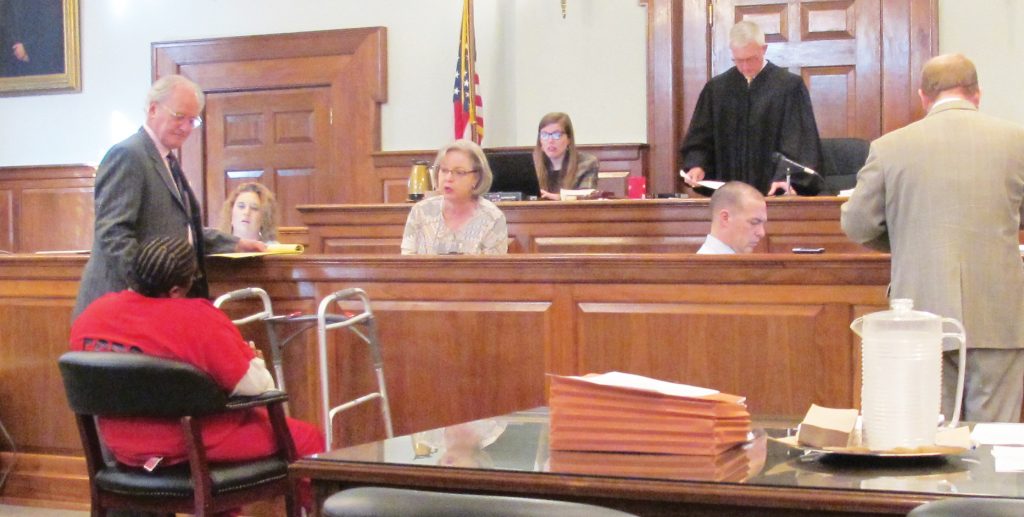
    Coleman is sworn in before Circuit Court Judge R. Keith Kelly. | Barbara Ball

    WINNSBORO – Sharon Coleman, 35, was sentenced to 20 years in prison Monday after pleading guilty in the Sixth Judicial Circuit Court in Winnsboro, to three counts of involuntary manslaughter and two counts of unlawful neglect of a child in the deaths of her two children and her husband last year.

    Circuit Judge R. Keith Kelly presided over the non-jury proceedings. Coleman had initially been charged with three counts of murder, first degree arson and two counts of unlawful actions toward a child. The arson charge was dropped and the murder charges were reduced to involuntary manslaughter in response to her plea.

    Coleman was arrested May 7, 2017 after she was accused of setting an early-morning house fire at 120 Robinson Avenue in Winnsboro that claimed the lives of her husband and her two children.

    According to Fairfield County Coroner Chris Hill, the bodies of Justin Wilson, 29, Kenya Coleman, 8, and Deshawn Wilson, 6, were recovered by firefighters inside the residence. An autopsy found the cause of deaths to be carbon monoxide poisoning and thermal burns.

    Assistant Sixth Circuit Solicitor Riley Maxwell told the Court that Coleman killed her husband and children by setting the residence on fire and failing to extinguish the fire while the victims slept inside the home. He said Coleman admitted leaving the home in the early morning hours of May 7 to go for a short walk, leaving her family asleep in the house, and when she returned the house was on fire.

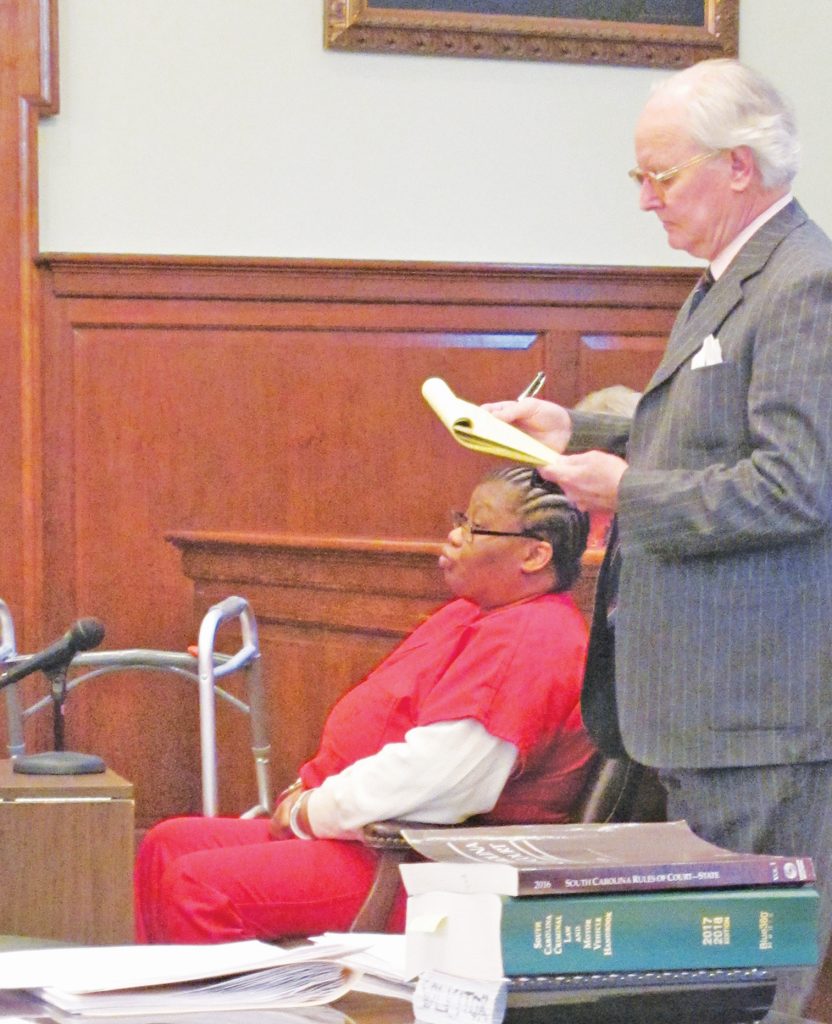
    Coleman and public defender Robert Fitzsimmons.

    Maxwell said Coleman’s version of entering the house through the burning kitchen and walking down a hall leading to the victim’s bedrooms before exiting the home and going to a neighbor’s home to call 911 was inconsistent with arson investigators’ findings.

    “The arson investigators were suspicious of Ms. Coleman’s story,” Maxwell said. “It was inconsistent with their findings. The kitchen would have been too hot to enter and her clothing did not appear to have smoke or ash on them,” he said.

    Maxwell said Coleman offered various reasons for the cause of the fire – faulty electrical wiring and that, as she left the home to go on her walk, she noticed a flame in a can in the kitchen that the family used to extinguish cigarettes, but she thought the fire would go out.

    Maxwell said investigators found no fault with the wiring, and could not determine the exact cause of the fire, although they did determine that the fire started in the kitchen.

    “No one knows the cause of the fire,” public defender Robert Fitzsimmons told the Court in Coleman’s defense. “There’s a lot of talk and investigation, but no one knows the cause of the fire. That’s why they dropped the arson charge.”

    Fitzsimmons said that while Coleman accepts responsibility for the deaths, he placed the blame for the three deaths on Justin Wilson.

    “Mrs. Coleman left her two children in the care of a responsible adult,” Fitzsimmons said. “She is here to take responsibility for her misjudgment that it was safe to leave her children with [Wilson.] All that talk about where the flame was and how hot it was, all we know is she left the house with her two children in the care of their father and they died.”

    In suggesting concurrent sentencing for all charges against Coleman or approximately five to seven years, Fitzsimmons said society has its own punishment in addition to what Coleman has already been through.

    “Her children are gone. She’ll suffer for the rest of her life,” Fitzsimmons said. “It’s very difficult to imagine the pain a mother goes through, the grief process. It’s difficult to get a picture of Sharon Coleman as she sits here. She’s taking anti-depressants. She’s lost two toes and is on pain meds. All this flattens her personality. And today she’s extremely nervous and hasn’t slept. She is always bereaved. Her two children and her husband are dead. No matter what else happens, she will always be a mother who lost two children before she was 35,” Fitzsimmons said. “She takes responsibility for the deaths of her children. It’s in her heart, her every waking moment.”

    Coleman, who Fitzsimmons said had suffered a broken foot, entered the Courtroom using a walker and sat throughout the proceedings.

    “I’m so sorry,” she told the judge in a soft voice that was barely audible, “I know I can’t bring them back, but…” Her voice trailed off, becoming completely inaudible before she placed her hand over her face and cried quietly.

    Justin Wilson’s brother, who was the only witness called, said he was visiting the home until late on the night of the fire.

    “I don’t know why she did it. There was no pot on the stove when I left, no wood in the stove, nothing was going on,” Wilson said during his length testimony. “I just wonder what was going on”.

    Each of the two unlawful neglect of a child indictments carry 10-year sentences and will be served consecutively. The three involuntary manslaughter charges each carry five year sentences and will be served concurrently with the two unlawful neglect charges for a total of 20 years. Coleman will receive 679 days credit for time she has already been incarcerated.

  • Chamber finances still in question

    Parler: There Was No Audit, Just a Review of Financial Statements

    BLYTHEWOOD – Former Blythewood Town Councilman Tom Utroska picked a scab at the Council retreat on Saturday when he suggested Council has never resolved its questionable financial relationship with the Greater Blythewood Chamber of Commerce.

    “I continue to harp on the Town’s fiduciary responsibility regarding the GBAC,” Utroska said. “My concern about the Octoberfest is that you are giving them [Chamber] $14,000, and they are going to make a $21,000 profit…16-18 months ago we required that the Chamber give [council] an accountable audit of their finances before you would give them any more money. In fact,” Utroska said, “you stopped giving them money for the Visitor Center. According to a former Town Council member, CPA Bob Massa, the Chamber gave you a bunch of numbers but didn’t give you anything to prove those numbers. Before the Town gives the Chamber more money, I’d like to see us have an audit [of the chamber]. I’d like to understand that what they say they’re spending is what’s actually happening.”

    For openers, Utroska criticized council for allowing the chamber to spend event advertising money provided by council on two of three newspapers, leaving out The Voice which he said is the one of the three that is a town business.

    “Don’t leave out someone that you’re supposed to be representing – a town business,” Utroska added. “The Council has done a good job with the Town’s finances. But I am concerned that you are not fulfilling your fiduciary responsibility [regarding the chamber.] I think you’re setting yourself up to be criticized more in the future.”

    Councilman Bryan Franklin defended the chamber saying it is having its books audited by the same auditor the town uses – Love Bailey.

    “As soon as that audit is completed, they are going to present it to the board based on the conversation we had before when we found out there were some issues with their internal auditing,” Franklin told Council. “So they have agreed to do an audit with our town auditor.”

    “Is there an actual audit that’s been done? That’s been completed on [the chamber’s] last year’s finances?” Mayor J. Michael Ross asked the Town’s Economic Development consultant Ed Parler, who also serves on the Chamber board as a liaison with town council.

    “As far as an audit that goes into depth – a management audit – no. It’s just purely on financial statements. We’ve been told that an organization the size of the Chamber really doesn’t need a certified financial audit, that their statements are accurate and are being independently reviewed by [Love Bailey].”

    Ross asked chamber board secretary Mark Cruise, seated in the audience, for a copy of that review.

    “We submitted a copy of that review with a final report on the A-tax Visitor Center funding at the year end and the numbers matched up,” Cruise said. “We made sure that Mr. Bailey’s review matched up independently with the chamber’s financials and they did.”

    Cruise went on to say that the reports are on the chamber’s website. A review of those reports by The Voice, however, revealed that the year-end report submitted to council in June, 2018 for the Visitor Center (and which is not posted on the website) does not match the financial review on the website produced by Love Bailey.

    According to a 2018 ruling by the S.C. Supreme Court, Chambers of Commerce in South Carolina are now only required to disclose financial information to the funding government which, in this case, would be the Blythewood Town Council.

    Both Parler and Town Hall have been unable to provide The Voice with the Chamber’s monthly financial statements since June, 2018, but Ross said he would be happy to meet with The Voice, Cruise and Parler to discuss the Chamber’s financials.

    In response to Utroska’s criticism of council voting unanimously to award the Chamber $14,000 for a fundraiser that is expected to raise $21,000 to benefit the Chamber, Ross explained council’s actions as, perhaps, a rushed decision.

    “We got that 48 hours before our meeting,” Ross said. “We sat up here looking at that for the first time and they needed approval for some of the vendors, performers, etc. and I think we rushed through that. But it’s [the event] not until 2019-20 budget approval, so we may have to revisit that.

    “For an organization to have a $21,000 profit, that’s great, but maybe they don’t need the money,” Ross said.

    “I wish the Chamber had gotten inside the true town center district, the businesses in town that should be the real nucleus of support,” Ross said. “I see new members being the United Way of the Midlands. But I still charge the Chamber to somehow be a voice for businesses in Blythewood…to reach out to the mom and pop businesses that really do make up Blythewood.”

  • McNulty’s Taproom hosts Wade Hayes, animal shelter fundraiser on Friday

    BLYTHEWOOD – When American country music artist Wade Hayes comes to McNulty’s Taproom in Blythewood Friday night, he’ll be making two appearances. One, his big show, will open at 10 p.m. inside the restaurant. The other will be from 7 – 8 p.m. out front in the WCOS tent, where Hayes will be partnering with the Fairfield County Animal Shelter to bring awareness to the needs of shelter animals and visiting with his animal-loving fans.

    “Wade’s newest release, ‘Who Saved Who?’ is about his own rescued dog,” McNulty’s Taproom owner Larry ‘Trippy’ Phillips explained. “He wants fans to bring donations of dog food, dog treats, dog toys, leashes/ collars, blankets, dog beds etc. to help with the needs of the Fairfield County Animal Shelter, and they will receive a free autograph and photo of Wade. They can even have a photo taken with him,” Phillips said.  “And there will be puppies and other pets on site for adoption,” Phillips said.  “It’s going to be lots of fun.”

    To hear Hayes perform his new release as well as his hits from the 90’s, purchase a ticket for $35, reserve a table (hightops, $50 and lowtops, $100) and stay for the 10 p.m. performance, where he will be singing fan favorites such as On A Good Night, Old Enough to Know Better, What I meant to Say and I’m Still Dancing with You.

    The WCOS tent will be out front from 6 – 8 p.m. Hayes will join WCOS from 7 – 8 p.m. The Yarborough Brothers will open the evenings’ entertainment at 9 p.m.

    “It’s filling up fast,” Phillips said. “It’s going to be a big night here in Blythewood – great music and great food. It’s a show you don’t want to miss.”

    For information or to purchase tickets, call 803-834-4037. McNulty’s Taproom is located at 420 McNulty St., in Blythewood.