Tag: slider

  • Sampson pleas, gets 4 years

    FAIRFIELD – Under a plea agreement, Kerry Sampson, 30, of Winnsboro was sentenced on Monday to 4 years in prison, reduced from 12, for the hit and run death of pedestrian John Caldwell on April 16, 2017 on Old Camden Road. The case was heard in General Sessions Court in Winnsboro by Circuit Judge Lawton McIntosh.

    SAMPSON

    Originally charged with reckless homicide, an uninsured motor vehicle violation, hit and run, DUI, and leaving the scene of an accident with injuries, Sampson’s attorney Geff Dunn of Rock Hill said Sampson thought he had hit a deer, not a person. Maximum sentence for the conviction of these crimes is 25 years.

    Prosecutor Riley Maxwell said Sampson had left a club on Old Camden Road about 2:20 a.m., driving a 2010 Dodge sedan. Maxwell said Sampson immediately passed a pickup truck in a no-passing zone and struck Caldwell who was walking along the roadway. Witnesses in the truck said Sampson turned his car around and drove off.

    Sampson drove to the home of his girlfriend, where he hid the car in the garage for several days before turning himself in, according to Maxwell.

    McIntosh said no evidence was presented that Sampson had intended to hide the car or that alcohol was involved.

    Asked by the judge if Caldwell could have survived had he been given aid, Maxwell said he could not have.

    Families of both Sampson and Caldwell spoke at the trial.

    “I know he didn’t mean to do it, but he should have stopped,” said one of Caldwell’s relatives.

    “My brother didn’t deserve that,” said one of Caldwell’s sisters. “Our family has gone through hurt and agony. I can forgive, but not forget. God is good, but this was wrong.”

    Trevon Kelly broke into tears as he barely spoke above a whisper in support of his stepson [Sampson.] Sampson’s mother, Gail Kelly, told the Caldwell family that she hurts for them and prayed for them and their loss continually. She said her son is not a bad person.

    “He works hard as a carpet layer and does not get into trouble,” she said.

    Sampson’s girlfriend’s mother read a note written by her own mother about Sampson.

    “I’ve known him since he was a baby and I love him. He is one of the most respecting persons in the world. He’s a good person,” Robbie Harris read.

    Sampson’s attorney, Geff Dunn, pleaded with the judge to sentence on the lower end of the punishment scale for the crime, citing that Sampson had never been in trouble and was a hard working young man. Sampson then turned to address the family of the man whose death he was responsible for.

    “I’m so sorry. I didn’t see him. I didn’t. I’m just so sorry,” Sampson said, concluding his comments to the family.

    Judge McIntosh lamented the scene of two families in the Courtroom, both hurting.

    Sampson will serve five years of probation after he is released from prison. McIntosh said the five years can be reduced to three if Sampson strictly complies with his rules of probation.

  • Chamber financials $22K in the red

    Council To Discuss Chamber Finances at Thursday Night’s Budget Workshop

    BLYTHEWOOD – The Greater Blythewood Chamber of Commerce’s budget and other documents reveal the Chamber is in financial trouble and has been for a while. Those documents were obtained by The Voice on Tuesday.

    Now in the red by $22,000, the 183-member organization is taking steps to dig its way out – moving to a less expensive location and taking out a line of credit for $20,000 as it adjusts to not receiving the lucrative financial support previously provided by the town government.

    Executive Director Mike Switzer resigned his position two weeks ago, and Interim Director Phil Frye said office manager Kitty Kelly has submitted her resignation as well, effective July 1. Chairman of the Chamber’s Board, Matt Cunningham, said in an email to members that Switzer is leaving his post with the Chamber in order to dedicate more time to one of his business ventures.

    Several Board members have confirmed to The Voice that the Board voted unanimously last week to give up their office in McNulty Plaza and are searching for less expensive office space in the town. According to records, the Chamber has been paying $23,500 annually for rent to Mayor J. Michael Ross and his business partner who own Blythewood Professionals.

    During the current fiscal year, the chamber received approximately $44,000 from the Town’s general fund and accommodation tax fund as well as additional funding for any events organized by the chamber. Council also approved $14,000 in Hospitality Tax revenue for a Chamber fundraiser to be held next fall. According to the request, the Chamber expects a total net profit of $21,125.12.

    Frye said the organization remains intact.

    The changes during the last couple of weeks have come as the deadline approached for the Chamber to turn over its financials for Council’s review prior to Thursday’s budget workshop. Mayor Pro Tem Eddie Baughman said Council will discuss those financials during the workshop on Thursday, May 23. The third and final vote on the budget is set for the regular council meeting on Tuesday, May 28.

    The financials were presented to Council members via email on Tuesday and include the Chamber’s budget for the current fiscal year ending June, 2019, a profit and loss detail and expense detail for the former Visitor Center from July – December, 2018.

    The Voice obtained the documents through a Freedom of Information request and reviewed them with Certified Public Account Bob Massa, a former Town Council member and former member of the Chamber board.

    While the Chamber had a total income of $88,587.13 (as of May 13) for fiscal year 2019, that amount was surpassed by total expenditures of $110,865.81, leaving a deficit of $22,278.68 for the year.

    A Chamber source said the Chamber will not be requesting any funds from Council for this budget year but hopes to receive some funding from Council in the form of sponsorships for various Chamber events throughout the year.

  • Fanning appoints 4 magistrates in Fairfield

    Follows Questions About Chester Appointments

    WINNSBORO – Senator Mike Fanning announced on Tuesday the appointment of four new magistrates for Fairfield County – Jannita Gaston, Danielle Miller, Katina Capers-Washington and Vannessa Hollins. They will join Magistrate Russell Feaster, appointed by Fanning last year, and Chief Magistrate Paul Swearingen.

    The new magistrates replace longtime magistrates William Robinson, Johnny DeWeese, Will Pope, who retired April 30, and Carol Tolen who retired in January.

    Robinson and DeWeese received letters from Fanning stating that they would not be reappointed.

    “Wednesday, May 22, will mark a fresh start…a new day…and a new court here in Fairfield County,” Fanning said in a press release issued on Tuesday.

    The turnover of Fairfield’s magistrates followed questions asked last week by a Charlotte television station after it learned that Fanning was replacing all but one of five sitting magistrates in Chester County.

    “Only Chief Magistrate Angel Underwood is being recommended for reappointment to another four-year term,” the station noted. “Underwood is the wife of Chester County Sheriff Alex Underwood who was just indicted on multiple criminal charges.”

    The station questioned why four qualified and long-term magistrates were being put out of jobs, noting that, “Several people had brought the issue to Channel 9 because Fanning is close to the Underwood family.”

    Fanning said he is making the process of choosing magistrates “more open and transparent than it used to be.”

    Fanning said he advertised the positions and that over 40 individuals expressed interest in the position and dozens applied. In order to insure an unbiased review, Fanning said he assembled a team of current or former magistrates from surrounding counties – to evaluate applications, interview finalists and recommend for appointment. The names of members of the review committee have not been made public.

    Fanning, who represents part of York County and all of Chester and Fairfield counties, has been passionate in postings on Facebook about his support for Alex Underwood.

    “This is the time to stand behind the man who would lay down his life for us all. This is the time to stand behind the man you voted for. This is the time to stand behind our Sheriff Alex Underwood.” Fanning posted.

    The Voice has been unable to contact Fanning regarding the Fairfield County appointments. He did release the following information about the new magistrates:

    Jannita Gaston, a Winnsboro resident, is a graduate of Benedict College, where she earned a Bachelor of Arts degree in Sociology. Gaston has served in corrections and law enforcement for over forty years as a correctional officer, deputy warden of administration, warden and regional director. During her career as an administrative manager with the state of South Carolina, she worked in all facets of correctional operations. She currently serves on the Fairfield Behavioral Health Service Board.

    Danielle Miller is a lifelong resident of Fairfield County and is a graduate of Winthrop University where she earned a Bachelor of Arts degree in English and creative writing. She has worked as a paralegal and also obtained certification as a Global Career Development Facilitator. She has served on the Fairfield County School Board and currently serves as chair of the Fairfield County Chamber of Commerce.

    Katina Capers-Washington is a resident of Winnsboro and a graduate of the University of South Carolina with a Bachelor of Arts degree in Psychology, and Webster University. She worked five years during college as a paralegal. She was a school counselor for the Newberry School District for seven years. Capers-Washington and her husband Carmen have established a scholarship for students of Fairfield Central High School majoring in business administration or culinary arts.

    Vannessa Hollins, a lifelong Fairfield resident, is a 1991 graduate of Midlands Technical College where she earned Associates and Bachelor degrees in Criminal Justice Administration. She also earned a Master’s degree of Public Administration at Bellevue University. In 2001, Hollins earned her Summary Court Judges Certification from the SC Criminal Justice Academy/SC Court Administration. Judge Hollins has served as a Municipal Court Judge for the Town of Winnsboro and is a director of her local non-profit, Chameleon Inspirations Learning Center, in Winnsboro.

  • County unveils ‘new’ market building

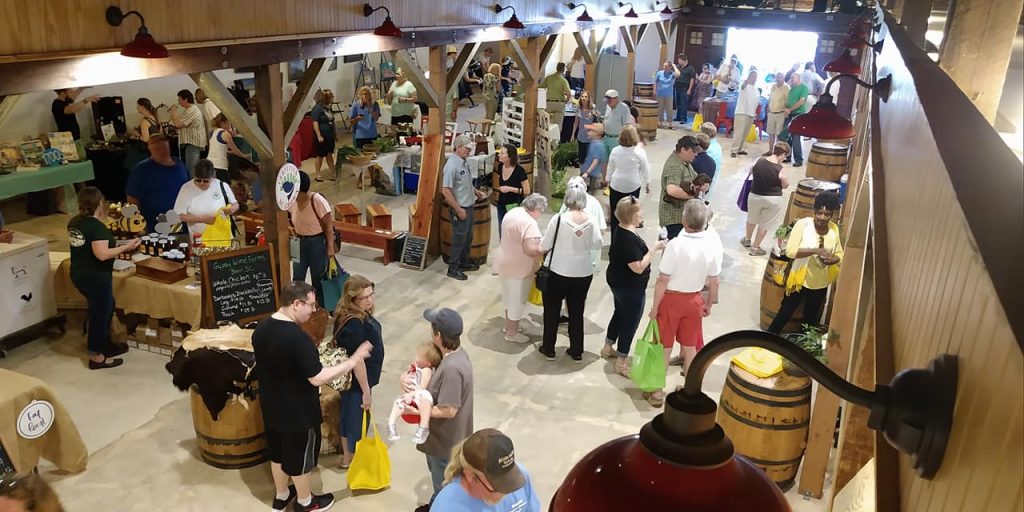
    Opening day at Fairfield’s renovated market building. | Michelle Taylor

    WINNSBORO – The opening of the newly renovated market building in downtown Winnsboro on Saturday was grand. Inside, it featured more than 40 vendors for shopping and a near-capacity crowd ready to buy. It was the place to be from 9 a.m. – 1 p.m.

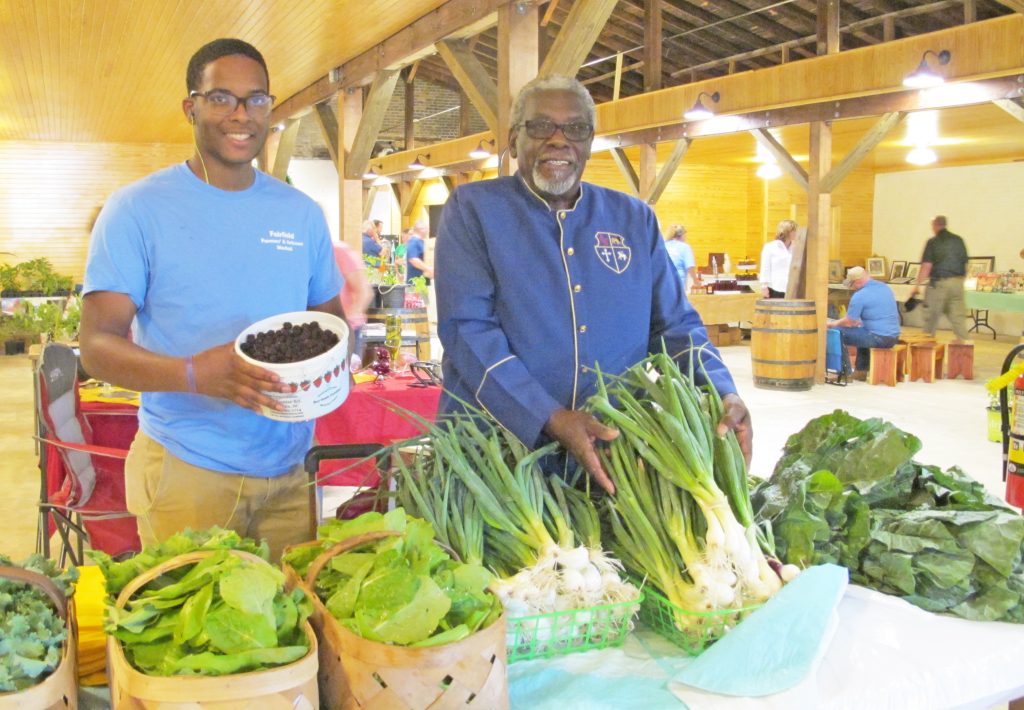
    Jules Ruff and Lonzo Ruff’s produce sold out in about an hour. | Photos: Barbara Ball

    Located at 117 E. Washington St., behind the clock, the building has served many capacities since the late 1800’s, including a livery stable, bowling alley, and car lot. On Saturday, the building found its perfect fit.

    Prior to cutting the ribbon, both Chamber of Commerce Director Gene Stephens and County Administrator Jason Taylor thanked former Chamber Director Terry Vickers for initially proposing the idea to revive the building.

    “A lot of things we do in local government are very important,” Taylor said. “One of those is to have projects like this that build our community and bring us together. While this project is ending, it will continue as a farmers market and a venue for weddings, reunions and other events. I hope this is the beginning of the revitalization of downtown Winnsboro.”

    The low cost project was paid for with $35,000, donated by the Chamber and matched by another $35,000 from the County.

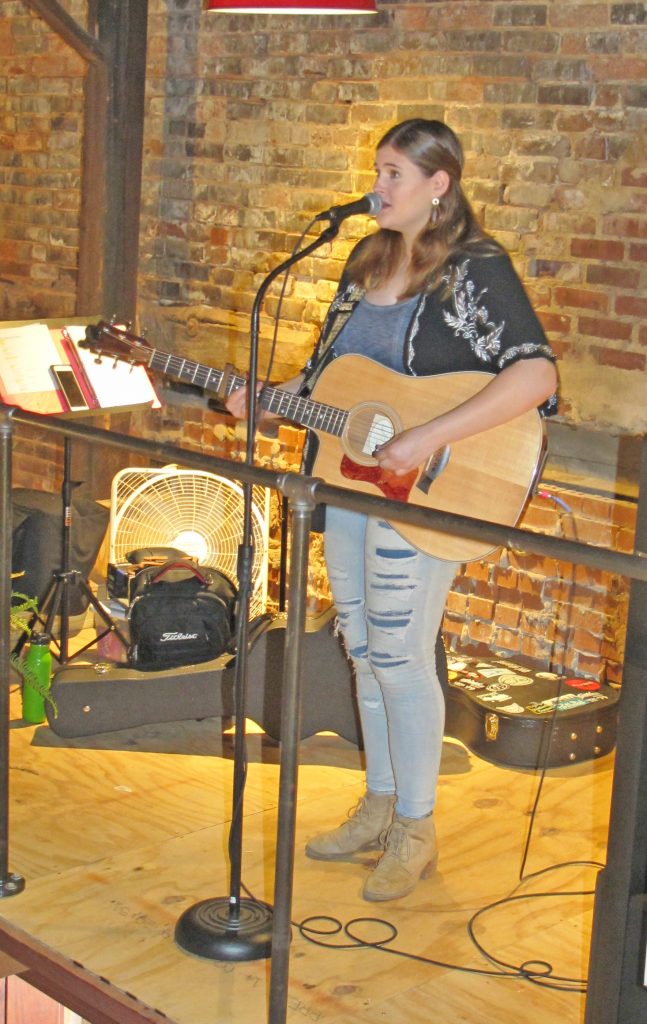
    Sophie Lynch

    Under Taylor’s guidance, county workers have turned the former stable into a show barn.

    Following the ribbon cutting, singer Sophie Lynch entertained from a balcony high above the front doors.

    Shoppers snatched up bargains on collards, potted plants, crafts, fresh veggies and massages.

    Door prizes were awarded every half hour and lunch was available from food trucks lined up in front of the building.

    The building features an open, rustic concept and includes a classroom and a large kitchen that Taylor said will be certified as a DHEC and catering kitchen.


  • FCSD’s Chanda Jefferson named South Carolina Teacher of the Year

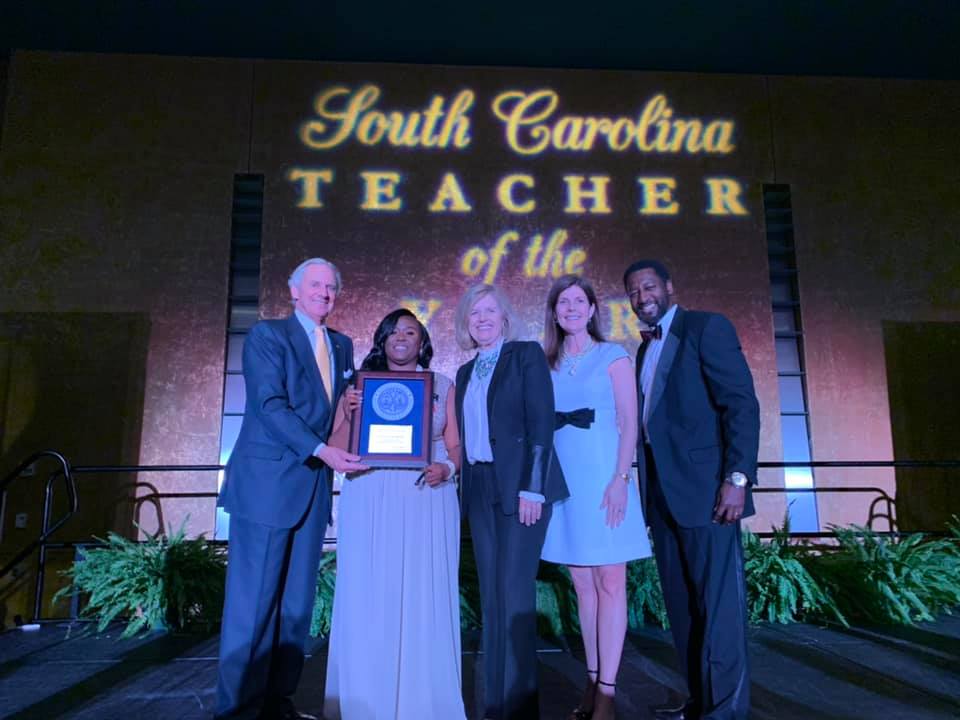
    Gov. Henry McMaster presents the S.C. Teacher of the Year plaque to Chanda Jefferson. Looking on are S.C. Superintendent of Schools Molly Spearman, Lt. Gov. Pamela Evette and Fairfield School District Superintendent Dr. J.R. Green. Photo: South Carolina Department of Education

    WINNSBORO – When Chanda Jefferson was named South Carolina’s 2020 Teacher of the Year last week, she made more than her mother proud. All of Fairfield County was bursting at the seams with pride for one of its own.

    A native of Beech Island, SC, Jefferson has been teaching for eight years, the last three as a Biology teacher at Fairfield Central High School. Prior to that Jefferson was named S.C. Outstanding Biology Teacher in 2014, and was one of 20 teachers to receive the Princeton University Fellowship for Teachers. Other honors during her career include being invited by a Harvard University professor to speak to world-renowned scientists and researchers at the 74th Annual Society of Developmental Biology Conference in Utah.

    “This has been a crazy adventure and a blessing at the same time!” Jefferson posted on her Facebook page.

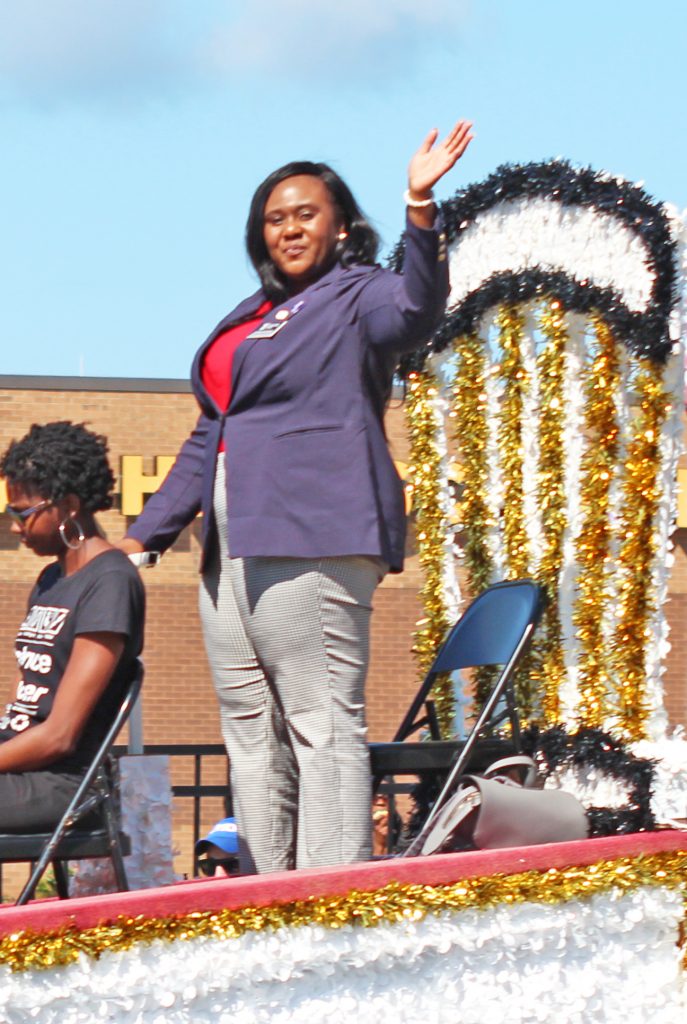
    FCSD honored Jefferson in a parade in front of Fairfield Central on Monday. Other District Teachers of the Year and 2019 Dual Enrollment graduates were also honored during the parade. | Martha Ladd

    The day after being named the top teacher in South Carolina, Gov. Henry McMaster honored the state’s new 2020 Teacher of the Year, and on Monday, the Fairfield County School District held a parade on Highway 321 in Winnsboro in Jefferson’s honor.

    A graduate of the University of South Carolina, Jefferson traces her love for teaching to her childhood.

    “As a child, I enjoyed playing school with my nieces, nephews, and cousins. I always took the role of teacher,” she said.

    Jefferson said she is thrilled to be honored and that the work of every teacher is something to be recognized on a regular basis.

    “Each day that we walk through the doors of our schools and classrooms, we positively impact the lives of students and that deserves to be celebrated every day, every day,” Jefferson said. “I am so thankful, honored, humbled and blessed to stand before you as the 2020 South Carolina Teacher of the Year.”

    Jefferson has said her goal is forming relationships and lighting the way towards achievement for her students and the students across South Carolina.

    “Each year, teachers receive students from all walks of life, and it is our job to teach them. Some students enter our classrooms with a village of support, while others enter alone,” she said. “Yet no matter how they arrive to our classrooms, we must build relationships with them, engage them, and show them that we care. All students will face challenging situations, hardships, and confusion, but in the midst of varying degrees of adversity, teachers have the power to show them how knowledge, uniqueness, and individual interests can empower them and create endless possibilities in life.”

    Jefferson will receive a total of $25,000 and the keys to a new BMW to use while serving a one-year residency at the Center for Educator Recruitment, Retention, and Advancement. Jefferson will be a roving ambassador providing mentoring, attending speaking engagements and other duties as she serves as the spokesperson for 50,000 teachers.

    Her winnings will also include a set of new tires – for when she’s finished with her new ride – and a Jostens ring.

  • Budget tweaks divide Council

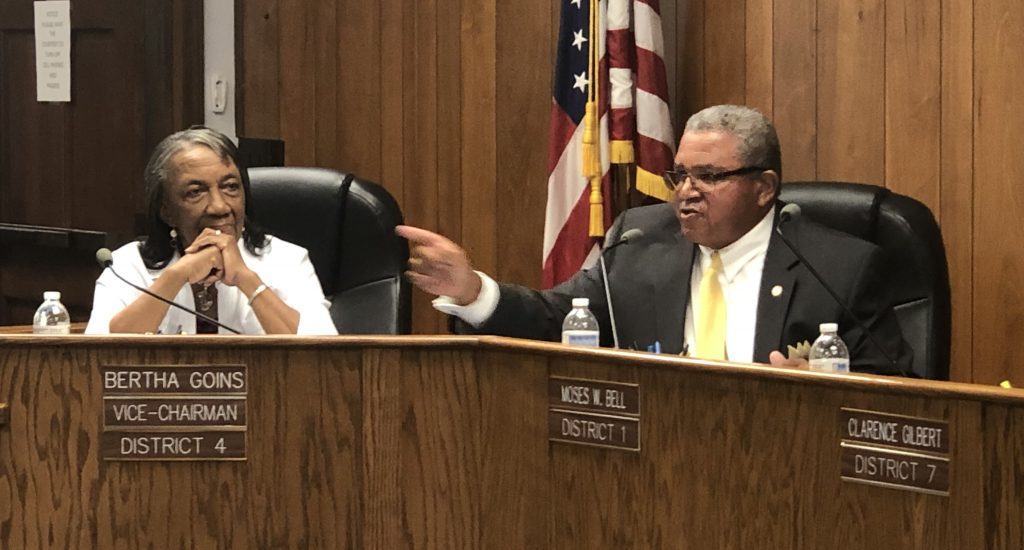
    Councilman Moses Bell, right, and Councilwoman Bertha Goins

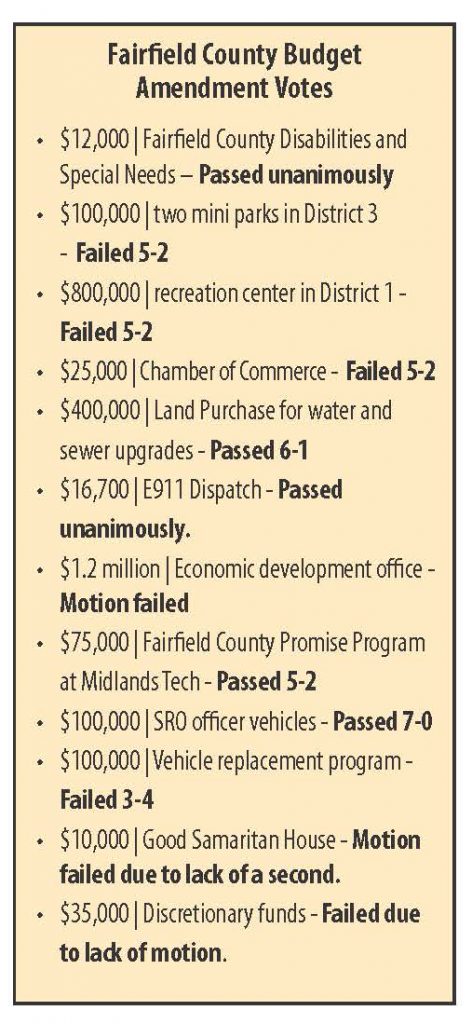
    WINNSBORO – In a series of votes Monday night, council members struck down budget amendments that would have added $900,000 in recreation improvements, $100,000 for vehicle replacement and a $1.2 million economic development office.

    Council members also balked at a proposal to fund individual discretionary spending accounts following public outcry. As one council member suggested, the votes boiled down to needs versus wants.

    “We cannot be selfish and think that we have all the answers,” said Councilman Clarence Gilbert. “I wouldn’t put a playground in my backyard if I knew I needed a refrigerator in my house and I didn’t have enough money for both.”

    Councilman Douglas Pauley, who voted against most of the amendments, raised concerns that the proposed $45.2 million budget rose 12 percent while it increased only an average of about 5 percent during the last four years.

    Reading from a prepared statement, Pauley called upon council members to cite the funding source for their various budget amendments.

    “We might be able to accommodate this by pulling from the fund balance,” he said. “But we will be increasing property taxes if we go down this path.”

    County Administrator Jason Taylor said a few amendments could be funded through other sources, such as bond revenue. But Taylor also agreed that dipping into reserves is unsustainable, noting that a three-mill tax increase would only generate about $450,000.

    “We cannot continue to do it (dip into reserves) year after year,” he said.

    In order to fund every council member’s request, “you’d have to raise taxes significantly,” Taylor added.

    Some council members, however, pressed   for increased spending.
    Angrily pointing his finger at the end of the meeting, Councilman Moses Bell said he was “really disappointed” a majority of council members wouldn’t support his request for $800,000 [toward a $1.5 million estimated cost] for a recreation center in his district [Ridgeway].

    In the end, Council members voted 5-2 against the $800,000 appropriation, with only Mikel Trapp and Bell supporting it.

    Bell claimed from the dais Monday night that the previous District 1 Council member had said the recreation center had been approved. That original approval, however, had been for $500,000, not $1.5 million.

    “The constituents are the same, the district lines haven’t been moved. The only               difference is that I’m here. This was not right what was done,” Bell said. “I am disappointed, I am so disappointed. This is a disgrace to this county.”

    One hot button issue not receiving a vote was a controversial proposal to allocate $35,000 for discretionary spending accounts for council members. If approved, the measure would have given each of the seven council members $5,000 to spend with no restrictions.

    After significant public outcry against the discretionary spending, none of the council members brought it up for vote.

    Five speakers addressed the proposal during public comments.

    “At best it’s Santa Claus at taxpayers’ expense,” resident Carol Turner said. “If $35,000 worth of pipeline could be funded, the money would be much better spent that way. You are not Santa Claus, you are our elected representatives.”

    Councilman Bell, who supported discretionary spending accounts, pointed to Richland County, saying council members there receive $12,000 apiece.

    Jackie Workman, spoke in favor of discretionary funds.

    Ridgeway resident Randy Bright noted that the Richland County discretionary accounts had come under fire following investigative reports published in The State and Charlotte Observer newspapers.

    “Terms like “loose,” “no accountability,” and “chaos” reigned supreme in the story,” Bright said. “Discretionary funds didn’t work before [in Fairfield], don’t work in Richland. It’s outside the true parameters of how our government is set up.”

    Final reading of the Fairfield County budget is tentatively scheduled for the May 28 meeting, which is being held on a Tuesday since Memorial Day falls on a Monday.

    (NOTE: There is an error in the box at right of the story –   $25,000 for the Chamber was actually approved, not denied.)

  • ‘New’ Farmers Market building opens grandly

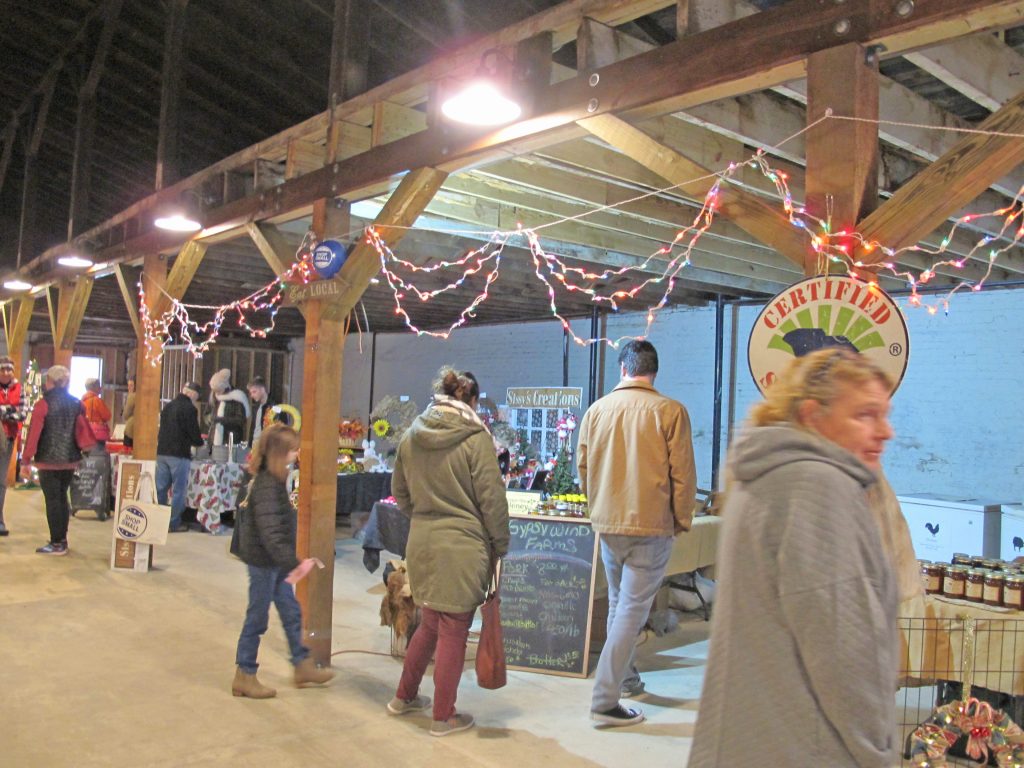
    Fairfield Farmers and Artisan’s Market during the Christmas season.

    WINNSBORO – A grand opening and ribbon cutting will be held Saturday for the new jewel in downtown Winnsboro – the recently renovated former county stable located on East Washington behind the Town Clock.

    Under County Administrator Jason Taylor’s guidance, county workers have turned the former stable into a show barn that will house the Fairfield Farmers and Artisan’s Market and eventually serve as an event venue for weddings, receptions, reunions and other social events.

    A celebration of the facility, organized by the Fairfield County Chamber of Commerce, will begin with a ribbon cutting at 9 a.m. and end at 1 p.m.

    During that time, about 30 food vendors including Doko Smoke and Winnsboro’s The Donut Guy will offer a full array of foods. Singer Sophia Lynch will entertain and, beginning at 9:30 a.m., there will be prize drawings every half hour to include gift cards to local restaurants and merchants.

    Local farmers will be selling fresh produce, eggs, meats and other foods. Other vendors will offer artwork and crafts, free massage demonstrations, an entertaining parrot who will pose for photos with event visitors and a kids’ drawing contest that will be judged with prizes for the winners. A magician and a balloon creations booth will also be performing throughout the day.

    Fairfield County Museum Director Pelham Lyles has displayed a number of colorful handmade quilts on the market building’s walls.

    “It’s just beautiful inside, and I think everyone is going to be surprised at what they see,” Fairfield County Chamber Director Gene Stephenson said during a presentation at the County Council meeting Monday night. “We have Mr. Taylor and Ms. Terry Vickers [former Chamber Director] to thank for this becoming a reality,” Stephenson said.

    Taylor, in turned passed along his appreciation to the county employees who did the renovation work.

    “We did all this work in-house for the most part,” Taylor said. “We hired very little outside labor, maybe plumbers and a few others.”

    Taylor said the cost was covered by $35,000 from the Chamber and about $35,000 in matching funds from the County.

    The facility includes a DHEC-approved teaching kitchen which can be used by the farmers market for teaching food preservation and similar classes. Work is still to be done on the exterior and the parking lot. That work is expected to be completed this summer, according to Taylor.

    “We’re going to have a lot going on at the market on Saturday. It’s going to be a big day,” Stephenson said. “We’ll have local as well as visiting state and national dignitaries visiting our town for the event, and I just hope everyone will take this opportunity to come out and enjoy it all. You’re going to be surprised,” Stephenson promised.

  • Doko title snafu cleared, but costly

    BLYTHEWOOD – During its first budget workshop for the fiscal year 2019-20 last week, Mayor J. Michael Ross asked Town Administrator Brian Cook to confirm that the $39,000 listed under capital improvement expenditures is the year-to-date amount the Town has spent on legal and professional fees associated with the sale of the Doko Depot building in 2019.

    Cook confirmed that it is.

    “So that should be enough to carry us through to closing?” Ross asked

    Cook said an additional $2,500 is budgeted for the closing.

    The sale of the Depot has been delayed since December, 2017, for myriad reasons. In September, 2018, Ross announced a new, more serious delay – this one caused by the discovery that property title restrictions had not been disclosed to the Town in prior financing efforts with Santee-Cooper.

    At last week’s council meeting, Ross said the title is now clear, but because the process took so long, the bank is requiring the purchaser to get new financing.

    “They are in the process of doing that now,” Ross said.

    Ross said the delay in the sale has also caused extra costs for the Town, including taking insurance out again on the building.

    “Hopefully, we’ll soon be able to announce a closing,” Ross said. But he said he could not yet estimate when that would be.

    Freeway Music and a second location for a popular Lexington restaurant, the Old Mill Brew Pub, are expected to be the eventual tenants of the building.

  • Switzer resigns chamber post

    BLYTHEWOOD – In what it called a leadership transition, the board of directors of the Greater Blythewood Chamber of Commerce announced Friday that executive director Mike Switzer has resigned his post with the Chamber.

    Switzer has served as the Chamber’s executive director since 2014. During his tenure he has expanded the Chamber’s membership and programming, Chamber board chair Matt Cunningham said in an email to Chamber members.

    “I am proud to have led the Chamber during this period of tremendous growth,” Switzer was quoted in the email. “I am grateful for the many businesses who have joined the Chamber and for all who have given of their time and talents to help the Chamber and our community grow and prosper.”

    While the Chamber has grown from 20 or so members to 187 under Switzer’s leadership in the last five years, much of that growth has come from businesses outside the town. Switzer has come under increasing public criticism from Mayor J. Michael Ross and some of the town’s businesses for focusing on bringing in large out of town businesses instead of focusing on bringing prosperity to what Ross calls the town’s mom and pop businesses.

    The Chamber’s financials have been a target of investigation by The Voice newspaper for almost two years.

    Last month, almost a year after the Chamber was unable to produce a credible set of books to Town Hall for the previous budget year, the Chamber’s board chairman-elect Phil Frye told Council last month that the Chamber still does not have a working budget or even a draft budget to present to Council.

    In May, 2018, after an investigation by The Voice of the Chamber’s financials, Council called for the Chamber, which is funded primarily by the Town, to turn over its complete financial records by June 12, 2018. Copies of those documents were subsequently provided to The Voice by town government officials.

    After being asked by The Voice to review the documents, CPA and former Town Councilman Bob Massa concluded the submitted financials were “confusing, lacking in detail and sometimes impossible to follow and understand.”

    Massa said records submitted by the Chamber indicated that $18,500 provided to the Chamber by the Town Council to fund a Visitor Center was more likely used to help pay the Chamber’s operating expenses, and that the Visitor Center served as little more than a pass-through for those funds to the Chamber.

    On June 25, 2018, council voted unanimously to stop funding the Visitor Center after Dec. 31, 2018.

    Financial records submitted to the town government at FY 2017-18 year end were also lacking in details for thousands of dollars the Chamber received from the town, t-shirt sales, sponsorships and other sources for events including the Big Grab and the Eclipse.

    Still, in February, 2019, Town Council voted to award another $14,000 of Hospitality Tax revenue to the Chamber for a fundraiser for itself.

    In an application requesting the funding, Sarah Ballard, an event manager hired for the event – a Bavarian Oktoberfest – noted that it was being held to raise funds for the Greater Blythewood Chamber of Commerce, and that it will also provide an opportunity for residents of Blythewood and the surrounding areas to build community and learn about Bavarian culture.

    The request said the total project cost would be $37,394 and would be partially funded by the proceeds from food, merchandise and beer sales ($14,500), cow paddy bingo ($18,450) and sponsorships ($10,000) plus $1,520 in in-kind services.

    According to the request, the Chamber expects a total net profit of $21,125.12.

    The Town has also funded the Chamber with a grant each year to cover operating expenses. Last year, the grant was for $19,500. According to the agenda of the April, 2019 Council meeting, the Chamber is expected to ask Council for $20,500 for the upcoming budget – $17,000 for an economic development work subsidy (previously called a grant by town officials) and $3,500 for an ‘elite partner’ annual membership for the Town government at the Premier Level.

    Since last summer, Ross has partially, though not officially, recused himself from discussions/voting on Chamber funding since he and a business partner are the Chamber’s landlords for the space the Chamber rents in McNulty Plaza in downtown Blythewood.

    In the announcement on Friday of Switzer’s resignation, Cunningham said Switzer is leaving his post with the Chamber in order to dedicate more time to one of his business ventures.

    The board has appointed Phil Frye to serve as interim manager, effective immediately. Frye is managing director of Pee Dee Enterprises, Ltd. and is the former chair-elect of the Chamber board. He received the Chamber’s community service volunteer of the year award at its gala in December.

  • Council finalizing $45.2M budget

    Some Council Members Want $35K Discretionary Fund

    WINNSBORO – Employee pay, infrastructure and vehicle replacement are some of the more costly initiatives in Fairfield County’s proposed $45.2 million budget.

    But it is the comparatively smaller line items that are generating debate.

    Both Councilmen Moses Bell and Mikel Trapp support allocating $35,000 for discretionary funds.

    Each council member would receive $5,000, up from $2,500 that had been approved for council members under the previous (Hinely) administration. The money could be spent for any purpose, according to the proposal.

    When approved previously, discretionary funds were spent on everything from recreation to meals and clothing for children, budget records show.

    At a recent budget workshop, some council members spoke out against handing out discretionary funds to council members.

    “Are you talking about giving each council member $2,500 so he can buy votes?” Councilman Jimmy Ray Douglas said, eliciting laughter.

    Councilwoman Bertha Goins said she thought discretionary funds were an invitation to abuse. She said it would be an accountability nightmare and impossible to administrate so that it’s fair to everyone requesting money.

    “If I had to come out of pocket myself for drinks, water or whatever, I would do that,” Goins said. “But my main priority is getting water and sewer in Fairfield County, because that’s what we need, so count mine (discretionary appropriation) out.”

    Bell, a proponent of budgeting discretionary spending accounts, noted Richland County appropriates $12,000 for each

    of its council members.

    He thought placing accountability on the shoulders of individual council members would mitigate potential abuse.

    “In Richland County, it’s totally discretionary. It’s dependent upon the council members themselves,” he said. “The responsibility is on the council member. They (Richland County) do it very well.”

    County Comptroller Laura Johnson said Fairfield County has funded discretionary accounts in the past, but accountability was lacking.

    “There were no receipts,” Johnson said. “There were no established policies, we were getting to the point where it was to defray the cost of funerals and pay for recreation needs in particular districts.”

    In 2014, the county implemented an application process and formed a review committee, leaving staff to approve or disapprove requests.

    That led to complaints of favoritism when a request was denied or money was used for purposes other than originally requested, Johnson said.

    “We made the mistake of giving them the money first and then ask them to turn in your receipts,” she said. “Then we found that after we got the receipts, it (money) wasn’t used as it was stated in the application.

    “(An) application said it was for healthy eating but you went to McDonald’s or took some people out to Fatz (Café),” she said. “We’ve had applications come in and say we’re going to hand out money to students.”

    The next year, council voted to discontinue discretionary funds altogether.

    During Council’s retreat last month, members focused on improving the county’s image in order to attract more industrial development. One suggestion was to spend a little extra money to build a top notch commerce welcome center near the front of the industrial park that would be the face of the community and rival those in Chester, Orangeburg, Richland, York and Aiken. That could cost as much as $1.2 millon County Administrator Jason Taylor said at the retreat.

    Another concern expressed at the retreat was blight in the county. An additional code enforcement officer to help reduce blight would cost $55,000.

    But Councilman Moses Bell, is looking for $1.5M for a recreation center for his district (Ridgeway) which he said would serve the entire County. Bell proposed the center be built on Highway 21 outside of the Town of Ridgeway adjacent to the county’s recycling center.

    The rec center and a proposed 9 percent pay increase for the Sheriff’s department, if they pass, could make the commerce welcome center and code enforcement officer financially unfeasible.

    The draft budget includes a 3 percent cost of living pay increase for most full- and part-time employees. This is a reversal of the current merit-based pay increases for most county employees, though pay increases in departments under elected officials have been based on cost of living increases.

    The 911 dispatchers would get a 5 percent increase, while sheriff’s department employees would see at least a 6 percent raise. Douglas wants a 9 percent increase for the sheriff’s department.

    The proposed budget includes an extra $109,000 to increase sheriff’s department raises from 6 to 9 percent.

    A 9 percent increase would raise the starting salary for a Fairfield County deputy from $35,000 to $38,000, said Sheriff Will Montgomery.

    “This will make us competitive with other agencies and help us retain deputies as well,” Montgomery said.

    “It would be cheaper than to train new officers,” Douglas said. “Let them have the money they need rather than lose our officers as soon as we get them.”

    Other amendments include six school resource officer vehicles ($263,521), reinstating the vehicle replacement program ($100,000), two mini-parks requested by Trapp for his district ($100,000) and water and sewer land purchases ($400,000).

    Vehicle replacement was a hot topic during the work session, with Bell questioning funding vehicles for SROs.

    “I don’t know why they need new cars,” Bell said.

    Councilman Douglas Pauley noted that SROs perform many other duties aside from monitoring schools.

    “They not only work at the school, but also are subject to answering calls in the community,” Pauley said.

    Two readings have already been given to the budget and council will vote on a list of amendments to the proposed budget Monday, May 13. After one additional workshop following the May 13 vote to give the amendments and county revenues a last look, final reading is scheduled for Tuesday, May 28. The budget takes effect July 1.


    List of Unbudgeted Project Requests

     Others may be added after press time.

    • Additional Code Enforcement Officer to address county blight  – $55,000 (REMOVED)
    • Inmate Pay adjusting from $4 per day to $5 per day – $7500
    • Promise Program to help Fairfield County Residents attend Midlands Tech – $75,000
    • Economic Development Building at the Commerce Park – $1.2 million (REMOVED)
    • 911 Dispatch 5% pay increase – $16,700
    • Two Mini Parks (M. Trapp’s District) – $100,000
    • Water & Sewer Land Purchase – $400,000
    • Chamber of Commerce additional – $25,000 local A & H tax allocation
    • Christ Central Ministries Building Purchase – $55,000
    • Reinstate Council Discretionary Fund – $35,000 ($5,000 each council member)
    • Ridgeway Sports Complex / Recreation Center -$1.5 million
    • 6 % vs. 9% cost of living for Sheriff’s Dept.  – $109,000
    • SRO Officers Cars (6) – $263,521
    • Reinstate Vehicle Replacement Programs – $100,000 annually
    • Additional funding for Disabilities & Special Needs – $12,000 (difference between $43,000 and $55,000).