Up Chester County way, Landsford Canal is so beautiful it ended up in a coffeetable book, “Reflections Of South Carolina” (Clark & Poland). You could say it’s as pretty as a picture. Getting to the canal is easy. From Blythewood and Winnsboro, it is only about 40 miles, much of which is on I-77 North. Go visit Landsford Canal State park and the Catawba River, all blue and rocky, that once upon a time was an avenue of commerce.
The locks at the south end of Landsford Canal remind us that man can make beautiful structures from rocks. Irish masons crafted the canal’s guardlock, a structure that lowered boats into the canal during floods. The finely cut, precise granite stones still stand, only now lush greenery grows between them where water once stood. In the river, an old diversion dam of rock continues its prolonged tumble. It’s as if time stands still while this old wall decides if it’s going to fall. Men built this diversion dam to direct water into the canal and to offer riverboat pilots a haven during floods.
People come to the canal all day, especially in May and June when the rocky shoals’ spider lilies burst into large white blooms. Anchored among rocks, the flowers festoon the river. You can see the earth’s true colors in the river and its load of jammed logs: blue, brown, green and white. One of the world’s largest stands of these exquisite white flowers lives here. This large plant has adapted to a very harsh environment and puts on one of the greatest natural “shows” on the East Coast. During their peak bloom from about mid-May to mid-June, these plants blanket the river in white blossoms. Their needs are simple: swift, shallow water and sunlight. Therein lies a problem. Man’s penchant for damming rivers leaves them few places to grow now.
Riverboat pilots used to ply the Catawba’s waters, but no more. Now kayakers do. Watch folks kayak by, deftly avoiding rocks. On land and by water, people come here to marvel at the old canal. These venerable stone structures stand as monuments to workers who toiled long and hard in the days before power and pneumatic tools came along. And yet their work not only endures, it gives us places stone cold beautiful and places to escape our modern, monotonous version of civilization.
Fishing, boating and just watching nature are fine activities to enjoy. Playground equipment is on hand for kids. Hike the interpretive trails and see the foundations of an early 1800s mill site. Pack a picnic and enjoy it at a shelter. Spend time in the museum, a restored Great Falls Canal lock keepers house. Check out its pictorial displays. (Open by appointment only. Call to schedule a visit.) You will love every minute of your visit. Keep an eye out for bald eagles, and best of all go when the rocky shoals spider lilies are in bloom from mid-May to mid-June.
Learn more about Tom Poland, a southern writer at www.tompoland.net. Email day-trip ideas to tompol@earthlink.net.
Workers at the V.C. Summer Nuclear Station in Jenkinsville, 25 miles east-northeast of Blythewood, lower a component of the recently poured nuclear island into place at the Unit 2 construction site. Representative from the Nuclear Regulatory Commission were in Jenkinsville last week to update the community on safety concerns and inspection findings.
JENKINSVILLE – The concrete is poured and construction on the Unit 2 reactor at the V.C. Summer Nuclear Station moves forward, but next week representative from S.C. Electric and Gas (SCE&G) will have to confer with the Nuclear Regulatory Commission (NRC) in Atlanta to answer questions and offer their perspective about a preliminary finding related to last year’s rebar issue.
That issue – with rebar construction on the nuclear island that will house the reactor deviating from the original design – was discovered last December and required a licensing amendment request from SCE&G that eventually got the green light from the NRC this year. The concrete pour officially got under way March 11, but now the NRC wants to hear from SCE&G about related safety conditions and the first finding to rise above the “Green” level of insignificant to “White,” or low to moderate safety significance.
The NRC completed an inspection of the site on Feb. 12, after the rebar issue had been detected. According to the NRC’s report (available online at http://pbadupws.nrc.gov/docs/ML1308/ML13085A058.pdf): “This finding did not present an immediate safety concern because the project is still in construction. Nonetheless, this nonconformance would likely have led to a latent construction defect that could have had safety consequences after transitioning to operation of the facility . . .”
Roger Hannah, with the NRC’s Region II office in Atlanta, said his office wants to ensure the project is moving forward appropriately. A re-pour of the basemat, he said, would likely not be necessary.
“The way it’s installed now is OK,” Hannah said. “We want to understand how they got there. Either they made structural changes or they met another part of the code, or some combination of both.”
The basis for the “White” level findings, according to the report, were that “without adequate spacing and anchorage of the headed reinforcement (in the rebar), the structural components that rely upon this system may be subject to brittle failure at a demand less than that required by the design basis loads.” The NRC said that information provided to them by SCE&G in December “appears to be insufficient for predicting behavior of the system, and as a result, may yield non-conservative results.”
In other words, the rebar supporting the nuclear island, as well as storage tank walls and walls on two auxiliary buildings, may not have been able to stand up to an earthquake or other terrain shifting.
Rhonda O’Banion, a spokesperson for SCE&G, said the issues were resolved prior to the March 11 pour, and her company will present that to the NRC Tuesday.
“This finding is a technical, design and licensing issue,” O’Banion said. “SCE&G continues to work with Westinghouse to take appropriate actions to ensure conformance with applicable license, design and regulatory requirements. We expect that there will be issues, whether self-identified or identified by the regulator, which will need to be addressed over the course of the project. This is a normal part of the nuclear construction process, and it is in keeping with our meticulous oversight as well as the rigorous oversight by the NRC.”
O’Banion said the project was still on schedule for Unit 2 to go online in 2017, followed by Unit 3 in 2018.
Doko Manor, one of several facilities available for events in Blythewood.
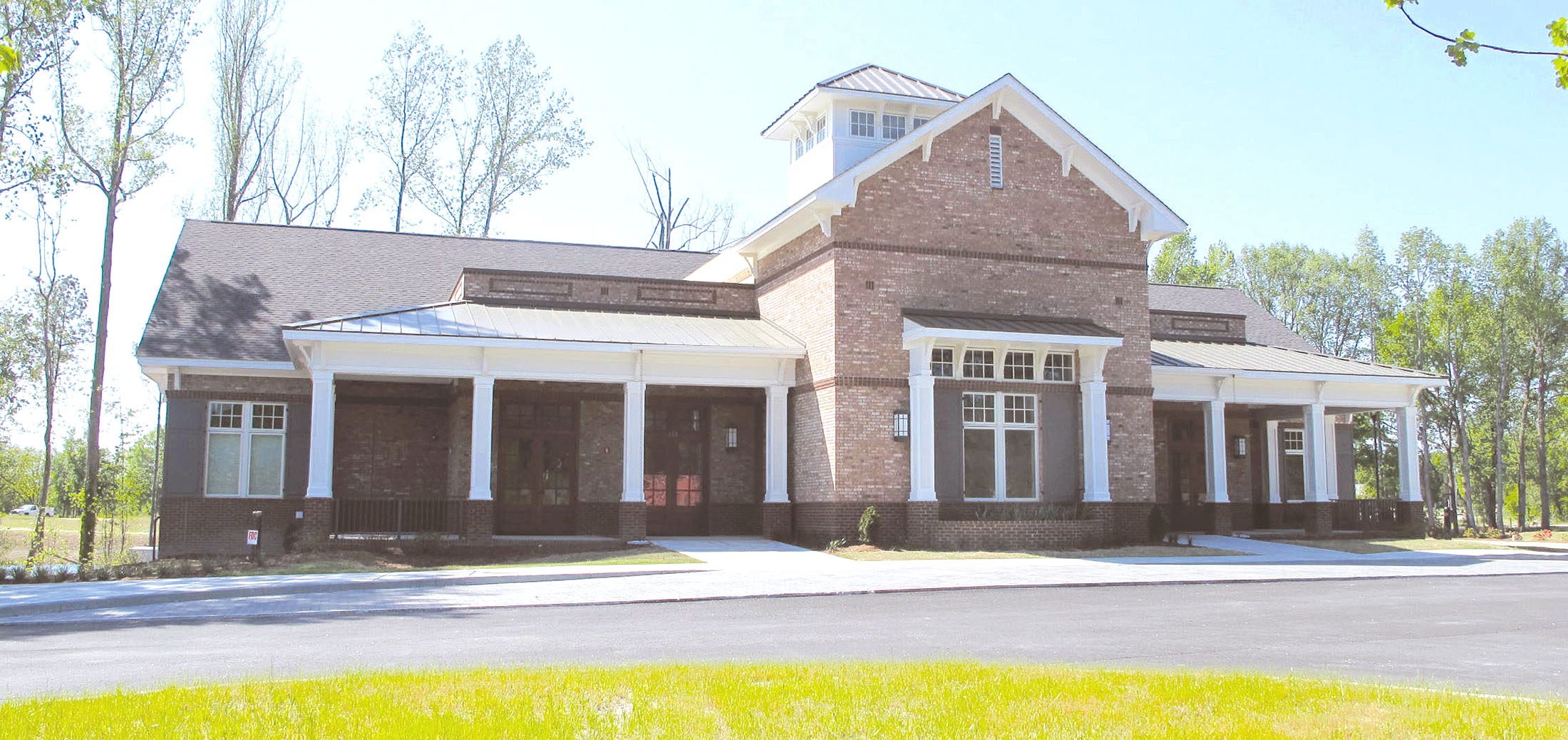
The Blythewood Community Center, under new ownership but still available for events.
BLYTHEWOOD – Even though the Blythewood Community Center and its surrounding 5 acres of land has been sold for development, it’s still available for rent for parties, reunions, receptions, whatever . . . just as it has been in the past. And at the same price – $200 per event, but with no deposit, according to Larry Sharpe, who purchased the Center and property from the Town in January.
“I hadn’t thought about renting it out,” Sharpe said of the property that was, for years, the hub of social activity in Blythewood. Sharpe purchased the property with plans to develop it for upscale shopping and business. “Then I started getting inquiries from people here in town who had rented it in the past and who were looking for a reasonably priced facility in Blythewood for their functions. Being right here on the interstate makes it a convenient place for folks who come from out of town for reunions and family gatherings. I do plan to develop the property, but until that happens, the Community Center and property are available for rent.”
While Sharpe doesn’t charge a deposit, he does ask that those renting it leave it in the same condition in which they found it. The building is air conditioned, has restrooms, a large kitchen with a pass through to the main room and was recently painted inside and out by members of several churches. The 4,000-square-foot building can accommodate up to 300 people for a dining event. Tables and chairs are included with the rental price as well as the 5 acres surrounding the building.
“It’s not fancy,” Sharpe said, “but it’s casual, comfortable and meets the needs of large groups that include children dripping ice cream cones and even pets. And the grounds are ideal for outdoor activities and games.”
The Building is located at 311 Blythewood Road, at Exit 27, off I-77, and across the road from the Food Lion and Groucho’s. For information call 206-8400.
The Farm
On the other side of town, on Highway 21 going toward Ridgeway, Sharpe offers another event facility he calls The Farm. The 130-acre property includes a 6,000-square-foot renovated barn that can accommodate approximately 300-400 people for any kind of event from blue jeans to diamonds. Outdoors, there are four ponds, a fire pit with seating, a rock garden and several fenced horse paddocks on the property.
The entire facility and grounds rents for $500 (no deposit) for a week day, $1,000 for one day on a weekend or $1,500 for a two-day weekend. The ‘day,’ Sharpe said, is the whole day. The barn includes a full kitchen, large restrooms with granite counter tops and tile floors, dressing areas for weddings, a banquet area, smaller meeting areas and a covered back porch for dining with a sweeping view of the outlying paddocks and treed skyline. Sharpe converted the barn’s wash stalls into an oyster roast facility with stainless steel tables. Dining tables and chairs are included with the rental price. A separate storage facility is included to accommodate equipment and preparation items for weddings and other large events.
Sharpe said he has plans to add more entertainment features to the property, including a sporting clay area. He said the bookings keep him hopping these days with some as far out as 2014, including a Frisbee tournament and a number of corporate meetings and church retreats. For information, call 206-8400.
Doko Manor
Back in downtown Blythewood, in the Town park, is yet another rental facility, The Doko Manor, that offers a formal setting that can accommodate up to 375 people in a 3,240-square-foot area for 12 hours on a weekend for $1,025 (for non-29016 residents) or for $770 (for 29016 residents.) This area, which overlooks a pond and patio, can also be rented for six hours for $338. Two smaller meeting rooms, measuring 27 x 29-feet each, can each accommodate up to 75 people for prices ranging from $150 for six hours on a weekday for 29016 residents to $450 for 12 hours on a weekend for non-29016 residents.
Booth Chilcutt, the Town’s new fulltime Accommodations Manager for the Manor, said the Town will try to allow Blythewood clubs and organizations free use of an 18 x 22-foot meeting room under some circumstances. An outdoor patio, called the passenger platform, is available for rent for outside picnics. Rental prices for the patio, which overlooks the pond, range from $150 for six hours on a weekday to $500 for 12 hours on a weekend day. Varying deposits are required along with a signed lease agreement.
The fully carpeted facility is equipped with automatic window shades and built in telecommunications equipment, restrooms and a warming kitchen. Chilcutt, who is both knowledgeable about the facilities and helpful to parties leasing it, is in charge of setting up the rooms to accommodate the various groups and is present at all events. Martha Jones is the Town’s fulltime Events and Conference Center Director and handles marketing for the Manor. Chilcutt, as the former Director of the Sumter County Cultural Commission, brings not only a background of experience in the cultural arts, but a long list of contacts whose events he hopes to bring to the Manor. One of those is the State Arts Commission, which is booked for next fall.
“It’s a beautiful facility,” Chilcutt said, “and we’re very excited about it.”
Chilcutt, who moved to Cobblestone from Sumter two years ago, said the Manor will have an exclusive catering contract (for events at the Manor) with the new restaurant that the Town of Blythewood plans to build in the park later this year. A catering exemption fee will be charged for events that use other catering services.
Chilcutt said the facility has already been rented for several events and that he expects the pace of leasing will pick up as the public learns about it and has occasion to use it. However, he said, he expects much of the business for the Manor to come from out of the area. For information, call 754-0501.
BLYTHEWOOD – In 2008, voters in Richland School District 2 passed a $306 million bond referendum for certain specified projects, including the construction of several new schools in Blythewood. Now it seems some of those specified projects in Blythewood are either on the block or delayed for the purpose of freeing up funds for a project that was never presented to voters before the 2008 bond was passed — a $40 million Student Education Center that was scheduled to be completed in July of this year. While it is rumored that the Center will be built on property near Two Notch and Clemson roads, possibly on the Clemson Extension Services property, no site has yet been disclosed by the Board. And a completion date is not on the radar.
Among the projects approved for Blythewood in the 2008 bond referendum were Langford Road Elementary, Muller Road Middle, Westwood High School, Elementary #19 on Kelly Mill Road and Elementary #20 to be built at an as-yet-unspecified location.
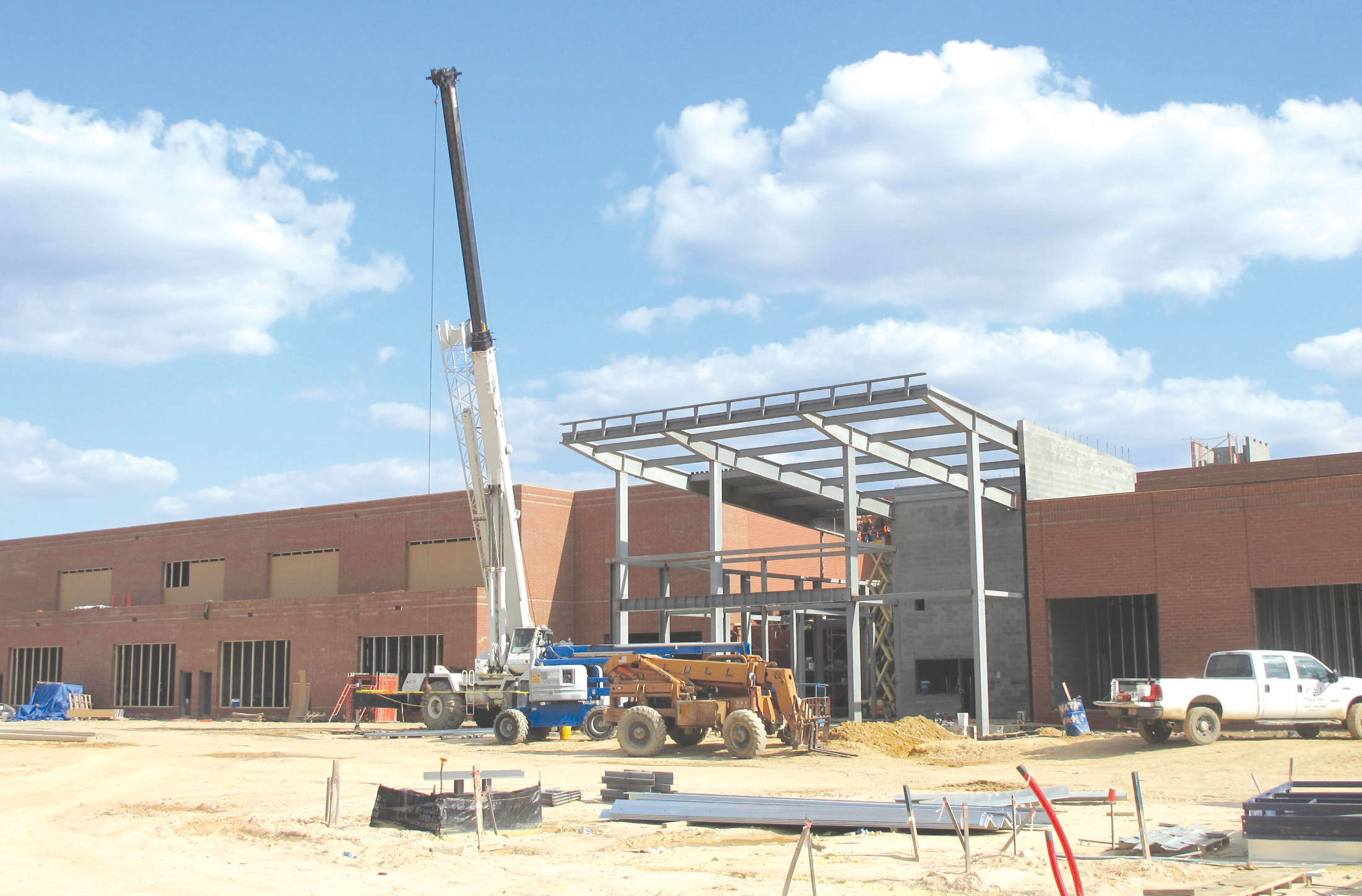
Now, more than a year after construction began on Elementary #19, the $30 million project is only 43 percent finished and construction is at a standstill with completion backed up at least another year. Elementary #20 has been put on indefinite hold. Sources close to the projects say the delays are intended to produce a savings for the District that is likely earmarked for construction of the planned Student Education Center that has yet to see the light of a full public discussion by the Board.
How did that happen? Via a legal loophole that allowed the Board, on Sept. 11, 2012, to make a $39.5 million change order to what appeared to be a $500,000 District Office renovation study initiated by the Board six months earlier. While the original renovation contract was billed to the public as a feasibility study, it was actually a design-build contract from the start. A design-build contract gives the Board enormous latitude to change any and all components of the contract without public discussion and is rarely used for construction projects for school districts. It is important to note, too, that the District’s 10-year Facility Plan hadn’t called for District Office renovations until the year 2016. The renovation plan now appears to have been little more than a means by which to initiate construction of the Student Education Center without having to go through the ramifications of public approval.
While the proposed Student Learning Center came as a surprise to the Richland 2 public, the fine print in the original RFP (Request for Proposal) actually laid out the Board’s real intent for the Center, stating that because neighborhoods do not provide the amenities critical for a community, the District has a role in providing these.
“Additionally,” the RFP stated, “community amenities normally found in mature neighborhoods are lacking in the region [Richland 2] and the District wishes to utilize its facilities where appropriate to meet the needs of the residents of Richland School District 2.”
Indeed, the proposed Student Education Center is more than a renovation of District Offices; it will include profession-based learning with a full catering operation, a tony snack bar and other school ‘business’ operations — all run, according to Superintendent Dr. Katie Brochu, by students in a high, airy space full of light and glass exterior walls so the public can watch the activities inside.
One District official not authorized to comment on the issue said the Center would also possibly include a public swimming pool. That was the case in a York County, N.C., when Dr. Brochu served as Superintendent in that District. There, a bond referendum was proposed to fund a similar Learning Center that did include a public swimming pool, but the voters rejected the bond. The pool was subsequently removed from the proposal and, at the same time, Dr. Brochu left her position with the District, after which the bond referendum passed a second vote.
The 7-0 vote on Sept. 11, 2012 by the Board for the $39.5 change order changed the project’s focus from the District Office/Community Center to a Student Education Center. This is legal and was directed by the District with the express approval of the Board. But the unseemly aspect of it all is that there was absolutely no heads up for the Richland 2 public. The vote took place after 10 p.m., following a second closed-door session with only two community members still in the audience. Furthermore, the Board’s agenda for the evening included no mention of discussion of, or a vote on, the Center, which runs counter to S.C. open meetings laws.
District officials and Board members have been reluctant to discuss the particulars of the project. However, on Tuesday evening, the Board authorized Superintendent Dr. Katie Brochu to secure a ground lease for 26 acres of land for a 99 year lease. It is presumed that the site is for the Student Education Center. That information as well as the site location will be disclosed after Dr. Brochu signs the lease.
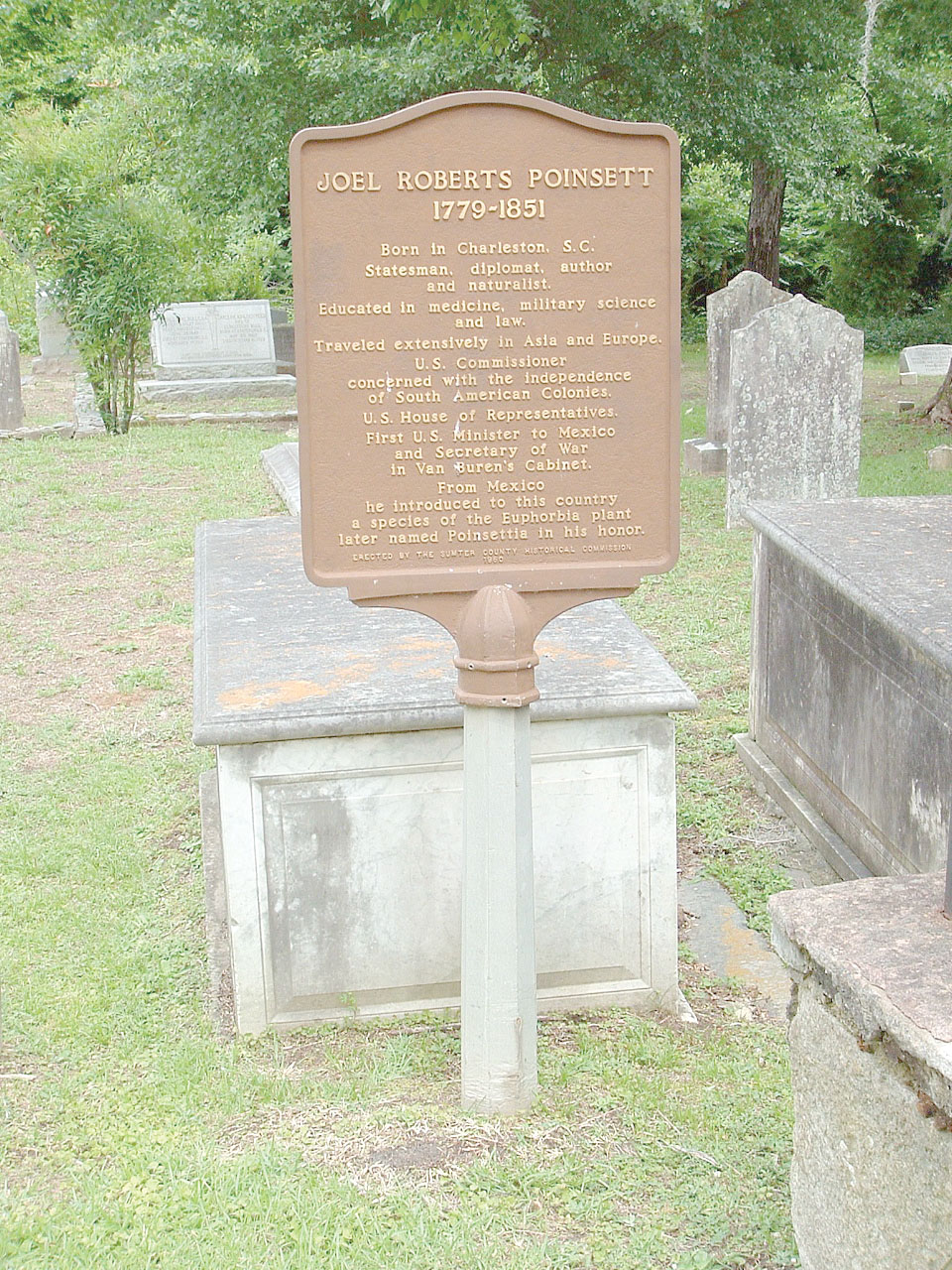
Nothing says ‘Old South’ quite like an Antebellum cemetery, like the one located at the Church of the Holy Cross in Santee, near Sumter, where you’ll find the gravesite of the man who brought South Carolina the Poinsettia.
There’s an old road that makes for a great Sunday drive, SC Highway 261. You’ll see historic sites; feel you are in the mountains, yet feel you are at the coast. More than that, you’ll come across the ghosts of history. Best of all, it’s about an hour’s drive southeast. An historical marker greets travelers, reading, “Over it came Indians, pack animals laden with hides, drovers, rolled hogsheads of produce, wagoners, and stagecoaches. The armies of two wars passed over it.” Some called it the King’s Highway.
Highway 261 winds through the High Hills of Santee. This area is rural, isolated and heartbreakingly antebellum. The land plunges, opening up vistas of distant ridges. You think at once of the mountains. It’s a curious sight to see Spanish moss in the mountains, but Highway 261 gives you massive oaks with limbs draped in Spanish moss.
You’ll find enough history here to fill several good-sized books. For starters, there’s the Church of the Holy Cross. This stately old church was built from 1850 to 1852 of rammed earth. In its old cemetery lies Joel Roberts Poinsett, the man who brought us the poinsettia. A ways down the road, off the beaten path, you’ll come across the grave of General Thomas Sumter, the “Carolina Gamecock.” He earned his nickname when he killed British soldiers for burning down his house.
Those of you who recall Ken Burn’s Civil War documentary will recognize the name Mary Boykin Chestnut. She grew up in Stateburg, a stone’s throw from Highway 261. Chestnut published her Civil War diary as a “vivid picture of a society in the throes of its life-and-death struggle.”
Along Highway 261 you’ll find the hamlet of Boykin Mill Pond and its quaint old sanctuary, the Swift Creek Church. In May 1860, approximately 75 young people met at Boykin Mill Pond to picnic right near the church. Late that afternoon, 30 or more crowded onto a flatboat, overturning it. Close to 25 young people drowned, mostly women. You’ll find an old mill here, too. Boykin Mill and its 100-year-old turbines have long preserved a time when mills provided communities cornmeal, grits and flour. A few steps away is the Broom Place, where Susan Simpson makes sturdy, colorful brooms the old-fashioned way.
As you drive along, the winding oak-shaded lane summons up images of a horse and buggy with men in powdered wigs and women in colonial attire. Then visualize a regiment of Confederates marching down the road, the dust rising around their feet. Imagine Mary Boykin Chestnut seeing the men and reaching for her diary as all, one by one, vanish into the eternal mists we call history. You’ve rediscovered the Old South and it’s just a short drive away.
Learn more about Tom Poland, a southern writer, and his work at www.tompoland.net. Email day-trip ideas to him at tompol@earthlink.net.
Westwood High School Swoop and Scoop clerk Antonio Maxwell, center, shows spirit merchandise to student-customers Jarmel Reese, left and Ashley Rudd.
Applying what is learned in the classroom to the business world is often the goal for those leaving high school. Once students leave school, they have an education but can lack work experience. But experience is just what the students in Jeremi Madden’s Business Education classes are gaining behind the counter at the Westwood High School Swoop and Scoop school store. The store, which is attached to Madden’s classroom, was created by the students in his Marketing class and is now being run by current students in the school.
The store was the brainchild of Principal Ralph Schmidt who wanted to provide an opportunity for students to gain real world experience within the walls of Westwood. Although it was Schmidt’s idea, it was the students of Madden’s class who developed a business plan, designed the store and pitched the plans to Schmidt and other members of his staff for the current store.
“I was so proud of the students and their presentation,” Schmidt said. “They were able to answer all our questions.”
Schmidt said that Madden did an excellent job of preparing the class for their presentation. The students are taking what they learned in the classroom and applying it to the store, gaining hands on experience as well.
Westwood Swoop and Scoop school store is thriving, offering school supplies, healthy snacks and Westwood spirit items. It is open Monday, Wednesday and Friday before and after school and during lunch. The excitement and pride that the students are taking in the store is just what Madden and Schmidt were hoping to see, and each shift is staffed by students, eager, apparently, to go to work.
“I send out a schedule on Google spreadsheet,” Madden said, “and within an hour all shifts are filled.”
The process for employment at the store is the same as for a regular job. Students must submit an application with references and go through an interview process. The skills that the students are gaining, such as time management, marketing, retail sales and more, will allow them to be ready to go on to other jobs after high school. And, Madden said, students know that if they do a good job in the store, he will be more than willing to give them a letter of reference for other jobs outside of school.
Schmidt is looking forward to the year-end review with the students. He is ready to get feedback from them on what worked, what did not work, their marketing plan and ideas for the next year. There are plans to develop a Web presence in which parents, family or friends can purchase items online and the student workers will pull the inventory, package the items and deliver to students in the school. The store has also helped multiple groups on campus with fundraisers – something it hopes to continue to do.
BLAIR – The Fairfield County Sheriff’s Office officially charged Matthew Richard Mahorsky, 40, with two counts of murder Tuesday morning after the bodies of his parents, Ruth Marion Mahorsky, 70, and Richard F. Mahorsky, 71, were found shot to death Monday outside their home at 80 Highway 215 S. in Blair, near the intersection of Highway 34. Matthew Mahorsky is also charged with possession of a firearm during the commission of a violent crime.
The Sheriff’s Office said a security check of the property was conducted Monday morning after Marion Mahorsky failed to show up at work at Provident Bank in Winnsboro and co-workers were unable to reach anyone at the home by phone. At 9:15 a.m. Monday, a deputy arrived at the home and immediately spotted a body, with obvious signs of massive trauma, lying in the driveway. The deputy backed out of the drive, secured the area and called for backup. When the Special Response Team arrived moments later, a second body was discovered nearby, between the first body and the house. Both had been dead for some time, the Sheriff’s Office said, and it was later determined that both had been shot some time late Sunday afternoon.
The first victim was later identified as Marion Mahorsky, while the body located closer to the house was identified as that of her husband, Richard F. Mahorsky. Both victims had been shot through the head with a high-powered rifle, the Sheriff’s Office said. Several weapons, including a high-powered rifle, were recovered from the home. An autopsy was being conducted at press time to determine the number of times the victims were shot, while the State Law Enforcement Division (SLED) is analyzing the weapons seized from the home. Keith Lewis, Chief Deputy of the Fairfield County Sheriff’s Office, said witnesses in the neighborhood reported hearing three shots fired late Sunday afternoon and several shell casings were recovered from the scene.
Approximately 10 minutes after the Sheriff’s Office secured the perimeter, Matthew Mahorsky emerged from the home through the garage, unarmed, and surrendered to deputies without incident. He was held for questioning as a person of interest for approximately 24 hours before being charged. Lewis said Matthew Mahorsky made several comments during questioning that led to the charges, including telling investigators where they could find the suspected murder weapon, a Remington model 700 .308, which was being tested by SLED at press time.
Matthew Mahorsky was previously arrested on a pointing and presenting a firearm charge following an altercation with his father in 2004. During that incident, Lewis said, Mahorsky pointed a handgun at his father’s head and threatened to kill him before his mother managed to calm him down. When deputies responded to that incident, Lewis said, they were told then that Matthew had a history of mental illness. He received a one-year suspended sentence with three years’ probation in the 2004 incident.
Lewis said there was no evidence that Matthew Mahorsky was using alcohol at the time of the shooting, but a bottle of prescription medication, used to treat schizophrenia and bearing Matthew Mahorsky’s name, was recovered from the home.
“This is a terrible and senseless tragedy,” Fairfield County Sheriff Herman Young said. “Our thoughts and prayers are with the Mahorsky family and friends.”
Rick Fosnacht (left) and Tim Lord, owners of Contingency Planning and Outsourcing, Inc., lead the way in disaster preparedness, for businesses and for schools.
Business models are set up to plan for success, but what about disaster? In the 21st century workplace, where companies store more data out in the ether than they do in filing cabinets, planning for disaster is the business model for one local company, Contingency Planning and Outsourcing, Inc. (CPO).
Tim Lord, of Winnsboro, founded the company back in 2000. With 31 years in the business, Lord knew he had the makings of a software system that could help companies recover data and, more importantly, stay in contact with customers and investors in the event of a disaster. Lord quickly brought in Rick Fosnacht, of Blythewood, a computer system designer and developer, to help him flesh out the CPO system. A year later, they hit the market, and soon they had converted to their system one of the biggest names in the technology field: Lockheed Martin.
That’s right: the people who build spaceships.
“Our software tool assists companies, schools and universities to be prepared for any type of emergency,” Lord said. “It’s not just the data, but the business. In the event of an emergency, how are they going to communicate with employees? How are they going to connect with their investors, their customers?”
For example, Lord said, suppose your local doctor’s office burned to the ground overnight.
“How is the doctor going to communicate with his patients?” Lord said. “How is he going to bill those patients? How is he going to know who to bill?”
And that is where CPO comes in, not just with a data recovery plan, but a contingency plan for the business itself.
“You have got to be ready,” Lord said. “Know what you’re going to do and know whose going to do what.”
It is a system CPO is currently marketing to schools, particularly in the wake of last December’s school shooting in Newtown, Conn.
“In (Newtown), one of the classroom doors would not lock, and the intruder was able to come into that room,” Lord said. “Our system can set up a task – ‘check door locks every two weeks.’ The system will automatically send a reminder to the person responsible for making that check and also send a notification to the school principal if it hasn’t been done.”
Schools are required to have a ‘safe schools’ plan, Lord said, but typically that information is housed at individual schools, is rarely practiced or rehearsed, and the information (emergency contact numbers, etc.) contained therein rapidly becomes obsolete. And, Lord said, most of what is in those plans should be maintained and managed at the district level, not at the individual schools.
That was precisely the scenario CPO found in the Greenville County School District six years ago when they installed their system there.
“The best plan they had was two years old,” Lord said, “and 85 percent of it belonged at the district level. We moved it there (to the District Office) and now one person sits at a desk and monitors 100 schools. The system tells them if they are ready for an emergency or not.”
Lord and Fosnacht are so passionate about schools adopting their system they are offering it for a cut-rate price. Still, Greenville County is the only K-12 public school system in the state to adopt their software. The state of Pennsylvania, meanwhile, is currently considering CPO for all of their school districts. Other CPO clients include the U.S. Navy, DHL, the University of California at Los Angeles and Fordham University.
“There is a need out there,” Lord said, “and we are almost giving this away to schools.”
After all, the worst time to discover you need a disaster plan is during a disaster.
RIDGEWAY – Two Ridgeway men were arrested last week and charged with a March 24 break-in of Sawney’s Creek Baptist Church at 14605 Highway 34 E. in Ridgeway.
According to the Fairfield County Sheriff’s Office, 17-year-old Morgan Dean Murphy, of 289 Murphy Trail in Ridgeway, and 19-year-old Cameron James Wells, of 1150 Centerville Road in Ridgeway, were charged with second-degree burglary. Murphy was arrested March 26 and Wells on March 27.
On March 24, Sheriff’s deputies responded to Sawney’s Creek Baptist at 9 p.m. after a church trustee discovered a 32-inch RCA flat-screen television worth $287 and a set of speakers worth $50 missing from the church’s children’s room. The next day, deputies received information leading investigators to question Wells about the break-in. According to the incident report, Wells told investigators that Murphy had “made (Wells) walk with him” to the church. While Wells waited in the parking lot, Murphy reportedly climbed through an unlocked window. Murphy then exited the church with a flat-screen television through a door. Wells told investigators that Murphy made him carry the television back to Murphy’s house. Wells also said Murphy had another television at his house that Murphy had stolen from the same church in February.
When officers arrived at Murphy’s home to execute a search warrant just before 5 p.m. on March 26, they spotted Murphy coming toward the home out of the nearby woods and placed him under arrest. Officers located the stolen speakers inside Murphy’s home and the RCA flat-screen television in the woods behind the home. According to the incident report, officers also learned that the Sylvania flat-screen television stolen in February had been sold at a pawn shop in Lugoff. Wells turned himself in to deputies the following morning.
“My office treats all crimes as serious, but crimes against churches are particularly senseless,” Fairfield County Sheriff Herman Young said. “I’m glad we were able to make two arrests and recover the stolen items for the church.”
GREENVILLE, S.C. – Barbara Ball, publisher of The Independent Voice of Blythewood and Fairfield County, was elected to the Executive Committee of the S.C. Press Association at the organization’s annual meeting at the Poinsett Hotel in Greenville March 23.
“Barbara has been an active member of the Press Association for many years and we think she will be a strong representative of smaller community papers on our board,” said Bill Rogers, SCPA Executive Director.
Ball founded The Country Chronicle in November 1998, selling the publication in June of 2005. Ball then founded The Voice in June of 2010, expanding that publication to include Fairfield County in June 2012.
Ball joins Dan Cook, editor of the Free Times in Columbia, Jane Pigg of Cheraw, publisher of The Link, and Gayle Smith, vice president of advertising for The Post and Courier in Charleston on two-year terms on the Committee.
Debbie Abels, publisher of The Herald in Rock Hill, and Mike Smith, executive editor of the Herald-Journal in Spartanburg, were re-elected to continuing terms on the Committee.
Jack Osteen, publisher of The Item in Sumter, was elected president of the SCPA. Morrey Thomas, publisher of the News and Press in Darlington, was elected weekly vice president; Judi Mundy Burns, publisher of the Index-Journal in Greenwood, daily vice president; and Ellen Priest, president and publisher of The Summerville Journal Scene, The (Goose Creek) Gazette and The Berkeley Independent in Moncks Corner, treasurer.
The SCPA Executive Committee is the governing body of the association, which represents every daily newspaper in the state and more than 90 weekly newspapers.
 Up Chester County way, Landsford Canal is so beautiful it ended up in a coffeetable book, “Reflections Of South Carolina” (Clark & Poland). You could say it’s as pretty as a picture. Getting to the canal is easy. From Blythewood and Winnsboro, it is only about 40 miles, much of which is on I-77 North. Go visit Landsford Canal State park and the Catawba River, all blue and rocky, that once upon a time was an avenue of commerce.