Two hours of back roads and about 98 miles will take you to McCormick, where the second-richest vein of gold in South Carolina history was discovered. In February 1852, William Burkhalter Dorn discovered gold where McCormick sits. The Dorn Gold Mine in McCormick is one of the more important gold mines in South Carolina. Dorn excavated close to $1 million in gold before the mine ran out in the late 1850s. McCormick stands over the old sites of gold discovery. Dorn himself became wealthy but lost much of his fortune after the Civil War.
Cyrus H. McCormick, inventor of the mechanical reaper, bought the property. When the mines didn’t pan out, McCormick planned the town that took his name.
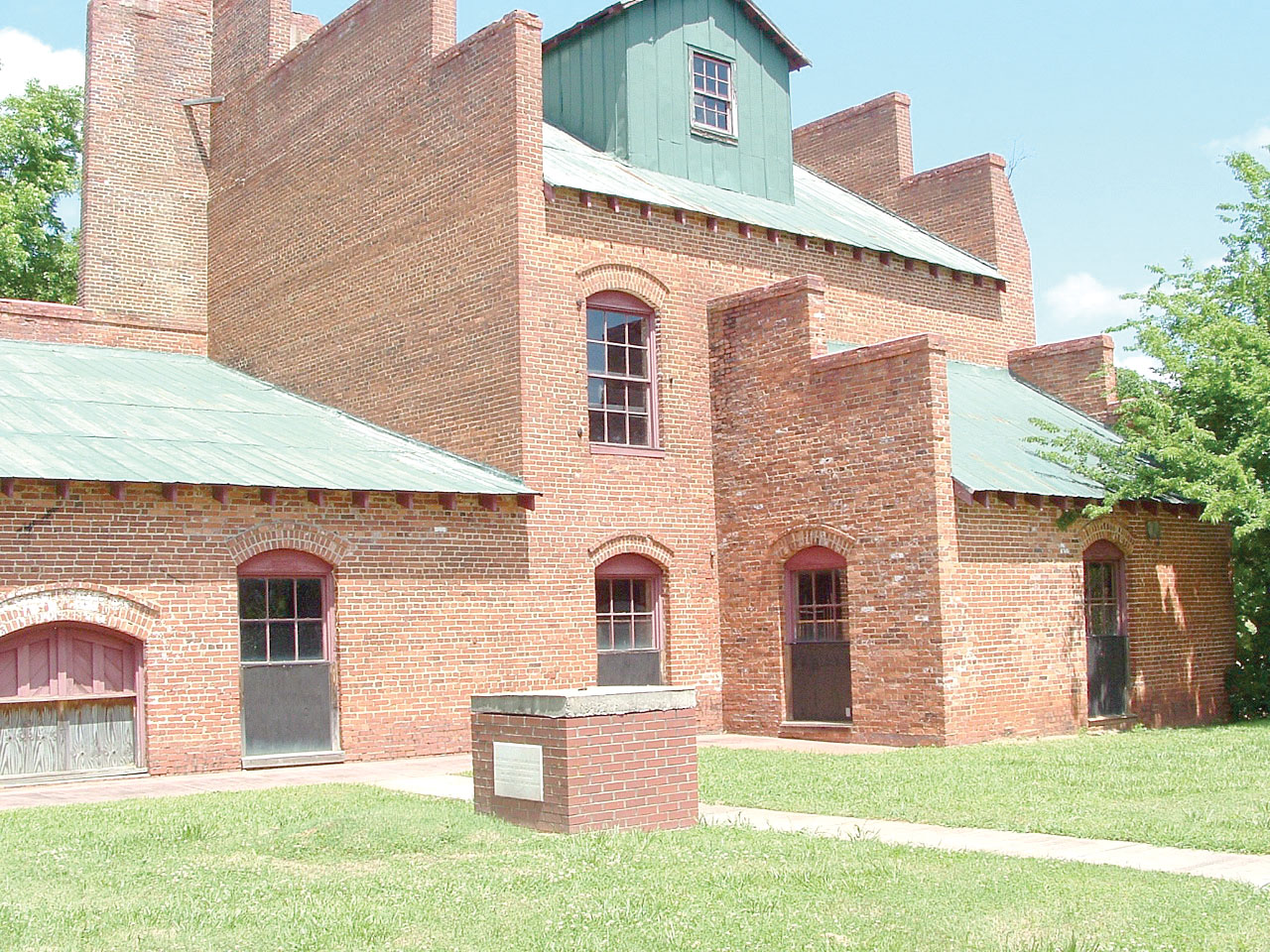
Evidence of boom times remains. McCormick has an historic mill, a grand courthouse and a fine old hotel that once housed train travelers. The Dorn Mill, restored in 1973, is one of the few remaining gristmills of its type in the United States. The three-story building, built circa 1898, has two steam boilers that powered two 10-ton stationary steam engines. Inside is a boiler made by the Lombard Iron Works of Augusta. That boiler powered this attrition mill where grinding plates revolved in opposite direction at 2,200 revolutions per minute. When this mill was up and running the din must have been unbelievable. A beautiful aspect of the old mill is its many hues of wood. Beams chutes and railings are blond, red and tan. Beautiful too is the Silver Creek Flour Packer.
Viewed from the front the mill has a medieval look. Listed on the National Register of Historic Places it’s lauded as an outstanding example of rural industrial architecture. The dominant feature of the exterior is a three-story brick wall built in 1915 to support a water tower tank.
Hotel Keturah, circa 1910, a building also on the National Register of Historic Places, faces the railroad tracks running through town. In front of the hotel, you’ll see six stones sunk into a sloping shoulder of grass just off the rail tracks. Down these “steps” black gentlemen in tuxedoes escorted train passengers to Hotel Keturah. Keturah, by the way, is the name of the wife of W.J. Conner. And who might he be? The man who built not one, but two hotels on this site and named them both in his wife’s honor (the first Hotel Keturah, 1900, burned in 1909).
Just beyond Hotel Keturah stands the handsome seat of justice. At 133 South Mine Street stands an historic building. Built in 1923, seven years after McCormick County was formed, the building is a Neo-Classical style brick building. The interior features pressed metal ceilings and the original transoms and doors. Like the gristmill and Hotel Keturah, it too is on the National Register of Historic Places.
Gold, a famous inventor and historic buildings wait in McCormick. And it’s a day trip away.
Carson Justice finishes the fast break. (Photo/Martha Ladd)
Jaycie Johnson (15) uses her size to loft in 2 points for the Lady Eagles. (Photo/Martha Ladd)
SUMTER – A flickering scoreboard, a whistle-happy first half, a frozen clock with less than a minute to go and an improbable, desperation 3-point bomb to send the game into overtime piled drama on top of drama in Saturday’s SCISA 2A girls’ state basketball championship. But when the dust had cleared, the Richard Winn Academy Lady Eagles cut down the net and hoisted their second consecutive state title trophy, topping Thomas Sumter 37-33 in overtime.
The Lady Generals’ man-zone defense held Richard Winn to their lowest point total of the season and their lowest output since their 43-38 loss to Union County, a class 3A public school, on Jan. 13. While the Thomas Sumter game plan forced the Lady Eagles into tough looks from outside, the Lady Eagles still managed to open the game on a 5-0 run as the Lady Generals’ offense sputtered out of the gate. Thomas Sumter finally got on the board with 3:30 left in the first period, ending the quarter on a 6-2 streak to cut the Richard Winn lead to 7-6 at the first buzzer.
“I give all the credit in the world to (Thomas Sumter head coach) B.J. Reed,” Richard Winn head coach Jason Haltiwanger said after the victory. “She had a great game plan defensively. It looks like man it looks like zone. We weren’t patient enough to move it around more. But the girls gutted it out, that’s all that matters.”
The Lady Eagles drew whistle after whistle in the first half, and by the second quarter Thomas Sumter had reached the bonus. The Lady Generals tied the game at 7 from the line early in the second, then took a 9-7 lead from the line with 5:37 to play. All but two of the Lady General’s 8 second quarter points came from the stripe.
Sophomore Jaycie Johnson tied the game at 9 with a turnaround jumper in the paint with 4:07 left in the quarter, but Thomas Sumter’s Taylor Knudson put the Lady Generals back out front with a layup at the 3:20 mark. Anna Cooke’s 3-point stroke gave Richard Winn a 12-11 edge with 3:03 to go before the half and Jessie Stidham added two more with 2:33 to go. The Lady Generals tied the game at 14 with just over a minute on the clock when Knudson sank one of two shots from the line, but senior Carson Justice nailed a pair of foul shots in the closing seconds to give the Lady Eagles a 16-14 advantage. The half ended with an astonishing 10-3 foul discrepancy in favor of the Lady Generals.
“There were multiple things that we can’t control that affected us early,” Haltiwanger said. “We got seven or eight fouls just like that. Our best thing we do is a man-to-man run and jump and that took us right of that, so our girls had to adapt and adjust.”
As foul calls reached a more even distribution in the second half, the pace of the contest picked up considerably and the see-saw battle for 2A supremacy was on full display. The Lady Generals tied the game three times in the third period and took a brief 19-18 lead at the 6:28 mark. Richard Winn freshman Bailey Taylor drove home a 3 with 3:09 remaining in the quarter to give the Lady Eagles a 23-20 lead. Taylor’s shot set off a 7-4 run by RWA, leading the Lady Eagles to a 27-24 lead at the third buzzer.
“Bailey Taylor hit some big shots,” Haltiwanger said. “They kept leaving her open and she was hesitating at first, then she took them and knocked them down. That was big.”
In the fourth, Richard Winn matched their largest lead of the game, opening up a 29-24 advantage in the early goings. With just over 3 minutes to play, Justice snatched the ball from Knudson and raced down the floor for the put-in to give the Lady Eagles a 31-24 lead. The Lady Generals, meanwhile, went stone cold, held off the boards for the first 5 minutes of the quarter. Knudson broke that drought with a pair of free throws. And while Richard Winn struggled uncharacteristically from the line down the stretch, Knudson’s buckets ignited a minor Thomas Sumter rally – enough to draw them to within three, at 32-29.
On an in-bounds pass with under a minute to play, the Lady Generals were gifted with as many as seven free seconds of playing time when the game clock failed to start. The unexplained and uncorrected bonus time extended the game just long enough for the Lady Generals to force overtime. With 4 seconds on the clock, Knudson launched a desperation shot from well beyond the arc. As the buzzer sounded, the basket miraculously swallowed the ball, tying the game at 32 and sending the decibel levels inside the Sumter Civic Center soaring to highs greater than a Who concert.
“I heard that (the clock didn’t start), but it’s not going to change anything,” Haltiwanger said. “There were a bunch of questionable things that happened tonight, but a champion doesn’t complain; they keep playing. That’s what the girls did.”
In the 4-minute extra frame, the Lady Generals used the charity stripe once again to take an edge, 33-32. It would, however, be the only point Thomas Sumter could muster in OT, while the Lady Eagles finally found their form from the line. Justice hit three of four attempts in overtime, while junior Emily Brigman hit two of four to sew up the title.
“It was kind of a nightmare free throw night for us,” Haltiwanger said. “(Justice) hit some big free throws of us down the stretch. Emily Brigman, who missed two to put it away (in regulation), came back in overtime to hit some to give us a lead there.”
Saturday’s final was the third consecutive trip to the title game for Richard Winn in as many years, and their second consecutive championship.
“It takes dedication and hard work,” Haltiwanger said. “A lot of girls are at the beach during the summer; they’re in the weight room working out and working on their basketball skills. It started a long time ago with people like Alex Maass (class of 2012) paving the way and now these girls followed and they put in a lot of hard work.”
With a potential dynasty on his hands, Haltiwanger will look to his underclassmen to step up next season. In addition to Justice, the Lady Eagles will have to move on without senior Anna Cooke in the 2014-2015 season.
“Jaycie Johnson is a sophomore, she had an incredible year,” Haltiwanger said. “Jessie Stidham (a junior) is someone you can build around in the post. Alyssa Atkerson, she’s a freshman. You can build around her as a point guard. She’s extremely athletic. So there are some pieces there.”
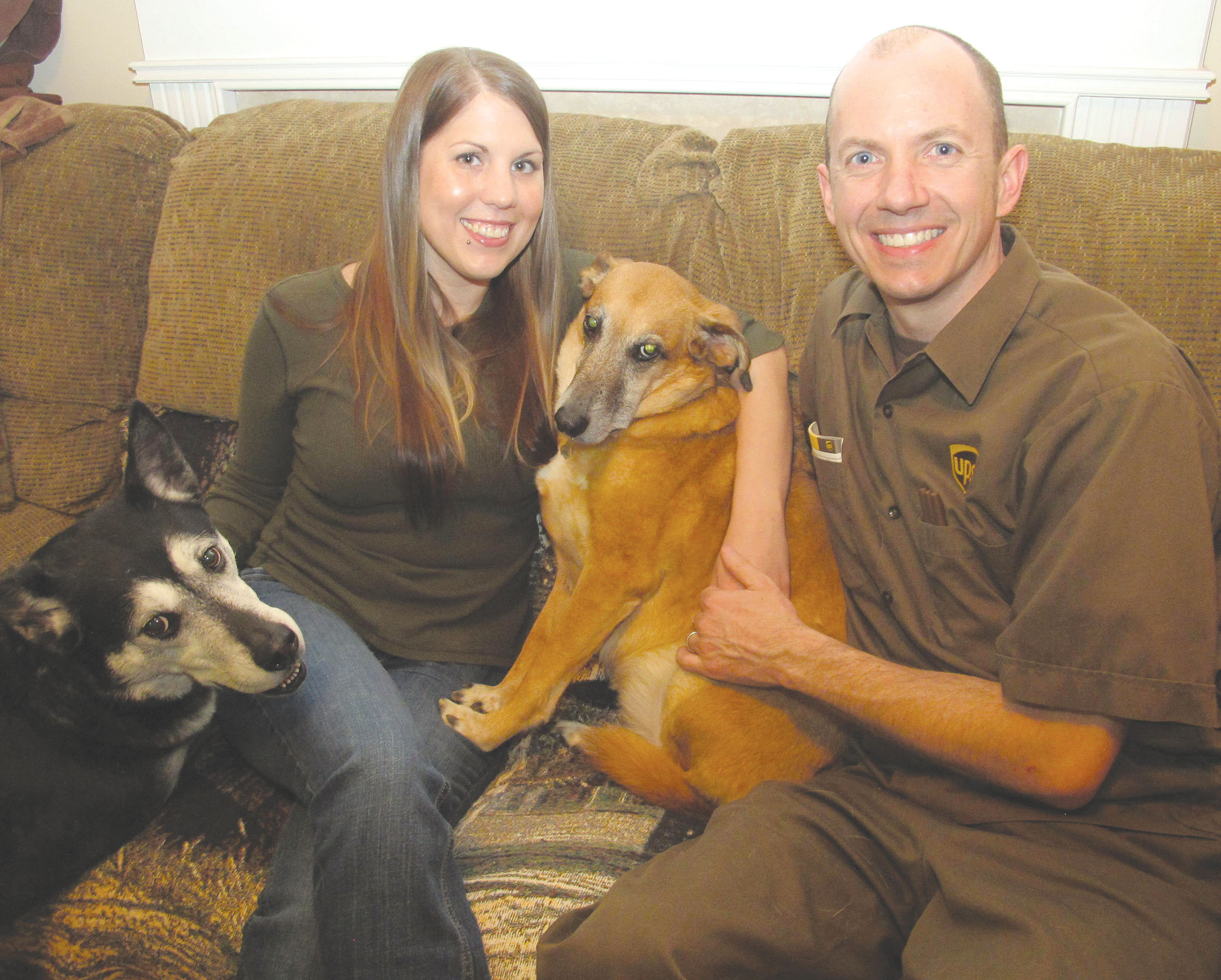
Jason and Michelle Ellisor at home with Maya, center, formerly known in Blythewood as Mommy. At left is Bud, the family’s more recently adopted Husky-German Shepherd mix.
Former Blythewood Stray Enjoying Comforts of New Home
Last February, a forlorn, mixed-breed stray dog was rescued from a vacant lot in the University Village shopping area off Blythewood Road. It was such an elaborate dog-rescue that the story ended up in The Independent Voice (“It took a village to rescue this dog,” March 15, 2013.) Since then, the newspaper has received occasional inquiries as to what became of the dog who for years hung out in the vicinity of the vacant lot, subsisting on handouts from concerned strangers. So, here’s an update.
Many caring people in the community, including employees of the dentist office next to the lot, had tried to rescue the dog they dubbed ‘Mommy.’ Fearful, she always eluded them. One of those would-be rescuers was Jason Ellisor, a UPS driver from Lexington, who always left food for Mommy when his delivery route took him to Blythewood. After the near-miraculous rescue of the elusive canine, it was Jason and his wife Michelle who took her in, changed her name to Maya and gave her a new life.
This weekend, on the anniversary of her adoption, the Ellisors will celebrate Maya’s first year as a member of their household. It was a year of adjustment for Maya; a year that, despite jubilation over her rescue, clearly began on a low note.
An initial veterinary examination revealed that Maya was about 10 years old, had heartworms and a painful limp caused by a previously shattered pelvis that had healed badly. Because of her poor health and age, she was not a candidate for traditional heartworm treatment. She would need an alternative treatment that might not prove successful. Pain medication was prescribed for her limp. In addition, Michelle recalls that Maya was terrified when they brought her home.
“Being captured was probably Maya’s worst nightmare,” Michelle told The Voice in a recent interview, “so we tried to make her comfortable in her new surroundings. We put a big dog bed in a corner of the kitchen. She liked it there because it was out of the way, but she could still see everything. I spent lots of time sitting next to her, reading a book or playing on my phone, to get her accustomed to being around me.”
The Ellisors devoted themselves to Maya’s rehabilitation and acclimation and gradually Maya responded to her new life of love, care and comfort. She eventually commandeered her own wing of the Ellisors’ L-shaped sofa and, today, Maya has a new spring in her step. She’s heartworm-free, no longer limps and is pain free with the help of medication. She has a big backyard, doting family, healthy diet and a newly adopted brother – a 7-year-old husky/shepherd mix named Bud.
“Maya is mind-blowingly smart,” Michelle said, ticking off the dog’s attributes without being asked. “She comes when called, has never had an accident in the house, minds perfectly and doesn’t tear things up. And she’s absolutely spoiled rotten,” Michelle added, ruffling the dogs ears, “which I love! When she’s called in from the backyard, she just prances right up to the door, tail wagging and ears up! She’s very quiet, but very people friendly and social now.”
Because of Maya’s special, time-consuming needs early on, the Ellisors had not anticipated getting a second dog. But, like many 10-year-olds, when Maya visited a Homeward Bound pet adoption event at Pet Smart with the Ellisors, she saw a dog she just had to have. His name was Bud, a handsome Husky-German Shepherd mix. The Ellisors adopted him.
“They’re great pals,” Michelle said of the two dogs.
The Ellisors were warned that because of her many years on the lam, Maya might stray again given the chance. But her only AWOL adventure occurred about five months after her rescue.
“She’d been in the backyard for just a few minutes by herself, when something in the woods caught her attention,” Michelle recalled. “She leapt over the fence and was gone. We looked for her all through the woods, calling her for hours and even brought Bud along to help. We thought she was gone. Then, suddenly, Maya came trotting up, muddy and happy. She had obviously been playing in the creek, but she was happy to come home at dinner time!”
As the Ellisors plan for Maya’s first year celebration – which includes a big yogurt-frosted dog cookie – they have a message for the people in Blythewood who helped Mommy/Maya survive all those years alone and eventually made possible her rescue.
“We want to thank them for all they did for Maya and let them know that she is well and happy,” Michelle told The Voice as Maya hopped up on her end of the couch and stretched out. “We just love her to pieces.”
Homeward Bound Pet Rescue provided all the funds for Maya’s hospitalization and vet care as well as a crate and other costs associated with her adoption. For information about how to support Homeward Bound’s Blythewood operation, call 803-454-9094 or go to http://www.petfinder.com/shelters/SC340.html.
I Can See My House from Here – The view from atop Sassafras Mountain, from which you can see four states.
Feel like a challenge? Drive about 122 miles to Pickens County and ascend Sassafras Mountain’s 3,560 feet – by car of course. When you do, you’ve reached the highest point in South Carolina, its rooftop. Standing on Sassafras Mountain you can look over a rippling green land in spring, a darker green in summer and a color-struck land in autumn. I’d avoid it when winter’s icy grip holds the land.
South Carolina’s rooftop attracts highpointers, people who pursue the sport of ascending the highest elevation in a given area. Thus do they come to South Carolina’s rooftop.
I’ve made it to the top in early morning. At dawn sun glints off three lakes as the forests of four states mutate from black to olive green to jade: From Sassafras Mountain you can see the Volunteer, Tarheel, Peach and Palmetto states. Lakes Jocassee, Keowee and Hartwell look like shiny dimes from 3,564 feet and they pale silver as the sun climbs.
In summer the rooftop grows pretty hot. Haze obscures things and the distant lakes appear ill defined. Atmospheric lines of blue, gray and white air stack along the horizon like lake sediment. One summer day all that hot air played a trick on me. It created a mirage. A freighter appeared to steam across Lake Keowee toward Jocassee. My Vortex Diamondback 8×42 glasses verified things. The freighter was there, all right, headed for mountain swells. It steamed along but got nowhere, this shimmering ship from the sea that cannot be.
In a blink it disappeared. Gone. I looked through the glasses again and saw a small watercraft plying the lake’s veneer, a feathery wake trailing it. This Fata Morgana brought to mind Hemingway’s “True at First Light” and a mirage extraordinaire he witnessed.
“In Africa, a thing is true at first light and a lie by noon and you have no more respect for it than the lovely, perfect weed-fringed lake you see across the sun-baked salt plain. You have walked across that plain in the morning and you know that no such lake is there. But now it is there absolutely true, beautiful and believable.”
You needn’t worry about mirages and you surely don’t have to be a highpointer to go to Sassafras. Strike out. It’s a great place to experience other seasons. In August you can stand atop Sassafras Mountain and feel fall’s chill. On Sassafras a man can see for miles and miles and miles, as Mr. Townsend famously wrote. Standing on South Carolina’s rooftop you look over a rippling green land and smoky blue hills. As night draws nigh wine, yellow, orange and cinnamon hues prevail until shadows reign supreme.
One final note: A recent South Carolina Geological Survey assessment downgraded Sassafras Mountain to 3,533 feet, because of grading that lowered the natural height. It still stands at least 50 feet higher than nearby Hickerynut Mountain (3,483 feet).
BLYTHEWOOD – As reported in the Feb. 14 issue of The Voice, Bravo Blythewood, the cultural arts arm of the Town of Blythewood, was sent a notification of fine for $2,000 from the S.C. Secretary of State’s office on Jan. 1 for continuing failure to register with and file its financial information with the agency’s Public Charities Division. The arts group was told it had 15 days to register.
According to minutes from Bravo Blythewood’s Feb. 17 meeting, obtained by The Voice last week, Bravo Blythewood CEO Martha Jones told the group that it had not been fined and that its registration with the Secretary of State’s office was in order.
When asked last Thursday if the matter was, indeed, settled as reported in the minutes of the meeting, Shannon Wiley, Deputy General Counsel of the Secretary of State’s office said Jones’s report was incorrect.
“Bravo Blythewood had not registered with the Division of Public Charities prior to submitting the registration form that we received on Monday, Feb. 10, 2014,” Wiley wrote in an email to The Voice.
“At this time, we are holding the registration at Ms. Jones’ request while she has her accountant prepare a (form) 990 EZ,” Wiley wrote. “An active charity is required to include a financial report with its registration if one has not been provided before.”
Wiley wrote that she had spoken with Ms. Jones on Tuesday (Feb. 11) and explained that the agency would not waive the $2,000 fine for late registration entirely, but would reduce the fine to $200 for administrative costs. Wiley said that Jones had 15 days to forward the financial report (990 EZ) and the $200 fine to her attention.
On Feb. 12, Wiley told The Voice that no financial records had been filed with the Public Charities Division for Bravo Blythewood since it was incorporated as a non-profit on Aug. 3, 2011.
While Bravo Blythewood is registered as a non-profit corporation with the business filing division, Wiley said because it solicits money and is funded by the town government, it must also be registered with the state’s Public Charities Division and file an annual financial report and an annual registration form.
Jones had not replied to an email request for comment from The Voice at press time.
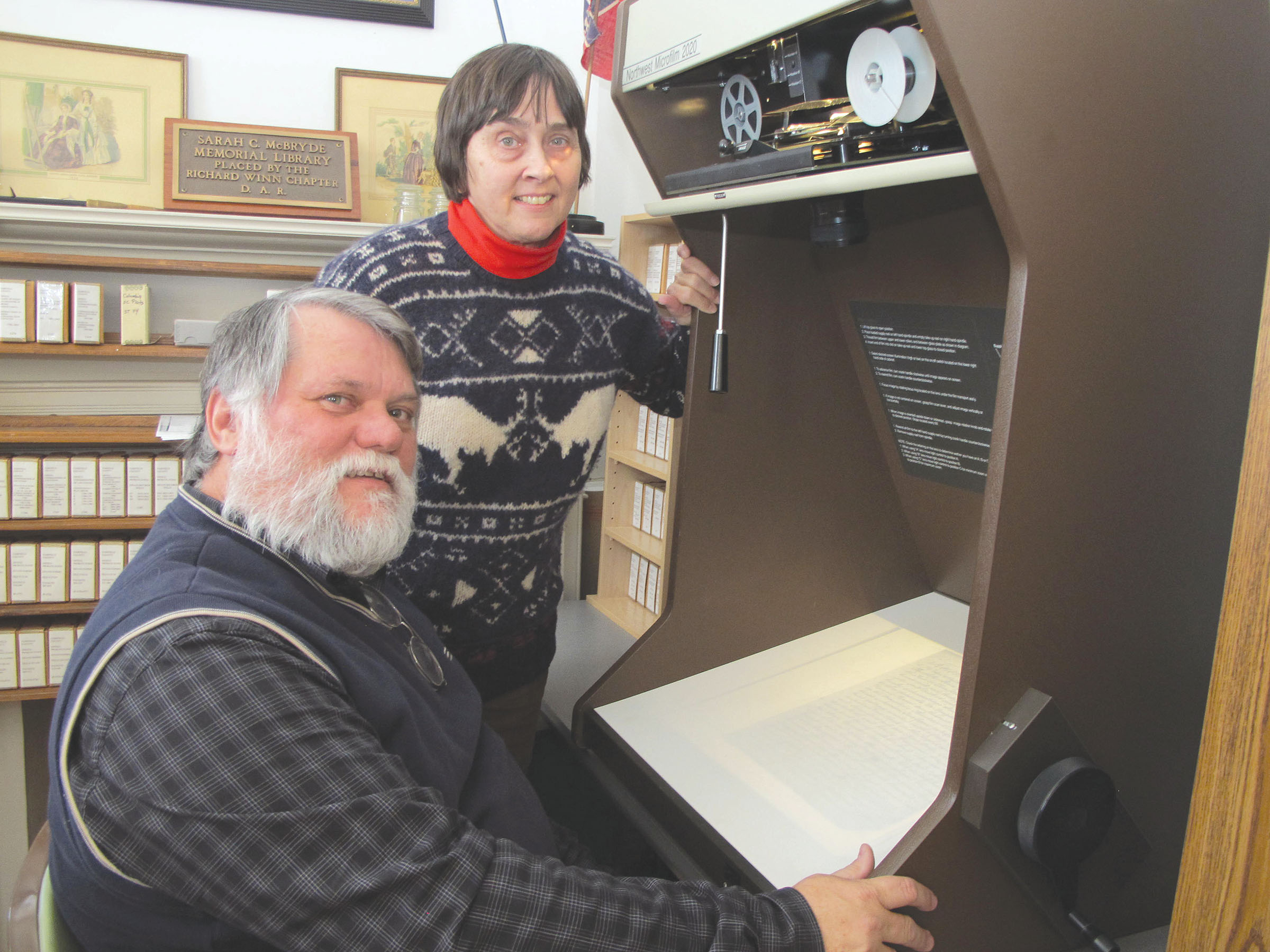
Much of the Fairfield Museum’s earlier records are on microfilm and have been largely inaccessible by the public because of the museum’s outdated, faulty microfilm reader. Eddie Killian, the museum’s lead genealogy researcher, is show here with the museum’s Director, Pelham Lyles, showing off a ‘new’ microfilm reader recently donated to the museum by the Latter Day Saints (LDS) Church in Camden. “This will allow our patrons to more easily research old records,” Killian said.
Volunteer Fuels Genealogy Research at County Museum
WINNSBORO – Have you ever wondered about the stories – and secrets! – of the ancestors on your family tree? The Fairfield County Museum can be a great place to start your search.
The museum’s genealogical research library houses a trove of historical documentation about people and places in Fairfield County dating back to the mid-eighteenth century. And it’s not just a treasure for locals. An increasing number of visitors travel to Winnsboro to research their family heritage. Part of what makes the collection so valuable is the expertise of volunteers like Eddie Killian, who has been the museum’s lead genealogy researcher for almost three years. He also serves as president of the Fairfield Chapter of the S.C. Genealogical Society, which is headquartered at the museum.
Museum Director Pelham Lyles said that Killian, an Information Technology specialist who began his work at the museum after retiring from Blue Cross Blue Shield in 2011, is a perfect fit for managing the research library and volunteer team. He brings experience as a project manager and analyst, and has been a genealogy hobbyist for 15 years.
“Eddie and his volunteers have done a great job figuring out what resources are available to us. He has worked extensively with local records, and understands the technology side as well. He can fix anything computer-related, can digitize complicated documents, and is constantly working to make our collection easier to access. I really didn’t think we could find anybody better able to handle all that,” she said. “And he’s such a nice guy, too!”
Killian says that helping people dig up their family’s history is at the heart of what he does.
“We go out of our way to make it a good experience for visitors, whether they are from around the corner or across the country,” Killian said. “It’s important for people to see southern hospitality, to know that we will go the extra mile.”
Make that an extra several miles.
“Genealogy research doesn’t just happen in the library and online,” he said. “It’s also about getting to the right places – and getting in touch with the right people – to find what you’re searching for. We have access to many old buildings, and have taken people on research trips to places like the Old Brick Church and Feasterville Academy.”
A recent request from a North Carolina resident, for example, led the team through several Fairfield communities.
“This guy came in looking for his grandmother’s story,” Killian said, “and we helped him do the research. We first took him to the family’s cemetery, then to meet a retired postmaster who was delighted to talk with him about all the people who used to live in that community. The postmaster even came with us to look at the grandmother’s old house. From the cemetery, we found out that the grandmother was a Blair, so we trekked out to Salem Crossroads in the Blair community to show the guy around and introduce him to a distant relation who was able to tell him even more about the past. It was a grand tour of this guy’s grandmother’s life.”
Killian says great stories turn up all the time, like the visit from a researcher in New York City who is working on a project about USC football coach Steve Spurrier. The museum team is working with her and Spurrier to track down his family’s history in Fairfield County, and they’ve recently located the probable site of his great-grandfather’s farm.
“We have located the graveyard of mostly unmarked fieldstone graves which most likely are his ancestors,” Killian said, “and we have figured out many of the names we’ll need to contact for more information. We hope to eventually have tombstone pictures and other documentation about his family’s time in Fairfield County.”
He points out that in many ways, genealogy research can be a recreational activity.
“Especially for seniors. It’s about getting out, visiting with people and going to historical places,” he said. “It’s good mental stimulation.”
Killian says that what drives his interest in genealogy is the concern that histories and memories can too easily be lost to time.
“Family dynamics have changed in the last few generations,” he said, “and we no longer sit around on the porch after dinner, telling family stories while we watch the young ones play together. A lot of family history isn’t getting passed down any more, unfortunately.”
When he started doing his own family research in 1999, Killian came up against a lot of brick walls and dead ends while looking for information about some of his ancestors.
“My search eventually led me to the Fairfield Museum in 2011, which is when I met Pelham and learned about volunteering at the museum.”
Lyles recalls Killian’s elation at the huge prospect of organizing, maintaining and improving the library’s collection.
“Eddie was like, ‘oh boy, I can do this!’” she recalled with a laugh. “He put in lots of hours, and was making an hour-long drive each way. Fortunately, within a few months I was able to use a little bit of money built into the budget and pay him minimum wage. And the County has since kicked in a little more which we are thankful for.”
Killian is paid for 20 hours a week and often volunteers an additional 20 hours, working on projects, helping at events and updating the collection. When he works on consecutive days, he stays at a cousin’s home in Winnsboro to save on the commute from Lexington, where he lives with his wife, Loretta, an elementary school teacher.
“The museum has a great team of volunteers, a great board and the Society is wonderful,” Killian said. “A lot of effort has gone into the last couple of years, as we’ve steadily worked through a big backlog of requests. As of this month, in fact, we are finally caught up to the point that we can work on a request the same month we receive it! As our collection becomes more accessible, public interest continues to increase.”
“We get requests through Facebook and email, from walk-ins and from people who travel quite a distance for appointments with us,” Killian said.
He notes that about 50 percent of genealogy visitors are from out of town, and 25 percent are from out of state.
“That means 75 percent of our visitors are traveling to Winnsboro, where they eat, buy gas and sometimes stay overnight – all of which contributes to the local economy,” he said. “It’s the type of visit that can make people want to stay here, to buy an old house here. The economic impact can be beyond measure, if you just treat visitors right.”
For more information about the museum and the Fairfield Chapter of the S.C. Genealogical Society, call 803-635-9811 or email fairfieldmus@truvista.net. The museum is located at 231 S. Congress St., Winnsboro and is open Tuesday – Friday from 10 a.m. – 5 p.m. (closed lunch) and Saturday, 10 a.m. – 3 p.m. Admission is free.
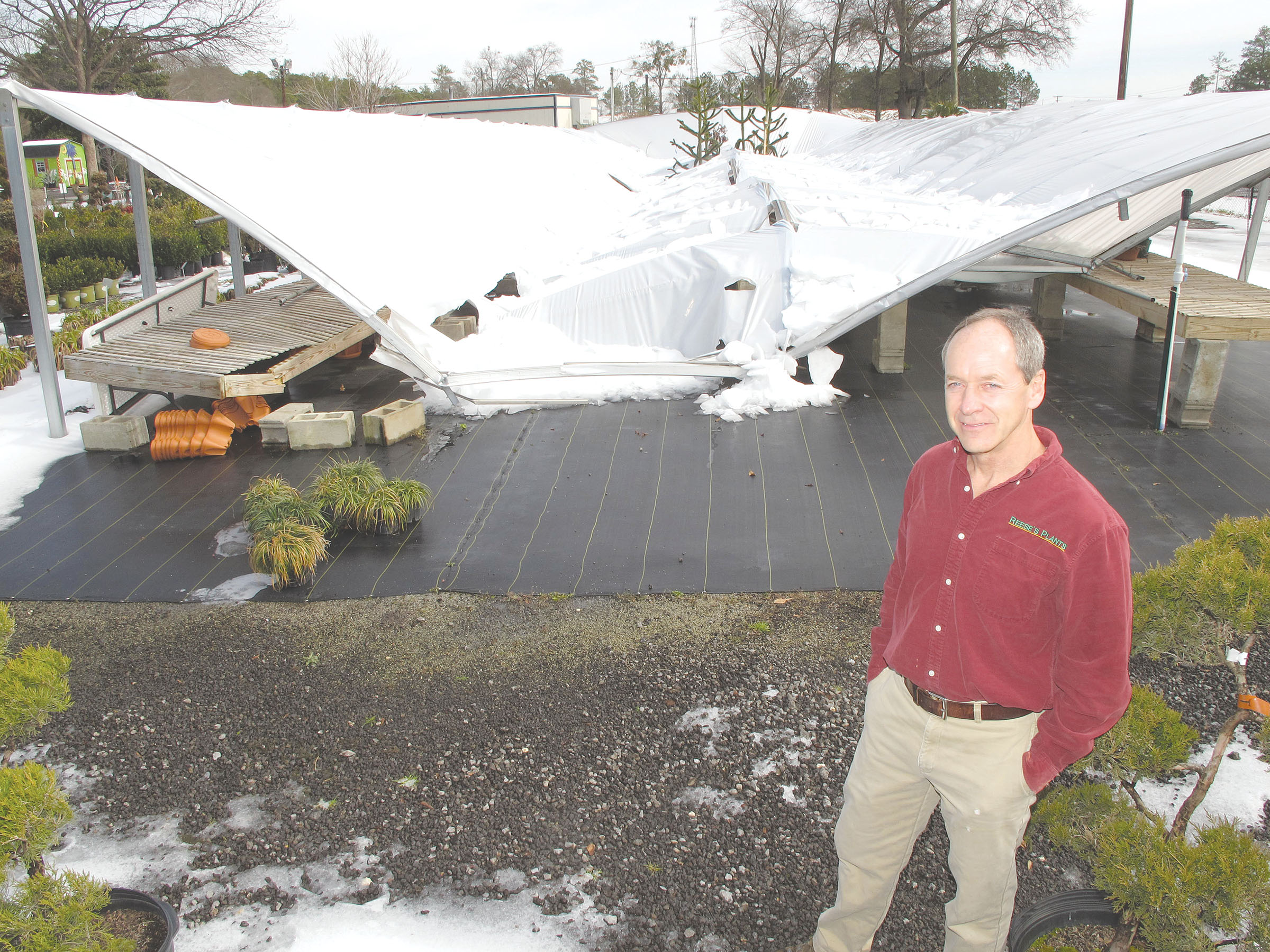
Philip Reese, owner of Reese’s Plants, stands near the wreckage of a greenhouse at his Wilson Blvd. business.
BLYTHEWOOD – While many in the Blythewood and Fairfield County communities enjoyed the recent snow day vacations, Reese’s Plants, located at 10418 Wilson Blvd. in Blythewood, did not. One of its three greenhouses, a 35-by-120-foot steel frame covered in plastic, collapsed under the weight of snow and ice that accumulated on the top of the greenhouse over two days.
Owner Philip Reese said the business was closed at the time of the collapse. He said he discovered the collapse when he arrived at the plant nursery about 3:30 p.m., Thursday, Feb. 12 to check on things. Reese said that while there was only about $5,000 of plant inventory in the greenhouse when it collapsed, he estimated the total loss at about $25,000.
While the greenhouse and damaged plants were insured, Reese said the difficulty is in trying to find a greenhouse builder who can get to it right away.
“It shouldn’t take them more than two or three days to build it as soon as we can get them out here,” Reese said. “We hope to have it up and running in a few weeks. In the meantime, we’re open for business.”
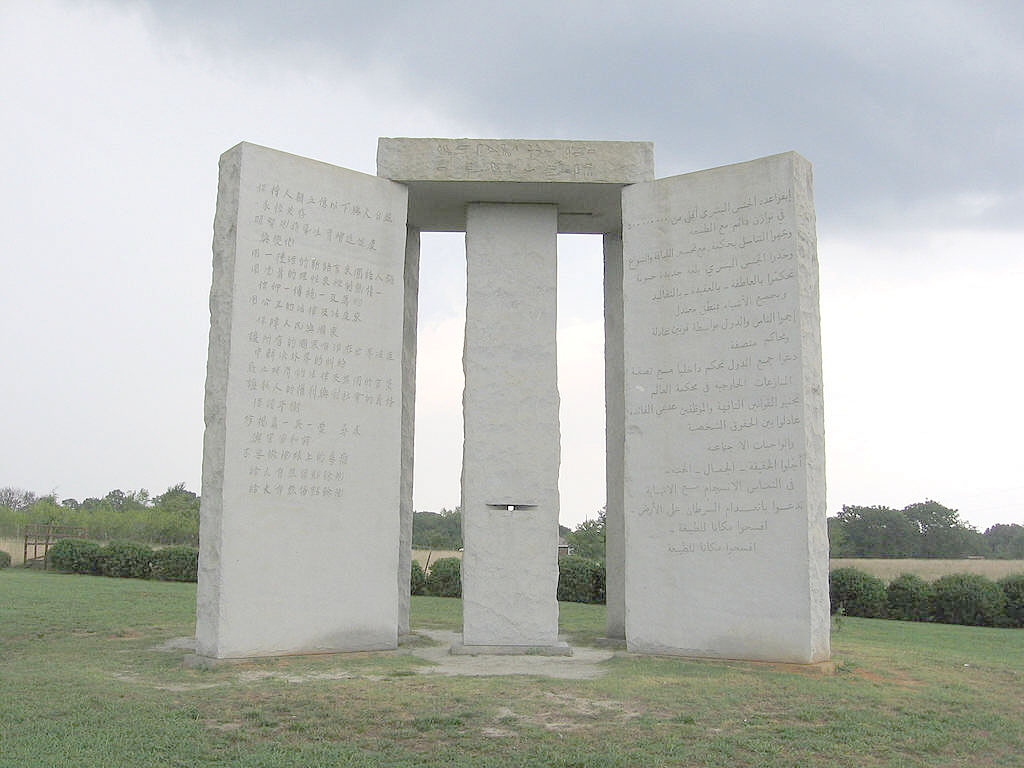
Written in Stone – The mysterious Georgia Guidestones, with their message to Mankind, stand in a field near Elberton, Ga. . . . Go figure.
Drive approximately 100 miles west and cross the Georgia line and you’ll come to Winnsboro’s sister city, you could say. Elberton, Ga., is a town with a blue granite heritage, too. Drive north of Elberton on Highway 77 for 8.7 miles and on a high hilltop you’ll see blue granite put to unique use. You’ll see an American Stonehenge and something more, one of this region’s true mysteries. No one knows who commissioned the construction of this extraordinary monument.
In June 1979, a dapper, persuasive stranger walked into the Elberton Granite Finishing Company and stated that he wanted to build an edifice that would send mankind a message. He said his name was R. C. Christian, but that was just an alias. The monument was built and it became known as the Georgia Guidestones.
Almost 20 feet tall, the Guidestones consist of six granite slabs that weight more than 100 tons. The four main stones radiate like spokes on a wheel from the fifth stone, which stands in the center of the ring. A capstone tops the astronomically aligned five slabs. The stones were carved with admonitions in eight languages: English, Russian, Hebrew, Arabic, Chinese, Hindi, Swahili and Spanish. Carved into the stones one reads sage advice such as “Avoid petty laws and useless officials.” A CNN writer referred to the Guidestones as “an astronomically complex, 120-ton relic of Cold War fears, built to instruct survivors of an Armageddon that the mystery man feared was all too near.” The monument’s admonitions advise mankind to . . .
1. Maintain humanity under 500,000,000 in perpetual balance with nature.
2. Guide reproduction wisely — improving fitness and diversity.
3. Unite humanity with a living new language.
4. Rule passion — faith — tradition — and all things with tempered reason.
5. Protect people and nations with fair laws and just courts.
6. Let all nations rule internally resolving external disputes in a world court.
7. Avoid petty laws and useless officials.
8. Balance personal rights with social duties.
9. Prize truth — beauty — love — seeking harmony with the infinite.
10. Be not a cancer on the earth — Leave room for nature.
A slot in the center column allows one to observe the sun’s transit throughout the seasons. A hole higher up focuses on Polaris, the North Star. A hole in the capstone directs a shaft of sunlight onto the central pillar at noon. Such features let survivors of R. C. Christian’s coming apocalypse reproduce the calendar, clock and compass.
Not all are content with this monument, however. Critics call the Guidestones ‘Satanic,’ and some want them to be destroyed. They’re still standing though, and it’s easier by far to drive to Elbert County Ga. than to fly to England. An American Stonehenge is just a day away. Check it out.
If You Go …
• Location: Grassy field north of Elberton on Highway 77.
• Directions: From Elberton travel north on Highway 77 for 8.7 miles. The Guidestones are visible on the right, a short distance from the main highway.
• GPS: WGS84 34° 13’ 55.14″ N, 82° 53’ 40.22″ W
34.231984, -82.894506
• www.thegeorgiaguidestones.com/Message.htm
Learn more about Tom Poland, a Southern writer, and his work at www.tompoland.net. Email day-trip ideas to him at tompol@earthlink.net.
BLYTHEWOOD – As the Town of Blythewood prepares for their March 11 special election to fill the remaining two years left on the seat vacated by former Councilman Roger Hovis in December, The Voice offers voters a glimpse of the two candidates, in their own words. . . .
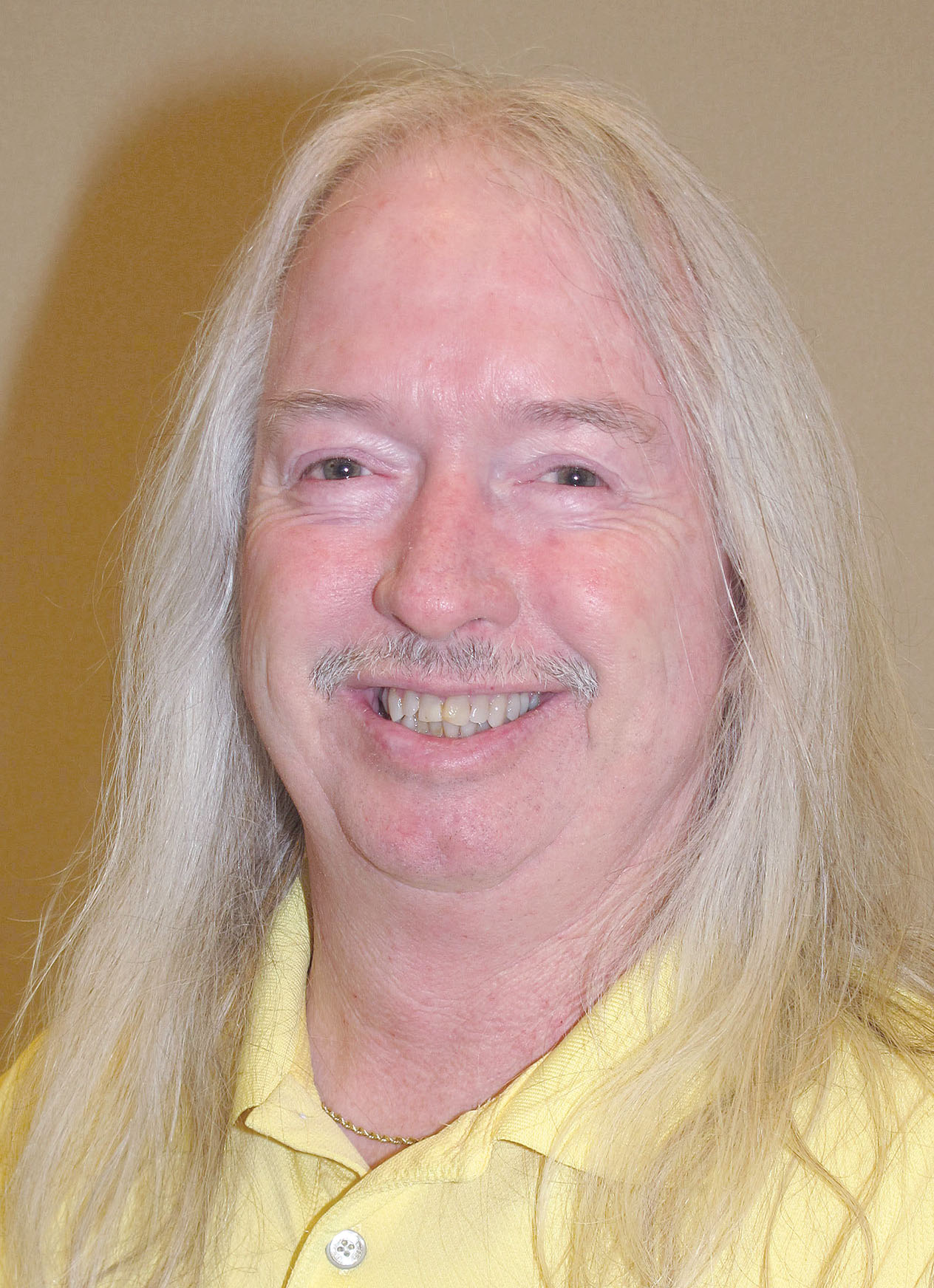
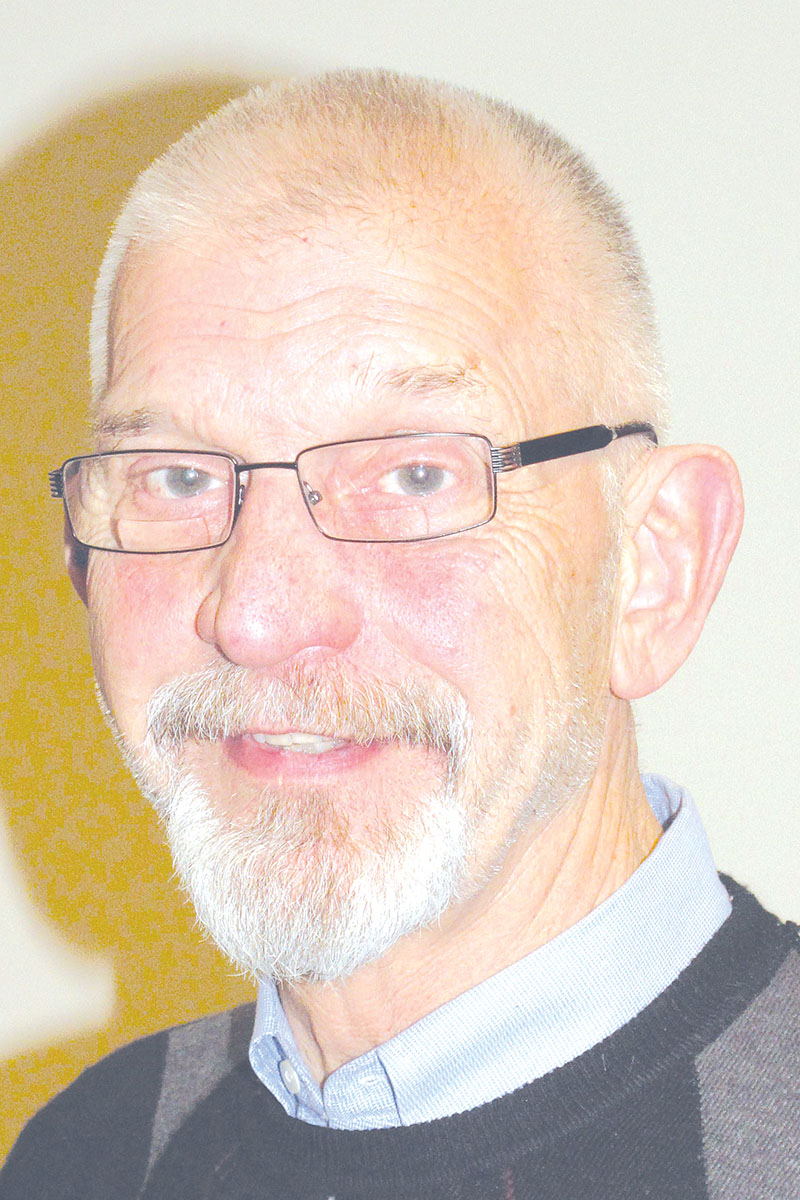
James Arnold, 73
Family: Wife, Glenda; 2 daughters and 6 grandchildren
Career: Retired after 31 years in the Navy. Last position,Chief Warrant Officer 4
Residency: Ashley Oaks. Lived in the town since 2006
I am running as a write-in candidate for Blythewood Town Council because I have a lot of concerns about how the Town is spending our money. My wishes are to see Blythewood as a family friendly place where we can live and raise our children.
Town Council needs to set new priorities for the people and their concerns. They need to focus on the things that will draw new families to our town and not on big ticket items that most people do not want or need, and that drain the town budget. I will be but one vote on the Council, but that one vote might be the one vote that will make a difference for the people of Blythewood.
I served 31 years in the Navy and retired as a Chief Warrant Officer 4. During that time I was an officer-in-charge of the Navy BEE school that had 80 instructors and 300 students. While there I instituted new programs that are still being taught there today. I was a range control officer in Puerto Rico at the Navy’s weapons training facility. My last duty station was at N S MY port at one of the training centers as an operations officer. At each of these places I had the responsibility of large budgets.
I graduated summa cum laude from Saint Leo University in Florida with a Bachelor’s Degree in Criminology. My wife and I are active members of Praise International Church of God where I serve as an usher and she interprets for the Deaf.
Whether you vote for me or for the other candidate, I urge each of you to use your right to vote.
Eddie Baughman, 55
Family: Wife, Donna; 2 children and 2 grandchildren
Career: Retired after 26 years with Columbia-Richland fire service. Last position, Battalion Chief
Residency: Lake Ashley. Lived in town for 28 years.
I am running for a seat on the Blythewood Town Council to be a voice for our citizens who feel their voice is not being heard on the issues facing our community and the direction it is headed.
As a public servant for 30 years and a longtime resident of Blythewood, I am confident in my abilities to serve the citizens of Blythewood. As a Battalion Chief with the fire service, I was responsible for the emergency operations on a daily basis. I am a U.S. Navy Veteran and, while on active duty, I was assigned to Fighter Squadron 101, a F14 tomcat fleet replacement squadron. We trained naval aviators to accept assignments in the fleet. I left active duty as a petty officer 3rd class with an honorable discharge.
As a public servant I’ve operated within a set budget to accomplish set goals and have worked to ensure a positive outcome. My experience in public service has allowed me to work hand in hand with many of the vital agencies that deal with the day to day activities of our town government and those which service this area of Richland County. I have held the first vice president position with the International Association of Firefighters CFFA here in Richland County and I’m the secretary of the Lake Wateree VFW post 8346 MA. I am also a Deacon at Sandy Level Baptist Church.
Blythewood is at a crossroads with its master plan. We are still a bedroom community where you can live, work and raise your family. The growth of our town depends on the infrastructure to handle that growth. A primary concern is that the infrastructure has not kept up with growth of our town. Improved infrastructure will allow us to grow at a rate that will improve the quality of life for all our residents and, for our business owners, this will allow an increase in job creation which in turn will boost the revenues needed to provide a safe living and working environment.
If elected, I will focus on maintaining financial accountability to those who have placed their trust in this Council and to put “public” back in public service.
BLYTHEWOOD – Town Council voted unanimously on Monday night to hire Booth Chilcutt as the new Events and Conference Center Director for The Doko Manner, replacing Martha Jones who recently resigned the position.
Chilcutt, who had served as Jones’ assistant, comes to the position with an enviable set of credentials. Prior to retiring to Blythewood in 2013, Chilcutt served for five years as Executive Director for the Sumter County Commission and the Sumter County Cultural Center (which includes the 1,000-seat Patriot Hall Auditorium, the Sumter County Gallery of Art and the Sumter Community Theatre). Before that he was the Cultural Director for the City of Sumter. Chilcutt is credited with organizing, promoting and directing Sumter County’s community based cultural arts program during the late 1990s. Behind the scenes, he also directed the Cultural Commission’s small grant program which supported local artists and art-based programming throughout Sumter County. Chilcutt has been nominated for the S.C. Art Commission’s Verner Award which is the Governor’s Award for the Arts. That award will be announced in April.
Under Jones, Chilcutt had served as the Manor’s Accommodations Manager, taking care of the operational duties – keeping it clean and in order, entering data into computers and making sure customers were accommodated. As Director he will manage the Manor and work toward creating a cultural program for the facility.
“I will initially be breaking down costs and working on our financial framework, but the part I’m really excited about is the events,” Chilcutt said. “I like programs that connect the whole community through the arts. There’s a lot to do, but first we need to get the finances in hand.”
“We think he’s the right person for the job,” Councilman Bob Massa told The Voice. “He has an outstanding resume and reputation in the cultural arts, both managing the Center in Sumter and creating and maintaining a vibrant cultural arts program over there. He is well connected in the cultural arts throughout South Carolina, and we’re looking forward to what he can do for our town. I’m looking forward to working with him.”