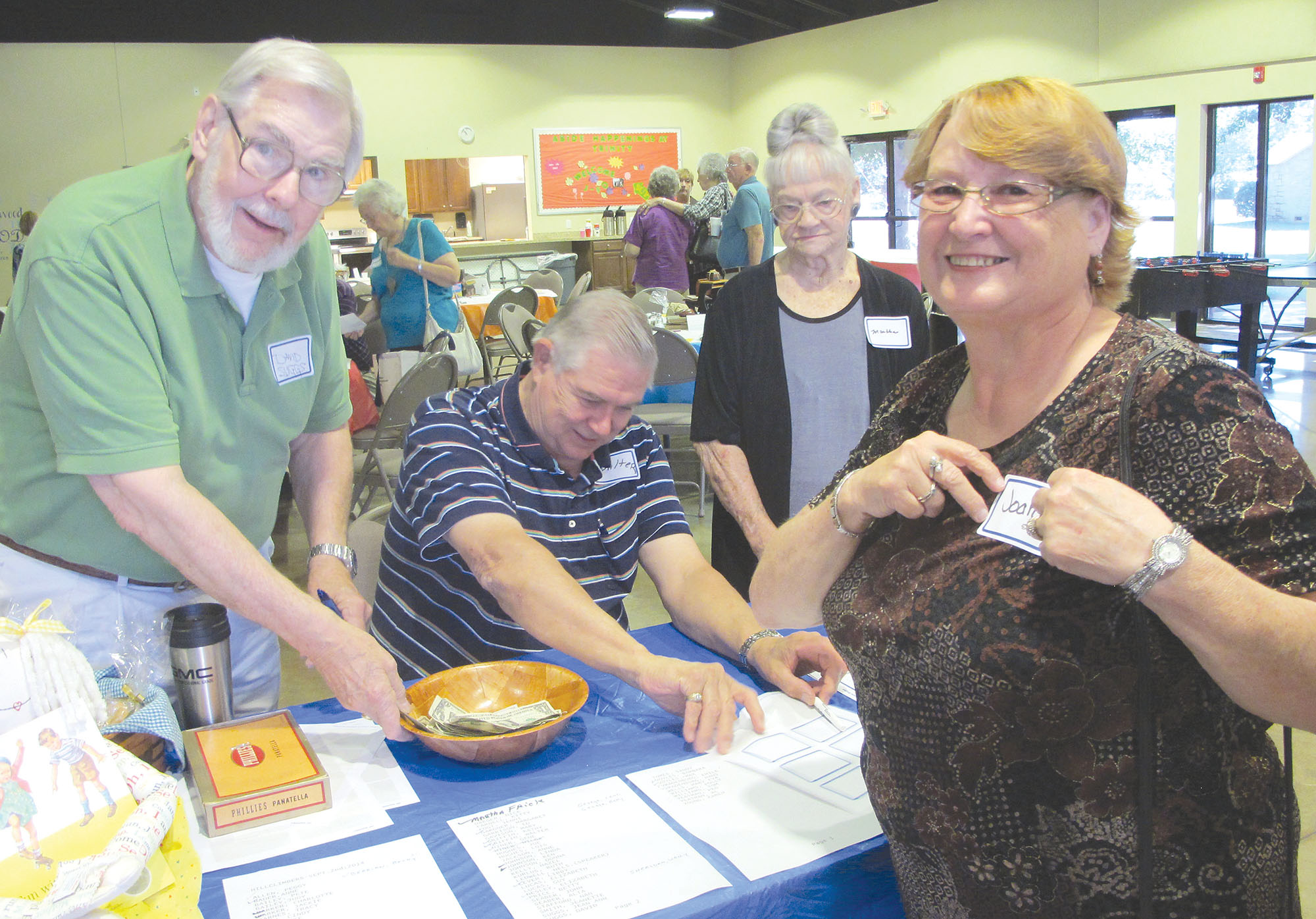
Joanie Caudill of Willow Lakes takes a name tag as she arrives at the Hillclimbers luncheon on Tuesday. David Suggs, left, and Walter Griffin assist with registration as Martha Frick waits her turn.
BLYTHEWOOD – If you’re a senior citizen looking for fun and fellowship, you’ll find it every second Tuesday at 11 a.m. at the Hillclimbers luncheon at Trinity United Methodist Church in Blythewood. After having the summer off, the 70 or so Hillclimbers and visitors spent a little extra time visiting and catching up on Tuesday at their first luncheon of the fall season.
“But it’s more than lunch,” said Kathy Griffin, Trinity’s assistant pastor who oversees the group and organizes the programs. “It’s lots of fun. We have really interesting programs, and lots of fellowship.”
On this day Trinity’s new pastor, the Rev. Nels Ledwell, was the speaker. Next month Grace Hamrick will talk about her new book, “Just Grace.” In November, Wayne Damoron will bring his collection of ‘Coins from the Bible,’ some of which are more than 2,000 years old. And in December, Trinity’s Oasis choir will perform Christmas carols.
“There’s always something,” said Griffin. “It’s a very social get together. We used to bring covered dishes, but some of us are single now and don’t really cook a lot, so we now have the lunches catered,” she said, adding that the lunch price is only $6.
While the Hillclimbers have met for years, it was not until Griffin took over two years ago that the numbers took off, increasing from about 20 in attendance to an average of 65 or 70. That necessitated a move from the old fellowship hall in the main church building to the new youth center across the campus.
Griffin said the growth has come from interesting programs, good food at reasonable prices, “and now we have plenty of room,” she said. “And seniors from all churches are invited. I send notices to other pastors inviting their members to attend,” Griffin said. “After all, it’s not really about church,” she said, smiling. “It’s about having a good time. And we do.”
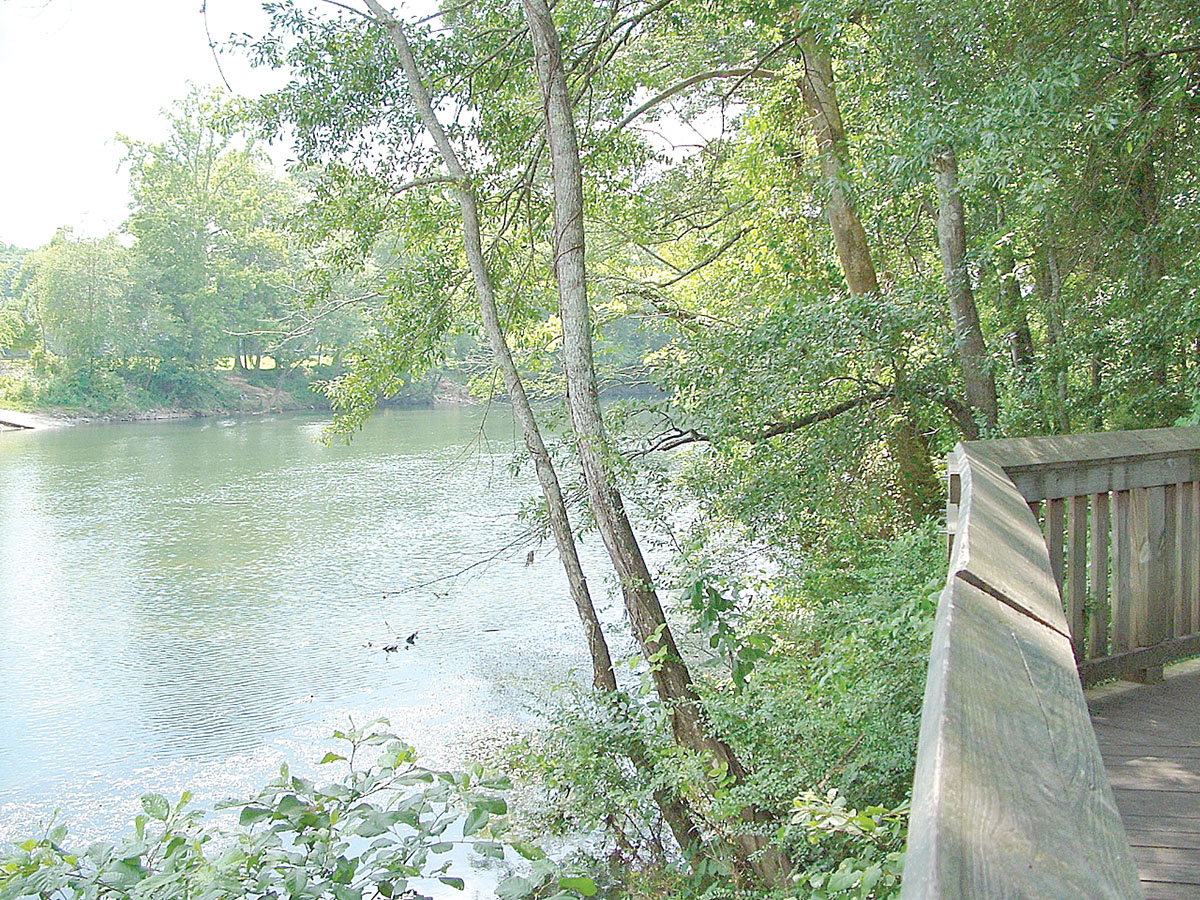
The Saluda River, from one of the many stopping points along the trails at Saluda Shoals Park. (Photo/Robert Clark)
Experience the outdoors. Enjoy nature. Fish. Kayak and canoe, and walk the nature trail. You can do this and more at a stretch of river that reveals how many Southern rivers used to be.
In older days a lot of hardworking inland farm families vacationed by the banks of shoals. It was their Myrtle Beach. Less than an hour’s drive, about 35 miles, will take you to a river that none other than Robert E. Lee first suggested could be dammed: the Saluda. Just 1.5 miles from the Dreher Shoals Dam, the Saluda Runs free here and you can spend a relaxing day with Old Man River, unleashed as if no dam ever existed.
Located along the banks of the Saluda River, the 350-acre Saluda Shoals Park features an 11,000-square-foot Environmental Education Center, Exhibit Hall, Auditorium, Classrooms and 3,776 square-foot outdoor deck. Miles of paved and unpaved trails provide wonderful places to walk and bike. You can rent bikes, canoes and kayaks here.
A river observation deck provides a good place to watch the Saluda River run by. And know too that the South Carolina Department of Natural Resources has established the Saluda Shoals Park Fishing Pier off Old Bush River Road, between St. Andrews Road and Lake Murray, south of Irmo. This wooden fishing pier parallels the Saluda River bank. A paved sidewalk to the pier from the paved parking area provides easy access. A boat ramp and canoe and kayak launch points make it convenient for water enthusiasts. Guided horse trails exist for equestrian-minded people too.
Families and organizations make good use of the picnic shelters and kids make good use of the playground. The River Center provides a good setting for receptions, meetings and other events.
Got some nature lover in you? You’ll find the Saluda Shoals Wetland Preserve to be a tranquil sanctuary. The quiet waters and woodlands provide habitat for many species of birds, animals, and wetland plants. Down near the river you can feel the temperature — and stress levels — drop. It’s hard to imagine that you’re only minutes from Harbison Boulevard and all its accommodations.
Saluda Splash is a good place to cool off on a hot summer day, and it’s a good place, too, to let the kids expend energy. Children love the interactive, zero-depth water playground, making it quite safe with no need to wear life preservers. Splash opened for the season on April 26, and closes Sept. 28. Pack a picnic lunch and enjoy it at one of six shelters, all equipped with ceiling fans, charcoal grills and conveniently located restrooms. Plan a mini-vacation this summer at Saluda Shoals Park.
From Columbia, take I-26 west toward Spartanburg. Exit Piney Grove Road and turn left. Proceed approximately 1.5 miles to St. Andrews Road. Turn right, then left at the first traffic light. Saluda Shoals Park is 1.5 miles on your left.
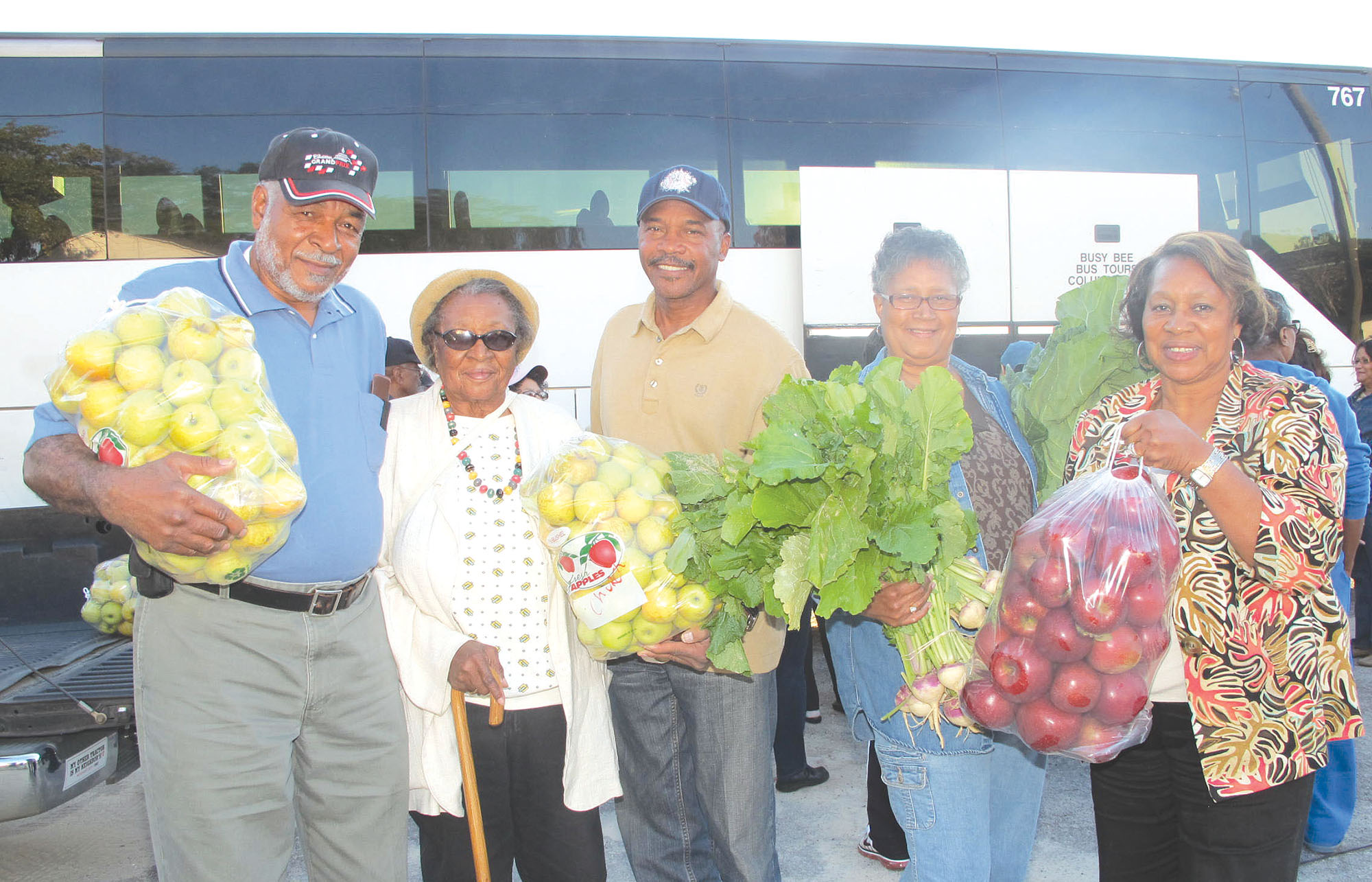
Walter Anderson, center, was one of several in the community who showed up to help the travelers from a recent apple-picking trip unload the heavy bags of produce from the Busy Bee bus to waiting car trunks and pickup trucks. Also shown in front of the bus are McAuthur Weeks, left, Sara McDaniels, Anderson, Lenora Griffin and Melvina Haigler.
BLYTHEWOOD – Sara McDaniels, 92, a life-long member of Round Top Baptist Church, has been organizing apple-picking trips to Hendersonville, N.C. every fall for the last 20 years. And it’s that time of year again for folks to sign up for the trip. While McDaniels’ early trips consisted mostly of members from her church, they now include friends and family from Winnsboro, Elgin and other towns as far away as Atlanta.
“It’s lots of fun, but lots of work to organize it,” McDaniel’s told The Voice recently. That organizing includes contracting with the Busy Bee Bus Lines for a 57-passenger bus months in advance, registering the participants and taking care of a myriad of details. Her daughter, Melvina Haigler of Blythewood, said she suggested to her mother last year that since the passenger list is getting longer every year, it might be getting to be too big of a job. “But mamma said, ‘I’m not giving it up.’ So I said, ‘Go ahead, then!’”
Haigler said she started going on the trips about eight years ago. “It looked like fun and they always brought back such big, beautiful apples. And not just apples. There are many other fall garden vegetables like collards, cabbages, turnips and lots of other things for sale at the farm.”
The bus pulls out from Round Top Church about 7 a.m. and arrives in Hendersonville around 11 a.m. “We first pick apples and shop around the farms in the area,” Haigler said, “then we have lunch and sometimes on the way home we stop at an outlet mall in Spartanburg and do a little Christmas shopping.”
Before they leave the main farm, Haigler said usually sing a gospel song for the woman who owns the farm. “She really loves it,” Haigler said with a smile.
Haigler said the trip home starts off rather quiet, and she usually starts dozing off after the long day. “But then someone in the back starts a little song and before you know it, everyone is singing. It’s really a beautiful trip,” Haigler said.
Arriving back at Round Top between 6 and 7 p.m., husbands and children are there to pick up the passengers and load the trip’s bounty into car trunks and pickup trucks.
“We’re really tired, but it’s a great trip,” McDaniels said. “And I look forward to it every year.”
Haigler said the bus is always full and that it’s first come-first served. Cost is $30 and payment may be made now until Sept. 25. For more information or to reserve a seat on the Busy Bee bus, call Sara McDaniel at 754-3823.
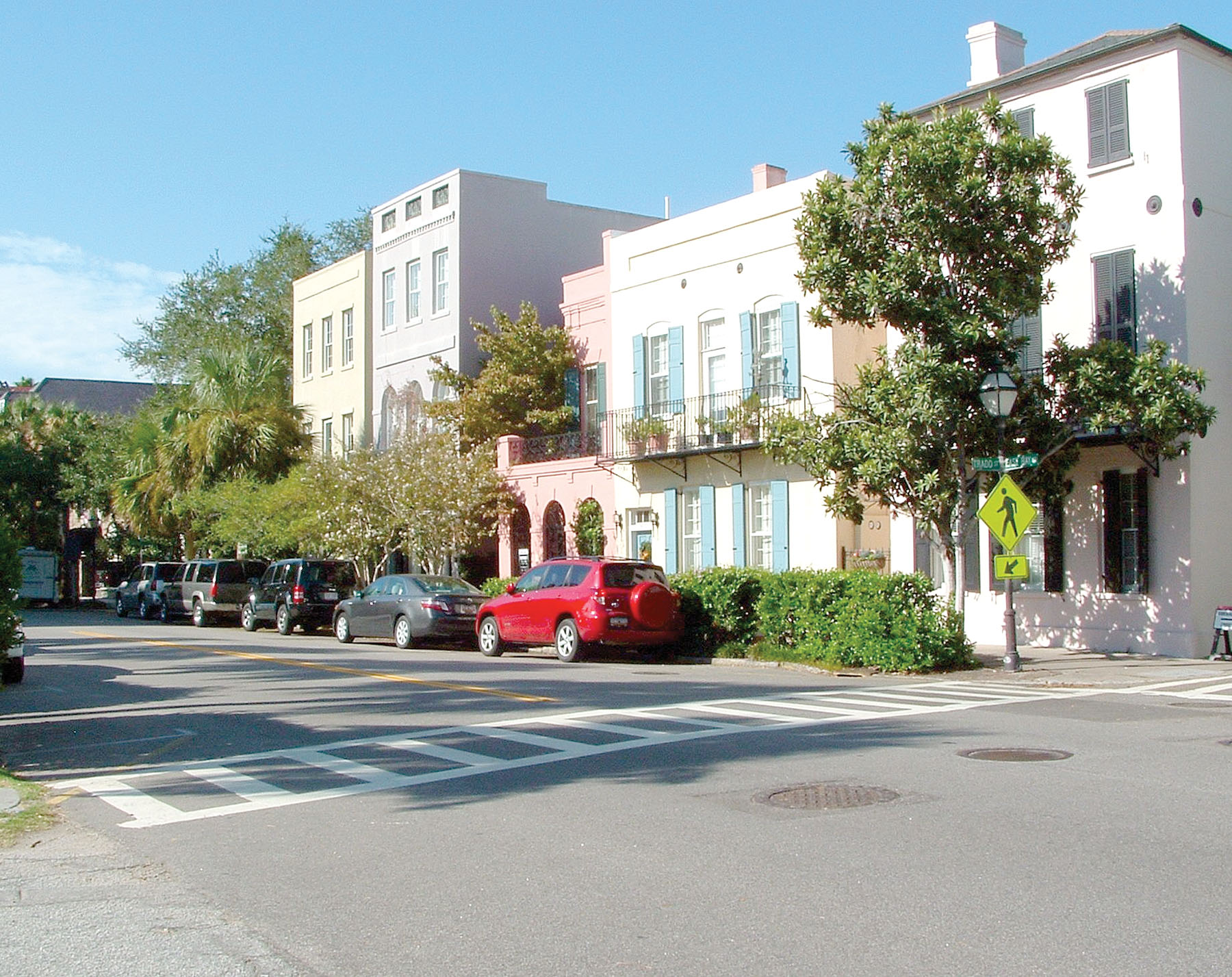
Pastel Chic – One of America’s more colorful neighborhoods, 79-107 E. Bay St., Charleston. (Photo/Robert Clark)
Drive 144 miles to Charleston. Wind your way to East Bay Street and proceed to 79 to 107 East Bay Street. There you’ll find Rainbow Row, the colorful and historic name for 13 colorful houses. North of Tradd Street and south of Elliot Street, that’s where you’ll find them. As you’ll see, the pastel paints make it easy to see how this section of historic homes got its name. An extremely popular tourist attraction, it’s one of Charleston’s more photogenic features.
What would become Rainbow Row came to bet in the mid 18th century on 83-107 East Bay Street. At first it was a center of commerce on Charleston’s waterfront built to provide services to the wharfs and docks of the Port of Charleston. Merchants ran stores on the first floor and at day’s end they retired in the top floors.
After the Civil War the Rainbow Row area gained a less-than-stellar reputation as it was run down. Some would have referred to it as a slum. Things changed for the better. Today, Charleston consistently ranks as one of the most-traveled to cities in the world, and Rainbow Row does nothing to diminish that reputation.
The Row’s history is a strong one. In the 1920s, Susan Pringle Frost, the founder of the Preservation Society of Charleston, bought six of the buildings. Money was tight and she was unable to restore the homes in a timely manner. In 1931, Dorothy Haskell Porcher Legge purchased houses 99 through 101 East Bay and renovated them. She painted them a colonial Caribbean color scheme. Other owners and future owners, taking a cue from her, created the “rainbow” of pastel colors present today. The pastel colors helped keep the houses cool inside, and in time a cool name evolved.
Restored, the houses represent the very first style of Charleston homes and they were destined for cultural history as well. They were portrayed in “Porgy and Bess,” George and Ira Gerswhin’s opera based on DuBose Heyward’s novel “Porgy.” Heyward was a Charleston businessman fascinated by the Gullah culture. That interest turned him into a novelist. (Heyward’s wife, Dorothy, developed the novel into a play.) All three works deal with African American life in the fictitious Catfish Row, which, of course, was based on the early 1920’s Rainbow Row. George Gershwin worked on “Porgy and Bess” in Charleston where the nearby James Island Gullah community influenced him.
Like any well-known spot, Rainbow Row suffers myths. An old tale holds that the homes got their unique pastel colors so drunken sailors stumbling ashore could spot the houses where they had rented “landlubber” accommodations. Of course, that’s just a myth.
Go see the real deal, Rainbow Row, a colorful, historical tourist attraction that a few folks call home.
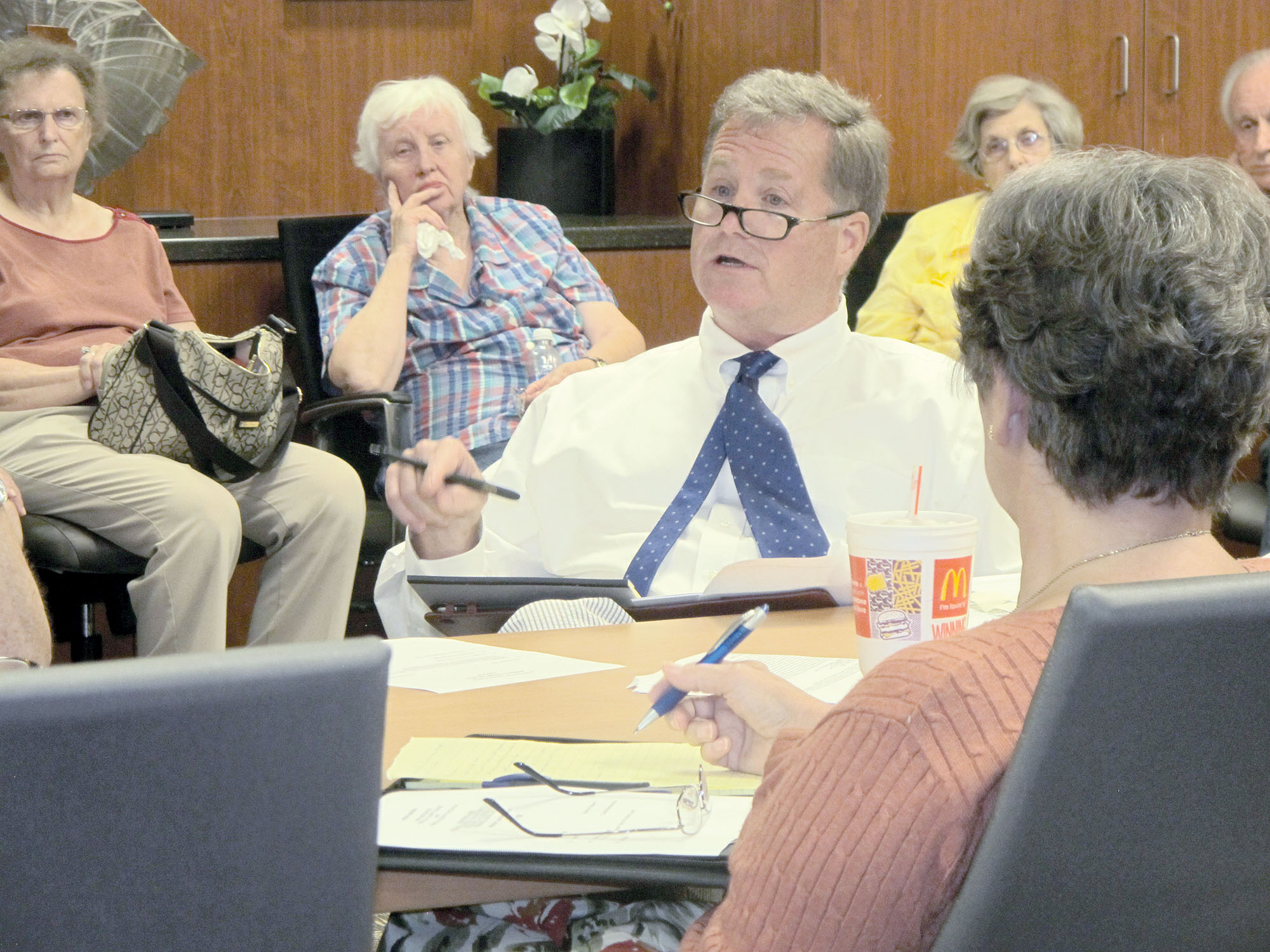
State Sen. Creighton Coleman lays out rough ideas for the future allocation of V.C. Summer revenues. (Photo/Barbara Ball)
Delegation Pitches Ideas to County
WINNSBORO – In a meeting at the Midlands Tech QuickJobs center Monday night, six of seven County Council members sat down with Fairfield County’s legislative delegation to begin discussions about the future impact of expected revenues from two new reactors currently under construction at the V.C. Summer Station in Jenkinsville.
It was the first of what Council Chairman David Ferguson (District 5) said would be a series of meetings with Fairfield’s various governing bodies, with future meetings to include the Fairfield County School Board and the towns of Winnsboro, Ridgeway and Jenkinsville. The talks would culminate in a joint meeting, Ferguson said, at which time it was hoped that the County would have acquired input from the Central Midlands Council of Governments (COG), with whom the County has recently contracted to perform long-range strategic planning.
The meeting began with a recap of the County’s long-term economic development plan, beginning with its adoption by Council in 2009, the construction of the Midlands Tech facility, the construction of a speculative (spec) building at the Walter Brown II Industrial Park and the purchase and development of property off Peach Road, now known as the Fairfield Commerce Center. The recap also touched on 2013’s $24.06 million bond issue, the repayment of which relies heavily on the projected V.C. Summer fee-in-lieu of taxes revenues (estimated to be between $80-$100 million annually).
“The purpose was to front-end load the money and plan when the new revenues will be coming in from the nuclear reactors coming on line, then make the decisions on how to pay those back and do things long term,” Interim County Administrator Milton Pope said.
The bond also obligates some of the reactor money, acting as “another legal protection for those monies in case there were a raid to take away a portion of the money from Fairfield County,” Pope said, referencing bills circulating at the state capital designed to share that revenue with other counties.
The Legislative Delegation
Fairfield County’s representatives in Columbia, Rep. MaryGail Douglas (D-41) and Sen. Creighton Coleman (D-17) have been clamoring for a sit-down with County Council to plan for the reactor money since at least last spring, and at the June 16 intergovernmental meeting the issue came to a head. Over a long, tense exchange, the delegation and Ferguson engaged in heated spat over who had ignored who’s invitation to planning talks. Monday night, however, both sides were on their best behavior as Douglas kicked things off by suggesting a more comprehensive recreation plan.
The 2013 bond allocates $3.5 million for the development of recreational facilities, with $500,000 to be spent in each of the county’s seven districts. Apart from Kamau Marcharia’s plan to erect a large facility in District 4, preliminary talks in the remaining district have thus far focused on smaller parks.
“I want our vision for Fairfield County to be more than swing sets and walking trails and basketball courts,” Douglas said. “It’s got to be more than that.”
Douglas also said the reactor revenues could also be used for property tax relief, as well as to address needs at, or alternatives to, Fairfield Memorial Hospital.
“I’ve had a vested interest in that hospital for many, many years,” Douglas said, “but we have to be realistic. We can’t continue to operate a hospital in the current state that it’s in. We’ve got to have some kind of medical care, but the vision you could have with another type of medical care in the community could be done.”
Coleman said infrastructure – primarily a secure source of potable water for both residential and future economic growth – was critical, as was property tax relief. Coleman also suggested that some of the reactor money could be devoted to scholarships for local students, while a portion could be returned to Fairfield County citizens as well as set aside for emergencies.
“Just because we have this money doesn’t mean we have to spend it all,” Coleman said. “We need to save some money in case something happens out there (at V.C. Summer).”
No date has been set for future planning sessions. Councilman Mikel Trapp (District 3) was not present at Monday night’s meeting.
Horticulture magazine praised it as “one of 10 gardens that inspire.” HGTV calls it “one of 20 great public gardens across America.” Well you don’t have to drive across America to see it. A 30-mile drive will take you to the Riverbanks Zoo Botanical Garden, across the Saluda River from the zoo proper.
Now’s a good time to go, although something is always blooming at the garden. The gardens are so lush, so beautiful that weddings and other events often take place there. The gardens are themed too. There’s the Collection Garden where 100 different milk and wine lilies grow. There’s the Old Rose Garden where you’ll find the world’s largest collection of Noisettes. Kids love the Play Garden, which features a playhouse and secret play garden.
The Walled Garden is a show stealer. This 34,000-square-foot garden features a maze of seasonal and themed gardens. Don’t be surprised if you go home with new concepts and ideas for your garden. It’s an inspiring place.
At the West Columbia entrance you’ll see the Bog Garden with is large waterfall. See too the carnivorous pitcher plants and water lilies. The large boulders will give you a sense of being in the mountains too. In a corner of the Bog Garden you’ll find the Asian Garden. Built in 2009, the Asian Garden quickly developed into a lush and botanically diverse space. Here, a short boardwalk overlooks a small pool. You’ll find benches to rest on and listening to the soothing white noise of trickling water will put you at ease. See the Asian trees, shrubs, perennials and bamboo in this garden.
The walk from the zoo proper across the brick span uphill can be taxing, but no worries. A tram can take you there with ease. Once you’re at the garden be sure to walk the nature trail. To me, trail highlights include the ruins of the old Saluda Mill ruins and its lonesome but winsome stone keystone arch, testaments to Sherman’s march through Columbia.
Once your garden stroll is over you can always take the tram back to the zoo proper. Over 2,000 animals will keep you enthralled, amused and outright surprised. Between the zoo’s wildlife and the gardens flora, a day here is like a trip around the world.
Each year I purchase a family membership to the zoo. I like to stroll through the gardens on cooler days, and I’m planning to go there with my laptop and work now and then. Seventy acres of botanical beauty makes for an inspiring place to write. And as for you? Well I have no doubts this place will bring out the gardener in you. It did in me and I have a themed garden of my own in my back yard as a result.
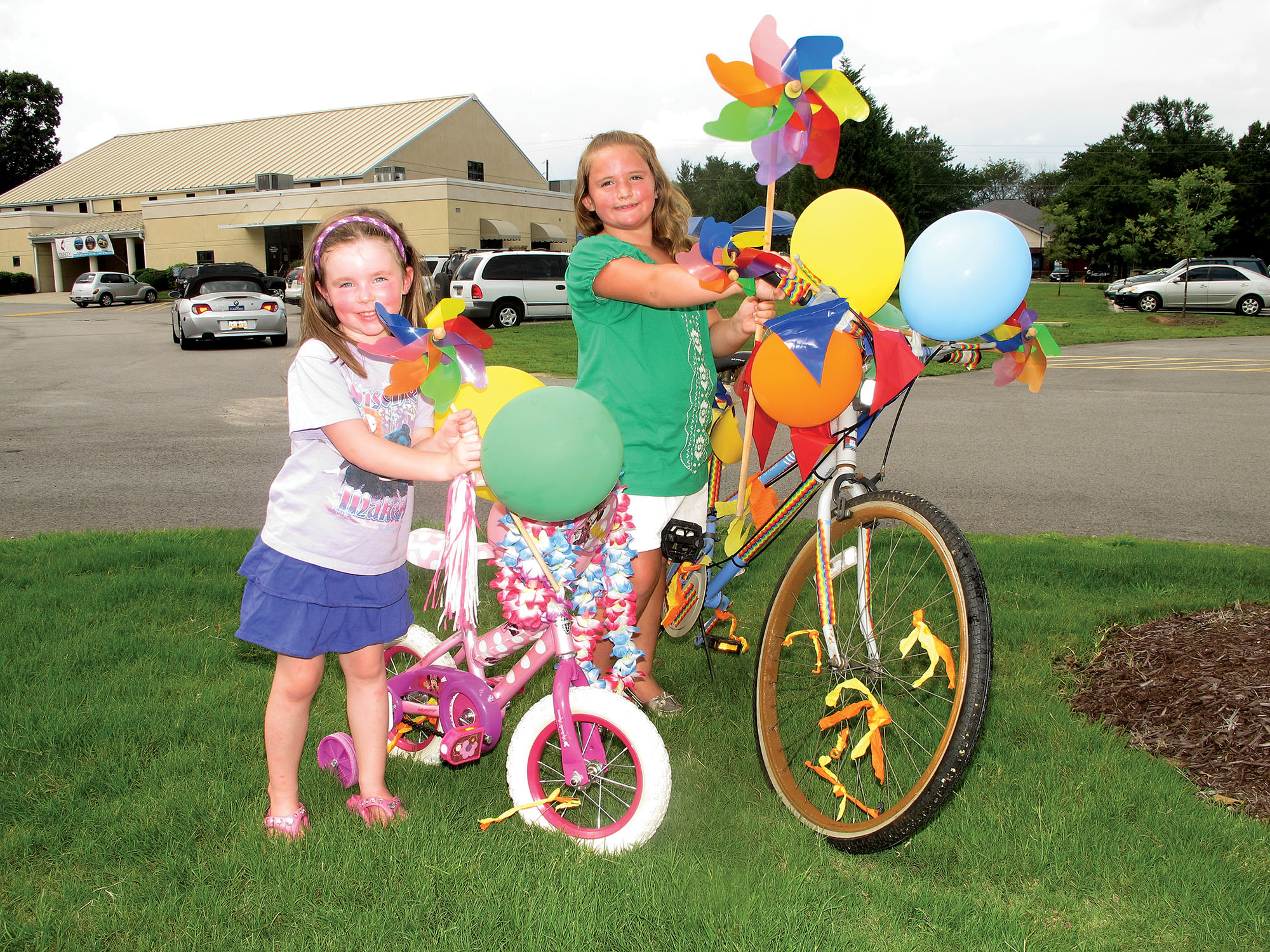
Madison Myers, 4, and Ryann Huggins, 7, put the finishing touches on bikes they will ride in Saturday’s first annual Blythewood Bike Parade. The parade will be held in the parking lot of Trinity United Methodist Church with sign in at 9 a.m. The parade will begin at 10 a.m.
BLYTHEWOOD – Trinity United Methodist Church in Blythewood is sponsoring the town’s first annual Bike Parade in the church’s parking lot Saturday morning. Organized by Kimberly Roberts, the church’s Director of Children’s Ministry, the parade will include kids ages 12 and under from Blythewood, Winnsboro, Ridgeway and surrounding communities.
“It’s going to be a fun event that I know a lot of kids are already looking forward to,” said Roberts. “They’re already registering and decorating their bikes, wagons, strollers, wheelchairs – whatever they ride or wheel around in.”
But Roberts said that while focus will be fun, the day will be devoted to raising money for wheel4life, a charity that provides people in Third World countries with bikes so they can get to work, market, school or other places without having to make the long trip by foot.
“It’s a great cause,” Roberts said. “I don’t think we stop to think that a bike is the best transportation available for many people in the world.”
Judges for the event will include Mayor J. Michael Ross and representatives from the Blythewood Library, the Waffle House and Groomadog Academy. Prizes will be awarded for Most Patriotic, Most Creative, Best Multi-Entry Group, Judges’ Overall Favorite and Best Non-Bike Entry.
There will be plenty to eat with a bake sale throughout the day. On-site registration will begin at 9 a.m. with the parade starting at 10 a.m. Participants should arrive between 9 and 9:45 a.m. for check-in.
“Everyone is invited to either ride or watch,” Roberts said. “Both will be lots of fun.”
Entry fee is $5 which is non-refundable (even in the event of rain) since all proceeds go to wheel4life. For more information, email kroberts@trinityblythewood.com.
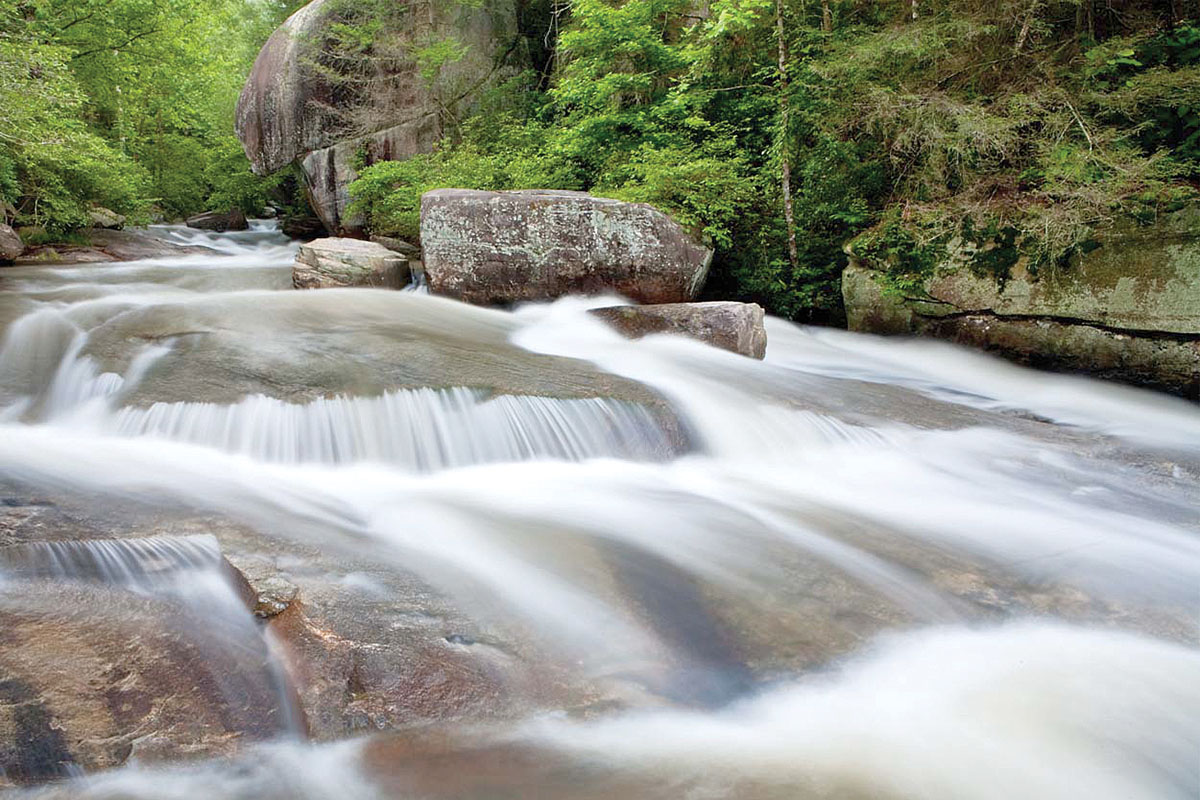
It Doesn’t Look Little – Little Eastatoe Creek, near Pickens: a good place for trout, and other stuff. (Photo/Robert Clark)
With much surprise my co-author, Robert Clark, and I learned that people have long been using our photo-essay books on South Carolina as unintended travel guides. A woman told me, “My husband and I use your book, ‘Reflections of South Carolina,’ as a way to make trips to interesting places.” And then another lady said much the same thing.
“Reflections of South Carolina, Vol. 2,” is coming out this week, and we expect it to serve as an accidental day trip guide as well. The University of Press is publishing the 10 x 12 hardcover book, 248 pages, which contains 236 color and 14 black and white photographs. The book presents beautiful venues in three regions: the Upcountry, the Heartland – from the western freshwater coast to Myrtle Beach region – and the Lowcountry.
Here’s a bit of insight from the USC Press itself. “From the Appalachians to the Atlantic, South Carolina’s awe-inspiring beauty is revealed in this visually stirring and heart-warming tribute to one of America’s favorite vacation destinations. Rich with 250 stunning photographs, this second volume of Reflections of South Carolina uncovers the geological, natural, and cultural grandeur the Palmetto State packs into 32,000 square miles. In a landscape abundant with waterfalls, rivers, lakes, and surf, South Carolina overflows with flora and fauna, as well as astonishing vistas. On their new journey, photographer Robert C. Clark and writer Tom Poland set out on a path of discovery that reveals charming country stores, water-powered gristmills, enchanting meadows, and extraordinary people and places. From angles high and low, this keepsake book illuminates the state’s summits, swamps, shores and islands that brim with life, beauty and culture. Turn the pages and explore the mountain majesties, fruited plain, and shining sea – South Carolina holds so much of what makes this country ‘America the Beautiful’.”
So, what trips might these photographs inspire? Consider a trip to Chattooga Belle Farm. Up near Long Creek, Chattooga Belle Farm sits 1,700 feet above sea level. Groucho Marx once owned this beautiful farmstead, which blesses the northwest corner with grapes, muscadines, scuppernongs, peaches and blueberries. The Chattooga River runs in the mountainous background while sunlight nurtures a medley of fruits.
Little Eastatoe Creek might bring out the sportsman in you. Ten miles from Pickens, cold, fast water plunges and pools creating one of South Carolina’s better, if not best, trout streams. Little Eastatoe Creek’s silky riffles shelter rainbow and brook trout and the creek’s fine spray sustains rare ferns.
Go to Fort Sumter and see the 42-pounder, with a charge of 8 pounds of powder, could penetrate a 26-inch brick wall. Cannons like this one were banded and rifled. Bands of wrought iron wrapped around a cannon enabled it to withstand the increased pressure of larger powder charges.
That’s but three venues in a book of more than 200. Great day trips you could say are now just a page away.
For Your Copy …
Reflections of South Carolina, Vol. 2
University of South Carolina Press
www.sc.edu/uscpress/books/2014/7393.html
Learn more about Tom Poland, a Southern writer, and his work at www.tompoland.net. Email day-trip ideas to him at tompol@earthlink.net.
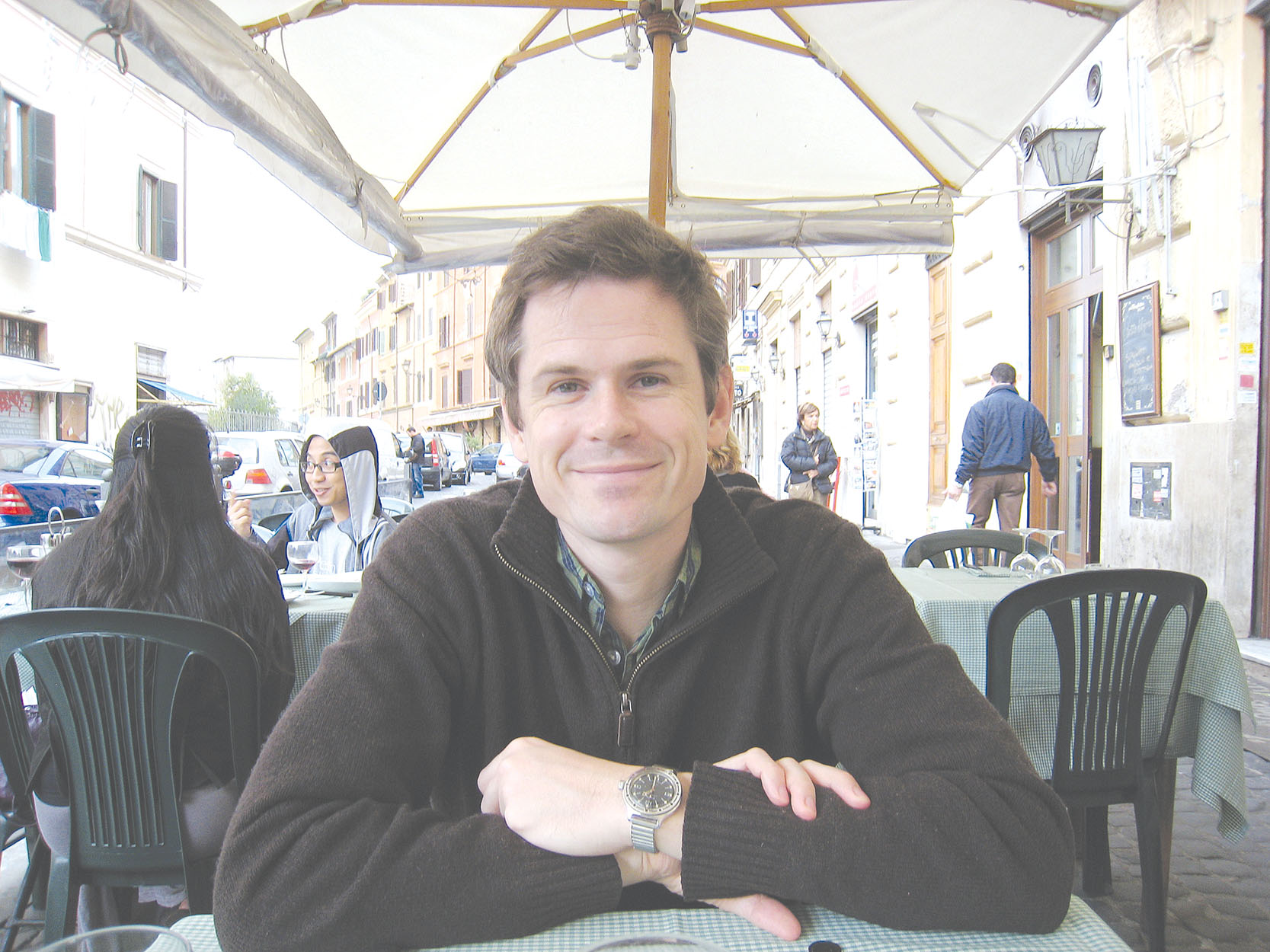
Winnsboro native and RWA grad Jack Livings during a recent stop at a café in Rome. His short story collection “The Dog” was released this week.
NEW YORK, N.Y. – Winnsboro native Jack Livings is the newest literary light in the New York publishing world. His debut short story collection, “The Dog,” was published by Farrar, Straus & Giroux on Tuesday as the first of a two-book deal, and it’s been selected by Barnes & Noble for their Fall 2014 Discover Great New Writers Program.
Livings, 40, is the International Editor in Licensing and Syndication at Time, Inc., and was previously an Editorial Director at Newsweek. He lives in Manhattan with his wife, writer Jennie Yabroff, and their daughters, ages 2 and 9.
Raised in Winnsboro, Livings graduated from Richard Winn Academy in 1992. His mother, Laurens “Bootsie” McMaster Livings, a music teacher and retired opera singer, said she’s delighted that he’s able to return home several times a year.
After majoring in English at Davidson College, Livings earned a Masters in Fine Arts in fiction from the University of Iowa Writers’ Workshop. In 2000, he was one of five writers selected for the prestigious Wallace Stegner Fellowship in Fiction at Stanford University.
Livings was a contributing editor at the Paris Review for three years, and his stories have been published in numerous literary journals. The eponymous story from his new collection was included in the Best American Short Stories collection of 2006.
“The Dog” draws on Livings’ experiences in China in the mid 1990s as a university student and English teacher. According to a review by Michiko Kakutani in the New York Times, Livings’ collection is “an incisive – and highly impressive – debut.” She writes that, “Mr. Livings demonstrates his virtuosity as a storyteller, his ability to immerse us instantly in the lives of his characters, to conjure the daily reality of the very different worlds they inhabit.”
“I was in Beijing in 1994,” he said in an interview with The Voice on Tuesday, “and I went back to travel around the country in 1997. I suspect that if I’d been able to go back on any kind of regular basis between then and now, I might not have been writing these stories. They’re a little bit nostalgic, in a way – I don’t mean that they’re sentimental, but when you’re separated from something you love, you think about it a lot. And I did – I thought about China an awful lot. There was a period of time when I read about China every day, extensively. I’d get tons of news reports and email digests, and I was processing a lot of information.”
He said the many remarkable and sometimes absurd-seeming situations in China are what draw his interest.
“From the Western perspective, there are a lot of puzzles [in Chinese culture], a lot of strange things that keep me in a constant state of interest. There’s a lot of material for fiction. The starting points for most of my stories are questions: ‘why in the world did that happen?’ or ‘why did that person make that decision?’ I write a story to try and understand it, or try to explain it to myself.”
Livings credits Richard Winn Academy with being “hugely influential” to his success.
“My English teacher, Selwyn Turner, pushed me hard not to rely on talent,” he said. “She’s an extraordinary teacher who did something that I don’t know if anybody does anymore – she taught us to diagram sentences. Learning how to break a sentence down enables you to learn to think logically. And for me, specifically, doing what I do, it was enormously helpful. I’ve still got her voice in my head a lot of the time when I write.
“I had a lot of phenomenal teachers, like Ellen Nicholson in art and music. And even though I was horrible at math, John McSwain was a great math teacher. His math classes were the closest thing to college-level discussions that I had in high school. The premise was always some kind of logic problem that we were trying to work out, and then it would spiral off into a philosophical discussion about politics, or athletics vs. academics. Those folks put so much time into trying to get us all on board and up to speed.”
Livings’ book launch reading was held at 192 Books in Manhattan on Tuesday evening, and he will be doing readings in Brooklyn, Washington, D.C. and California. He’s already writing his next book, a novel set in a New York City snowstorm in the late 1970s.
“And I have to get to work every day, too,” he said, adding that he always starts writing early, before the day fills up with family and professional obligations.
“I get up to write between 4 and 4:30 – when distractions are minimal, and it’s easier to concentrate. That’s when the world feels quiet.”
“The Dog” is available for purchase on Amazon.com, at Barnes & Noble and through independent bookstores.
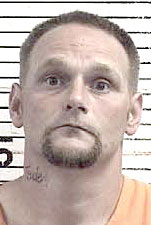
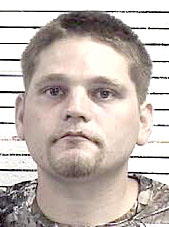
RIDGEWAY – The Fairfield County Sheriff’s Office last week arrested a Ridgeway man they believe responsible for a string of thefts that have plagued the Ridgeway, Longtown and Lake Wateree communities since May. In the process, investigators arrested a second man after uncovering a stash of heroin and an elaborate marijuana growing facility inside a Longtown Road home.
Eric Lee Matthews, 37, and his brother, Larry Kay Matthews Jr., both of 2800 Longtown Road were arrested at their home on July 30. Investigators had linked the elder Matthews to the thefts after several stolen items were tracked down at a Columbia pawn shop in the days leading up to the arrests. While serving a search warrant on the Matthews’ home, several other stolen items were discovered inside. Also found inside the home were 13 small bags of heroin, with a total weight of more than 1 gram. The marijuana growing room was sophisticated, Chief Deputy Keith Lewis said last week, although it was not in operation and no plants were found. Other drug paraphernalia were also found at the home, including a crack pipe and a small amount of marijuana.
Eric Matthews was charged with burglary, grand larceny and petty larceny. Larry Matthews has been charged with possession with intent to distribute heroin. At press time, Eric Matthews remained at the Fairfield County Detention Center. Larry Matthews was released on a $20,000 surety bond on Aug. 1.
Since May, the larcenies have picked off more than $70,000 in various items from yards, sheds and car ports in the area. The items consist mostly of random tools, boating equipment, lawn care gear and gas cans. Last month, a tractor was stolen from outside a home near Lake Wateree. Investigators followed a trail left by the tractor down Longtown Road to Highway 650 where they lost the track. The tractor was recovered last week at a home in Blythewood. Also recovered at the same Blythewood home was a stolen jet ski.
The Sheriff’s Office said Eric Matthews has so far been linked to more than 14 cases, with investigators working to tie Matthews to even more cases in both Fairfield and Richland County. Lewis said approximately 99 percent of the recovered property has been connected with its original owners and will be returned.
“I’d like to recognize our deputies, especially our criminal investigators,” Lewis said. “They did a great job of staying with these cases when it seemed that all leads had been exhausted. I can’t say enough for how hard they work, not only on these cases, but on all of them. We’re a lucky community to have such dedicated professionals.”