White Lake, N.C. – Myrtle Beach without the frenzy.
Drive east about 173 miles to White Lake, N.C., (about three hours) and you’ll get a triple treat. You’ll see a Carolina bay, White Lake, which was a legendary shag haunt during the early days of North and South Carolina’s official state dance. You’ll see to a miniature Myrtle Beach.
It was here that the Queen of Shag, Clarice Reavis of Fayetteville, N.C., danced during the shag’s formative days at Goldston’s Beach in the 1930s. The late Harry Driver, considered the “Father of the Shag” by some, recalled listening to “race” and Hit Parade music at White Lake’s Crystal Club during World War II when German submarines prowled coastal waters and blackouts forced the dancers inland. The Crystal Club, by the way, was notorious for the male dancers’ fistfights. That was back in shag’s rowdier times. Today it’s a family oriented place.
At White lake you have a fascinating natural and cultural confluence: one of the larger Carolina bays in the region, an historic shag venue, and a summer hotspot for people who like the trappings of Myrtle Beach without having to go to the beach. The population is small during the off season but when the summer vacation season arrives the population skyrockets as families and visitors from West Virginia, Virginia, North and South Carolina, and beyond come to the shores of this Carolina bay known for its white, sandy bottom and clear waters. Swimming here is not as dangerous as the beach with its currents. Some, in fact, refer to this shallow lake of 1,100 acres as “The Nation’s Safest Beach.”
You don’t have to be a beach goer or a shagger to enjoy a visit to White Lake. Let the naturalist in you enjoy this Carolina bay, a unique landform that has long baffled scientists as its origin goes. Was it created by artesian springs? Spawning fish? A meteorite bombardment or limestone sinkholes? Or as many believe, the long-term effects of prevailing winds and associated currents? Given the fact that all bays are oriented from the northwest to the southeast, the oriented wind theory holds water . . .
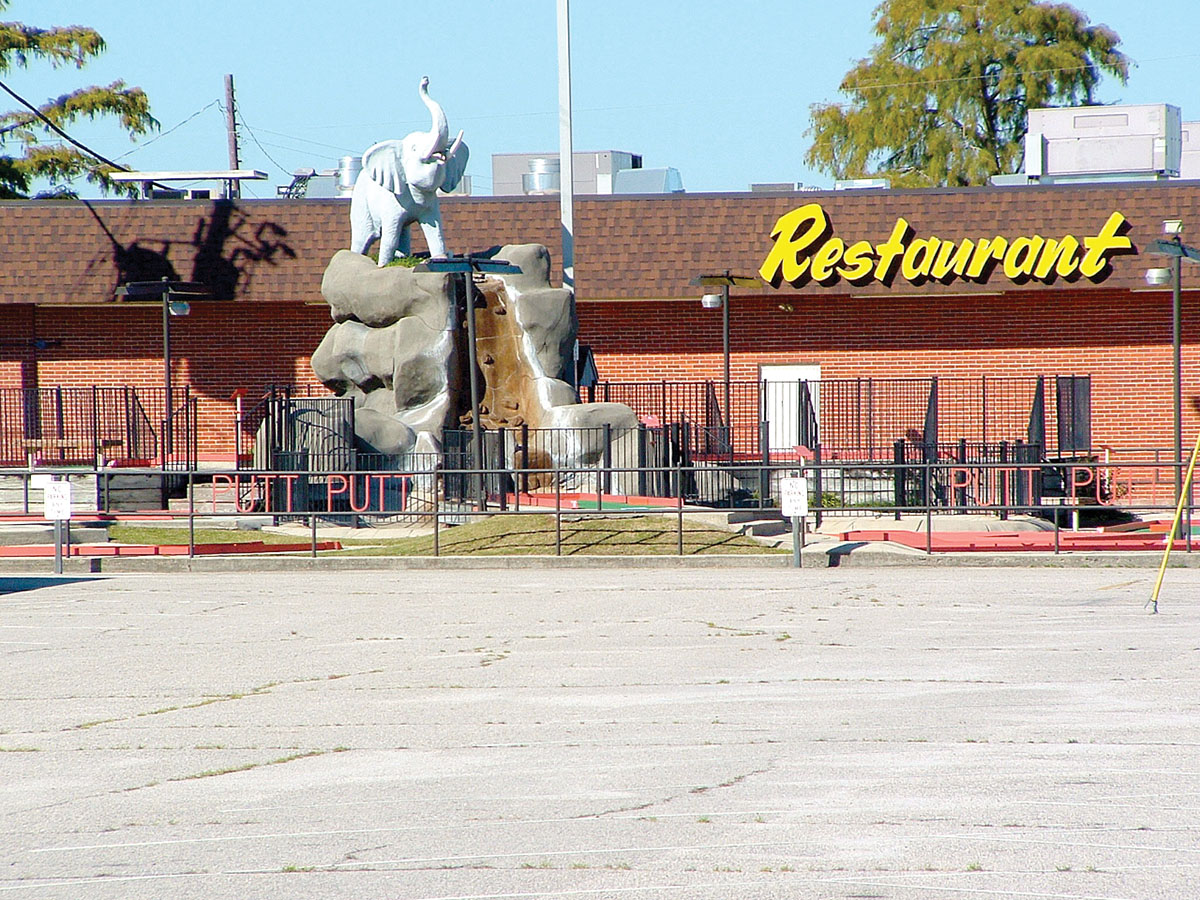
White Lake is a place to remember as winter sets in. Why not plan a daytrip to White Lake next summer to see this miniature version of Myrtle Beach. You’ll see water parks, putt putt courses and houses on stilts — just like you see at the beach. You’ll find motel, cottage and campground accommodations available as well as permanent home sites.
It’s a lot like Myrtle Beach, but nowhere as frenzied. It’s family friendly with a laid back style. A lady working on the sign for her rental property summed things up nicely: “We don’t get excited about anything here.”
Pay it a visit and take the road that circles the lake and see if you don’t get the feeling you’re at Myrtle Beach. You’ll get excited when you realize just how unique it is to get a real “beachy” feeling some 90 miles from Myrtle Beach.
If You Go …
www.whitelakenc.com/
Learn more about Tom Poland, a Southern writer, and his work at www.tompoland.net. Email day-trip ideas to him at tompol@earthlink.net.
Peaceful Southern Gothic at Savannah’s Bonaventure Cemetery. (Photo/Tom Poland)
Perhaps you recall the book and movie, “Midnight in The Garden of Good and Evil.” If you do, you will recall, too, that I was set in a special Southern locale. Drive 3 hours south, about 191 miles, and you’ll arrive in a distinctive Southern city, Savannah, Ga.
We have to go way back to the early 1980s to a time when Savannah found itself in the midst of a social firestorm. John Berendt, a one-time editor at Esquire magazine, found Savannah so fascinating he moved there and documented the unbelievable characters and their shenanigans in a book that Clint Eastwood turned into a movie.
Now let it be said that there’s much to do and see in Savannah and its popular riverfront, but this column focuses on a part of Savannah deservedly described as quintessential Southern Gothic and hauntingly beautiful. This column takes a look at one of the memorable settings in the book and movie, Bonaventure Cemetery. It was there that a voodoo scene took place in the “Garden of Good and Evil.”
Bonaventure’s story goes back to two early and prominent colonial families, the Mullrynes and the Tattnalls. In 1771 John Mullryne, and son-in-law, Josiah Tattnall, owned well over 9,000 acres of land, including 600 acres 3 miles from Savannah on St. Augustine Creek. This site became the family plantation, Bonaventure, French for “good fortune.” A subsequent owner set aside 70 acres of it as the Evergreen Cemetery of Bonaventure, a public burial ground. The City of Savannah bought Evergreen Cemetery in 1907 and much later, in 1982, the city’s Department of Cemeteries took oversight of it.
Today Bonaventure is more than a beautiful place of eternal rest. It’s historical. Buried there are Johnny Mercer, the songwriter of “Moon River” fame, poet Conrad Aiken and Georgia’s first governor, Edward Telfair. I’ve been there and it’s historically significant for another reason. The nearly 100-acre cemetery provides a walkabout reflection of how views changed on death and dying in the Victorian Era. Death, romanticized and more ritualistic, led to cemeteries becoming opulent “cities of the dead.”
I walked the cemetery one green April afternoon. Spanish moss, ancient oaks, beautiful monuments and a view of the marsh give this cemetery an atmosphere rivaled by few. The Bonaventure Historical Society poetically expresses all that the cemetery is. “Part natural cathedral, part sculptural garden, Bonaventure transcends time.”
You can transcend time too if you visit this magnificent setting of mausoleums and more. Savannah is close by with its great shops and seafood restaurants. One more thing: Berendt’s book made the “Bird Girl” statue in Bonaventure Cemetery so famous it had to be moved to the Telfair Museum of Art. Another good stop on your trip.
If You Go …
330 Bonaventure Road, Thunderbolt, Ga. 31404
912-651-6843
www.bonaventurehistorical.org
Learn more about Tom Poland, a Southern writer, and his work at www.tompoland.net. Email day-trip ideas to him at tompol@earthlink.net.
WINNSBORO – An employee at the Fairfield County Detention Center became a resident last week after an undercover sting nailed him attempting to solicit prostitution.
Joe Wayne Gladney, 52, of Paper Road in Winnsboro, was arrested by Fairfield County Sheriff’s investigators on Nov. 11 in the parking lot of the CVS Pharmacy at 27 Highway 321 Bypass South.
According to the Sheriff’s report, narcotics officers had received complaints about Gladney attempting to solicit prostitution from various females known to him through his duties as a corrections officer. A confidential source and an undercover officer reportedly agreed to meet Gladney in the CVS parking lot just after 8 p.m. on Nov. 11. Investigators recorded the meeting, during which Gladney reportedly discussed with the source and the undercover officer exchanging money in return for a sexual favor.
Teresa Lawson, Director of the Fairfield County Detention Center, said Tuesday that Gladney had been placed on unpaid leave until the investigation is concluded. Gladney has been employed by the Detention Center for 10 years, Lawson said.
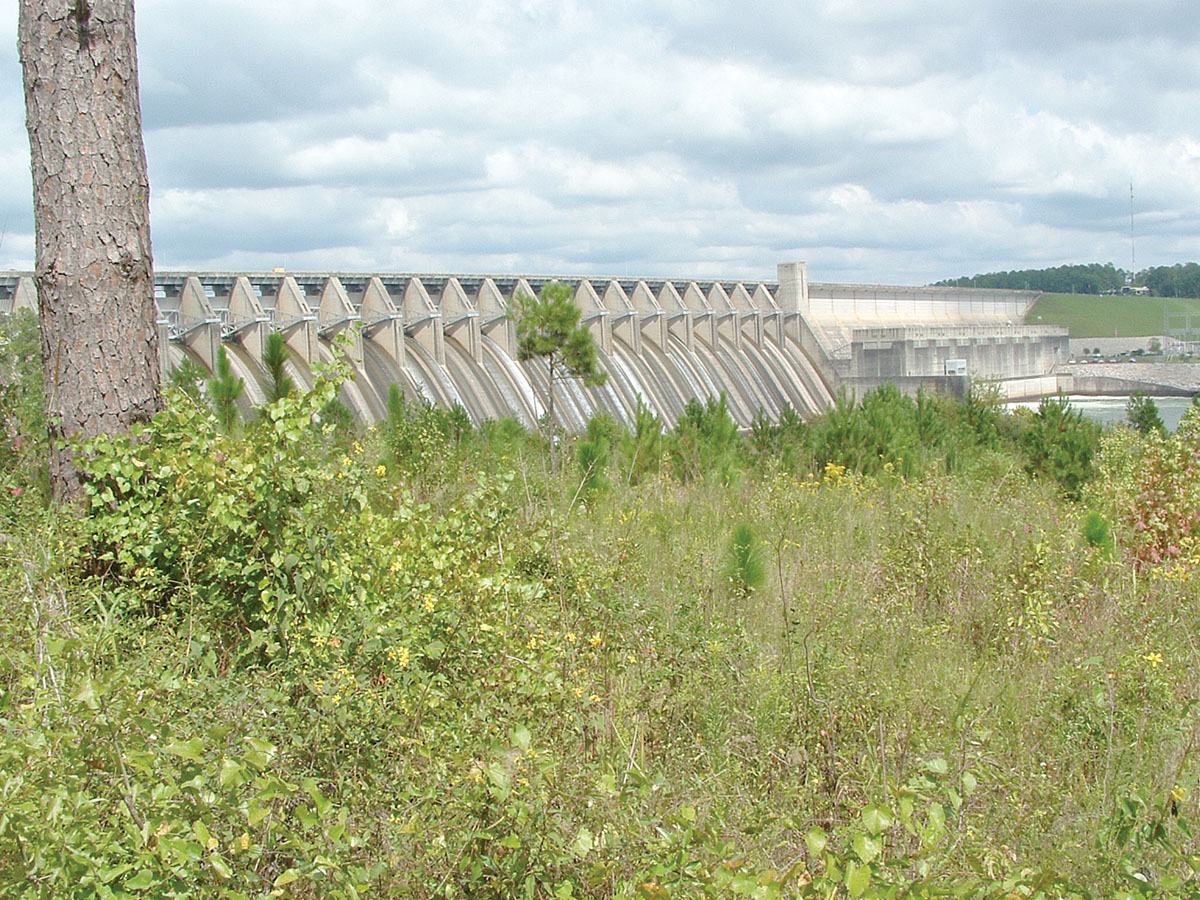
Ain’t that a Dam Site – Clarks Hill Dam, creator of the third-largest man-made lake east of the Mississippi. (Photo/Tom Poland)
At 71,535 acres, it’s as big a lake as you’ll see in this region. In fact it’s the third-largest man-made lake east of the Mississippi River, and it’s only 100 miles, about two hours, away. A mighty dam backs up the Savannah River creating more than 1,200 miles of shoreline. Along that shoreline are some fine state parks and great fishing and recreation opportunities.
This watery wonderland came about from man’s need to control the raging Savannah River. For many years it flooded the region and in particular Augusta, Ga. Erecting a major dam provided a solution with the double bonus of providing hydroelectric power and recreation opportunities. Be sure to go to the Visitor’s Center to learn more about this major dam and reservoir.
Clarks Hill Lake forms a vast border between Georgia and South Carolina along Abbeville, McCormick and Edgefield counties. The U.S. Army Corps of Engineers built it from 1946 to 1954 near the confluence of the Little River and the Savannah River. As names go, the lake has had its problems. Originally referred to as Clarks Hill Dam, the “s” in Clarks was left out by error and the dam project became known as Clark Hill Dam. In 1987, Congressional Representative Butler Derrick introduced a bill to rename the lake after Strom Thurmond. That didn’t sit well with Georgians. Georgia’s Legislature passed House Resolution No. 115 making “Clarks Hill” the official name for the dam and the lake. To this day no self-respecting Georgian refers to the reservoir as Lake Strom Thurmond.
Each year, millions of people flock to the parks, marinas and campgrounds clustered around the lake to enjoy outdoor recreational experiences. Clarks Hill Lake is one of the 10 most visited Corps-built lakes in the nation. Both Georgia and South Carolina refer to the lake as their “fresh-water coast.” Largemouth, white, striped and hybrid bass, crappie, bluegill and catfish make the lake a fisherman’s paradise. Bass tournaments are common there.
Nowhere as developed as many lakes are Clark Hill Lake’s wildlife is abundant. Wildlife Management Areas offer prime places to hunt and just enjoy nature. Just getting outdoors is fine too. State parks on the South Carolina side include Calhoun Falls, Baker Creek, Hickory Knob and Hamilton Branch. State Parks on the Georgia side include Mistletoe, Elijah Clark and Bobby Brown. You’ll find plenty of campgrounds and cabins to choose from.
On the South Carolina side be sure to check out the Little River Blueway and its opportunities for canoeing and kayaking. You’ll find 51 miles of beautiful paddling trails here. Ample opportunities for mountain biking and hiking too. The Blueway area features 63 holes of golf, skeet shooting and numerous historical sites. Be sure to visit the Badwell Cemetery while in the area. There’s also a 50-mile scenic drive for those who choose to forego paddling and biking.
Fall makes for a great time to head over to this major reservoir. Seeing the reflections of colorful leaves along a glassy shoreline is a treat. Whether you camp or stay in a cabin, fall is a fine time to visit the “Georgialina” freshwater coast.
If You Go …
• Consider making reservations at some of the fine cabins in South Carolina and Georgia’s parks.
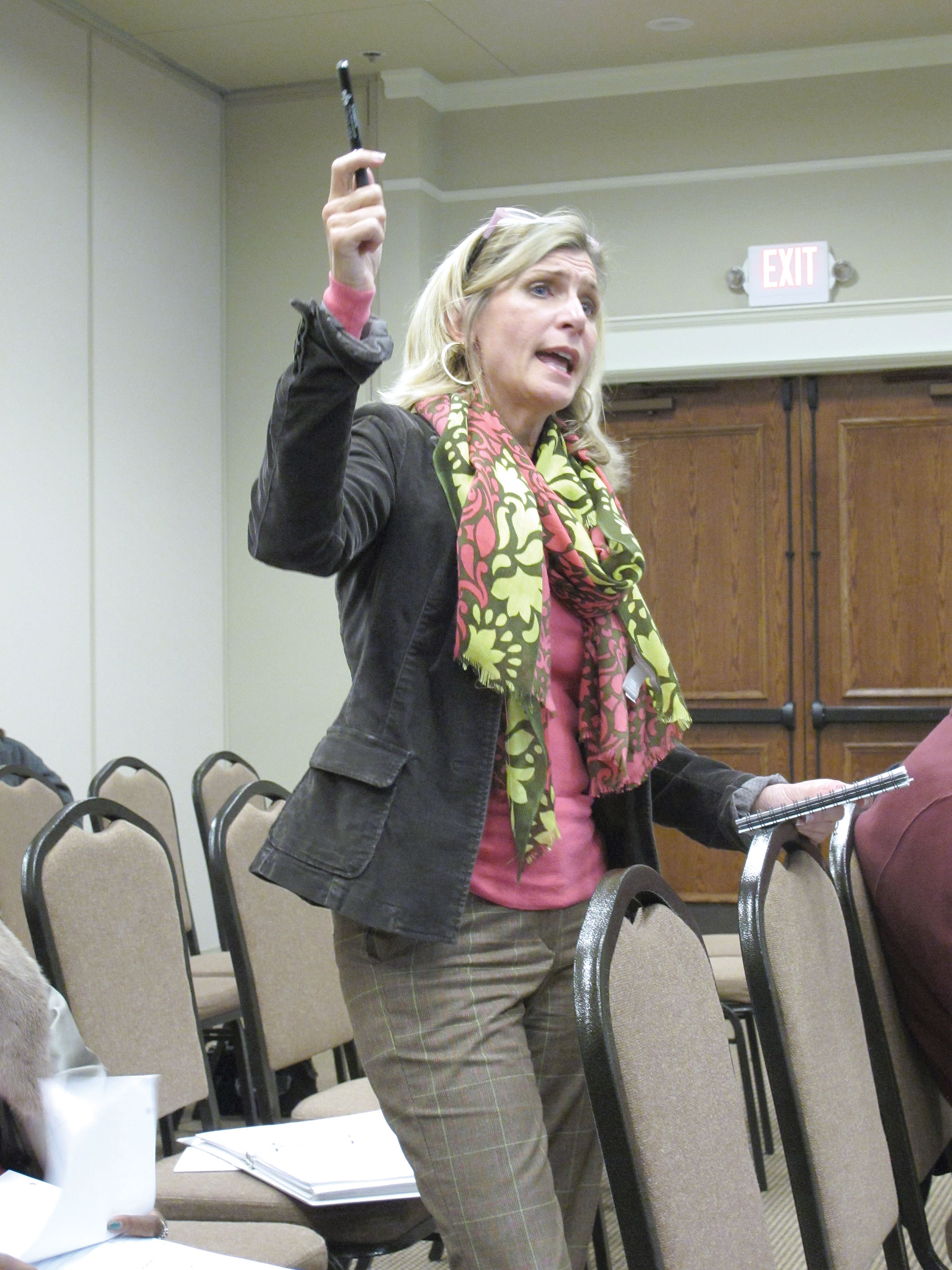
Pat Littlejohn, Vice Chairwoman and a 12-year member of the Blythewood Board of Zoning Appeals, argues that changes to the BZA’s rulings by Town Hall leads to inequality in the application of the Town’s sign ordinance. (Photo/Barbara Ball)
Planning Commission Pushes for Delay
BLYTHEWOOD – In a surprise announcement at the October Planning Commission meeting, Chairman Malcolm Gordge reported that Town Council was rethinking the sign ordinance that was passed in 2009 that calls for the majority of non-conforming signs in the town limits to be replaced with conforming signs by Jan. 26, 2016. The high-rise signs along I-77 would have to comply with the ordinance by January 2020.
He said the ordinance is “obviously going to cause some difficulties for local businesses. . . . What’s being proposed,” Gordge said, “is a work session with representatives of the Planning Commission, the Board of Architectural Review and the Chamber of Commerce to get some feedback to determine how the businesses perceive this requirement to comply with the ordinance . . . so that we have plenty of time to come to a compromise.”
Gordge said the issue came to light as Town Hall began preparing to send notices out to businesses with non-conforming signs at least a year before the deadline when all signs (except the high rise interstate signs) in the town limits must to comply with the ordinance.
That workshop was held Tuesday night with Gordge and his fellow panel members quickly laying the groundwork for postponing conformity for all signs in the town until 2020. Mayor J. Michael Ross was represented by J.B. Bishop who argued for an extension of the compliance, raising his voice that it was not fair to ask businesses to purchase new signs.
Before inviting the opinions of any business owners in the audience, Gordge got the ball rolling by suggesting three options to the current sign ordinance, two of which call for an extension of the sign ordinance for four more years:
Follow the ordinance as written with compliance required on Jan. 26, 2016 and, for high-rise interstate signs, January 2020.
Extend the compliance order until 2020 for all businesses, but require a formal statement from the business owners that they would comply with the ordinance at that time.
Consider some form of continuing license so that businesses could pay an annual fee to retain their grandfathered signs until Jan. 26, 2020.
While only one business owner, Larry Sharpe of Blythewood Oil, and representatives of Trinity Unity Methodist Church had questions about their particular signs, there was no groundswell from the audience for changing the ordinance. And both the chairman and vice-chairwoman of the Board of Zoning Appeals (BZA), who were not on the panel, gave the panel a tongue lashing for allowing some business owners and churches a bye while others either agree, or are forced, to abide by the sign ordinance.
Pat Littlejohn, vice-chairwoman of the BZA and a member of the board for more than 12 years, said “Ninety-five percent of our requests are for sign variances.”
Addressing her question to Bishop, she asked, “How will you compensate those businesses who have complied with the sign ordinance regulations, who came here anticipating the 2016 deadline? I would argue that they have not been allowed to have the same advertising capacity as the other businesses who have non-conforming signs.”
While Bishop, speaking for the mayor, talked about the drop-dead date of the ordinance and the recession, Littlejohn reminded him that he was not answering her question.
“There are a lot of businesses out there who have complied. The Hardee’s was not allowed to put up a sign equal to McDonald’s, so if I were Hardee’s I would say these folks have gotten a bye. The same is true for the Days Inn who was made to comply,” Littlejohn said.
She also pointed out that the town administration is “obviously changing the rules (for some businesses and churches) after they have been denied a variance from the BZA. I don’t know how Trinity (UMC) now has a sign that does not comply with the ordinance,” she said referring to a comment earlier in the meeting by BZA chairman Sabra Mazyck that the motion for a variance for Trinity’s sign was denied on Monday, May 5, 2008 according to the minutes from the meeting.
Littlejohn recalled that “at one point, there was an effort for us to not look like Two-Notch Road. There are plenty of communities that do not have non-conforming signs. And they have plenty of business, so that’s an invalid argument.”
Sharpe said he had no problems complying with the signs within the town, saying, “Everybody knew this date was coming (for compliance).”
But, he said if he was made to take down his interstate high-rise BP sign, he would consider that a government taking.
“If that sign has to come down, I think the Town will have to pay me for it,” he said.
He said he erected the sign in 1978 when the town was only loosely formed and he didn’t feel it should have a date set to come down. He said he felt the signs brought business to the town and that the town government benefited from the business taxes he paid.
“We bought that property because of the visibility on the interstate. Those issues will have to be decided in the courts,” Sharpe said.
He said it would cost $150,000 to replace his high-rise sign and $50,000 to replace the Bojangles sign.
“But I don’t have any problem conforming (my) other signs in the town,” he said. “That’s not an issue.”
Several members of the panel mentioned that the town’s businesses needed more time to comply with the ordinance. Bishop suggested that they needed time to save up some money for new signs.
But Littlejohn said she was surprised at the sudden amnesia.
“Since 2009, every person who has come before us, we have informed them of the 2016 decision,” she said. “It’s frustrating that we have been very diligent to enforce the ordinance while trying to be pragmatic. If the rules keep changing, we will continue to have problems.”
While one member of the panel seemingly dismissed her by thanking her for her service, Gordge stuck to his guns.
“We aren’t going to please everyone, but we must reach a conclusion that will be fair to the majority,” he said. “The only mitigating circumstance is that we weren’t anticipating a recession in 2006, 7 and 8.”
Town Councilman Bob Massa, a member of the panel, pointed out that the ordinance wasn’t passed until 2009 and that the committee that wrote the ordinance included many of the town’s business owners.
When a representative of Trinity said he didn’t feel the Town was giving enough notice to comply with the ordinance, Town Councilman Bob Mangone, who was sitting in the audience, said, “You have been notified seven years ago. I have not heard anything in this room to make me believe that four or five more years is going to cause the business owners to have an epiphany and decide to plan ahead. We had seven years to plan for this and the BZA has worked their butts off to make the best decision based on the ordinance. And now, one and a half years before the deadline, we’re saying, ‘Oh, my. I didn’t know this was going to happen’.”
Gordge sallied forth. “I’m hoping to get a consensus tonight that we make a recommendation to the Town Council to extend the deadline date from Jan. 26, 2016 to 2020. That seems to be the most popular response,” he said.
“If that’s what is going to happen, then please don’t ask for any more variances from the BZA, because we’ll be acting on what’s currently written in the ordinance,” Littlejohn declared.
Town Administrator Gary Parker spoke up from the back of the audience, cautioning Gordge, “I think it would be more appropriate to report information gathered at this meeting than to recommend to Council. Generally,” he said, “it’s only when a committee is appointed by Council and authorized to come back with a recommendation that that would be the case.”
Town Council’s next meeting will be Monday, Nov. 25.
WINNSBORO – After a primary, a runoff and in the midst of an ongoing SLED investigation, voters in Fairfield County made it official Tuesday with the special election of Will Montgomery as Sheriff.
Montgomery, who sealed the deal with 1,970 votes Tuesday, will fill out the remaining two years on the term of Herman Young, who stepped down in July because of health reasons.
Montgomery comes from a long line of Fairfield County lawmen. His father, Bubba Montgomery, and his grandfather, S. Leroy Montgomery, both served as Fairfield County Sheriff for 12 years each. Montgomery is a shift supervisor with the Richland County Sheriff’s Department, where he has worked for the last 13 years.
Montgomery defeated Chief Deputy Keith Lewis in a special Democratic primary runoff on Oct. 14 with 56.25 percent of the vote. As the only name on Tuesday’s ballot, Montgomery got much more than that in the special election, with 125 write-in ballots cast.
Just days after the runoff, the S.C. Law Enforcement Division (SLED) confirmed reports that their agency had launched a preliminary investigation into allegations of vote-buying leading up to the runoff. SLED would not reveal details of the investigation, specifically who was allegedly paying who to vote for which candidate, but independent sources have since told The Voice that as much as $5,000 in cash was allegedly paid for votes.
Tuesday afternoon, a SLED spokesperson confirmed that the investigation was still open and ongoing.
Phone calls to Montgomery were not returned at press time.
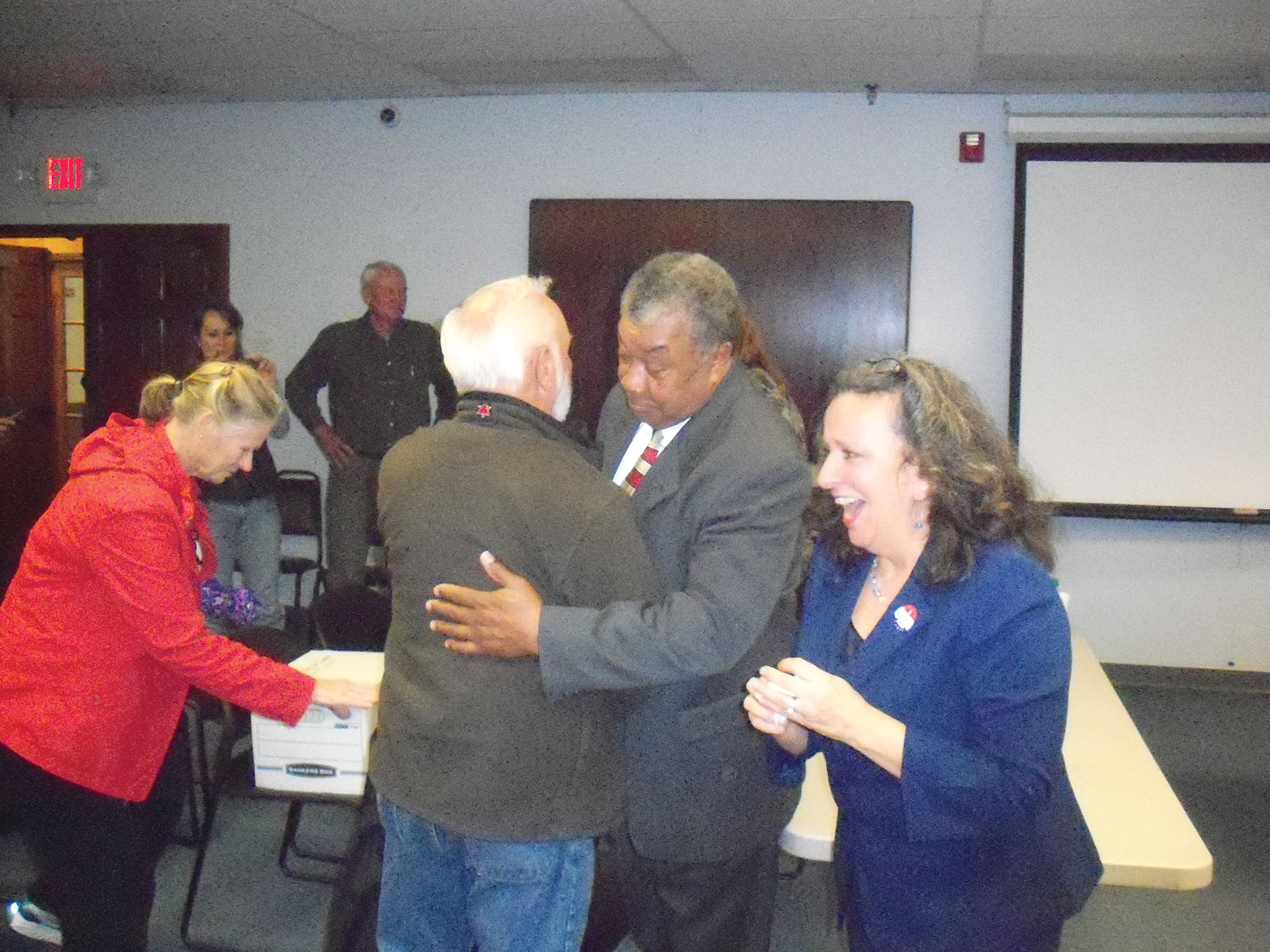
Winnsboro attorney Debra Matthews (right) celebrates as District 3 challenger Walter Larry Stewart (second from right) receives congratulations from Vernon Plyant following the Election Commission’s ruling Monday that a new election would be necessary between Stewart and incumbent Mikel Trapp for the District 3 County Council seat. (Photo/James Denton)
Battle for District 3 Seat Rages on
WINNSBORO – The proverbial Fat Lady who has been waiting in the wings since Nov. 4 to perform her closing aria for the District 3 County Council race will have to go back to her dressing room, at least for the time being. Monday afternoon, the Fairfield County Election Commission unanimously upheld two of the three grounds for protest presented last week by challenger Walter Larry Stewart and ordered a new election between Stewart and incumbent Mikel Trapp.
In results certified by the Election Commission following a recount on Nov. 7, Trapp edged out Stewart in the hotly contested race, 489-485. But irregularities found on absentee ballot envelopes by Stewart supporters, as well as reports of voters in District 3 receiving the incorrect ballot style at their polling places, prompted Stewart to file an official protest of the results last week.
While the Election Commission overruled Stewart’s protest on the absentee envelopes, it agreed with the Stewart camp that five voters – two in Mitford and three in Monticello – had been presented with the wrong ballot style on election day and therefore were unable to cast a vote in the District 3 race for County Council.
“This is democracy at its best,” Debra Matthews, a Winnsboro attorney representing Stewart at the hearing, said. “It’s a great day in South Carolina.”
Trapp did not make an appearance at Monday’s hearing, instead sending as his representative Winnsboro resident Kadena Woodard. Woodard’s participation in the proceedings, however, was limited.
As Woodard prepared to read a statement from Trapp to the Commission and offer two attached documents as evidence, Matthews objected.
“There is a notary spot at the bottom of this which is not filled in,” Matthews said. “This is a hearsay statement and I’m going to object.”
Liz Crumb, an attorney with the McNair Law Firm, retained by the Commission for the hearing, advised against Woodard making a case for Trapp at all.
“She’s not counsel and that would be practicing law without a license,” Crumb told Commission Vice Chairwoman Carolyn Y. Prioleau.
Prioleau chaired the hearing in place of Commission Chairwoman Betty M. Trapp, who recused herself from the proceedings and was not present Monday in the County Council chambers. She is related to Mikel Trapp by marriage to a Mikel Trapp cousin. Betty Trapp did chair the Nov. 7 recount and certification.
“I am not counsel, but I do have the right to read a statement that (Trapp) sent to the (commission),” Woodard said. “I would be treated so unfairly not to be able to read it.”
Woodard said she had in her possession a letter from Trapp apologizing for not being able to attend the hearing, but Matthews again objected.
“This is a hearsay statement and I’m going to object to the entry of this statement,” Matthews said. “I hadn’t seen it previously. It is directed to the board. I don’t know if the board has seen it previously.”
Both of Matthews’s objections were sustained. The Commission did eventually accept Woodard’s documents as an “offer of proof.” The documents were not reviewed by the Commission, but were instead sealed in an envelope and left to the State Election Commission to determine, in the event of an appeal, “whether or not the (commission) wrongfully kept you from making a statement,” Crumb explained to Woodard.
The Arguments
Matthews successfully argued that five voters had received the incorrect ballot style in the Nov. 4 elections, and therefore were prevented from casting a ballot for the District 3 Council race. Two of those voters were in the Mitford precinct and live at 202 Peay Ridge Road.
According to the 9-1-1 maps, which Debbie Stidham, Director of Fairfield County Voter Registration and Elections, testified were the means by which her office verifies voting districts, all even-numbered addresses on Peay Ridge Road lie on the south side of the road. That orientation places the even-numbered addresses in District 2. But through the testimony of Randy Roberts, of the Fairfield County Assessor’s Office, who on the witness stand reviewed the County’s aerial map of the road, 202 is an anomaly. It is the only even-numbered address among a host of odd-numbers lying on the north side of the road. And, according to Stidham’s testimony, addresses on the north side of Peay Ridge Road are in District 3.
Affidavits of the two voters living at 202 affirmed that they had both been given ballots for District 2 instead of District 3 on Nov. 4.
Three voters in the St. Peters Church precinct in Monticello were also given the incorrect ballot style on Nov. 4, Stidham’s testimony confirmed. Voters from both districts 3 and 4 vote at the church, and based on the records from the voting machines, the three District 3 voters who cast ballots there on Nov. 4 had their votes counted in District 4.
Trapp has until Nov. 24 to file an appeal, at which time the State Election Commission will make its ruling. A new election will not be scheduled until the State Commission sends their findings to the Governor’s Office and the election is ordered by Gov. Nikki Haley.
Efforts to reach Trapp by telephone for comment for this story were unsuccessful.
“We’re moving forward,” Stewart said after the hearing. “I’m going to need everybody’s support for this next step, in this next election. I need everybody’s support in this next election to make it a new day in Fairfield County, because we’re going to have to work hard to get there.”
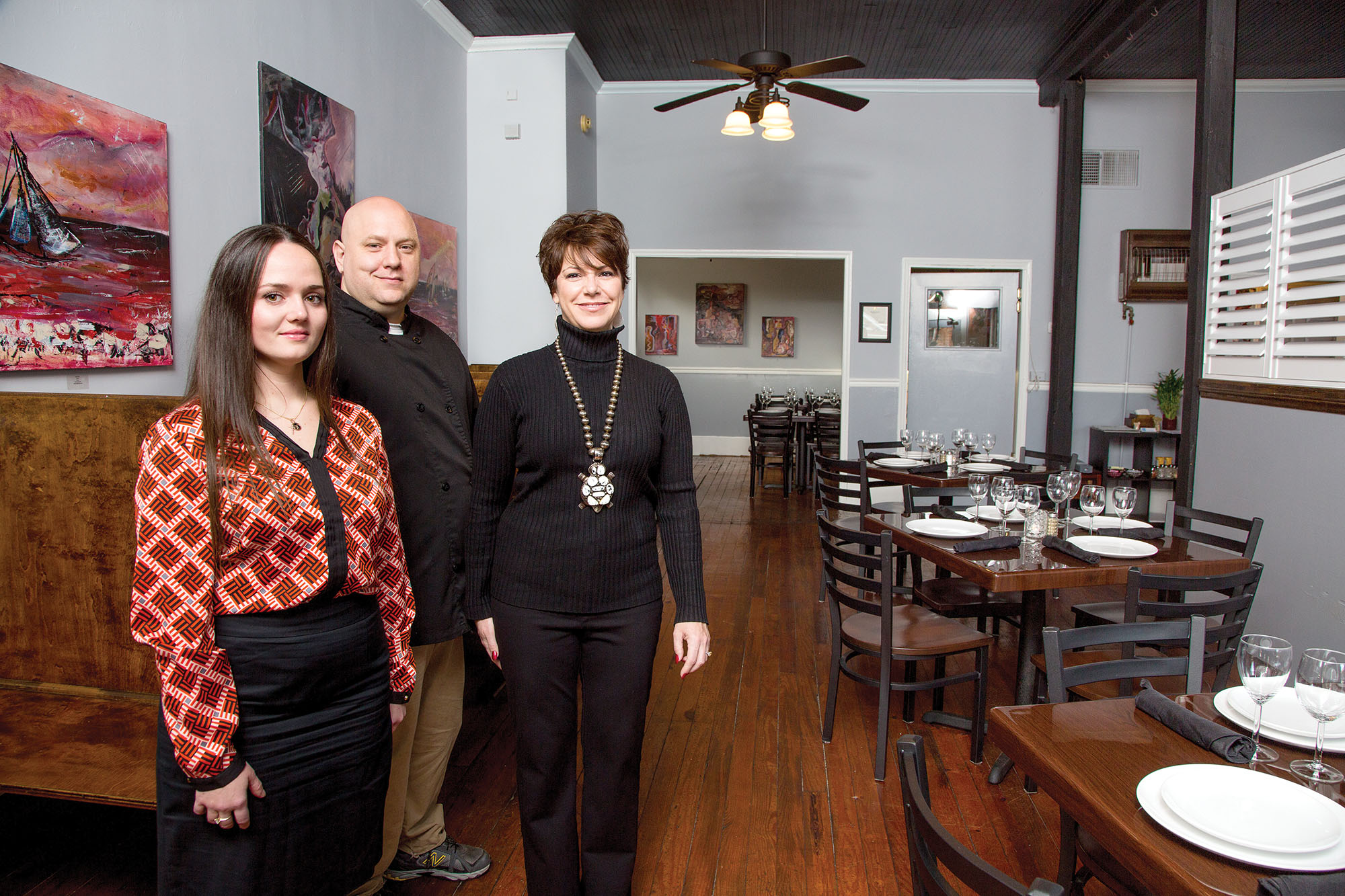
The Old Town Hall Restaurant’s staff includes co-owner and server Angelina Surina, Chef Mike Culley and Deb Phelps who, along with her husband Mike Phelps, are also co-owners. (Photo/Barbara Ball)
RIDGEWAY – The Town of Ridgeway is anchored once again by a full service restaurant that features steak, lava shrimp, salads, wings, pizza and several absolutely fabulous desserts.
The new owners, locals Deb and Mike Phelps and Angelina Surina, formerly of Russia, offer upscale casual dining, a full bar with both draft beers and a rotating array of craft beers such as Sweet Josie Brown. The walls of the newly redecorated restaurant are hung with artwork on consignment by Charleston artist Emily Stein. And the front dining area offers a great conversation starter, a clear view of the old Ruff Hardware Store across the street.
The crown jewel of the eatery, Deb Phelps said, is Chef Mike Culley, formerly with 82 Queen in Charleston and other fine dining establishments. Going on for a while about Culley’s expertise in the kitchen, Phelps said he’s full of culinary surprises, like the chipotle pimiento cheese dip and his ‘cheesecake of the moment,’ which changes flavors and toppings frequently.
“But whatever the flavor or topping,” Phelps said with delight, “the basic cheesecake melts in your mouth. It’s really wonderful, light and full of flavor.”
Other dessert offerings include crème brulee and chocolate mousse.
Phelps said she and her partners wanted to keep the restaurant’s traditional name, “because we used to come here when it was owned by Lisa Caplan several years ago, and we just had so much fun here.” And the fun continues since the Phelpses and Surina opened during Pig on the Ridge two weeks ago.
“We’ve had great community support,” Phelps told The Voice. “We’ve had so many favorable comments on the food, the décor and the service. Our goal is to create a dining atmosphere that compliments the town and keeps the town’s tradition in focus.”
The restaurant is located at 140 S. Palmer St. in the center of town and is open Tuesday – Thursday, 11:30 a.m. – 10 p.m.; Friday and Saturday, 11:30 a.m. –midnight (kitchen closes at 10 p.m.).
A Sunday brunch featuring eggs Benedict and the chef’s specialty, French toast that’s crusty on the outside and soft inside, is served from 11:30 a.m. – 3 p.m. Reservations on Sundays are recommended.
For more information, go to info@oldetownhall.com.
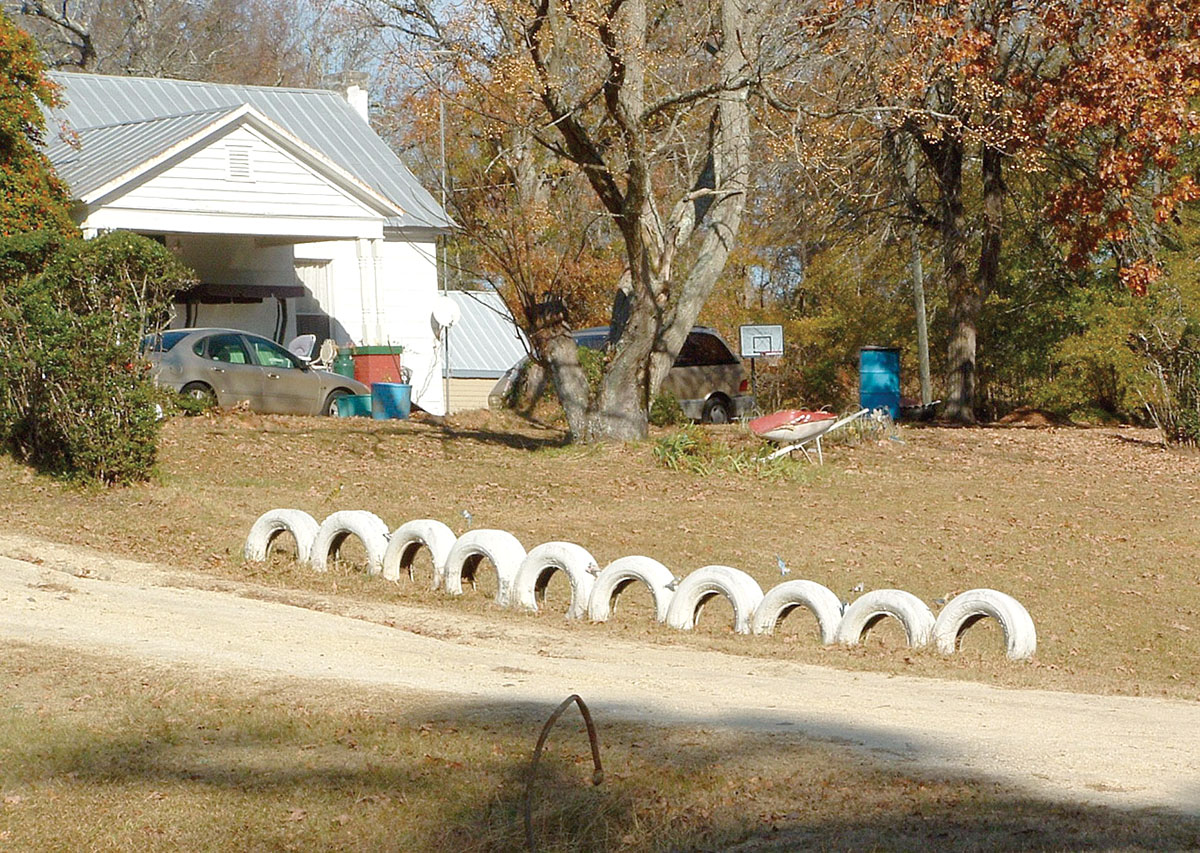
Your Yard Looks Tired – Classic Southern yard art comes in many forms and puts old items to new use. (Photo/Tom Poland)
Remember these lines from an old Chuck Berry song? “Cruisin’ and playin’ the radio/With no particular place to go.” Well, the next time you have no particular place to go I have a suggestion. Drive into the countryside and see what “vintage Southern yard art” you can find. Take a camera. Look for tree trunks painted white. Look for swings suspended from big oak limbs. See if you can find purple martin gourds, and give yourself extra points if you can find a row of tires half buried in the ground and painted white. You may have to drive many a mile, because vintage yard art is rarer than ever.
Anyone who’s bought new tires knows they have to pay a tire disposal fee. No problem back in the day. Just turn it into yard art. Growing up, it was nothing to see truck tires made into flowerpots. Painted white and featuring scalloped edges, the pots held red geraniums. Around the curve, rows of white-painted trees flanked a driveway, and up by a big, old clapboard home, a homemade swing hung from a big oak. I’d see tires made into swings too. A tire swing is pure Americana, a scene right out of a Norman Rockwell painting.
Giving junk a second life was alive and well back in the day, though it wasn’t thought of as recycling. A nail-ruined tire could be turned into a flowerpot or swing. People found new uses for things before the era of plastic this and that arrived. And some practicality backed some customs. Painting orchard trees white was considered a safeguard against fungi, disease and insects. The white paint deflected sunlight too. I don’t believe the painted trees I saw were being protected. No, I believe the folks who painted pine trunks white were simply trying to achieve a pleasing appearance.
When I see a pole dangling gourds for purple martins I know I am deep into the country. Putting up gourds for cavity-nesting birds is something you see rarely, if at all, in the city. How many people even grow gourds in the city?
No doubt you’ll spot bottle trees, but they have seen a bit of a revival of late. Once the domain of the Lowcountry you see bottle trees most anywhere. People in the Congo hung bottles from trees to ward off evil spirits, and slaves brought the practice here. Now they please the eye more so than capturing evil spirits as designed. Other oddities include miniature windmills and carved ducks with “windmill” arms that spin with the wind.
For me, though, the true yard art of yesteryear is a row of half-buried tires edging a driveway. It steered you straight and most likely made finding the driveway at night a whole lot easier. Hit the backroads and see what you can find as yard art from yesteryear goes. Take some good photos because you’ll not see the likes of it again. For sure, your grandkids won’t.
If You Go …
Take the lesser-traveled roads, roads like the ones in the 200s and 30s. Highways 34 and 39 come to mind. Should you find an old tar-and-gravel, or even better a dirt road, take those and go exploring.
Learn more about Tom Poland, a Southern writer, and his work at www.tompoland.net. Email day-trip ideas to him at tompol@earthlink.net.
UNION – The S.C. State Law Enforcement Division (SLED) is investigating an officer-involved shooting and has charged a Winnsboro man with assaulting a police officer after a high-speed chase through Union County Friday afternoon.
Joshua Kevin Burbage, 28, formerly of Winnsboro and whose most recent address was reported as 3300 Sweet Springs Drive, Lexington, was arrested Friday and charged by the Union County Sheriff’s Office (UCSO) with failure to stop for a blue light, third offense; driving under suspension, fourth offense; and violation of the Habitual Traffic Offender Act. A spokesperson for SLED said Monday that SLED is also charging Burbage with assault and battery of a high and aggravated nature on a police officer.
According to the UCSO, the incident began when Union Public Safety officers responded to a report of shoplifting in progress at the Walmart on the N. Duncan Bypass. As officers arrived, they spotted the suspected shoplifter, identified as Burbage, fleeing the parking lot in a Ford F-250 pickup truck. Officers gave chase, but soon lost sight of the vehicle. UCSO deputies picked up the chase on Industrial Park Road near the Union Post Office and followed as Burbage headed south on S. Duncan Bypass, crossing Whitmire Highway and onto Beltline Road.
Just past the Hawkins Road junction on Beltline Road, Burbage stopped in the middle of the road, threw the F-250 in reverse and backed over the hood of the Union County deputy’s patrol car. The impact spun the squad car around 45 degrees, exposing its passenger side to the F-250. Burbage rammed the patrol car a second time, bashing the tailgate into the passenger side of the car. The deputy then stepped out of the cruiser, drew his service weapon and fired at the F-250. Burbage sped away, but backup units made contact with him on S.C. 215 near Lablaw Road.
With speeds reaching up to 100 miles an hour, the chase entered the town of Carlisle where Burbage made a hard right onto S.C. 72, crossing into oncoming traffic and heading toward Newberry. The F-250, meanwhile, was losing air in its left front tire and the chase began to slow. Near the intersection of Tuckertown Road, Burbage came to a stop and was apprehended by deputies.
As they were handcuffing him, deputies noticed Burbage had been shot through the thumb on his right hand. Burbage was transported to Spartanburg Regional Medical Center where he was treated and released into custody. Burbage was, at press time, still being held in the Union County Detention Center.
According to SLED records, Burbage has a list of prior arrests dating back to March 8, 2004 when he was picked up for grand larceny by the Fairfield County Sheriff’s Office (FCSO). Burbage was also charged with shoplifting in December of 2005 by the Richland County Sheriff’s Department, petty larceny in August of 2008 by the FCSO, grand larceny in July of 2009 by the Winnsboro Department of Public Safety (WDPS), burglary and unlawful neglect of a child in December of 2009 by the FCSO, and shoplifting charges in July of 2011 and September of this year by the WDPS and the Lexington County Sheriff’s Office, respectively. In between, he has no fewer than six driving under suspension charges.