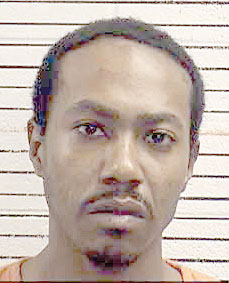
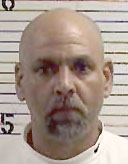
WINNSBORO – A North Carolina man suspected of robbing the Wells Fargo bank at 101 N. Congress St. was captured by Winnsboro Public Safety officers Thursday afternoon, a mere 16 minutes after dispatch received the call.
Jermaine Leonard Faulk, 25, of Rose Hill, N.C. was spotted walking down the 400 block of Cemetery Street by officers sweeping the area. Faulk fit the description of a man who, at 11:47 a.m., had forced his way behind the counter at the Wells Fargo bank and snatched approximately $1,000 in cash from teller drawers. Freddie Lorick, Chief of Public Safety, said Faulk was breathing heavily when officers caught up with him and patted him down. Lorick said some of the stolen money was found on Faulk; the rest was found in the pockets of his jacket, which he had discarded on the nearby railroad tracks during his flight.
No one was injured during the incident, Lorick said. Faulk is being held at the Fairfield County Detention Center, charged with robbery. Lorick said investigators are also seeking one or more possible accomplices who drove Faulk to the bank that morning.
Ice, Ice Baby – While most of Blythewood and Fairfield County woke up to a beautiful winter wonderland of ice-coated trees and fences Tuesday morning, Taylor Harrison of Ridgeway awoke to find a large iced tree had fallen on the rear of her red 2013 Prius and had taken with it a telephone pole that landed on the top of the car. Harrison’s younger sister, Rosalee, 8, is shown here dramatically describing her reaction to the devastation caused in the family’s yard by the ice storm. (Photo/Barbara Ball)
BLYTHEWOOD/FAIRFIELD COUNTY – While the Midlands largely escaped the brunt of the winter storm that ripped through the Southeast late Monday night and into Tuesday morning, leaving more than 100,000 homes without power in the Upstate, Fairfield County and a portion of northeast Richland County took some minor punishment.
Monday night’s storm dumped approximately a half-inch of ice on the area, coating trees and power lines and making roads hazardous for travelers. The Fairfield Electric Co-Op reported that around 1,800 customers were affected by the storm overnight as ice-laden trees succumbed to the additional weight and bowed into power lines. By mid-morning on Tuesday, the Co-Op said that number had been cut to approximately 500 customers – 100 in northeastern Richland County and 400 in Fairfield. Most of the damage occurred in the corridor between Blythewood and Ridgeway.
Crews were still on the job Tuesday afternoon, being assisted by crews from the Edisto Electric Co-Op from Bamberg. All power was expected to be restored by Tuesday evening, the Co-Op said.
In Winnsboro, ice began forming around 5 p.m. Monday and by 11 p.m. the first reports of power outages began to trickle in. William Medlin, Director of the town’s Electrical Department, said the outages peaked at around 1,200 customers. By 2 p.m. on Tuesday, however, Winnsboro crews had whittled that down to just two remaining customers.
Fairfield County schools were closed Tuesday, and many of Tuesday night’s games in the first round of the state basketball playoffs in the girls’ bracket were rescheduled for Wednesday, including Fairfield Central’s visit to Indian Land. The Lady Bengals’ first-round game at Goose Creek, meanwhile, remained on schedule.
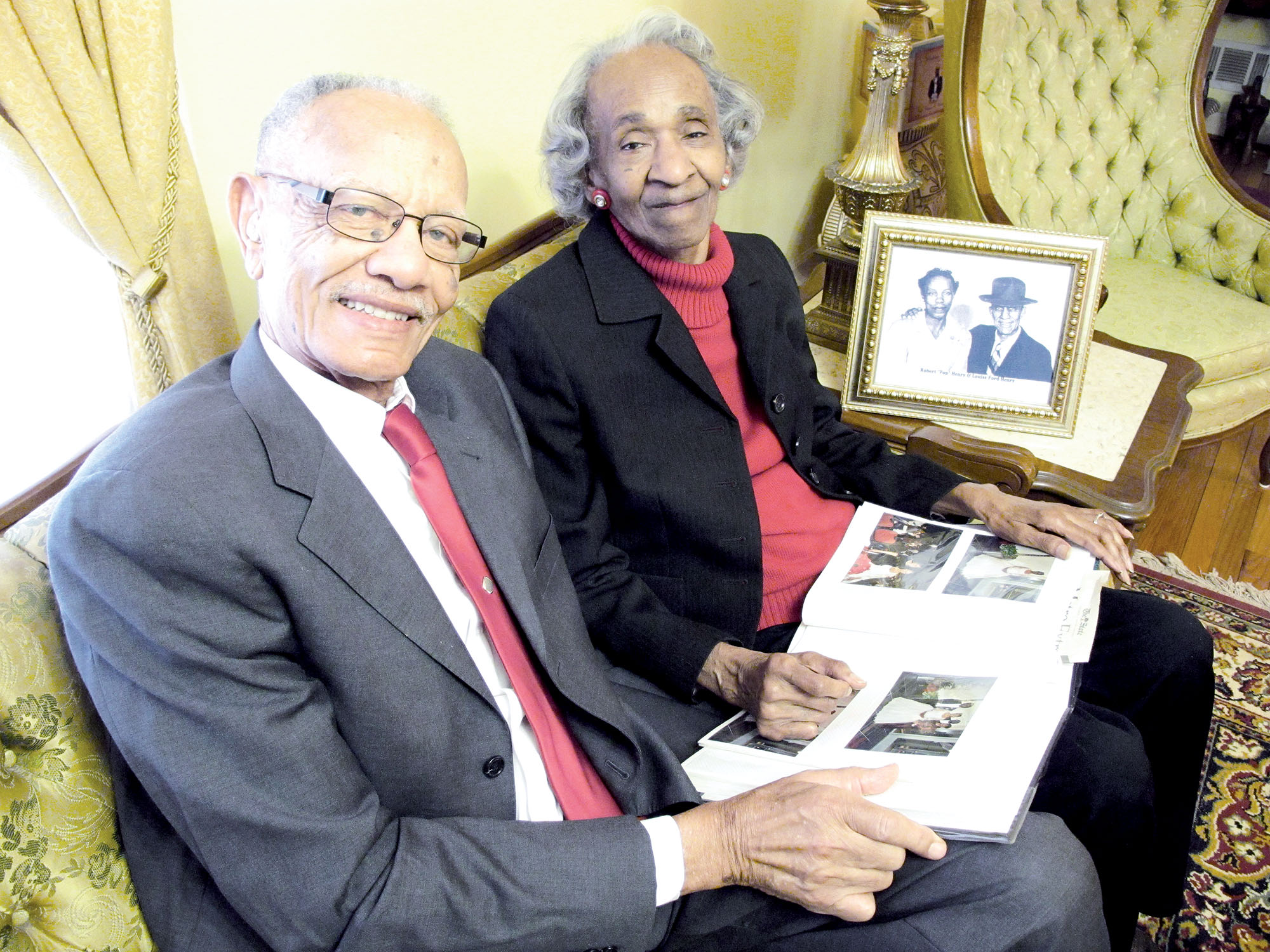
Taft and Evelyn Henry of Winnsboro reminisce about their 62 years of marriage as they look pour over a family album. The two say they treasure time with each other and their family.
The Henrys: Can I Walk You Home?
WINNSBORO – Lifelong Fairfield County residents Taft and Evelyn Henry have been married for 62 years, and they say the secret to a long and happy marriage isn’t anything fancy or elaborate.
“The biggest thing is to be friends,” Evelyn said. “If you’re friends, you’ll go a long way. You’ve got to like each other – that’s very important!” she said, adding with a laugh, “It’d be pretty miserable to stay married for 62 years to somebody you don’t like!”
The Henrys, who raised two children and now have two grandchildren and a 6-year-old great-grandchild, met while they were both students at Fairfield County Training School, as it was known at the time.
“He asked to walk me home,” she recalled fondly. “That’s how we started talking.”
Evelyn graduated in 1947 and went on to earn a bachelor’s degree in education from USC, while Taft earned his GED, joined the Army and served in the Korean War. They maintained a long-distance engagement for three years before marrying in 1952 at her parents’ home.
Then they set off to see the world together. They were stationed in Virginia and then Germany before returning to settle in Fairfield County. Evelyn taught at McCrorey Elementary School and eventually retired as the school’s principal for a 30-year education career. Taft retired from Fort Jackson after 22 years of service.
“I won’t say it’s all been a bed of roses!” she said with a laugh. “Everybody gets upset with each other from time to time. But we know how to calm down and talk things out. We have respect for each other – that’s how you work things out.”
She said the family’s years together have been rich in laughter and happiness.
“There are so many fun memories,” she said. “For instance, when the children were small, they would always have a Saturday conference with their daddy out on the porch, to give him the rundown of the week. One week, they could hardly wait to talk to him – they ran out to the porch and excitedly informed him that ‘Mama cursed! Mama cursed!’ So he asked – a little scared, I think! – ‘well, what did she say?’ And the children said – ‘on the drive to school, she called us hellcats!’” Evelyn laughed at the memory. “They had gotten to fussing in the backseat and I called them hellcats. They thought that was some pretty bad cussin’!”
She said the family’s longtime involvement in church life has been a big source of strength.
“Even when we were stationed in Germany,” she said, “we got in there and got involved with the church. I was a moderator of the ladies’ group, and my husband worked with the men. It was wonderful to be a part of the church group, and to have people like that to talk to.”
Evelyn said the couple’s decades together have been filled with love.
“It’s been interesting,” she said with a smile. “It’s been a very good life together.”
Don and Kat Daniels of Blythewood, married for 64 years, stand next to their restored 1929 Ford Model A truck that they frequently drive around the town and show off in the annual Christmas parade.
Mr. & Mrs. Daniels: See You in Church
BLYTHEWOOD – Kat Smith, a Ridgeway girl, was 19 when a church friend, James Sharpe, introduced her to Don Daniels at a Sunday afternoon football game in a field near Daniels’ father’s store on Lorick Road in Blythewood. She did not know that Daniels had arranged with Sharpe to make the introduction. Now she recalls that it all just sort of conveniently fell into place as Daniels ended up tagging along with Sharpe and Kat to church services that evening.
“And the rest is history,” she said with a smile as she reached over to clutch her husband, Don’s, hand. “We’ve been going to church together ever since.”
After 64 years of wedded bliss, the Daniels credit their deep abiding faith in God and their work with their church for their long, happy years of marriage that has produced two sons, four grandchildren and two great grandchildren, most of whom live close by in Blythewood. Their son Alex, a Hollywood stunt man and actor, and his wife, Carolyn, the 1992 Miss America, and their three children live in California.
“But they visit Blythewood quite often,” Kat said. “Carolyn was in town with the children recently to judge the Miss South Carolina contest.”
“We’ve had a good life,” Don, a WWII veteran, said. “We go to church and have always been involved with our children’s and grandchildren’s lives.”
Kat was, for the most part, a stay-at-home mom and looked after grandson Will during his growing up years while his parents, who live next door, were at work. “He was always over here. It has been a blessing living next door to Don and Linda,” Kat recalled.
Kat still works in her flower garden and even has a year-round greenhouse in the back yard. Don tools around town in his 1929 Ford Model A pickup truck from which he and Kat can be seen waving every year during the Blythewood Christmas parade. Until a few years ago, the couple, now in their 80s, used to make yearly visits to see Alex and his family and take in Hollywood where their son regularly introduced them to the rich and famous. While they say it was lots of fun, they were undaunted by the glamour and were always glad to get back home to their quiet rural Blythewood existence, their family, friends and fellow church members.
So what’s their secret for a happy marriage over the course of 64 Valentine Days?
“Well, life is no bed of roses,” Kat offered, looking over at her husband. “And we’ve had our ups and downs. But that’s how life is. I once heard a woman say that she and her husband never had an argument. That woman,” Kat smiled, rolling her eyes, “was probably telling a story. Besides, if you haven’t had some disagreements along the way, then you haven’t had the joy of making up.”
“We have always just stayed in there and served God and let Him direct us,” Kat said. “Our prayer was always that our children and grandchildren would grow up to be in church on Sunday morning, and they are, wherever they are, every one of them,” she said smiling proudly. “We couldn’t ask for more than that.”
WINNSBORO – Facing a new election in his district in three weeks, incumbent County Councilman Mikel Trapp (District 3) made an unusual campaign pledge near the close of Monday night’s Council meeting, vowing to end his reimbursement to the County of more than $26,000 in tuition assistance.
Trapp made the pledge after District 2 resident Beth Jenkins, speaking during the meeting’s second public comment segment, asked Council if any provisions had been made to recoup the money should Trapp lose the March 3 election to either of his challengers – Walter Larry Stewart or Tangee Brice Jacobs. Trapp, who stopped receiving tuition assistance from the County just before a July 8, 2013 opinion from the S.C. Attorney General’s Office classified such payouts as improper, voluntarily began reimbursing the County in $100 increments, taken from his monthly County paycheck. According to County records, Trapp had received $26,806 from the County for tuition assistance while he pursued a degree in business from Columbia College.
But responding to Jenkins Monday night, Trapp completely reversed course.
“Whether I’m elected or not,” Trapp said, “the County will get a note telling them to stop taking any money from my check, regardless. You want to know the date when I will continue paying? That will be the first of never.”
Trapp then turned the discussion into a race issue.
“You keep mentioning the citizens and taxpayers,” Trapp said, although Jenkins mentioned neither in her comments. “All the citizens and taxpayers I’ve seen come to that mic were white. I haven’t seen any blacks come complain about tuition reimbursement. It’s a 60 percent black population. If they had a problem they would come up here and let me know. The only problems brought here are someone from Saving Fairfield.”
Trapp also said someone had obtained his Social Security number and had made an attempt to retrieve his records from Columbia College, but that the unnamed person in question had committed one critical error in the attempt.
“Next time one of you tries to go to Columbia College with my Social Security number and try to get my personal information, make sure you take someone with color to their skin,” Trapp said. “They know what color I am down there.”
In spite of the serious nature of Trapp’s allegations, the Councilman said after the meeting that he had not filed a police report. He said he may do so in the future. Trapp also would not say when the alleged incident occurred.
The Columbia College registrar’s office, meanwhile, said they had no record or recollection of anyone other than Trapp requesting his records.
In October 2013, Winnsboro attorney Jonathan M. Goode filed a lawsuit in the Sixth Judicial Circuit trying to recoup Trapp’s tuition money, as well as cash paid out by the County in lieu of supplemental health insurance to Trapp, Councilwoman Mary Lynn Kinley (District 6) and former Council Chairman David Ferguson (District 5). The suit was dismissed in January 2014 when Judge R. Knox McMahon ruled the plaintiffs lacked standing to pursue their claims.
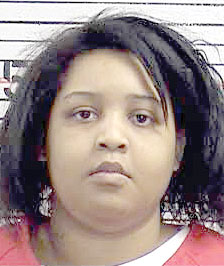
RIDGEWAY, FEB. 6, 2015 – A Greenwood woman was arrested by Fairfield County investigators Thursday and charged with murder in the death of Edward McClurkin, 50, of Ridgeway.
McClurkin’s body was discovered by family members in his home at 9181 Highway 34 E. early Thursday morning, the victim of an apparent gunshot wound. Fairfield County Coroner Barkley Ramsey said Friday that an autopsy revealed the fatal shot had struck McClurkin in the head.
Investigators arrived at the scene at approximately 9:30 a.m., and Fairfield County Sheriff Will Montgomery said the front door of the home had been kicked in, giving the appearance of a home invasion. McClurkin had been found still lying in his bed, and Montgomery said early indications are that McClurkin was asleep at the time of the shooting. Montgomery said investigators later learned that McClurkin’s girlfriend, 23-year-old Kitoria Shapel Glenn, had been at the home the night before.
Thursday evening, investigators traveled to Highland Forest apartments in Greenwood to question Glenn’s mother about Glenn’s possible whereabouts and found Glenn there in her mother’s home. Glenn was brought back to Fairfield County where Montgomery said she later confessed to shooting McClurkin after the couple had had a domestic dispute at approximately 4:30 Thursday morning. Glenn fired two shots, Montgomery said, with only one – the fatal shot to the head – striking McClurkin. It was not known at press time what type of gun was used in the shooting, Montgomery said.
In addition to murder, Glenn is also charged with possession of a weapon during a violent crime. A judge denied bond to Glenn on Feb. 6. She is being held at the Fairfield County Detention Center.
“We still want to continue to remember the family of Mr. McClurkin during this difficult time,” Montgomery said. “We want to thank members of the community for providing information that helped us to develop this case.”
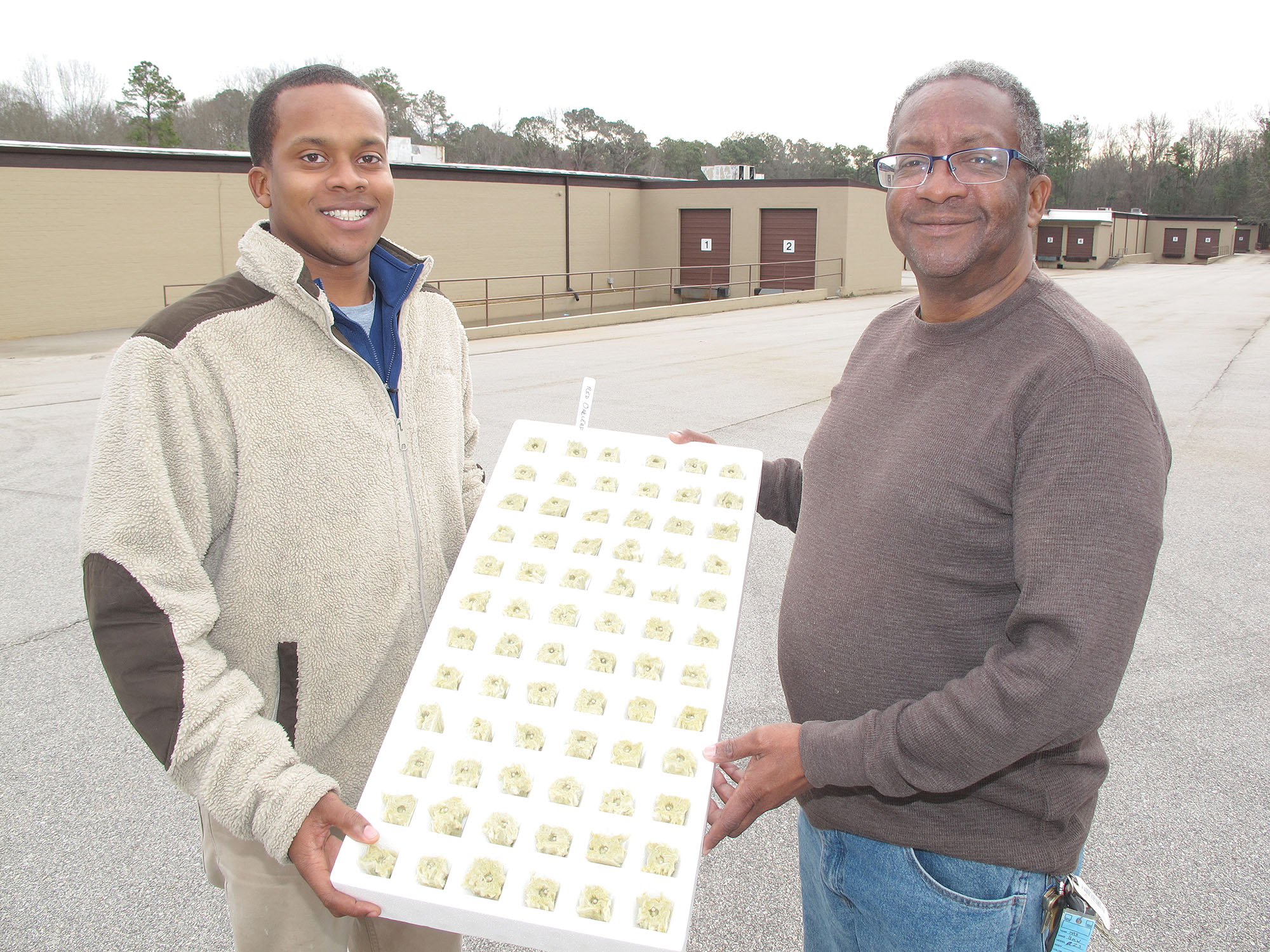
Chip Harriford, (right) manager of operations of Royal Greens, and his son, Scott, show off a freshly planted seed tray of lettuces in front of the 176,000-square-foot Charm building in Ridgeway where they will soon open to the public what will become the national headquarters of a wholesale/retail hydroponic growing operation.
RIDGEWAY –
A hydroponic growing business, Royal Greens, is setting up shop in downtown Ridgeway where it will soon headquarter a national wholesale company supplying greens and other organically grown vegetables to the likes of US Foods, Sysco and Whole Foods.
Director of Operations Chip Harriford, 52, said the hydroponic and, later, aquaponic components of the business will fill the inside of the 176,000-square-foot Charm building by next October. The grounds surrounding the building will be covered in raised-bed gardens, butterfly gardens, bee hives, chickens, and a 500-foot length of wall of the building will be covered in a vertical garden of seasonal flowering plants. Harriford said he also hopes to incorporate local artwork and yard art on the grounds among the plants.
While Royal Greens is mainly geared toward wholesale customers, it will also offer retail sales to the local public.
“Customers can purchase live lettuces, kale and other greens including 15 types of romaine and 20 types of basil,” Harriford said. “We’ve already planted 30,000 heads of lettuce and will offer over 60 varieties of lettuce when we open in March. The company will eventually offer beans, tomatoes, peppers, hens’ eggs and a variety of flowering plants.”
Harriford said an equally important offering is the economic development component of the business: jobs for people in the community – lots of jobs.
“We’re now hiring about 20 employees. We’ll hire 100 by the end of the year and 500 within five years,” Harriford said.
Plus, he said, the company is committed to providing a living wage with the lowest wage jobs starting at $12 an hour and going up to $18.
“We hope that people working here will also support businesses in Ridgeway and the surrounding communities. It’s a win-win,” he said.
Another plus for the community, Harriford said, is the business’ sustainability.
“We’re about as sustainable as we can be and that keeps prices low for customers. Nothing in the local offerings will cost more than $1 per pound, except for specially picked items that are $1.25 per pound. We incorporate numerous environmentally friendly features, like 300-gallon rooftop rain barrels to catch water for the business. And of course, as we add businesses across the country we plan to reclaim old, abandoned buildings, like this one,” he said, surveying the cavernous interior of the Charm building, “instead of building new ones.”
While Royal Greens will not be offering boat ride tours of the hydroponic facility like those at the popular ‘The Land’ hydroponic exhibit at Epcot in Disneyworld, it will offer walking tours through the facility for shoppers and tourists alike.
“It’s a great way for visitors to see people working in a hydroponic garden and to learn about the process. Our goal is to not be just a commercial facility but also an educational resource for the community,” Harriford said.
Harriford, a Columbia businessman, and his son, Scott, have been creating the Royal Greens company over the last few years, and while it’s a family business at heart, they are also poised to become a major commercial player.
It all started, Harriford said, when Scott, now 21, began studying hydroponics in 2010, as part of a high school research project, and quickly realized it as an excellent business idea. To get a feel for the different aspects of a produce supply business, he spent time working at a variety of places, such as Rosewood Market and City Roots, a 3-acre family run urban farm in Columbia.
At the time, Chip Harriford was the Chief Operating Officer of NDR Energy Group, a Charlotte-based company, and had previously worked as a business consultant for companies that worked with renewable energy.
“I knew absolutely nothing about hydroponics,” Harriford said. “But Scott convinced me, and he and I developed a business plan.”
They tried a few different avenues before attending an EngenuitySC business meeting in Columbia, a monthly gathering of entrepreneurs and tech people.
“That’s where I met Dr. Simon Hudson, a professor of Hotel, Restaurant and Tourism Management at USC,” Harriford said, “and he’s been a wonderful mentor to us.”
Through their connection with Dr. Hudson, they were able to work with graduate and undergraduate classroom teams in USC’s Colleges of Business and Information Technology, which helped the Harrifords organize an overall business model, an agri-tourism component and a social media strategy.
“The students worked with us, produced an end product, and got a grade for it. We were able to put a lot of other people’s brain power together,” said Harriford, who has a bachelor’s degree in Economics and an MBA from USC. Scott will graduate in December from USC’s College of Hospitality, Retail and Sport Management.
Harriford then secured funding from a venture capital group in Florida where he worked with investors Garry Merritt and Steve Nelson. Those and other investors, including a tribe of Delaware Native Americans in Oklahoma, initially settled on a building in the Poconos, but Harriford wasn’t thrilled with the cold, rainy weather they encountered during the inspection. He asked if he could try finding a better place for the company, and the investors agreed, as long as he could secure a suitable location within two weeks.
So Harriford opened his rolodex, and the first call he made was to Fairfield County realtor George McCutcheon, with whom he’d worked years before. McCutcheon connected Harriford with the Charm building in Ridgeway, which had been abandoned for 20 years but was in good condition.
“I was already familiar with the area so I went to the Ridgeway Town Council and they worked very rapidly to help us,” Harriford said. “Within 10 days, they convinced our investors that Fairfield County and Ridgeway were worth the gamble. So a decision was made, checks were written, and 30,000 heads of lettuce have already been planted! We had to get started quickly to meet our supplier deadlines.”
Harriford said he will be working through economic development issues with Fairfield County and the Fairfield Chamber of Commerce over the next few months.
Royal Greens is currently leasing the Charm building and hopes to make it a permanent home. It will soon function as the headquarters and training center for an expected 20 additional facilities – each over 100,000 square feet – that will be developed over the next five years, beginning with locations in New Jersey, Pennsylvania, Oklahoma and Florida.
“We use the same business strategy that Amazon does, which is to place facilities near our customers and significantly reduce transportation costs,” he said. “Our produce is delivered within 8 hours of harvest, and stays within a 200-mile radius. We do sell to restaurants and small stores, but our primary focus is the big boys – national wholesalers and regional distributors who can buy by the truckload. We’re close, we’re flexible, we can grow exactly what they want, we can promise delivery and they can come see us at any time – plus, we know that we have the best prices!”
Harriford said that a big part of building a successful business is creating a place that enhances the community and brings people together.
“We’ve got good people around us, and we’re in a good place,” Harriford said. “The building and the community of Ridgeway are great. We’re very happy here.”
Royal Greens is hosting a Grand Opening for the public on March 19 at its location in the Charm building at 200 E. Church St. Harriford promises a wonderland of organically grown lettuce greens – over 60 varieties – and a day of fun for the community. For more information email sarah@royalgreens.biz.
WINNSBORO – A Winnsboro man was arrested last week after Narcotics investigators with the Fairfield County Sheriff’s Office discovered a methamphetamine (meth) lab inside his Hudson Street home.
Mark Allen Walker, 49, of 802 Hudson St., was arrested Jan. 23 and charged with manufacturing methamphetamine, disposal of methamphetamine waste, violation of the Hazardous Waste Management Act and violation of the Pollution Control Act. At press time Walker was being held at the Fairfield County Detention Center, with his bond set at $33,000.
The Sheriff’s Office said they were tipped off on the investigation by a member of the community. In addition to the makings of a meth lab found inside the home, investigators also found a collection of items and ingredients that are only used together in the production of methamphetamine.
Outside the home, investigators located several areas in the back yard where waste products from meth production had been burned and buried, prompting the two environmental charges against Walker.
“We take these meth lab investigations very seriously,” Sheriff Will Montgomery said. “Even small-scale meth labs such as this one pose a serious threat to our environment.”
Former Fairfield County Sheriff’s deputy Buddy Wilkes Jr. has put his experiences in law enforcement in writing.
CHAPIN – In October of 1981, Earl Douglas “Buddy” Wilkes Jr. was a newly minted Fairfield County Sheriff’s deputy. Just hours into his first day on the job, he realized that “for better or worse, people take notice of you when you’re wearing a lawman’s uniform.” His adventures and experiences during the next seven years as an officer of the law in Fairfield County could fill a book.
And now they have.
Wilkes’ recently published memoir, “The Way I Remember It – the Sheriff’s Office,” is a charmingly funny read.
The collection of anecdotes spans his years as a deputy, sergeant and captain in Fairfield County during the 1980s. The fast-paced, mainly humorous vignettes run the gamut, from a “haunted” Halloween jailhouse, to deer hunting misadventures, runaway prisoners and a stolen cash register recovered at the end of a trail of change. Every page contains a memorable character, including, he writes, “a likeable Yankee, one of the rare breed that didn’t know it all.”
While most of the book recounts Wilkes’ own experiences, several gems feature the adventures of co-workers, like the story about an officer dealing with a man driving very much under the influence of something other than alcohol. The Fairfield County patrolman noticed the fellow’s 280-Z sports car just off the shoulder of the newly finished I-77. As Wilkes tells it, the car was “stuck up to the axles in mud. [The officer] walked up to the driver’s window and saw that the guy was just driving and driving, motor running, wheels turning, but going nowhere in the deep, slick Fairfield County red clay.”
He tapped on the window to get the driver’s attention.
“The guy looked at the patrolman and panicked. He geared down and floored it, getting the Z car up to what he thought was warp speed. He looked out the window again, and when he saw the Patrolman still standing there, he totally freaked, put on the brakes, and surrendered.”
Wilkes, a Fairfield County native, graduated from Richard Winn Academy in 1977 and went on to earn a degree in English from the Citadel. He retired as a Fairfield County deputy in 1987 and hired on with the South Carolina Law Enforcement Division (SLED) in 1990. After 30 years in law enforcement, he now lives in Chapin with his wife, Tracey. He retired from SLED last year as a captain.
In his book, Wilkes paints a nostalgic description of rural Fairfield County, and the stories brim with ‘oh-wow’ glimpses of a long-ago world. The ‘80s was a time in Fairfield County when “common sense and a sense of humor were the most important attributes a lawman could have,” Wilkes writes. “Virtually every call we answered involved someone we knew or were kin to.”
“Fairfield County is in my DNA,” he said in a phone interview with The Voice.
But before Wilkes rolls out great stories of practical jokes, dispatch calls and courtroom comedy, he takes the reader all the way back to the beginning, to his first day on the job, recalling his trip to the “old school” haberdashery and uniform shop in Columbia to be fitted for his uniform. It was a “creaky old place [that] smelled just like it should, of woolen suits, leather and floor wax.” Then he headed out on his first call – a rookie deputy with an eye for the interesting and a penchant for memorable details of entertaining antics.
Already at work on his next book, Wilkes has tentatively titled it, “Driving Strom Thurmond.” It’s about his years at SLED and his experiences driving Sen. Strom Thurmond around South Carolina during Thurmond’s last Senate campaign in 1996.
“Many people don’t know that Thurmond actually created SLED in 1947 when he was governor,” Wilkes said.
“It was like driving Elvis Presley around,” Wilkes said with a laugh. “Everywhere we went, people knew him, and he knew them. We’d arrive in some tiny little town and he’d get out of the car and start calling people by name. It was quite an experience.”
Wilkes said it was a fascinating period of time and admitted, “I’m getting addicted to the research!”
He said he hopes to finish his new book by summertime. In the meantime, look for “The Way I Remember It…” on Amazon as an e-book or in paperback.
Valentina’s (a.k.a. Blythewood House of Pizza) got on board early. This time next year, all Blythewood businesses may have to conform.
Town Planner Warns of ‘Fudge Creep’
BLYTHEWOOD – The controversy over the January 2016 deadline for compliance with the Town’s sign ordinance continued to percolate during a 5-hour Town Council work session on Jan. 14, but at last appears to be nearing an end.
During the session, three of the five Council members were leaning heavily toward maintaining the current sign ordinance, adopted in 2009. At the Blythewood Architectural Review (BAR) board meeting Tuesday evening, where a recommendation on proposed changes to the current sign ordinance was on the agenda as an action item, Town Administrator Gary Parker conceded to BAR members that wording was being drafted for the Jan. 26 Town Council agenda to leave the current ordinance intact.
Last week’s work session opened with a suggestion that had been backed in previous discussions by Mayor J. Michael Ross – that a 10 percent variance be allowed on sign dimensions for all current signs. In presenting the item for discussion, Parker referred to the proposed variance as a ‘fudge factor.’
Councilman Bob Massa, however, opposed fudging, saying some fudging leads to more fudging.
“Leave it (the current sign ordinance) out there and deal with it on an individual basis,” Massa said. “If it (the sign) is 4 inches over, that’s fine, but if you build in a 10 percent fudge factor, that’s an additional three feet on a sign that’s only supposed to be 32 square feet. That’s a pretty big variance.”
Massa gave the example of an unwritten understanding by the public that the police won’t pull a driver over for going just 5 miles over the speed limit.
“We, as a society, have stretched that to 15 miles over the limit. We do what we can get away with. So if there’s a 10 percent fudge factor, we know it’s out there and we fudge to 15 percent. That’s only 5 percent more,” he said with a shrug. “I could bring you a design for a 32-square-foot sign and you approve it, but I could tell my contractor to stretch it out that extra 3 feet because I’ve got a 10 percent variance.”
Town Planner Michael Criss agreed saying, “There is the potential for fudge creep.”
Massa said the Town was just trying to maintain uniformity.
“We’re not telling businesses what materials or designs to use. There’s enough discretion (with the zoning administrator) to provide variance relief,” Massa said. “The language in the ordinance is there because we thought that was a fair standard to build to. If (business owners) can’t build to that standard for some reason, then they can come in and talk about it and we can make a decision. The ordinance is what it is. It’s the target.”
Current Ordinance Allows Variances
Parker agreed, explaining that the ordinance, as it is written now, actually allows for some discretion on the part of the zoning administrator regarding signage size. He said, for example, that wall signs have a size limitation but a provision allows the zoning administrator to decide whether a larger wall sign might be more appropriate for a larger area.
“Then,” Parker said, “the administrator has the latitude to overrule the dimension requirements.”
Criss said there was additional discretion. “If the sign is 6 inches to the nearest foot, it might give the administrator 6 inches to play with – round up, round down,” Criss said.
Ross, who has favored making changes to the 2009 sign ordinance, said more than 60 percent of the businesses could have to put up new signs to comply with the ordinance.
Parker pointed out, however, that while about “Sixty percent of the current signs might be out of compliance, most of them only marginally exceed the current requirements and fall within the discretion I have to say, ‘You’re okay’.”
Ross said he felt businesses needed “to know they are going to have to replace that sign. There will be a cost. It’s in black and white. It’s got to be 4-feet-by-8-feet now. It will look good, but I believe there will be a backlash from the businesses,” Ross added.
In the end Ross conceded that the ordinance was passed five years ago and that it will result in making the town look better.
“Maybe we could offer a seminar that would show businesses how to offset their costs,” Ross said. “We could bring in an expert to tell them how to write this off.” He continued, however, that a 10 percent variance would be a good idea.
No Outcry of Opposition
Parker said he didn’t think there would be an outcry of opposition to enforcing the ordinance. Parker said letters went out to all business owners last week explaining the need for compliance by next January, and that only six business owners/managers had called, mostly the larger businesses with high-rise signs. And those, he said, were not complaining but just asking questions.
During the BAR meeting on Tuesday evening, the board verbally agreed not to vote on the issue, even though it was listed as an action item on the agenda, saying they felt the current sign ordinance came about because of the community’s desire for the town to have a nice appearance.
McLean Calls for Minimum Standards
But BAR member Jim McLean did suggest the sign ordinance be amended to address minimum standards for signs.
“Signage does set the tone for the town,” McLean said, referring to the lack of rules and regulations for the upkeep and maintenance of signs in the town.
BAR member Curtis Brown pointed out that the current ordinance (155.442 sec. E) does address maintenance of signs, but that there are no teeth in the ordinance to make business owners maintain their signs in good appearance.
In other business, the BAR re-elected Michael Langston chairman and elected Curtis Brown vice-chairman. They also decided, without voting, though it was on the agenda as an action item, to ask McLean to create wording to propose that the Blythewood Historical Society be designated as an advisor for the recommendation of historical structures within the town.