WINNSBORO – Members of the Fairfield Memorial Hospital Board of Directors confirmed last week the selection of Suzanne Doscher, 54, as their next Chief Executive Officer. Doscher replaces Mike Williams on Sept. 1. Williams, who has served as CEO for the last seven and a half years, announced his retirement late last May.
Board member Boyd Brown, who served on the search committee, said Doscher was selected from a list of four finalists culled from nine initial candidates.
“I think we made a great hire,” Brown said. “She’s an experienced administrator from Georgetown Hospital who understands administration, who understands policies and who has a relationship with healthcare professionals across the state. She came to us highly recommended by the S.C. Hospital Association.”
Doscher has served the Georgetown Hospital System since 2001, rising from Assistant Administrator to Vice President of Operations. During her tenure there, she has been responsible for $330 million in revenue and 175 full-time employees. She also established a Research Affiliation Agreement between the hospital and the Medical University of S.C. (MUSC).
Doscher was selected over three other finalists, each of whom had current or former ties to Fairfield Memorial Hospital (FMH). Those three were: Dr. Shane Mull, head of the Emergency Room at FMH; Karen Reynolds, Health Information Manager at FMH; and Brent Lammers, CEO at Alleghany Memorial Hospital in Sparta, N.C. since January 2014, but a former administrator at FMH in the 1990s.
Brown said Doscher’s lack of Fairfield ties made her an attractive candidate.
“She comes into her role without any connections to Fairfield County, which I think is good,” Brown said. “It’s a new set of eyeballs. She knows nothing about county politics or any of the local cliques. She is going to be strictly healthcare oriented.”
Born in Virginia but raised in Missouri, Doscher came to S.C. after graduating high school in 1979 to attend the College of Charleston and has remained in the state ever since. She earned her BA in chemistry from the C of C in 1983 and a BS in medical technology from MUSC in Charleston in 1985. In 1996, she earned her Master’s in healthcare administration, also from MUSC.
Doscher began her work in the healthcare field as a Medical Technologist at Charleston Memorial Hospital in 1985 and over the ensuing 10 years worked her way up the ladder at an assortment of Charleston area hospitals. In 1996, she took the position of Administrative Resident at Newberry County Memorial Hospital, eventually rising to Vice President for Support Services in 1999.
Doscher said she was attracted to the position by Fairfield Memorial’s size and the surrounding small-town atmosphere.
“I’m a ‘small-hospital girl’,” Doscher said. “I was at Newberry County for five years and I like the smaller hospitals. I like the small towns where you know everybody and everybody knows you.”
Doscher will take the reins of a hospital that has struggled financially in recent years, obtaining emergency loans from the County just to meet payroll and falling behind on its contributions to the state Retirement System. Over the last year and a half, FMH has been in partnership negotiations with a Richland County hospital, a process Doscher said she thinks she can move forward.
Doscher will receive a salary of $130,000.
Phone calls to John McGraw, Chairman of the Board of Directors, were not returned at press time.
And then there were none – Council holds forth in an empty chamber Monday after the Chairwoman cleared the room.
WINNSBORO – A plea Monday night from students, teachers and administrators from the Midlands STEM Institute Charter School (MSICS) for funding assistance from County Council met with a cool reception from the Council Chairwoman who eventually cleared the chamber after her third warning to refrain from applause was violated.
Chairwoman Carolyn Robinson (District 2) gaveled the standing room only audience twice after appeals for funding by a pair of elementary aged children elicited enthusiastic applause and warned that a third such outburst would result in the clearing of the chambers. Robinson then asked a small contingent of the STEM supporters to leave the meeting before proceeding with the second public comment segment of the night.
“I think Mrs. Brown (Clerk to Council, Shryll) advised you that you could not discuss funding with us tonight,” Robinson said after asking the supporters to exit.
Council’s bylaws contain no prohibition against requesting funding during the second public comment portion of the meeting, stating only that “Input will be for items not currently on Council’s agenda or under Council’s consideration. The subject matter shall be related to and limited to items, issues and topics regarding Fairfield County.”
“Council does not have anything to do except collect the taxes on your tax notices for schools,” Robinson continued. “This is a subject that has to be dealt with with your Fairfield County delegation, which is Sen. (Creighton) Coleman and Mrs. (MaryGail) Douglas, as well as your school board. County Council has zero to do with funding for schools. If you had been attending our budget work sessions you would have seen there’s not one thing in our County budget that associates and deals with Fairfield County schools.”
Asserting a point of order, Councilman Billy Smith (District 7) asked Robinson to hold her comments until County Council time, as she had similarly requested of Councilman Kamau Marcharia earlier in the meeting. Nevertheless, Robinson forged ahead, telling Smith she was “taking personal privilege.”
In Roberts Rules of Order, under which Council operates, a “point of privilege” allows a council member to interrupt a speaker to complain about room temperature, lighting, noise, etc. It does not, however, provide a member a platform from which to engage in open debate or dispense their opinion on a subject.
“You need to also check and see the lawsuit that’s out there and has been out there a long time with Chester County,” Robinson continued, addressing the remaining STEM crowd. “They’re doing the same thing of trying to get the funds to go to Chester County for the students in Chester to go there that you’re doing right now with this school.”
Robinson’s uncertain reference to the four-year-long Mitford Case left many in the audience scratching their heads. The lawsuit, filed by Fairfield County Schools in July of 2010, was an effort to block legislation that required Fairfield to pay Chester County Schools 103 percent of Chester’s prior year per-pupil cost for each of the approximately 200 Mitford student enrolled in Chester schools. The case reached its end a little over a year ago when the S.C. Supreme Court ruled 3-2 in favor of the legislation and of Chester County Schools.
State education per pupil dollars – a little more than $5,700 – follow students to whatever public school they attend, including Chester County and including the STEM Charter School. What the 2010 legislation achieved was to send an additional $10,000 or so in local funds along with it – funds that do not currently follow students to charter schools.
When public comment continued, Marie Milam, Executive Director of MSICS, told Council that the school had been squeaking by on the $5,709 in state per pupil money, yet accomplishing great things. Barred from asking directly for financial assistance, Milam asked Council for moral support.
“We are a struggling school, in terms of finances,” Milam said. “All new schools go through that. We are asking for your support in terms of your voice, in terms of your opinions, in terms of your judgment.”
Closing the public comment segment, Douglas (D-41) told Council she was disappointed in how the applause for the children was gaveled away.
“I am embarrassed,” Douglas said. “I’m embarrassed at what these children witnessed here tonight. They don’t know that it is the School District that controls that money. I have sat here on many occasions and have seen children come to this place and we have applauded them, we have encouraged them. And for us to let them leave tonight without that encouragement for having come, I am disappointed in that.”
But it was Smith’s chiding of Robinson during County Council Time that elicited the applause that broke the camel’s back.
“I’m embarrassed by what happened here tonight,” Smith said. “We shouldn’t conduct ourselves up here that way. If we’re not going to allow clapping, Madame Chair, we don’t need to allow it any time. We had clapping earlier in this chamber and nothing was said because it was something that we were all amenable to and we all appreciated it. Some folks may not appreciate what those folks from STEM came in here and said, but I certainly did and I don’t see a problem with applause if we’re going to allow it at another time.”
The ovation for Smith was short lived. Robinson dropped the gavel and called for the room to be cleared. Only Council, members of the administrative staff and the media remained.
With the room now virtually empty, Smith was allowed to continue his comments.
“You already got most of them I was talking to out of here,” Smith said to Robinson. “We ought to be fair about things. If we’re going to allow something, then allow it. If not, then don’t. Either way I’m fine. But let’s just set a decision and then go from there.”
Robinson said applause was reserved for presentations. The public comment segments of the meetings, in which each speaker is limited to 3 minutes, are for receiving information and for discussion items.
“Asking for funding during that 3 minutes is not a presentation,” Robinson said. “For them to have properly done this tonight, they should have come to the Presentation Committee and asked for a time to come and make that presentation to us.”
Councilman Dan Ruff (District 1), however, said the matter could have been handled with a softer touch.
“I understand that applause rule,” Ruff said, “but I think there are some times when we can allow a little latitude, especially when there’s children involved, and maybe a little bit more diplomatic way of handling it when they do applaud.”
When Robinson asked Ruff for specific suggestions on how the matter could have been handled, Ruff said it could have been done in “a little kinder way.”
“Say, ‘I appreciate ya’ll’s interest in this, but we have an applause rule that we can’t allow it’,” Ruff offered. “I think it’s just a better way of handling it so we don’t disrupt everything like happened here tonight. I’m not condemning you; I just think there’s a better way—”
“I already asked them three times,” Robinson interrupted.
“I guess it was the way you asked,” Ruff said.
“I’m sorry?” Robinson asked.
“That’s just my opinion,” Ruff said. “I’m just making a suggestion.”
When Councilman Walter Larry Stewart (District 3) also suggested Robinson could have handled it better, Robinson for the second time in her tenure as Chairwoman referred to her own rashness.
“Sitting in this position, you have to make snap decisions and you can’t always think how ya’ll want us to think,” she said. “The adults sitting there should have been able to tell those children to behave and not participate.”
Robinson also called her decision last June to change her vote and support cuts to County allocations to social programs a “snap decision” (see the June 12 edition of The Voice).
Robinson did receive some support, however, from Marcharia (District 4) and Mary Lynn Kinley (District 6).
“This is a business meeting,” Kinley said, “and my thought is why did they not come at budget time? I think the budget time is for those kinds of requests. In a business meeting you have to have your rules and you have to abide by them or you’re going to have chaos.”
“You gave them ample warning not to do that,” Marcharia agreed, “but maybe we definitely need to make it clear – we’ve always had that rule about clapping.”
Still, Marcharia said, Council was not likely to be viewed in a positive light after Monday night.
“You go on their Web site tonight and we’re going to look like animals,” he said.
Once a dangerous place to be, good times now abound in Seneca’s Ram Cat Alley. (Photo/Robert Clark)
Drive 133 miles northwest, about 2.5 hours, to Seneca, and turn back the hands of time. “Seneca” comes from an Indian village that stood nearby. Aged rocks and timeless waterfalls create a region where the past never dies. Not only is the northwest corner old geologically, it’s historical, and you can visit old places preserved much as they were. One exception is an alley that turned into a popular attraction.
To see this one-time unsavory alley reinvented as a cool pedestrian-friendly spot, go to Seneca’s Ram Cat Alley. The lyrics of that Led Zeppelin tune sum up its history: “Good times, bad times, you know I had my share.” If you could go back to the early 1900s, you’d find the bad times of pool halls, bars and cat-luring fish and meat markets. So many hungry cats congregated in the alley that some wag said, “You couldn’t ram another cat into the alley.” Ram Cat Alley, thus, had its colorful name. In time, the alley fell into neglect.
In the mid-1990s, good times arrived. Revitalization turned this one-time alleyway of pool halls, bars and meat markets into a walk-about place of boutique shops and restaurants. It’s lively. On Thursdays, restaurants and the city set up tables for “Jazz On the Alley.” From disrepute to being on the National Register of Historic Places and jazzy: that’s how far Ram Cat Alley has come.
Seneca and Oconee County offer day travelers many ways to visit the past. Stumphouse Tunnel revives frustrated dreams of train commerce to the West, and Isaqueena Falls reveals shimmering veils of water that have long blessed the area with beauty. Not far away, Oconee Station and its beautiful fieldstone building served as protection against the Cherokee, a trading post and a storage place for furs.
Step back in time at Keil Farm and see an antebellum farmhouse that changed from the mid-19th to early 20th century. By 1905, the circa 1850 farmhouse had evolved from a two-room house, kitchen and loft building to a seven-room house. Today, the farm consists of a one-and-one-half story frame farmhouse and rustic outbuildings that completed farm life: a barn, corncrib, chicken house, smoke house, tenant house and outhouse.
Add the Newry Historic District to your itinerary. See what a textile mill village looked like. Most of the buildings in Newry arose from 1893 to 1910 and illustrate a turn-of-the century mill village in South Carolina.
Plan a trip to Seneca and Oconee County in general where the National Register of Historic Places works overtime. Soon the mountains and valleys will green up as spring brings its warmer days. It’s as good a time as any to visit the past. And at revitalized Ram Cat Alley you’ll be hard pressed to conjure up images of frantic felines looking for a meal. After a day of sightseeing, you’ll be the one with dinner on your mind.
If You Go …
For information on Seneca:
www.oconeecountry.com/seneca.html
For other historic sites: www.nationalregister.sc.gov/oconee/S10817737014/index.htm
Learn more about Tom Poland, a Southern writer, and his work at www.tompoland.net. Email day-trip ideas to him at tompol@earthlink.net.
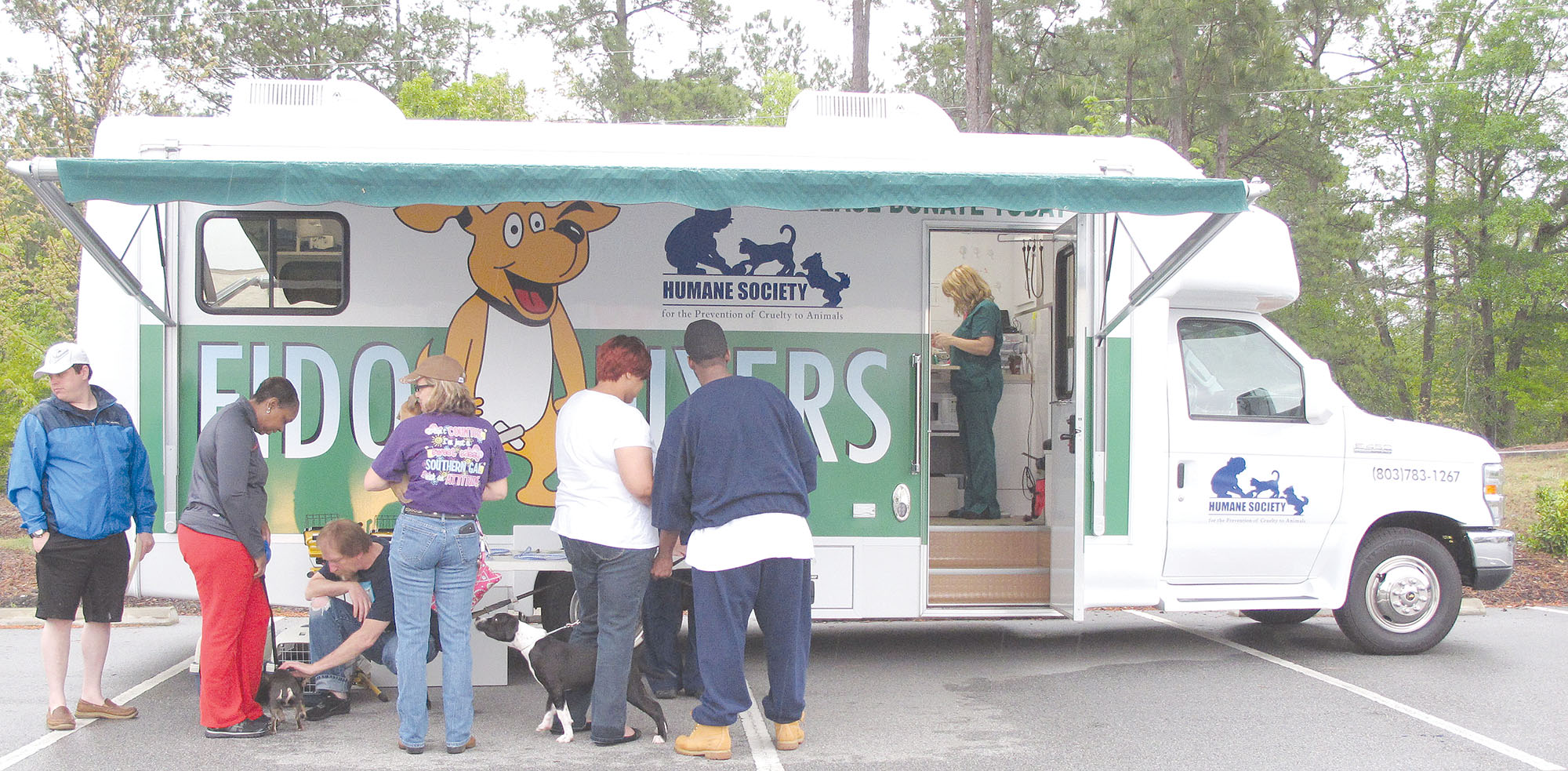
The Fido Fixer mobile clinic, sponsored by the Columbia Humane Society, will dock in Winnsboro July 30 where it will perform, by appointment, low-cost spay/neuter surgeries for dogs and cats. Other offerings will include vaccinations, microchips and heartworm tests.
WINNSBORO – If your dog or cat has not been spayed/neutered, July 30 is your lucky day. The Fido Fixer mobile clinic is coming to the Fairfield Square Shopping Center, 27 Highway 321 Bypass, in Winnsboro on that date offering on-the-spot, low-cost spay/neutering as well as the following vaccines: rabies ($9), distemper ($9) and bordatella ($15). Microchips and heartworm tests are each $20. Proof of rabies and distemper vaccines are required for all dogs and cats undergoing spay/neutering and can be administered at the time of the surgery. Dogs must weigh between 5 and 40 pounds. Cats must weigh at least 3 pounds. Dogs and cats must be between 3 months and 4 years of age.
Sponsored by the Humane Society in Columbia, the Fido Fixer is a not-for-profit corporation that provides a well-appointed mobile clinic staffed by veterinarians and technicians.
The Fixer will be at the shopping center (where the CVS is located, across from the hospital) at 7 a.m. and owners must have their pets there between 7:30 and 8 a.m. Pets must have appointments for services offered by the Fixer. To schedule your pet, call 803-783-1267. More information can be found at www.humanesc.org. Dogs must be on leashes and cats must be in travel crates.
NASHVILLE, TENN. – More than a year after she was originally charged, former Blythewood Town Councilwoman Kathleen (Katie) Devereaux Cauthen is still waiting for her day in court for her alleged part in a $28 million health care fraud.
Cauthen has been charged with two felony counts in a U.S. District Court in Nashville, Tenn. The charges include conspiracy to commit “theft or embezzlement in connection with health care” and misprision, the failure to report the commission of a felony to judicial authorities. Cauthen, who was a member of the South Carolina Bar until her license to practice law in South Carolina was suspended last year, faces a maximum sentence of eight years in prison and $500,000 in fines if convicted of the two charges.
Cauthen’s case has been delayed on multiple occasions as she has been helping the U.S. Attorney’s Office make a case against her co-conspirators. However, documents filed in her case, and that of others charged in the scheme, state she could plead guilty soon.
“The Defendant (Cauthen) has been and continues to cooperate with the Government in its investigation of other individuals,” Cynthia C. Chappell, Cauthen’s appointed attorney stated in court documents. “The trial of related defendants was continued some time ago and has not been rescheduled. Based on the foregoing, the parties submit that the ends of justice would be best served by continuing Ms. Cauthen’s plea hearing and, therefore request that the Court continue this matter to a convenient date for the Court in or around August 2015.”
Four of Cauthen’s alleged co-conspirators – William Worthy of Isle of Palms; Bart and Angela Posey of Springfield, Tenn. and Richard H. Bachman of Austin, Texas – were indicted by a federal grand jury in Nashville in June 2013. That case was scheduled for trial in U. S. District Court in Nashville in January 2015, but has been moved up and now is unlikely to see a jury until August 2016. Some of those charged in this case are also cooperating with the U.S. Attorney’s Office and so are likely to accept a guilty plea and not go to trial. According to U.S. Department of Justice statistics, more than 95 percent of federal criminal defendants plead guilty to charges.
Filed June 16, 2014, the former Councilwoman is alleged to have aided others in a scheme purported to provide health care benefit coverage to more than 17,000 individuals and multiple employer groups in various states. It claims that although holding themselves out as providing health care coverage, the defendant and her co-conspirators did not comply with either state or federal regulatory requirements. Cauthen and her co-conspirators are alleged to have collected more than $28 million in insurance premium payments.
Some of those premiums went into an account opened by Cauthen at First Citizens Bank in Blythewood in the name of Nationwide Administrators for which Cauthen listed herself as president and used her home address for the company’s physical address according to the federal charges. This action is the basis of the misprison charge.
“The funds deposited into the account at First Citizens Bank were intended to represent payments to a non-existent underwriter, but were instead primarily converted to the personal use of defendant Kathleen Devereaux Cauthen and co-conspirator William M. Worthy II,” according to the information.
On July 10, 2014 Cauthen waived her right to be indicted on the charges, and instead she was charged in a federal criminal information – a formal criminal charge made by a prosecutor without obtaining a grand jury indictment. In the document, Cauthen consented to prosecution by information, a path normally taken by individuals who implicate themselves and cooperate with the U.S. Attorney’s Office. This cooperation, if it is substantial, provides original information to the prosecution and if honest, can lead to a federal court reducing the offense level of the crime and so reducing the sentence.
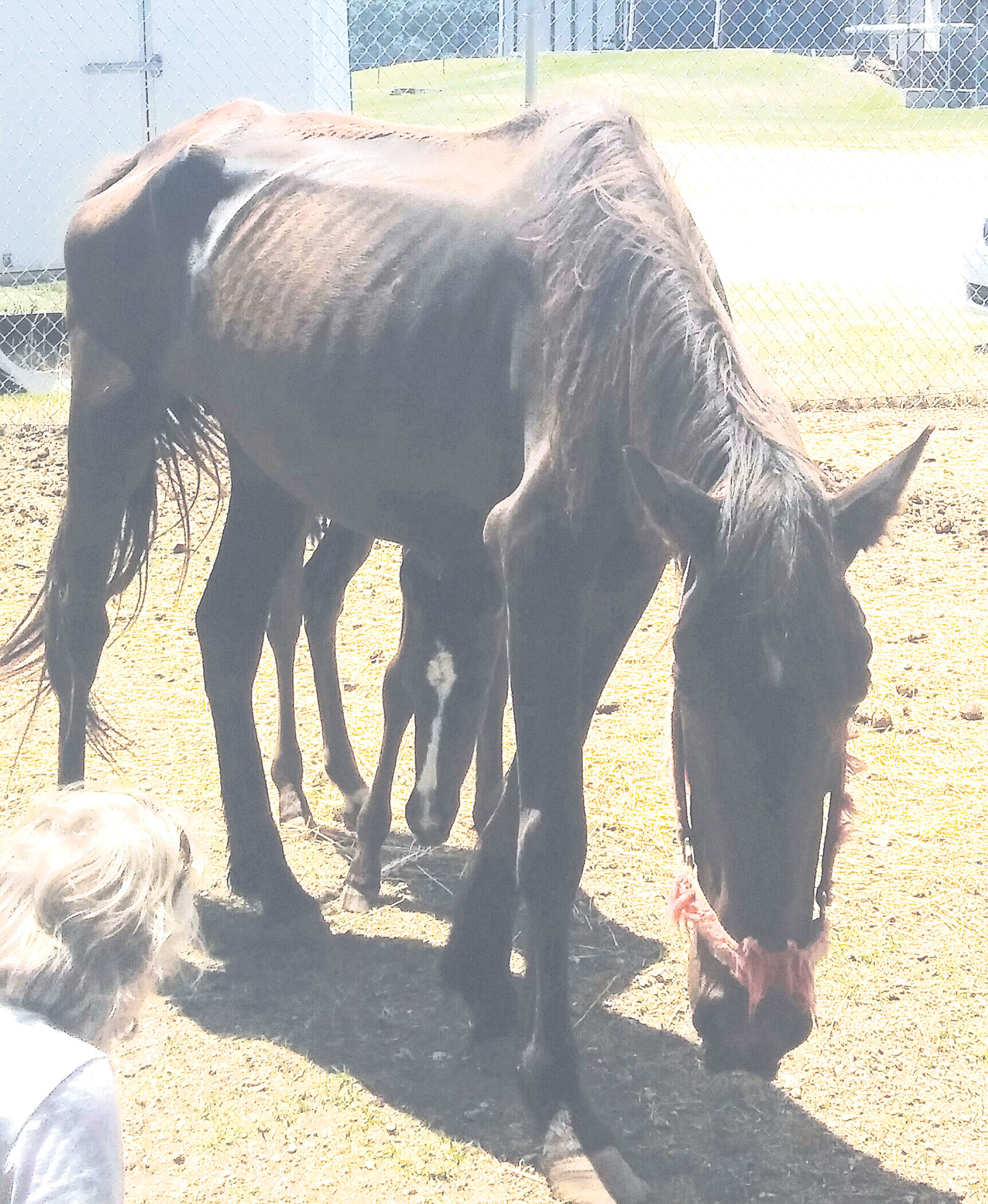
An emaciated mare and her ailing foal, just minutes after their arrival at a Greenwood rescue farm. Both had spent almost four weeks in the care of Fairfield County Animal Services. Two days later, the mare was dead.
WINNSBORO – The death of a 7-year-old mare and a second round of surgery on her 4-month-old colt just days after they had been shipped to a rescue farm in Greenwood after spending nearly a month in the custody of the Fairfield County Animal Shelter has raised some serious questions about how the County cared for the animals.
The mare was emaciated and weak when she and her colt left the shelter for Big Oaks Rescue Farm in Greenwood, where the mare went down the day she arrived and died two days later. The founder of Big Oaks, Joe Mann, said the mare was suffering from starvation and the worst case of worms he’d ever seen. The colt, he said, was suffering from a surgery performed by a small-animal vet at the Fairfield Animal Shelter that left the colt in pain and unable to walk properly.
While David Brown, the County’s Animal Control Officer in charge of the shelter, told The Voice that the mare was in much worse condition when she was brought to the shelter four weeks earlier, he has not presented any documentation or photos of her condition upon arrival, has not identified or brought charges against the owner, has not explained to The Voice why the horses were kept in inadequate conditions at the shelter for such a long period of time and why an equine veterinarian was never called to check on them.
The mare and her colt were both taken from a pasture in Blair on May 19, according to Brown, who said Animal Control received a call that day from the daughter of the owner of the horses saying the colt had sustained serious injuries after becoming entangled in barbed wire. The owner, Brown said, was out of town at the time of the incident.
Instead of contacting an equine veterinarian, Brown said he contacted the shelter’s regular veterinarian, Dr. Robert Chappell, a small animal vet whose offices are in Richburg and Fort Mill. Brown said Dr. Chappell was met by a Fairfield County junior Animal Control Officer at the Blair farm. Chappell described the colt as not more than a week old when it was injured. But Minge Wiseman, a respected local horsewoman and vice president of the Hoof and Paw Benevolent Society, a group of volunteers who work with the County Shelter and Adoption Center to protect neglected animals, put the colt’s age at 4 months when she first saw him a month after the injury occurred.
After the colt had been freed from the barbed wire, Chappell transported him to the Fairfield shelter. Chappell said that because the colt was still nursing, he also brought the mare in. Both animals were housed in a small pen behind the Shelter where they were subsequently held for a month. Brown said the colt needed immediate surgery for his wounds, which Chappell performed, and the mare was badly undernourished. In spite of the condition of the mare and colt, Brown said no criminal charges are pending against the Blair owner.
“When they release (the animals) to us, we won’t normally prosecute anything,” Brown said.
But it is not clear why he did not bring charges since the owner did not actually release the mare and colt until they were discovered at the shelter by members of Hoof and Paw on June 13, almost four weeks after the horses were removed from the Blair farm.
Brown told The Voice that he had notified Hoof and Paw members about the mare and colt after the horses had been at the shelter for about a week. But members of Hoof and Paw said Brown only relayed to them at a June 1 luncheon that he was holding a mare and foal until their owner paid Dr. Chappell $1,800 for the surgery Dr. Chappell had performed on the foal. They said Brown did not inform them about the mare’s emaciated condition. Wiseman said it was not until several Hoof and Paw members were helping with a fundraiser at the Adoption Center on June 13 that they learned the mare and foal were still at the shelter and walked over to see them.
The mare was “pretty emaciated,” Wiseman said, and both animals were “in a very small holding pen . . . not designed to keep horses for any length of time.”
Wiseman said she asked Brown if he needed help with the horses, urged him to move the mare and colt to foster care immediately and offered to find a place for them. Wiseman posted a plea for foster care on Hoof and Paws’ Facebook page, and Mann responded. After two more days, Brown told Wiseman that he had gotten an official release from the owner and gave Wiseman and Hoof and Paw president Deborah Richelle permission to use the County’s horse trailer to transport the mare and colt to Big Oaks the next day, June 16.
Wiseman said when she arrived at the shelter, she noticed that the colt was “gimpy” in the hind end at the trot. She also reported that when loading, the mare buckled to her knees and went down trying to step into the trailer, which was about a foot off the ground. Wiseman said the mare didn’t seem strong enough to lift herself into the trailer and that the two women managed to get the mare back on her feet and into the trailer with her colt.
Shortly after arriving at Greenwood that afternoon, the mare went down again, according to Mann, and equine veterinarian Dr. Alexandra Tracy was called. While Dr. Tracy has not returned calls from The Voice, Meg Francoeur, a hoof trimmer from Aiken who volunteers at Big Oaks, wrote in an email to The Voice that she was with Dr. Tracy at Big Oaks until 6 p.m. on June 17 while Dr. Tracy continued to give fluids, steroids and pain meds to the mare. But the life-saving effort failed, and Mann said the mare succumbed and died early the next morning, June 18.
Francoeur also wrote that Dr. Tracy checked the mare’s colt and “found a large lump where he had been injured. She sedated the (colt) to check to see what it was, and ended up having to cut away adhesions on the colt so that he would be able to open his legs and walk normally.”
“Our vet had to re-do everything (Dr. Chappell) did,” Mann, who witnessed the second surgery, said. “He had (the wound) sewed to one of his hind legs. Every time (the colt) moved his leg, he was in agony. I’ve never seen anything done like that before. It was unbelievable.”
From his perspective, Dr. Chappell told The Voice that the colt had severely lacerated the inner portion of a hind leg near its stomach while struggling to free itself from the barbed wire. The cut was very deep, Chappell said, exposing the bone, and the wound was bleeding profusely.
Once the animals were moved to the shelter, Chappell said he sedated the foal and was ready to begin surgery outside on the ground. Rain then began to fall, he said, and the foal was moved back inside the horse trailer for the procedure.
Chappell, who is not an equine vet, said that prior to the surgery he had telephoned his uncle, Dr. John H. Chappell III, an equine vet in Rock Hill, to ask him to take the foal. His uncle did not have stall space available, Chappell said, but did advise him on how to proceed with the surgery.
“Most doctors probably would have put that foal down,” Chappell said. “He was bleeding so bad.”
Chappell said he had to trim some of the muscles, then mend the arteries.
“I moved some scrotal tissue to cover the wound,” Chappell said. “Horse skin doesn’t heal very well. There were blood vessels exposed and I couldn’t leave them open, so I covered them with some excess tissue from the scrotum.”
Within 45 minutes of coming to, the foal was up and nursing, Chappell said.
But Big Oak’s version of the surgery does not match the happy ending Dr. Chappell described.
Francoeur, who said she has more than 30 years’ experience working with horses as a trainer, a hoof trimmer and generally caring for them, said that, “In most cases, an injury (like the colt’s) would have had repair to the muscle but the external tissue would have been left open to heal from the inside out. (Horse) wounds generally heal cleaner if left to heal slower.”
Francoeur also noted that Dr. Chappell had used non-dissolving sutures to close the wound and that they were still in the wound when it was opened on June 17, nearly a month later.
After reading an account in another local newspaper in which Brown praised Dr. Chappell for his surgical efforts, Francoeur wrote, “Brown may have been impressed with the surgery, but the folks at Big Oaks were not. The amount of work that had to be done to undo all the damage was extensive, but I don’t really blame the other vet. He’s not experienced with horses, which was obvious in that he thought the (colt) was only days old.”
The second surgery was successful, Mann said, and the colt is now on its way to a full recovery. It has since been placed in foster care. The mare, however, was another story.
While Mann said the mare died of starvation and worms, Chappell said he de-wormed the mare a month before, and Brown said he and his staff had implemented a feeding schedule.
“The doctor (Chappell) said not to overfeed her,” Brown said, “because that could be fatal.”
Brown initially told The Voice that the mare was being fed “small amounts in three applications” a day, but he later revised that, and said hay was left in the pen, while the mare was given approximately 3 quarts of sweet feed four times a day. While Brown said the mare was eating well and putting on weight, a photograph of the mare taken the day it arrived at Big Oaks indicates a severely undernourished horse.
Dr. Chappell placed responsibility for the mare’s death at the feet of Big Oaks Rescue Farm.
“They overfed her the first night and she died, which was stupid” Chappell said. “We had her putting on weight. We de-wormed her. She was gaining weight. I don’t know if it was the stress of being moved or what. I think they overfed her.”
Mann, however, said it was actually Fairfield County’s Animal Control staff, and not Big Oaks, that was overfeeding – and not even with the correct feed.
“I’m not criticizing the people at the shelter,” Mann said. “Obviously, their vet didn’t have a clue about what he was doing, so he couldn’t advise them well. A horse in that state of starvation needs a small amount of fluid and a small amount of food over a period of time and you gradually increase it.”
Mann said he would have recommended 1 quart, five to six times a day, of “good mare-and-foal feed.” But, according to Brown, the mare was being fed twice as many quarts a day of sweet feed at the Fairfield County Animal Shelter.
“Sweet feed and hay won’t do them any good,” Mann said. “We would not have given her sweet feed. It has a lot of artificial fillers. You need good quality feed, a proper feeding schedule, a good living environment, water and some hay.”
But, Mann said, the mare was still riddled with parasites, which were consuming any nutrients that might have been supplied to her.
“For a starving horse, you have to stabilize the horse, then you have to kill the tapeworms, and a vet needs to be involved,” Mann said. “The mare was full of some of the largest tapeworms we had ever seen. I don’t know what he de-wormed her with.”
What is also unclear is why the County, with the resources and expertise of an organization like Hoof and Paw at its fingertips, never brought them into the picture and why Brown kept the horses at the shelter for a month without ever contacting an equine vet to check on them.
“We thought we did what we could do for her while she was here,” Brown said, “but I guess it wasn’t enough. I learned from that. I would do it differently next time. I would let Hoof and Paw know immediately.”
The Voice submitted a Freedom of Information Act request on June 26, seeking, among other things, records related to the animals. Although the County still had more than a week to respond to the request, Brown told The Voice on June 29 that he would be providing the newspaper with his notes from the case the next day. As The Voice went to press July 8, Brown had not done so.
Mann, meanwhile, said that had the horses been transferred into the care of Big Oaks sooner, both animals might still be alive.
“We got her just a little too late,” Mann said. “The (colt) is going to be fine, but it was almost like the mother hung in there until she realized her baby was going to be taken care of and then she gave up.”
At his last official meeting as a Town Councilman, Bob Massa (second from right) gives a farewell handshake to Mayor J. Michael Ross and says so-long to colleagues Eddie Baughman (left) and Bob Mangone.
BLYTHEWOOD – During his last meeting as a Blythewood Town Councilman, Bob Massa, who is relocating with his wife, Teresa, to Seneca this week, was wished well by his fellow Councilmen on Monday evening.
“These presentations are usually fun for me,” Mayor J. Michael Ross said as he presented Massa a plaque recognizing his service to the Town, “but this one is not fun.”
Ross then read the plaque, which thanked Massa for his leadership and dedication to the Town.
Massa became active in the Town’s politics in 2010, writing columns for The Voice both criticizing what he felt were government missteps and making suggestions for improved government. He later served as Chairman on both the Planning Commission and the Board of Zoning Appeals. In 2014 Massa was elected to serve on Town Council and was tapped by his fellow Councilmen as Mayor pro tempore.
While Massa was popular with the public, his government service was not without drama. While serving as Chairman of the Planning Commission, fellow commissioners Mike Switzer and Neal McLean, in a much publicized political move, tried unsuccessfully to unseat Massa as Chairman calling for a vote for his removal. However, Massa received a resounding vote of confidence from his fellow commissioners and continued in the position. He was easily elected to Council the next election cycle.
As a former Finance Director of the City of Forest Acres, Massa, a CPA, brought both financial expertise and municipal government experience to the table.
“His expertise is going to be sorely missed,” Councilman Eddie Baughman told The Voice. “He served us well.”
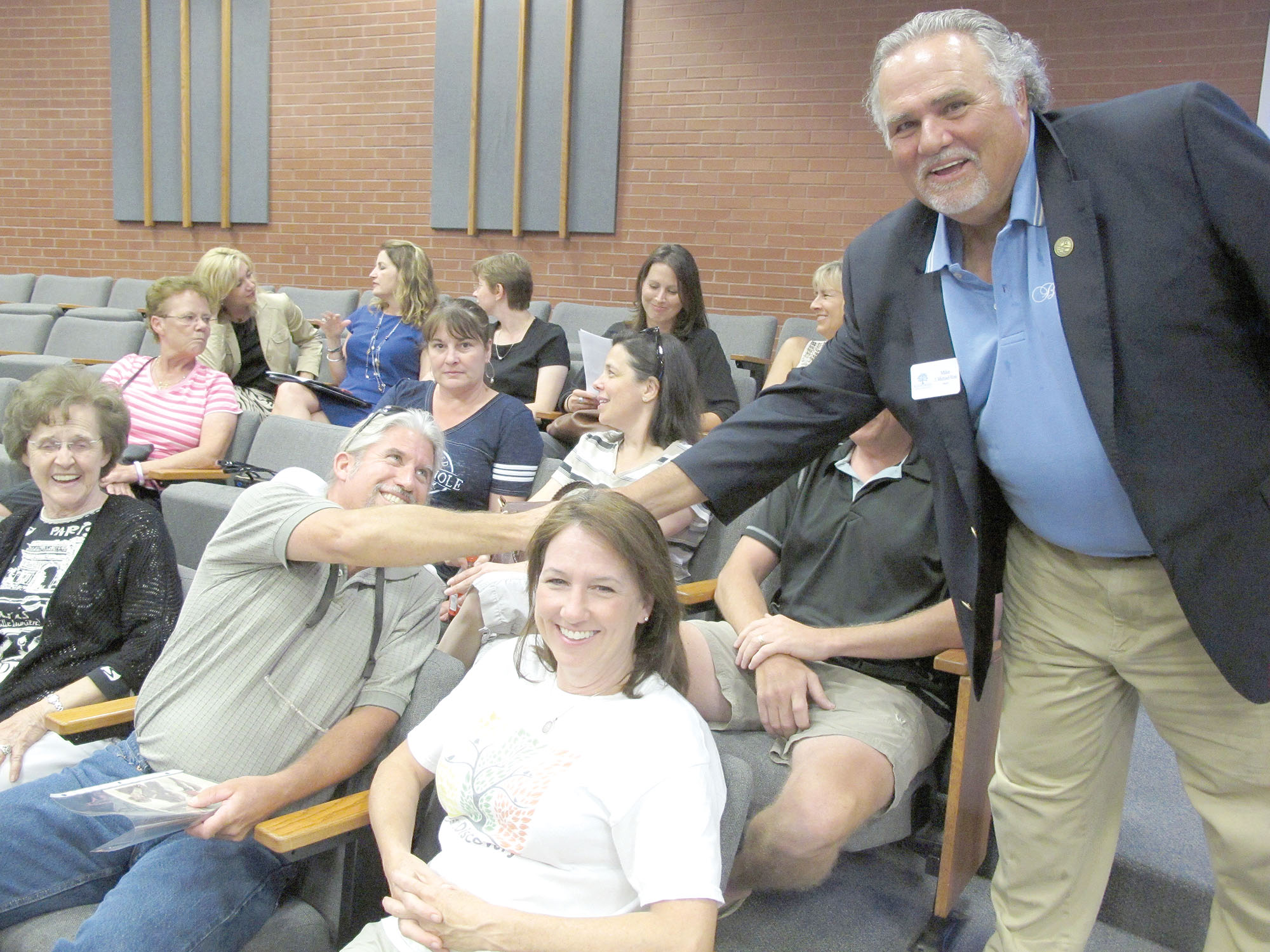
Blythewood Mayor J. Michael Ross greets Blythewood residents and shakes hands with Michael Watts as he arrives at Richland County Council chambers on Tuesday evening to support opposition to commercial zoning proposed on Rimer Pond Road. Seated in the front row, from left: Mary Lee, Micahel Watts and Joanna Weitzel.
COLUMBIA – After months of meetings and postponed meetings related to an effort by commercial real estate agent Patrick Palmer to rezone 5.23 acres on Rimer Pond Road for commercial use, many residents of Rimer Pond Road, LongCreek Plantation, Eagles Glen, Seton Ridge and Cooper’s Pond who opposed the rezoning breathed a sigh of relieve Tuesday night when Palmer officially withdrew his application.
Some Richland County Council members told residents in private prior to the meeting that Palmer did not have the votes he needed on Council. Palmer did not return phone calls from The Voice before press time.
The issue was scheduled for first vote by Council Tuesday night following a public hearing that was well attended by a crowd of residents opposing the rezoning. Among those who signed up to speak against it was Blythewood Mayor J. Michael Ross who had earlier in the day sent an email to all the County Council members asking them to “not compromise the residential areas around (Rimer Pond Road) and our middle school by allowing such uses as a gas station, pizza joint, etc. to locate there.”
“I know this is not in the Town of Blythewood,” Ross continued, “but if you go to the end of Rimer Pond Road, it is Blythewood. You may remember in our Master Plan that was developed about five years ago, we included a small commercial hub at the end (of Rimer Pond Road). Well, that went over like a lead brick and brought people from out of the woods on Rimer Pond Road,” Ross wrote. “We have since focused on our Town Center District, letting that be the Town’s primary commercial district and Rimer Pond remain residential.”
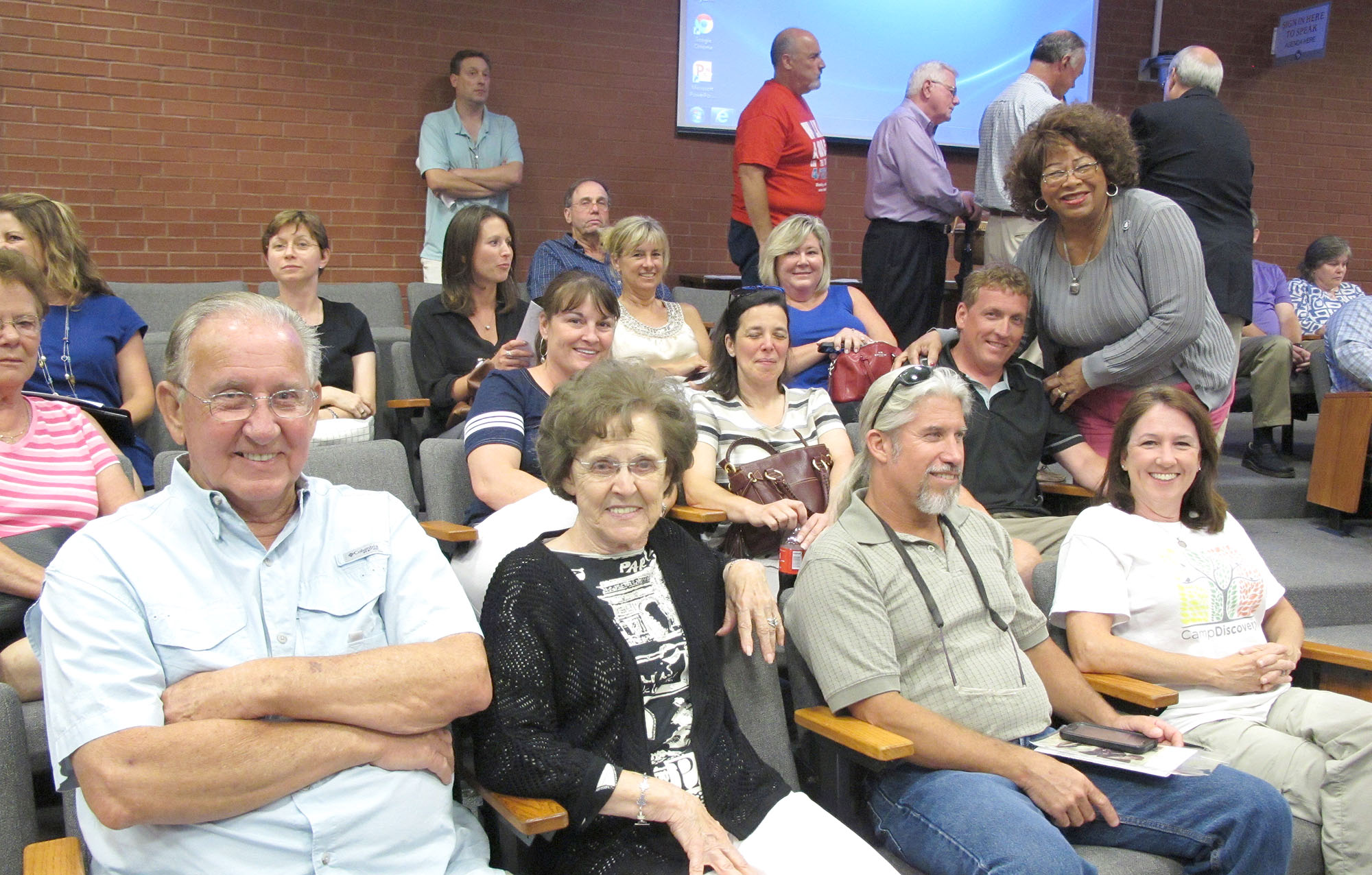
As the crowd of residents took their seats before the meeting started, several Council members, including Joyce Dickerson, who formerly represented the Blythewood area, stepped down from the Council platform and into the audience to shake hands and reminisce about previous trips the Rimer Pond Road group had made to Council chambers in recent years to oppose commercial zoning on the road.
Richland County Councilwoman Joyce Dickerson who formerly represented Blythewood on County Council visits with Blythewood residents who attended Tuesday night’s Council meeting to protest proposed commercial zoning on Rimer Pond Road.
According to Council rules, if Palmer wishes to bring his rezoning request back to Council he must start the process over by first bringing it before the Richland County Planning Commission. A major obstacle for Palmer in trying to get the 5.23 acres rezoned to Rural Commercial (RC) is the wording of the RC ordinance, which states that RC zoning is suited for the more isolated agricultural and rural residential districts and residents located beyond the limits of service of the municipalities.
The Planning Commission cited that wording as the reason they voted against recommending RC zoning for the 5.23 acres. Commissioner Beverly Frierson commented that the area in question was not isolated and not underserved.
Palmer, who is Chairman of the Richland County Planning Commission, placed on the Commission’s June 1 agenda for discussion the possibility of rewording the ordinance. That rewording is expected to be considered and voted on at the July 6 Planning Commission meeting to be held at 1 p.m. in Council Chambers, 2020 Hampton St. in Columbia. The agenda and meeting packet for that meeting will be available at richlandonline.com.
Pelham Lyles, Director of the Fairfield County Museum, displays some of her artwork. She will be doing live sketching during this year’s Ag+Art Tour.
FAIRFIELD COUNTY – Looking for a great family outing this summer? Bring the kids along for a fun weekend in the countryside at the Ag+Art Tour, June 27-28 – rain or shine!
This year’s free, self-guided tour through Fairfield County includes six rural farm sites and will feature local artisans, farmers’ markets, barnyard animals, hayrides, history, food, music and lots of activities and events for the whole family. Be sure to bring a cooler along for toting the fresh produce and other farm stand treats available for purchase. The tour is open on Saturday from 9 a.m. – 5 p.m. and on Sunday from 1 – 5 p.m.
And don’t miss the Jazz & BBQ kickoff event at the Terrace Under the Oaks at Mission Ridge Retreat in Winnsboro on Thursday, June 25 from 6 – 8 p.m., featuring local art, craft and farm exhibits. Barbecue plates will be $10.
Fairfield County’s Ag+Art locations include Celtic Lane Farm in Winnsboro, a 1940s replica General Store featuring historical artifacts, a greenhouse, beehives and a solar panel demonstration at 1 p.m. on Saturday. On-site artisans will include Barbara Yongue, a Plein Aire artist, and Herman Thompson, a metal sculptor whose work incorporates white-out, wool and crayons.
And at Ee-oh-lay Farm in Ridgeway, kids can enjoy feeding and petting the farm’s free-range chickens (and checking out the colorful eggs!) while grownups peruse the handloom knits and home décor of Perfectly Imperfects.
Elder Farms is a sustainable family homestead in Winnsboro that produces homemade soaps and lotions from goats’ milk, and the farm also features an aquaponics watering system. Kids can swing on tree ropes and visit with the goats, ducks and miniature horse. Bring a picnic and blanket to enjoy lunch under a shade tree, then check out artist Pelham Lyles’ live sketching and Voice columnist Brenda Tobin-Flood’s organic pet treats, Ruby’s Natural’s.
The Fairfield County Farmer’s Market at the Town Clock in Winnsboro will offer locally grown vegetables, honey and herbs for purchase. Special activities on Saturday include a raised-bed garden demo at 10:30 a.m. and grit-grinding demos by Congaree Mills at 11:30 a.m. and 3 p.m. Fresh homemade ice cream will be also available for purchase on Sunday from 3-5 p.m.
Christy Buchanan’s lushly blooming art studio in Winnsboro is another fun stop. The She Garden at the Painted Picket is a sustainable herb, flower and vegetable garden highlighted by the “Bottle House,” a whimsically colorful structure built with glass bottles and topped with a living garden roof, one of the location’s many delightful artistic features.
And in Ridgeway, you can visit Royal Greens, a comprehensive and inviting hydroponic facility featuring a “living wall” of hanging gardens. Guided tours will be available of the hydroponic seeding process and the outdoor raised beds, and a variety of lettuces and other greens will be available for purchase. Painting and pottery by artists on the Fairfield Arts Council will also be on exhibit.
Check out the Ag+Art website at www.agandarttour.com for maps, schedules and other tour info. You can also check out facebook.com/agandartfairfield or call the Fairfield County Chamber of Commerce at 803-635-4242.
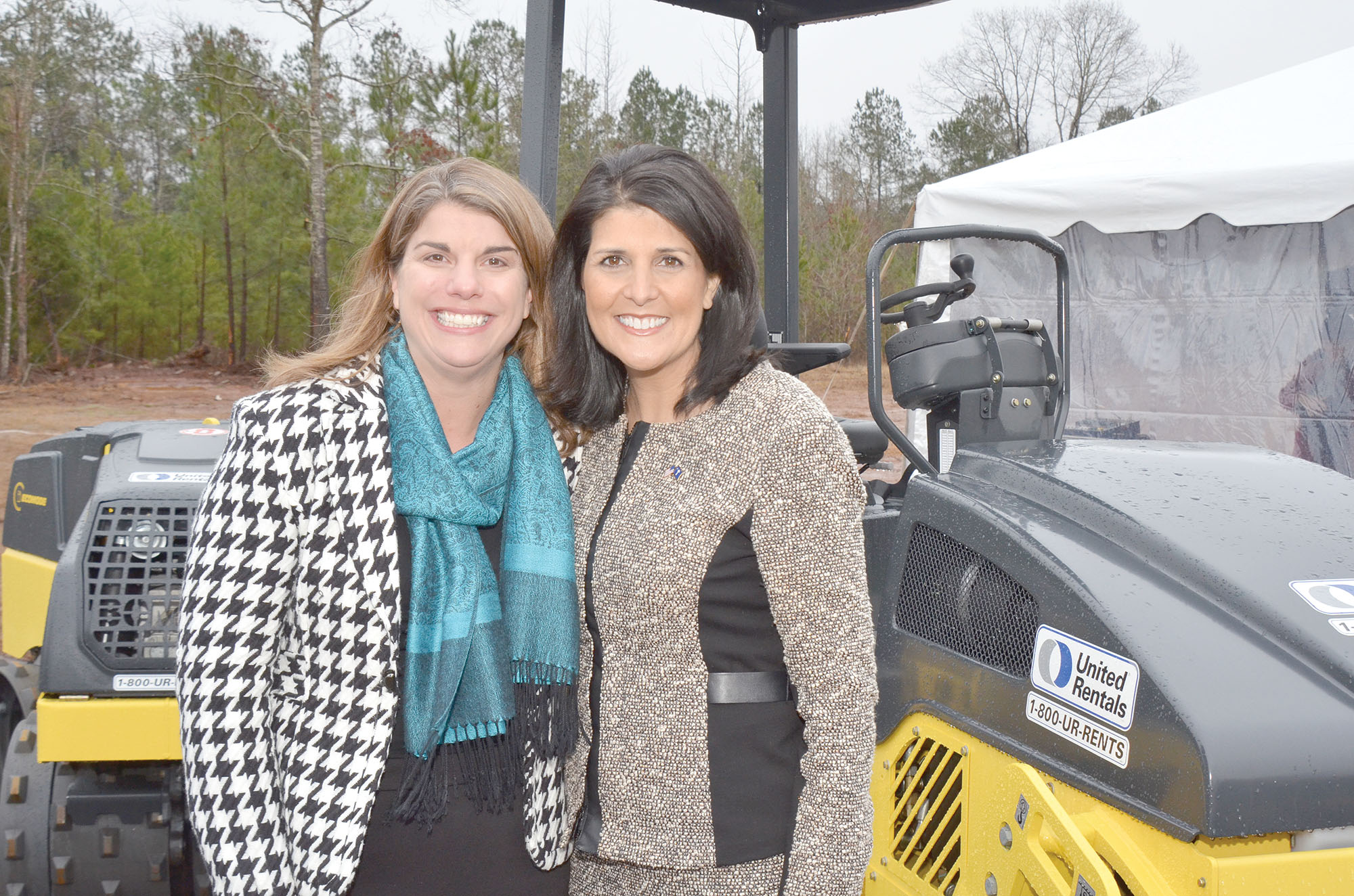
Tiffany Harrison (left), Fairfield County Economic Development Director, with Gov. Nikki Haley at last year’s BOMAG Americas, Inc. groundbreaking.
WINNSBORO – Tiffany Harrison, Fairfield County’s Director of Economic Development since 2006, announced her resignation last week, effective July 2. Harrison has accepted the Executive Director position with the Midlands Education Business Alliance in Columbia, an organization that fosters work-ready educational needs.
“It’s a great opportunity to support economic development from the workforce side,” Harrison said. “And I will continue to support Fairfield County.”
During Harrison’ tenure, Fairfield County broke ground on a new industrial park on Peach Road in 2011 and welcomed its first tenant in February of 2014, BOMAG Americas, whose assembly operation and showcase room for industrial machinery promises 121 new jobs. Prior to that, in August of 2013, Element Electronics announced 500 new jobs at its television manufacturing plant on the Highway 321 Bypass in downtown Winnsboro. In May of 2014, the Spanish manufacturer of elevators and lift systems, Hidral, announced a $1.5 million investment and 25 jobs for its new North American sales office in the Walter Brown Industrial Park. In August of 2014, toy and games manufacturer Enor Corp. announced 151 jobs at its new location on the Bypass.
“The county is in great position for growth and success,” Harrison said. “We have the building blocks in place so the next person coming in will be able to continue that success.”
County Council Chairwoman Carolyn Robinson (District 2) said the Administrator would initiate a search for Harrison’s replacement, but the County would miss Harrison’s easy demeanor.
“It’s going to be hard to fill that void for a while,” Robinson said. “She’s been with us nine years. She has come to know our county, know our product and work well with the Department of Commerce and the alliances, and we have seen growth. She has been easy to work with as the liaison to the County. But she has a good opportunity and I wish her well.”
Harrison said none of the county’s recent economic success would have been possible without the support of County Council. Now, Harrison said, she is looking forward to helping ensure Fairfield County and the Midlands have the workforce to meet future economic needs.
“Sixty-five to 70 percent of jobs in this county and the state require something less than a four-year degree, but something more than a high school diploma,” Harrison said. “The Midlands Education Business Alliance will help grow the workforce businesses need.”