Tag: slider

  • JWC Meeting Turns into Bedlam

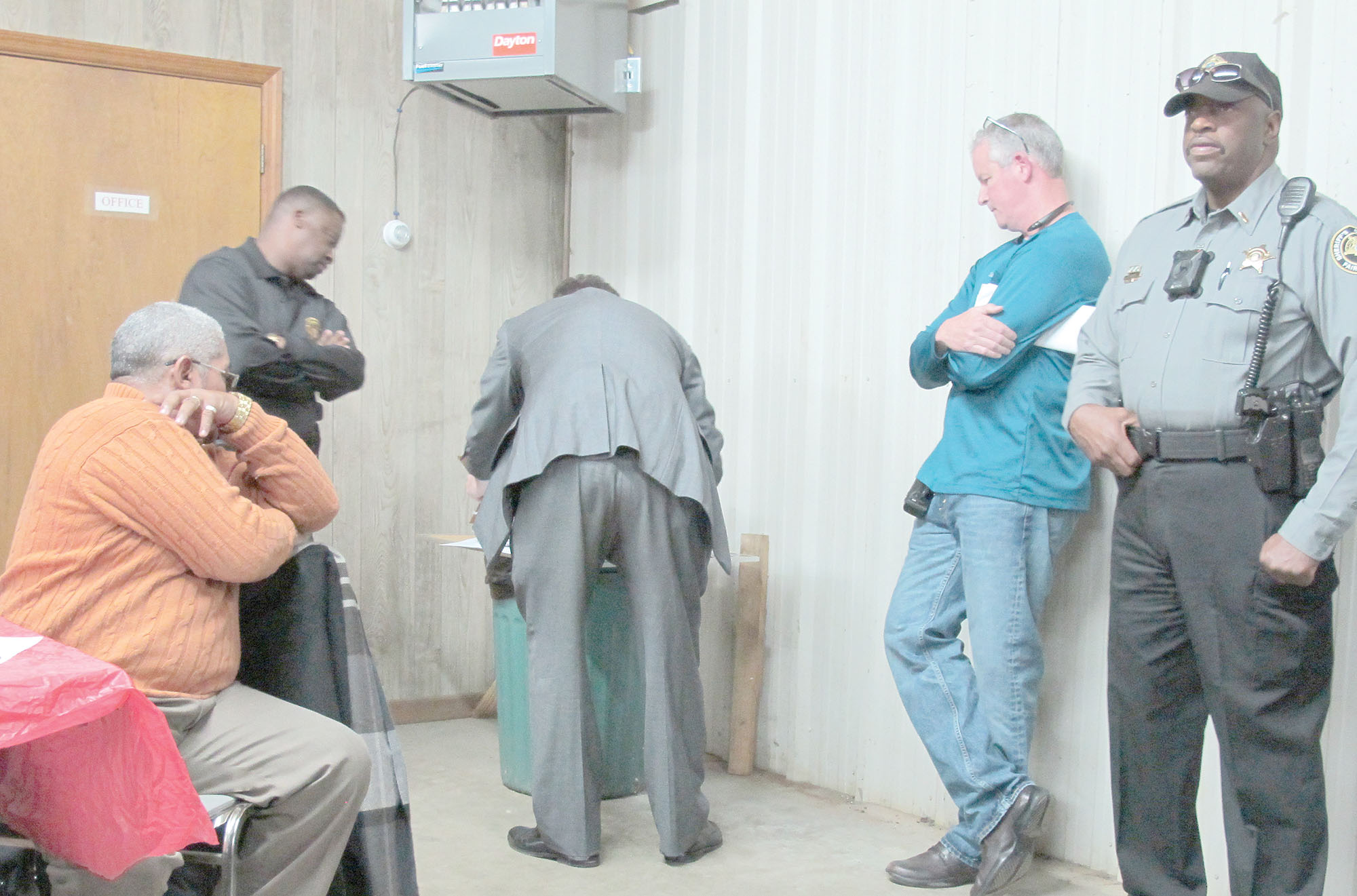
    Jenkinsville Water Company Board President Gregrey Ginyard (left) looks on as ballots are counted during last week's annual meeting. (Photo/Barbara Ball)
    Jenkinsville Water Company Board President Gregrey Ginyard (left) looks on as ballots are counted during last week’s annual meeting. (Photo/Barbara Ball)

    JENKINSVILLE (Jan. 19, 2017) – The Jan. 13 annual meeting of the Jenkinsville Water Company (JWC) was, by most any standard, a Donnybrook, complete with angry outbursts and shouting matches between the President of the Water Company Board and many of the 100 or so members in the audience. It was a repeat of last year’s annual meeting.

    Claiming that the JWC Board did not adhere to the Freedom of Information Act or even their own bylaws in conducting last year’s meeting, which included the election of Board members, Donald Melton and Broad River Campground, LLC filed a pre-emptive motion in the Fairfield County Court of Common Pleas for a temporary restraining order and preliminary injunction to delay the Jan. 13 meeting until 1) proper notification is given, 2) a procedure is put in place to verify that voters claiming to represent commercial customers were actually asked to represent them and 3) the Board can ensure that the one-member/one-vote rule in the bylaws is being followed.

    After hearing testimony from both sides on Jan. 6, Sixth Circuit Judge DeAndrea Benjamin ruled that while she would allow the JWC to proceed with its annual meeting as scheduled, she would also allow the plaintiff, if not satisfied that the meeting and the election of Board members had adhered to the company’s bylaws, to bring the case back before the court for a re-hearing.

    Melton’s attorney, Glenn Bowens, told The Voice on Monday that he hopes to bring the case back to court to challenge the election within the next couple of weeks.

    “We’re hoping to have the election overturned and a new election held that will result in properly elected trustees,” Bowens said.

    Bowens said that while notice of the meeting probably met the requirements of the bylaws this year, he said the election process itself was obstructed.

    “Some members were allowed to cast more than one vote if they had a water bill for both a residence and a business,” Bowens told The Voice. “That is not allowed in the bylaws, which state, ‘No member shall be entitled to more than one vote at meetings of the Members or to hold more than one membership in the corporation.’”

    Bowens also expressed concern that members who cast ballots on behalf of commercial entities were not asked for verification from the commercial entities as required by the company’s bylaws.

    Melton asked JWC President Gregrey Ginyard from the floor if members were allowed to “just show up and say they are casting the ballot for a church or company without some verification from the commercial entity?”

    “That’s been taken care of,” Ginyard said. “We have an attorney here, and that’s been taken care of.”

    But the issue did not appear to be entirely resolved when at least some members requesting ballots to cast votes for commercial entities were not asked for verification supplied by the commercial entities. Instead, they were allowed to offer only self-verification, with their own signature, that they had been authorized to vote for the commercial entity. Instead, those members were allowed to self-verify, on the strength of their notarized signatures, that they had been authorized to vote for the commercial entity. The Board’s attorney notarized the signatures on the self-verified forms, and told The Voice that the notarized form was sufficient.

    Shortly after the meeting opened, Ginyard called for approval of the minutes. When it was discovered that there were no minutes, Ginyard suggested tabling their approval until they could be found, which did not happen during the meeting.

    Other issues causing angst boiled over during public comment time.

    After CPA Yvette Jones reviewed the company’s annual financial report, Ginyard was asked by a member in the audience about the reported $8,089 in travel expenses.

    “That’s mileage for driving to the law firm, to the bank to make deposits and things like that,” Jones explained.

    Ginyard added that some of the mileage is from trips to meetings.

    “Who is this being paid to?” member Billy Hendrix asked.

    “To Mr. Ginyard,” Jones replied.

    Asked by Hendrix if any disciplinary action had been taken by the company last year when Ginyard reported to the Sheriff’s Office that $10,000 in water receipts had been stolen after he had left it in his unlocked pickup truck overnight, Board member Julie Brendall quickly came to Ginyard’s defense.

    “That was a mistake,” Brendall said.

    “We made a police report, but it was taken out of the truck,” Ginyard said.

    Another point of contention erupted into noisy pushback after Board members seeking re-election were allowed to give lengthy campaign speeches, but shouted down member Bertha Goins as she introduced Tony Taffer who had been nominated from the audience for Peach’s seat.

    The voting process itself was marred as voters roamed around the room as the votes were being collected in the president’s hat by a company employee, making it difficult to determine who had already voted and who had not.

    When Ginyard was nominated for another term during the first round of nominations, another Board member called for the nominations to close. Again, the audience shouted down the Board until a second nomination was allowed.

    After the ballots were collected, they were given to the Board’s attorney, Jeff Goodwyn, who took them to a small table in the corner at the front of the room, shielding the ballots from the audience as he counted and piling them into two stacks. Later, Melton and a Deputy Sheriff approached Goodwyn’s ballot table to observe the count.

    Of the five Board members seeking re-election, only Tim Roseborough was unopposed by the audience and retained his seat without a battle. No vote was taken for that seat. The other four incumbents (Ginyard, Preston Peach, Joseph McBride and Tangee Jacobs) each received the same number of votes – 46, while the votes for those nominated from the audience ranged from 30 to 40 each. All Board members were re-seated.

    (Next week, a report on Board member Preston Peach’s explanation to a raucous crowd of how the cost was covered for two letters and a JWC newsletter that he mailed to 800+ water members in envelopes with the Jenkinsville Water Company logo.)

     

  • Clothing Donations Earn Discounted Sweets

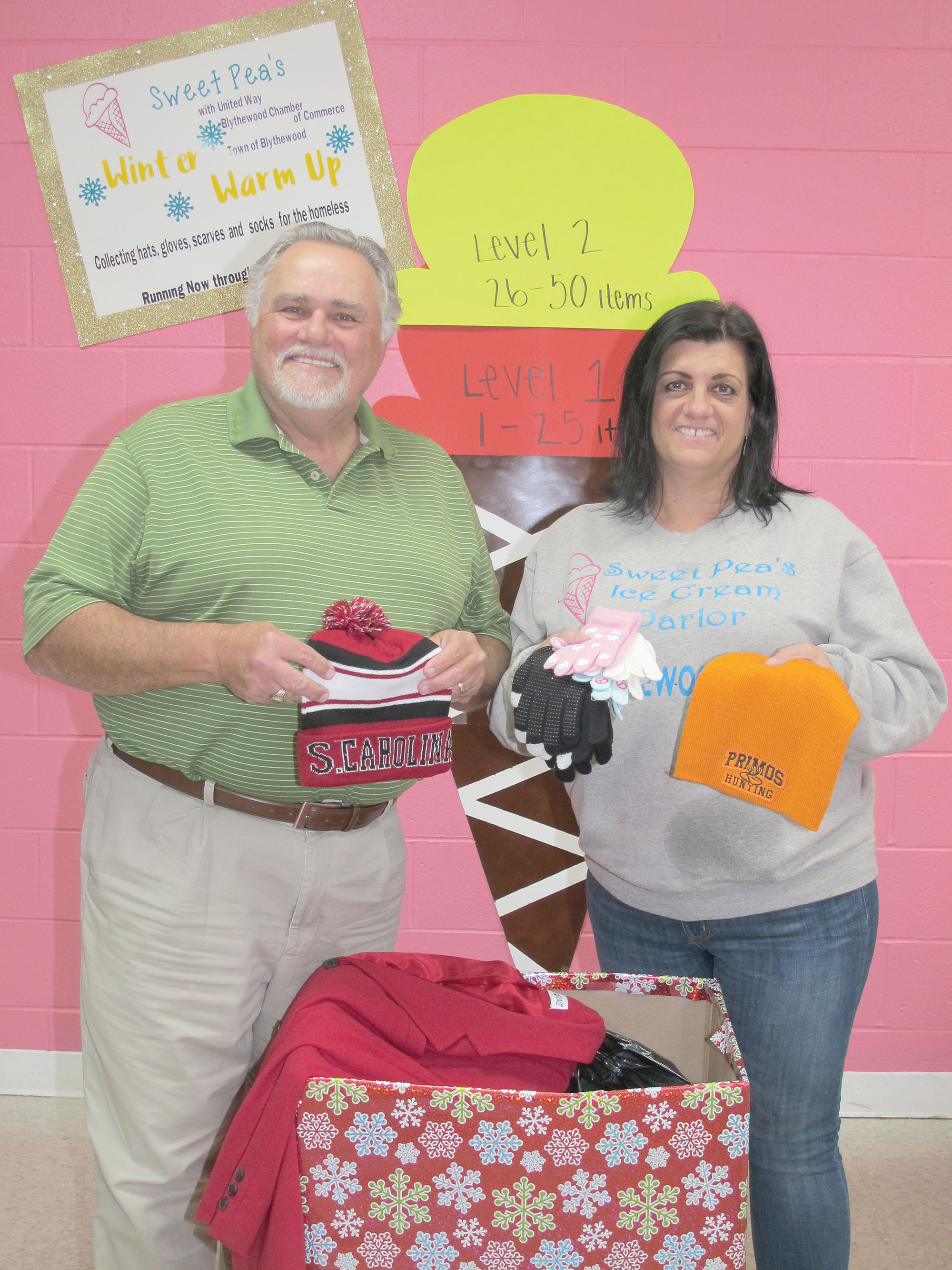
    Blythewood Mayor J. Michael Ross and Susan DeMarco, owner of Sweet Pea’s Ice Cream in Blythewood, display some of the warm weather jackets, hats and gloves that have been donated for homeless people in the community. (Photo/Barbara Ball)
    Blythewood Mayor J. Michael Ross and Susan DeMarco, owner of Sweet Pea’s Ice Cream in Blythewood, display some of the warm weather jackets, hats and gloves that have been donated for homeless people in the community. (Photo/Barbara Ball)

    BLYTHEWOOD (Jan. 12, 2017) – Folks in the community are being asked to donate lightly used, good winter clothing (coats, gloves, hats, scarves warm sweaters) at Sweet Pea’s Ice Cream shop in Blythewood to be given to United Way for distribution to the homeless.

    The shop’s owner, Susan DeMarco, will give each donor a 10 percent discount on any menu item as well as a chance to win a $50 Target gift certificate. The donations are part of the Winter Warm Up collection effort by Sweet Pea’s, The Town of Blythewood, The Blythewood Chamber of Commerce and United Way of the Midlands to provide warm clothing for homeless people in the area this winter.

    The event, which ends Jan. 20, was kicked off at Sweet Pea’s by DeMarco, Mayor J. Michael Ross, Town Councilmen Eddie Baughman and Malcolm Gordge, Blythewood Chamber of Commerce President Belinda Portnall and United Way representative Helen Cotton. Landon Penfield, a Sweet Pea’s regular, made the first donation.

    DeMarco records the donations with mock ice cream scoops that she adds to a giant ice cream cone replica on the wall of her shop. For every 25 items donated, DeMarco ads another ‘scoop.’ The donation level is currently at two scoops.


  • Council Seats New Members

    img_4142-copyWINNSBORO (Jan. 12, 2017) – Amid pomp, refreshments and almost no business, County Council seated three new members Monday evening after a swearing in ceremony conducted by Fairfield County Clerk of Court Judy Bonds. Jimmy Ray Douglas (District 2), Bertha Goins (District 4) and Neil Robinson (District 6), whose 5-year old son called out from the audience, “That’s my Daddy!” took their seats along with new Councilman Mikel Trapp (District 3) who was seated last month following his election to fill the seat of former Councilman Walter Larry Stewart who resigned last summer for health reasons.

    After the swearing in ceremony, Council elected Billy Smith (District 7) chairman and Bertha Goins as vice chairwoman.

    “This means a lot to me and I’m committed to doing the best I can in this position,” Smith said after thanking his fellow Council members for electing him chairman. “I don’t plan on disappointing anyone, but I can’t promise that there won’t be times when I come up short. In those cases, I ask that you keep me in line and point out whatever the issue may be. Not only do I need your help, but I want your help. I hope to be guiding our meetings by a sense of fairness and respect as a top priority to my fellow Council members and to the citizens. I hope this will be a welcome approach and change to this position.”

    Smith said he looked forward to working with Council and the citizens of Fairfield County, “doing our best to improve the lives of the citizens of our county and moving our county forward.”

    Trapp, Robinson and Dan Ruff (District 1) congratulated Smith and Goins and all the newly elected members, thanked their districts and wished everyone a happy new year.

    Goins told the Council and audience that she thanked God for being able to serve the County and that she did not take her service lightly. She said she was thankful to be working with a County Council team that, she pointed out, includes the whole county as well as her district. She also recognized County Administrator Jason Taylor and the new Clerk of Court, Patti Locklair, and thanked them for their service to the County.

    “That’s how I’m going to look at everything,” Goins said. “All of us are a team. County Council may be the first string, but we are all in the game together to make it fair and just.”

    She referenced her campaign slogan, “Fairfield for All,” and said she is “looking forward to us working together to move Fairfield forward.”

    Speaking last, Douglas said he was reminded of what one of his supporters advised him after he won the election.

    “I want to let everyone know that this is not about me,” he said. “It’s about you.”

    Annual Retreat

    After Council approved the annual meeting calendar (soon available online), Taylor reminded members of the annual retreat tentatively set for Saturday, Jan. 21, from 9 a.m. – 3 p.m. He said it will be held in the County this year at the Midlands Tech Campus, 1674 U.S. 321 Business. An attorney from the S.C. Association of Counties will conduct the meeting, which will focus on a review of the County’s operating bylaws, Roberts Rules of Order, the Home Rule Act and will touch on budgeting and a few of the projects the County is working on. The public is invited to attend.

    Public Comment

    Ridgeway resident Tommy Richards addressed a rezoning request recently forwarded by the Planning Commission to County Council with a recommendation of denial. Ronnie and Rose Murphy are requesting the rezoning for a property they own on Longleaf Road in Ridgeway from its current R-1 zoning to R-2 zoning that would allow for mobile homes. R-1 prohibits mobile homes. The property was downzoned from R-2 to R-1 by the County in 2012 during a rezoning sweep approved by Council at that time.

    “The motion for rezoning of the property by Murphy will be coming before you, so I wanted to touch base with you,” Richards said. “The rezoning is vehemently opposed to by the neighbors. It’s detrimental (to the neighboring homes) to bring in housing that’s not up to the standards of Longleaf Road. Please go look at the property. It is not kept up.”

    Smith told The Voice that the Council has not yet received the rezoning request.


  • Thriller Tops Community Reading Event

    Fiona Smith, Library Associate at the Blythewood Library, holds a copy of ‘Grant Park,’ a thirller about racial tensions and the subject of the community’s second Blythewood Reads event to be held in February. (Photo/Barbara Ball)
    Fiona Smith, Library Associate at the Blythewood Library, holds a copy of ‘Grant Park,’ a thirller about racial tensions and the subject of the community’s second Blythewood Reads event to be held in February. (Photo/Barbara Ball)

    BLYTHEWOOD (Jan. 12, 2017) – It’s time again for the next chapter of Blythewood Reads, the popular community reading event organized by the Blythewood Library in collaboration with the Blythewood Historical Society.

    Library Associate Fiona Smith said the program has been a success in bringing readers together for interesting discussions about books that not only entertain, but that also reflect important issues.

    The next gathering will be held at the Langford-Nord House on Thursday, Feb. 9 at 7 p.m., to discuss “Grant Park,” a novel by Pulitzer Prize winning journalist Leonard Pitts Jr.

    “It’s a fast-paced thriller,” Smith said, “about the history of race relations in America over the last few decades. Everyone who’s brought it back has been raving about it. It’s really been a hit!”

    Smith said that the event is scheduled for early in the month because Pitts will be speaking in Columbia in mid-February as part of the city’s One Book, One Community reading program, and she thought that Blythewood readers may be interested in going to see him after reading and discussing the novel.

    “It’s been great to see how Blythewood Reads has brought together different factions of the community,” she said. “Last time we had over 70 people participate in reading the book, and there were 36 people at the event. Everyone really enjoys the occasion. We have cookies and drinks and lots of great conversation!”

    February’s gathering will again consist of several small groups led by facilitators, and she added that the library hopes to develop the program into a regular monthly book club.

    You can reserve your copy of “Grant Park” through the Richland County Public Library website at richlandlibrary.com, or by calling the Blythewood branch at 803-691-9806.

    “The library system as a whole has plenty of copies,” Smith said, “so the chances of getting one are pretty good. You can also download an e-copy from the website or listen to an audio version.”


  • Vigil of Freedom, Faith

    Serving Communion during the Night Watch are Deacons Clifton Hendrix, Clarence Lyles, Lawrence Coleman, John Peoples, Thomas Coleman and the Rev. Eric Bell. (Photo/Clifton Hendrix)
    Serving Communion during the Night Watch are Deacons Clifton Hendrix, Clarence Lyles, Lawrence Coleman, John Peoples, Thomas Coleman and the Rev. Eric Bell. (Photo/Clifton Hendrix)

    WINNSBORO (Jan. 5, 2017) – The members of Gethsemane Baptist Church in Blair gathered on New Year’s Eve for their church’s annual Night Watch service. Visiting Minister Whitney Bell gave the history of Watch Night and her husband, the Rev. Eric Bell, was the speaker for the evening. The service has been a tradition in many African-American congregations since New Year’s Eve 1862 and is still observed by many churches in Fairfield County.

    The Watch Night service can be traced back to gatherings also known as Freedom’s Eve, which began Dec. 31, 1862. On that night, black slaves and free blacks came together in churches and private homes all across the nation awaiting news that the Emancipation Proclamation actually had become law.

    At the stroke of midnight on Jan. 1, 1863, all slaves in the Confederate States were declared legally free. When the news was received, there were prayers, shouts and songs of joy as many people fell to their knees and thanked God.

    Blacks have gathered in churches annually on New Year’s Eve ever since, praising God for bringing us safely through another year. It’s been over a century since the first Freedom’s Eve, and tradition still brings us together at this time every year to celebrate ‘how we got over.’ This celebration takes many African American descendants of slaves into a new year with praise and worship.

    The service usually begins anywhere from 7 to 10 p.m. and ends at midnight with the entrance of the New Year. Some people come to church first, before going out to celebrate. For others, the Night Watch service is the only New Year’s Eve event they celebrate.

    Source: The African American Desk Reference. Schomburg Center for research in Black Culture. ©1999 The Stonesong Press Inc. and The New York Public Library, John Wiley U Sons, Inc. Pub. ISBN 0-471-23924.


  • Shining the Light: Local Journalist Exposes Corruption

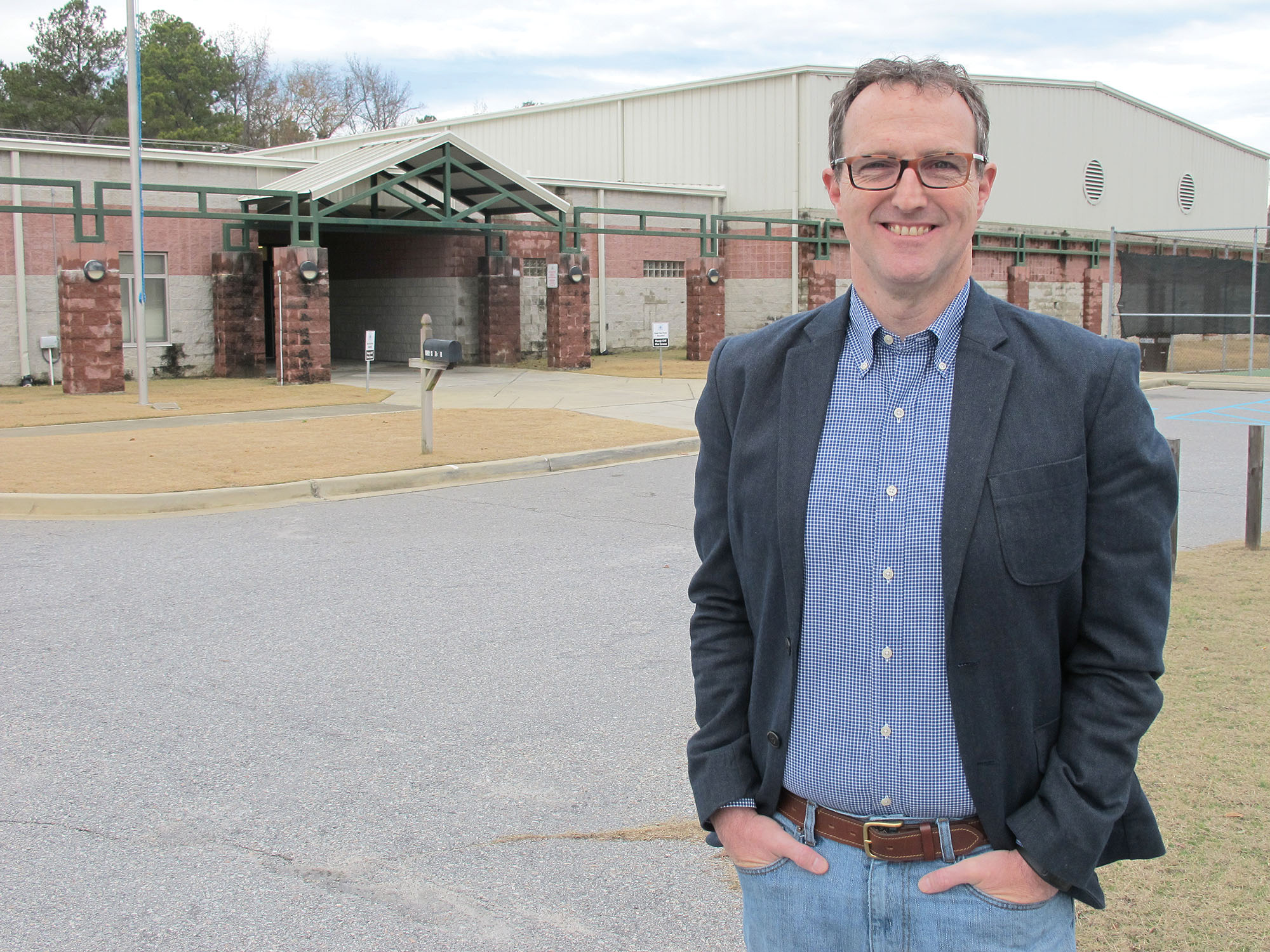
    Local journalist Ron Aiken outside the Blythewood offices of the Richland County Recreation Commission. Aiken broke the news last year of Commission corruption. (Photo/Barbara Ball)
    Blythewood journalist Ron Aiken outside the Richland County Recreation Commission’s park in Blythewood. Aiken broke the news last year of Commission corruption. (Photo/Barbara Ball)

    BLYTHEWOOD (Jan. 5, 2017) – It may not have been entirely the work of a single man that last year brought down the Richland County Recreation Commission Board. But it was the work of one man that tipped over the first domino.

    Writing for the news website The Nerve, local journalist Ron Aiken broke the story of sexual harassment, nepotism, the bullying of employees, abuse of power and cash payoffs to Commission board members by the board’s director in exchange for protection. Aiken would later follow up on that lurid tale on his own website, quorumcolumbia.com, as larger news outlets picked up on his trail. Largely as a result of Aiken’s investigation, the Commission director was indicted last October on charges of misconduct in office and retired, and Gov. Nikki Haley removed all but one of the Commission’s seven board members.

    Aiken also broke other Richland County stories – about hundreds of thousands of dollars’ worth of engineering contracts let to someone with no engineering education or experience; about a business partner of a Richland county councilman given over a quarter-million dollars in Hospitality Tax money; about the practice of each council member giving away $165,000 annually any way they please with no oversight or accountability. . . . And the lists goes on.

    These and other investigation stories by Aiken have resulted in the FBI, SLED, Attorney General’s office and the S.C. Secretary of State all having open investigations.

    Not bad work for a journalist working solo.

    “It’s exciting to me to reveal wrongdoing, possible fraud, corruption, lack of transparency where there should be transparency,” Aiken recently told The Voice. “At The Nerve, it was getting a stagnant 3,000 views per month. I was able to get those numbers up to over 100,000 views per month. Starting from nothing, I had the Quorum up to 50,000 views the first month.”

    Aiken lives in Blythewood with his wife and three stepchildren. He previously worked for The State newspaper, beginning in 1999, for three or four years as a sports reporter. Not satisfied covering just sports, Aiken got the job as senior editor for the Columbia Business Monthly.

    “There I caught the news bug and went to work in Wyoming for a small-town newspaper,” Aiken said. “I learned the techniques of covering all sorts of news – car wrecks, sports, school board meetings, court cases, town councils, etc.”

    Aiken eventually worked his way back to Columbia and a gig with Gamecock Central for three years. Not conducive to family life, the away time required by Gamecock Central soon had Aiken looking elsewhere. Local CBS affiliate WLTX reached out to him at the right time, needing someone to cover high school sports. After a year at WLTX, Aiken finally got the chance to work as an investigative journalist at The Nerve, an investigative news website that watchdogs state and local government. Although Aiken was finally doing what he really wanted to do, changes in the direction The Nerve was headed led to some dissatisfaction on Aiken’s part. This led Aiken to create Quorum where he has been busy digging up the dirt.

    The sort of work that’s being done at the Quorum would sometimes naturally get on the bad side of some influential people. Aiken takes precautions, but has not had, nor does he expect, any direct threat.

    “I believe in the work,” Aiken said. “If I am reporting everything correctly, I don’t worry about it (personal safety). One of the overall purposes of my work is to make everybody’s life better.”

    As a one-man show at quorumcolumbia, Aiken does all the research for his articles. Sometimes this involves pouring through stacks of  paperwork, contracts, etc.

    “I don’t have a team of lawyers behind me,” Aiken said. “The onus is on me to make sure my information is accurate and air tight. I have to know that before I print anything. I have to have 100 percent confidence of its accuracy.”

    And that means vetting his sources carefully – sources he said are surprisingly not hard to find.

    “The right people will find you,” Aiken said. “They contact me. I won’t report after a source comes to me unless I know the story is true. I normally won’t report information from a one-time source. I have to develop a relationship with the source and corroborate their information five ways unless they are people I have known for a long time, and there’s already trust built up.”

    Catching the attention of the larger daily newspapers has prompted Aiken and The State to consider some sort of working relationship.

    “Their publishing process and mine differ,” Aiken said. “I serve my business first, and if I can get exposure from them (The State), all the better. There is a way to do it, but we haven’t nailed it down quite yet.”

    Aiken’s work recently earned him second place in the Society of Professional Journalists’ Larry Peterson Memorial Awards for Investigative Journalism. He placed between two major Pulitzer Award winning newspapers, the Atlanta Journal Constitution (first place) and the Charleston Post & Courier (third place).

    So what does the future hold for Quorum? In the short term, Aiken said his goal is to maintain the website. Currently, there are enough subscribers to keep it running, but he said the big money hasn’t started rolling in yet. Once the value of the Quorum is fully appreciated, Aiken is hoping the amount of subscribers will increase to the point that more reporters are needed.

    Long term, the possibilities are almost endless. Aiken said he is interested in expanding his coverage to Lexington County or State Government. Who knows, maybe Quorum Greenville or Quorum Charleston?

    For $10 per month, subscribers can follow Aiken’s investigations at quorumcolumbia.com.


  • Co-Op Enters Solar Age

    An overhead view of the Fairfield Electrical Cooperative’s new solar array. (Photo/Walter Allread)
    An overhead view of the Fairfield Electrical Cooperative’s new solar array. (Photo/Walter Allread)

    WINNSBORO (Dec. 29, 2016) – The Fairfield Electric Cooperative is letting a little sun shine into its power production with the introduction this month of a modest solar farm built on a little less than an acre of land at the Co-Op’s Winnsboro office on Highway 321 North.

    Construction on the array of solar panels began just over a month ago, and on Dec. 9 work crews officially flipped the switch and tied the panels into the company’s grid.

    “It’s producing electricity,” Doug Payne, Vice President of Member and Strategic Services said. “We’ve begun selling subscriptions and we’ll roll it out in January in our Co-Op magazine. We’ve gotten a lot of interest in it. We’re getting inquiries daily.”

    This “community” solar service is an ideal fit, Payne said, for Co-Op members who have always had a desire to go solar – either in part or entirely – but who don’t have the space or the optimal sun exposure for a solar array on their own property. It also allows customers to get in on solar without having to make the huge investment in installing panels on or around their own homes.

    Installing solar on one’s own home can cost tens of thousands of dollars, even with federal tax credits. With such big upfront costs, recouping that investment can take many years. But with the Co-Op’s community solar service, customers can see a return in five to six years, Payne said. And the upfront cost is significantly less.

    The Co-Op is selling blocks, which consist of approximately four solar panels, for an upfront cost of $140 plus a one-time administrative fee of $35. After that, customers pay $14 per month per block. Customers can buy up to four blocks and the overall subscription term is for 20 years.

    Each block generates 1 kilowatt, or approximately 160 kilowatt hours per month on average. With the average home using approximately 1,200 kilowatt hours per month, four blocks could generate nearly half of a home’s electricity each month. The output of the block will be credited back to the member at 10 cents per kilowatt hour.

    “This is the right project at the right time for Fairfield Electric,” Fairfield Electric CEO Bill Hart said. “Community solar is a terrific option for many of our members. It’s affordable. It’s safe. And we’ll make sure it’s reliable.”

    The Winnsboro solar farm is the first of its kind for Fairfield Electric, Payne said, and came as a response to a recent customer survey.

    “We’ve got a lot of members who said they were interested in solar,” Payne said, “who said they would participate in community solar, and we decided it was something we should do for people who couldn’t do it themselves.”

    And although it is the first, it very well may not be the last community solar farm for Fairfield Electric.

    “Once we sell all 60 units (in Winnsboro),” Payne said, “we’ll look into selling more. We have some other areas at some of our substations, on land that we already own.”


  • Local Business Owner ‘Pays it Forward’

    Liz Humphries, owner of Blythewood Consignment Shop on Main Street in Blythewood, recently loaned a stranger $5 for fuel for his pickup truck. “And then,” she said, “to my surprise, I got this!” (Photo/Barbara Ball)
    Liz Humphries, owner of Blythewood Consignment Shop on Main Street in Blythewood, recently loaned a stranger $5 for fuel for his pickup truck. “And then,” she said, “to my surprise, I got this!” (Photo/Barbara Ball)

    BLYTHEWOOD (Dec. 18, 2016) – It’s not unusual for strangers to walk in to Liz Humphries Blythewood Consignment shop on Main Street. It happens every day.

    “They’re called customers,” she said with a laugh.

    Just before Thanksgiving, however, a stranger came in who was not a customer.

    “He said he was lost and had run out of gas trying to find his way back to the interstate. He needed $5 for gas to get home to Columbia,” Humphries recalled.

    “I didn’t know if he really needed the money for gas or what. But he seemed down on his luck, and I couldn’t not help him. It could have been one of my kids needing help. So I gave him the $5 and kissed it good-bye,” she said.

    “Then last Friday I opened my mail and found an envelope with a $5 bill and a nice note inside thanking me for the loan,” Humphries said.

    “People are good.” she said with a smile.


  • Pelican Requests Rezoning

    The Forest Acres franchise of Pelican Sno-Balls.
    The Forest Acres franchise of Pelican Sno-Balls.

    BLYTHEWOOD (Nov. 23, 2016) – A request to rezone a property on Wilson Boulevard near the intersection of Rimer Pond Road to Multi-Neighborhood Commercial (MC) to accommodate a Pelican Sno-Ball restaurant is on Town Council’s agenda Monday night, Nov. 28. It arrives on Council’s desk with a recommendation from the Planning Commission against the rezoning.

    The Commission voted 3-2 on Nov. 7 against recommending Pelican’s request for the more intense commercial zoning. Commissioners Michelle Kiedrowski and Sean Pilker, both Cobblestone Park residents, voted in favor of the commercial rezoning.

    When no residents were in attendance to speak against the rezoning, Commission Chairman Bryan Franklin asked Town Administrator Gary Parker if the neighbors had been notified of the rezoning request. Parker said they had not at that point.

    Commissioner Cynthia Shull asked what other commercial ventures would be permitted on that property if Pelican was granted the commercial rezoning and decided not to move there or later moved away. Town Planning Consultant Michael Criss explained that any business or recreation permitted outright in the Town’s MC zoning classification could occupy the property once it is rezoned. Buildings up to 20,000 square feet would be allowed outright for many kinds of businesses including drug stores, laundromats, grocery stores, stores selling beer and wine, convenience stores, dry cleaners and public recreation facilities as well as a myriad of other retail stores and restaurants. With a conditional vote from Council, gas stations, car washes and apartment buildings could be allowed. Hotels and motels could be permitted as special exceptions.

    Bryan Keller, owner of two ice specialty stores in Elgin and Columbia, had already appeared before the Board of Architectural Review (BAR) on Sept. 19 to find out if Board members would approve the use of several different bright colors on the exterior of the building the franchise hopes to rent at 10117 Wilson Blvd.

    Keller said he had been discouraged last year by Town Hall zoning officials from trying to open a Pelican’s Sno-Balls franchise in downtown Blythewood because of the company’s trademark bright purple, pink and blue building colors.

    Parker explained that the colors weren’t the only problem, that the business would also require a zoning change to at least MC if it locates on the Wilson Boulevard property. Several residents from nearby Rimer Pond Road who oppose commercial zoning in the area were in attendance.

    “It was made clear to us that the location in downtown was not going to happen,” Keller told the BAR. “So we’ve expanded our search (for a building).”

    That building is the former 3-G Windows and Doors building that was renovated about five years ago and operated under a Multi-Neighborhood Office zoning designation.

    BAR members who are charged with safeguarding the Town’s aesthetics, took a collective deep breath when Keller passed around photos of the proposed color options.

    “The 3-G building has a very nice renovation,” Board member David Shand pointed out, “and I think your color scheme would take away from the look.”

    After much discussion about the colors that all concerned agreed were garish, Matt Marcom, the Pelican Sno-Balls franchise representative, said there is some flexibility with color.

    “We can’t change the color scheme, but we can change where the colors go, the amount of color and saturation levels,” Macom said.

    “It is the gateway to the town and the entrance to Rimer Pond Road,” Board member Jim McLean reminded Keller. “I don’t think this Board can maintain its continuity and approve these colors.”

    Macom then said he could possibly get approval for a white building with only brightly colored trim, wall menus and signage.

    “I understand. What you’re trying to prevent is what we’re trying to bring in,” Macom said.

    The properties on all sides of the 3-G property are currently zoned Rural (RU). The Dawson’s Pond and Dawson’s Creek residential neighborhoods border the back side of the property.

    During public comment, Michael Watts said he and other Rimer Pond Road neighbors in attendance shared the Board’s concerns about the colors.

    “But our biggest concern is up-zoning the property to a more intense commercial zoning. We’re opposed to commercial zoning in this area,” Watts said.

    Town Council will meet at 7 p.m., at Doko Manor in the Town Park.


  • Amphitheater Tops Agenda

    Artist's rendering of the proposed amphitheater at Doko Meadows Park.
    Artist’s rendering of the proposed amphitheater at Doko Meadows Park.

    BLYTHEWOOD (Nov. 23, 2016) – After four bids were opened last September for construction of an amphitheater in Doko Meadows, Council has had several delays bringing the bids to a vote. That vote is expected to take place at Monday evening’s Council meeting.

    The base bid includes the amphitheater stage and pavilion and the concrete pad in front of the stage. The add alternate bid includes installation of the interior radial sidewalks that connect to the road and the handicap parking areas.

    The low base bid was submitted by AOS Contractors at $415,893. Their bid for the sidewalk alternative came in at $54,884, for a total of $470,777.

    The low bid for both the base bid and the add alternative was submitted by Digging Deep Construction. Their base bid came in at $426,900 with the alternative adding $40,280 to the price, for a total of $467,180.

    Rick McMackin’s Landplan Group South was selected by Town Council last June as the architect for the design of the proposed amphitheater and is responsible for site prep/demolition, grading, stage retaining walls, concrete stage pad, dance pad, electrical, sound, lighting, landscaping and oversight of the construction of the band shell. McMackin’s contract is for $383,820.

    Town Council gave its approval last May to an agreement with Palmetto Citizens Federal Credit Union for the right to name it the Palmetto Citizen’s Amphitheater. The nearly $400,000 band shell is funded with a grant and pledges from across the community, including $125,000 from the credit union for the naming rights and $25,000 from Fairfield Electric Cooperative.

    According to Town Administrator Gary Parker, the amphitheater, which is estimated to seat 2,000 to 3,000, is expected to be completed by mid-summer of 2017.