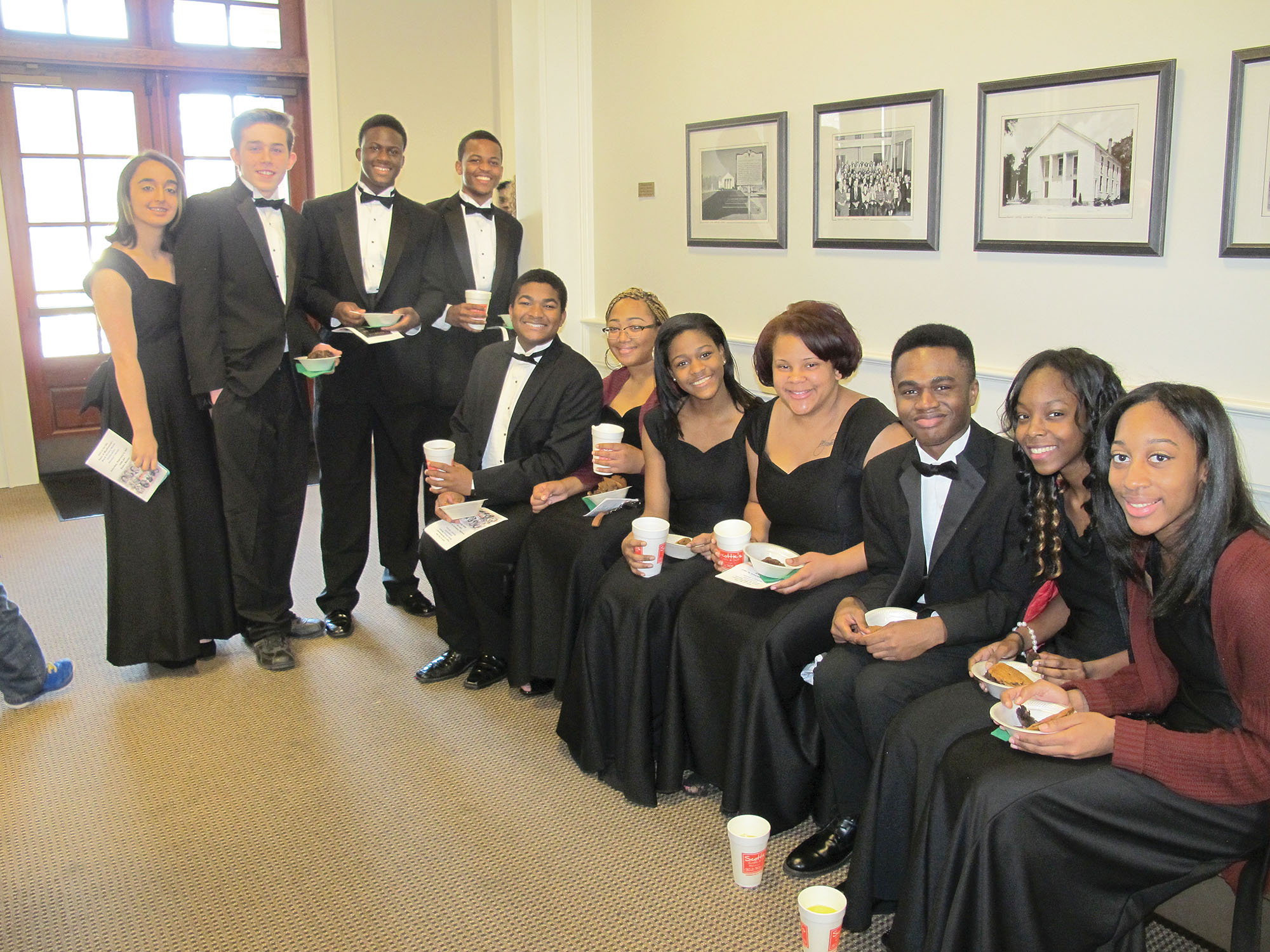
After performing during the celebration of Blythewood’s Historic Heroes at Doko Manor on Saturday, these members of the Blythewood High School chorus took time out for refreshments: Lisa Ortuno (left), Jacob Rubino, Kiryl Lashley, Haven Davis, Will Stocker, Amyah Ritter, Kira Chiles, Jatoa Baker, Kalen Mattocks, Trinity Reese and Erykah Alford. Choral Director is Kristin Claiborne. (Photo/Barbara Ball)
BLYTHEWOOD (Feb. 16, 2017) – The Blythewood Community celebrated and honored the heroes of its own black history on Saturday with a program at The Manor.
Opening with a welcome from Mayor J. Michael Ross and Town Councilmen Larry Griffiin and Malcolm Gordge, the afternoon of entertainment and remembrance included performances by members of the Blythewood High School Choir and a dance team from Westwood High School. Blythewood Middle School student Ethan Harrell was announced the winner of the Black Heroes art contest, and Ray Smith presented a video documentary that included remembrances from several Blythewood women: Naomi Waden, Nettie Benson, Constelena Cunningham, Francis Davis, Ruby Brice, Dorothy Wilson and Mattie Lois Squirewell of Winnsboro.
The program ended with a projection on screen of early editions of the yearbooks of the former Blythewood High School.
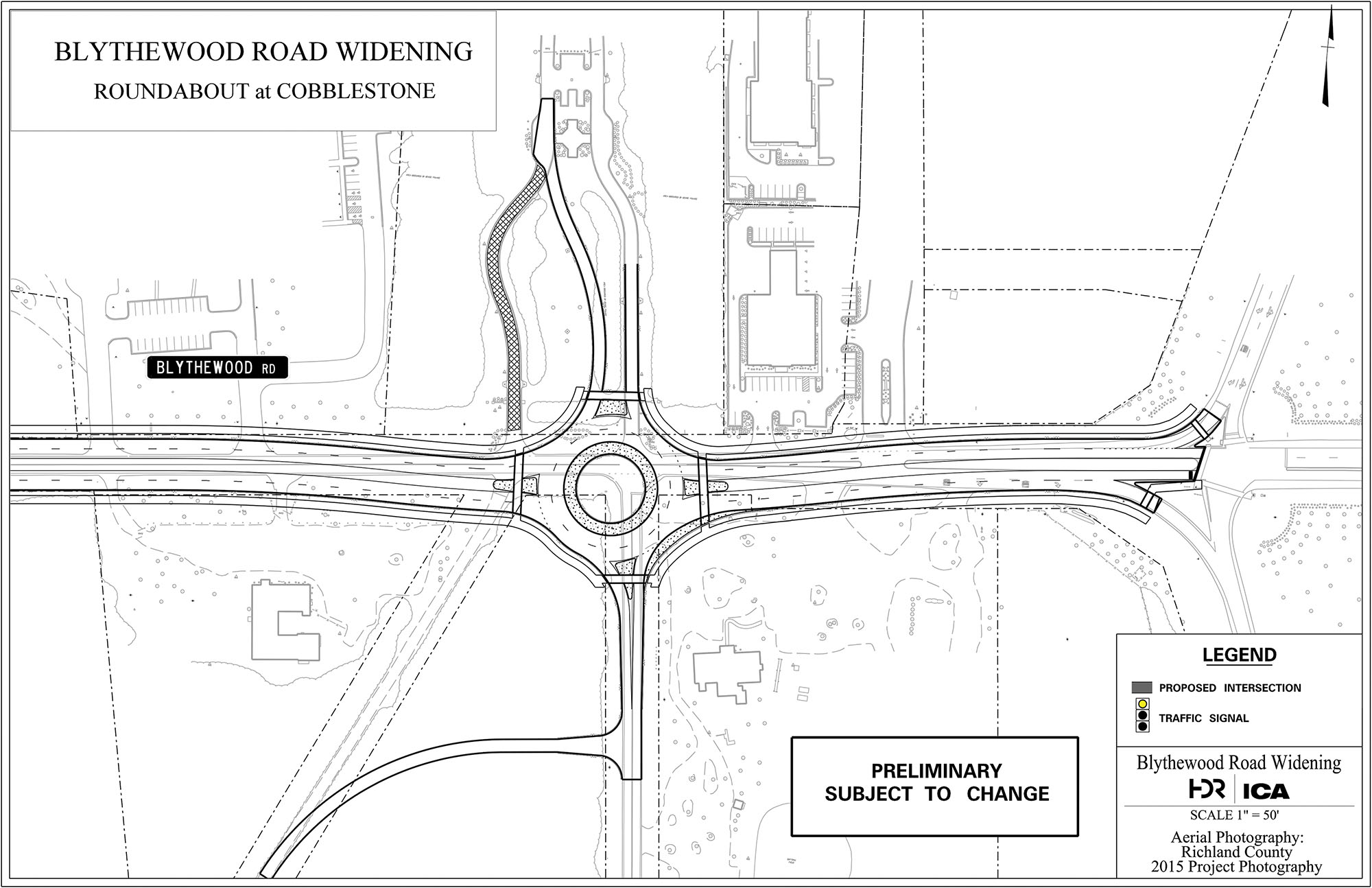
BLYTHEWOOD (Feb. 16, 2017) – At the outset of Town Council’s Jan. 30 meeting, Councilman Malcolm Gordge reported that he had attended as an observer that morning a meeting between Chamber of Commerce members and Ben Lewis, Project Engineer for the Richland County Penny Sales Tax Ad Hoc Committee, the purpose of which was to discuss the double-lane traffic circle slated for Blythewood Road near the entrance to Cobblestone Park.
Facilitated by the Chamber, approximately 14 Chamber members and a handful of guests met with Lewis in the Cobblestone Park Golf Club conference room.
“At this point, there appears to be about a 50-50 split between the property owners regarding a traffic light vs. a traffic circle,” Mike Switzer, Chamber Director, told The Voice recently. “This was our first meeting and I don’t think anybody is ready to commit to a preference until all their questions are answered. We have a follow-up meeting scheduled for Feb. 27, 10 a.m. at the same location.”
Switzer said that the properties near the proposed traffic circle are owned by Chamber members, while member businesses located in the University Village shopping center would also be affected by the circle.
“Therefore the Chamber has initiated this effort to bring these parties to the table with the planners so that our members’ voices can be heard before the planning gets too far along,” Switzer said. “The County planners are estimating that their second public meeting (the first was last October) will be this summer to show their final proposal and so we wanted to make sure they received our input well before then. This was a very positive meeting. It was very beneficial for these Chamber members, property owners, developers, agents, engineers and county reps to meet each other, see more details about the project, ask questions face to face, etc.”
Members want to know, Switzer said, if a traffic circle will actually perform better than a traditional four-way stop with lights. Affected property owners and businesses, he said, want to know if they will be reasonably compensated for any detrimental effects of either a circle or a four-way stop.
“All of the affected parties are wanting what is the best balance for the community and their own business interests,” Switzer said.
Lewis reported to Council at their Dec. 19 meeting that the roundabout was a go and that an executive summary of plans for the project had been given the OK by Richland County Council on Dec. 13.
But after hearing from Chamber members at the Jan. 30 meeting, Lewis and the Committee have some additional convincing to do.
“The roundabout was part of a 2012 referendum,” Lewis said, “and it is in the Town’s Master Plan. It has been evaluated in a traffic report and shown to operate efficiently.”
Nevertheless, Lewis said a comparison plan was being drawn up to be presented to Chamber members at the Feb. 27 meeting. That alternate plan – a traditional four-way stop with traffic lights – has already been studied, Lewis said, and rejected in favor of the traffic circle. However, such a plan has not been presented to the public in a mock-up, which will be the focus of the Feb. 27 meeting.
A traffic light set-up, Lewis said, “doesn’t seem to fit DOT (Department of Transportation) standards.” A roundabout, on the other hand, does.
“This section of Blythewood Road has had 80 percent of Blythewood accidents over a three-year period,” Lewis said. “DOT studies say that a roundabout reduces accidents by 80 percent. And it keeps traffic moving – there is no stoplight.”
Switzer said Chamber members hope to see a graphic and video comparison of a traffic circle vs. traffic lights at the Feb. 27 meeting. Members also hope to see estimations, he said, of the effects on nearby properties of the circle and stoplights.
While the vote ended in a tie, the residents left Monday’s Planning Commission meeting jubilant. (Photo/Barbara Ball)
COLUMBIA (Feb. 9, 2017) – A Richland County lobbyist who said he was hired by Hugh Palmer, the father of Richland County Planning Commissioner Patrick Palmer, addressed the Commission Monday afternoon to convince members to vote to recommend Rural Commercial (RC) zoning on 5.23 acres on Rimer Pond Road. The property is owned by Hugh Palmer. About 70 Blythewood community residents tuned out to beseech the Commissioners to spare their neighborhood from that rezoning. With Patrick Palmer recusing himself, the vote ended in a tie, which means the rezoning request will go forward to County Council without a recommendation for either approval or denial. The residents left the meeting jubilant.
Richland County Council will convene on Feb. 28 to take the first of three votes on the contentious rezoning issue that has been simmering for the better part of three years.
That simmer turned into a boil at times Monday as 34 of the residents streamed to the microphone for more than an hour to voice their opposition to the rezoning.
Lobbyist Boyd Brown of Tompkins, Thompson, Brown Government Affairs in Columbia spoke for Hugh Palmer. Brown, a former member of the S.C. House of Representatives, representing Fairfield County, said he was speaking as one who is familiar with the County’s land use plan for that area.
“We feel as though this (parcel) is tailor-made for Rural Commercial (RC) use,” Brown said. “If you were to take the definition for Rural Commercial (zoning) in the Richland County Land Use Plan, you would feel like it was written primarily for this specific parcel. Rural Commercial zoning was designed to help communities like this.”
Some residents, having boned up on the County’s land use plan during their three-year battle against the Palmers, mocked Brown’s assessment of the land use plan for the area.
“We feel? Who is ‘we’? We are here and we don’t feel,” resident Steven Greenburg shot back at Brown’s comment.
“Contrary to Mr. Brown’s statement, Rural Commercial zoning is not tailor-made for this area,” said resident Jay Thompson. He said county staff seems to be of the opinion that the requested zoning is in compliance with the objectives for commercial uses.
“That’s not correct,” Thompson said. “I hold in my hand a map of future land use and priority investments. If you look at this map, this neighborhood is shown as medium density, not rural. That directly contradicts this proposed zoning for Rural Commercial. It does not fit.
‘The staff reports that the requested rezoning would not be out of character with the existing surrounding development and zoning districts. I would ask staff, anyone, to find another property in this area zoned Rural Commercial,” Thompson said. “You will not find one in any direction.”
Asked by Commissioner Ed Greenleaf if Thompson was correct, Planning Director Tracy Hegler, who participates in the staff report which called for approval of the rezoning request, said, “Yes, that is correct.”
Another common target for residents was the County’s zoning district summary that states that RC zoning is needed to provide commercial services for residents in more isolated agricultural and rural areas.
The Palmers have said the RC zoning is designed for businesses such as pizza restaurants and dry cleaners for the convenience of surrounding residents.
Almost every speaker repeated the crowd’s mantra – “We are not isolated.” “This area is not underserved by commercial.” “We do not need it.” “We do not want it.”
“Within a four-mile radius of my home, there are four pizza restaurants, three dry cleaners, a Dollar Store, a Dollar General, three large grocery stores and at least five service stations,” said LongCreek Plantation resident May Vokaty. “There are plenty of commercial resources available to this area.”
Resident Stacey Young said she had to take time off from work just to be at the afternoon meeting. “It is that important to me. We don’t need this commercial. I have five boys, and we can order pizza any time of the night. We are not going to go hungry without the proposed commercial.”
“If you have pizza delivery, you are not beyond commercial services,” resident Joe Johnson reminded the Commissioners who, along with the audience, responded with a laugh during an otherwise tense meeting.
On a more serious note, Johnson questioned, “Is the staff who keeps approving this venture familiar with the land use plan?
“And I think Mr. Palmer has made some mistakes with this property which has got him in the position he is in,” Johnson said.
Residents repeatedly reminded Commissioners that nearby commercial zoning would bring crime, congestion, more traffic and commercial lighting that would affect the environment and dark skies they enjoy in their rural neighborhood.
“You are slowly taking away from us what we moved here for,” said Nanette Howerin of Longcreek Plantation.
They also addressed the safety of students who would cross a very busy Longtown Road West to the commercial area from Blythewood Middle after school.
Trey Hair of Rimer Pond Road pointed out that there is no commercial zoning anywhere on the road.
“The only beneficiary to this zoning change will be the applicant who stands to make a large sum of money from the property. We’re asking you to stand with the people you serve. Stand with the community. We’re highly opposed to this zoning and we continue to show up in large numbers to protest. Being rural is our choice,” Hair said.
“The Palmers are the ones who came to Rimer Pond Road 10 years or so ago and changed this parcel from Rural to Residential Medium Density (RS-MD),” Rimer Pond Road resident Ken Queen said. “We didn’t want that, but the Palmers wanted it. They didn’t even come out and meet with anyone in the neighborhood and they have not this time. There is nothing they can put on that property that we don’t already have within five or six miles.”
“We do not want Rimer Pond Road to be anything other than rural residential with schools, homes and churches,” Rhett Sanders told the Commissioners. “The Planning Commission is tasked to oversee the strategic growth of our County to keep the big picture in mind and not make decisions based on personal requests that are not in the interest of the community.”
“I bought my property in 1982” Benny Solton told the Commissioners. “That a single person is doing this to a neighborhood is unbelievable.”
“It’s in your hands now to decide if you’re going to stick up for the people or for a developer, which won’t look good for you. We hope you’re with us,” Adams Road resident Michael Watts told the Commissioners.
While Commissioners Beverly Frierson, Ed Greenleaf and Wallace Brown Sr. did vote with the residents, three Commissioners, David Tuttle, Chairman Stephen Gilchrist and Christopher Anderson, did not. Another three Commissioners were absent.
While there was criticism of staff for its approval of the zoning request and for what residents said was staff’s lack of understanding of the zoning applicability to the land, Commissioner Tuttle took staff’s side saying, “We should not impugn staff. I commend staff.”
“We are to look at this as planners. It (RC) meets our guidelines,” Commissioner Anderson said.
Council will hear the rezoning request at 7 p.m. in Richland Council chambers on Feb. 28.
(Note: An earlier version of the story said the lobbyist said he had been hired by Patrick Palmer.)
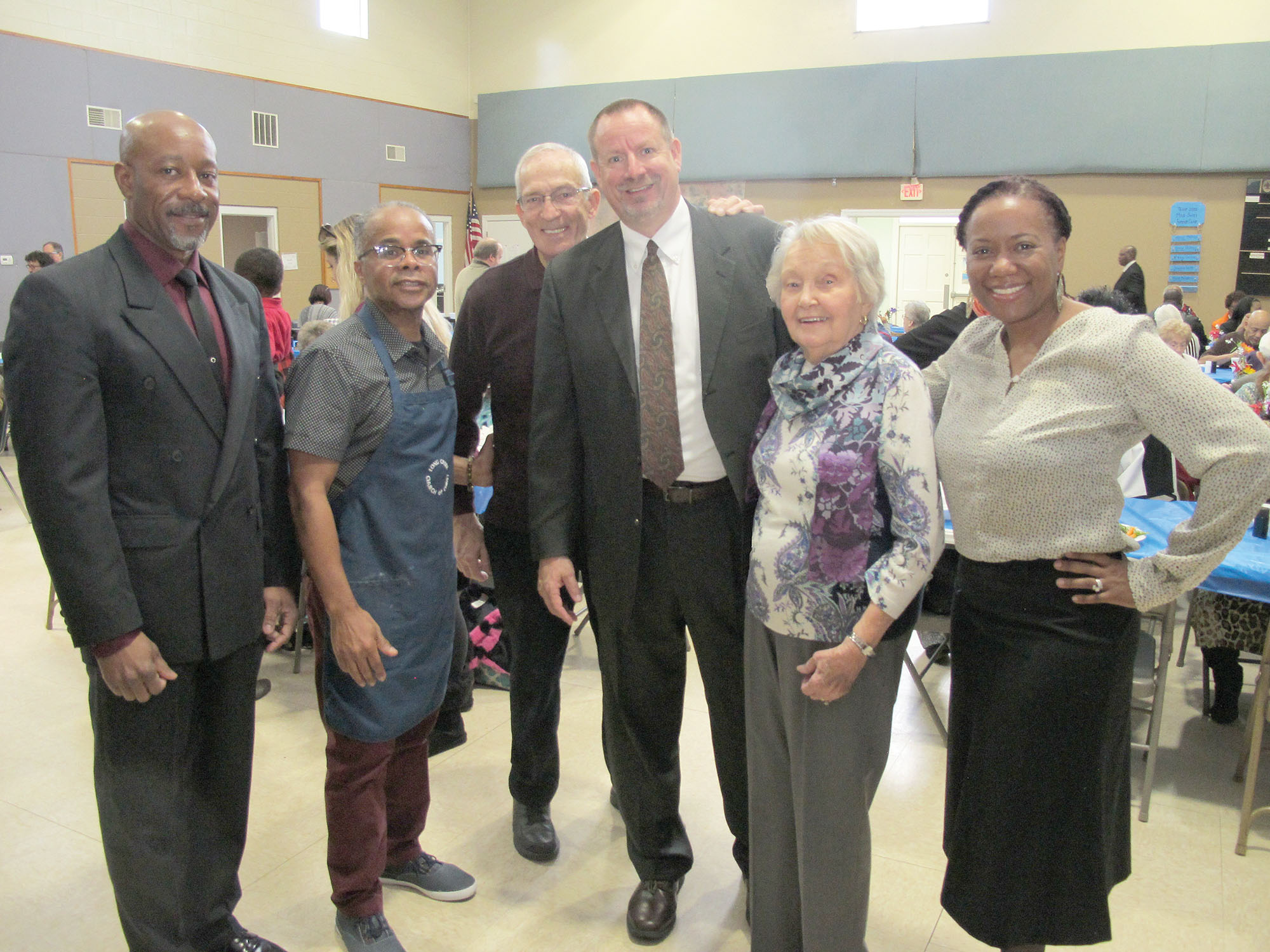
Bidding farewell to the church’s pulpit minister, David Hamilton, center, are from left: Dan King (family life minister), Dr. Gary Bell, (deacon, who doubles as the church’s chef), member Leon Philpot, Hamilton, member Jane Farley (whose late husband, Jim, built the church building) and member Valissia Palmer. (Photo/Barbara Ball)
BLYTHEWOOD (Feb. 2, 2017) – As issues over racism and racial equality have swept anew across some parts of the country recently, there are many places where racial tensions are not a topic, not an issue, not a worry. One of those places is the LongCreek Church of Christ in Blythewood.
The church’s 180-plus membership of all ages is somewhere close to a 50/50 split between white and African American members, and the congregation has been integrated since the doors opened more than a quarter century ago when the church moved from downtown Columbia to the edge of Blythewood 29016. And members say the racial mix has worked well over the years as the church grew.
“This is a very peaceful, unified, loving group of people,” said one of the church leaders, Gil Potter, who is white. “In the Church, we are all one. In the Churches of Christ, there is no overall hierarchical organization. Each local congregation is overseen by Shepherds or Elders selected from among the members.”
At the LongCreek Church of Christ, the Elders include both black and white members. There are both black and white song directors who lead the congregation in a capella singing. David Hamilton, the pulpit minister, is white. Dan King, the family life minister, who also fills in regularly in the pulpit, is black. The two ministers have different styles of preaching, and the differences are wholly embraced by the congregation.
Our different styles have never impeded the congregation’s unity, Hamilton said.
“There is no strife here. No power struggles between the races. We don’t divide along racial lines. We are all Christians who come together for one reason, to worship God. We are brothers and sisters in Christ. We don’t just get along,” King said. “We truly love each other.”
About the only unhappiness among the members occurred recently when Hamilton, who also writes a weekly column for The Voice, announced his retirement from the ministry. For family reasons, including his mother’s declining health, Hamilton and his wife, Kim, are returning to their roots in Kentucky. Sunday was Hamilton’s last day to preach at the LongCreek church. Following services, members gathered in the church’s family life building for an emotional farewell luncheon honoring and thanking the Hamiltons for their eight years of service to the congregation and the community.
Potter said he expects King and, perhaps, other men of the congregation will fill the pulpit as the church searches for another minister. The church is located at 720 Longtown Road, just south of LongCreek Plantation subdivision.
WINNSBORO (Feb. 2, 2017) – A Winnsboro woman charged with starving a dog to death turned herself in this week to the Winnsboro Department of Public Safety.
Acting Chief of Public Safety Maj. John Seibles said Katera Latrice Alexander, 28, of Forest Hills Drive turned herself over to police on Sunday. Alexander faces a misdemeanor charge of cruelty to animals, first offense. She was released on a $1,000 personal recognizance bond and will return to Municipal Court for trial at 11 a.m., Feb. 20.
Seibles said Alexander’s offense did not rise to the level of a felony charge because no torture was involved.
According to Chapter A of the state statute, “Whoever knowingly or intentionally overloads, overdrives, overworks, ill- treats any animal, deprives any animal of necessary sustenance or shelter, inflicts unnecessary pain or suffering upon any animal, or by omission or commission knowingly or intentionally causes these things to be done, for every offense is guilty of a misdemeanor . . .”
Those convicted “must be punished,” the statute states, by not more than 60 days in jail or a fine of not less than $100 and not more than $500, or both.
A Public Safety officer responded on Jan. 13 to a call of a malnourished dog tied up on the front porch of Alexander’s home. The female pit bull was, according to the incident report, so badly emaciated that vertebrae, ribs and hip bones could be seen pressing through the skin. A bucket for water sat on the porch, but it was turned over on its side and empty. There was no food bowl available for the dog, the report states. Instead, there was a milk jug with a hole cut into the top sitting on the porch near the dog’s house. Inside the jug, according to the report, was what appeared to be milk with a layer of grease floating on top.
One of the last photos of the Alexander pit bull. The dog, approximately 3- to 4-years old according to Animal Control estimates, was malnourished and emaciated beyond recovery and later euthanized by the County. (Fairfield County Photo)
Alexander reportedly told the officer that the dog had been ill for more than a month and would not eat, but she said she had not taken the animal to a vet because she could not afford to do so. Nevertheless, the dog immediately consumed two packages of crackers offered to her by the officer and drank a large amount of water once the officer filled her bowl.
Alexander reportedly told the officer that she had given the dog deworming medication, but that it did not help. Someone told her, she said, to give the dog milk and grease as a remedy, but the officer noted that it did not appear as though the dog had consumed any of the concoction.
When the officer asked Alexander to show him the food she had been feeding the dog, she said she did not have any. She had only been feeding the animal table scraps, she said.
Alexander agreed to allow Fairfield Animal Control to pick up the dog and take it to the Adoption Center, but according to Bob Innis, Director of Fairfield County Animal Control, “the dog was in dreadful condition” when it arrived at the shelter.
“We did all we could,” Innis said last week. “We had the vet (Dr. Robert Chappell) come out, we gave it medication. We gave her a blood transfusion – her blood count was in terrible shape. When an animal is that malnourished, it affects the internal organs. In the end, we had to put her down.”
Maj. Seibles said last week that Dr. Chappell’s report stated that the dog suffered from “obvious animal neglect,” and was “severely anemic” as a result of malnutrition. The County euthanized the dog on Jan. 15.
Two notices recently popped up at the intersection of Rimer Pond Road and Longtown Road West announcing two hearings for a request for commercial zoning for 5.23 acres across from Blythewood Middle School. The first hearing is scheduled for the Richland County Planning Commission on Monday, Feb. 6. The second is scheduled for the Richland County Council on Tuesday, Feb. 28. (Photo/Barbara Ball)
BLYTHEWOOD (Feb. 2, 2017) – Residents on Rimer Pond Road and the surrounding area are once again faced with a request for commercial zoning on their road.
A sign staked at the corner of Rimer Pond Road and Longtown Road West gives notification by Richland County that a 5.23-acre parcel across the street from Blythewood Middle School is scheduled for a public hearing on a request by Hugh Palmer to rezone the parcel for commercial use. The rezoning request will come before the Richland County Planning Commission on Monday, Feb. 6 at 1 p.m. At that hearing, the Commission will make a recommendation to Richland County Council for approval or denial of the request – a request with a history.
Since April of 2015, Patrick Palmer – a developer/commercial realtor and longtime member of the Richland County Planning Commission – and his dad, Hugh Palmer, have launched several efforts to get commercial zoning pushed through the Planning Commission and County Council for the parcel, which is owned by Hugh Palmer. Patrick Palmer is the real estate broker for the property. The Palmers have said they want the commercial zoning designation so they can provide surrounding residents with commercial conveniences such as a pizza restaurant, dry cleaners and other businesses.
But the Palmers’ opponents, the residents who live in that area (Rimer Pond Road, LongCreek Plantation, Cooper’s Pond, Round Top Community and Eagles Glen), have fought the Palmer’s commercial zoning requests, saying they neither need nor want commercial zoning or commercial entities in their rural neighborhood, testifying repeatedly before the Commission and County Council that they are already well served by nearby businesses in Blythewood and on Killian Road. For the better part of three years, the residents have fought the Palmers tooth and nail, showing up in large numbers at Commission and Council meetings to speak out against the zoning request.
The score so far – Residents: 2, Palmers: 0.
Against strong neighborhood opposition, Hugh Palmer withdrew his request after the Planning Commission recommended denial (4-1) in June 2015. On the eve of Thanksgiving in November that same year, after another recommendation of denial (5-5) from the Commission, County Council failed to pass the Palmers’ request for commercial zoning when the vote ended in a tie, rendering a denial of the request.
But with close to $2 million riding on commercial rezoning of the property, the Palmers are not giving up. Again they are calling on Patrick Palmer’s fellow Planning Commissioners to grant him and his father a commercial zoning designation on the property, which is advertised for $350,000 per acre.
Residents say the timing for the hearing, on a weekday afternoon, causes a hardship on those who would like to oppose the rezoning.
According to the County’s zoning history of the parcel, it was part of a larger 36-acre parcel that was zoned Rural District (RU) in 1977. Palmer later had the entire parcel rezoned from RU to Residential Single-Family Medium Density (RS-MD) District and sold 31.23 acres for residential use, keeping the 5.23 acre point of the property that contained a cell tower. It is that point that the Palmers want rezoned to Rural Commercial (RC).
The County planning staff (not the Planning Commission) has, for the third time, recommended approval of the commercial zoning, citing the district’s zoning summary that says, “RC zoning is designed to bring commercial services to residents in the more isolated agricultural and rural districts who are located beyond the limits of commercial services.”
The summary also states that the RC district is designed to be located at or near intersections of major collector roads.
“All the (zoning) guidance points to this intersection as a parcel needing rezoning,” Hugh Palmer told the Planning Commission in 2015. “The documents that the County has passed have put this area as an area for change per the comp plan.”
Planning Commissioner Heather Cairns disagreed at a previous hearing.
“If all it takes is an intersection for there to be commercial development in what is an otherwise totally rural area, I’m sort of horrified,” Cairns said. “That means we won’t ever have integrity in our rural areas. It may be an intersection, but this area is already well served by commercial development a couple of miles away. This area is not underserved by commercial development.”
Commissioner Beverly Frierson agreed, saying that the properties along Rimer Pond Road are not isolated from commercial services.
“These residents,” Frierson said, “would be adversely impacted (by commercial zoning.) There are already stores and conveniences nearby.”
The rezoning request will be heard by the planning Commission on Monday, Feb. 6, at 1 p.m., in County Council chambers, 2020 Hampton St. in Columbia (at the corner of Hampton and Harden streets) and is the second item on the docket. The agenda and information packet about the property can be found at richlandonline.com. Click on ‘government,’ then ‘commissions,’ then ‘planning commission,’ then agendas.
The public can attend the meeting and speak for or against the rezoning request.
Chuck and Debbie Kegley, holding their book, “After A Stoke Strikes,” relax on the back porch of their home in Cobblestone Park overlooking the fairway. (Photo/Barbara Ball)
BLYTHEWOOD (Jan. 26, 2017) – Cobblestone resident Chuck Kegley is no stranger to the world of book publishing. As a professor emeritus of International Relations at USC, he’s written over 60 books and many scholarly articles on international affairs. But his latest book, co-authored with his wife, Debra Kegley, is more personal.
“After A Stroke Strikes: A Long Night’s Spiritual Journey Into Day” was released in November by Live Twice Press, and has since drawn glowing reviews from readers touched by the story and its purpose.
“It’s a book about miracles,” Chuck told The Voice. “In the Bible, in 1 Peter, it says to always be prepared to share the reason for the hope that you have. So by sharing the story of Debbie’s miraculous recovery, we hope it will help to strengthen the faith of others.”
He explained that it all started on Jan. 8, 2014, when Debra, 54 at the time, suffered a brain aneurism as the couple was driving home to Blythewood from Virginia.
“Before that, Debbie had been the picture of health, in perfect shape,” he said, his voice still carrying echoes of the harrowing experience. “Miraculously, there was a hospital only two exits away, and being able to get her into the ER so fast saved her life.”
From there, she was helicoptered to a hospital in Charlotte, where Charles remained by her side for 83 days. During that time, she endured many serious complications, including a second aneurism near her stomach, paralysis, full life support and numerous operations.
“And in all that time, our Cobblestone neighbors were so, so wonderful,” he said. “They helped us out in countless ways, as did members of our church. When we were finally able to return home, we were just blown away to be greeted with balloons on all the trees and a big banner that said ‘Welcome Home, Debbie!’ They did so many kind things, like bringing meals and praying with us, and we’re so grateful.”
Since then, Debra has continued to heal – she can walk again and is able to enjoy life. But Charles said that the impact of her experiences and recovery extended far beyond their own lives and concerns.
“It turned out that she’s one of only five people in the past 25 years to have survived two aneurisms within a month,” he said, “and she’d actually become a case study. One Saturday night in the ER, the Head Surgeon told me that her progress was being closely followed by other health care professionals around the world!”
The book also conveys a philosophical perspective about mortality, the afterlife and Christian faith.
“I had dinner with a miracle a few weeks ago,” wrote Cobblestone neighbor Don Sanders in his review of the book on Amazon. “She was at my house, laughing and enjoying the meal and friends, my wife and me, as we assembled in our dining room . . . light years away from [the day] her stroke struck. . . . You need to read this book to rekindle your faith in medicine and the people trained in that field. You also need to read it to rekindle your faith in Jesus Christ. Medicine can heal you . . . but only with the hand of the Lord involved.”
Another review, from the Dean of the Honors College at the University of Alabama at Birmingham, describes the book as a “touching story about a couple’s journey from stroke to recovery, and how it brought them closer to each other and to God. It will tug on your heartstrings and offer inspiration and hope for dealing with adversity in the face of seemingly insurmountable circumstances.”
Charles said that he never intended to write a book, but had simply started keeping a notebook to track information like Debra’s vital signs. But eventually, he said, the project grew into a wholehearted chronicle of their experiences, written from both of their perspectives.
“We want the book to give people hope and encourage faith, because I am certain that these were interventions from God,” he said. “The first thing Debbie remembered during her recovery was from a sermon, that ‘we ought to thank God for our blessings, and not just call on Him when we’re in need.’”
“After A Stroke Strikes” is available for purchase at Amazon.com.
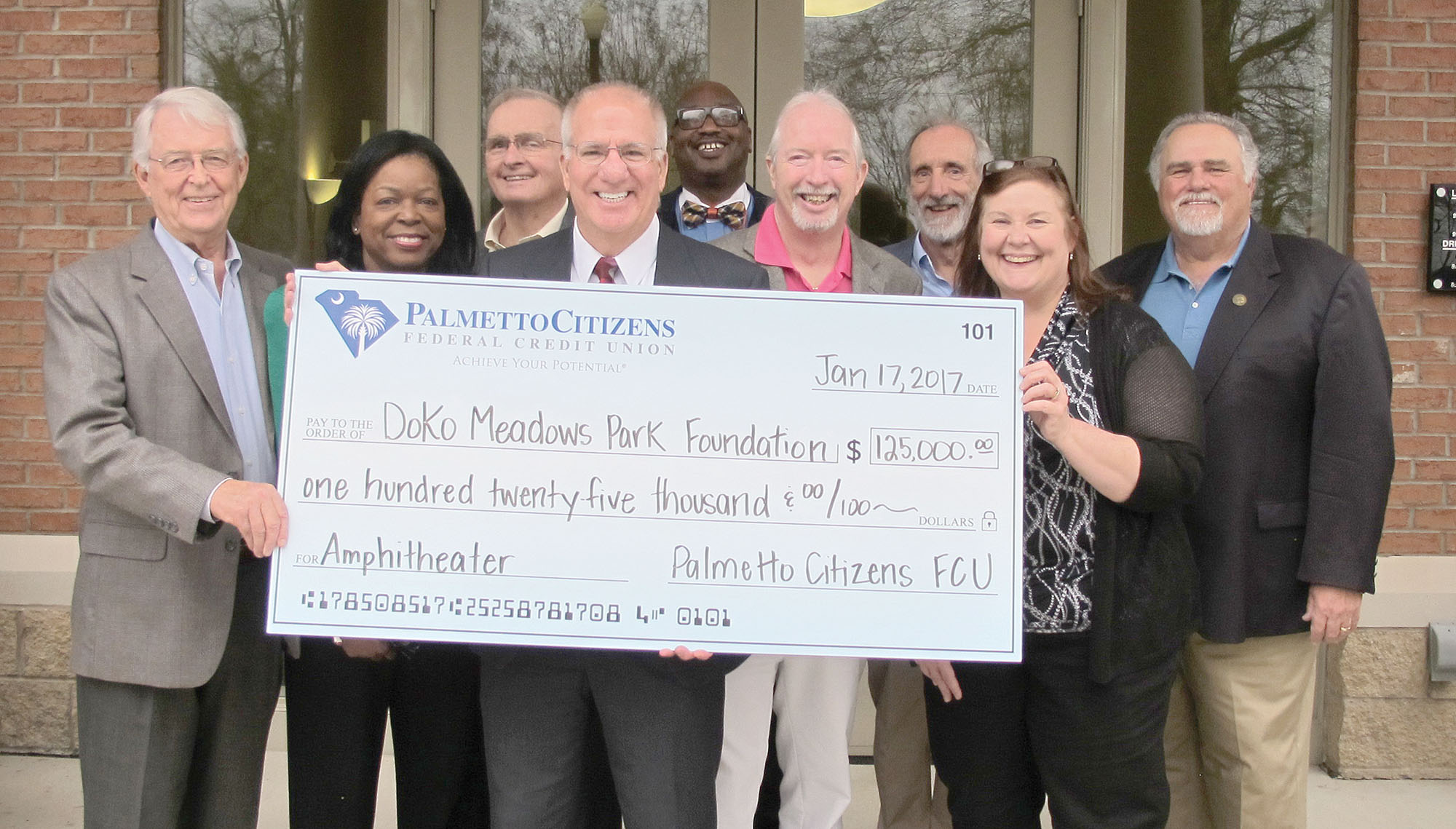
Nick Wodogaza, center, President of Blythewood’s newly opened Palmetto Citizens Federal Credit Union, presents a check for $125,000 for the naming rights to the Town’s new amphitheater to Jim McLean, left, Chairman of the Doko Meadows Park Foundation; Foundation members Martha Crawford and Buddy Price; Wodogaza; Town Councilmen Larry Griffin, Eddie Baughman and Malcolm Gordge; the Town’s financial assistant Chris Keefer and Mayor J. Michael Ross. (Photo/Barbara Ball)
BLYTHEWOOD (Jan. 26, 2017) – During a check presentation ceremony last week, Nick Wodogaza, President of the town’s newly opened Palmetto Citizen’s Federal Credit Union, made good on the bank’s pledge of $125,000 for the naming rights to the Town’s planned amphitheater in Doko Meadows Park. Town officials and donors broke ground last week for construction to begin on the amphitheater.
The outdoor entertainment venue was planned as an integral part of the Town’s Master Plan that was approved by Council in 2010. A non-profit foundation was established in 2015 to bring in donations and grants to fund construction of the facility.
The foundation received its first major contribution, a $25,000 check from Fairfield Electric Cooperative, in January 2016. That was followed by a $75,000 check from Central Carolina Community Foundation in March to purchase concert-quality sound and lighting systems.
Last June, Palmetto Citizen’s Federal Credit Union, which opened a branch office in Blythewood last week, sealed the deal on the amphitheater’s naming rights with a $125,000 offer.
“We are so happy to be here in Blythewood now, and we hope that our contribution to the amphitheater will make a difference for the community,” Wodogaza said during the groundbreaking ceremony for the amphitheater last week.
Foundation Chairman Jim McLean said the Foundation raised 80 percent of the funds to build the amphitheater in less than a year. Individual donations include a $100,000 donation from Blythewood’s Joyce Martin Hill. McLean said the Foundation only needs $60,000 more to cover the cost of the base bid of $415,893 to construct the amphitheater stage, pavilion structure and concrete pad in front of the state.
Construction is expected to be completed by mid-May.
During a watch night party at Columbia Country Club, Dr. Cheryl Guy, Principal of Westwood High School, stands next to a big screen showing Jeopardy host Alex Trebek congratulating her on her big win on the show Friday night. (Photo/Barbara Ball)
BLYTHEWOOD (Jan. 19, 2017) – Westwood High School principal Cheryl Guy, who won $20,600 on Jeopardy Thursday night, was the star of a watch party at Columbia Country Club as she and more than 100 friends, family and colleagues gathered to have dinner and watch the show on a big screen in the Club’s ballroom.
Because Guy had been prohibited by the show’s rules from revealing any information about the outcome of her participation on the show, which was taped several months ago, the suspense in the audience was palpable as the first round ended for a commercial break with Guy having the correct question for only one answer and the lowest score. But as the half-hour show resumed, Guy picked up steam and winnings.
For the final Jeopardy question, Guy bet big – $10,000 of her $10,600. Trebek read the answer: “Unlike newer Bibles, the King James version usually translates pneuma hagion as this, which can lead to unnerving images.”
As the familiar musical clocked ticked, Guy wrote, “What is Holy Ghost?” Trebek pronounced Guy the winner, and the audience in the ballroom shot to their feet with cheers and clapping. For Guy, it was like winning all over again.
While she came back on Friday night for another try at the jackpot, it wasn’t to be. Still, she said she was thrilled with her visit to the show, which was the culmination of 30 years of planning.
“I always wanted to be on Jeopardy,” Guy told the audience before the broadcast, “and I auditioned several times but was never chosen. It was a goal I wanted to achieve,” she said, happily, “and I did. I had a dream and I never stopped working toward it.”
RIDGEWAY (Jan. 19, 2017) – Although Town Council has yet to nail down a definite site for a new water tank, the fate of the old water tower standing over downtown Ridgeway has been the subject of some concern among merchants and citizens.
During Council’s Nov. 10 meeting, the Merchants Association asked Council to preserve the old tower and seek an alternate site for the new tank. Last week, during public comment, Dee Dee Ruff told Council she agrees with the Merchants.
“The historic nature of our current tower is part of what we sell as merchants,” Ruff said. “When you think about replacing this tower, think about what we have; and I’d also like you to think about what we could have in the future.”
Ruff said the future of Ridgeway’s water sales lies closer to I-77, where Fairfield County is buying up parcels for a proposed mega-industrial site. A new water tower closer to the interstate, she said, could support industrial and residential growth in the future.
Lee Dixon, of the Fairfield County Revitalization Commission, presented Council with a proposal to help in preserving the old tower. Dixon said his organization would, at no cost to the Town, garner bids and facilitate funding for the restoration of the water tower; provide consultation to the Town regarding the selection of contractors and scheduling of project estimates; serve the Town as consultants to discuss and research all findings; and ensure that the project meets all municipal, county, state and federal guidelines.
Dixon asked for a period of between 30 and 90 days to complete the proposal to restore the tower as a non-working historical landmark.
“I’ve spoken to two tower restoration companies already – one out of North Carolina – and they are ready to give us soft bids,” Dixon said.
Funds to complete the project would come from grants or private or corporate donations, Dixon said.
“The whole point would be that the Town would then be relieved of the cost of restoration,” Dixon said, “also no cost for me to do the work to facilitate this subcontracting and finding out is it being done through the proper channels of municipal government, whether it’s in a grant situation or whether the council requires a certain regulation or code.”
During Councilman Doug Porter’s Water Committee report, Porter said the condition of the existing water tower was exceptionally poor, but, he added, he was glad to hear Dixon’s proposal.
“It’s safe to say that the old tank will stay there,” Porter said. “There’s no worry about it coming down.”
Porter said the Committee has explored several alternate sites for the new tower, including behind the existing tower on S. Palmer Street, beside the new fire station, behind Aimwell Cemetery on N. Dogwood Ave. and behind the Century House.
To erect a new tower behind the existing tower, Porter said, would cost approximately $22,000 more just to connect with the water main.
But, Porter said, “we don’t want to mess up the skyline with another tank nearby.”
To build it beside the fire station would cost an additional $25,000 to $35,000 to run the lines from the fork at highways 21 and 34 to the new tower. Building it behind the Aimwell Cemetery would involve purchasing an acre of land from the church and running lines to the main. The Town owns the property behind the Century House, Porter said, and the water main is on the Century House side of the road.
The Town recently received a Rural Infrastructure Authority grant for $500,000 to replace the tank. The Town would have to front $97,550 for engineering services, geotechnical services, DHEC fees and contingencies.
“It’s an 18-month grant,” Mayor Charlene Herring said. “It will take 18 months. Only two tank companies in the U.S. build these. Then it takes them about a year to do that. The real issue is, do we have the money if we find another site? Remember we already have to pay $95-98,000 for this grant anyway. Do we have additional funds? The County says they will do the piping and whatever. We hope. So it’s almost like we’re maxed out on what we can spend.”
Council will hold a work session tonight (Jan. 19) at 6:30, followed by a special meeting.