JENKINSVILLE – A Jenkinsville woman was arrested on Dec. 28, 2017, by Fairfield County Sheriff’s Deputies and charged with attempted murder.
Metz
Tiffany Nakia Metz, 38, is accused of shooting Calvin Workman, 58, in the stomach at about 5:30 a.m. the previous day at the intersection of Highway 215 South and Profit Lane.
After at least two witnesses reported the shooting, the incident report states that deputies arrived to find Workman lying on the ground with a bullet wound in his lower abdomen.
While the incident report does not state how deputies knew where to find the suspect, a report filed on Dec. 28, 2017, states that Metz was called out of her residence using the patrol vehicle’s public address system. She was detained without incident.
Investigator William Dove reported that Metz did admit to shooting at the victim in her yard, but stated that she said she was not aware that a bullet had struck Workman.
Metz was denied bond and remains in the Fairfield County Detention Center.
JENKINSVILLE – At approximately 1 p.m. on Tuesday, Jan. 9, SCE&G will sound the 109 sirens located within a 10-mile radius of V.C. Summer Nuclear Station in Fairfield County near Jenkinsville. All sirens surrounding the plant are usually sounded on the first Tuesday of each quarter for one minute as part of the plant’s regular testing program. Because of the New Year holiday, this test will be conducted on the second Tuesday.
Area residents are reminded that the one-minute sounding of sirens during this time period is only a test. In the unlikely event of an actual emergency at the plant, the sirens would sound for three minutes with no prior notice and would alert area residents to tune in to an Emergency Alert System radio or television station for further instructions.
For more information, log on to www.sceg.com/nuclearpreparedness, or call the Fairfield County emergency management office (803-635-4444) or S.C. Emergency Management Division (803-737-8500).
A Bad Deal for Clean Energy in South Carolina and for SCE&G Ratepayers, who get Stuck Paying for the V.C. Summer Nuclear Reactor Debacle for 20 Years
COLUMBIA, S.C. – On January 3, 2018, Dominion Energy and SCANA announced that Dominion has instigated a takeover of SCANA, a South Carolina-based utility. SCANA has been vulnerable to takeover as it’s facing financial and regulatory woes due to pursuit by its subsidiary South Carolina Electric & Gas (SCE&G) of two nuclear reactors that were canceled on July 31, 2017, after a waste of $9 billion.
The take-it-or-leave-it deal falls far short of protecting ratepayers from absorbing the costs of the nuclear fiasco, while replacing the unneeded nuclear plant with unnecessary natural gas capacity instead of cheaper and cleaner energy alternatives. The deal proposes an initial rebate to SCE&G electricity customers for a small amount of the money already paid for the V.C. Summer nuclear reactor construction debacle. The proposal would then require that a typical customer continue to pay 13% of their monthly bill for a period of 20 years, with full profits on the remaining abandoned nuclear project costs. About 18% of customers’ current bill now goes to the nuclear project, with SCE&G collecting about $37 million per month from ratepayers.
SCE&G is still expected to file a formal abandoned nuclear project cost recovery petition with the South Carolina Public Service Commission on or about January 8, 2018, as the company announced last month. That petition will provide important details on Dominion’s proposed deal and draw engagement from public interest groups. Friends of the Earth and Sierra Club will respond aggressively to any proposal which fails to protect ratepayers and assure a clean energy future for South Carolina.
Friends of the Earth and the Sierra Club currently have a complaint pending before the PSC which seeks repayment to customers of money wasted on the nuclear project and a future commitment to pursue cleaner, cheaper, alternative energy. In that on-going case Friends of the Earth and Sierra Club are actively seeking to compel discovery of documents from SCE&G that could hold evidence of fraud and imprudence on the part of the utility. While it is unclear how the merger proposal will proceed, the organizations will continue to fight at the PSC for a return of money spent on the nuclear fiasco.
VC Summer Nuclear Plant, May 2017 | Courtesy of High Flyer
CAYCE, S.C. – Barely two weeks after Fairfield County Council took South Carolina Electric & Gas Company (SCE&G) to court to request an injunction to prevent SCE&G from relinquishing its nuclear license for VC Summer Units 2 and 3, and before a judge could rule on the request, SCE&G filed a formal request with the Nuclear Regulatory Commission (NRC) to withdraw the combined operating licenses (COLs) for the two VC Summer Units.
In addition, on Wednesday, Dominion Energy and SCANA announced that Dominion has instigated a takeover of SCANA which has been vulnerable to takeover as it’s facing financial and regulatory woes due to pursuit by SCE&G of two nuclear reactors that were canceled on July 31, 2017, after a waste of $9 billion. (For the complete breaking news on this announced takeover, go to blythewoodonline.com.)
SCE&G is still expected to file a formal abandoned nuclear project cost recovery petition with the South Carolina Public Service Commission on or about Jan. 8, 2018, as the company announced Dec. 28. That petition will provide important details on Dominion’s proposed deal.
“This notification (Dec. 28, 2017) is consistent with our plans for abandonment and helps to ensure we qualify for a tax deduction in 2017 so that we can capture approximately $2 billion for our customers to offset the costs of the new nuclear project,” said incoming SCANA CFO Iris Griffin.
In its notification to the NRC, SCE&G stated that it has irrevocably abandoned its interests in the VCS Units 2 and 3, ceased all completion and preservation activities, and has limited work at the plant to only those actions required to place the site in a safe condition, terminate construction and close active permits.
SCE&G has offered to cede its abandoned interest in the VCS Units 2 and 3 to Santee Cooper, for no consideration. If, prior to the NRC approval of this request to withdraw the COLs, Santee Cooper chooses to seek to become the sole licensee for the project, SCE&G officials said they will support an application to the NRC to transfer the licenses to Santee Cooper.
“Fairfield County is aware of SCE&G’s desire to withdraw the licenses for VC Summer Units 2 and 3 so it can take a tax write-off for 2017,” said attorney John McKenzie, one of two law firms representing the County in its legal action against SCE&G.
“The County is also aware that Santee Cooper, by letter of December 15, 2017, has yet to consent to the surrender of these licenses, and apparently cannot do so until its board meets in late January,” McKenzie said. “We also understand that there are interested parties who might purchase Santee Cooper. We would hope that SCE&G would not return the licenses in question until all options to restart this project have been explored. Otherwise, SCE&G will have taken additional steps to show its bad faith toward both the citizens of Fairfield County and Santee Cooper, which also furnishes power to electric cooperatives serving the citizens of Fairfield County.”
RIDGEWAY – Following executive session at the Dec. 14, 2017, Town Council meeting, Ridgeway Council voted 3-1 to purchase the Cotton Yard property from Norfolk Southern Railroad for the contracted price of $73,000. However, that price does not include surveying, attorneys’ fees and other fees that could bring the total cost of the property closer to $90,000, a source with knowledge of the transaction told The Voice.
Councilman Cookendorfer voted against the purchase, and Councilman Donald Prioleau left the meeting prior to the vote. Mayor Charlene Herring, Councilwoman Angela Harrison and Councilman Doug Porter voted for the purchase.
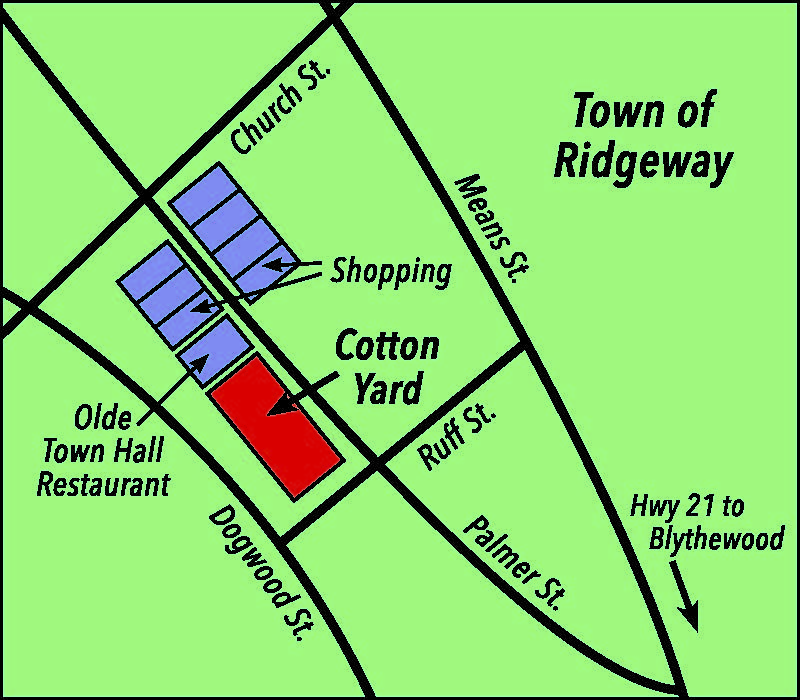
The approximately 1/2 acre Cotton Yard lies just off Palmer Street and between Olde Town Hall Restaurant & Pub and Ruff Street. | Graphic/Ashley Ghere
How the Town came to be staring down the barrel of a $73,000+ purchase price of a property that it had utilized for free for decades dates back to 2014, when then-Councilman Russ Brown and other council members accused Mayor Charlene Herring of officially contacting Norfolk-Southern about a company parking trucks on the lot without notifying Council. The lot is directly in front of her residence.
Rufus Jones, former mayor of Ridgeway and a political opponent of Herring told The Voice that he sometimes parks his sod truck on the lot.
Herring said she had received questions from members of the community about trucks parking on the lot. She did not identify those community members.
“But there were also citizens who were against contacting Norfolk-Southern, and Council members here were against contacting Norfolk-Southern,” Brown told Herring.
It was reported in the Dec. 19, 2014 issue of The Voice that Cookendorfer said that Council had, indeed, agreed to break off discussions with the railroad at a previous meeting.
Mayor Accused of Poking Giant
“We were done with it,” Cookendorfer said, accusing Herring of contacting Norfolk-Southern against council’s wishes.
“That’s what woke the sleeping giant to where we’re at today with basically [Norfolk-Southern’s] demand to take on [a] lease. That’s something we should have discussed as a council,” Cookendorfer said.
Herring countered that she made initial contact with Norfolk-Southern several months earlier after unnamed citizens came to her with concerns about cars for sale parked on the property as well as a truck on the lot.
“If citizens contacted you, under protocol you should have brought that to the council and council would say if we were going to contact Norfolk-Southern,” Councilman Donald Prioleau said.
Herring said that in the future, she would adhere to protocol, but followed that by asking, “As a right of a citizen or a mayor, why can’t you contact the railroad? This is in the heart of our town.”
“September [2014] it was brought up in this room we said ‘do not bother Norfolk-Southern anymore, because they will put up a fence’.” Brown said. “They’ve threatened to do it before, and they’ll still do it if you bother them. Don’t toy with the railroad.”
Herring said she told Council at the September meeting that she would be pursuing questions about leasing the property from the railroad and no one objected.
“In September you didn’t have the lease,” Brown said. “The lease was presented in October. But that had already got to the point where Norfolk-Southern sent a lease because there was communications back and forth.”
Herring said the Town had to have a copy of the proposed lease in order for the document to be reviewed by an attorney.
“Again, in the capacity of mayor, you went to an attorney without Council (knowing about it),” Brown said.
But Herring said she also informed Council that an attorney would be reviewing the lease, and no one had objected to that either.
Don’t Bother Norfolk-Southern
“But this conversation came from you, in the capacity of mayor, (talking) to Norfolk-Southern, which led to them providing a lease,” Brown said. “We, at every single meeting when Norfolk-Southern was brought up, we all said don’t bother Norfolk-Southern.”
Brown said the proposed lease had sat idle with the Town for a month. Then, during the October meeting, Council reviewed the document and opted to not move forward with the lease. The day after the meeting, Brown said, Herring contacted Norfolk-Southern via email.
“Telling them we were not going to pursue a lease,” she said.
“After we said not to communicate,” Brown said. “And then they sent their email back, basically giving the Town the ultimatum that if we do not lease the property, accept responsibility for the lot, accept liability for the property, then they will have the lot fenced off and the buildings removed.”
Herring said Norfolk-Southern is currently reviewing all of their properties, and eventually Ridgeway would have been forced into an official lease. Several buildings, including the world’s smallest police station and the fire station, had been constructed on the property without permission from the railroad, and Herring said it simply was not right for the Town to continue to use the property without the blessing of Norfolk-Southern.
“Eventually this would have happened,” Herring said. “And this came sooner because I did ask some questions. But eventually it would have happened.”
Herring said the railroad company needed an answer as to the Town’s choice of direction on the lease, and she was only doing the courteous thing by letting them know Ridgeway was not interested in signing a lease.
“Again, back to the form of government discussion we just had,” Brown said, “we’re not a strong mayor form of government, and as a council we chose to let it lie.”
Cookendorfer said it would have been preferable to let the railroad force the issue instead of the Town taking the lead.
“I think ya’ll are making the issue at the wrong point,” Herring said. “You made an issue about the form of government and I understand that, and I will tell you sometimes Charlene Herring errs because she is very compassionate about this town and wants to get things done. And I agree, we are a council and we will act as council. I think you’re pulling at straws now and you’re trying to blame (me) instead of doing the right thing. I’ve got the point and I think we need to move on. If you don’t want to sign the lease, don’t sign the lease.”
“You call it compassion, I call it total disregard for Council,” Brown said. “It’s not the end of the world that we’re going to have to lease the lot, but how it was handled…”
Herring reiterated her point that had she not received questions from citizens about the lot she never would have contacted Norfolk-Southern in the first place. But Brown once more pointed out that an entirely different group of citizens had urged the Town to keep mum on its use of the property. At that point, Roger Herring had heard as much as he could stand from his seat in the audience.
“The Rufus Joneses of the community!” Roger Herring, a former Council member and husband of the mayor, erupted. Brown told Roger he was speaking out of order, but Herring continued his defense of the mayor.
“You don’t do the community organization she does,” Roger Herring said, even as the mayor brought down the gavel. “You (Council) don’t do what you’ve already agreed to do!”
As the mayor attempted to restore order to the small Council chambers, Roger Herring stormed out, slamming the door of the Century House behind him.
“Now, do we need any further discussion on it?” the mayor asked.
“I just wanted to bring it up now,” Brown said, “so the people who are going to be paying for that insurance and paying for that lease when they pay their taxes and their water bills, they know where their money is going and why.”
From Lease to Purchase
Since 2014, the Town has paid Norfolk-Southern $1,000 annually for insurance and lease of the Cotton Yard. Recently, however, Council changed its position on the Cotton Yard. It hired an attorney last year to approach Norfolk Southern about purchasing the front portion of the Cotton Yard property where the police and fire stations are located.
The railroad company’s answer came in the form of an email on April 12, 2017, from a Norfolk representative to the Town’s attorney in the matter, Jim Meggs.
“Would the Town of Ridgeway be interested in purchasing the whole parcel shown on the attached [exhibit]? It is not in the best interest of Norfolk Southern to sell only the front of the parcel, losing the street frontage. We could agree to letting the whole parcel go for $35,000,” the representative wrote.
After considering the offer during executive session on April 13, 2017, Council voted in public session to go forward with the offer. However, while it was noted in the June, 2017 Council meeting that the town had allocated $40,000 for the railroad purchase, survey and legal fees, the sale has never materialized.
Purchase Price Jumps
The railroad company has now jumped the price to $73,000 and it is estimated that legal fees, surveying and other extras could increase the total cost of purchasing the property by another $15,000 – $20,000.
While Council has held numerous executive sessions on the purchase of the Cotton Yard, there has been no public comment about why the price has more than doubled.
Councilwoman Angela Harrison reported to The Voice in an email on Thursday that no further vote, ordinance or resolution is needed on the purchase, that the vote on Dec. 14 was the final vote. The next Council meeting is scheduled for 6:30 p.m., Thursday, Jan. 11 at The Century House.
NOTE: This story includes excerpts from another story that appeared in a December, 2014 issue of The Voice.
WINNSBORO – With five fire fatalities this year in Fairfield County, and two of those during the Christmas holidays, interim Fire Director Gregory Gerber said the number is above normal.
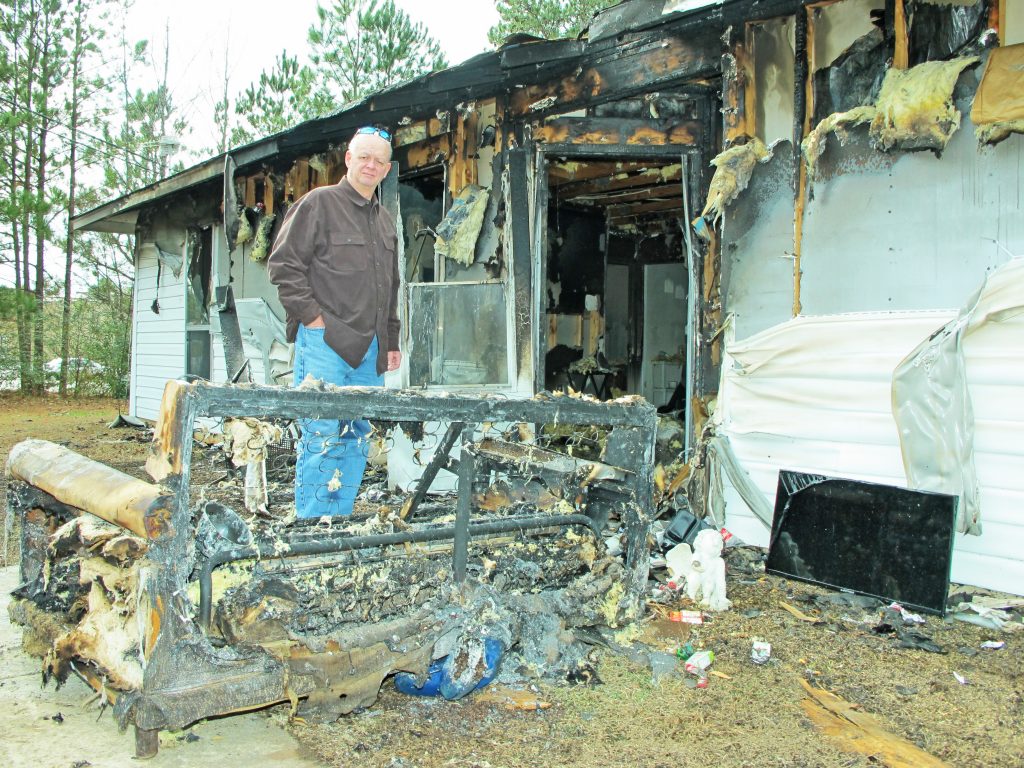
Jimmy Ray Douglas looks over a burned out unit at the Lamplighter Apartments (behind Bi-Lo) that he and his sister Gloria Blackwell own. The apartment burned Saturday at 2:45 a.m. | Barbara Ball
A man died in a fire in Blair on Dec. 16, and the body of Sharon Sapp, 55, was found by firefighters in her residence after it burned about noon on Dec. 28.
“On Saturday morning, a woman and two relatives escaped unharmed from their apartment in the Lamplighter Apartments after what began as an early morning kitchen fire gutted their apartment.” Gerber said.
Jimmy Ray Douglas, who, with his sister, owns the apartment complex, said the total damage is between $120,000 – $140,000.
On Tuesday, another home burned in Jenkinsville.
“We’re just having an unusually high number of fires,” Gerber said.
To help combat structure fires. Gerber said Fairfield firefighters are handing out smoke detectors the County acquired through the Fire Marshall’s office.
“So far, we’ve given out 1,000 smoke detectors this last year,” Gerber said. “And if anyone in the community needs a smoke detector, let us know by calling 712-1070.
WINNSBORO – Okay, everybody get out a pen and paper – it’s time for class! Art class, that is… in a vibrant new community art center coming to life in Winnsboro. Fairfield County’s Dru Blair, an internationally recognized photorealist painter who also manages a popular art school in Blair, is renovating the former Winnsboro Furniture Building on Congress St. into an energetic hub for creativity and artistic expression.
“The concept we have right now is to make one side of it an art center that can be used by the community, and the other side a gallery to represent different artists,” Blair said. “It’s a large building – about 7000 square feet. So there’s plenty of room for many things.”
Blair Art Center & Gallery on Congress Street, Winnsboro.
Blair purchased the building five years ago, but because he was busy with other professional obligations and wasn’t able to start work on it right away, he allowed the STEM school to use the space free. He said the time has finally arrived, though, to start developing the art center, and he’s enthusiastic about the process.
“We don’t have an exact time frame yet,” he said, “but we do already have people who want to use it. So I’m trying to move it along as fast as possible!”
Blair said the new center will function as an extension of his art school in Blair, which he founded 20 years ago, originally in North Carolina.
“In 2008, I moved the school to Blair, which is my ancestral hometown,” he said. “We have students come from all over the world to this school, but it’s not a ‘community center’. I figured it might serve the community better to have a place in a more accessible area. The Furniture Building seemed like an ideal location, and the owner, John McMeekin, had decided to retire and sell the building. So it worked out really well.”
Blair said that community support for developing the center has been very encouraging.
“Terry Vickers and Don Bonds both contacted me about moving forward with the art center. Don is an artist himself, and he recently retired from a position in the county tax assessor’s office. He volunteered to do some of the heavy lifting as we make changes with the building, so I purchased some paint and he got it painted. Changing the color was a big step,” he said.
“I’ve also been working with Julianne Neal, the director of the arts in Fairfield County public schools. She works with the performing arts, and I’ve been talking to her for years about setting up something together. So we’re trying to make sure the building can accommodate not just visual arts but also performing arts.”
Blair intends for the school to include a wide variety of artistic media, including his own instruction in photo-realism and traditional brushwork. .
“We’re also planning to offer acrylic, watercolor, things like that,” he said. “And we’ll bring in guest instructors, even from around the world, who will come give classes or workshops in the building. What I’d like to see is a community center where people can explore a craft or an art, and where different art groups can meet. I think it will benefit Winnsboro greatly.”
Blair, who holds a Master of Fine Arts in Painting from USC, has received a plethora of awards and recognition over the years for his photorealistic painting. He’s interviewed regularly for magazines, television and radio, and was even featured on the Japanese television show, ‘Battle of the Experts’.
“That was about five years ago,” he said. “Two Japanese TV crews came to Blair to film the competition. The goal was for me to create a painting that would fool one of the world’s foremost photographic experts into thinking it was an actual photograph – and I won. Then I went over there and won again, against their champion. It was a great experience.
“I think people like realism, and I think that’s what brings the students to visit me. Even if they’re not photo-realists, they certainly can pick up new techniques to apply to their own art.”
Blair keeps a busy schedule of teaching workshops and classes around the world, and often receives invitations to over a dozen places a year. He just returned from teaching in Melbourne, Sydney, Brisbane and Perth, Australia.
“I’m fortunate to have this life,” he said, “but I do get homesick – I miss Fairfield County. I always look forward to coming home after every trip.”
He said that helping students develop into artists is what makes it all worthwhile.
“Art is therapeutic,” he said. “A lot of my students are creative people who chose careers in other fields, like surgery or carpentry, and now they are realizing a creative outlet later in their careers and are taking great enjoyment from it. You’re never too old to learn, and anyone can improve and become a better artist.”
Blair has no shortage of ambitions for fostering a new era of artistic expression in Fairfield County. Some of his upcoming project ideas include planning an illusionistic art mural near the Town Clock in Winnsboro and setting up a children’s art camp in Blair within the next few years.
“And my ultimate goal is to bring a college – an art college – to Fairfield County. There’s a lot of support for the idea, but it’s not a small task. It takes money, of course, and the paperwork is probably 3 or 4 feet high just to apply for the license,” he said. “But everything begins with a dream!”
WINNSBORO – On Nov. 21, Winnsboro Town Council voted to accept a Memorandum of Understanding (MOU) between Fairfield County and 1st & Main Development of Durham, N.C., regarding the revitalization of the Mt. Zion property.
The MOU was proposed by Councilman Billy Smith last summer, but before it could be voted on, Council was distracted for several months by the VC Summer abandonment. The MOU, which did not require Council approval, was later signed by County Administrator Jason Taylor on Nov. 11.
According to the MOU, the Town of Winnsboro would deed the 3.27-acre Mt. Zion property and buildings to 1st & Main Development for the purpose of rehabilitation. The plan, according to the MOU, is for 1st & Main to be given 180 days to come up with a plan to develop the property. There is also a provision for additional days, should the project be on track but needed a reasonable extension of time. After the property is developed, the County would begin leasing it back from 1st & Main for use as a government complex. Through the lease agreement, the County would eventually own the rehabilitated property.
The MOU states that “[Town] Council believes it is in the best interest of the citizens of Winnsboro that surplus public property with historic significance to the Community, be revitalized and put to private uses that blend with the residential neighborhoods while creating jobs and bringing quality commercial enterprise to the Town.”
While Winnsboro Town Council has voted to accept the MOU between the County and 1st & Main Development, there is a significant bump in the road before the property deed would be binding. The deed, as it has been written by the Town of Winnsboro, stipulates that if, for some reason, 1st & Main Development does not move forward with the rehabilitation of the Mt. Zion property, ownership of the property would be assumed by the County.
“That deed would have to be approved by a vote of County Council before it could be signed by the County Administrator,” Council Chairman Billy Smith said. “I don’t know what the outcome of that vote will be, but I’m not in favor of the property becoming the County’s should the project not materialize.”
Smith was said he was not sure when the matter would come to Council for a vote.
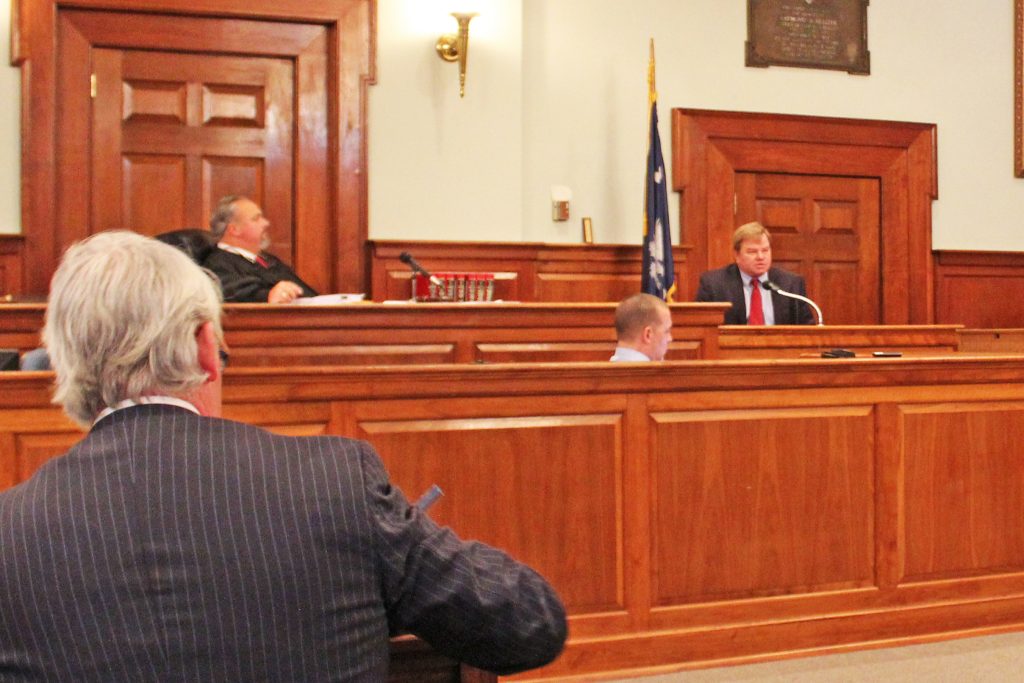
WINNSBORO – Fairfield County faced off with attorneys for South Carolina Gas and Electric (SCE&G) last week in Common Pleas Court in Winnsboro before Sixth Judicial Circuit Judge Brian Gibbons.
Lawyers for the County called for the immediate issuance of a temporary injunction against SCE&G based on what the County says is the power company’s failure to comply with the terms of the County’s fee-in-lieu contract with SCE&G. The county also asked for an immediate, temporary restraining order to prevent SCE&G from abandoning the project at V.C. Summer nuclear plant and not protecting the assets at the plant.
Fairfield County’s Director of Economic Development, Ty Davenport, explains the economic impact of the VC Summer abandonment on the County.
At the heart of the County’s concern is getting access to the plant so it can assess all aspects of the property.
Terry Richardson, Jr. of Richardson, Patrick, Westbrook & Brickman law firm, one of two law firms representing the County in the lawsuit, said the County is only asking to hold the status quo until it can assess the property. He said the County has been trying to get access but that SCE&G hasn’t responded.
Judge Gibbons determined that it is the County’s right, according the Fee-in-Lieu agreement to have full access for the purpose of assessing the property.
Richardson said the County is eager to go in the following Monday (Dec. 18) to begin the assessment. Gibbons said he planned to have a ruling on Thursday, Dec. 21, and asked Richardson to have the evaluations and assessments back to him by Wednesday, Dec. 20.
“We were ready to take our county assessor, Randy Roberts, and a team of assessors from the State Department of Revenue in with us on Tuesday,” County Administrator Jason Taylor said on Wednesday. “But even though SCE&G promised to give us access, they have not given that access yet. We don’t know when we will be allowed in. A lot of things are happening in Columbia right now. We need to talk to the attorneys to see what the outcome of this thing is going to be. We were supposed to have the information back in to Judge Gibbons today (Wednesday, Dec. 20) and be back in to court for his ruling tomorrow, so I don’t know when that’s going to happen,” Taylor said.
Richardson said there is immediate concern, as well, that SCE&G is turning in its nuclear license for the two reactors, a $9 billion issue for this county.
“That would have tremendous ramifications for the County,” Richardson told the Court. “We want to get our County people out there evaluating that property and take a look at it, inspect and evaluate it. We need all that to be done before the license is turned back, before there is complete and total abandonment of the site. There may be pollution issues, permits may be needed,” Richardson said. “We want to hold the status quo.”
According to sources who asked not to be quoted, there is speculation that SCE&G could soon be turning its license over to Santee Cooper.
“The license is a huge asset and we want to slow the process down before they turn it in,” Taylor said. “We hope to work with the governor and the state for a good outcome.”
The County’s lawsuit alleges breach of contract, fraud negligent misrepresentation, breach of fiduciary duty and unfair trade practices. The County claims that SCE&G’s expressed intention to abandon the project and dispose of the properties, plus abandon regulatory permits and licenses by year’s end in order to gain a tax advantage, deprives the County of determining what potential tax and license fees could be due from the property within its jurisdiction and may leave dangerous or potentially dangerous conditions to the County’s citizens.
Judge Gibbons told attorneys for both parties that his ruling, when it is given, will be only temporary.
The McDonald McKenzie, Rubin Miller and Lybrand law firm is also representing the County.
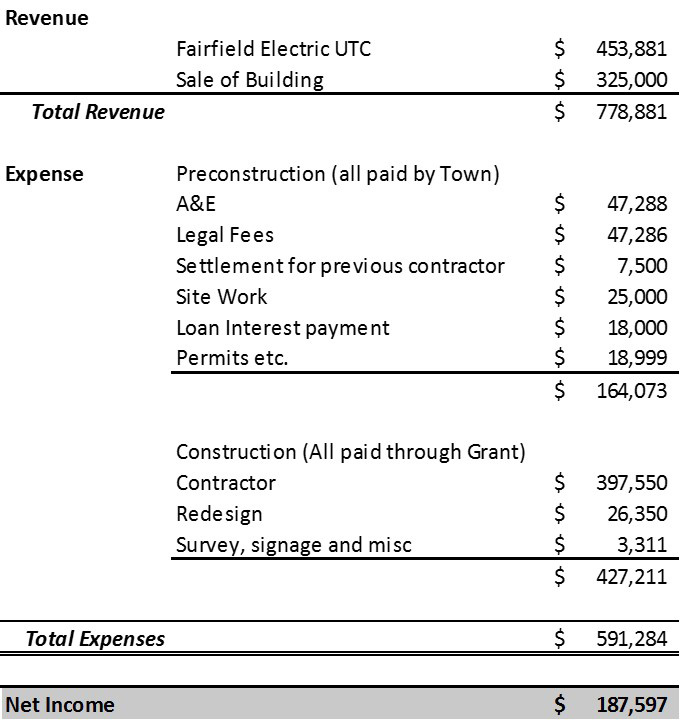
BLYTHEWOOD – Town Council finalized the sale of the Doko Depot property Tuesday evening and issued information that showed the Town had a net income of $187,597 from the sale.
“From January, 2017 until September, 2017, we were involved in serious discussions with a local restaurateur to purchase the property,” Mayor J. Michael Ross said. “Unfortunately, those negotiations did not come to pass. So we approached a Columbia developer, Wheeler and Wheeler, LLC. After much consideration, Mr. Wheeler came up with a plan as well as prospective tenants and we are in the process of accepting his contract for sale,” Ross said.
Financial Summary
The proposed sale price is $325,000 for the building and land underneath and included covenants and restrictions on the current and future uses of the property. While the property is in the Town Center District (TCD), all of the TCD uses are not available to this property.
The previous Town Council and Administration approved the concept of designating a portion of the Doko Meadows Park as a business park. The first step in development was to attract an upscale restaurant which, Council hoped, would in turn stimulate other private developers to invest and construct office and/or retail in the area.
The initial plan was to construct a 5,000 square foot building and lease the facility to Sam Kendall’s, a successful restaurant in Camden. Next, the Town approached Fairfield Electric Cooperative and requested assistance through their grant program available through the Utility Tax Credit Program. The Town would borrow the balance needed to complete the building.
The Town’s received grants totaling $456,881.29 from annual Coop allocations in 2013 and 2014. Santee Cooper loaned the Town $900,000. That brought the project revenue to $1,356,881. While Town staff began pre-construction matters and final negotiations of the lease with Same Kendall that was to cover all costs borne to include the building, improvements and all other costs absorbed by the Town, there were other costs.
The Town paid $47,286 for architectural and design, $32,000 in attorney fees for the loan and $25,500 for site work. A contractor was selected and was prepared to begin.
In early 2014, newly elected Town Council members questioned the feasibility of the Town bearing the liability owning the debt and looked to the prospective buyer to do a take out at completion. Negotiations failed, and the Town elected to abandon the project as designed.
“We repaid the Santee Cooper loan principal as well as the interest payment for the year it held funds,” Ross said. “We paid $900,000 plus the $18,000 interest payment.”
The Utility Tax Credit assigned to the Town could not be returned without a severe penalty payment. In 2016, Council decided to use the $456,881 to build a spec shell building. A survey of the community concluded that a restaurant would be the most popular choice for the building.
The size of the building was reduced to meet the new budget. Lyn Rich Construction began work in the early fall of 2016 and the building was completed in late spring, 2017 at a final cost of $397,550.