Tag: slider

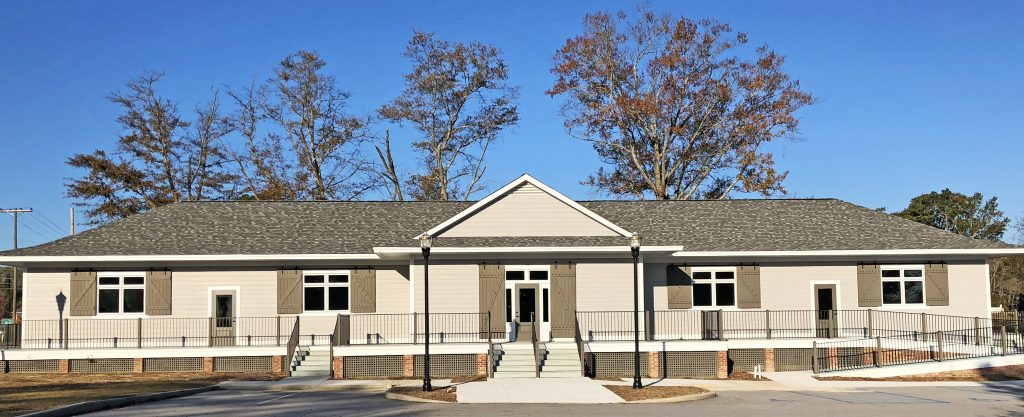
  • Pub-type restaurant to open in Doko Depot

    Doko Depot

    BLYTHEWOOD – In a special called Town Council meeting Monday evening, it was announced that the owners of the Old Mill Brew Pub in Lexington will be leasing half of the Doko Depot building for a similar restaurant to open under the name of Doko Station.

    “I’m very excited about the restaurant,” the Town’s economic development consultant said. “It will offer a full menu including salads, sandwiches, steaks and a number of craft beers.”

    The other half of the building will house Don Russo’s Freeway Music, Jeff Wheeler of Wheeler & Wheeler, LLC, a Columbia development company, told Council. It was also announced that Russo will now be purchasing the building, not Wheeler & Wheeler, who signed a contract with the Town last December to purchase the building for $325,000.

    By late January 2018, Wheeler asked for and was granted a more favorable earnest money arrangement and an extension on the purchase contract. At the same time, Freeway Music owner, Don Russo, told The Voice in an exclusive interview that he planned to lease the building from Wheeler and Wheeler. That extension ended last month without a closing.

    On Monday night Wheeler appeared before Council to ask for an additional 90-day extension of the contract and for Council’s approval of an assignment of Wheeler & Wheeler’s interest in the contract to Russo’s company, Blythewood Depot Property, LLC.

    Council voted unanimously to approve the assignment and to extend the inspection period of the contract for 90 days.

    “I don’t expect it to take nearly that long,” Mayor J. Michael Ross told council members. “But I don’t want to have to come back and approve another extension.”

    The Doko Station restaurant is expected to open in about three months, Wheeler said.

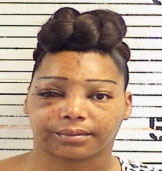
  • Woman, 31, charged with assaulting relative

    WINNSBORO – The first call came in to dispatch about 1:30 a.m. on March 31.

    “It happened at Washington Highlite Club, Sharonda Richards cut Charlene Sanders with blade, driving blue Honda to FMH,” the caller stated.

    The second call came in about 20 minutes later from Sharonda Richards. She said there was a fight at the club and requested a deputy meet her at her residence.

    Richards

    Charlene Monique Sanders, 28, told the responding officer when he arrived at Fairfield Memorial Hospital (FMH) that she was at the Washington Highlite Club on Jackson Creek Road when Sharonda Richards bumped into her inside the club. Sanders said, according to the report, that the two women began to argue, the altercation subsequently moved outside where they began to fight and Richards “pulled a knife and started slashing her [Sanders] in the face and arm.”

    Sanders said blood began to run down her face and that she was transported by two friends to FMH where she was treated for a deep laceration from over her left eye to her left ear and injuries to her right hand and wrist, the report stated.

    Sanders reportedly told the deputy that she and the defendant are relatives and that the incident was an ongoing occurrence precipitated by the two women dating the same man. That man was also one of the two people who transported Sanders to the hospital, the report stated, and who remained with her while she was being treated.

    At the same time, the defendant, Richards, 31, was being treated for a swollen right eye at Richland Memorial Hospital in Columbia and was reported to be sending threatening text messages to the man Sanders had told the deputy both were dating and who was with her at FMH.

    Following treatment, Richards also gave a brief statement to the deputy, claiming that after the two women began fighting and had fallen to the ground, she [Richards] pulled a folding utility knife with a razor for the blade from her bra and began swinging the blade, cutting Sanders.

    Asked by the deputy if she was targeting a particular area of the victim’s body, Richards reportedly told the officer, “I was just swinging my blade.”

    Richards was arrested on April 2, and charged with aggravated assault. She was released from the Fairfield County Detention Center on a $10,000 surety bond.

  • Head-on collision leaves two dead

    FAIRFIELD COUNTY – A head-on collision Monday morning resulted in two driver fatalities.

    Just before noon on April 9, a 2015 Kia and a 2013 Chrysler collided on South Carolina 200 near Patrick Road when the east-bound Chrysler drifted into the oncoming lane and hit the Kia. Both drivers were wearing their seatbelts. The driver of the Chrysler was pronounced dead at the scene. There were no passengers.

    The Voice will update this story as more information is available.


    Related: Drivers identified in Hwy 200 crash 

  • Board to list hospital for sale

    WINNSBORO – Although for the most part it was “business as usual” at the regular Fairfield Memorial Hospital Board of Trustees meeting March 27, the meeting ended with a vote that signals the final days of the hospital.

    After an hour-long executive session, the Board voted to “authorize the CEO to proceed with executing the agreement as presented with one revision.” But there was no clarification as to what the agreement was for or who it was with.

    The Voice has learned from other sources that the agreement is with Nelson Grubb Wilson Keibler, a Columbia commercial real estate company, to list the hospital grounds and facility for sale for $4.5 million and includes two general practitioner offices. One of those offices houses Fairfield Medical Associates and the other is vacant.

    At least one Board member complained that the Board had not been given the contract to read over prior to executive session.

    The motion to approve the agreement was passed with only Trustee Ron Smith objecting.

    “I won’t sign anything I don’t have the chance to read or study,” Smith said.

    The County is having the property appraised, which, County officials said, should take perhaps another week to complete.

    Hospital owes $3.3M

    During the Finance and Audit Committee meeting that preceded the full Board meeting, Mitchell pointed out that accounts payable continued to grow in February by more than $400,000, although some of that was due to bills that occur quarterly. By the end of February, the hospital owed more than $3.3 million to vendors and contractors.

    Financial Reports

    CFO Timothy Mitchell’s February financial report to the Board showed that while operating expenses were down by $716,027 from adjusted prior year operating expenses, gross patient service revenues decreased by $1,466,990 – twice as much – from prior year.

    The hospital experienced a net operating loss of $130,837 for February, but this reflected a premium refund the hospital received for workers compensation insurance, Mitchell said.  Excluding this, the adjusted operating loss for the month of February was $174,613. EBIDTA (earnings before interest, depreciation, taxes and amortization) for the five months ending Feb. 28 was a negative $765,793.

    The loss for February, Mitchell said, does not include any bad debt recoveries from the South Carolina Department of Revenue (DOR), because the DOR has been slow in processing tax returns and getting these payments out. Instead the hospital received the GEAR payment in early March.

    GEAR (Governmental Enterprise Accounts Receivable Collections) and tax offsets are used by the DOR to collect money owed to public entities, such as FMH, through the garnishment of state individual income tax refunds and additional collection tools, such as payment plans, wage garnishments and bank levies.

    “Had we gotten the GEAR payment in February, we would have gotten very close to a cash breakeven point,” Mitchell noted. “The February and March GEAR payments are about a $311,000 offset against bad debt.  We are anticipating making our budget with a $500,000 profit in March.  That should bring us very close to the budgeted EBIDA or cash loss for the six months ending [in March].”

    In other words, at the halfway mark, the hospital does not anticipate incurring a greater loss than the one accounted for in the hospital’s current budget.

    Mitchell also reported to the Board that the hospital management exceeded the cost saving goal they were charged with at the February Board meeting – to reduce overhead costs by 5% for an estimated target of about $23,000.  Instead, the hospital managed to identify $39,728 in monthly overhead cost savings, Mitchell said.

    And, if one excludes things like taxes and fixed costs that the hospital has no control over, the identified savings are closer to 15%, Mitchell added, although he did not specify exactly what had been done to achieve these savings or why the measures could not have been implemented sooner.

     “Business as Usual?”

    Even though – given the dire state of the hospital’s finances and the lack of patients – sale of the property can be seen as inevitable, the FMH Board and management have been carrying on with business as usual.

    The Board still heard department reports on patient safety initiatives, approved a purchase for an emergency room ventilator and talked about the hospital’s Facebook page.

    Certain costs, such as the hospital’s contract with HMS for housekeeping and maintenance services, remain and are on-going, meaning the hospital cannot reduce these costs even though there are fewer patients served and fewer services provided.

    Doscher reported that the strategic plan, which initially envisioned what the future might look like in three to five years, has been changed to reflect the fact that the hospital will be closing in 9 to 10 months. However, sources tell The Voice that the hospital is in talks with bankruptcy attorneys and that the doors could close as early as this spring.

    “Now the strategy is retaining the staff we have,” she said.  “We are not looking to grow right now, we have changed to a transition strategy and the things we are looking to do to transition from an acute care hospital.”

    And, finally, the hospital is closing the kitchen completely, concluding that it is too costly to keep it open. Despite the fact that it has been many months since there were inpatients, the hospital has been keeping the kitchen open to provide employees with lunch three days a week and meals to management and Board members during Board meetings.
  • Gladney sentenced to 14 years

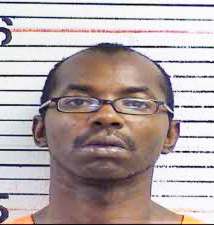
    Gladney

    WINNSBORO – A Winnsboro man has been sentenced to 14 years in prison for criminal sexual conduct with a minor under 11 years of age, first degree.

    Jonathan Gladney, 36, whose history of criminal sexual conduct against minors dates back to 2011, was sentenced on March 26 by Sixth Circuit Judge Brian Gibbons.  Gladney had been released on a $10,000 personal recognizance bond since Oct. 8, 2012.

    Gladney was charged with three counts of criminal sexual conduct with a minor or attempt, 11 – 14 years of age, second degree; five counts of criminal sexual conduct with a minor or attempt, first degree; two counts of engaging a child under 18 for sexual performance and two counts of sexual exploitation of a minor, first degree.

  • JWC deficits total $290K since 2011

    JENKINSVILLE – Jenkinsville Water Company has operated with a deficit every year since 2012, with revenue shortages totaling nearly $236,000 in the past two years alone, according to a review of its federal tax returns.

    On its Federal 990 tax forms, which non-profits like the water company must file and are public record, the JWC reported deficits in each of the past five years.  JWC reported a slight surplus of $1,442 in 2011, tax records show.

    In 2016, the water company reported a deficit of $107,135. The deficit was even higher in 2015 at $128,783, tax records show.

    The fiscal data shines a light on what’s otherwise been a murky subject for the JWC, which routinely shields financial data from public view.

    At its monthly meeting Monday, the board reviewed its financial report and profit and loss statements in open session, but didn’t discuss them.

    Greg Ginyard, the water company’s president, wouldn’t discuss finances when asked about them after the meeting.

    Jill Miller, executive director of the S.C. Rural Water Association, a support organization for the state’s 400-plus water companies, couldn’t be reached for comment.

    A representative of the group declined to comment about financial data, but noted the JWC has previously been a member of the rural water association, though it currently isn’t one.

    The representative also said JWC occasionally attends association events, most recently in December 2017.

    Of the $551,013 the JWC spent in 2016, the largest expense was for salaries and wages, accounting for $102,336, or about 18.5 percent, according to tax returns.

    Depreciation, depletion and amortization accounted for $93,217, followed by purchase of water at $88,465, tax records show.

    Travel expenses, an issue that’s arisen in past JWC meetings, have also been recurring line items in the water company’s tax returns.

    Since 2012, the water company has spent more than $67,483 on travel, including $12,687 in 2013 and $17,955 in 2015.

    The $14,880 reported in 2016 tax records is at odds with a figure of $8,089 announced during the water company’s 2017 annual meeting.

    At the time, JWC accountant Yvette Jones attributed the travel costs to routine trips.

    “That’s mileage for driving to the law firm, to the bank to make deposits and things like that,” Jones said at the time.

    Also at that meeting, Ginyard said travel expenses covered trips to meetings.

    A review of travel expenses for other S.C. water companies of comparable size or larger found most reported minimal to travel expenses. Many reported none at all.

    In 2016, the Marlboro Water Company reported $5,178 in travel expenses. Its annual revenue was $1.6 million, more than three times that of Jenkinsville Water Company.

    Browns Creek Water Company in Union County reported $1,443, while Oswego Rural Water Company in Sumter County spent $990 on travel, according to 2016 tax records.

    Water companies in Greenville, Orangeburg, Pickens, Marion and Chesterfield counties didn’t report any travel expenses in 2016, tax records show.

    The anomaly was High Hills Rural Water Company in Sumter County. It reported $60,053 in travel expenses, with overall annual expenses totaling $2.28 million.

  • JWC Board breaks FOIA laws

    JENKINSVILLE – The Jenkinsville Water Company (JWC) board of directors spent more time behind closed doors Monday evening than in open session, but it’s what happened after executive session that ignited fireworks.

    At its monthly meeting Monday, the JWC board of directors voted to accept three items merely dubbed “Items A, B and C” as discussed in executive session.

    Board members refused to specify the nature of Items A, B and C, and scolded audience members who challenged the vote.

    The meeting adjourned immediately after the votes, and board members promptly exited the building.

    Bill Rogers, executive director of the S.C. Press Association, said conducting votes without specifying what they’re about is in violation of the state’s Freedom of Information Act, or FOIA.

    “How can they vote on something without saying what you’re voting on?” Rogers said Tuesday. “It’s an illegal vote. They’re really out of control. They’re flying in the face of logic and the law.”

    The Voice pressed board president Greg Ginyard as he and other board members were exiting Monday’s meeting. Ginyard said the votes involved, “items brought up that the members requested.”

    When The Voice asked if Ginyard could be more specific, he declined to answer and the interview ended. Exiting board members referred The Voice to the water company’s attorney for further remarks.

    Reggie Belcher, a Columbia attorney representing the water company in a pending FOIA lawsuit, could not be reached for comment Tuesday.

    A telephone call had not been returned as of press time. An email auto reply stated Belcher would be out of the office until Monday, April 2.

    At Monday’s meeting, Ginyard scolded The Voice and Fairfield County businessman Donald Melton for openly challenging the secret vote.

    “You can’t blurt out in the middle of a meeting,” Ginyard said. “We’re past the public comment period so please don’t blurt out.”

    “We’re just asking for transparency,” Melton answered.

    Ginyard said public input is the proper time to address the board. Public input is scheduled before executive session, which prohibits the public from challenging the vote until the board’s next meeting on May 7.

    Melton sued the water company in 2016, citing multiple FOIA violations. The case is pending.

    According to the suit, the water company has claimed that it’s not a public body and not subject to FOIA. The S.C. Attorney General’s office said otherwise in a 2011 opinion.

    The eight-page opinion states the JWC formed in 1970 when the U.S. Department of Agriculture provided a loan as seed money.

    The JWC received $34,751 in government grants in 2007 and in 2011, the S.C. Budget and Control Board approved grants of $73,000 and $132,500 to the water company.

    It’s further stated in the attorney general opinion that Fairfield County also provided public funding for the JWC.

    “There is considerable evidence, based upon the information which you have provided, that the Jenkinsville Water Company has received and currently receives both federal and state grand funding,” the opinion states.

    The JWC’s retreat into executive session Monday also prompted a protest from The Voice.

    Ginyard initially stated the purpose of the executive session was for “contractual and personnel matters.”

    When pressed by The Voice for the specific purpose, a requirement under state law, Ginyard responded that the private meeting was to discuss a new well being installed and “employees.”

    State law requires public bodies to state the specific reason for entering executive session. Violating this statute has proved costly for other public bodies that have disregarded it.

    In 2016, an Aiken County judge ordered the City of North Augusta to pay $14,724 to a North Augusta resident who filed a lawsuit that said the city wasn’t specifically stating the reason for entering executive session.

    A year later, the city of Newberry was ordered to pay $13,708 for a similar violation in not stating a specific reason for executive session.

  • Planning Commission sides with developers against tree law amendment

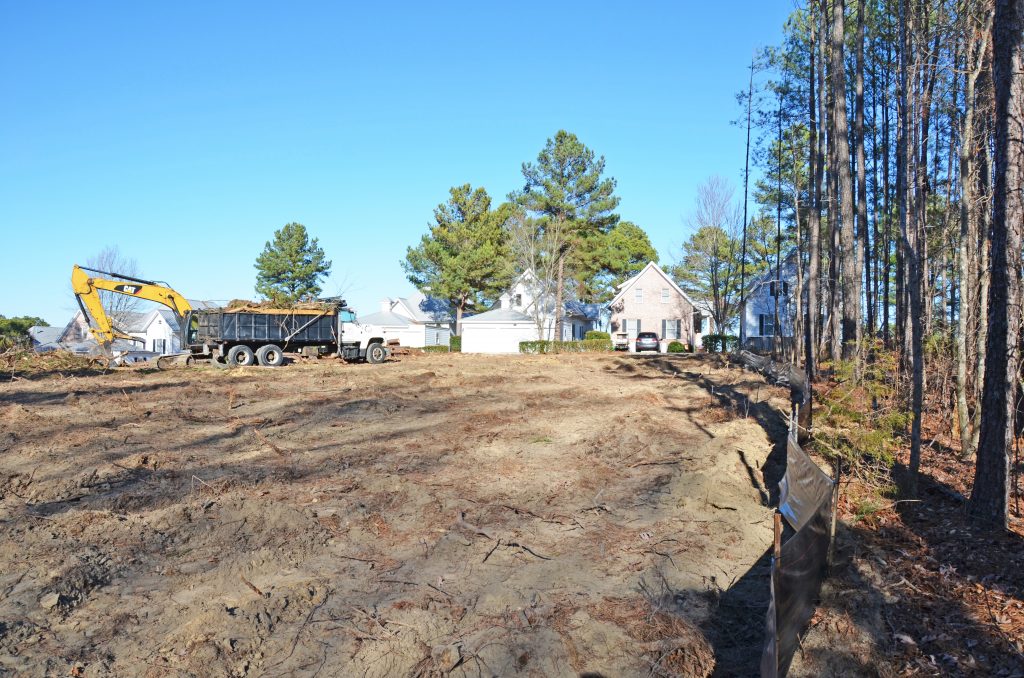
    This photo was taken on Jan. 14, 2018, shows a clear cut in progress on five contiguous wooded lots between Links Crossing Drive and Golden Spur Lane in Cobblestone Park. | Michael Criss

    BLYTHEWOOD – During its February meeting, Town Council voted to adopt an amendment to the town’s tree preservation ordinance that would remove an exemption that Town Attorney Jim Meggs suggested is being interpreted by developers as permission to clear cut lots without a tree removal permit from town hall.

    On Monday night, the Planning Commission saw things from the developers’ perspective and unanimously recommended that Council reverse its decision and vote against adopting Meggs’ amendment when it takes a second and final vote on the issue at its April meeting.

    For years, Blythewood’s town administrator, with input from the town attorney, planning consultant and planning commission, has been interpreting the town’s tree preservation code to mean the town government can enforce tree removal permits on undeveloped, platted, single-family residential lots in established subdivisions or new neighborhoods like Abney Hill Estates, Phase 2.

    But when Michael Criss, the town’s planning consultant, recently tried to stop developer D.R. Horton from clear cutting five lots in Cobblestone Park next to the mayor’s home, the town’s attorney, Jim Meggs, examined the town’s tree preservation ordinance more closely and decided the ordinance contained a weakness that allowed another interpretation of the ordinance, one that developers were using to clear cut lots without a permit from town hall.

    That weakness, Michael Criss told the Planning Commission on Monday evening, is found in section (H) of the ordinance and states that, those projects are exempt from the permitting process for tree removal if they have received major subdivision or site plan approval prior to the effective date of this subchapter and amended major subdivision and site plans.

    “If Mr. Meggs’ interpretation of the current code is correct and would prevail,” Criss told the Commissioners, “the town’s hands are tied in enforcing permits for tree removal on undeveloped lots in most of our neighborhoods in the town – Ashley Oaks, Abney Hill Estates, Cobblestone Park, Blythe Creek, Lake Ashley, etc.”

    To remedy what Council termed a loophole in the ordinance, Meggs’ drafted amendment surgically removes exemption (H) from the ordinance.

    Jesse Bray, representing D. R. Horton, pushed back against that amendment.

    “We’ve cleared [clear cut] dozens of acres in Cobblestone and it wasn’t an issue, but now it seems to be an issue because it’s next to the mayor’s house,” Bray told the Commissioners. “You throw around ‘flaw’ and ‘loophole’. It’s not a loophole. It’s in your ordinance. D. R. Horton is not trying to get away with anything. We’re the largest builder in the U. S. We don’t skirt rules,” Bray said.

    “Look at the plot plans…we have a 60-foot x 120-lot, the average lot size in Cobblestone. It has a 15-foot setback, a five-foot side set back and we’re allowed to clear a 20-foot buffer around the 50-foot x 50-foot home site. That leaves you ten feet in back. If we have a swale for drainage, that comes out of the ten feet,” Bray told the Commissioners.

    Complicating the issue is that the current tree preservation ordinance, which was adopted in 2015 with the intent of preserving trees, would have done just that had the General Assembly not interfered.

    “In its wisdom, the General Assembly voted in 2010 and again in 2013 to protect developers hard hit by the 2008 recession by extending the life of the existing local development permits for nine years,” Criss said.  “That kept permits alive that dated as far back as 2007. Since then, Blythewood has adopted stricter tree preservation regulation and stricter storm water management regulations. But just about all of the town’s projects now fall under the General Assembly’s grandfathered rules,” Criss said. While the grandfathered rules continue projects previously permitted for roads and infrastructure, they can also thwart the town’s current ordinance by enabling previously permitted mass-graded projects to remove all trees from individual lots as well as roadways, storm drainage areas, etc.

    “Under the current ordinance, we felt the individual lots were protected from clear cutting in Cobblestone Park,” Criss said. “The town attorney felt there was a weakness in the ordinance and he is trying to fix it with this proposed text amendment.”

    Town Council is expected to take its second and final vote at the April meeting.

  • Fire burns 10 acres near downtown Blythewood

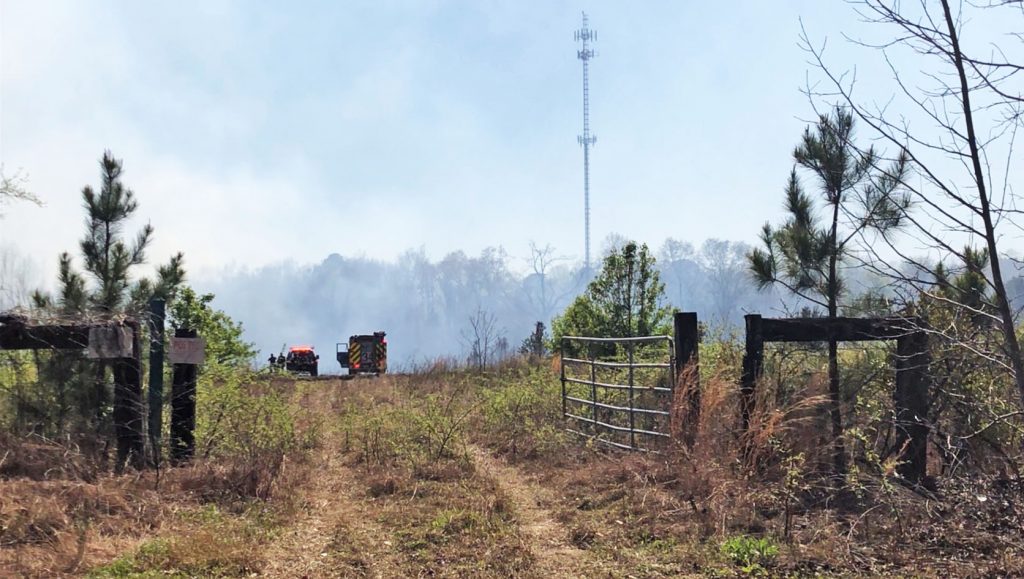
    BLYTHEWOOD – A brush fire consumed about 10 acres of a 158-acre parcel on Langford Road, just outside of the Blythewood town limits on Sat., March 31.

    The center of an open field on the property was burning and smoke was billowing above tree tops when firefighters arrived on scene around 2:30 p.m. The fire was extinguished by a little after 6 p.m. according to a fire report by the Richland County Fire Department.

    The property is one of two joining parcels owned by Jacobs Creek LLC that stretch between Langford Road and I-77.

    The fire report stated that the fire was pushed in multiple directions by the wind. Due to the size and nature of the fire, the S. C. Forestry Commission as well as other units were called.

    An investigation by the Richland County Fire Department concluded that the cause of the fire was undetermined. No structures were damaged.

  • Cookendorfer elected RW Mayor

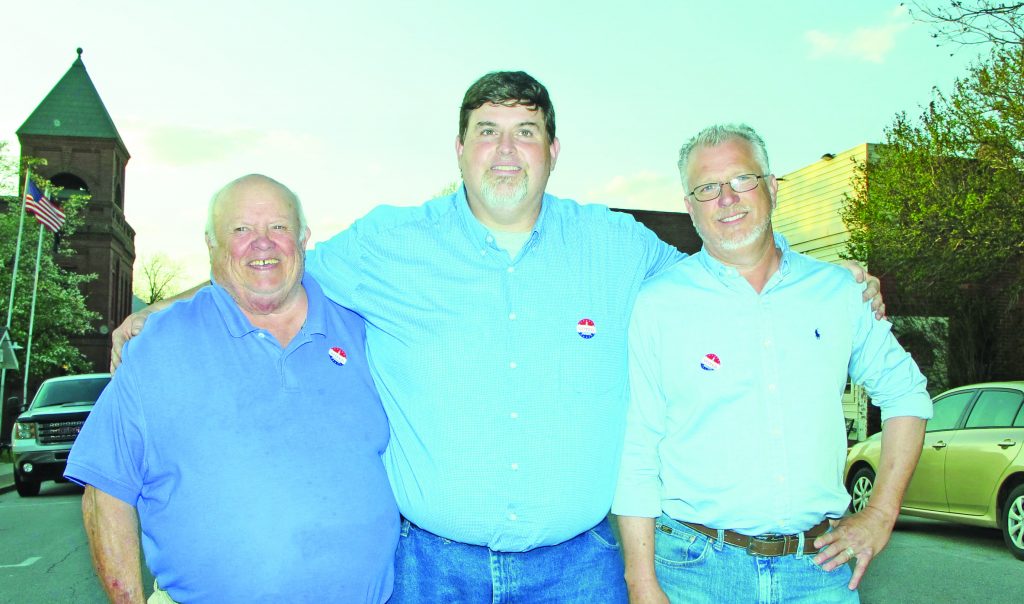
    RIDGEWAY – In a deeply divided race for mayor and two council seats, three candidates who ran as a block won as a block, tipping the balance of power in the Ridgeway town government.

    Councilman Heath Cookendorfer, with 71 votes (54.20 percent), bested Councilwoman Angela Harrison, with 59 votes (45.04 percent) to capture the mayor’s seat.

    Newcomer Dan Martin, with 77 votes (30.43 percent), and former mayor and councilman Rufus Jones, with 66 votes (26.09 percent), won the two vacant council seats over Rick Johnson, 59 votes (23.32 percent), and Roger Herring, 51 votes (20.15 percent).

    There was one write-in vote for Rufus Jones for mayor. Of the town’s 229 registered voters, 131 (57.21 percent) turned out to cast their ballots.

    Among the issues at stake in the race were the future of the current four members of the Pig on the Ridge steering committee and Bella the dog whose tenure at Town Hall had been on the block for more than a year.

    “It feels good to be in a position to get Ridgeway back on track,” Cookendorfer told The Voice following the election. “I’m thankful for those who voted for me and for those who supported me. I want to thank my running mates, Dan Martin and Rufus Jones, and I’m proud of how they ran their campaigns. We’re going to work together and with the council. We need cohesiveness so we can move Ridgeway forward. Go Ridgeway!”

    Martin echoed Cookendorfer’s desire to bring the town together after a campaign that divided much of the town.

    “What Ridgeway needs most right now is unity between residents and council,” Martin said. “It was clearly a divided race, and we have some people who are hurting. This is Ridgeway, and I hope we can all come together now, heal and move forward. We will do our best, I promise, to help make that happen.”

    Rufus Jones, mayor from 2000-2004, made a political comeback that, he said, made him feel really fortunate.

    “Our goal, all three of us, is now to help our town come together,” Jones said. “I appreciate, more than you know, everyone who supported us and everyone who came out to vote. My goal is to do a good job for Ridgeway. And if I don’t, tell me.”

    Debby Stidham, Director of Voter Registration said the canvas and certification of the votes will take place at the voter registration office at 10 a.m. Friday.