Tag: Richland Two

  • R2 board votes 4-3 to not be required to hear grievances

    Gilchrist: The Board’s Vote Could Deny Due Process

    COLUMBIA – Discussion of a complaint policy took center stage at Tuesday’s meeting of the Richland Two School District Board of Trustees.

    The two opposing factions on the board appeared to talk past each other about the intent of a change in wording to a rule known as “Policy KE,” which governs complaints made to the school district. It became the center of discussion during the meeting.

    Those in favor of the new language argued that it would better direct complaints through the proper channels before they reach the board, while those in favor of the old language argued that it better protected the rights of parents and members of the community.

    The board never discussed the content of the policy’s few paragraphs or sought compromise wording; instead, the revision passed with the characteristic 4-3 vote that often occurs when the board considers controversial issues.

    The old wording, most recently adopted in 2019, briefly described a process of referring complaints to administration for resolution, making it clear that the complaining person, if not satisfied by the outcome, has a right to appeal the issue to the school board.

    The new wording, based on a model policy of the South Carolina School Boards Association, is more verbose and details the order of authorities to contact by those seeking resolution of complaints.

    But it then goes on to add the two additional items with which the speakers and board members – and others in the community – took issue:

    The first: “Anyone who defames a district staff member and damages a person’s professional reputation, whether before students or any third party, may be subject to legal action brought by the staff member.”

    The second: “The board is not obligated to address a complaint. If the board decides to hear the issue, the board’s decision is final. Otherwise, the superintendent’s decision on the issue is final.”

    During the meeting’s public comment period, two men spoke against the new wording, requesting that any changes to the policy be rewritten with clearer, more precise wording and eliminate parts that stifle the voice of the public.

    “It seems to me what we are doing here is like they are changing the rules of the game. When you change the rules of the game, you stifle collaboration and trust, hence the problem never gets resolved,” said Larry Smalls, a parent who spoke at the meeting.

    “This is not a popularity contest sitting in these [school board] seats; you’re dealing with the public. You’re dealing with taxpayers, people’s livelihoods, their kids, and I’d hope you would take it seriously and not just change the rules so you can get commendation from the people you select coming up here.”

    Stephen Gilchrist, who is a founding member of the Richland Two Black Parents’ Association and past chairman and current member of the Richland County Planning Commission, as well as chairman of the South Carolina African American Chamber of Commerce and a member of the U.S. Commission on Civil Rights, e-mailed concerns about the policy to the board members before the meeting, noting the risks of vague terminology, lack of accountability, and a potential chilling effect on free speech.

    “We have a history that has not been too far in our past that prevented folk from being able to have a voice in the political process and the public policy arena, so my hope is that… a district that classifies itself as premier does not in some ways revert back to those days of old,” Gilchirst says.

    “I don’t see this any different than the times where black people were asked to count how many jellybeans were in a jar to vote.”

    After the vote, he expressed disappointment in approval of a policy that he says will deprive parents and students with grievances of due process.

    He says it would be better – and possible – for school board policy to strike a balance that both protects educators from wrongful accusations and protects the right for people to weigh in on issues impacting schools and education in the district.

    The policy change was considered in the context of two incidents that occurred at recent school board meetings.

    In one case, a parent publicly accused a school administrator of sexually abusing a child, an allegation that the parent later apologized for and declared to be false.

    In another case, two men who sometimes express criticism of board actions and policies and board behavior were removed from a school board meeting on Jan. 25 after witnesses say the two men and others were aggressively confronted by Superintendent Baron Davis and his wife, schoolteacher Pamela Davis – an incident that has resulted in multiple complaints against the district.

    One of the men, local blogger Gus Philpott, says it was a lengthy struggle to get the details of his ban from district property in writing – and maintains that he did no wrong and violated no policy on the evening in question, a claim that’s backed up by eyewitness accounts.

    The other individual who was banned, parent Gary Ginn, has a similar story. Eyewitnesses say he spoke up when a 14-year-old student was verbally attacked by Mrs. Davis. Ginn has expressed criticism of board policies in recent months, but was orderly in expressing that criticism.

    Philpott, 83, contends that the real reason for his ban is to silence his online journalism and protect corrupt officials from the public’s right to information about the actions of elected leaders. His blog, which frequently draws attention to school board issues, is often critical of current school system leadership.

    Philpott has sought to appeal the decision to the school board under the old wording of the complaint policy, he says – a right that he believes prompted the new wording and a right that was taken away by the new wording approved Tuesday night.

    Board Chair Theresa Holmes provided a copy of the document stating that administrative authorities and the school board had decided to uphold Philpott’s ban from school property for the remainder of the school year.

    “After reviewing and considering the record in this matter, which included statements from you regarding the January 25 incident, the Board voted to uphold the administration’s decision in this matter, which means that your trespass notice will continue through the end of the 2021-2022 school year,” according to the letter, which is signed by Holmes.

    Holmes, who supported the policy change, during the meeting accused board and community members of insincere grandstanding on the issue.

    “There [were] two weeks to make changes to this, and the day before there’s all this, because people want to come to a public meeting and make all these statements and these lectures and all that because it’s in public,” Holmes said. “Let’s not play the game up in here tonight because that’s what we’re doing.”

    Davis, the superintendent, said the new policy on public complaints is similar to that governing personnel matters. He said that, hypothetically, under the old policy, the board could get stuck spending large amounts of time hearing complaints that have not gone through the proper channels.

    “The policy has nothing to do with public participation. There’s a different and separate public participation policy,” Davis said in the meeting.

    Board member Lashonda McFadden said the new policy can prevent complaints that do go through proper channels from being appealed to the board and tie up time-sensitive issues in months of bureaucracy, to the detriment of students and parents who need help.

    Board member Monica Scott implied that the policy change was a form of hypocrisy.

    “We are elected officials. The public and the parents are actually the reason why we are sitting here, and… when many of us were campaigning, we were campaigning because we want to be a voice for the community, we want to be a voice for parents, we want to be a voice for equity. We want to be a voice for integrity… but once we get here, we’re not who we say we want to be,” Scott said.

    “I’m going to respond to every e-mail that comes to me, whether it’s a complaint, whether it’s a compliment, whether it’s something that they’re not happy with – it doesn’t matter to me because we’re here because of the public, and I just think that when we’re trying to take away the right of the people who have placed us here, I have an issue with that.”

    The new policy passed with the support of Holmes, James Manning, Amelia McKie, and Cheryl Caution-Parker. McFadden, Scott, and Lindsay Agostini voted against it.

    Philpott, meanwhile, says he’s looking for a lawyer to help him take his complaint against the district to the next level: the courts.

    “My complaint was that I myself was not guilty of their charge and that I did not get a chance to defend myself,” he says, contending that school board policy was applied improperly in his case – and that rules barring speakers from mentioning individuals or job titles are also improper.

    “The board says there’s no appeal. No, no, no. There’s always an appeal,” says Philpott, who promises to resume attending school board meetings in July, as soon as his ban expires. “A person can always go to court.”

    Gilchrist, meanwhile, says he and the Black Parents’ Association are looking forward to this year’s school board election. He says there are a lot of potential candidates preparing for the start of campaign season – and November’s election promises to be an interesting one.

    “I guess that the biggest concern for me is protecting the rights of the citizens of the community who have children in the district, who are taxpayers in the district, and who sometimes do offer constructive criticism,” he says, calling the Jan. 25 incident “unfortunate” and the actions of current leadership “exhausting.”

    “I am presently encouraged that… we’re seeing a large segment of our community – black and white, rich and poor, Democrat and Republican – who say enough of this, and that’s encouraging,” he says. “It’s time to get to get some adults in the room who will run the school district on behalf of the children.”

    Board members up for re-election are Holmes, McKie, Caution-Parker and Manning.

    Looking forward, he says, he’s hopeful that the upcoming elections will result in more civility in school district leadership at Richland Two.

    “It’s my hope that as we move toward these elections in November, that parents are paying attention, parents are beginning to get more engaged, and they see this for whatever it is,” Gilchrist said.

    “We look to bring on some energy on the school board that cares about governing, that cares about parents, that cares about learning, that cares about the things the parents care about, and not about using taxpayer money, using the district apparatus, and using the power of governing to silence the community.”

  • R2 board suspends public comment

    SCSBA Recommends Districts Not Accept FOIA Requests During Pandemic

    COLUMBIA – In an effort to curtail the spread of COVID-19, the Richland Two school district has followed the lead of other government agencies by streaming meetings electronically.

    No member of the public may attend meetings in person nor participate in public comments. They can listen to audio on the district’s website.

    By a 6-1 vote, the Richland Two board voted Tuesday night to suspend policy BEDH, which spells out the district’s public participation policy. Board trustee Lindsay Agostini opposed the measure.

    In a related vote, the board also voted to cancel the April 7 meeting, citing a lack of business to address. That vote passed unanimously.

    Agostini said she voted against suspending policy BEDH, fearing it would prevent parents with students facing expulsion hearings from addressing the board.

    “While not frequent, on more than one occasion we’ve had parents come and address the board in public participation,” she said. “As long as we’re having a board meeting and talking about appeals, I can’t support this.”

    Trustee Amelia McKie said suspending the policy doesn’t prevent parents or the community from communicating concerns to the board. She said it’s imperative to make meetings “more skeletal” to protect district staff, students and the public from COVID-19, also known as the novel coronavirus.

    Initially, the board agenda only stated that the board planned to vote to take action on policy BEDH, without any explanation. Board agendas typically include supporting documentation further explaining the measure being voted on.

    After The Voice brought this to Richland Two’s attention, the district amended the agenda to state that the board planned to suspend policy BEDH.

    The decision to suspend public participation came at the recommendation of the SCSBA, according to the revised agenda. On its website, the SCSBA recommends “temporarily eliminating public comment” periods as a way to curtail COVID-19.

    “If your board policy allows for public comment, the board should make a motion and approve temporary suspension of the associated policy… until the COVID-19 threat has ended,” the SCSBA site states.

    Jay Bender, a media law attorney with the S.C. Press Association, of which The Voice is a member, said there’s no law requiring local governments to provide a public comment period. Public bodies are only required to allow the public to speak at meetings where there’s a public hearing, such as during budget passage.

    The S.C. Freedom of Information Act (FOIA) also allows public bodies to conduct business electronically. Streaming can be by video or audio; the law only states such meetings be broadcast electronically.

    “It would be better if they could stream it,” Bender said.

    Richland Two’s audio streaming encountered some hiccups Tuesday evening.

    “The school board association has never thought anything should be public. They are run by superintendents whose goal is to keep all unfavorable news about schools out of the press.”

    Jay Bender, Media Attorney

    The Voice attended the meeting remotely and experienced occasional interruptions in audio. Sometimes audio volume fluctuated and other times, audio cut out altogether.

    During a discussion of cancelling the April 7 board meeting, Agostini reported that she couldn’t hear Superintendent Dr. Baron Davis’ explanation of the measure.

    “That was a very bad echo. I didn’t hear a word that was said,” she said.

    Other board members reported not being able to hear portions of the meeting.

    Richland County resident Gus Philpott, a frequent critic of the board, vehemently objects to suspending public input. He also takes exception with virtual meetings as well as board members participating remotely versus in person.

    “There is no need to suspend BEDH. If the Board is successful at prohibiting the public from attending the meeting, there won’t be anyone to speak, will there?” Philpott wrote in an email to board members.

    “Please consider how very serious it is to attempt to silence the public,” Philpott continued. “You might benefit by re-reading the First Amendment of the U.S. Constitution, which refers to abridging the freedom of speech.”

    The South Carolina School Board Association (SCSBA) also recommend that school districts not accept any FOIA requests submitted during the coronavirus crisis and de-prioritize requests filed prior to Gov. Henry McMaster’s state of emergency declaration.

    Bender disputed the legality of those suggestions.

     “The law establishes deadlines and I don’t think the governor or anybody else can suspend the law,” Bender said. “The school board association has never thought anything should be public. They are run by superintendents whose goal is to keep all unfavorable news about schools out of the press.”

  • Richland Two’s new kind of ‘homeschool’

    BLYTHEWOOD – When Governor McMaster mandated on March 13 that schools, colleges and universities across the state had to shut their doors until at least March 31, teachers and administrators had to prepare and execute, in a very short period of time, a plan to continue educating their students remotely.

    Richland Two School District administrators wasted little time in formulating a plan and prompted their teachers, several days ahead of the shutdown, to be proactive in planning for the Covid-19 closing of schools.

    The plan began to unfold as the district packaged 10 days of learning activities in remote e-learning packets for grades Pre K- 5 district-wide.

    R2 teacher Dr. MaryPaul Hoile finds innovative ways to reach her students remotely. | Contributed

    “Teachers at my school were given all day on Tuesday to prepare to teach our students remotely,” Dr. MaryPaul Hoile said. Hoile, a 25-year veteran teacher, is in her first year of teaching at Bridge Creek Elementary, a STEAM-M school. She teaches child development for children age four (CD-4).

    “We immediately focused on getting our rooms prepared for the long absence. We gathered up materials and contacted our students/families,” She said the teachers at her school were given specific schedules and directions for the first few days of the shutdown.

    According to Hoile’s review of week one, all is going as smoothly as possible, and students and teachers are now in their second week of e-learning. She said her students receive their learning packets every Monday morning either by email, in person by way of car rider line pick up or online via her class’s private Facebook group.

    Hoile depends heavily on Facebook and other social media to connect with her students during the pandemic. She begins class each weekday morning by going ‘live’ at 9 a.m. and greeting her students and their families.

    “I had previously set up an online Facebook group connection to share a virtual newsletter with all my 20 students and their parents. They (her students) need connection in order to allow for optimal learning,” Hoile said. “We didn’t have an opportunity to say our goodbyes for such an extended period of time, so Facebook provides that connection,” Hoile said. “All of my students’ parents and guardians actively participate with their children by logging in each morning and responding to questions or by greeting each other using the CHAT feature. It’s been a wonderful experience as I read books and sing songs with them. I have also had guest readers/speakers share videos in our group,” Hoile said.

    In addition to following her typical morning meeting time as much as possible, she allows time for her students to work on their remote learning packets. Throughout the day she will go “live” again to add a video of herself or another guest reader and to add resources for the parents to use.

    “I realize that this is a very stressful time for families as they work hard to teach their children at home, so I don’t want to overwhelm them with too much work. Resources are a great way to allow parents the opportunity to extend learning.”

    Hoile credits her previous online teaching experiences in helping her to be prepared for this unique situation. She is also in contact with her co-teachers in the child development program by way of virtual meetings where they can plan and share ideas with one another.

    “I feel that we have taken this negative situation and made it the best possible experience for all of our students,” Hoile said. “By joining each other’s Facebook pages, we (CD teachers) have been able to observe and learn from each other to better teach our students,” she said.

    As teachers, students and parents learn the ropes of remote teaching and learning, posts are popping up on social media comically depicting frustrated parents, and students eager to get back into the school setting with real teachers and teachers, like Hoile, proving their metal under difficult circumstances.

  • R2 board OKs $1,000 bonuses for teachers

    Revenue Source is $16.9M Budget Surplus

    COLUMBIA – Richland Two school board approved $1,000 bonuses for its 3,600 district employees during a special called meeting Tuesday night.

    The district allocated $4.1 million of a $16.9 million budget surplus for teachers and all full-time permanent employees. Superintendent Dr. Baron Davis said the allocation is an effort to be competitive with surrounding school districts that have recently approved similar bonuses.

    Teachers’ salaries in Richland Two, on average, are $52,149, higher than the $50,182 average of teachers statewide.

    Besides the bonuses, other allocations from the surplus approved by the board include $750,000 for classroom supplies ($25 per student), $750,000 for media center upgrades ($25 per student) and $3.5 million for building renovations to help lessen the impact on taxpayers for the funding of annual capital improvement expenditures, according to an email released by the district following the meeting.

    The remaining $7.8 million of the surplus will be rolled over into the FY 2019-20 budget rather than into the fund balance as the district has done in the past.

    The source of the surplus was a combination of $9.3 million in lower expenditures than budgeted (primarily in salaries and fringe benefits) and $7.6 million in higher than anticipated revenues ($3.6 million in local taxes and $4.1 million in state revenues), according to district officials.

    Last year, the state legislature spent $160 million for a four percent raise for teachers.

     School officials say the $1,000 bonuses could be paid out as early as next month.

  • Fairfield schools Report Card released

    How Area School Districts Compare

    WINNSBORO – A major talking point Fairfield County education leaders have been making about the 2018 state report cards is that no Fairfield school rated Unsatisfactory.

    “We were competitive,” said Dr. J.R. Green, district superintendent, said of the results at a recent Board of Trustees meeting. “Virtually every district that adjoins Fairfield County had at least one unsatisfactory school.”

    That ratio is actually closer to 50-50 for the six surrounding districts, with three districts reporting no Unsatisfactory schools and three others reporting at least one Unsatisfactory school. Union, Newberry and Lancaster counties didn’t report any Unsatisfactory schools, according to report card data. Chester, Kershaw and Richland Two reported at least one Unsatisfactory school.

    Additionally, Green’s comparison includes some districts substantially larger than Fairfield County, which has seven schools, excluding the state-run Midlands Stem Institute which has two schools.

    Chester has 13, Newberry has 14, Kershaw has 18 and Lancaster has 20. Richland Two is the largest adjoining district with 32 schools.

    Fairfield

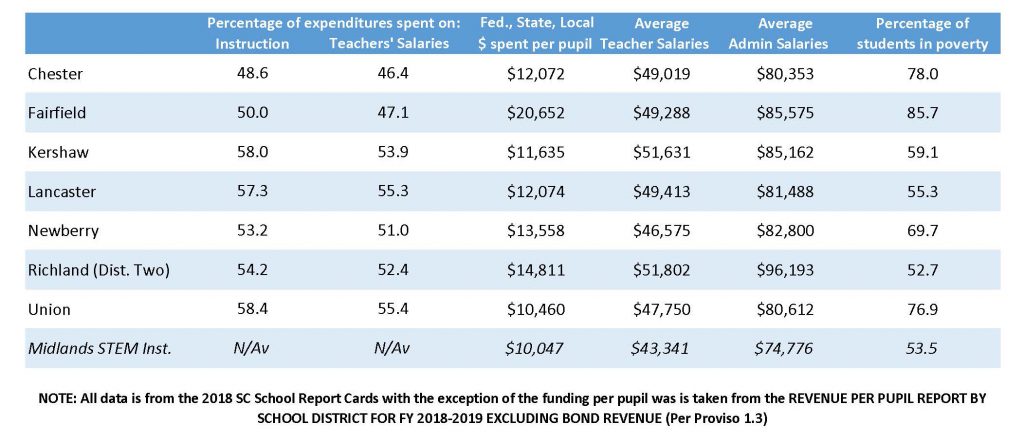
    With the highest federal, state and local funding per pupil ($20,652), the highest percentage of students in poverty and the smallest average number of students per teacher ratio, Fairfield County had one school rated as Excellent, and another received a Good rating on the 2018 SC school report card. Three others were rated Average and two were rated Below Average. None were Unsatisfactory, the lowest rating.

    Here’s a breakdown of how each school performed:

    • Fairfield Magnet School for Math & Science (Excellent)
    • Kelly Miller Elementary (Good)
    • McCrorey-Liston Elementary (Average)
    • Geiger Elementary (Average)
    • Fairfield Central High School (Average)
    • Fairfield Middle (Below Average)
    • Fairfield Elementary (Below Average)

    Chester

    Chester, with the highest average student to teacher ratio (25.4 students per teacher), second highest percent of students in poverty (78.0) and third lowest average teacher salary ($49,018), struggled the most among the seven districts. Chester had one Excellent school, three Average schools, six Below Average schools and three schools receiving the state’s lowest rating of Unsatisfactory.

    Kershaw

    Aside from reporting one Unsatisfactory school, Kershaw’s 18 schools performed well, with five schools earning Good ratings, nine rated Average and three rated Below Average.

    Lancaster

    In Lancaster County, eight schools scored either Excellent or Good. Seven were rated Average and five received a rating of Below Average. Lancaster had no Unsatisfactory schools.

    Newberry

    Newberry County, with the lowest average pay for teachers ($46,575) of the seven districts, and the fourth highest percentage of students in poverty (69.7), reported three schools with Excellent ratings, five schools with a Good ranking, five schools with an Average rating and only one school with a Below Average rating, report card data shows. Newberry had no Unsatisfactory ratings.

    Richland Two

    In Richland Two, about one-third of schools (11) scored Good or Excellent on the report cards. Of the nine Blythewood area Richland Two schools, six were among the 11 top schools:

    • Langford Elementary (Excellent)
    • Round Top Elementary (Excellent)
    • School for Knowledge Elementary – housed in Muller Road Middle (Excellent)
    • Bethel-Hanberry Elementary (Good)
    •  Sandlapper Elementary (Good)
    •  Blythewood High (Good)

    Westwood High, Blythewood Middle and Muller Road Middle (grades 6 – 8) schools received an Average rating,

    The Center for Achievement elementary magnet school housed in the Kelly Mill Middle school, is the only Blythewood area school to receive an Unsatisfactory rating. Two other Richland Two schools also received Unsatisfactory ratings.

    Union

    Union County, which has eight schools, reported one Excellent school, six Average schools and one Below Average school. Union has the third highest percentage of students in poverty (76.9) and allocates the highest percentage (55.4) of its expenditures to teacher salaries which, at an average of $47,750, are the second lowest of the seven districts.

    Midlands Stem Institute

    The report cards list the Midlands Stem Institute, or MSI, of Winnsboro under the S.C. Public Charter School District. The state issued two report cards for the K-8 school – one for elementary grades and one for middle school grades:

    • MSI, elementary (Below Average)
    • MSI, middle (Average)

    The school added ninth grade last fall which was not included in the 2018 ratings. MSI receives $10,047 in federal, state and local funding per pupil, about half the amount the Fairfield District receives and the least of any of the other seven comparison districts.

    Comparing the seven districts

    In 2018, the state revamped the report cards into two main categories: Academics and School Environment. There are six subcategories under Academics and four under School Environment.

    At the Dec. 18 school board meeting, Green stated that the new report cards create a “forced distribution” of schools.

    According to the model, only the top 15 percent of schools are rated Excellent. The next 20 percent receive a Good rating, while the middle 35 percent receive Average ratings.

    Below Average schools make up the next 20 percent while the bottom 10 percent are Unsatisfactory.

    “This system has negatively impacted all kinds of districts with all kinds of populations,” Green said at the meeting. “It creates a ‘Hunger Games’ mentality. Everyone is scrambling to the top and to reach the top.”

    Class sizes

    Fairfield County’s student to teacher ratio of 16.9 to 1 is the smallest [number of students per teacher] ratio compared to the six districts surrounding Fairfield.

    Richland Two has the next lowest ratio at 19.7 to 1. Chester has the highest at 25.4 to 1.

    Teacher Retention

    Statistically speaking, teacher retention appears to be an issue for Fairfield, according to report card data.

    Fairfield’s percentage of teachers on continuing contract is lowest (63.2 percent) of the seven districts. The six surrounding districts range between 75 percent and 81.6 percent, with Union County leading the pack even though it has the third highest percentage of students in poverty and the second lowest average teacher salaries according to report card data.

    Fairfield falls in the middle in average teacher salaries at $49,288. Richland Two leads at $51,802, followed by Kershaw at $51,631.

    Newberry trailed all seven at $46,575 despite its schools receiving comparatively high ratings.

    Other average salaries by district include: Union, $47,750; Chester, $49,019; and Lancaster, $49,413.


    All Report Card data is available online at https://ed.sc.gov/data/report-cards/sc-school-report-card/