Tag: Richland 2

  • R2 Board extends Super’s contract

    COLUMBIA – On Tuesday, Sept. 18, 2018 the Richland School District Two Board of Trustees met to conduct the superintendent’s performance evaluation for Dr. Baron Davis.

    Davis, Superintendent for Richland School District Two,  was given an overall distinguished evaluation for the 2017-18 school year, his first year as superintendent of the district, by the School Board, it was announced at Tuesday evening’s school board meeting.

    Board Chair Amelia McKie also announced that the board approved a motion to extend Davis’ contract with the district by one year, to June 30, 2021, and to increase the contribution to his annual annuity by 2.5 percent effective Sept. 30, 2019.

    Board members assessed Davis’ performance in the areas of policy and governance; planning and assessment; instructional leadership; organizational management; communications and community relations; and professionalism.

  • Back to School

    BLYTHEWOOD – Marsha Washington, left, and Christine Stoney, kindergarten teachers at Bethel-Hanberry Elementary School, ready their rooms with last minute touches before welcoming their charges on Wednesday, the first day of school for Richland 2 students.

  • Legal loopholes complicate R2 code

    BLYTHEWOOD – It’s being billed as a way to simplify the school district’s procurement code.

    But loopholes in state law could pose legal and ethical complications to the Richland 2 school procurement policy.

    Approved at its July 24 meet­ing, the Richland 2 Board of Education voted to strike a se­ries of policy revisions, includ­ing one that prohibited the dis­trict from doing business with board members.

    “No purchase of materials or services shall be made from any member of the Board,” the stricken measure states.

    Dr. Harry Miley, the district’s chief financial officer, said via email that the probation al­ready exists elsewhere in the board’s policy. He also said the district follows state law.

    “A board member may not provide services or sell prod­ucts to the district or to in­dividual schools,” the policy states.

    “We are undertaking a com­prehensive review and update of all of our policies with par­ticular attention to trying to eliminate places where the same topic is addressed in mul­tiple policies,” Miley said. “We are also undertaking a review of our procurement code to see if there are revisions needed.”

    State law, however, appears to provide an escape route for public bodies whose elected members could potentially be awarded contracts.

    The law states that: “A public official, public member, or pub­lic employee may not have an economic interest in a contract with the State or its political subdivisions if the public offi­cial, public member, or public employee is authorized to per­form an official function relat­ing to the contract.”

    “Official function” is defined in the law as “writing or pre­paring the contract specifi­cations, acceptance of bids, award of the contract, or other action on the preparation or award of the contract.”

    Similar verbiage appears on the State Ethics Commission website. But the law was revised in 1995, with an amendment that appears to allow elected officials to bid on contracts if they don’t participate in awarding the contract.

    “Nor does it [the law] prohibit the award of contracts awarded through a process of public notice and competi­tive bids if the public official, public member, or public employee has not performed an official function regarding the contract,” the amendment states.

    On July 24, Richland 2 board members voted unanimously to approve the revised purchasing policy. There was no discussion of the policy change prior to the vote.

    Miley said during the June 26 board meeting that the changes were made merely to simplify the district’s pro­curement code.

    “We think the policy should be very simple,” he said. “We have a procurement code. We think the policy should state that we adhere to the procure­ment code.”

  • R2 Board proposes $468.4M bond

    BLYTHEWOOD – Two football stadiums, a fine arts center and facility upgrades at several schools are among the taxpayer-funded initiatives Richland 2 voters will decide in a November referendum.

    Richland 2 school board members, though, aren’t prepared to dive into a proposed $20 million aquatic center just yet.

    On July 24, the board voted 6-1 to place $468.4 million worth projects on the November ballot. Board member Lindsay Agostini voted against the measure.

    If approved, school district millage would increase about 10 mils, with the typical homeowner paying an extra $65 a year in taxes, said Harry Miley, the district’s chief financial officer.

    Miley said the average Richland 2 home is valued at $167,000, the metric he used to define a typical homeowner.

    Board member Cheryl Caution-Parker said it’s been 10 years since Richland 2 last passed a bond referendum.

    “We always do what we say we’re going to do with the funds. There’s never been any question, there’s never been any doubt,” Caution-Parker said. “When we go for a bond referendum, it’s not spur of the moment. It takes a lot of time and effort.”

    Before the vote, Agostini said she supported everything in the bond referendum, but also pressed for the inclusion of a $20 million aquatic center. She said swimming is a needed skill for Richland 2 students, referencing two recent drownings.

    Agostini also said the Blythewood and Spring Valley high school swim teams lacked proper facilities to hold region swim meets.

    “We just don’t have the facilities,” she said. “I would like to see a pool included in a referendum.”

    Other board members were sympathetic, but also noted that upgrading existing facilities and making schools more safe were higher priorities. They also questioned whether voters would buy into an aquatic center with $468.4 million in projects already bundled into the referendum.

    “It would just be absolutely wonderful to have an aquatic center here in Richland 2,” Caution-Parker said. “However, I think we need to do a complete study. We need to pick a site. We need to have partnerships. We need to have the plan completely in place to present to the community.”

    Aquatic centers elsewhere in South Carolina, such as in Greenville, Myrtle Beach and North Myrtle Beach, are largely functions of county or municipal governments, according to the aquatic centers’ websites.

    Other aquatic centers in which a school district is involved typically share costs with other government entities.

    For example, the York County Aquatic Center is a joint venture between Rock Hill area YMCAs and local schools, according to the Rock Hill & Fort Mill Visitor’s Bureau.

    The City of North Charleston and Dorchester 2 are joining forces to build a $20 million center, with Dorchester 2’s portion amounting to about $7.5 million, according to media reports.
    The ballot measure that Richland 2 board members approved actually contains two separate questions, according to the school district’s website.
    The first asks voters for permission to issue bonds totaling $381.95 million. Items covered under the bond issue include:

    • Safety improvements at all schools
    • Buying new buses and enhancing security in existing buses.
    • Replacement schools for Bethel-Hanberry Elementary, Forest Lake Elementary and Center for Knowledge North
    • Replacement school for E.L. Wright Middle, with renovations to the three-story existing building
    • Technology infrastructure improvements
    • Miscellaneous costs, including improvements to academic learning spaces, other unspecified improvements, and costs of land, engineering fees, and legal costs.

    • The second question is for a bond issue totaling $86.45 million. It includes:
    • Athletic facility upgrades at Richland Northeast and Ridge View high schools, including football stadium upgrades.
    • Miscellaneous unspecified athletic facility upgrades
    • Building a new School District Fine Arts Center
    • Miscellaneous costs, including improvements to academic learning spaces, other unspecified improvements, and costs of land, engineering fees, and legal costs.
  • Richland 2 conducts active shooter training

    COLUMBIA — Richland School District Two hosted a full-scale active shooter exercise at Jackson Creek Elementary on Tuesday, July 17, in partnership with the Richland County Sheriff’s Department, Richland County Emergency Services and the City of Columbia’s 911 Communications Center, Fire Department and Emergency Preparedness Department.

    More than 100 teachers, school and district administrators played the roles of students and teachers. The exercise was an opportunity to test the district’s emergency response plan as and allow law enforcement and emergency services agencies to collaborate. The drill was the next step from the active shooter drills conducted in Richland Two schools at least two times a year. Some administrators relayed vital information to a 911 operator as a “shooter” roamed their halls firing a weapon. Others experienced what it was like to hear gunfire just outside a classroom, practice lockdown steps, how to remain calm under stress and utilize safety precautions under intense circumstances.

    District Superintendent Dr. Baron Davis stressed that schools and districts must be proactive and prepared for any crisis. He noted that Richland Two is fortunate to have an emergency services manager with both law enforcement and emergency management experience to coordinate the event. He praised the collaboration between agencies and the district.

    “It’s not enough to do a lockout or lockdown drill,” Dr. Davis said. “We needed this exercise to pinpoint the strengths and weaknesses of our plans and to prepare our staff to respond in the case of actual emergency when their adrenaline is pumping and emotions are high.”

    The next day, the same “actors” convened to discuss the drill and work through the district’s family reunification plan.

    In addition, the recently approved 10-year facilities plan calls for the rebuilding of several schools to improve building safety.

  • Richland Two students make holidays brighter

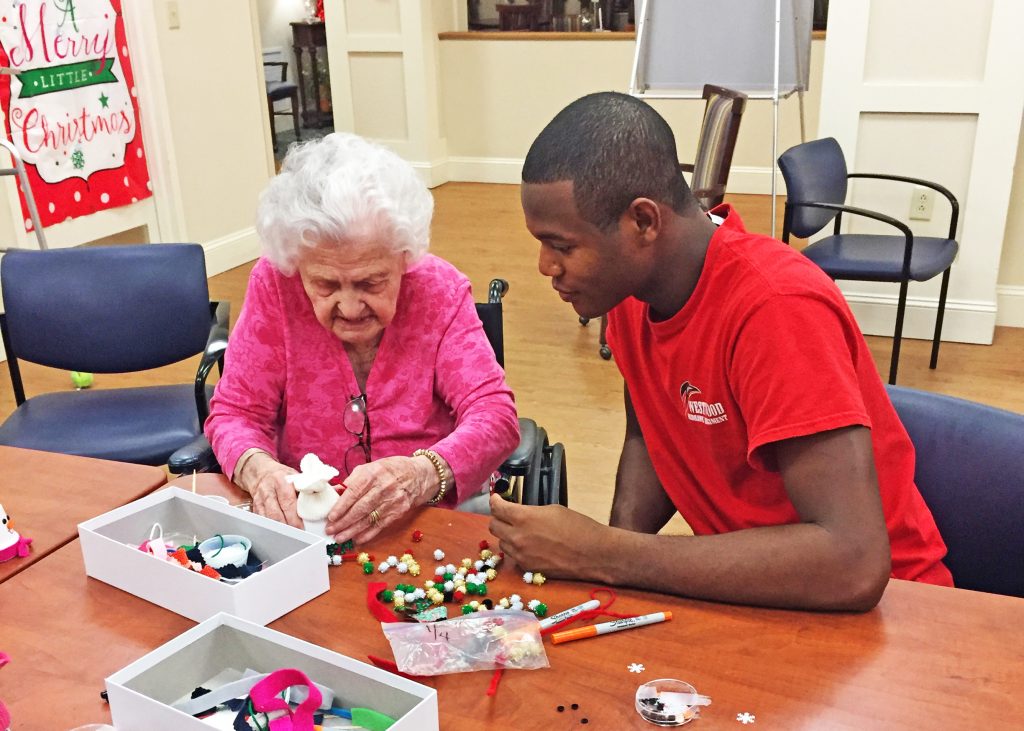
    Westwood High School’s Student Senate visited residents of The Crossings.

    BLYTHEWOOD – The holidays were brighter for many in the Midlands, thanks to the hard work of Richland Two high school students.

    During the first week in December, Westwood High School’s Student Senate, along with three honors societies, visited residents of The Crossings, an independent and assisted living community. They played Bingo, tic-tac-toe and crafts with the seniors.

    Also in December, Westwood and Blythewood high schools joined forces for military families in the Blythewood area. The “Red, White, and Blue Holiday Party” included food, games, carriage rides and a visit from Santa.

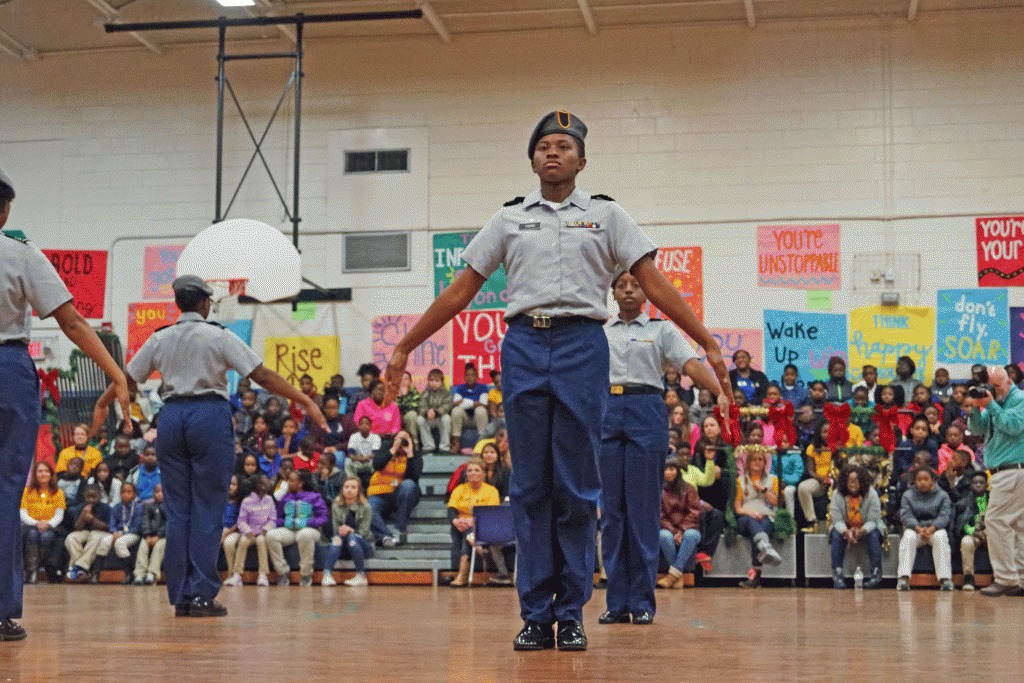
    Blythewood High’s Unarmed JROTC Drill Team performs at during the pep rally at Main Street Elementary School in Lake City.

    Blythewood High adopted Main Street Elementary School in Lake City through a program called Project Connect. The school received donations from parent groups, individuals and other Richland Two schools to provide supplies for each of the school’s 14 classrooms as well as related arts classrooms.

    On Dec. 7, BHS students traveled to Lake City to deliver and set the supplies in every classroom. Main Street Elementary students arrived the following morning to positive notes on their desks and a festive gym ready for a pep rally.

  • Low Scores, High Costs Follow Schlechty

    RICHLAND – At the March 12 Richland 2 School Board meeting, Board Member Melissa Anderson spoke passionately in support of the increasingly criticized Schlechty training model that was introduced to Richland 2 three years ago by Superintendent Dr. Katie Brochu shortly after she was hired by the District.

    Anderson encouraged every principal and teacher to buy into the Schlechty model of education. She further stated emphatically that she didn’t want to hear any more negative comments about the Schlechty teaching model. The Schlechty model, she said, is the right path for Richland 2. This presentation was followed by a District teacher addressing the Board to express her positive sentiments about Schlechty. Such a public show of support for the Schlechty model is something new at Richland 2 Board meetings.

    But not everyone in the District is enamored with the Schlechty model of educating students. Under the Schlechty model, Richland 2’s total professional development costs have soared to over $2 million last year alone. Yet, since Dr. Brochu was hired and introduced the Schlechty philosophy for education, the District’s SAT scores have dropped a total of 71 points — 15 points during each of the first two years and 41 points the third year. Likewise, the District’s PASS scores in elementary and middle schools have also dropped over the same three-year period while the state average has gone up. District officials say the drop in scores is merely a hiccup. But the Schlechty model has made it clear that it dismisses the importance of test scores as a measurement for learning.

    As Dr. Brochu introduced the Schlechty model to the District, she also recommended the Evergreen Study to evaluate all areas of the District. Dr. Brochu’s detractors say the Evergreen Study made recommendations in language right out of the Schlechty playbook. The Study came to be seen by some as the public document that conveniently allowed Dr. Brochu to say that rigorous professional development was needed and that the Schlechty model just happened to fit the bill. It met all the criteria of the recommendations made by the Study.

    Many in the Richland 2 community are asking why Brochu champions the Schlechty education model when it has been around for 20 years but has been incorporated into less than 1 percent of the school districts in the country. More troubling is that while the Schlechty model has seen limited success in smaller, underperforming districts, it has been considered an expensive failure to educate in other districts, according to newspaper accounts and interviews in school districts where Dr. Brochu has previously, as superintendent, introduced the Schlechty model.

    Prior to being hired by Richland 2, Dr. Brochu was Superintendent of the Whitfield County School District near Dalton, Ga. from 2005-2010. She introduced the Schlechty model for educating students to that district, quickly incorporating the Schlechty language: students became the WHO, their studies became the WORK and teachers were the DESIGNERS OF WORK, no longer the holders of knowledge, etc. The superintendent became the LEADER OF LEADERS, the School Board members became the COMMUNITY LIASONS, and the Schlechty way of educating becomes WORKING ON WORK or WOW. According to Schlechty, the work that’s created or designed by the teacher will be so inspiring that the students will engage in learning that subject to great depth on their own. The teacher will no longer ‘teach’ the student, but will be a facilitator of learning.

    According to the Dalton County Daily News in Whitfield County, Ga., the Whitfield School Board initially welcomed Dr. Brochu, but test scores failed to rise with the soaring costs of teacher development during her term of employment. Much of the public discontent with Dr. Brochu and the Schlechty model was unleashed during a Whitfield County School Board election during her final year at the district. Dr. Brochu left her post shortly before the election.

    As part of Dr. Brochu’s first and only Richland 2 evaluation last fall, the Board asked her to submit two reports. One of those reports was to be a “detailed and itemized report on professional development expenses for the 2011-12 year.” Several Board members reported that such a report was received. However, they were not able or would not produce it, and offered no information from it other than that it was a 50-page report that amounted to about $600,000.

    When a reporter for The Voice obtained the report from the District through a Freedom of Information Act request, it turned out to be a 147-page report that was so incomplete as to be of little value in determining actual expenses. It was a listing of numbers and names and charges with no connection. It totaled $2.2 million for one academic year. There were no dates with any of the conference registrations and no dates or connection to any conference for meal/baggage/mileage/car rental expenses. American Express charges were not specified to the attendee and there were no dates. Bank of America charges had no dates or connection to a conference.

    When asked directly about the expense report, Board Chairman Bill Fleming said he was fine with it and considered Dr. Brochu’s evaluation successful.