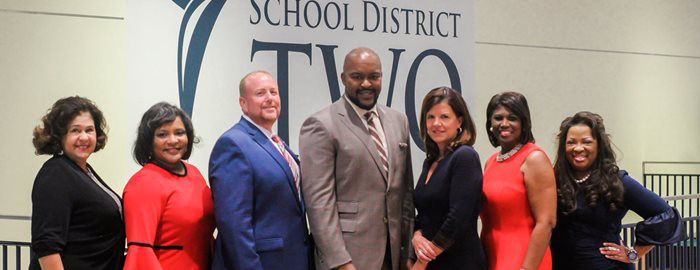
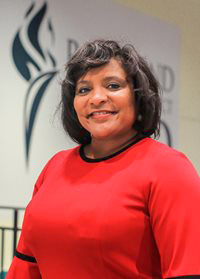
Richland Two school board members, from left: Teresa Holmes, James Manning, Cheryl Caution-Parker, Monica Elkins-Johnson, Amelia McKie, Superintendent Dr. Barron Davis, Lindsey Agostini and James Shadd III. | Barbara Ball
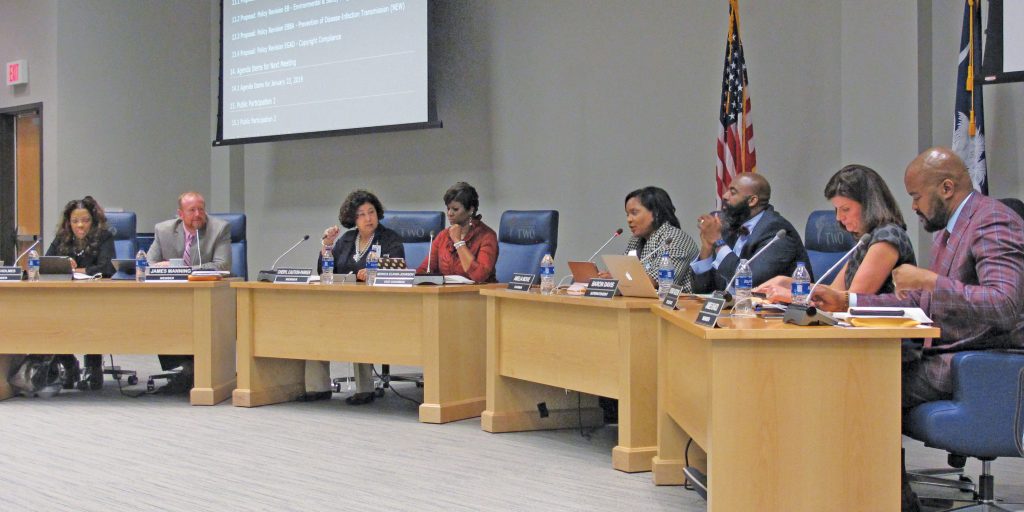
COLUMBIA – Despite some members dismissing an ongoing ethics flap as merely a distraction at a meeting last week, the Richland Two school board spent 90 minutes behind closed doors Tuesday night discussing that topic.
At a special meeting, the board immediately retreated into executive session to receive “legal advice regarding Ethics Act issues.”
No action was taken after the executive session – some of which was audible in the hallway – and the board promptly voted to adjourn.
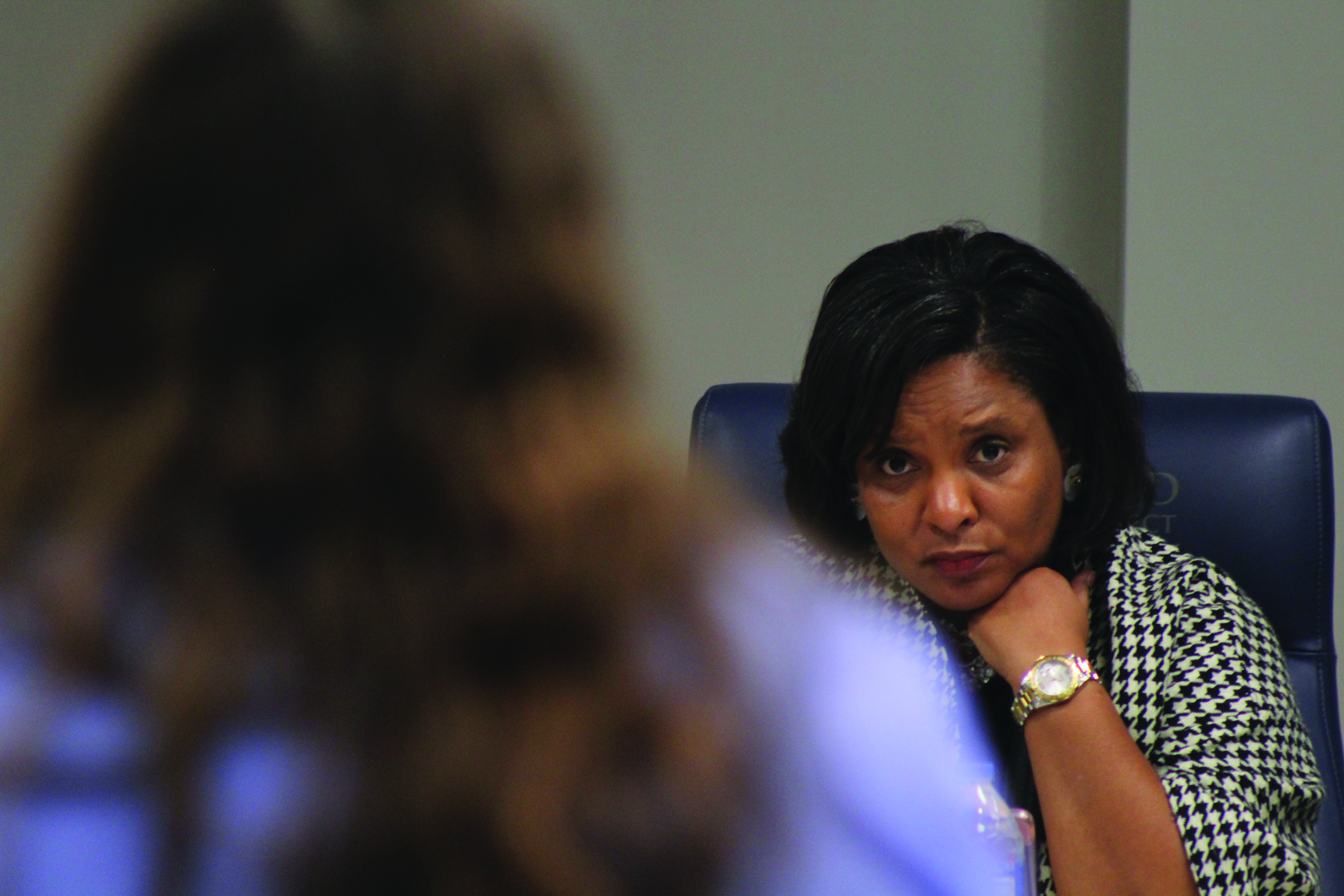
When pressed by The Voice about whether the executive session pertained to an individual member or the entire board, board chairwoman Amelia McKie wouldn’t say.
“I can’t clarify that any more than what was said in the motion,” McKie said.
Jay Bender, an attorney with the S.C. Press Association, of which The Voice is a member, said if the board discussed individual members’ ethics issues behind closed doors, the discussion would violate state law.
“I don’t see any legitimate reason to get advice unless it’s regarding other board members,” Bender said. “If it’s regarding board members with individual ethics problems, I don’t think they can discuss any punishments that may be meted out.”
During executive session some board member conversations were discernable in the hallway beyond the closed doors to the boardroom.
Those conversations seemed to focus on violations of individual board members, which Bender said is not permitted under the S.C. Freedom of Information Act.
The session appeared to become heated at times.
Board member James Manning, one of two sitting board members with no previously missing ethics forms, wouldn’t comment on the specifics of what was discussed.
“There was nothing to take action on. It was all just legal counsel,” Manning said.
Manning noted the issue of ethics is likely to arise at a future board meeting.
“I would keep an eye on the agenda,” he said.
That was difficult to do with Tuesday’s meeting agenda, which was buried among four unrelated press releases in an email titled, “Dear reporters and editors, please find attached four news releases from Richland Two…” with no mention of the agenda or the special called board meeting in the body of the email. The agenda also did not appear on the school’s board docs.
In recent weeks, several board members have come under scrutiny for failing to file various ethics forms required by state law.
Richland Two parent Rhonda Meisner called upon those board members to resign. At the Jan. 9 meeting, Meisner stated during public input that state law prohibits members from being sworn into office if they haven’t filed Statements of Economic Interest (SEI) forms.
In the 2018 election, board members James Shadd III, Cheryl Caution-Parker, Monica Elkins-Johnson, Teresa Holmes and McKie failed to file either SEI forms or quarterly campaign disclosure reports by deadlines set in state law, according to the State Ethics Commission.
Those board members have since filed their forms following a series of investigative reports by The Voice.
McKie, however, has garnered the most attention.
In July 2018, the ethics commission fined her $41,000 for failing to file multiple quarterly campaign reports between 2015 and 2018. Those forms were not filed until last week, the ethics commission website states.
The fine zoomed to $51,750 after McKie failed to pay the first $21,000 of the original $41,000 fine on Dec. 31, 2018.
In all, McKie filed 16 forms on Jan. 9, 2019, including her 2019 SEI form that isn’t due until March 30. Also on Jan. 9, she filed her first quarterly campaign report of 2019, which was due Jan. 10.
After the Jan. 8 board meeting, McKie said she planned to issue a press release addressing the ethics issues, but no statement had been released as of press time.
The status of McKie’s fine remained unclear, however, as the ethics commission, as of Tuesday, listed her outstanding debt at $41,000, the original fine amount, instead of the $51,750, according to the agency’s debtor’s list.
R2 parent Rhonda Meisner, left, addresses Board Chair Amelia McKie and calls for her resignation. | Michael Smith
BLYTHEWOOD – Amelia McKie didn’t respond to a public call for her resignation Tuesday in the first Richland Two school board meeting of the year amid mounting ethics fines for the board chair.
After missing a recent payment deadline, McKie now owes nearly $52,000 to the South Carolina Ethics Commission, an agency spokesperson confirmed last week.
In July 2018, the commission fined McKie $41,000 as part of an eight-count complaint that said she failed to file quarterly campaign disclosure reports.
McKie was ordered to pay the first $20,000 by New Year’s Eve. She missed that deadline, meaning the total fine increases to $51,750, according to the complaint.
“No payments were made prior to Dec. 31, 2018 and the fine amount for that particular order reverts as outlined in the order,” an ethics commission representative said via email.
Richland Two parent Rhonda Meisner called for McKie’s resignation while speaking during the second public comment period at Tuesday night’s meeting.
“I would respectfully request that you resign from the school board,” Meisner said from the lectern. “I think that as a person you’re a very nice person, you’re very sweet, but unfortunately you put the community at risk in my opinion.”
Meisner pointed to state law, which says candidates who’ve not filed Statements of Economic Interest, or SEI, forms cannot be legally seated until they do.
Section 8-13-1110 of state law says no public official “may take the oath of office or enter upon his official responsibilities” unless an SEI form is filed.
State law also says SEI forms must be filed by March 30 each year.
Board members with previously unfiled SEI forms include James Shadd III, Teresa Holmes and McKie. All have since filed SEI reports following investigative reports by The Voice.
Holmes and McKie filed their missing SEI forms shortly after The Voice contacted them on Dec. 4, according to the ethics commission’s online database. Shadd III filed his 2017 and 2018 forms on Jan. 7, 2019.
Meisner said any recent past votes taken by those board members should be invalidated because SEI forms hadn’t been filed when they were sworn in.
“There are others of you on the board that are in the same situation,” she said. “I would ask that you look at your situation and resign.”
Board members respond
Board member Lindsay Agostini, during comments by board members, said, “My integrity and my character are very important to me.” She noted that The Voice’s investigation made it clear that she and James Manning were the only two sitting board members who had filed all their eithics forms on time. Agostini ended her comment saying, “A premier district deserves a premier board.”
Other Richland Two board members didn’t directly address Meisner’s comments or missing ethics filings listed in public records during the business portion of Tuesday’s meeting.
However, several made veiled comments from the dais amid the ethics filing fallout. At least two made references to “special interest” groups or attempts to “undermine the district.”
In a prepared statement, McKie thanked teachers and district staff, encouraging them to “stay the course regardless of the slings and arrows that come your way.”
“We don’t need to let side things distract us,” board member Teresa Holmes said. “We’re here for the business of educating children. That’s what I’m here for.”
After the meeting, Holmes declined to comment on McKie or Meisner’s call for board member resignations. She did, however, address what happened with her own 2018 SEI form.
“I’m brand new to this, I had no idea,” Holmes said. “I’m glad that you actually did the story. Nobody tells you these things when you’re running.”
Holmes’ 2019 SEI form has already been filed, according to the ethics commission website.
Others, including board members Monica Elkins-Johnson and Cheryl Caution-Parker, had previously missing quarterly campaign reports. Those reports were filed in December, ethics filings state.
McKie’s ethics record, though, has the most gaps.
As of Wednesday morning, McKie still hadn’t filed a campaign disclosure report since here last one in January 2015, according to the ethics commission database.
An investigation by The Voice also found inconsistencies in her SEI and lobbyist forms, which listed different amounts of income in 2015 and 2016.
McKie said she soon plans to issue a statement addressing the ethics filings.
“I’ve been working with the ethics commission to clear up some things that haven’t been accurate, and I’m going to issue a press release about that,” she said.
If McKie’s fines go unpaid and unresolved, the ethics commission has strategies it can employ to collect.
In 2015, the commission partnered with the S.C. Department of Revenue to increase ethics debt collection efforts through the DOR’s Setoff Debt Governmental Enterprise Accounts Receivable, or GEAR, collection programs.
Debtors who have reached “bad debt status” are referred to the Department of Revenue, according to the Ethics Commission website.
The Department of Revenue is authorized to garnish wages and tax refunds, or also impose liens to satisfy debts.
Richland 2 board members are responsible for a $273.9 million annual budget.
In 2017, school district millage accounted for more than two-thirds of a typical Richland 2 property tax bill, according to a report by the S.C. Association of Counties.
After missing a recent payment deadline, the Richland Two school board chair now owes nearly $52,000 in fines to the South Carolina Ethics Commission, an agency spokesperson confirmed.
McKie
In July 2018, the commission fined McKie $41,000 as part of an eight-count complaint that said she failed to file quarterly campaign disclosure reports.
McKie was ordered to pay the first $20,000 by New Year’s Eve. She missed that deadline, meaning the total fine increases to $51,750, according to the complaint.
“No payments were made prior to 12/31/18 and the fine amount for that particular order reverts as outlined in the order,” an ethics commission representative said via email.
Attempts to reach McKie have been unsuccessful.
In 2015, the ethics commission partnered with the S.C. Department of Revenue to increase ethics debt collection efforts through the DOR’s Setoff Debt Governmental Enterprise Accounts Receivable, or GEAR, collection programs.
Debtors who have reached “bad debt status” are referred to the Department of Revenue, according to the Ethics Commission website.
The Department of Revenue is authorized to garnish wages and tax refunds, or also impose liens to satisfy debts.
The Richland Two school board’s next meeting is scheduled for Tuesday, Jan. 8 at the Richland Two Institute of Innovation at 763 Fashion Drive, Columbia.
An agenda says the board will meet in executive session at 5:30, with the business meeting commencing at 6:30 p.m.
Lobbyist Income Report Doesn’t Match SEI Filing, Investigation Reels in 19 More Late Filings
Richland Two School Board memberes include Cheryl Caution-Parker, left, Chairwoman Amelia McKie, Jim Manning, James Shadd III, Lindsay Agostini, Monica Elkins-Johnson and new member Teresa Holmes. | Richland Two Website
BLYTHEWOOD – As the deadline to pay a hefty ethics fine nears, more questions are arising over reports filed by Amelia McKie, chairwoman of the Richland Two Board of Trustees.
Meantime, more previously unfiled ethics forms have been submitted by another Richland Two board member following an investigation by The Voice of campaign finance violations, according to public records.
The latest issues involving McKie revolve around lobbying activity reported on her 2015 and 2016 Statements of Economic Interest, or SEI, forms.
McKie’s SEI form for 2016 doesn’t list any lobbying activity or income.
However, on her Individual Lobbyist report, McKie reported earning $13,562.50 as a lobbyist for the S.C. Association of Developing Colleges, or SCADC, between Jan. 1, 2016 and May 31, 2016,
Her 2015 forms don’t match either.
In 2015, McKie reported $15,000 in lobbying income from the SCADC on her economic interest form. But her lobbyist report lists a year-to-date number of $27,125.
In addition, $2,000 in lobbying income from the Coalition for Access to Healthcare appears on her individual lobbyist report, but not her SEI form.
McKie couldn’t be reached for comment.
In response to inquiries from The Voice, McKie filed previously missing SEI forms for 2015-2018 on Dec. 4, according to Ethics Commission records.
As of Friday, Dec. 28, she still hadn’t filed quarterly campaign disclosure reports since early 2015, ethics records show.
The commission has already fined McKie $41,000 as part of an eight-count complaint alleging unreported campaign contributions dating back to 2015.
She had until Dec. 31 to pay the first $20,000. If she misses that deadline, the fine increases to $51,700. That information was not available to The Voice at press time.
In related news, board member Monica Elkins-Johnson filed a slew of outstanding quarterly campaign finance reports and amendments on Thursday, Dec. 27, nearly two months after the Nov. 6 general election, according to the S.C. Ethics Commission online database.
Elkins-Johnson joins fellow board members Teresa Holmes, Cheryl Caution-Parker and McKie among those who filed missing ethics forms only after being contacted by The Voice.
The Richland Two school board plays a direct role in developing the district’s annual budget, which for the 2017-2018 fiscal year totaled $273.9 million, according to the school district website.
Because Richland Two board members are entrusted with spending millions of dollars in taxpayer money, greater scrutiny of their ethics filings is appropriate, said Jay Bender, a media law attorney representing the S.C. Press Association.
“You have all these people who take office who pay no attention what the requirements are, and that’s unfortunate,” Bender said.
Since The Voice’s investigation began in early December, Richland Two candidates have rushed to file at least 19 tardy ethics forms, detailing previously unreported campaign contributions, income sources and potential conflicts of interest.
Here’s a breakdown of each board member’s campaign contributions and statements of economic interest, when available, for recent election cycles.
Amelia McKie
On her 2018 SEI form, McKie reported $15,000 in income from lobbying activity for NextEra, a Florida-based energy company that recruited people to lobby the state to sell Santee Cooper, ethics forms state.
She performed additional consulting work for Infusion and LHI, though ethics forms don’t list income from those sources.
In addition to lobbying activity, McKie reported $9,600 in annual income from her position as school board chair.
McKie’s most recent quarterly campaign disclosure report was filed Jan. 10, 2015, ethic filings show.
She filed two amendments, one on Jan. 11, 2015 and the other Feb. 10, 2015.
Her Jan. 10, 2015 disclosure form, filed two months after the Nov. 4, 2014 general election, reported $10,861.95 in total contributions. She spent $9,524.41, leaving $1,337.54 cash on hand.
One contribution, a $1,000 donation from the Lou-Von Family Foundation in Sumter, was returned at the donor’s request, ethics forms state.
Though nearly four years old, an amendment McKie filed to her campaign disclosure reports in February 2015 raises additional questions.
In that filing, McKie lists 889.5 miles driven by various Columbia vendors for Get Out the Vote-related work, totaling $498.72 in mileage expenses at 56 cents a mile. The expenses were incurred on four dates in 2014: Nov. 3, Nov. 21, Dec. 11 and Dec. 22.
It is unclear from the forms what would require driving 890 miles in four days – roughly 222.5 miles per day – in the Columbia area.
James Shadd III
Board member James Shadd III has experienced issues with his ethics forms since 2014, when the ethics commission fined him $13,000 for failing to file several quarterly campaign disclosure reports, documents state.
The complaint has since been resolved, according to the ethics commission website. More recently, Shadd III hasn’t filed quarterly campaign disclosure or SEI reports since October 2016, according to ethics filings.
The absent filings only pertain to his school board seat. Quarterly reports for his 2014 solicitor’s office bid are available for public inspection.
Shadd III couldn’t be reached for comment.
In 2016, the last year Shadd III filed an SEI form, he only listed his school board trustee position, but not his income. He didn’t report any lobbying activity or any other potential conflicts of interest.
Shadd III filed three campaign disclosure reports in 2016, all on Oct. 31 of that year, which included his initial report, October quarterly report and his pre-election report.
He reported $10,375 in contributions for the election cycle, mostly from attorneys, physicians and other individual professionals. He spent $7,244.88.
Monica Elkins-Johnson
In all, Elkins-Johnson filed 14 previously missing quarterly campaign disclosure forms last week on Dec. 27, 2018, some of them dating back to 2016, according to ethics records.
One of the filings was a final campaign disclosure report for her 2016 campaign.
The report listed $12,860.52 in total contributions, most of which came from personal funds ($7,341). Most other contributions came from individual donors, filings show.
Elkins’ SEI forms have been filed on time most years. Her 2018 SEI report only listed $9,600 in income for her school board seat.
Teresa Holmes
Most of Holmes’ campaign contributions before the 2018 election come from personal funds.
For the 2018 election cycle, she reported $3,683.94 in contributions, of which $3,183 came from her personally, ethics records show.
The remaining $500 consisted of a donation from Sam Green, whose occupation is listed in ethics records as bishop of the 7th Episcopal District.
After the election, Holmes filed two amendments on Dec. 10 and Dec. 12, respectively amending her pre-election and initial reports to include additional contributions and expenditures.
As before, contributions mainly consisted of personal loans and small, individual donations.
Like McKie, Holmes filed her 2018 SEI forms after she was informed by The Voice that they had not been filed.
On her SEI form, Holmes reported $83,000 in personal income from the Fairfield County School District. She’s an assistant administrator and guidance counselor at the Fairfield Career and Technology Center, the Richland Two website states.
Cheryl Caution-Parker
Caution-Parker filed her four 2018 quarterly campaign disclosure reports on Dec. 17, shortly after The Voice contacted her that the forms hadn’t been filed prior to the Nov. 6 election.
Caution-Parker previously told The Voice that she had correctly entered the information, but didn’t complete the submission process because she failed to click the “File” button.
Her October 2018 pre-election report listed $5,150 in contributions and $5,129 in expenditures. She reported two contributions from developers: M.B. Kahn Construction Co., $1,000; and Stevens & Wilkinson, $250.
Caution-Parker spent the bulk of her funds on billboard advertising and campaign signs.
James Manning
Manning filed his quarterly campaign disclosure and SEI forms on time.
While it was previously reported that these fillings were late, most of his campaign disclosure reports are associated with the 2014 election cycle. Only a pre-election report filed Oct. 28, 2018 is associated with the 2018 election cycle, records state.
Manning said that’s because he announced his intentions to seek re-election late in the election cycle, which explains why his other quarterly reports are linked to 2014.
For the 2014 election cycle, Manning reported $9,198.76 in total contributions.
Manning reported an additional $7,775 in contributions for 2018. Notable donations for the most recent election cycle include: M.B. Kahn Construction, Co., $1,000; Brownstone Construction Group, LLC, $1,000; Darrell Campbell, construction, $500; and Grayson Thompson, architect, $300.
Manning reported $118,737 in personal income from working in state government. He works for the S.C. Public Employee Benefits Authority as a risk and compliance manager, according to the state’s online salary database.
Manning reported additional family income of $69,289, also from state government, and his $9,600 school board salary.
Lindsay Agostini
Besides Manning, Agostini was the only other current board member to file all her Campaign Disclosure and SEI forms on time. As reported previously in The Voice, Agostini hasn’t been required to file quarterly campaign disclosure reports since March 24, 2017, when according to ethics records, she submitted a final report.
Office holders may file final reports only after he or she closes their campaign account, which is what Agostini did, according to the Ethics Commission.
To qualify for this exemption, a candidate must have a zero balance and no outstanding campaign debts, according to the Ethics Commission websit, which Agostini met.
When her campaign accounts were open, Agostini was one of the school board’s top fundraisers. Her final report listed $22,947 in total contributions for the 2016 election cycle.
Contributions mainly came from attorneys, physicians and other business professionals. She spent the bulk of her funds on mailers and signage, records show.
On her 2018 SEI form, Agostini reported board member pay of $9,600 and various food and gas reimbursements totaling $1,146.89.
Under personal income, she listed Agostini and Associates as the source and event planner/swim lessons under the type. A dollar amount was not specified.
Agostini also listed 11 sources of family income, which include DaVinci Financial Designs, LPL, Midland Insurance, The Members Club, Washington & Lee University, Pomona College and other entities.
Craig Plank
Craig Plank, who did not win re-election to the board in November, but has filed all his forms on time during his time on the board, reported $13,090 in contributions this past election cycle, which included $2,100 from personal funds. He spent $9,483.85, mostly on advertising and direct mailing, records state.
Most of Plank’s donors consisted of individual business professionals, including several insurance agents.
Plank reported several contributions from developers: SC Builders PAC, $250; Stevens & Wilkinson SC, Inc., $250; Covert Homes, LLC, $250; LCK, LLC, $500; and M.B. Kahn Construction Co., $1,000.
On his 2018 SEI form, Plank reported a $12,000 stipend from the district.
Plank also reported receiving unspecified income from four sources: WIS TV, family income; State Farm Insurance Co., personal income; Millie Lewis of Columbia, personal income; and NFIP, personal income.
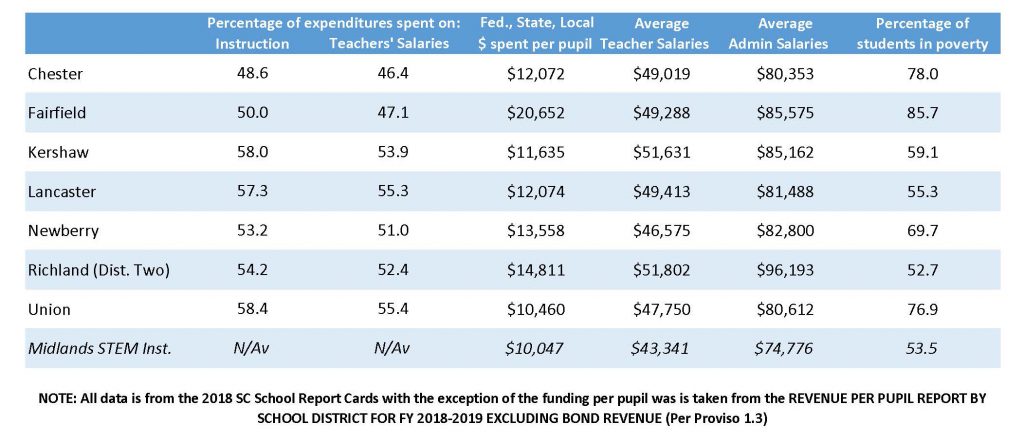
WINNSBORO – A major talking point Fairfield County education leaders have been making about the 2018 state report cards is that no Fairfield school rated Unsatisfactory.
“We were competitive,” said Dr. J.R. Green, district superintendent, said of the results at a recent Board of Trustees meeting. “Virtually every district that adjoins Fairfield County had at least one unsatisfactory school.”
That ratio is actually closer to 50-50 for the six surrounding districts, with three districts reporting no Unsatisfactory schools and three others reporting at least one Unsatisfactory school. Union, Newberry and Lancaster counties didn’t report any Unsatisfactory schools, according to report card data. Chester, Kershaw and Richland Two reported at least one Unsatisfactory school.
Additionally, Green’s comparison includes some districts substantially larger than Fairfield County, which has seven schools, excluding the state-run Midlands Stem Institute which has two schools.
Chester has 13, Newberry has 14, Kershaw has 18 and Lancaster has 20. Richland Two is the largest adjoining district with 32 schools.
Fairfield
With the highest federal, state and local funding per pupil ($20,652), the highest percentage of students in poverty and the smallest average number of students per teacher ratio, Fairfield County had one school rated as Excellent, and another received a Good rating on the 2018 SC school report card. Three others were rated Average and two were rated Below Average. None were Unsatisfactory, the lowest rating.
Here’s a breakdown of how each school performed:
Fairfield Magnet School for Math & Science (Excellent)
Kelly Miller Elementary (Good)
McCrorey-Liston Elementary (Average)
Geiger Elementary (Average)
Fairfield Central High School (Average)
Fairfield Middle (Below Average)
Fairfield Elementary (Below Average)
Chester
Chester, with the highest average student to teacher ratio (25.4 students per teacher), second highest percent of students in poverty (78.0) and third lowest average teacher salary ($49,018), struggled the most among the seven districts. Chester had one Excellent school, three Average schools, six Below Average schools and three schools receiving the state’s lowest rating of Unsatisfactory.
Kershaw
Aside from reporting one Unsatisfactory school, Kershaw’s 18 schools performed well, with five schools earning Good ratings, nine rated Average and three rated Below Average.
Lancaster
In Lancaster County, eight schools scored either Excellent or Good. Seven were rated Average and five received a rating of Below Average. Lancaster had no Unsatisfactory schools.
Newberry
Newberry County, with the lowest average pay for teachers ($46,575) of the seven districts, and the fourth highest percentage of students in poverty (69.7), reported three schools with Excellent ratings, five schools with a Good ranking, five schools with an Average rating and only one school with a Below Average rating, report card data shows. Newberry had no Unsatisfactory ratings.
Richland Two
In Richland Two, about one-third of schools (11) scored Good or Excellent on the report cards. Of the nine Blythewood area Richland Two schools, six were among the 11 top schools:
Langford Elementary (Excellent)
Round Top Elementary (Excellent)
School for Knowledge Elementary – housed in Muller Road Middle (Excellent)
Bethel-Hanberry Elementary (Good)
Sandlapper Elementary (Good)
Blythewood High (Good)
Westwood High, Blythewood Middle and Muller Road Middle (grades 6 – 8) schools received an Average rating,
The Center for Achievement elementary magnet school housed in the Kelly Mill Middle school, is the only Blythewood area school to receive an Unsatisfactory rating. Two other Richland Two schools also received Unsatisfactory ratings.
Union
Union County, which has eight schools, reported one Excellent school, six Average schools and one Below Average school. Union has the third highest percentage of students in poverty (76.9) and allocates the highest percentage (55.4) of its expenditures to teacher salaries which, at an average of $47,750, are the second lowest of the seven districts.
Midlands Stem Institute
The report cards list the Midlands Stem Institute, or MSI, of Winnsboro under the S.C. Public Charter School District. The state issued two report cards for the K-8 school – one for elementary grades and one for middle school grades:
MSI, elementary (Below Average)
MSI, middle (Average)
The school added ninth grade last fall which was not included in the 2018 ratings. MSI receives $10,047 in federal, state and local funding per pupil, about half the amount the Fairfield District receives and the least of any of the other seven comparison districts.
Comparing the seven districts
In 2018, the state revamped the report cards into two main categories: Academics and School Environment. There are six subcategories under Academics and four under School Environment.
At the Dec. 18 school board meeting, Green stated that the new report cards create a “forced distribution” of schools.
According to the model, only the top 15 percent of schools are rated Excellent. The next 20 percent receive a Good rating, while the middle 35 percent receive Average ratings.
Below Average schools make up the next 20 percent while the bottom 10 percent are Unsatisfactory.
“This system has negatively impacted all kinds of districts with all kinds of populations,” Green said at the meeting. “It creates a ‘Hunger Games’ mentality. Everyone is scrambling to the top and to reach the top.”
Class sizes
Fairfield County’s student to teacher ratio of 16.9 to 1 is the smallest [number of students per teacher] ratio compared to the six districts surrounding Fairfield.
Richland Two has the next lowest ratio at 19.7 to 1. Chester has the highest at 25.4 to 1.
Teacher Retention
Statistically speaking, teacher retention appears to be an issue for Fairfield, according to report card data.
Fairfield’s percentage of teachers on continuing contract is lowest (63.2 percent) of the seven districts. The six surrounding districts range between 75 percent and 81.6 percent, with Union County leading the pack even though it has the third highest percentage of students in poverty and the second lowest average teacher salaries according to report card data.
Fairfield falls in the middle in average teacher salaries at $49,288. Richland Two leads at $51,802, followed by Kershaw at $51,631.
Newberry trailed all seven at $46,575 despite its schools receiving comparatively high ratings.
Other average salaries by district include: Union, $47,750; Chester, $49,019; and Lancaster, $49,413.
BLYTHEWOOD—Administrators are making more and teachers are making less in the Richland Two School District.
In 2017-18, the average teacher salaries dropped from $52,092 to $51,802, while average administrator salaries rose from $95,003 to $96,193, the South Carolina Department of Education Report Card data shows.
A similar trend occurred in Fairfield County School District.
In 2017-2018, average administrator salaries were $85,575, up from $84,833 the year before, according to report card data.
Average Fairfield County School District teacher salaries, however, declined from last year, falling from $49,504 to $49,288.
At the Dec. 18 Fairfield County School District meeting, Dr. J.R. Green, superintendent of Fairfield County schools, said in the past year he’s forgone receiving a pay raise.
However, when board member Paula Hartman asked Green to state his salary, Green said he didn’t know the figure. The Voice has filed a Freedom of Information Act request for that information.
In Fairfield County, the inverse relationship between administrator and teacher pay comes as district leaders continue pressing for the creation of a Teacher Village, a proposed subdivision catering to educators.
Affordable housing, they say, is key to recruiting and retaining teachers.
“People who live in a home are going to stay longer than in an apartment,” said Dr. Sue Rex, chairwoman of the Fairfield education foundation, which is working with the district on the Teacher Village project.
Fairfield County lags behind Richland Two in most teacher retention categories.
Richland Two reported 86 percent of teachers returning from the previous year, compared to 82.6 percent in Fairfield. Richland Two (86.6 percent) also leads Fairfield (81.3 percent) in teachers returning – three year average, according to report card data.
Finally, only 63.2 percent of Fairfield teachers are on a continuing contract, compared to 75 percent in Richland Two.
At the Fairfield County School District’s October meeting, the board voted to appropriate $1 million from its $3.5 million surplus for salaries.
However, the money won’t be budgeted until 2018-2019 and it includes all district employees, not just teachers. The remaining $2.5 million was earmarked to fund facility needs.
BLYTHEWOOD – Amelia McKie, chair of the Richland 2 Board of Education, owes at least $41,000 in fines to the S.C. Ethics Commission, according to agency documents obtained by The Voice.
McKie
McKie has until Dec. 31 to pay the first $20,000. The remaining $21,000 is due June 30, 2019, documents state.
The fines are spelled out in an order the ethics commission issued July 3.
According to an eight-count complaint the commission filed, McKie failed to file quarterly campaign disclosure reports on seven occasions in 2015 and 2016 for the 2014 election.
The eighth count says McKie failed to disclose expenditures on a campaign report, documents show.
As of Thursday, the forms still had not been filed. The most recent quarterly report appearing on the ethics commission’s online database is dated Jan. 10, 2015.
Campaign disclosure reports for the 2018 election also don’t appear on the ethics commission’s website.
If the fines aren’t paid, McKie faces a judgment of $51,750, the order states.
Attempts to reach McKie by phone and email were unsuccessful.
More ethics forms remain unfiled
McKie’s $41,000 fine is in addition to any additional fines or penalties she may face for failing to file Statements of Economic Interest forms with the ethics commission.
On Dec. 4, McKie filed her 2018 economic interest forms, hours after The Voice telephoned her about the forms not being filed, according to the ethics commission website and an agency spokeswoman.
The forms were due March 30, according to state law.
In a telephone interview Tuesday, McKie told The Voice that she had filed her 2018 form “weeks ago.”
“I’ll try to find out where the disconnect was,” McKie said. “There here shouldn’t have been a problem. Certainly I want to get to the bottom of whatever the disconnect is.”
The ethics commission stood by its assertion that the form was filed Friday, Dec. 4, not weeks ago.
“The statements were filed on the date and time shown on the website,” the agency said via email. “I am aware of no glitch in the application that would cause a document to become ‘lost’ in the system.”
In addition to 2018, McKie also didn’t file economic interest forms for 2015-2017 until Dec. 4, 2018.
McKie filed her 2014 form on Aug. 15, 2014, the ethics commission online database shows.
The ethics commission spokesperson declined to comment about the potential for additional fines relating to McKie’s economic interest forms, but reiterated that the online database is correct.
“Everything on the website is accurate but may not contain the latest information,” the spokesperson said.
According to state law, a $100 civil penalty is levied to candidates failing to file on time following a five-day grace period. Penalties increase to $10 per calendar day starting 10 days after the commission provides notice by certified or registered mail.
Daily fines increase to $100 for every day the form isn’t filed, with total fines capping at $5,000. Criminal penalties kick in if forms still aren’t filed.
The ethics commission website also lists McKie on the agency’s debtor’s list, a list consisting of public officials with unpaid fines and civil penalties.
As of Dec. 6, the list said McKie owes $233.30 stemming from an unspecified 2016 debt. It’s unclear whether or not that debt is associated with the $41,000 judgment.
The ethics commission said it couldn’t respond to The Voice’s inquiries about McKie’s inclusion on the debtor’s list.
Why McKie owes $41,000
McKie’s $41,000 fine includes a “reduced late-filing penalty” of $24,245, a $16,000 civil penalty and a $575 administrative fee, documents show.
According to the order, McKie’s failed to file campaign disclosure reports after January 2015. The ethics commission fined McKie $600 for late filings of her 2015 and 2016 quarterly contribution reports.
Daily fines began accruing in August 2016. A complaint was then filed after the ethics commission said it received no response from McKie.
The filing further states that an agency investigator telephoned McKie on Sept. 29, 2016, instructing her to file the required paperwork.
“From October 27, 2016, and January 10, 2017, Commission investigators made multiple attempts to bring Respondent into compliance with no success,” the order states.
Investigators visited McKie’s home on Jan. 10, 2017, “to advise Respondent of the accruing penalties and the need to file the requisite reports,” the order continues.
McKie made an appointment with the agency the following day, but failed to file the reports, according to the order.
At that point, the ethics commission subpoenaed McKie’s campaign bank records. The last check written from that account was dated April 3, 2016.
“Respondent’s campaign bank account records revealed no other activity with the exception of bank fees in the amount of $10.00 per month until the bank account was force-closed on January 30, 2017,” ethics documents state.
The commission issued a Notice of Hearing to McKie in May 2018. The hearing took place June 21, but McKie didn’t appear, agency records state.
BLYTHEWOOD – While Blythewood High School seniors taking the SAT hovered just below the state average, the school ranked near the top in the number of test takers.
Blythewood High placed in the top 20 statewide at 71.1 percent, ranking 16th out of 230 schools, with 335 of 471 seniors taking the test, according to S.C. Department of Education figures released last week.
Other Richland 2 schools reported high percentages, ranging between 46 and 56 percent tested.
“Students in the Class of 2018 and their parents decided whether or not to take the SAT,” Richland 2 spokeswoman Libby Roof said via email. “We don’t have any data that would indicate why a greater percentage of students in one school chose to take the SAT than in another school.”
Blythewood seniors averaged 1,048, scoring a point shy of the state average. The school also shed 10 points from last year’s tally of 1,058, data shows
Blythewood’s tally this year was the second highest in Richland 2. Spring Valley High School led the district at 1,098.
Westwood High, meantime, struggled. The school averaged 970, creeping up four points from 966 last year.
“As the district’s total score is below the state average, we recognize there is room for growth and are committed to helping our students better prepare for this assessment,” Roof said. “That being said, these assessments don’t provide teachers with the standard or strand-level results that are needed to make informed instructional decisions.”
Slightly less than half – 168 of 342, or 49.1 percent – of seniors took the test, data shows.
“We avoid using SAT scores as a measure to compare our schools to each other,” Roof said. “The SAT is designed to gauge a student’s readiness to perform college level work. It is used by colleges and universities to compare the academic readiness of students and to make admission decisions.”
In tabulating SAT data, the Department of Education counted individual students only once, regardless of how many times they took the test. The most recent score was counted, figures show.
Accurate data comparisons to 2016 and before were not possible because the College Board, which administers the test, changed the format in 2017.
In 2017, the College Board, which administers the SAT, revised the test to score in two critical areas – evidence-based reading and writing, or ERW, and math, according to the Department of Education website.
The ERW portion replaced the English/Language Arts and Writing sections, which gave the SAT three components, the website states.
The test became a two-part test in 2017, broken down into Evidence-based Reading and Writing and Math.
While Richland 2 saw high percentages of test takers, the number of Fairfield County seniors taking the SAT continued to sag.
Only one in five Fairfield County seniors took the SAT in 2018, and those who did take the test averaged more than 80 points below the state average.
Fairfield Central High School climbed from 922 to 983, with 41 of 198 seniors – or 20.7 percent – taking the test, about the same as last year, state data shows.
Fairfield’s performance still fell 81 points behind the state average of 1,064. The national average was 1,049.
Dr. J.R. Green, district superintendent, couldn’t be reached for comment Tuesday.
In a prior interview with The Voice about the impact of per pupil revenues on student achievement, Green said that rural districts like Fairfield, where poverty tends to be high, tend to struggle academically.
He also noted student achievement is measured in more ways than how students score on standardized tests.
“The reality is there are students who can be successful, but not at a four-year institution,” Green told The Voice. “It doesn’t mean these kids aren’t sufficient. Poverty has an adverse effect on a kids’ ability to be successful academically.”
Blythewood – While in-school suspensions are generally trending downward in Richland 2, the opposite is true of out-of-school suspensions and expulsions, including at Blythewood area schools.
Both Blythewood area high schools and all three middle schools reported increases, as did one elementary school, according to online state report cards published by the S.C. Department of Education.
That’s consistent with data recently presented to the Richland 2 Board of Education. On Sept. 25, district staff said in-school suspensions (ISS) have been plummeting, but out-of-school suspensions (OSS) and expulsions are trending upward.
“Each year, we are well under 1 percent of students that actually get expelled,” said Cleveland Smith, the district’s chief administrative officer. “Even though last year’s numbers were up, which were 0.37 percent, its still less than 1 percent.”
Smith noted that increasing enrollment year to year has helped offset percentage increases in suspensions and expulsions.
“99.63 percent of our students never got to that point,” he said. “In any year, 99 percent of students are not at that level of expulsion.”
There are some key differences in how the state and district data were measured, however.
State report cards only report OSS and expulsion data “for violent and/or criminal offenses,” according to the Department of Education website.
District data presented on Sept. 25 included all suspensions and expulsions, regardless of the reason. The district’s data also included ISS figures, which are not listed on the state report cards.
In the report, delivered during the Sept. 25 board meeting, district staff said out-of-school suspensions rose from 2,380 in 2016 to 2,462 last year. Expulsions increased from 52 to 102, district data shows.
In-school suspensions dropped from 1,850 to 1,617. They had been as high as 2,382, the data shows.
School district data, though, is likely higher. In tabulating suspension and expulsion data, the district counted by the student. If one student was suspended multiple times, the district counted it as only one suspension, Smith said.
Dr. Monica Elkins-Johnson, the board’s vice-chair, questioned the methodology.
“You indicated that the students, if they served in in-school suspension six or seven times, they’re only counted once,” Elkins-Johnson said. “Walk me thru that. I’m trying to figure out how we’re having an accurate account if they’re only on the chart once. Is this an accurate reflection?”
Smith said the district used “unduplicated” data in compiling suspension and expulsion figures. He pledged to provide a more detailed report showing the total number of actual suspensions and expulsions at a later date.
According to state data, Blythewood High School out-of-school suspensions and expulsions involving violent and/or criminal offenses rose from 2.2 to 2.5 percent in the past two school years.
The 2017 report card lists Blythewood High’s student population at 2,001 students, resulting in about 50 suspensions and expulsions. That’s about one suspension or expulsion every 3.6 days in a 180-day school year.
Westwood High School reported an even higher percentage of suspensions and expulsions, rising from 2.2 to 4.1 percent.
The 4.1 percent figure translates to at least 55 suspensions and expulsions, or about one suspension or expulsion every 3.3 days, according to the data.
Muller Road Middle (0.8 percent), Blythewood Middle (1.7 percent) and Kelly Mill Middle (1.2 percent) saw increases as well, data shows.
Lake Carolina Elementary suspensions and expulsions rose slightly, from 1 to 1.2 percent. The rate dropped from 0.6 to zero percent at Round Top Elementary.
Bethel-Hanberry and Langford elementary schools didn’t report any suspensions or expulsions in 2016 or 2017, state data shows.
BLYTHEWOOD – Another school bond referendum presentation will be held in Blythewood on Oct. 8 at 6 p.m. at Westwood High School, located at 180 Turkey Farm Road. Richland School District Two is inviting the community and media to learn more about the bond referendum at two upcoming information presentations.
Two bond referendum questions will appear on the Nov. 6 ballot. One asks voters to approve the issuance of bonds not to exceed $468,406,000. Richland 2 School District is billing the referendum as a safety/security bond that will bring improvements at schools and for buses, improvements to academic learning spaces, additions and improvements to arts/athletic facilities and technology infrastructure improvements.
Find information about the bond referendum at www.richland2.org/bond.