Tag: Richland 2

  • R2 board names new officers

    Manning

    COLUMBIA – Richland Two’s board of trustees has new leadership.

    James Manning is now chairman, taking over for Amelia McKie, who remains a voting member.

    Teresa Holmes was named vice chairman and Cheryl Caution-Parker became secretary, according to votes taken at the June 25 meeting.

    Manning and Caution-Parker were unanimously voted into their new positions. The board voted 4-1 to make Holmes vice chair, with McKie and Caution-Parker abstaining. James Shadd cast the lone dissenting vote.

    Holmes

    McKie had nominated Shadd for vice chair, but that vote failed 4-3, with McKie, Caution-Parker and Shadd voting in the minority. Shadd declined a separate nomination to serve as secretary.

    Manning said he’s appreciative of the support the board displayed in nominating him as chairman. His goals include successfully managing the school’s building program, improving school safety and boosting student achievement.

    “I want to continue to focus on those things, to make sure that we do the best we can,” he said.

    Caution-Parker

    One board issue that’s arisen lately is public participation at meetings. In recent months, some residents have complained that the former chair altered the order in which speakers registered to muffle public criticisms.

    Manning said he plans to follow board policy.

    “Public input, like everything else, is managed through our policies,” he said. “I do think that’s something we need to take a look at, but ultimately the board chair should not have any undue influence in that process.”

    The board officer turnover comes at a controversial time for the Richland Two board, with one member owing nearly $51,000 in ethics fines and another facing a criminal disorderly conduct charge.

    In July 2018, the S.C. Ethics Commission fined McKie $41,000 for various campaign violations.

    The most current ethics commission’s debtor list available online, which is dated Jan. 3, 2019, still lists McKie’s fine at $41,000.

    However, documents obtained by The Voice state that the fine increases to $50,750 if McKie misses certain deadlines.

    Documents state that McKie was supposed to pay the first $20,000 by Dec. 31 and the remaining balance by June 30.

    An Ethics Commission representative said via email Monday that there has been no change in McKie’s status.

    Richland County resident Gus Philpott, a frequent critic of the board, said he’s looking forward to seeing positive changes with new board leadership at the helm.

    However, it still doesn’t change his belief that McKie and Holmes should step down from the board.

    Philpott maintains that McKie and Holmes aren’t legally allowed to serve because neither filed Statements of Economic interest forms until after taking the oath of office. State law prohibits elected officials from taking the oath when SEI forms haven’t been filed.

    “They are, in my opinion, not legal board members,” Philpott said. “Teresa Holmes was nominated for the position of vice chair and was elected. My contention is since she is not a board member, she cannot serve as an officer.”

    Asked about Philpott’s comments, McKie provided the following response:

    “One of the most sacred aspects of our American democracy is that every citizen is entitled to his/her own opinion, regardless of the accuracy of the same. The day that ceases to be is the day we no longer embody a democracy.”

    Holmes said she doesn’t plan to step down, and disputes that she’s not legally qualified to serve on the board.

    “There is no reason that he should continue to say that,” Holmes said. “He knows that that’s not true.”

    Elkins-Johnson is also facing legal difficulties.

    In January, the Richland County Sheriff’s Office charged her with disorderly conduct following an altercation occurring after a board meeting.

    According to a police report, the suspect shouted obscenities and threatened relatives of a state senator and the board chair.

    The Richland County Public Index lists a tentative court date of July 22, though the case has been continued several times.

  • Agostini: Board chair plays favorites with speakers

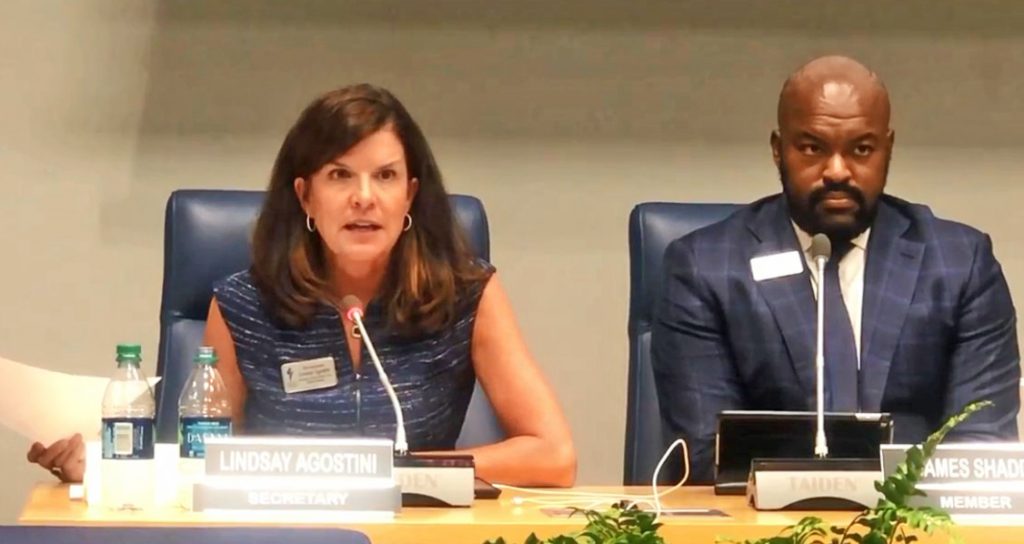
    COLUMBIA – Amid budget discussions, policy revision votes and a slew of special recognitions, one board member’s critique of the Richland Two chairwoman’s job performance punctuated a more-than-four-hour meeting.

    The drama began at about the 38-minute mark of the May 14 meeting when board member Lindsay Agostini called attention to “inconsistent” enforcement of the board’s public participation policy.

    Agostini

    Agostini accused McKie of giving preferential treatment to some speakers while shutting down others.

    “At a Feb. 12 meeting, we denied a participant. The chair stated they had missed the signups. The chair stated we are going to strictly adhere to board policy going forward because we are going to be as ethical and policy abiding as we possibly can,” Agostini began.

    The speaker in question had, at a previous meeting, called for McKie to step down, saying that McKie was not legally seated due to having failed to file a statement of economic interest form which is required by law before an elected school board member can be sworn into office.

    “However, on March 26, a different community member came to speak who admittedly showed up too late to sign up on the list, and the forms had been pulled,” she continued. “When I expressed concern to our board chair in an email, she responded by saying she chose to allow latitude to allow the person to speak.”

    McKie said she had started cracking down on public participation after she felt some speakers failed to display proper decorum.

    “When our meetings became out of order, when they became a three-ring circus, and people used my graciousness and latitude for personal gain and for insult, I chose to abide by public policy,” McKie said. “I don’t make any apologies for that. I’m happy to abide by public policy.”

    McKie has come under fire in recent months, largely over a litany of violations of state ethics laws.

    The S.C. Ethics Commission recently fined her $51,750 for failing to file various ethics forms. There have also been calls for her to step down from the board.

    As public participation began last Tuesday night, the evening’s only speaker sided with Agostini and called for greater transparency from the board.

    Columbia resident James Mobley, who ran unsuccessfully for the board in the past, also called upon the board to extend public participation from three to five minutes.

    “You have hurt Ms. Agostini and I’m sad about that,” Mobley said. “I believe that she deserves an apology. Unity should be a driving factor on this board.”

    Later, during the board member comment period, Agostini again raised the issue of inconsistent adherence to district policies. Then she turned to McKie’s ethics issues.

    Agostini didn’t directly mention McKie by name, though she referenced a story in The Voice that stated McKie hadn’t filed her April 2019 quarterly campaign disclosure report as of May 7. It was due April 10.

    According to Ethics Commission filings, McKie filed the form May 8, the day after The Voice notified her about the tardy filing.

    Agostini stated the missed ethics deadline came on the heels of the board adopting a policy demanding punctuality from staff when submitting reports and assignments.

    “Once again we’ve heard from the media of another missed deadline for campaign disclosure reports after being assured in January that it wouldn’t happen again,” Agostini said. “When do we start walking the walk and hold ourselves to the same standards we put in place for others?”

    McKie was visibly frustrated with what she called “accusations” and “personal attacks,” though she never addressed anyone by name.

    “I have a bevy of comments to share but in the respect of your time I won’t do so,” McKie said. “I won’t dignify certain accusations tonight that haven’t been asked of others.

    “You can’t pick and choose who’s acceptable to hurt and who’s not,” McKie continued. “At a board meeting or any facility, nobody should be hurt. Nobody should be injured; nobody should be castigated.”

    Other board members, most of whom have also missed ethics filings, and some of whom have paid fines, avoided addressing Agostini’s comments. Most declined to say anything at all.

    Board member Cheryl Caution-Parker was the only other trustee to speak. She didn’t directly address any issues from the meeting.

    “I do have something to say, but I’m not going to say it, but it’s on the tip of my tongue,” Caution-Parker said. “I’m sure a lot of you out there know what I want to say.”

  • Altered bond doc slips past R2 board

    COLUMBIA – When the Richland Two school board trustees’ former secretary declined to sign documents asserting that Board Chairwoman Amelia McKie is legally allowed to serve on the board, two trustees say the board was not notified the documents were modified to include phrasing dismissive of McKie’s ethics controversy.

    “I was not aware of the addition of the extra line in the bond documents,” trustee James Manning said. “I really don’t have a response to the legitimacy [issue]. I’m spending all my research looking into why that [the paragraph] is there and why we need it, so I’ll be looking at that.”

    Lindsay Agostini, the former board secretary, said her attorney advised her not to sign the documents. She thinks the document revisions should have been brought to the board’s attention.

    “We weren’t briefed as a board,” she said. “I do believe, with the modifications, I think it would’ve been important for the board to be briefed, either individually or as a group.”

    District Superintendent Dr. Baron Davis couldn’t be reached for comment.

    At issue are clauses added to documents relating to the district’s $468.4 million building program. Richland Two voters recently approved a bond referendum that raises taxes to finance construction.

    Added to the bond documents was the following statement:

    “The School District is aware that members of the public have called for the resignation of the current Board Chair because of fines owed by the Board Chair to the South Carolina State Ethics Commission because the Board Chair did not have on file a current Statement of Economic Interest prior to being sworn in to a second term as a member of the Board,” the document states.

    “The School District is not aware of any litigation, regulatory effort, or official proceeding challenging the Board Chair’s right and title to serve as a Board member of Board Chair,” the document continues.

    Agostini repeated her call for McKie to step down as chair, but hasn’t called for McKie’s outright resignation as some members of the public have.

    Manning said he doesn’t question McKie’s eligibility to serve.

    “Our legal counsel has told us based on the current law and previous attorney general opinions, the board really has no purview over whether Ms. McKie is a legitimate board member or not,” he said. “That is beyond board control.”

    Manning thinks state law should more clearly state whether public officials who fail to file ethics forms are legally allowed to serve.

    Section 8-13-1110 of state law says no public official “may take the oath of office or enter upon his official responsibilities” unless a Statement of Economics Interest form is filed.

    Section 8-13-1520 further states that ethics law violations are misdemeanors punishable by up to a year in prison, a $5,000 fine or both.


  • McKie fails to file ethics form… again

    COLUMBIA – In January, after racking up $51,750 in fines over unfiled ethics forms, Richland Two school board chair Amelia McKie vowed she would remedy the problem.

    “I am working with my legal counsel to address the fines and penalties imposed,” McKie said at a January board meeting. “I’ve learned a lot from my experience. It’s a problem that certainly will not happen again.”

    Apparently, it has happened again.

    As of Tuesday, McKie had not filed her quarterly campaign disclosure report with the S.C. Ethics Commission, according to the agency’s online database.

    The disclosure report was due April 10.

    Replying via email Tuesday evening, McKie disputed she had any missed ethics filings.

    “All my filings are compliant,” the email said.

    Disclosure reports not filed between 2016 and 2018 prompted the ethics commission to fine McKie $41,000 in July 2018. Another $10,750 was tacked on after she failed to pay a percentage by Dec. 31, 2018.

    At the Jan. 22 board meeting, while reading from a prepared statement, McKie publicly apologized for the ethics flap.

    “I made a number of mistakes and trying to address them simply got out of hand,” she said. “I am human. I’m not infallible. I am responsible and I am not running from those problems. I am taking action to fully resolve and address them.”

    News of the missed filing comes as several public citizens and a fellow board member have called upon McKie to step down as board chair or the board altogether. McKie has said she’s not stepping down.

  • R2 board secretary resigns when asked to verify that McKie is legally seated

    R2 school board member Lindsay Agostini resigns as secretary. James Shadd, right, was elected to replace Agostini as board secretary. | Barbara Ball

    COLUMBIA – Chairwoman Amelia McKie’s ongoing ethics problems have prompted another member of the Richland 2 Board of Trustees to resign her officer position.

    Lindsay Agostini stepped down as secretary of the Richland Two board, but still remains on the board as a voting member. Agostini notified McKie and Superintendent Dr. Baron Davis of her decision via email Friday.

    In a prepared statement read at Tuesday’s meeting, Agostini said she consulted her personal attorney after raising concerns about two documents she says she was asked in her position as secretary to sign.

    Both documents alluded to lingering legal and ethics issues that have haunted McKie for months.

    “With these questions in mind and under advice of legal counsel, my principles would not allow me to sign these two documents,” Agostini said. “Therefore, I felt it was in the best interest of the district for me to resign as board secretary but continue in the capacity as a member of the Board of Trustees.”

    Neither McKie nor other trustees at Tuesday’s meeting responded to Agostini’s statement.

    One document, titled “Certificate of Incumbency,” asked Agostini to confirm McKie as the board chair. It also stated the dates of McKie’s chairmanship are July 1, 2018 to June 30, 2019, Agostini said.

    The “Signature and No Litigation Document,” which related to the recently passed $468.4 million bond referendum for school building upgrades, was modified to include verbiage inferring that McKie is legally allowed to serve on the board in spite of failing to follow state ethics law.

    “The School District is aware that members of the public have called for the resignation of the current Board Chair because of fines owed by the Board Chair to the South Carolina State Ethics Commission because the Board Chair did not have on file a current Statement of Economic Interest prior to being sworn in to a second term as a member of the Board,” the document stated.

    “The School District is not aware of any litigation, regulatory effort, or official proceeding challenging the Board Chair’s right and title to serve as a Board member or Board Chair,” the document continues.

    Agostini said she refused to sign both documents since she said she cannot, in fact, verify that McKie is legally allowed to serve.

    “This presented several questions to me. Is this normal wording? Why is an extra paragraph needed? Have we ever included wording like this in a Richland Two bond document?” Agostini asked. “We are asking our community for half of a billion dollar bond and we need to include this language?”

    McKie owes nearly $52,000 in ethics fines for failing to file various campaign disclosure reports.

    She also didn’t file statements of economic interest, or SEI, forms from 2015 to 2018 until December 2018, the S.C. Ethics Commission’s online database states.

    McKie did not file the forms until after The Voice sought comment from her about the missing forms. March 31 is the deadline to file SEI forms in a given year, according to the Ethics Commission.

    Section 8-13-1110 of state law says no public official “may take the oath of office or enter upon his official responsibilities” unless an SEI form is filed.

    McKie has been serving on the board since her re-election in November 2018. She didn’t file her SEI forms until Dec. 4, nearly a month later.

    McKie’s apparent ineligibility to serve has prompted several residents to call for her and other non-compliant trustees to step down.

    “The proper action is for Ms. McKie and [board trustee Teresa] Holmes to stand up now and step away from the board immediately,” Richland County resident Gus Philpott said at a Richland Two meeting in March. “Ms. McKie is not legally a board member and so cannot be chair of this board.”

    In January, when The Voice asked the state ethics and election commission spokespersons which agency is tasked with enforcing the eligibility statute, each agency punted the issue back to the other.

    “I would think compliance would be a question for that body [the ethics commission],” Chris Whitmire, spokesman for the S.C. Election Commission, told The Voice in January.

    Meghan Walker, the ethics commission’s director, said only the election commission has the power to remove a candidate from the ballot. She said the ethics commission only fines candidates for non-compliance.

    “We don’t file an injunction or anything,” Walker said.

    Section 8-13-1520 further says violations of the ethics chapter are misdemeanors punishable by up to a year in prison, a $5,000 fine or both, though there’s been no indication that charges will be filed.

  • R2 board OKs stricter conduct for teachers

    COLUMBIA – Weeks after brushing aside adopting greater accountability measures for their own conduct, the Richland Two school board voted 6-0 for similar conduct rules for district staff.

    On March 26, board members combed through the five-page policy, which lists numerous behaviors classified as “misconduct.” Many behaviors focus on teacher-student interactions.

    Board vice-chair Monica Elkins-Johnson said she thought the staff conduct policy might discourage students from confiding with teachers who they trust.

    “Not all students have a relationship with school counselors,” Elkins-Johnson said. “This [policy] is stating that they can only have these conversations with a school counselor.”

    Superintendent Dr. Baron Davis said the district always encourages dialogue between students and staff. He said the policy is aimed at students in crisis situations, such as suicide.

    “Advice is absolutely not counseling,” Davis said. “We just want to encourage a student, [who] for example is having suicidal [thoughts] or harming themselves, we need to immediately get that student to a trained professional to de-escalate that situation.”

    Board member Teresa Holmes expressed another definition of misconduct, which includes “refusing to follow a supervisor’s instructions and directions.”

    “It’s too subjective that you have to follow instructions without them being clarified,” Holmes said. “You could tell me to go down the hall and if I don’t go, I didn’t follow your instructions. It’s too subjective.”

    Discussion of staff conduct comes on the heels of an ethics controversy involving a quorum of the board.

    At least three members have been fined by the S.C. Ethics Commission. Board chair Amelia McKie owes the most at $51,750.

    In February, board members voted 4-3 against the policy revision that would’ve authorized stripping board members of officer titles “for cause,” provided a supermajority approves.

    Board members found in violation would still retain their elected post.

    Those voting in the majority to reject the measure took issue with the phrase ‘for cause,’ calling it vague.

    Board member James Shadd III, who was fined $13,000 by the ethics commission in 2014, took issue with the proposed misconduct policy’s “for cause” terminology, voting against the proposed policy on Feb. 12.

    He suggested the policy proposal was reactionary, saying sanctions for legal troubles some board members face already exist in state law.

    “What does ‘just cause’ mean?” Shadd III asked.

    A search for the phrase “probable cause” in the state ethics statute generated 19 results. The phrase “just cause” appeared three times.

    Many of the board members voting down the policy were themselves in violations of various state ethics laws.

    “Because of recent events, I have made sure that I’m a stickler to policy now. I’ve become a policy guru,” McKie said in February.

    McKie would’ve been impacted by the policy change had it passed.

    “I would greatly shun having a nebulous policy,” she said. “If you want a policy that tightens things up a bit, I’ve got that.”

    Richland Two board members voted against the policy revisions following an investigation by The Voice that numerous board members violated state law by going months, and in some cases, years without filing campaign finance and/or conflict of interest forms.

    Also at the March 26 meeting, the board discussed language of the district’s profanity policy.

    Elkins-Johnson, the board’s vice-chair, asked if the policy applies to coaches. District staff said it does.

    Violations of the policy are “grounds for placing an employee on administrative leave, with pay, pending an investigation and possible recommendation for termination of employment,” the policy states.

    Ironically, Elkins-Johnson is facing a disorderly conduct charge following an obscenity-laden outburst after a recent school board meeting.

    At the Feb. 22 board meeting, while reading from a prepared statement, Elkins-Johnson apologized “for the language that I used” during an altercation at the Jan. 22 board meeting.

    A Richland County Sheriff’s Department incident report states that Elkins-Johnson cursed and made threatening comments during a dispute involving McKie’s husband and the sister of state Sen. Mia McLeod.

    Elkins-Johnson was charged with disorderly conduct. She’s tentatively scheduled to appear back in court later on April 29, according to Richland County court records.

  • Supers take home top pay, benefits

    COLUMBIA – Public education isn’t the most profitable profession in South Carolina.

    For a select few, however, the field can be quite lucrative.

    In a state where the governor earns $106,078 a year and agency heads like the state superintendent of education make $92,007, many district level school superintendents rake in two to three times that amount.

    That’s the case in Fairfield and Richland counties, where superintendents take home considerably more compensation than state agency heads accountable to 5 million South Carolina residents.

    Throw in generous retirement plans, copious car allowances, travel and other high end perks, and total superintendent annual compensation pushes well past $200,000. For Fairfield Superintendent Dr. J. R. Green, with responsibility for eight schools, it’s in the neighborhood of $225,000. For Richland Two Superintendent Dr. Baron Davis, with the responsibility of 32 schools, the pay and benefits bring in about $260,000.

    And it’s all subsidized with taxpayer money.

    Meantime, teacher pay has continued to lag.

    In 2018, Fairfield County School District teachers averaged $49,288 and Richland Two teachers averaged $51,802, South Carolina district report cards state.

    Teachers’ salaries in both districts fall well short of the national average of $58,950, according to figures from U.S. Department of Education.

    Swelling superintendent pay has become a nationwide trend, with some superintendents being paid close to $400,000, according to a January 2019 report by the American Association of School Administrators, or AASA.

    Salary Rises, Attendance Falls

    “Often times the superintendent is the highest paid member in the community,” Noelle Ellerson, an associate executive director with AASA, said in a video on the group’s website.

    Since 2012, salaries of superintendents in the Midlands have risen considerably faster than student growth.

    Green has seen his base salary climb 23 percent since 2012, rising from $140,000 to $182,287, contract documents show. In the same period, the district’s student population has dropped 15 percent, decreasing from 3,108 to 2,641, according to South Carolina school report cards.

    Richland Two’s student population has increased since 2012, but at a notably slower rate than superintendent salaries, public records show.

    Davis’ starting base pay was $186,312, according to his initial superintendent contract dated July 25, 2016. He now earns $191,904. The pay increase is more than double the Richland Two student enrollment growth of 9.85 percent (25,964 to 28,503) in the same period.

    Davis’ contract says as of July 1, 2018, he was entitled to annual salary increases equal to the “average rate of percentage increase” that the district’s certified employees receive.

    The board awarded him a 2.5 percent increase in September 2018.

    Green is among the highest paid superintendents nationwide for districts of Fairfield’s size, according to the AASA report. His base salary of $182,287 is well above the AASA median of $167,444 for male superintendents in districts with 2,500 to 9,999 students. But Fairfield’s 2,641 student population is near the bottom of that AASA range of student enrollment.

    Green’s pay is closer to the 75th percentile of education chiefs who make at least $193,000, according to the AASA report.

    Davis’ base salary technically falls below the median for large districts based on AASA findings. However, the AASA classifies any district with more than 25,000 students as large, lumping Richland Two, at 28,503 students, with the nation’s largest districts, many of which have between 100,000 and 1 million students. These upper echelon districts pay between $340,000 and $400,000 a year, according to U.S. Department of Education figures.

    According to a March, 2018, report in the New York Daily News, the New York City school district, the nation’s largest, pays its superintendent $353,000, about $100,000 more than Davis is paid. In South Carolina, the state’s largest three districts – Greenville (75,471 students) Charleston (48,937) and Horry (44,669) – are substantially larger than Richland Two and pay their superintendents around $225,000 a year in base pay, according to S.C. Ethics Commission filings.

    Defending Supers’ Pay

    William Frick, chairman of the Fairfield County school board of trustees, said Green is fairly compensated. He said Green brings a long list of qualifications to Fairfield County.

    “[Superintendents] are paid well, but they have a difficult job to do,” Frick said. “They are compensated accordingly.”

    Richland Two board chair Amelia McKie couldn’t be reached for comment about Davis’ compensation package. However, in a Sept. 15, 2018 letter summarizing Davis’ performance, McKie spoke very highly of him.

    “You have done an excellent job developing the District’s culture and creating the expectation that the District and all of our schools will be ‘premier,’” McKie wrote. “You exhibit excellence at all times, and we would like to see all departments throughout the District reflect your commitment to excellence, professionalism and customer service.”

    Evaluating Green

    The board voted on Dec. 18 to extend Green’s contract to 2024. Board member Paula Hartman raised concerns about extending it so far into the future.

    “I really don’t understand the reasoning – not saying there are any objections – but most districts have three-year contracts,” Hartman said. “I don’t understand why we continue to keep it at six years.”

    Frick said prior to hiring Green, the district has had a history of struggling to retain superintendents.

    “I’m happy that we have the opportunity to have an amendment to extend it out one more year. I’m glad we can essentially tie him down for another year,” Frick said.

    Green said he views the board’s extending of his contract as an affirmation of his performance.

    “When the board says it wants to extend my contract, that says you’re interested in having me for the long haul,” Green said.

    The superintendent went on to say that a year ago, he put a letter into his file saying that regardless what the board did, his salary should remain the same.

    “I felt that I was fairly compensated,” Green said. “I wanted the focus at this point to be on salaries of the staff.”

    However, Green’s contract states that he is automatically entitled to salary and benefit increases every time his contract is extended, provided he receives at least a “satisfactory” rating on his performance evaluations.

    The superintendent evaluation form the Fairfield board of trustees currently uses, and which contains only five two-word categories to be evaluated, doesn’t feature “satisfactory” as a rating, but instead uses “needs improvement,” “proficient” and “exemplary.”

    In December 2018, Fairfield board members rated Green as “exemplary” in almost every category. One board member rated Green as proficient in Leadership and Learning Environment, but exemplary in the others.

    “I enjoy working with Dr. Green,” one board member wrote. “We need make it harder [sic], going too good!”

    Green’s raises started at 3 percent in 2013, increased to 4 percent in 2014, and rose to 5 percent in 2015, documents show.

    Green can now receive an automatic 5 percent pay increase every year forward so long as he receives at least a “satisfactory” rating, according to his contract.

    Neither his salary or benefits are tied to student performance, test scores or enrollment.

     R2 Evaluations Mixed

    Davis’ second contract, a three-year contract, took effect July 1, 2017 and expires June 30, 2020. In September 2018, after his most recent annual review, Davis’ contract was extended a year to 2021 to keep it at three years. Davis received generally positive reviews during his evaluation.

    Collectively, the board gave Davis a score of 142 out of 150 possible points, earning him a “distinguished” rating, the highest rating possible.

    Two board members opted to submit individual evaluations.

    Board member James Manning gave Davis a perfect score of 150, according to district documents obtained through the S.C. Freedom of Information Act.

    Board member Lindsay Agostini was more critical.

    Her individual evaluation marked Davis down in several areas, characterizing him as defensive, antagonistic and expressing “difficulty recognizing a problem or concern with constructive criticism,” evaluation forms state.

    One area of defensiveness Agostini raised involved a disagreement over the elimination of keyboarding as a class.

    Agostini also said Davis gave “antagonistic responses” during a bond referendum presentation at an event sponsored by the Bethel-Hanberry Alumni Association.

    “The following day, prior to the start of executive session on August 28, 2018, the superintendent acknowledged and apologized to the board for his actions,” the evaluation stated.

     Benefits Boost Pay

    Superintendent compensation extends well beyond base salary.

    In Fairfield, Green’s original contract called for the district to provide an annual annuity contribution equal to 4 percent of his salary, which in 2012 amounted to $5,600.

    In 2014-2015, the board amended Green’s contract to increase the annuity contribution to 8 percent. Now it automatically increases 2 percent every year the contract remains in effect.

    Today the district pumps $29,165 per year into Green’s annuity, documents state.

    Besides the usual perks of paying for moving expenses, other benefits include $100,000 of term life insurance, free cell phone use and free use of an automobile that’s fully maintained by the district. The invoice for the last full maintenance on his automobile last fall came to $1,800 according to district records.

    The district also pays Green’s car insurance, and he receives two weeks of paid vacation on top of legal holidays and other school holidays. The district also paid for his professional memberships into the AASA, the South Carolina Association of School Administrators (SCASA) and other professional groups and local service clubs.

    In the event the board terminates the contract, Green is entitled to 18 months pay which would currently come to about $275,000.

    R2 Benefits Add Up

    In addition to Davis’ base salary of $192,104, the district makes an annual retirement contribution of $43,261 on Davis’ behalf. The district also pitches in $6,717 in annual annuity payments calculated at a rate of 3.5 percent of his annual salary based on a “satisfactory” evaluation, documents state.

    Davis essentially doesn’t pay for travel. Richland Two covers $18,000 a year in travel payments for Davis, covering commutes to virtually anywhere in the Midlands, essentially backfilling his take home pay with compensation not available to most other employees.

    Davis can also request reimbursement from the district for travel outside the Midlands or out of state if it’s for reasons benefiting the district.

    Other perks include $760 in payments for a $250,000 term life insurance policy and $768 for cell phone use, both funded annually by the district.

    Counting these benefits, Davis’ total compensation is in excess of $261,000.

    Beyond that, Davis receives other perks – 20 vacation days per year, plus legal and other holidays recognized by the district. He’s also entitled to receive pay for unused sick leave, annual leave and vacation days in an amount that’s “consistent with Board policy.”

    In addition, the district pays for Davis’ memberships in the AASA, SCASA, the Rotary Club, “and any other reasonable and customary professional group memberships for which the Superintendent believes is necessary to maintain and improve his professional skills.”

    Davis’ contract has been amended twice.

    In July 2017, his monthly automobile allowance increased by $1,500 a year.

    A year later, Davis’ salary increased to its current figure. His annuity contribution also rose from 1.5 percent to 3.5 percent of his annual salary, and this September it will increase again to 6 percent.

    Salary, Benefits and Ethics

    Documents showing the salaries and compensation of Green and Davis were obtained through S.C. Freedom of Information Act requests.

    In requesting the documents, The Voice asked not only for both superintendents’ salaries, but also their contracts, any amendments, and documents listing total compensation, including retirement benefits, vehicle allowances and other supplemental income backfilling personal expenses a typical person would ordinarily incur.

    Green’s contract has been amended six times in seven years (since 2012), most recently in December 2018. Dr. Davis’ contract has been amended twice during his nearly three-year tenure.

    S.C. superintendent salaries are available for public inspection on the S.C. Ethics Commission’s website.

    State law requires superintendents to file annual Statements of Economic Interest, or SEI, forms. The forms are supposed to document the “source, type, and amount or value of income received from a governmental entity by the filer or a member of the filer’s immediate family,” according to the ethics commission website.

    Citing state law, an ethics commission spokesperson further defined “income” as “anything of value received, which must be reported on a form used by the Internal Revenue Service for the reporting or disclosure of income received by an individual or a business.

    “Income does not, however, include retirement, annuity, pension, IRA, disability, or deferred compensation payments received by the filer or filer’s immediate family member,” the law states.

    Some superintendents are thorough in their filings.

    Burke Royster, the superintendent of Greenville County Schools, and one of the highest paid education chiefs in the state, reported his $247,000 salary and several benefits on his SEI form.

    Other superintendents, however, don’t report their total compensation to the ethics commission.

    On his SEI forms, Green only reported his base salary from year to year. He didn’t list any annuity payments, his district-provided automobile or other perks.

    Davis listed his travel compensation, but nothing relative to retirement payments.

  • Update: R2 board member claims harassment

    Bender: “Public officials have to expect feedback from constituents.”

    COLUMBIA – Another spat involving a Richland Two board member and law enforcement is further fueling criticisms of elected officials already marred by mounting ethical and legal issues.

    Columbia area resident Gus Philpott is identified as the subject in a harassment complaint he says Richland Two board member Teresa Holmes recently filed with the Richland County Sheriff’s Office.

    In recent public meetings, Philpott has called for Holmes and board chair Amelia McKie to step down from their seats for failing to file Statements of Economic Interest, an ethics form required by state law.

    South Carolina elected officials are required by law to file SEI forms before taking the oath of office. Violations are punishable by up to 30 days in jail or a $5,000 fine, according to the S.C. Code of Laws.

    Instead, it was Philpott who recently found himself facing a potential legal entanglement.

    “I was home Thursday afternoon around 3 o’clock when the phone rang,” Philpott said. “[A sergeant] called me from the sheriff’s department and he told me that he had a report about harassment that had my name in it.”

    Philpott met deputies at the sheriff’s office. After hearing Philpott’s side, deputies told him that he didn’t commit harassment, Philpott said, and was not charged.

    Holmes declined to comment when asked why she filed the report.

    “When there are legal issues or potential pending further legal issues or additional actions pending, I have been advised not to comment by my attorney,” Holmes said. “The public needs to know that I am in compliance with the State of South Carolina and I am not now or never have been in danger of going to jail nor facing a $5,000 fine as alleged.”

    In a post on The Voice’s website, Philpott wrote: “While filing her Statement of Economic Interests on Dec. 4, 2018, did get her into good standing with the S.C. Ethics Commission, it did not validate the oath of office that she took on Nov. 13, 2018. She must now take the oath of office.”

    In response to a request from The Voice for the police report that Holmes filed, the sheriff’s office provided a heavily redacted report that shielded virtually all information about the complainant and subject from view.

    Asterisks fill the fields normally reserved for the complainant’s and subject’s name, phone number, age, gender and ethnicity.

    Jay Bender, a media law attorney representing the S.C. Press Association, said there’s no legitimate reason to redact an elected official’s name from an incident report, especially when it’s the official who filed it.

    “You don’t lose all of your rights when you become a public official, but you certainly lose the right to be anonymous,” Bender said. “You certainly lose the right to file a criminal complaint because you don’t like what someone is saying.”

    Bender further said it’s “nonsense” for a public official to file a harassment report against a constituent attempting to discuss public policy matters.

    “All he’s doing is calling on a public official to follow the law,” Bender said. “When you offer yourself for public office, you have to expect feedback from your constituents.”

    Legal issues have haunted Richland Two board members since December 2018 when The Voice began investigating unfiled ethics reports by a majority of members.

    Six of seven board members failed to file either quarterly campaign finance reports or SEI forms, public records state.

    A Richland Two board member has also been criminally charged following an altercation that occurred shortly after the Jan. 22 board meeting adjourned.

    Board vice chair Monica Elkins- Johnson has been charged with disorderly conduct. She remains free on bond and a trial date hasn’t been set.

    Police reports state that the suspect was yelling, cursing and issuing threats. A sheriff’s office news release stated that Elkins-Johnson “did attack several individuals,” and cursed and threatened them.

    At the March 12 board meeting, a week before the harassment report was filed, Holmes said she has  taken responsibility for not filing her SEI forms on time.

    She went on to say she thinks board member ethics issues have become sensationalized.

    “I’m not going to be one of those board members that sits by idly and accepts when things are done for personal reasons, or things are being done to be sensationalized,” she said. “I don’t like being used for personal reasons of other people.”

    The harassment report states the incident occurred between March 11 and March 20. The report does not specify how anyone was harassed.

    “C/V (School Board Member) came into the RCSD to report that a man that has approached her at several Richland County School Board meetings is harassing her,” the report states. “C/V said she feels threatened by subjects [sic] behavior.”

    The report accuses Philpott of approaching the board member at meetings and also by sending her several emails that attack her.

    Philpott said he’s personally spoken to Holmes only once at a board meeting and described the conversation as cordial. He noted he only emails the entire board, and not any member individually.

    “If they are in a public place and at a public meeting, they have no expectation of privacy,” Philpott said.

    Philpott said ethics compliance is important because board members handle heaps of taxpayer money. He also said their votes impact non-monetary matters, citing recent 4-3 board votes on student appeals.

    At a meeting in February, the board also voted 4-3 against a proposed policy that would sanction board members when there’s “cause.” Holmes and McKie voted against the measure.

    Philpott said those votes would’ve flipped the other way had the board followed state law by not allowing Holmes or McKie to serve for not filing 2018 SEI forms by the March 30 due date.

    Neither filed their forms until December 2018, S.C. Ethics Commission records show.


    R2 board member files harassment report with Sheriff’s office against Blythewood resident

    COLUMBIA – A female member of the Richland Two school board has filed a harassment complaint against a private citizen who’s previously criticized board members for violating state ethics laws.

    Blythewood area resident Gus Philpott said the Richland County Sheriff’s Office telephoned him last week to notify him of the complaint.

    “I was home Thursday afternoon around 3 o’clock when the phone rang,” Philpott said. “[A sergeant] called me from the sheriff’s department and he told me that he had a report about harassment that had my name in it.”

    Philpott said he went to the sheriff’s office, where he spoke with two deputies who asked him to give his side of the story. He said they later told him he didn’t commit harassment and he wasn’t charged.

    All information about exactly who filed the report is hidden from the public in the report. Asterisks fill the fields normally reserved for the complainant’s name, phone number, age, gender and ethnicity.

    Philpott believes Richland Two board member Teresa Holmes filed the report.

    At previous board meetings, Philpott, among others, has called for Holmes and board chair Amelia McKie step down from the board for failing to file Statements of Economic Interest, an ethics form required by state law to be completed before a person elected to the school board can take office.

    Jay Bender, a media law attorney representing the S.C. Press Association, said there’s no legitimate reason to redact an elected official’s name from an incident report.

    He said it’s especially egregious when an elected official files a report against a constituent over political disagreements.

    “You don’t lose all of your rights when you become a public official, but you certainly lose the right to be anonymous,” Bender said. “You certainly lose the right to file a criminal complaint because you don’t like what someone is saying.”

    Holmes declined to comment when asked why she filed the report.

    “When there are legal issues or potential pending further legal issues or additional actions pending; I have been advised not to comment by my attorney,” Holmes said.

    3/26/19

  • R2 ethics debate smolders

    Residents: Some R2 Members Could Face Charges

    COLUMBIA – Calls for the resignation of Richland Two board members once again punctuated an otherwise mundane agenda filled with student appeals, a diploma petition and votes on policy revisions.

    And this time, one resident says some board members could face criminal charges for failing to comply with state ethics laws.

    Gus Philpott, a frequent critic of the Richland Two board, said during Tuesday night’s board of trustee’s meeting that board chair Amelia McKie and board member Teresa Holmes should step down immediately.

    Speaking during public participation, Philpott said both McKie and Holmes are serving illegally.

    Philpott said neither McKie nor Holmes filed Statements of Economic Interest, or SEI, forms until after they were sworn in, and pledged to keep publicizing their ethics woes until they step down.

    “It’s going to continue to come up until the problem is resolved. I believe that there are two board members not legally entitled to sit on the board,” he said. “I believe you must leave your seats immediately. I hope the attorney for the school district is here to advise you now.”

    State law says it’s illegal for public officials to be sworn in if they’ve not filed their SEI forms. McKie and Holmes filed their SEI forms on Dec. 4, 2018, nearly a month after the November election.

    Citing another section of state law, Philpott said violating the ethics law is a misdemeanor crime.

    “The proper action is for Ms. McKie and Ms. Holmes to stand up now and step away from the board immediately,” Philpott said. “Ms. McKie is not legally a board member and cannot be chair of this board.

    “If she does not immediately leave the board, then all of you become complicit in the illegal functioning of this board,” Philpott added.

    Section 8-13-1520 of the state law says violations of the ethics chapter are misdemeanors punishable by up to a year in prison, a $5,000 fine or both.

    McKie didn’t comment on Philpott’s demand.

    Holmes said she’s taken responsibility for not filing her SEI forms on time, and repeated prior explanations that nobody informed her of the requirement.

    “No one comes to even tell you that you have to file a Statement of Economic [Interest form] by a certain amount of time or anything like that,” Holmes said. “I had no clue, no clue at all.”

    Meghan Walker, the ethics commission’s director, has previously said the onus of complying with the state’s SEI form mandate falls to the candidate.

    “It is the duty of every candidate to understand the law when filing,” Walker told The Voice.

    Holmes went on to say she thinks board member ethics issues have become sensationalized.

    “What bothers me is that I’m not going to be one of those board members that sits by idly and accepts when things are done for personal reasons, or things are being done to be sensationalized,” she said. “I don’t like being used for personal reasons of other people.”

    Ethical and legal issues have haunted Richland Two board members and the district’s superintendent since early December.

    Six of seven board members were late filing either SEI forms or quarterly campaign disclosure reports.

    Dr. Baron Davis, district superintendent, reported last month that he also was late with an SEI form. He has since paid the fine.

    McKie, however, has garnered the most attention.

    She owes nearly $52,000 in ethics fines stemming from multiple violations of failing to file campaign disclosure reports.

    She had been fined $41,000 previously, but the fine increased to $51,750 after she missed a December deadline to make a partial payment, according to public records.

  • BHS teacher finalist for SC’s top teacher

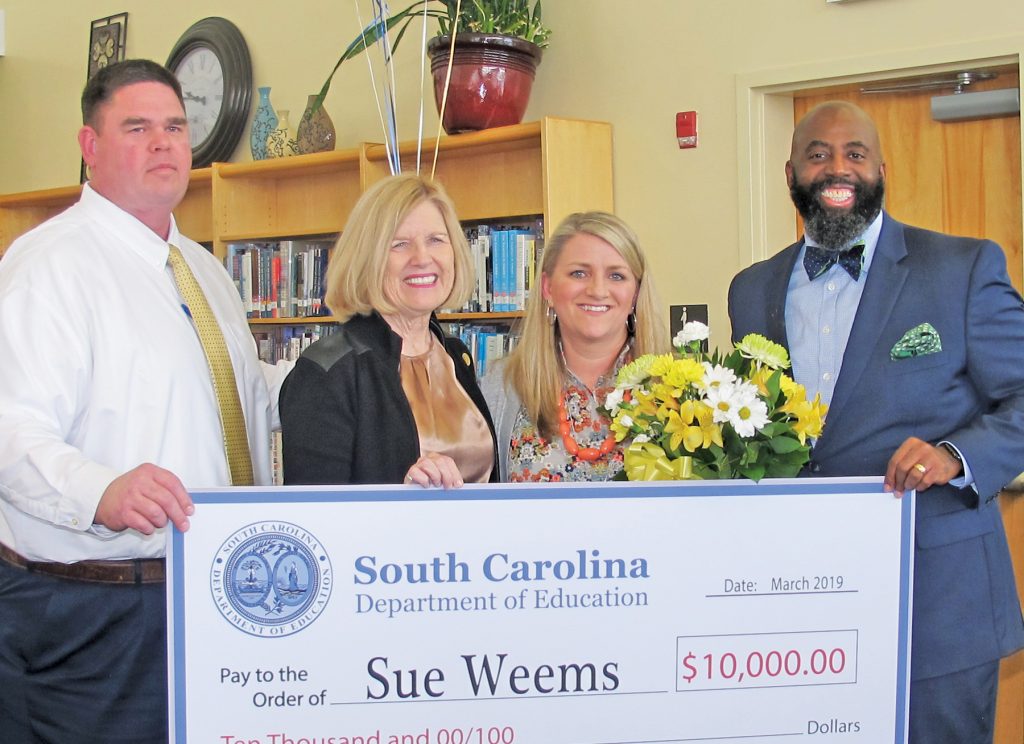
    Blythewood High School principal Matt Sherman, left, State Superintendent of Education Molly Spearman and Richland Two Superintendent Barron Davis, right, congratulate Sue Weems, center right, for being named a finalist for SC Teacher of the Year. | Barbara Ball

    BLYTHEWOOD – Blythewood High School English teacher Sue Weems got a big surprise Tuesday morning when State Superintendent of Education Molly Spearman made an unexpected stop at the high school to announce that Weems has being named one of five finalists for the South Carolina Teacher of the Year award.

    Richland Two School Superintendent Barron Davis presented Weems with flowers and Blythewood High School Principal Matt Sherman presented her with a bouquet of balloons.

    Weems was also presented a $10,000 check as she faced a bank of television and newspaper cameras. She will now go on to the next stage of competition that will culminate in the crowning of the South Carolina Teacher of the Year at a Gala on May 8 in Columbia.

    “Sue has spent her career meeting the needs of each individual student and challenging them to be their very best,” Spearman said. “Her experience in both K-12 and higher education is an invaluable tool that helps her identify with her students and show them what is possible.”

    Spearman also noted that Weem’s husband, who is in the military, is deployed in San Diego. Libby Roof, Richland Two’s Chief Communications Officer, tried to make phone contact with Weem’s husband so Weems could give him the good news, however, he could not be reached.

    Weems, a tenth and eleventh grade English teacher, and a Blythewood resident, is the published author of fifty original short stories for students in kindergarten through sixth grade.

    “Mrs. Weems possesses an innate ability to inspire students’ success,” said Richland Two superintendent Dr. Baron Davis. “Her own experiences including being the child of educators, mother of four and a military spouse who has lived in many locales, has shaped her approach and teaching philosophy. Her students benefit from her abilities to tailor her teaching style to meet the individual needs of each learner and to make connections with all of her students. Richland Two is extremely proud of Mrs. Weems,” Davis said.

    Weems said she considers her most profound legacy to be that she deeply understands her students and individualizes instruction to meet their needs. She said her teaching mantra is “care, connect and challenge.”

    The teacher selected for the State Teacher of the Year will receive a total of $25,000 and will be provided with a brand new BMW to use while serving for one year as a roving ambassador providing mentoring, attending speaking engagements, working with teacher cadets and teaching fellows, leading the State Teacher Forum and serving as the state spokesperson for over 50,000 educators.