Tag: midlands technical college

  • MTC president questioned on how county funding is spent

    WINNSBORO – With Fairfield County considering tax increases and agency cuts to balance the budget, questions arose during a work session Tuesday about how the county funds Midlands Technical College.

    MTC president Ronald Rhames acknowledged this year’s $155,100 funding request – up from about $143,000 last year – would be spent not only in Fairfield County, but also Richland and Lexington counties.

    “It’s used for all of our physical plant operations,” Rhames said.
    Pauley questioned other aspects of MTC funding that he said is often vague.

    This year’s request of $155,100 is characterized as “Other.” In prior years, MTC classified its requests to the county as “building maintenance.”

    Pauley found that odd, noting that the county fully maintains the MTC building in Winnsboro, a process that involves trimming bushes and removing bird nests. Then the county also provides MTC with funding for maintenance.

    “I’m pretty sure it doesn’t take $155,000 to do those things,” Pauley said. “You could offer a whole lot more in Fairfield County. Two academic classes, I feel, is not enough.”

    Rhames suggested that the Fairfield money helps backfill MTC’s overall budget, thereby saving students money in the long run.

    “The money you provided helped lower the costs of students attending MTC when they come to Columbia to attend one of our campuses,” he said. “We have a number of Fairfield citizens taking advantage of those courses.”

    Pauley also stated that MTC’s Fairfield campus is only offering two courses – English 101 and History 201 – in the upcoming fall semester. There was conflicting information about whether MTC-Fairfield offered one or two courses this past spring.

    “With the amount of money that Fairfield County has given, we’re not getting the best bang for the buck,” Councilman Doug Pauley said.

    Moments earlier, Rhames extolled how 25 Fairfield County high school students were slated to receive associate’s degrees or certificates this week. He said county funding helped make that happen.

    “These students have a head start. Your investment allows this,” Rhames said. “These students are saving their parents a tremendous amount of money.”

    MTC is one of 22 outside agencies that have requested county funding to help subsidize their 2022-2023 budgets. Tuesday’s work session gave those agencies a forum to formally request funding.

    Most presentations wrapped up in a few minutes with council members asking few to no questions. MTC’s request, however, garnered considerable commentary.

    Pauley pressed Rhames about whether MTC students really attended spring classes for free as the state had promised.

    Rhames responded that while the governor’s office recently pledged free technical college education for eligible students, the state only provided 20 to 25 percent of the necessary funding.

    MTC covered what the state didn’t fund, Rhames said.

    “For the students who qualified for it, the institution made up the difference to make sure we honored the commitment the governor made,” he said.

    Not all council members contested MTC finances.

    In spite of scant academic offerings at the Winnsboro campus and most of Fairfield’s funding being spent in other counties, County Chairman Moses Bell applauded the college system for its efforts.

    “You and I have talked about those courses, those free courses, those community courses,” Bell said. “That’s been a success for this county.”

    No decisions were made on any of the outside agency requests.

    The county will likely hold second of three readings on the budget in two weeks. A third budget work session is tentatively set for Monday, May 16.
  • County Promise awaits MTC’s OK

    WINNSBORO – Fairfield Promise, a program designed to allow qualifying students to attend college at no cost, is moving forward without participation from Fairfield County Council — at least for the time being.

    At last week’s Fairfield County school board meeting, Superintendent Dr. J.R. Green announced that 24 students are participating in the inaugural Promise Program class.

    Twenty-one graduated from Fairfield Central High School. Two from Richard Winn Academy and the other from a virtual charter school.

    “I anticipate we’ll see the number of students [attending] even higher next year,” he said, calling this year’s class “an excellent start.”

    Green has previously estimated that it would cost $150,000 to launch the Promise Program. The initial vision was for the county and school district to each pitch in matching $75,000 appropriations.

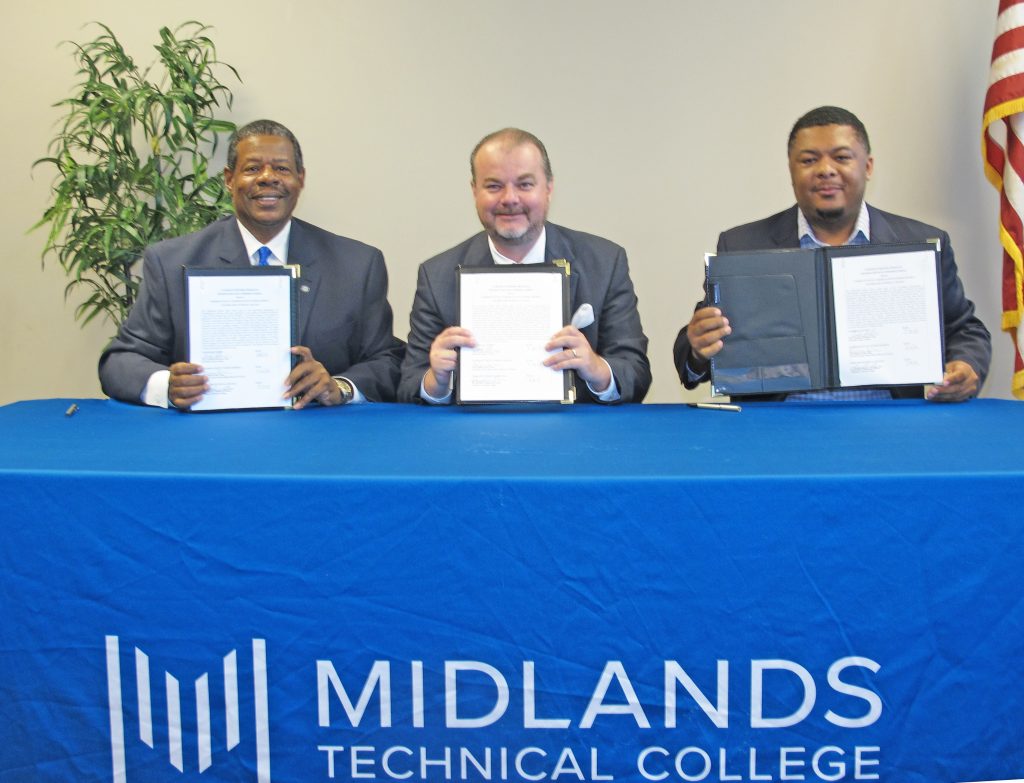
    On July 8, the school district, the county council and Midlands Tech signed a Memorandum of Understanding, or MOU, pledging to work together to craft a formal joint agreement.

    In the end, however, the school district and county signed separate agreements with Midlands Tech.

    The school district had already put together its version of the Promise Program agreement, voting June 4 to fund it and finalizing its approval on July 16.

    Fairfield County approved its version of the contract on Aug. 12, voting to “approve the [school district’s] Promise Program agreement with amendments,”

    The county’s contract has not yet been approved by Midlands Tech.

    Neil Robinson, chairman of Fairfield County Council, said that while the school district is doling out a $75,000 lump sum payment, the county has asked to be billed as needed.

    “We’re pulling money from two different pots (the school district and the county},” Robinson said. “From the council’s perspective, a majority of us wanted more accountability.”

    “The main thing here is kids are going to school for free,” Robinson said.

    The Voice sought a copy of the county’s version of the contract under the state’s open records law, but the county said it couldn’t comply, citing the lack of final approval [by Midlands Tech.] 

    “The Promise Program contract has not been executed by all parties,” County Attorney Tommy Morgan wrote in a response letter. “Therefore, the County is unable to provide those documents at this time pursuant to [state law].”

    Councilman Douglas Pauley said he supports the pay-as-you-go method as opposed to paying a lump sum.

    “We have not given our $75,000 yet,” Pauley said. “When they send us a bill with how many kids they’ve got, then we’ll cut them a check.”

    Green said the district moved forward on its own. He wouldn’t discuss the school district’s position on the county’s amendments, but acknowledged the county isn’t yet bound by the contract until it is approved by Midlands Tech.

    “I will defer to the county on their positions on specific amendments,” Green said.
    A recent Fairfield County school newspaper article stated that Green said the Promise Program wouldn’t require taxpayer support. 

    Green said the school newspaper was in error.

    “A student journalist covered the meeting and incorrectly stated that tax dollars would not be used to fund the program,” he said via email.

    At the May 14 school board meeting, during second reading of the 2019-2020 budget, the district announced the inclusion of $75,000 for the Promise Program, according to school board documents.

    Green has previously said he hoped the district could establish an endowment to fund the Promise Program. 

    “Ultimately, we may try to get to that point,” Green said. “But initially we [the school district and county] are funding it through our respective budgets.”

  • County, FCSD disagree on ‘Promise’

    WINNSBORO – Fairfield County and the Fairfield County school district still have some homework to finish before a plan allowing students to attend college at no cost takes effect.

    County Council on Monday approved its version which would cover college costs for qualifying Fairfield County students enrolling in Midlands Technical College’s Winnsboro campus.

    The vote was 5-1 with Councilman Douglas Pauley opposing. Councilman Mikel Trapp left the meeting before the vote, which followed a 60-minute executive session.

    However, it is not clear exactly what the council actually approved.

    Council members voted to “approve the Promise Program agreement as amended,” according to the motion to approve.

    It was not disclosed in public session what those amendments are.

    Council Chairman Neil Robinson wouldn’t release a copy of the agreement or even a summary of the new amendments, saying after the meeting that the county’s attorney needed time to draft the formal document.

    The S.C. Freedom of Information Act states that negotiations incident to proposed contracts can be discussed behind closed doors, but contracts themselves become public once entered into.

    “These documents are not exempt from disclosure once a contract is entered into,” the law reads.

    The Promise Program’s reception has been mixed since the school district announced the proposal in May.

    A majority of school board and council members have touted the Promise Program as an opportunity for Fairfield students to receive a college education that otherwise would remain out of reach. They also see it as a way to facilitate economic development.

    Critics have raised concerns about cost, lack of course offerings and accountability.

    On Monday night, Ridgeway resident Randy Bright said while he supports the Promise Program’s general premise, the lack of course offerings at MTC concern him.

    “We need to leverage MTC. We need to offer enough classes to make this a viable situation for our Fairfield County students,” Bright said. “The last time I looked the Fall schedule had 12 entire classes. Most of them were germane to basic studies. It needs to be a more robust program.”

    Differences between the agreement signed by the school district last month and what some council members say they want to approve for the Promise Program were enough to concern Councilman Moses Bell, but not enough for him to vote against the deal.

    “Let me discuss my reservation to the new agreement. At this point we do not know whether they [school board members] agree. Do we give them a courtesy review?” Bell asked. “We may be looked upon as a group that can’t keep its word. Yes, I definitely want the promise program to educate the students of Fairfield County, regardless of circumstance.”

    While one council member told The Voice that the school district jumped the gun by signing an agreement last month that the county had not yet agreed to, Bell said he thought the school district should have been allowed to view the county’s modifications before it gave final approval on Monday night.

    Robinson said the county would share its version of the contract [with the school district] now that it is approved.

    “The reason they haven’t got any copies is because this is the official [document] we’ve agreed upon now … I’m sure they will view it and make notes as they see fit.”

    However, at least one council member disagrees that the council has actually approved an agreement at all.

    Councilman Jimmy Ray Douglas told The Voice that council’s vote was only ‘approving’ that the Promise Program is a good thing, not a vote for approval of the agreement that was presented to them in executive session.

    The agreement that was included in the school board packet and voted on was identified as a Memorandum of Understanding.

    Councilwoman Bertha Goins said it is only natural that the agreement the council approved Monday night would evolve from the Memorandum of Understanding that was signed in July. But the July 8 MOU ‘agreement’ signed by representatives of the council, school board and Midlands Tech was half a page long and lacked specifications that were included in the three-page agreement approved later in July by the school board.

    “It’s my understanding this began with the [July 8] MOU to understand the process,” Goins said. “Both parties have the discretion of choosing their own avenue of how to do the proceeds.”

    The Fairfield County school board’s meeting is scheduled for Tuesday, Aug. 20. It will be held at the District Office Auditorium, with executive session starting at 6 p.m. and the regular meeting following.

    An agenda for the meeting had not been published as of Tuesday, though the Promise Program is likely to be discussed.

  • County, School District promise free MTC tuition

    A memorandum of understanding to create a Promise Program was signed Monday by Midlands Tech President Ron Rhames, Fairfield County School Board Chair William Frick and County Council Chair Cornelius Robinson. | Barbara Ball

    WINNSBORO – Providing free technical college tuition to financially struggling students is noble. Supporters say the Fairfield County taxpayer-funded Promise Program initiative will open college to more students and boost the local workforce.

    On Monday, representatives from Fairfield County, the Fairfield County School District and Midlands Technical College inked a Memorandum of Understanding (MOU), pledging their commitment to the Promise initiative.

    “This is a wonderful program and a way to move our county forward,” County Administrator Jason Taylor said to those gathered at the signing. “A good education is one of the surest ways to guarantee that our children will have access to good jobs and the opportunity for a better future.”

    Later that night, Fairfield County Council discussed in public, and also behind closed doors, its role in the Promise Program, recently pitched by Dr. J.R. Green, district superintendent.

    “Any kid in Fairfield County could go to Midlands Technical Institute at no cost,” Green said. “Students have to apply for financial aid. They’ll look at all the federal and state aid, and Promise revenue will cover the difference. But no one will be required to pay any tuition.”

    Similar programs exist in Kershaw, Sumter, Lee, Green wood, Clarendon and Williamsburg counties, according to the S.C. Technical College System, which governs the state’s technical schools.

    Most counties make free tuition available, but not unconditionally. The only conditions of note in the Fairfield MOU are that recipients must live in Fairfield County and graduate from a public or private school, approved homeschool or have a GED.

    Greenwood prorates tuition aid based on a student’s length of residency, according to the Greenwood Promise Program website.

    Sixty-five percent aid is offered to students attending grades 9-12, but students attending two years or less receive nothing. Full aid only goes to lifetime residents.

    In Sumter County, qualifying students can attend Central Carolina Technical College at no cost provided they maintain a 2.0 GPA and remain enrolled for six consecutive semesters, according to the CCTC website.

    Aid only covers tuition, however. Books, lab fees and other miscellaneous costs aren’t covered, the website states. What the funding covers is not made clear in the Fairfield Promise MOU.

    Promise creates confusion

    There’s some disparity between how some council members, the school district and MTC perceive the Promise Program arrangement.

    The MOU signed Monday describes the deal as a “nonbinding Memorandum of Understanding to announce their intent and purpose to work together to establish the Fairfield County Promise Program.”

    An MTC media advisory announcing the signing states that dignitaries “will sign an agreement that allows 2019 high school and GED graduates living in Fairfield County to attend MTC at no cost.”

    Both the school district and county have budgeted $75,000 for the Promise Program, but neither body has formally voted to authorize any expenditures for the program, though approval is likely.

    At Monday’s council meeting, Councilman Jimmy Ray Douglas repeated prior assertions that MTC doesn’t attract enough students to its Winnsboro campus to justify holding classes there.

    “I’m not against educating children, I’m all for it,” Douglas said. “I’ve been trying to get Midlands Tech to teach classes in the last five years, yet they’ve had no classes whatsoever. It’s a shame we have to pay them $75,000 to start a class.”

    Speaking to The Voice on Tuesday, Councilman Douglas Pauley identified several elements that concern him, namely cost and accountability.

    Pauley said MTC needs to more clearly state how many students plan to attend and what classes will be offered. He said county’s $75,000 share should be doled out in quarterly installments based on MTC’s ability to meet those standards.

    “To give a lump sum of money with no accountability to the taxpayers how that $75,000 is specifically going to be used, I’m not in favor of that,” he said.

    In addition, Pauley said students should be required to take more classes than the six-credit-hour minimum he said other council members support.

    Many traditional student loan programs require students to register for at least 12 credit hours to receive full financial aid.

    Pauley also said students should meet specific academic standards to qualify.

    “To me, with a C average, you’re just kind of coasting along,” he said. “If someone else is paying for your college tuition, you can do better than a C average.”

    Other council members embraced the Promise Program.

    “This is a huge deal to be able to allow our students to go to school tuition free,” Councilman Moses Bell said. “This is big, this is a good thing. This is something we ought to be jumping up and shouting about.”

    Council Chairman Neil Robinson also supports the Promise Program.

    “I just think investing in our future for the kids is definitely something that’s needed in this county so we can have a stronger workforce, a better quality of life,” he said. “We’d be bridging that gap for the workforce.”

    Robinson said the Promise Program would likely receive further discussion at the next meeting set for July 22.

    Transparency concerns

    Government secrecy is also throwing cold water on the initiative for some.

    On Monday night, council members retreated behind closed doors to further discuss the Promise Program. Ridgeway resident Randy Bright chided the council for doing so.

    “You’ve taken a slip back with this Promise Program. There’s lots of confusion, lots of secrecy,” Bright said during public comments. “Why are you talking about this in executive session? This is between governments. You shouldn’t need to talk about this in executive session. It should be open.”

    An agenda for the meeting stated the executive session was for a “contractual matter” to discuss and receive “legal advice regarding [an] agreement between Fairfield County, Fairfield County School District and Midlands Technical College as to the Promise Program.”

    Pauley said he didn’t agree with discussing the Promise Program behind closed doors.

    “I thought that matter pertaining to the Promise Program could’ve been done in an open forum,” he said. “I didn’t see a need for it to be in executive session.”

    Monday night’s executive session was improper because the county had already signed an MOU, said Jay Bender, an attorney with the S.C. Press Association, of which The Voice is a member.

    Bender also called the receipt of legal advice explanation “vaguely worded.”

    “The MOU sounds like a contract to me,” Bender said. “If there’s an MOU, which is a contract, you can’t go into executive session under the rubric of contractual matters.”