Tag: John Seibles

  • Counties differ on animal abusers

    WINNSBORO  – A man convicted of setting a dog on fire is serving a five-year prison sentence, the maximum allowed under state law.

    Another man who dragged a dog with a truck more than a mile didn’t spend one day in prison.

    So what makes these cases different?

    One was prosecuted in Richland County; the other in Fairfield County.

    Hykeem Dontavious Jabar Golson, 23, of Columbia, was sentenced to five years in prison and fined $5,000 after a Richland County jury convicted him in December 2017 of one count of felony ill treatment of animals, according to Richland County court records.

    Golson is one of only two South Carolina defendants to receive the maximum sentence, according to media reports.

    Billy Ray Huskey, 51, of Great Falls, pleaded guilty in July 2016 to dragging a nine-month-old dog with his Dodge Ram pickup truck in Fairfield County.

    Two other dogs were later found emaciated and had to be euthanized.

    Huskey had been charged with ill treatment of animals, torture – also a felony.

    But instead of going to prison, Huskey was allowed to plead to the misdemeanor charge of ill treatment of animals and sentenced to 90 days in prison, suspended to three years of probation.

    Richland throws book at abusers

    The disparity between the Richland and Fairfield cases is representative of how both counties traditionally handle animal abuse cases.

    A recent investigation by The Voice found that of 14 ill treatment of animals cases prosecuted since 2016 in the 6th Judicial Circuit, which includes Fairfield County, very few resulted in actual jail time.

    Often times, defendants either received probation or the cases were nolle prossed, meaning the cases weren’t prosecuted.

    Richland County, however, has quickly developed a reputation for a no-nonsense approach to animal cruelty.

    “Our pets need to be properly cared for and treated with love because they are a part of our families,” Richland County Sheriff Leon Lett said in a news release announcing Golson’s arrest.

    A lot of Richland County’s assertiveness appears to be in allocating resources to combat animal cruelty.

    In 2015, the Richland County Sheriff’s Office founded an animal cruelty task force.

    That year, its founder, senior investigator Holly Wagner, also investigated at least four dog fighting rings, according to a sheriff’s office news release, landing her honors from the American Society for Prevention of Cruelty to Animals and Humane Society of the United States.

    Judicial discretion

    Often times, how defendants are prosecuted hinges on the presiding judge, a point raised during a recent Winnsboro Town Council meeting.

    In June, Police Chief John Seibles told council members that officers have charged several people with cruelty to animals, with some facing felony counts.

    Penalties, however, are set “at the discretion of the court,” Seibles said. Katera Alexander, however, was arrested by a police officer in Seibles jurisdiction and charged with only a misdemeanor after it was discovered that she had tied a pit bull to her porch and starved it to the point that it had to be euthanized by the County’s Animal Control. Seibles’ comments were part of a larger discussion council members were having about proposed revisions to the Fairfield County animal control laws.

    While some Winnsboro town leaders were reluctant to follow the county’s lead, others were open to tougher penalties in more severe cases.

    Councilman Clyde Sanders, for example, said he thinks the town should mirror the county’s $500 fine for cruelty cases.

    “I can’t stand seeing dogs chained in the yard without anything to eat,” Sanders said. “If we catch someone doing that, the fine ought to be high enough to prevent them from doing it again.”

    In the Huskey case, Assistant Sixth Circuit Solicitor Melissa Heimbaugh, who prosecuted, told the Court she thought the state would not win a felony case with the available evidence.

    The presiding judge grudgingly agreed.

    “The State (solicitor) is right, they would have had a high burden to prove your guilt,” Gibbons said. “We have no evidence of intent, so I’m giving you the benefit of the doubt, which I have to do under the law.”

    Huskey faced up to five years in prison, but escaped prison by pleading guilty to the misdemeanor charge. He was also ordered to perform 30 hours of community service and banned from owning a dog.

    “I want to sentence you to the maximum jail time that I can under the guidelines,” Gibbons said. “I’m going to give you not two years of probation but three.”

    Lax laws

    Prosecutorial leniency is one reason most Fairfield defendants have escaped accountability in animal abuse cases, but not the only reason.

    One S.C. House member says South Carolina lags when it comes to meaningful protections for pets.

    “The laws need to be strengthened,” said Rep. Bill Taylor, R-Aiken. “It’s common knowledge that people who torture and abuse other animals are one step away from torturing or harming human beings.”

    In 2014, Taylor introduced a bill that would’ve toughened penalties for animal abusers, making most cases felonies. The measure, however, failed to gain traction.

    That year, though the General Assembly did revise animal abuse laws that cases are now heard in general sessions court versus magistrate or municipal court, where penalties tend to be lighter.

    But it’s not enough, Taylor says.

    “There’s a myriad of bills filed every session about this,” he said. “Very few of them ever get passed.”

    As recently as February, the S.C. Senate introduced a bill, which among other things, tightened anti-tethering laws. The Senate passed the bill, but it died in the House.

    Penalties for violating the tethering law would’ve included up to 90 days in prison and a $1,000 fine.

    The law also required magistrates to receive animal cruelty training and improving shelter standards, but the anti-tethering provisions drew opposition.

    “Serial killers over the years tortured animals at some point,” Taylor said. “These are serious crimes that can lead to other crimes, we need to be serious about this.”
  • Chairman contests response to proposed ordinance

    WINNSBORO – Fairfield County is shooing any notion that it’s trying to coax the Town of Winnsboro into adopting the tougher animal control laws that the County is considering.

    But that’s the perception Winnsboro Town Council expressed during its June 5 meeting.

    Mayor Roger Gaddy called the county’s proposed ordinance “cumbersome,” and he and other council members questioned the town’s ability to enact it.

    County Council Chairman Billy Smith, however, said the ordinance is in the very early proposal stages.

    Smith said it’s subject to change, and there aren’t any plans to nudge Winnsboro into passing a similar measure. He was especially surprised the document was presented and debated by Winnsboro Town Council.

    “I think that discussion was probably premature,” Smith said, noting he first learned about the Winnsboro discussion by reading about it in The Voice.

    Smith said staff prepared the draft ordinance, and that it hasn’t been presented to county council.

    “We haven’t even seen it (the ordinance),” he said. “I was told it was not something meant to go to any other council.”

    At its June 5 council meeting, the Winnsboro Town Council accepted as information a proposed county ordinance it said was aimed at strengthening animal control regulations.

    Gaddy held a copy of the proposed ordinance in his hands as he told council members about the county’s request.

    He and others, though, expressed concerns about the town’s ability to enforce a stricter animal control ordinance.

    “I think the ordinance is relatively lengthy and cumbersome and may impose some difficulty and cost in enforcing it,” Gaddy said. “We still have to deal with issues with animal control without passing something consistent with the county.”

    Gaddy also opposed a provision that limits dog ownership to three, noting he owns six dogs.

    “I don’t want an ordinance limiting the number of dogs I have as long as they behave and believe me, they’re treated right,” the mayor said.

    During the meeting, council members expressed general support for prosecuting overt acts of animal cruelty, but were reluctant to implement comprehensive changes to the law.

    Winnsboro Police Chief John Seibles said manpower remains a challenge, noting the town doesn’t have a full-time animal control officer.

    Seibles also said fines don’t always deter lawbreakers, noting penalties are set “at the discretion of the court.”

    Animal control and financial data, and how it relates to the number of animals the county houses, are elements that Fairfield County officials are reviewing with its proposed ordinance.

    Smith declined to comment about specific numbers, but acknowledged he’s interested in learning the percentage of animal calls originating from within Winnsboro town limits that county officers respond to and foots the bills for.

    “I have the concern, but I want to figure out to what extent,” he said.

  • Town of Winnsboro resists tougher animal control laws

    WINNSBORO – Winnsboro leaders think Fairfield County is barking up the wrong tree by asking the town to emulate the county’s animal control ordinance.

    On Monday night, Winnsboro Town Council members resisted the request, saying the county’s law is overly superfluous and restrictive.

    “I think the ordinance is relatively lengthy and cumbersome and may impose some difficulty and cost in enforcing it,” said Winnsboro Mayor Roger Gaddy. “We still have to deal with issues with animal control without passing something consistent with the county.”

    For example, Gaddy said he opposes a provision that would limit households to owning three dogs or less.

    “I have six, and as far as I know they’re not a nuisance,” Gaddy said. “I don’t want an ordinance limiting the number of dogs I have as long as they behave and believe me, they’re treated right.”

    Councilman John McMeekin said he was open to enacting a reasonable animal control ordinance, but noted the town needs adequate resources to enforce the law.

    Councilman Clyde Sanders agreed with Gaddy that the county law was burdensome, but also said he’d support higher fines for animal abuse. He proposed increasing animal cruelty fines to $500.

    “The one thing I would like to see the town do is have a fine of that amount,” Sanders said. “I can’t stand seeing dogs chained in the yard without anything to eat. If we catch someone, the fine ought to be high enough to prevent them from doing it.”

    Winnsboro Police Chief John Seibles said officers handle several animal cruelty cases, including a few felonies. He noted manpower is the greatest challenge.

    “We don’t have a full-time dedicated animal control officer, though our officers do a good job with that,” Seibles said. “If it is on the books, we’d be charged with enforcing it in some kind of way, but we don’t have the means to.”

    Council members accepted the county’s request as information, but took no action.

    “We have ordinances on the books that we don’t enforce now unless someone complains about it,” Gaddy said. “I don’t want us to vote on something if we’re not able to fulfill the letter of the law.”

    In other business, the council voted unanimously to appoint McMeekin as an ex-officio member to the Fairfield County Chamber of Commerce.

    The vote mirrors a similar action Fairfield County Council took last month.

    On May 14, the council voted to authorize the chairman to appoint a county council member to the board as a condition of receiving its annual grant of $87,507 in its entirety.

    The county’s appointee can vote, but cannot hold an office, such as president or secretary. The town’s appointee, however, would serve as an ex-officio member with no voting powers.

    “I think it would be a great idea. I think it would help give the chamber input from the town, and give a liaison from the town the opportunity to let us know what’s going on with the chamber,” Gaddy said. “There can be a line of communication, but not conflicted when it comes to voting on matters affecting the chamber.”

    First reading of the budget and annual tax levy by title only was also on the agenda Monday night.

    Second reading and a public hearing on both budget ordinances will take place at the next council meeting.

  • Chamber Board meets secretly; votes to become ‘inactive’

    WINNSBORO – The elephant in the room was not mentioned during the Fairfield County Chamber of Commerce’s monthly breakfast on Wednesday. That elephant was the surprise announcement on Monday that the Chamber Board voted for the Chamber to become ‘inactive’ as of June 30, 2018.

    While Facebook pages lit up with the news, neither the Chamber’s Board Chairman, nor any of the Board members mentioned the issue at the breakfast.

    Following the breakfast, when two Board members were asked by The Voice when and where the Board had met to vote for the ‘inactive’ status, neither would divulge the information. Board member Lou Ann Coleman accused The Voice of harassment for asking the question. In an email later that day, Coleman did respond that the vote was held during a meeting at the Chamber offices on April 19. However, no meeting had been posted for a Chamber Board meeting on that date.

    The S. C. Freedom of Information Act, Sec. 30-4-60 states, “Every meeting of all public bodies shall be open to the public unless closed pursuant to Sec. 30-4-70 of this chapter. In Sec. 30-4-80, it further states that notice must be given of meetings of all public bodies.

    “The South Carolina Freedom of Information Act requires not just governmental entities, but ‘any organization, corporation, or agency supported in whole or in part by public funds or expending public funds,’ to abide the Act’s transparency requirements,” S.C. Press Association attorney Taylor Smith said. “The Act provides that such organization must have meetings open to the public and that the public be notified of the time, location and agenda for the meeting. The failure to notify the public of an upcoming meeting of an organization is a violation of the South Carolina Freedom of Information Act,” Smith said.

    “After carefully evaluating its feasibility, the Board of Directors unanimously voted to take this action,” the Board’s press release stated. “The primary factors that led to this decision included limited financial support, reduced participation during the traditional Chamber structured events, as well as limited volunteers,” the release stated.

    Asked to clarify whether the Board planned to disband the chamber on June 30, 2018, a source on the Board who asked not to be identified said the chamber will still file with the Secretary of State as an organization, but that it will become inactive as of June 30. Until that time, activities will go on as normal, the source said.

    The source also said all Chamber employees will be let go as of June 30, but that the Chamber will remain in an inactive state after June 30, the end of the Chamber’s fiscal year.

    Asked by The Voice to clarify ‘inactive,’ Shull answered in an email, “Inactive means not in operation.”

    In the email, Shull also stated that the newly hired Interim Director of the Chamber, Chris Timmers, who was hired March 1, would not be employed through June 30. On that same day, in a Facebook post, Board member Lou Ann Coleman posted that Timmers “is no longer employed by the Chamber. Ms. (Susan) Yenner is.”

    Asked to clarify Mr. Timmers’ employment status further, whether he would continue receiving a salary until June 30 even though he is no long employed, or if he received a separation package, Shull has not, at press time, responded.

    The Chamber is funded primarily by the County, at $87,500 annually, and by the Town of Winnsboro for Town sponsored events at $35,000 annually. In reference to the Chamber’s reported ‘limited financial support,’ County Council Chairman Billy Smith said he was surprised to hear that was a factor in the Board’s decision to go inactive.

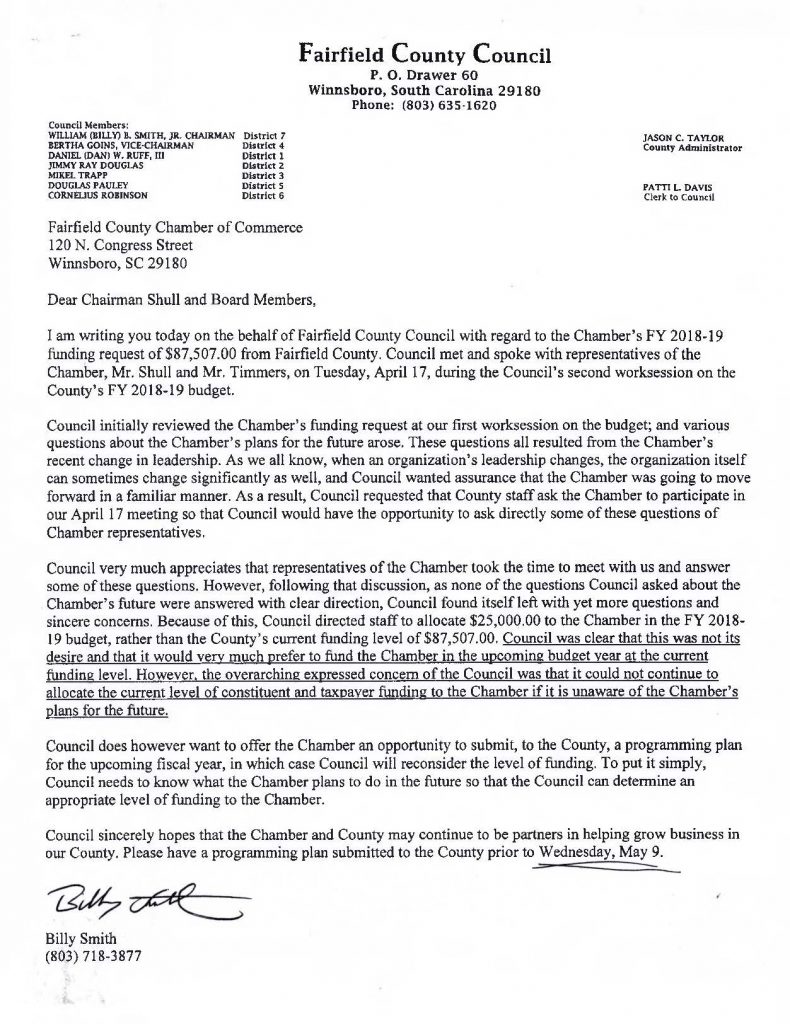
    “No, the County has not cut the Chamber’s funding,” Smith said. “We have contemplated the idea of reducing it, but only because their representatives couldn’t answer basic questions Council members had about their plans for the future during our second budget work-session.

    “In a letter from Council that was delivered to the Board on April 17, Council offered the Chamber every opportunity to keep their County funding the same as it has been in the past. I offered assistance on planning. Now, I really don’t understand the suggestion of ‘limited financial support,’” Smith said.

    “Between County funding, the money the Town of Winnsboro gave the Chamber for the first time this year, and the proceeds from their golf tournament (which they said they aren’t going to do anymore),” Smith said, “ I’d think the Chamber had more financial support now than at any time before, at least in recent history.”

    Asked if he had seen a decrease in attendance at Chamber sponsored events, Chief John Seibles with the Winnsboro Department of Public Safety, which oversees safety of the festivals in the Town, including Rock Around the Clock and the Pumpkin Festival, said the crowd at last year’s Rock Around the Clock was large and orderly.

    “It [Rock Around the Clock] was larger than in past years and it ran smoothly as I recall,” Seibles said.

    Board Chairman Harper Shull has not returned phone calls from The Voice at press time.

    County Council Chairman Billy Smith sent the following letter to Chamber Board Chairman Harper Shull following Chamber Interim Director Chris Timmers’ presentation to Council during a budget workshop on April 17.

    Related: FC Chamber Board votes to become inactive, Council gives Chamber notice