WINNSBORO – Last week attorneys for South Carolina Electric and Gas Company (SCE&G) argued in the Sixth Circuit Judicial Court for a change of venue for the lawsuit filed against them by Fairfield County.
Attorneys for Fairfield County argued that the trial should remain in the county where the incident (the abandonment of reactors two and three at V.C. Summers nuclear plant) occurred.
A decision from Judge Paul Burch is expected by next week.
Attorneys for SCE&G said in court that it would be necessary to move the trial to Lexington County since some county officials, including County Administrator Jason Taylor, Senator Mike Fanning and certain County Council members had poisoned the public by saying negative things about SCE&G which created the situation where the people of Fairfield could not be expected to rise to the level of giving a fair judgement.
The County’s attorneys argued, essentially, that the people of Fairfield County have a right to trial here in Fairfield County.
“Even if the trial is not held in Fairfield County where the plant is, by law it must be held in the circuit which includes Fairfield, Lancaster and Chester counties. Holding the trial in Lexington County is not an option,” McKensie said. “Legally it must be held in the county or at least in the circuit.”
WINNSBORO – South Carolina Electric and Gas Company has filed a motion for a change of venue for the lawsuit Fairfield County filed on Nov. 29, 2017 against the utility for a temporary injunction. The matter is to be heard on Thursday before Judge Paul Burch.
“SCE&G is asking to have the trial moved to Lexington County since they’re based in Cayce,” Fairfield County Administrator Jason Taylor told The Voice on Wednesday. “That would be more convenient for them, but we, of course, don’t want to do that. Fairfield is where the incident occurred, this is where we work and live and there would be many inconveniences for our council members if it were moved,” Taylor said.
Council members signed affidavits on Monday stating their particular inconveniences, health problems and other reasons why it would be difficult for them to travel to Lexington County for a trial.
“We’ve submitted the affidavits to our attorney, and he will submit them to the judge on Thursday,” Taylor said. “Hopefully, the judge will rule on Thursday, but at this point, we don’t know.”
RIDGEWAY – The County’s Director of Economic Development, Ty Davenport, is tickled pink that the county has a potentially interested buyer for its only spec building, a 75,000 square foot big box in the Walter Brown Industrial Park off Cook Road, but his elation is exceeded by his worry that the County doesn’t have the marketable industrial properties that it needs to stay up with its competition.
Some Fairfield County residents, however, have voiced objection when the County considers purchasing more land for economic development.
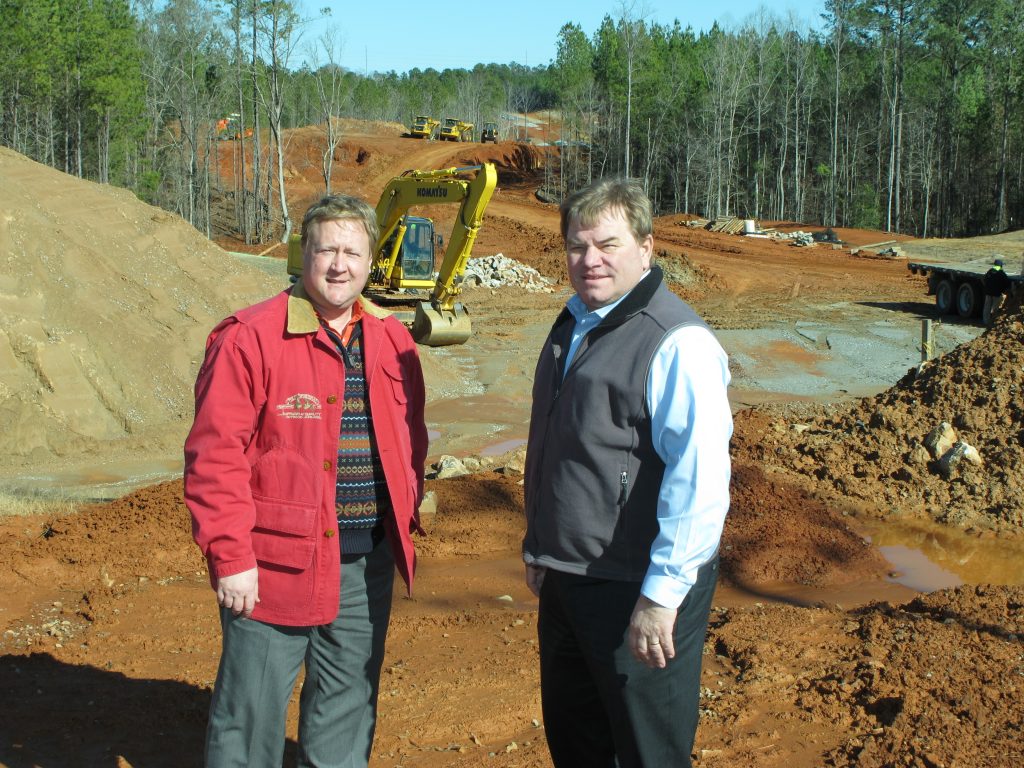
Fairfield County Administrator Jason Taylor, left, and the County’s Director of Economic Development Ty Davenport, survey infrastructure construction in the Fairfield Commerce Center off Peach Road that is scheduled to be finished in the spring. | Barbara Ball
“When it comes up that the County is looking to buy several hundred acres of property for economic development, the perception is that the County owns all this property and has a tremendous amount of inventory,” Davenport told The Voice last week during a tour of the County’s 600-acre Fairfield Commerce Center off Peach Road, the second of its two industrial parks.
“But we don’t,” he said. “Our marketable territory is pretty slim today compared to the main counties we compete with. We have a total of about 600 buildable acres. Chester County has 1,353 marketable acres available, twice what we have. Kershaw has 1,000+ marketable acres and Orangeburg County, a big competitor of ours, has 1,850 acres ready to go,” Davenport said. “Orangeburg has 10 industrial parks compared to our two – the Fairfield Commerce Center and the Walter Brown Industrial Park. And these numbers don’t include mega sites.”
Davenport said the County has about 475 buildable acres in the Fairfield Commerce Center and only 32 total buildable acres in the Walter Brown Park.
“When recruiting industry, we have to be ready for them. Things happen faster today than they did 20 years ago, and the county that has marketable, ready-to-go property is going to do better,” Davenport said.
Asked what other inventory there is in the County, Davenport said there are six available buildings – the former Mack Truck building, (676,000+ square feet), the former Caterpillar building (50,000+ square feet), the spec building (75,000 square feet), the 123,000-square-foot Charm building in Ridgeway that has only 22,000 square feet available, the Fazio (Plastec) building (175,000 square feet) on Highway 34 and about 20,000 square feet available in the 65,000+ square foot Ying Zin building in Walter Brown Park. All but the spec building are privately owned but marketed by the County.
“With the improving economy, the Mack Truck building has been getting lots of looks lately. It’s one of only six buildings over 600,000 square feet available in the whole state. It has rail and a new $3 million roof. It’s a clean building inside with a clean environmental report. It’s ready to go,” Davenport said. “It’s a big property with a lot of value on 150 acres. It could be expanded up to a million square feet fairly easily. A company that’s interested in a big building in South Carolina will look at it,” Davenport said. “Besides the potential jobs, that building can bring in significantly more property taxes annually for the County than the $400,000 it now generates.”
The only other site that could hold a building the size of the Mack Truck building is a 100-acre site located in the 210-acre second phase of the Fairfield Commerce Center. That site will be ready to market in late spring. Graders are currently adding water and sewer lines and roads. That work is being financed with $7 million from the County’s $24 million bond money.
Davenport said the County has saved about $1 million on the project by redesigning part of the site and securing almost $700,00 in grants. The County harvested a portion of the timber on the property and plans to use the proceeds to pre-grade building pads for new users.
Driving past BOMAG, a mid-size company that sits at the entrance to the Fairfield Commerce Center, Davenport pointed to a yard full of shiny yellow road paving equipment that the company assembles. He described the company as fantastic.
“It’s an international French-owned German company that employees 120 people and owns 120 companies around the world. That’s a good connection for us.” Davenport said.
For some in the County, the 1,200-acre mega site purchased last year on Highway 34 east of I-77 is the elephant in the room. Shortly after the County purchased the site, Val Green, a local engineer, announced during public comment session of a County Council meeting, that the property was full of granite and would be difficult to develop. Davenport said the state conducted geo technical studies on the property that show the granite to be well below the surface and should not be an issue. He also said soil borings were conducted on the site. Davenport conceded that this site, like all sites, has grading challenges. He also said the site would require water, sewer and natural gas before it would be marketable. However, he said the site has two big pluses.
“It’s the only industrial site the County owns that has rail access,” Davenport said. “That’s a top priority for the more desirable industrial sites.”
Another plus is that while the property cost a whopping $8,700,000, the County only had to kick in approximately $3,000,000. The Department of Commerce covered the remaining $6,000,000. The state has also agreed to assist in covering the cost of infrastructure for the site.
“This site is for the big one, the big user, the grand slam, the home run,” Davenport said of the mega site. “But it’s not going to be marketable for 12-18 months. We still have to design truck access. As for rail access, a spur just needs to be constructed from the track to reach into the site,” Davenport said.
In the meantime, Davenport said the County is trying to recruit more good mid-size companies like BOMAG for sites soon to be available in its two existing industrial parks. “I’d like to bring in 10 companies like BOMAG,” Davenport said. “Ten companies bring in 10 accountants, 10 lawn care people, 10 people doing whatever. We want those people in the County. We’re trying to figure out ways to drive the local economy, not the national economy.”
While Davenport said he feels the County is woefully short on marketable properties, he rattles off some of the County’s assets.
“The region is attractive, and the County brings a lot to the table to attract good, clean industry,” he said. “We have 1.2 million people in a 60-minute drive time, giving us access to a good workforce – about half a million employed people – and companies are looking for people who are currently employed. We have Lake Wateree, Lake Monticello, proximity to an international airport in Charlotte and a world class zoo and university in Columbia. We have the Fairfield County museum and Carolina Adventure World in our back door, Gamecock sports, plenty of great housing in Columbia, Northeast Columbia, Blythewood and other rural and small town settings in the County. And the shopping in Ridgeway and Winnsboro is getting better every day. There’s something for everyone here,” Davenport said.
Another plus, Davenport said, is that Winnsboro and the County are becoming big assets to each other. He said the two leaderships are working together now to make things happen.
“County Administrator Jason Taylor has a background in town administration and understands town development. He has a passion for it. We have a new grant writer in the Town, and the County has hired a new community development director who will be working not only with Winnsboro but the smaller towns in the County as well. What he’s doing will make my product easier to sell,” Davenport said.
“More than anything, I hope the people in the county understand that when the County buys land, we are not just land banking. We are trying to acquire an inventory to accommodate different size buildings that meet the needs of multiple end users,” Davenport said. “We have to have outside money coming in or the town and county will wither up. That’s what we’re trying to do. We’re trying to recruit money into the County.”
WINNSBORO – Fairfield County Administrator Jason Taylor has announced the appointment of two department directors – Jason Pope, Director of the Fire Service and Chris Clausen, Planning and Community Development Director.
Pope
“After 17 years of leaving the county every day to go to work, it’s a privilege and honor to come back home to work,” Pope told Council Monday night.
A graduate of The Citadel with a Bachelor’s degree in Business Administration, Pope had a year or so of experience with the Lebanon Volunteer Fire Department before being hired by the S. C. Fire Academy in February, 2001. He has held several positions with the Academy, most recently serving as the Deputy Director.
“I have great confidence that Jason’s wealth of knowledge and experience will help him continue to move the department forward in a positive way,” Taylor said.
A native of Fairfield County, Pope said he has lived in the County all his life and has deep roots. He and his wife, Karen, and their three children, Emma Grace, Jase and Samuel Jason, live on a farm in the Lebanon community and attend Lebanon Presbyterian Church.
Clausen
Clausen comes to Fairfield County with broad experience in planning for small to medium size organizations focused on rural and suburban development. He was most recently the Zoning Administrator for Chapin, where he oversaw the growth of several large development projects, initiated numerous updates to the planning and zoning ordinances and secured funding for several community development projects. Prior to that, he served as Assistant Director of Economic and Community Sustainability Department of the Santee-Lynhes Regional Council of Governments where he was involved in numerous regional planning efforts focusing on environmental, transportation, economic development and community development projects and plans.
Clausen holds a Bachelor’s degree from Liberty University with a concentration in Business and two Master’s Degrees – one from the University of South Carolina (Master of Business Administration) and one from Clemson University (Master of City and Regional Planning.) He currently resides in Northeast Columbia with his wife Carla and their three children.
In addition to managing the planning, building and zoning functions of the County as well as the development regulations and ensuring code compliance, Clausen will also be charged with proactively seeking new community development initiatives with an increased utilization of grant funding.
“I’m excited to have an asset like Chris in the county,” Taylor said, “and I’m looking forward to the developments he will bring to the residents of Fairfield.”
WINNSBORO – Before going into executive session Monday evening to discuss a contractual matter concerning a Memorandum of Understanding and proposed deed agreement between the County and the Town of Winnsboro aimed at renovating Mt. Zion for use as County office space, County Administrator Jason Taylor laid out the sticking point. To go forward with the project, Council would have to allow Taylor to sign a deed requiring the County to accept Mt. Zion from the developer should the renovation project prove, in the end, not to be feasible.
During the first public comment period, residents Shirley Green and Yvette Howard urged Council not to accept the deed to Mt. Zion. Their myriad reasons included: that the project would be wrought with challenges, that a Confederate monument faces the main entrance to the complex on College Street; that protests to the monument would be a major hindrance to economic development and that moving the County’s administration building would blight the Mill Village.
Taylor readily addressed the monument, saying the Town had agreed the confederate monument could be moved. When pressed for assurance of that, Taylor said he would have a document drawn up to request the Town to sign, giving up the monument at the same time he signed the deed.
Councilman Billy Smith said that while the Heritage Act, a S.C. statute, prohibits public bodies from moving monuments of any kind, there is no prescribed penalty for them doing so. Smith also said the property where the monument stands, which is separate from the Mt. Zion grounds, could also be transferred to 1st and Main, a private company seemingly not governed by the statute. And if, in the end, Smith said, the project does not move forward and the building must be demolished, the County will still own the land.
Taylor addressed the more pressing issue for the County.
“It has long been known that at some point in the near future, the County must address the need to improve and provide additional space for both the Courthouse, Sheriff and administrative functions,” Taylor said.
He said rehabbing the existing administration building would cost an estimated $2.5 million just to replace the roof and all the mechanical systems. He cited problems with the building including near-waterfalls down the back stairs during hard rains. That $2.5 million would not include more space or replacing an antiquated, possibly unrepairable HVAC system that, Taylor said, could go anytime. Taylor said it would cost $17 million to build a new courthouse on Congress Street, then relocate much of the courthouse staff to it before beginning renovation of the existing courthouse.
“With the abandonment of the two nuclear reactors,” Taylor said, “we cannot afford that. Renovating either the administration building or Courthouse, we are looking at considerable disruption to operations and significant cost associated with temporality relocating staff and services while the work is being done.”
Taylor said repurposing Mt. Zion’s school building poses a solution. He said it would increase the County’s office space by 10,000 square feet, cost less than renovating current offices and help revitalize downtown Winnsboro. He said a previous study commissioned by the County identified Mt. Zion as a catalyst for redevelopment, saying it would help improve the community and spur new growth.
“To explore this possibility, we began working with 1st and Main Development, a company that specializes in historic renovation and reuse,” Taylor said. “They have a successful track record of using historic tax credits to affordably redevelop old buildings. With their expertise and taking advantage of the tax credits, they can [renovate] the building far cheaper than we could.”
“The County’s lease agreement (rent-to-own) with 1st and Main would allow us to get the space we need in a timely manner and at a price that would not burden our budget or preclude our ability to pursue other important economic development and community projects,” Taylor said.
After a lengthy executive session Monday night, however, Council seemed no closer to reaching an agreement on signing the deed.
“There was no vote on the deed tonight because, collectively, we need a couple questions and concerns more fully addressed before making a decision,” Smith told The Voice following the meeting.
“These concerns are mainly centered on the nearby confederate soldier monument and what the State’s short-sighted Heritage Act does and does not allow pertaining to monuments on public grounds,” Smith said. “As long as all involved parties remain interested after the County is able to gain more information on these matters, the Council does plan to hold an up or down vote on the proposed deed agreement.”