Tag: Grace Tarrant

  • Don’t Let the Wheels Fool You; Ellisor & Crew Take it to the Lake

    William McCants, Rafe Ellisor and Ruby Burns enjoy a day at Lake Wateree during this month’s Splash Bash.

    In 1989, a young man named Rafe Ellisor applied for employment at HealthSouth Rehabilitation Hospital. Although he was turned down, he was also told to come back after he received his Master’s degree. Two years later, he did just that. In 1991, Ellisor went to work for HealthSouth and is now Patient/Family Counselor in the Neuropsychology Department, where he has been employed for the past 21 years.

    Being in a wheelchair himself due to a spinal cord injury, Ellisor has compassion for those who are wheelchair bound and began to think of a way that he could bring joy to others in this condition. He saw no reason they could not do some of the same things that others did. And so he and a colleague formed a non-profit organization they call Fun4All. They take groups to baseball and basketball games, bowling, kayaking, fishing and on turkey hunts. Another special event arranged for these groups is the HealthSouth sponsored ‘Splash Bash’ that was held Sept. 15 of this year. This was the fifth year for this activity. Since one of the men involved is with the National Guard, he made arrangements for this event to be held at the Lake Wateree Recreation area of Shaw Air Force Base on the Camden side of the lake.

    Many of those attending had never been on a boat, in the water or had even seen the lake before. Some of them were pulled behind boats in tubes and rafts; some swam, rode a jet ski, kayaked and fished. One young man caught a 19-pound striped bass and was so excited. This event is advertised by posters, word of mouth and notification to all healthcare centers and boards of special needs in the state. It is open to any special needs person aged 14 years and above. These are adapted sports and leisure activities for adults and young adults with disabilities. They have access to adaptive equipment for hunting and other wheelchair sports. The first year of this activity was attended by 15 consumers. This year was attended by 118 people with as many as 80 having to be turned away. Counting the 87 volunteers, the event was attended by close to 300 people. A variety of organizations and vendors were present and provided their expertise and services.

    Ellisor is also on the board of the Babcock Center, which was one of the sponsors of the event. This center provides a place of residence for people with developmental and related lifelong disabilities. Some other sponsors, in addition to the primary sponsor HealthSouth, were PAALS (Palmetto Animal Assisted Life Services), S.C. Spinal Cord injury Association, River Runners (who furnished the canoes), Hanger Prosthesis Company, DSS Medical Equipment and Bruce’s Brake King, to name a few.

    Knowing of this event and seeing a chance for the residents of Fairfield Healthcare Center of Laurel Baye in Ridgeway to enjoy the day, Frances Maddox, Activity Director of the center, accompanied 15 to 20 of them to the lake for the day’s activities. You may recognize Ruby Burns, one of the residents seen in the photo, as the resident who carried the torch through the town of Ridgeway during the healthcare center’s August Olympics.

    In order to put together such a day for these special people, it takes a lot of preparation from advertising, making posters and phone calls, setting up the events, getting the equipment to the site, busing in the participants and furnishing food since everyone was there from 9 a.m. to 5 p.m. This work is all done by caring and devoted folks who want to bring some happiness into the lives of others. Bless them all for what they do.


  • The numbers become human: Cancer and the fight for survival

    It is estimated that a total of 638,910 new cancer cases and 577,190 deaths from cancer are projected to occur in the United States by the end of 2012. These are mind boggling figures that amaze us and we sympathize with; but once you have walked into an oncology center, as many of you have, and seen the number of people fighting cancer or with a loved one who is fighting, these numbers take on a whole new meaning. I recently have had to spend a lot of time in such a facility and all of a sudden these numbers that I have read about over the years have faces. Some are covered with masks to prevent infection, some have oxygen over their nose, some in wheel chairs, walking with walkers and canes and many wearing scarves, turbans or hats of some sort to cover their hair loss. A few are in tears, maybe having just been given the news of their disease or from the pain, but just as many are still able to smile and greet you with a ‘hello, how are you?’ Where do they get the strength to smile and inquire as to how I am when I know what they are going through? If you talk to them, they will tell you that it is their faith in God in most cases.

    This particular facility is a three story building and it is bustling with people on every floor. This is just one center out of hundreds across the United States, each one just as busy. This oncology center has 20 doctors and with nurses and the technicians to operate the equipment for diagnosing and treating the patients I was told that 600 people are seen during a single day. When I questioned the head nurse about this number that seemed so high, she corrected me and said the number was closer to 800 people. It was shocking to realize how many people suffer with this terrible disease. Cancer has no age connected with it. It can affect a person in their 80s as well as small children. To think we are safe from it once we reach our senior years is not true. It can strike at any time.

    There has been a decline in deaths from cancer over the past five years. For men, death is down by 1.8 percent and 1.6 percent for women. The most rapid decline in death rates have been with Blacks and Hispanics. There are so many different kinds of cancer. The two most common are breast cancer and lung cancer. These cancers are a major public health problem in the United States and many other parts of the world. The four major cancer sites, lung, colorectal, breast and prostate are declining each year. The exact number of cases diagnosed each year is unknown because cancer registration is incomplete in some states. The overall estimate of more than 1.6 million new cases does not include carcinoma, basal cell and squamous cell cancers of the skin. More than 63,300 cases of carcinoma and melanoma are expected to be newly diagnosed this year. Those of you who frequent the tanning beds, you have to know that it is not good for you. Golfers, gardeners, fishermen and boaters may want to take note that being in the sun so much requires a good sun screen. Of course if you are a smoker, you have to have seen or read of the danger of lung cancer.

    Some cancers require radiation, some require chemo and some require both at the same time. In 1898 the discovery of radium began as a source of a possible cure, by exposing the tumor directly to the radiation by placing the radium in a body cavity with a needle implant. This is known as brachytherapy. Over the years this procedure has been improved and the radiation is now centered on the tumor cells while sparing many of the normal tissues. The body’s cells, including cancer cells, are continually in a state of repair and reproduction. The cancer cells are always dividing while normal cells do not. With radiation, cell division is interrupted and cell death occurs.

    This oncology center has close to 100 chairs for treatment. For those who receive the chemo in the form of a shot, it takes a half hour for the solution to be made up for you after you arrive but after the shot you are free to go. For those patients undergoing the drip chemo, it can take two or three hours. Some sleep, talk on their phones, watch videos, read books and Kindles and one man even had his laptop set up and continued to work. There are so many people undergoing treatment, it is a sight you would not soon forget.

    I cannot stress enough the importance of seeing about any unusual nodule that might appear on your body. It may be nothing or it could be a tumor, many of them fast growing, or a dark spot that does not go away for a long period of time. Ladies, get those mammograms and gentlemen have that prostate checked. Your medical doctor will know what procedure is recommended and who you should see. Putting it off could make the condition worse.

    Researchers all over the world are looking for new and better ways to prevent, detect, diagnose and treat cancer. They are learning more about what causes cancer and are conducting many types of clinical trials. So many are fighting this fight that it is a blessing for support groups such as the one Bonnie Myers and her friend started many years ago in Winnsboro for the people of Fairfield County and surrounding areas. If you have already been diagnosed with cancer, it is important that you join such a group of survivors that share your experience.

    Remember this quote by an unknown “at any given time you have the power to say this is NOT how the story is going to end.” Live to win.

  • The osprey and the owl: A battle for the bird’s eye view

    The osprey has to settle for new quarters down the block.

    An interesting sight I saw on a recent trip to Florida was an osprey nest that had been built on top of a traffic signal at a very busy intersection. The interesting fact about this nest is that the osprey had been booted from her original nest by an owl. You might wonder how this could happen, since the adult osprey weighs close to 5 pounds with a wing span of 50 to 71 inches compared to the owl weighing in at 3 pounds with a wing span of only 40 to 60 inches.

    This osprey had originally built her nest high on top of one of the lights at the local baseball field where I imagine she felt safe and away from danger, as well as taking advantage of the warmth from the light. But now the great horned owl has taken over her home. Stadium officials cannot do anything with the nest because the owls are federally protected as a migratory species. Experts say it is extremely rare to see the reclusive nocturnal species, one of North America’s largest, in such a public place. Yet, she is perched atop the platform that was once used by the osprey, above the right-field lights. Last year the osprey made her nest over the left-field lights and the owl did not bother her there. There is some concern about twigs, prey parts and bird droppings falling on the fans, but they have never come close to any of the fans.

    Building a nest is beneath the great horned owl. They let ospreys, hawks and crows do that kind of grunt work, then they rudely boot them from the nest. This devilish-looking squatter seems to have nudged the osprey to the traffic light about two blocks away. A gnarl of twigs dangles precariously from the nest where this predator had a bird’s-eye view of spring training that went on below. This owl can hear a mouse’s heartbeat from 10 yards away. Despite its sensitivities, the owl with the constant scowl perches motionless, unmoved by the roar of the cheering fans, the pops of bat-cracking line drives, the organ playing or any other sounds of baseball. She is not fazed by players rounding bases or people carrying hotdogs, even though she is highly attuned to motion.

    An owl’s eyes are 10 times as light sensitive as human eyes. They can snatch a slithering snake in the grass at night from hundreds of feet up, swallow a small rabbit whole and eat squirrels, muskrats and skunks. Not sure how long she will be on this nest since the young owls can fly in 10 weeks, but the male and female owl will care for the young for five months. Officials at the ballpark have used decoy owls to spook off other birds, but the owl does not flinch. Officials have said that they will not try to keep her away next year.

    That is why the osprey had to rebuild her nest in a different area. The osprey was just no match for the cunning owl. The osprey is from the hawk and eagle family and is a fish-eating bird of prey. She tolerates a variety of habitats, nesting in any location near a body of water that provides a food supply. It is found on all continents except Antarctica. The osprey and the owl have some similarities in the fact that they are the only two birds of prey whose outer toes are reversible, allowing them to grasp their prey with two toes in front and two behind. This is very helpful when grasping a slippery fish. Fish make up most of its diet and ospreys can be as large as 14 inches in length and weighing up to 68 ounces. Their vision is so good that they can detect underwater objects in the air from as high up as 130 feet above the water. It will then hover before plunging feet first into the water and it can close its nostrils to keep out the water during these dives. In addition to fish, the osprey will eat rodents, rabbits, hares, amphibians, other birds and small reptiles. The osprey mates for life and the female lays two to four eggs within a month. The eggs are incubated for five weeks and the chicks weigh only 2 ounces. The typical lifespan is seven to 10 years, although there are records of individuals who have lived to the age of 20 to 25 years.

    So you see there are a few similarities between the osprey and the owl besides liking the same spot for a nest. The owl won this contest, the osprey had to move out and adjust to the change, but the owl ‘didn’t give a hoot!’

  • Remembering the Great Boat Lift of September 11, 2001

    Once again we think back to that tragic day 11 years ago this week, when the Twin Towers were attacked in New York City, the Pentagon in Washington, D.C., and an attempt on the White House and we experienced the loss of 2,977 lives. Victims of the World Trade Center totaled 2,606. One hundred and twenty-five lives were lost at the Pentagon and 246 in the four planes. Much has been written about that day and we have seen photographs and videos of all the sites, but the little known story that you do not hear much about is the ‘great boat lift’ that took place Sept. 11, 2001. It is known as the largest boat lift in history. Even greater than the boat lift at Dunkirk during World War II when 339,000 British and French soldiers were rescued over a period of nine days.

    The people in New York City flocked to Manhattan to try to escape the ash and falling debris from the buildings that fateful day. Their only thought was to get out of the area. They did not know where they would be going, nor did they care. Every bridge and tunnel off the island was blocked. The only way out of the city was from lower Manhattan. When they got to the water’s edge, many were jumping in the water in fear and in an attempt to get away. There were so many in the water that the boats had trouble avoiding them. People were lined up on the walls crying out for help. A United States Coast Guard pilot of ‘Boat of New York’ sent out a call saying “All available boats wanting to help with evacuation report to Governor’s Island.” Private boats of every size, shape and description showed up to help; many of them untrained civilians. The slips were shrouded in the dark, acrid smoke making it hard for the boats to see, but more than 1,000 boats responded. In less than nine hours, close to 500,000 people had been transported by water out of the city. These citizens were operating their boats in violation of dozens of marine regulations, but these were unusual times. These boats went back and forth all day long. Those rescued were business people, housewives, children and even an elderly woman and her seeing-eye dog were lifted and handed over the railing to a waiting boat. The Coast Guard, owners of the ferries, tugboats, Pilot boats and party boats all responded in an amazingly short length of time. The captains of many of these boats have since said it was the best day of their lives on the water.

    This is a story that we did not hear too much about, but these were very brave individuals. These New York City boat owners should be remembered for their heroism as much as the firefighters, police, doctors, EMS personnel, nurses and others who risked their lives that day. They had no way of knowing if another attack was on the way and if they might be in harm’s way. Their concern for their fellow man was much more important to them that day than fear of harm to themselves. As a crewman for one of the boats said, “This was just ordinary people stepping up because something needed to be done.”

    A plaque hangs in the United States Merchant Marine Academy detailing the accomplishments of the Midshipmen who participated. All these people should be remembered with a plaque of some kind or at least more recognition than they have received. Everyone should hear about this great rescue mission. A hero is a person who does what he can.

    Strange, when you think about it, how humans are capable of hating each other, treating each other badly, putting each other down verbally and in some cases even doing injury to one another, but when a tragedy strikes, people have a way of coming together and uniting in an effort to help their fellow human beings.

    That was the case on Sept. 11, 2001 at the water’s edge.

  • I scream, you scream – Presbyterians love their ice cream

    Members from Lake Wateree Presbyterian Church sit down to some cold ice cream and warm fellowship Aug. 18.

    With the terrible heat that we have experienced this summer, many thoughts often turn to the savory taste of old fashioned ice cream. Whether it be in a bowl with toppings, in a cone, as a malt or mixed with root beer or coke as a float, most people like ice cream. Because of this the Lake Wateree Presbyterian Church at the corner of Old Windmill Road and River Road Aug. 18 held an ice cream social that was open to the public.

    National Ice Cream month was actually the month of July, but ice cream is enjoyed all year around. Ice cream is a frozen dessert, similar to custard, yogurt and sorbet. Adding fruit to it gives us hundreds of flavors to choose from. There is some controversy as to where this dessert originated. Some say China, some believe Europe and others think Mesopotamia. In any case, the earliest known time for it to be served was by Nero in the first century A.D. when he enjoyed an ice cream-like dessert. His servants brought fresh snow from the mountains and he topped it with fruit. Charles I of England served this dessert at his royal table dating back to 1649. An actual recipe for ice cream first appeared in 1718 and it was served at the inaugural balls of George Washington, Thomas Jefferson and James and Dolly Madison. The cone came into use in 1894 and soon after the cone came the birth of the sundae. The United States production of ice cream is more than two billion gallons, the favorite being vanilla and then chocolate, Neapolitan, strawberry and cookies ‘n cream. This year the makers of ice cream have even come out with an avocado flavor and a sweet corn flavor. This one actually has kernels of corn in it. No thanks, I do not want vegetables in my ice cream and my avocado belongs in my salad, in my taco and on my toast.

    We all know that when we enjoy ice cream we add a few calories to our diet (267 in one cup) but it is still worth it. Did you know that if you eat ice cream right out of the carton, standing up at the sink, that it is not as many calories? It is when you put it in a bowl and sit at the table that you pack on a few pounds. At least that is what I try to convince my husband of each night. But calories or not, the Presbyterian Church members and friends got together recently to eat ice cream together and enjoy sharing stories and laughter. A few hymns and camp-fire type songs were sung also. When this church first started holding ice cream socials many years ago, they used only the hand cranked makers and everyone took turns with the churning. As the congregation grew older, they tired of this and soon went to the ice cream purchased from the store. But one couple brought fresh peach ice cream made in the hand churner and it was a big hit. There were a total of 10 different ice creams and several syrups, whipped cream and chopped nuts. Of course desserts of brownies, cookies and tarts accompanied the ice cream sundaes made by the Lake Wateree folks.

    It has been a year or so since this church held an ice cream social but they have had other get-togethers to enjoy fellowship with their Christian friends. This small church, once called The Chapel because of its appearance – wood siding and built in the woods as it is – was founded in the year 1989 to serve people of the lake area. It is a Presbyterian Church, USA that welcomes visitors. With an early morning worship service at 9 a.m. it gives the lake residents the rest of the day to enjoy being out on the water. The congregation is active in litter pickup, sponsorship of a children’s cottage at Thornwell Children’s Home, contributes food to the Food Bank and many of the members participate in missionary work in foreign countries and participate in Habitat for Humanity. In the past this active congregation enjoyed Halloween parties, hayrides, pontoon boat picnics, trips to Myrtle Beach at Christmas and fish fries, to name a few. Being smaller in number now, they currently celebrate Valentine’s Day with a dinner at the Windmill restaurant, several breakfasts throughout the year and a Christmas dinner and a Christmas eve celebration. The Elders serve communion on the first Sunday of each month. The church also has a lovely, well-kept cemetery on the adjoining lot.

    If you missed this year’s ‘open to the public’ ice cream social, make a note for next year. Since it is a favorite with this congregation, I feel sure the Lake Wateree Presbyterian Church will be holding another one at this same time next year.

  • The Olympic Games come to Ridgeway and Laurel Baye

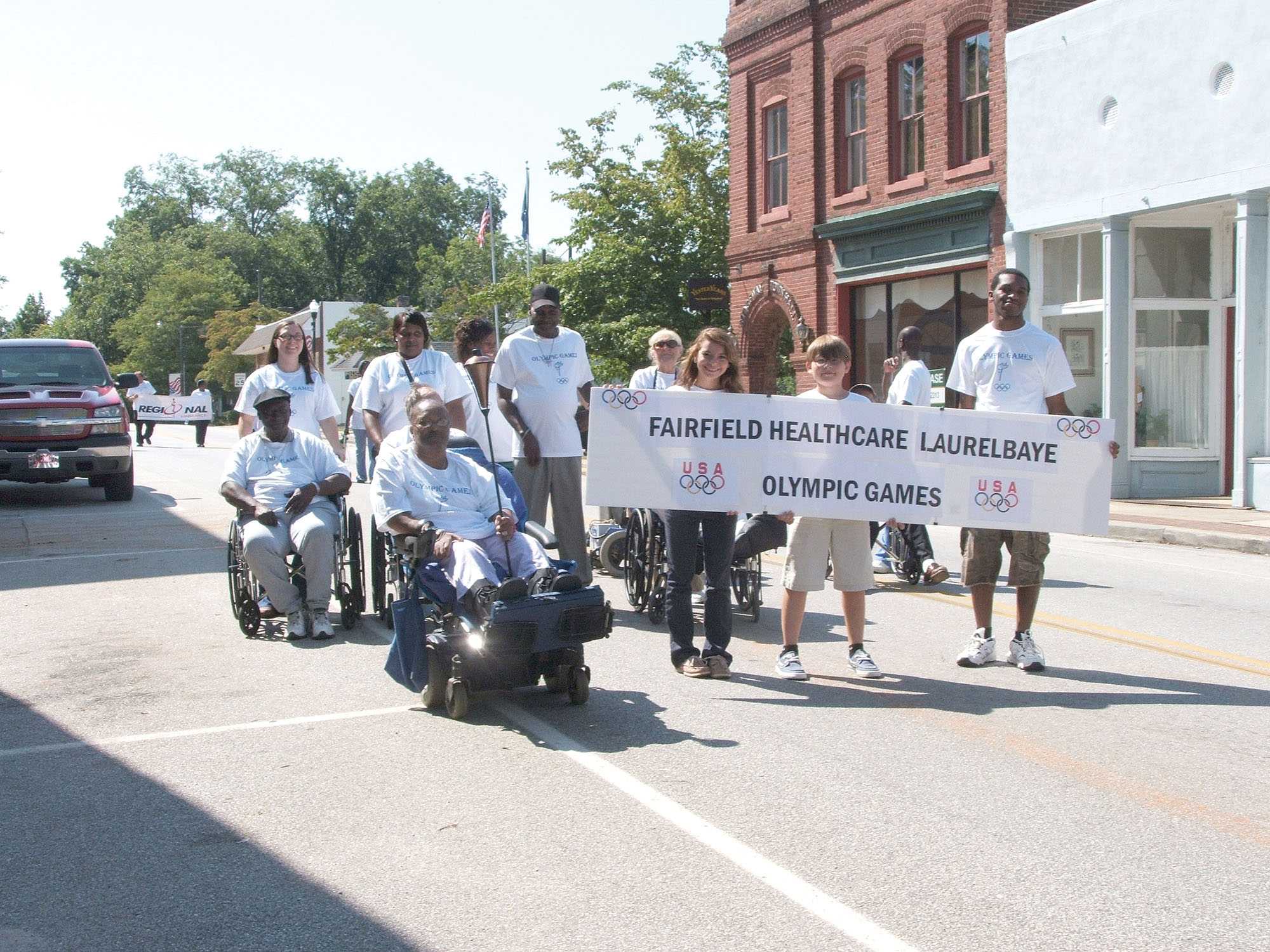
    Fairfield Healthcare Center of Laurel Baye held their Olympics in Ridgeway. The opening parade is led by torch carrier Ruby Burns.

    In keeping with the spirit of the summer Olympic games that we enjoyed from London, England earlier this month, the Fairfield Healthcare Center of Laurel Baye in Ridgeway held its own Olympics for their residents called simply The Olympic Games.

    The first Olympic games were created in 776 B.C. in Ancient Greece by Hercules, the Greek hero of myth. The games lasted until 393 B.C. when they were abolished by the Roman Emperor Theodosius. He had been tolerant of most pagan practices, but in 392 B.C. he enacted laws against all pagan practices, of which he considered the games to be. And so they were discontinued until their revival in 1892 by a Frenchman who founded the first Olympic Committee. The first Olympic flame was introduced in 1928. During war time was the only time when the games were not held. That was 1916, 1940 and 1944.

    The Olympic Games of the Fairfield Healthcare Center started at the Ridgeway post office with a parade and the carrying of the Olympic torch by resident Ruby Burns. American banners lined the streets and spectators and shop owners came out from Ruff’s Hardware, the Cotton Yard Market and the First Citizen’s bank to cheer on the marchers. A hydration station was sponsored by Regional Ambulance who also used their vans to transport the marchers to their starting point. Each of the participants wore a white T-shirt with the words “Olympic Games” and the emblem of the Olympic rings on them. The shirts were made by Roger Browning of Browning Tee’s. Thanks to the support and efforts of the Fairfield County Sheriff’s Office, deputies Steve McDonald, Rick Gibson and Ronald Mull closed the street to traffic and an escort deputy car lead the group with siren wailing. Due to an illness in the family, Mayor Charlene Herring was unable to attend the event this year.

    The rest of the week, the residents were kept busy with such games as wheelchair races, horseshoes, volleyball, javelin throw, dance, Wii bowling, Frisbee golf, a spelling bee and trivia games.

    An awards ceremony was held at the end of the week’s activities with the winners receiving gold, silver and bronze ribbons.

    This was a week of fun and a feeling of achievement for the residents, thanks to the efforts and thought that went in to making their Olympic Games special, by Activity Director Frances Maddox, the staff of the Fairfield Healthcare Center, volunteers and sponsors Regional Ambulance and Laurel Baye.

  • Cancer Friends Support Group gives children a ‘Chance’

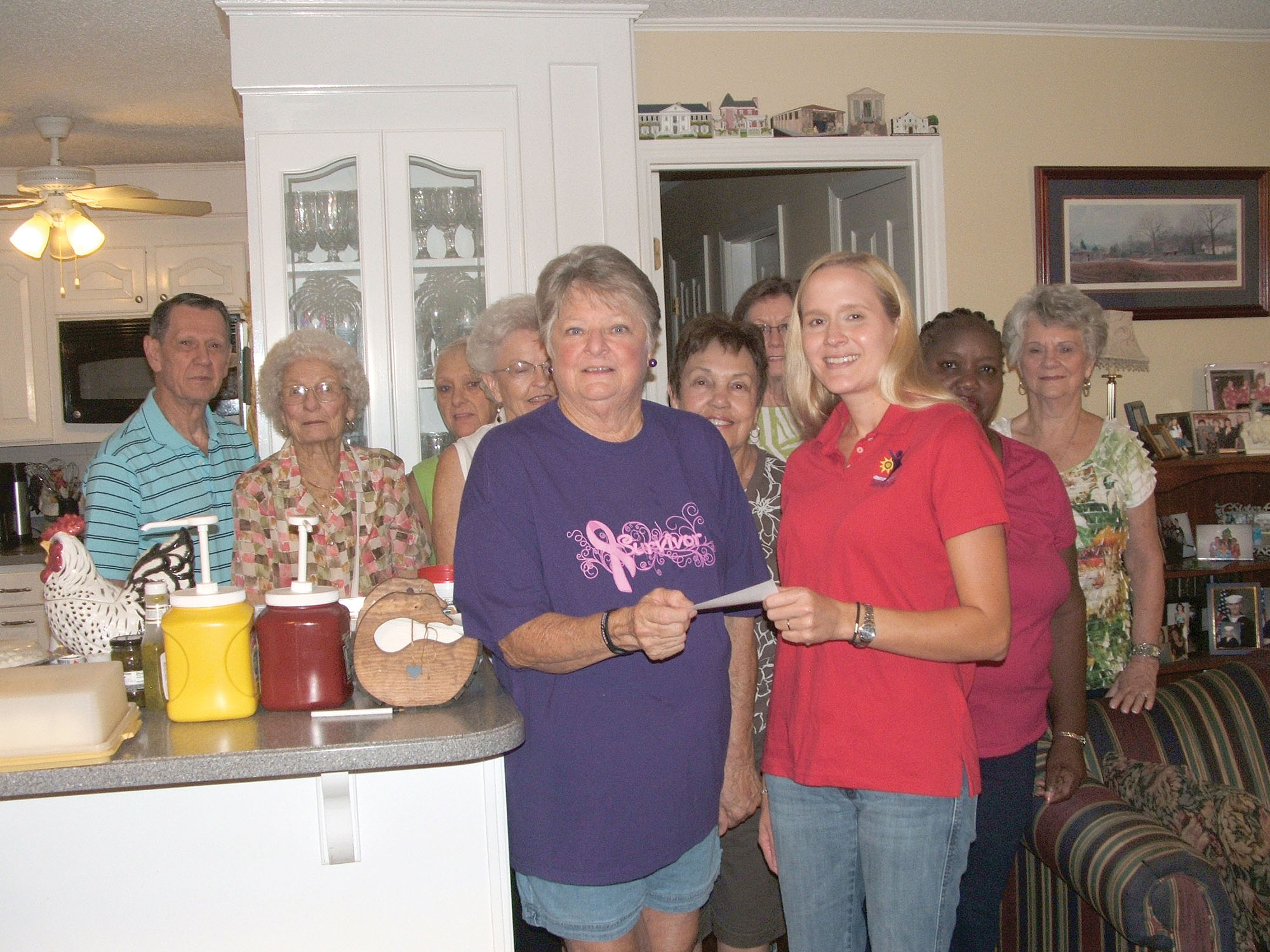
    Bonnie Myers of Cancer Friends Group presents check to Samantha Higgins of ‘Children’s Chance’

    The Breast Friends and Cancer Friends Support Group that meets once a month at the Good Samaritan Resource Center, held this month’s meeting Aug. 11 at the home of Bonnie and Tommy Myers in Winnsboro. It was to be a poolside party and many of us were looking forward to dangling our feet in the pool’s cool refreshing water. But as fate would have it, the skies opened up and it poured with rain.

    Myers, a cancer survivor herself, was the co-founder of this group with her friend Nancy Stone. It was organized back in April of 1999 with the purpose of giving support to cancer patients, providing a place where they can be with others who understand and to give hope and praise for the survivors. There was a dire need for such a group in Fairfield County as “the list of cancer patients continues to grow each year,” Myers said.

    A discussion was held on the Memory Quilt that the group will be making. They will first make a survivors quilt with images of cancer survivors on it. After the first quilt is finished, they will decide where best to display it and start a quilt for those who lost their battle with cancer. Money for the material will come from the sale of cookbooks and the bake sale held earlier this year.

    It was decided that money from the successful cookbook sale was to go to ‘Kids with Cancer.’ The books went on sale last year in time to be purchased as Christmas gifts. There are a few books left; if anyone is interested, contact Bonnie Myers at 635-5826. More than 300 books were sold and after a few donations, a check in the amount of $3,300 was presented on behalf of the cancer group to Samantha Higgins of Children’s Chance at the August meeting.

    Children’s Chance is a non-profit organization that was established in September of 1996 by two mothers of children with cancer. The organization takes children from birth to age 18 years. This organization assists South Carolina children with cancer and their families with non-medical needs by meeting their emotional, psychological and financial needs. They furnish help with rent, mortgage, utility bills, groceries, lost wages, school supplies and counseling. The facility is located in Columbia and is the only statewide organization that offers this type of help. These programs are provided with the help of oncology clinics located in Columbia and Charleston in South Carolina; Augusta, Ga.; Charlotte, N.C. and Greenville. Regardless of where the child is being treated, if he or she is a resident of South Carolina and is either on active treatment for cancer or less than one year of treatment, they are eligible for this program.

    The mission of Children’s Chance is to improve the quality of life of children dealing with the trauma of children’s cancer and to help the families remain intact and functional during their crisis. Monies for this organization come from grants, fund raisers and donations – it is not government funded. The check presented this day from the Breast Friends and Cancer Friends will be administered to children with cancer in Fairfield County. Higgins said that there are 150 to 200 new cases in South Carolina each year. The most common diagnosis for the children is leukemia, which can take two or three years of treatment. Another project for the cancer children considered by the group is the knitting or crocheting of hats for the cancer patients who have experienced hair loss.

    As he has in the past, Tommy Myers, Bonnie’s husband of 36 years, cooked hotdogs on the grill for the group. Also served were condiments and chili, coleslaw, potato chips and baked beans. And what would a luncheon be without desserts, which included pineapple cake, pecan pie, key lime pie and blueberry and banana cake.

    This group should be very proud of themselves for the amount of money they made toward such a worthy cause.

  • Busy summer for the Lake Wateree Helping Hands Club

    Miche Handbag ladies Faye Darby and Carol Smith

    So far it has been a fun summer for the Lake Wateree Helping Hands Club. The ladies do not hold meetings throughout the summer months but continue to meet for social outings and lunches one day a month. During the rest of the year, the members took a collection each month for the Harvest Food Bank, helped with the auction to raise funds for the Fairfield County Disabilities and Special Needs Board, filled Easter bags for the residents of the Fairfield Healthcare Center of Laurel Baye in Ridgeway, donated money to St. Jude’s and also to Juvenile Diabetes in memory of Helen Thomas, long-time resident and ex-Mayor of Ridgeway. All 18 club members signed a petition in favor of the new ‘welcome to Winnsboro’ sign to show support for that town and its improvements. They are now planning to help a ministry in Camden and Children’s Garden in northeast Columbia.

    Being well into summer, the club members have been enjoying other events. After their outing to the S.C. Museum for the Body World’s Vital exhibit, they have enjoyed a Valentine luncheon at the lake home of Martha Blackmon and a Mexican themed luncheon at the lake home of Sue Bowers. Lunches out have been at Huller’s Black Forest German restaurant in the Columbiana area, Ridgeway’s Yesteryear restaurant and Red Robin in the Sandhill shopping area. The members choose different places for their lunches each month.

    Other outings have taken place at Blue Ginger Asian in Columbia and Maggie’s Market and San Jose in Blythewood. In April the ladies spent a day at the Farmer’s Market in Columbia with lunch at Judy’s Market, a quaint little restaurant on the premises. Many purchases of fresh fruit and vegetables took place. If you have not been to the new Farmer’s Market yet, it is well worth the trip.

    One of the club’s latest get-togethers was a Miche (pronounced “mi-shee”) Handbag show given by Faye Darby and Carol Smith of Myrtle Beach and held at the Lake Wateree home of Brenda McFarland. Before the demonstration, the hostess served many different wines and a lunch consisting of a hot dip with crackers, three kinds of finger sandwiches, cucumber, pimento and chicken salad, brie cheese, chips and fresh fruit with cream puffs and cheesecake squares for dessert.

    If you are not familiar with this particular product or have not seen it demonstrated, it is very interesting. The Miche company is now in 40 countries. You purchase one chic handbag from a large selection and using the same bag you can change the exterior without having to move all your personal items to another bag.

    Each new outer shell that snaps over the purse gives it a different fashionable look. You can also purchase and change the straps from a selection of interchangeable handles. Several of their handbags are called ‘Hope Bag’ and are decorated with the signs of hope and pink ribbons and all proceeds from this bag go to cancer research. This stylish, convenient handbag demonstration was a big hit with the Helping Hands ladies.

    In July the ladies traveled to McCloud’s Roadside Market in McBee to purchase fresh fruits, (mostly peaches) vegetables, meat and enjoy lunch at Big’s Restaurant, topping off the day with a special treat of peach ice cream.

    At the last business meeting the new board was voted into office. They are: President, Jan Smith; Vice President and Devotionals, Marie “Mo” Branham; Secretary and Historian, Grace Tarrant; Treasurer, Carol Hefner and Sunshine Gals in charge of sending plants and cards to those who are ill or hospitalized, Pam Roy, Marge Whitney, Grace Black and Ginger Anderson. The members also signed up for the year of being hostesses for the meetings through April of 2013.

    As they did last year, many of the club members will spend a few days at the Edisto Beach home of member Patti Register in mid-September. A fun time will be enjoyed with golfing, days on the beach and games of bridge. In early October the club will once again start their business meetings and make plans for the coming year.

  • Lake Wateree Presbyterian Church welcomes new Pastor

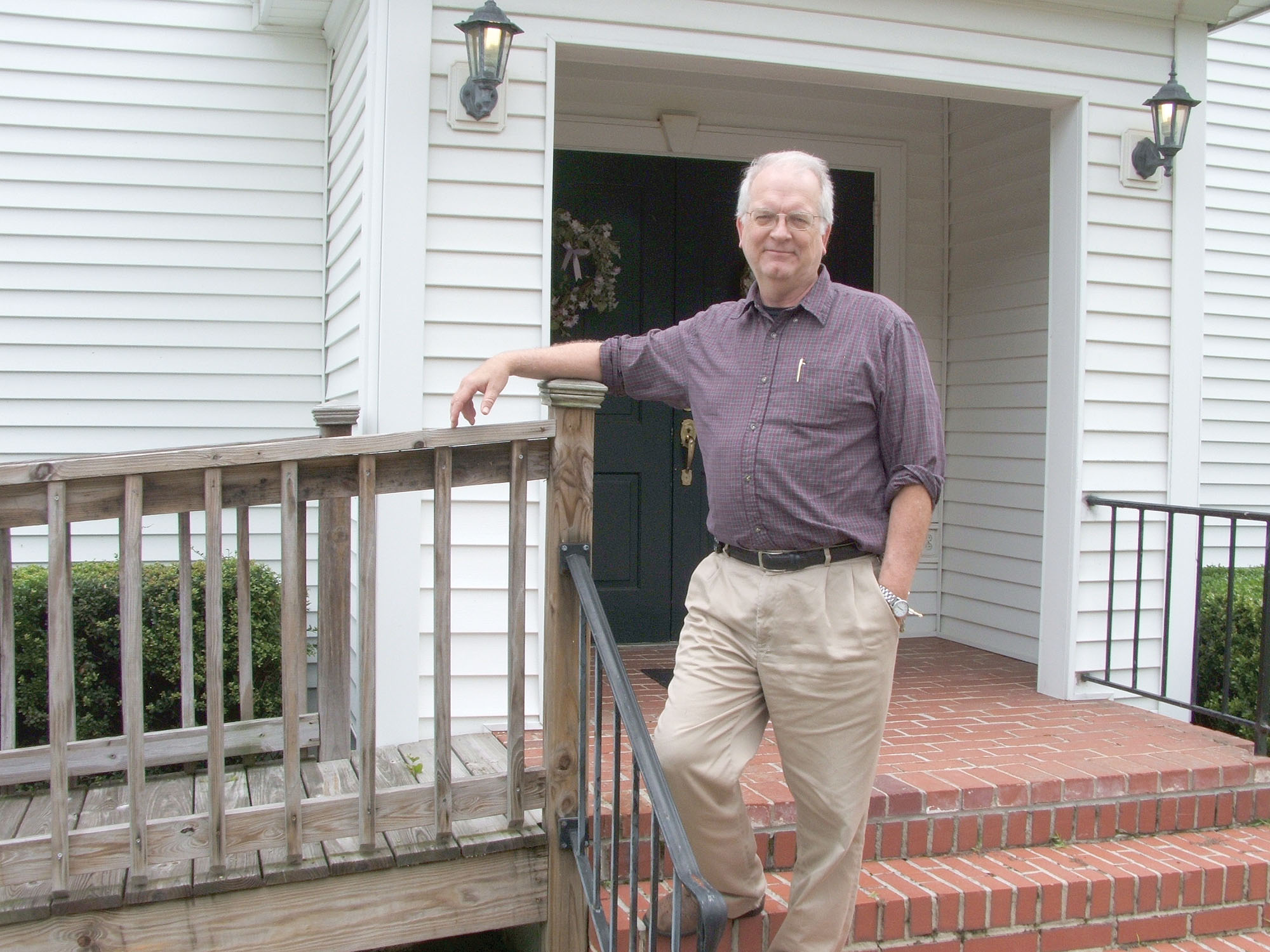
    Pastor Gary Bainton has found a new home at LWPC.

    While attending an event at the Lake Wateree Veterans of Foreign Wars post #8346, I was introduced to the new pastor of the Longtown Presbyterian Church on Longtown Road in Ridgeway. As a way of welcoming him to the area and at the same time introducing him to those who do not know him, I have chosen him as my person-of-interest for this month.

    His full name is Gary Arthur Bainton. Pastor Bainton was born in Milford, in the Southern part of Connecticut, to parents Warren and Audrey Bainton. The elder Baintons currently live at Lake Carolina and will celebrate their 66th anniversary this year. Pastor Gary’s father was in the military when he met his mother, who was a USO hostess. Although attending another church in their own area, they often worship at Bainton’s Longtown church. He has a sister, Stacy, who is married to Charlie and living in Augusta, Ga. Together the couple have a blended family of nine children, so Pastor Gary has many nieces and nephews to keep him busy. His own family consists of two grown children, a daughter Noelle who is married to Keith and living in Atlanta, and a son Matt who is married to Erin and living in Greenville. Each of them have baby boys under the age of 13 months. Bainton’s grandsons’ names are Levi and Truett.

    He attended Marist Catholic boys Military School, a private school started in 1901 and located in Atlanta. After graduation he furthered his education with two years at William & Mary and Augusta College, where he earned a Bachelor’s degree in history.

    Entering the seminary at Erskine Seminary in the town of Due West in South Carolina, near Abbeville, it was there that he got his Masters of Divinity degree. After graduation he fulfilled a one-year internship. He then went to the Greater Augusta Presbyterian Ministries where he worked with inner city families and became an ordained deacon and ruling elder. He became an ordained pastor on July 31 of 1994 to a small country church in Columbia called Rose Hill Presbyterian where he stayed for the next 11 years.

    Due to a personal family situation in 2005, Bainton took a break from the ministry, working at Staples and the University of South Carolina doing administrative work. He was called back to do God’s work in 2011 and ministered at several churches before his move to the Lake Wateree church at the beginning of this year. Bainton has been well received and immediately became a part of the Longtown church family.

    His hobbies and interests include history, especially American history, vexillology and heraldry. In the past he has enjoyed woodworking. Since he has a degree in history and is interested in all pertaining to it, flags from the Revolutionary War are seen flying in the front of his home. One in honor of the Fourth of July, the Betsy Ross flag (or Great Circle), the Gadsden flag (lately identified with the Tea Party but is flown for its historical connection to South Carolina) the Fort Moultrie flag (an important American victory in Charleston) and the Naval Jack, which until 9/11 flew on the oldest ship in active duty. After 9/11 all American war ships fly this flag.

    “I enjoy reading, teaching, preaching the Bible and helping people apply these great truths in their lives,” Bainton said.

    He has said that he loves it here at the lake and while sitting on the porch of the church’s manse, he was reminded of the verse from the 23rd Psalm that says, “He maketh me to lie down in green pastures,” and that is what he sees as he looks around at the peace and the quiet of the area.

    The Longtown Church is small in number but big in heart. They have a prayer service each Tuesday night in addition to their Sunday morning service and a brunch that is held one Sunday each month. His hopes for the future of the church are to increase membership and to revive the hearts of the congregation through prayer. He is a charming gentleman and a real asset to the church. We had a good visit and a prayer session during our visit.

    Welcome Pastor Gary Bainton to the Lake Wateree area.

  • ‘Angels’ Descend on Ridgeway for ‘Aimwell Action Week’

    The anonymous ‘angels’ in Ridgeway.

    There are angels all around us. You know who they are. We see them everywhere, doing God’s work, helping those less fortunate, seeing where there is a need and doing something about it without fanfare or praise of any kind. Hearing of such a group, I went to where they were working to talk to them and find out what makes some folks give of themselves and their time in this way.

    The week’s activity was called “Aimwell Action Week.” This particular group of volunteers was made up of church members from the Aimwell Presbyterian Church, Bethlehem Baptist Church, St. Stephen’s Episcopal Church and the Lebanon Presbyterian church, all in Ridgeway. These are some of the oldest churches in the area. Aimwell was established in 1790, Lebanon in 1875 and St. Stephen’s was built of wood in 1854, covered with brick veneer in 1920 and added a wing in the 1940s. The Lebanon Church was organized in 1872. The folks were from all walks of life and different ages. There were Deacons and Elders from the different churches, consultants, students and a master gardener, to name just a few. Teens were working alongside seniors, everyone having a certain job. The day’s repairs went like clockwork, well thought out and planned.

    The home of a family in Ridgeway was in dire need of repairs. This group of church people heard of the need by word-of-mouth and, using donated supplies, as well as their own money and that of other church members, worked for three days on the home. They repaired windows, fixed structural damage, replaced siding, painted, fixed gutters and sewer lines, plumbing and waste drainage. Yard work was also done – raking, planting of plants taken from their own gardens, the removal of trees and trimming, and an unused pile of bricks on the property became a decorative walkway at the front of the house.

    You might notice that there are no names under the picture, identifying the workers. That was one of the conditions of my being allowed to photograph them. They all feel that what they do is the Lord’s work and they are only the instruments and that all the glory belongs to Him. This is a hard working but humble group that enjoys what they do, but does not feel they should get any recognition for the work.

    One of the men said, “The best aspect of the project was the opportunity to work and fellowship together as members of multiple community churches to meet the needs of a local family.”

    Not all the workers were around continually and so those in the picture represent a small number of those who participated. The homeowners also wished to remain anonymous but were very thankful for the work being done for them.

    The workers stopped for lunch each day under a tent erected at the site where they discussed what was to be done next and have fellowship and prayers. The lunch was prepared by church members and in the evenings they met back at the church with the pastor for devotions.

    I would like to think that by reading about this project, it would be an incentive to other churches in the area to do God’s work in this way. Not everyone can do the physical labor, but can help in other ways: Planning, transportation, running errands for supplies or preparation of food. This is similar to the work done by Habitat for Humanity and the work of the Salkehatchie youths and adults who worked in Fairfield County recently, but on a much smaller, local scale. As Patrick Henry said, “Only one life, ‘twill soon be past. Only what’s done for Christ will last.”

    God bless this group and others like them.