Tag: FMH

  • Board to list hospital for sale

    WINNSBORO – Although for the most part it was “business as usual” at the regular Fairfield Memorial Hospital Board of Trustees meeting March 27, the meeting ended with a vote that signals the final days of the hospital.

    After an hour-long executive session, the Board voted to “authorize the CEO to proceed with executing the agreement as presented with one revision.” But there was no clarification as to what the agreement was for or who it was with.

    The Voice has learned from other sources that the agreement is with Nelson Grubb Wilson Keibler, a Columbia commercial real estate company, to list the hospital grounds and facility for sale for $4.5 million and includes two general practitioner offices. One of those offices houses Fairfield Medical Associates and the other is vacant.

    At least one Board member complained that the Board had not been given the contract to read over prior to executive session.

    The motion to approve the agreement was passed with only Trustee Ron Smith objecting.

    “I won’t sign anything I don’t have the chance to read or study,” Smith said.

    The County is having the property appraised, which, County officials said, should take perhaps another week to complete.

    Hospital owes $3.3M

    During the Finance and Audit Committee meeting that preceded the full Board meeting, Mitchell pointed out that accounts payable continued to grow in February by more than $400,000, although some of that was due to bills that occur quarterly. By the end of February, the hospital owed more than $3.3 million to vendors and contractors.

    Financial Reports

    CFO Timothy Mitchell’s February financial report to the Board showed that while operating expenses were down by $716,027 from adjusted prior year operating expenses, gross patient service revenues decreased by $1,466,990 – twice as much – from prior year.

    The hospital experienced a net operating loss of $130,837 for February, but this reflected a premium refund the hospital received for workers compensation insurance, Mitchell said.  Excluding this, the adjusted operating loss for the month of February was $174,613. EBIDTA (earnings before interest, depreciation, taxes and amortization) for the five months ending Feb. 28 was a negative $765,793.

    The loss for February, Mitchell said, does not include any bad debt recoveries from the South Carolina Department of Revenue (DOR), because the DOR has been slow in processing tax returns and getting these payments out. Instead the hospital received the GEAR payment in early March.

    GEAR (Governmental Enterprise Accounts Receivable Collections) and tax offsets are used by the DOR to collect money owed to public entities, such as FMH, through the garnishment of state individual income tax refunds and additional collection tools, such as payment plans, wage garnishments and bank levies.

    “Had we gotten the GEAR payment in February, we would have gotten very close to a cash breakeven point,” Mitchell noted. “The February and March GEAR payments are about a $311,000 offset against bad debt.  We are anticipating making our budget with a $500,000 profit in March.  That should bring us very close to the budgeted EBIDA or cash loss for the six months ending [in March].”

    In other words, at the halfway mark, the hospital does not anticipate incurring a greater loss than the one accounted for in the hospital’s current budget.

    Mitchell also reported to the Board that the hospital management exceeded the cost saving goal they were charged with at the February Board meeting – to reduce overhead costs by 5% for an estimated target of about $23,000.  Instead, the hospital managed to identify $39,728 in monthly overhead cost savings, Mitchell said.

    And, if one excludes things like taxes and fixed costs that the hospital has no control over, the identified savings are closer to 15%, Mitchell added, although he did not specify exactly what had been done to achieve these savings or why the measures could not have been implemented sooner.

     “Business as Usual?”

    Even though – given the dire state of the hospital’s finances and the lack of patients – sale of the property can be seen as inevitable, the FMH Board and management have been carrying on with business as usual.

    The Board still heard department reports on patient safety initiatives, approved a purchase for an emergency room ventilator and talked about the hospital’s Facebook page.

    Certain costs, such as the hospital’s contract with HMS for housekeeping and maintenance services, remain and are on-going, meaning the hospital cannot reduce these costs even though there are fewer patients served and fewer services provided.

    Doscher reported that the strategic plan, which initially envisioned what the future might look like in three to five years, has been changed to reflect the fact that the hospital will be closing in 9 to 10 months. However, sources tell The Voice that the hospital is in talks with bankruptcy attorneys and that the doors could close as early as this spring.

    “Now the strategy is retaining the staff we have,” she said.  “We are not looking to grow right now, we have changed to a transition strategy and the things we are looking to do to transition from an acute care hospital.”

    And, finally, the hospital is closing the kitchen completely, concluding that it is too costly to keep it open. Despite the fact that it has been many months since there were inpatients, the hospital has been keeping the kitchen open to provide employees with lunch three days a week and meals to management and Board members during Board meetings.
  • Qualls Helping FMH Cut Costs

    linda-qualls-web
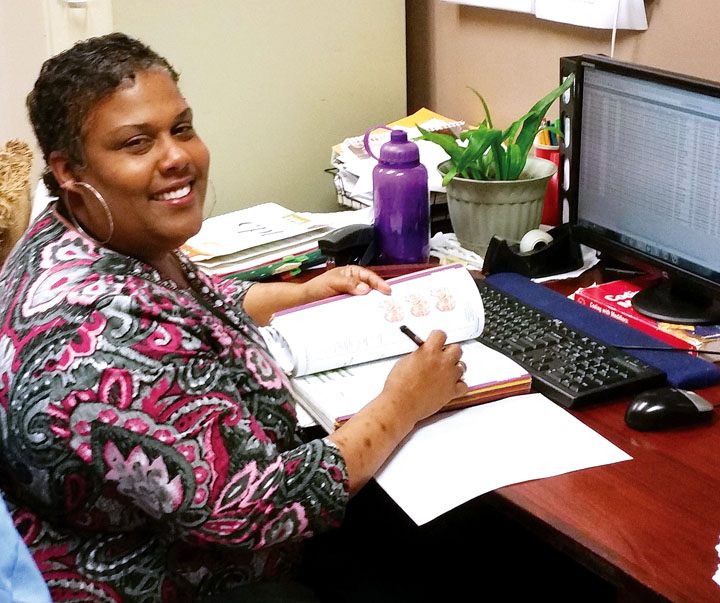
    Linda Qualls, Certified Coding Associate for Fairfield Memorial, looks up coding information for her newest batch of hospital files.

    WINNSBORO – It’s no secret that the future of Fairfield Memorial Hospital is up in the air and has been for a long time. As the hospital has struggled in recent years to stay afloat with County funds until it can work out a partnership with another health care facility, its problems and debt have mounted as solutions remained elusive.

    But there are beginning to be some bright spots – new management, new board members and Linda Qualls.

    Last year, Qualls, employed by the hospital for 12 years, with much of that time as a billing records clerk, took it upon herself to help the hospital save money, a lot of money, by becoming a certified billing and medical coder. This year the hospital is on track to save as much as $50,000 because of Qualls’ certification.

    “Regulations and laws require that billing records be coded for us to get paid,” Karen Reynolds, Senior Director of Health Information at FMH, told The Voice. “Because we had no one in house to code our billing records, we’ve had to outsource that work at a significant cost every year. By becoming a certified coder, Linda has been able to take on many of those coding duties such as our new Mako Laboratory account claims, provide all coding and billing for our Blue Granite outpatient clinic and handle roughly fifty percent of all other medical coding needs within the hospital. What Linda has accomplished for the hospital is no small feat. She has earned both the Certified Coding Associate and the Rural Health Coding and Billing Specialist credentials. ”

    Those certifications required course work at Midlands Technical College, various coding boot camps, independent study and sitting two national exams, Reynolds said. “I’m very proud and the hospital management is thankful for what Linda has done.”

    The courses, training and certifications are regulated by the Association for Rural Health Professional Coding (APHPC), Office of Rural Health and American Health Information Management Association.

    “There are certain nuances about Rural Health coding that are a little bit different than in a doctor’s office or a hospital,” Reynolds said. “So to understand those nuances and be certified to not only code, but bill as well, is a unique certification that not a lot of people have.”

    Qualls told The Voice that she was hesitant, at first, to take the qualification classes, even though she knew she liked to code and had a natural knack for it.

    “I was scared the classes would be too hard, but Karen really encouraged me,” Qualls said.

    “My advice to her was ‘nothing ventured, nothing gained,’” Reynolds said. “I felt confident that she could do it.”

    With a dedicated support system, Qualls pushed past her fears and finished her certification with flying colors. Now she says she feels like she’s accomplished something really big and is proud of herself for it.

    “It really has made all the difference,” Qualls said.

    Reynolds said that while the hospital has lowered its costs by no longer having to outsource most of its coding and billing paperwork, she doesn’t think the hospital will eliminate outsourcing coding and billing altogether.

    “Those (coding) companies have 25-100 coders and so the advantage is having them as kind of our back up,” Reynolds said. “They can essentially code around the clock and on weekends. There’s great value in having both (in house and outsourcing),” Reynolds said.

    For her part, Qualls says she is willing to help out however possible in the hospital’s struggle to not only survive but to thrive.

    “I love this hospital. It’s like my home, and I’m glad to do what I can to save the hospital money and hopefully it will be here for years to come for the County’s residents,” Qualls said.

    But for Qualls, her accomplishments are not a signal that it’s time to coast. She’s now working toward becoming certified on an even higher level.

    “I’ve got one more level of certification that I’m studying for and it’s the highest level, a Certified Code Specialist,” Qualls said. “Hopefully, I’ll soon be able to set a date to take the test.”

    And for Fairfield Memorial Hospital, that certification will likely mean even greater cost savings.

    “It’s another positive step for our hospital,” Reynolds said.

  • FMH Seeks Additional County Aid

    FAIRFIELD – Administrators for Fairfield Memorial Hospital say they can see the light at the end of the tunnel, but added at Monday night’s joint work session with Fairfield County Council that they’re not through the tunnel just yet. And while revenue and operating expenses have remained fairly constant compared with last year, the hospital has some additional expenses on the horizon – expenses for which they are seeking assistance from County Council.

    Near the close of Monday night’s presentation, hospital CEO Mike Williams unveiled a list of “unfunded cash requirements” facing the health care facility in coming months. At the top of that list was a $500,000 line of credit, necessary to keep the hospital solvent while they transition to a new electronic medical records system, known as “Cerner.” Williams later explained that the new system will make Fairfield Memorial compatible with other larger hospitals in the exchange of medical records, including Palmetto Health Richland, with which Fairfield Memorial has a growing relationship.

    “Any time you go from one computer system to another, when you’re talking about an organization with revenues of $27 million and you’re actually collecting around $9 or $10 million of that, $11 million of that, there’s a transition period where you’re going to need cash to carry you over,” Williams said. “There’s going to be a down time. That is a concern and we need to prepare for that.”

    The total cost for implementing Cerner is $1.8 million, Williams said, half of which is covered by incentive programs. The hospital began installing the system last December and is expected to launch the new program in September. During the transition, Williams said, the hospital will require the half-million dollar line of credit to cover expenses while the new records and billing program comes online.

    In addition to the Cerner costs, Williams said the hospital is asking the County for $75,000 in start-up money for the Blue Granite Medical Center. Williams said the money will be used to hire a full-time physician, which the center must have on staff in order to qualify for state and federal grant funds. The hospital is also seeking another $75,000 to renovate their emergency room, as well as an unspecified amount to repair the facility’s aging roof.

    Pressed by Council for an estimate on the cost of the roof repair, Williams approximated that the cost could be between $200,000 and $250,000. The worst part of the roof, he added, is over the operating room, and reopening the operating room is one of the hospital’s plans for increasing future revenue. Williams said earlier in the meeting that the hospital hoped to bring general surgery, orthopedic surgery, OB/GYN procedures and colonoscopies back to Fairfield Memorial in the near future.

    Tim Mitchell, the hospital’s Chief Financial Officer, noted that the $500,000 Cerner credit line would be paid back to the County after the transition to the new records and billing system had been completed. The line of credit would have to be in place by September, before Cerner goes live. The hospital currently has a cash balance of about $50,000, Mitchell said, down from $350,000 in February 2012.

    Collections compared to last year, Mitchell said, are down from 44 cents to 39 cents on every dollar owed. Mitchell attributed that trend to the growing number of self-pay patients and the shrinking number of Medicare and Medicaid patients. Bad debts, he said, accounted for 16 cents of every dollar written off by the hospital last year. That number has increased to 25 cents.

    The hospital is also in a precarious position regarding access to emergency capital.

    “If any piece of major equipment went down,” Williams said, “it would be hard to replace it.”

    But, Williams said, he does expect the hospital’s cash flow to improve over the next nine to 12 months with expected changes to Medicaid.

    “We’ve just got to get there,” Williams said.

    Council Chairman David Ferguson said the requests would be brought to the full Council at an upcoming meeting. Just a little over one year ago, the County poured $1.2 million into the hospital.