Tag: Fairfield Memorial Hospital

  • FMH CEO takes unpaid leave

    Smith: Council Close to Making Offer on FMH Campus

    WINNSBORO – After a relatively short, uneventful meeting Tuesday evening, the Fairfield Memorial Hospital board came out of executive session and voted unanimously to give an unpaid, one month leave of absence, beginning in June, to the hospital’s CEO Susie Doscher. There was no other explanation concerning the leave.

    County Council Chairman Billy Smith told The Voice in an interview on Tuesday that Council is moving closer to making an offer on a portion of the hospital campus. He said the offer could come as early as the next council meeting.

    “We’re interested in the two medical office buildings – the one housing Fairfield Medical Associates and the John Martin Primary Care facility,” Smith said. “The appraisal for those two is right at $1.6 million. If we add the rehab facility, that appraisal jumps up to about $1.9 million.”

    Smith said the offer depends on removal of the liens from the property.

    “They need to remove the liens if we’re going to purchase the property,” Smith said. “We’re not going to make an offer so long as it has liens.”

    Smith said there are no other obstacles to the making an offer that he is aware of.

    The next council meeting is May 29 at 6:30 in the County building.

  • Millions in debt, no rescue in sight

    Doscher, Board at odds over cutting expenses

    WINNSBORO – The harsh reality of Fairfield Memorial Hospital’s financial situation – millions of dollars in the red and no rescue forthcoming from Fairfield County Council – was the all-consuming topic of discussion during the Finance and Audit Committee meeting before the regular FMH Board meeting April 24.

    Committee chairman Randy Bright attempted to tackle the issue head on by asking hospital administration to look for more ways to cut costs. “In light of our fast-approaching $3.4 million in vendor payables, and $5.3 million in additional long term liabilities, and that we are dropping revenue and we are dropping traffic (patient) census in our operations” … expenses are “something we can impact… instead of looking back, we can look forward.” Bright said.

    “Also, the (Fairfield County) Council has committed to not giving us any extra money aside from the potential land sale,” he said.

    During Council’s April 16 budget workshop, Council declined to budget either the $4,000,801 that the hospital requested for 2018-19 or the $1,043,000 recommended at the administration.

    “So that being said, do you have any particular expense cuts you would like to propose?”  Bright asked hospital CEO Suzanne Doscher.

    “We evaluate the entire budget constantly,” Doscher responded. “I had the impression that if we were on target with the (current) budget then it wasn’t the board’s decision to redo the financials – the budget – again.”

    Bright agreed, but said “The only problem with that is, however, that budget through September is expected to lose a million six, and if we go all the way through December, then we are going to lose well over two million dollars.  We don’t have that kind of financing.

    “And the real kicker is,” Bright continued, “the county council is not going to give us any more money. We need to start looking at even more expense savings or anything that gets us away from losing two million plus by the end of the year. Because we are not going be able to sustain that.”

    Bright pointed out line items in the current hospital budget as examples of expenses that could be cut: “travel and education – we are going to shut down in December.  Do we really need this?  We have budgeted more than $12,000 (in the budget) for travel and education,” Bright said.

    “We evaluate it every time,” Doscher responded.

    “Give me an example, what do we have on the agenda for travel now…no seminars, no sessions for hospital staff in Greenville…” Bright persisted.  “Aren’t these things planned some time in advance?”

    “I can’t keep up with other people’s schedules to tell you that right now. I don’t get into the weeds like that,” Doscher said.

    Bright noted that hospital expenses are currently 80% of gross revenue versus 70% of gross revenue a year ago.  “It’s our balance in our revenues and expenses that has worsened and we have got to do more.”

    However, His comments did not go over well with Doscher, who quickly defended the hospital’s fiscal management.  “We are running operations and we are managing the operations. If you want to rebase the budget again, we can do that.  But we have to run the operations.”

    “Yeah, we were saying that right up to the point we got rid of – finally – three under-performing departments; that is my point. We did that way too late, two years too late.” Bright said.

    “In your opinion but not in everybody’s opinion.” Doscher shot back.

    “It was the opinion of the consultants.  No one wanted to get rid of them, we had to,” Bright said.

    “So we are exactly where you started from,” board member William Turner added.  “I don’t know how we do expenses and such when we don’t have any money?  …How much did we spend last month? I don’t see how we have the doors open now.  But every day it’s money lost, money lost.  I don’t see how we can spend anything without approving every penny and I don’t know how you approve money you don’t have.  And we don’t have any money.  That’s how simple it is!”

    “We are five million dollars in debt and we only have current assets of about 1.2 million dollars,” Bright added.

    Bright and other committee members continued to press for more specific cuts to the hospital budget. “We should look at memberships,” Trustee Ron Smith suggested.

    After discussion, the committee approved a motion to ask hospital administration to come back with more cuts.  At minimum, the categories of expenses for review would include dues, subscriptions, mileage, advertising, marketing, and hosting and participating in events except for the purposes of employee appreciation.

    Bright said the hospital has “carte blanche” to make any cuts to the budget as long as patient care was not affected.

    “And employee morale,” Fantry added.

    March Financials

    CFO Timothy Mitchell’s monthly financial briefing did have some good news – the month of March brought in extra revenue in the form of collections from the SC Department of Revenue of outstanding patient debt.  As a result, the hospital ended the month of March with $96,136 in revenue over expenses.   However, excluding bad debt recoveries and a premium refund, the hospital experienced operating losses of $241,777 for the month. For first six months of the current fiscal year (July through March, the hospital’s EBIDTA (earnings before interest, depreciation, taxes and amortization) was a negative $610,077.

  • FMH employees air concerns about leadership

    WINNSBORO—At Monday’s meeting, council members listened intently as the director of Fairfield Memorial Hospital’s Rehabilitation Center openly criticized hospital leadership during public input.

    “We question and don’t quite understand decisions made by administration, such as finances, priorities at this stage of the game and treatment of employees,” Laura Willingham, the hospital’s rehabilitation director, said. “Of course we’ll do what we’re asked to do. But it’s still disconcerting.”

    Willingham also emphasized the need to keep a rehab facility in Fairfield County as opposed to having rehab patients travel to Columbia for service.

    Smith commended Willingham for speaking publicly.

    “I think probably since I’ve been on council, it’s the most brave thing I’ve heard spoken to  us,” he said. “When we question some of the hospital administration, we’ve been chastised. I hope there are no reprisals against you.”

    Councilman Cornelius Robinson also signaled support for the rehab center.

    “Rehab is something that we need in Fairfield County,” Robinson said. “Each one of us is definitely thinking about it.”

    Sexual harassment suit filed

    Willingham’s address was unrelated to a developing legal matter involving Fairfield Memorial Hospital – a sexual harassment lawsuit filed by a former employee.

    Tabitha Williams, a former certified nursing assistant, made that claim in a lawsuit Feb. 22 in Kershaw County Circuit Court. The litigation was removed to federal court in March.

    The lawsuit says a human resources employee made several unwanted sexual comments to her shortly after he started working at the hospital in October 2016.

    The comments came during conversations at work, on the phone and via text message, according to the litigation.

    Williams further says the employee tried to “lure” her into a sexual relationship. The lawsuit calls him a “sexual predator.”

    She said the man fired her in August 2017, “ostensibly for reasons related to job performance,” the suit continues.

    “He began a period of inappropriate and aggressive communications with Plaintiff in and out of the workplace,” the suit states. “Plaintiff is informed and believes that her termination resulted from her refusal to engage in sexual activity with Defendant.”

    In its response, the hospital denies the allegations.

    The hospital’s response says Williams refused to cooperate in an investigation of her claims. It further states Williams was fired for poor performance and attendance issues, court documents state.

    Williams is seeking damages for lost pay, embarrassment and humiliation, punitive damages, legal fees and other unspecified damages.

    No trial date has been set, though in April a deadline of Jan. 2, 2019 was set to complete mediation.

    County Mulls FMH purchase

    While the diagnosis doesn’t look good for Fairfield Memorial Hospital, efforts to resuscitate parts of it by buying some health care properties are underway.

    At Monday night’s meeting, some hoped the county would vote to purchase several parcels associated with the hospital property. That was one of three items on the agenda for discussion in executive session, but a vote did not materialize.

    Council Chairman Billy Smith predicts a vote will come soon.

    Smith said the county is interested in purchasing parcels encompassing the rehab center, as well as a couple of private practice offices. He hopes a third party will take over operations.

    “We’re close to making a decision. I was actually hoping for a little bit more in executive session tonight,” Smith said. “Certainly we hope to set it by the next meeting.”

  • Council wraps up budget requests

    WINNSBORO – Council wrapped up its fourth budget workshop recommending several changes in agency allocations as well as a proposal to encourage the county’s elected officials to buy in to a merit based system of salary increase.

    After considering agency requests and County Administrator Jason Taylor’s budget recommendations over the last six weeks, Council is looking at continuing to pay $15,150 for Behavioral Health Services’ annual audit. It will also begin paying $11,000 for the Council on Aging’s annual audit. Council will also provide lawn maintenance at Behavioral Health Services’ new facility which is not county owned. Councilman Billy Smith said the County generally only provides lawn maintenance for agencies occupying county owned buildings.

    Of the $65,000 recommended by administration for Disabilities and Special Needs, Council is pulling out $19,000 DSN requested for a new van. Smith said he recommends withholding that amount since the agency still has several vans with low mileage.

    No consideration was given to allocating $4,000,801 requested by Fairfield Memorial Hospital or $1,043,000 recommended for the hospital by administration. With the exception of the current rehab departments, the hospital is expected to shut down operations by the end of 2018 when construction of a new standalone Emergency Services facility is expected to be completed on the bypass by Providence Hospital.

    The full $87,500 the County allocates each year for the Fairfield Chamber of Commerce was been placed in a holding pattern earmarked for tourism after the Chamber’s interim director failed to present a plan of action for the agency for the 2018-19 fiscal year two weeks ago.

    “We’re leaving it in tourism for Council for a future date to decide how to allocate that money,” Taylor said.

    “The latest word is that the Chamber has gone inactive, so it would not make sense even for us to allocate $25,000 at this point,” Smith said. “So we’re going to put that in a new line item right now?” Smith asked Taylor.

    “The money will be there should the Chamber come forward with a plan that you all find acceptable. If it is not acceptable, then that money could be reallocated for another project to be tourism related,” Taylor said. [Note: since the budget workshop, the Chamber’s new interim director has submitted a plan of action that is being considered by the County.]

    Looking at salary increases for county employees and elected officials, Smith suggested said he would like to see the county’s elected officials buy into a merit based system of salary increases.

    “If elected officials buy into the merit based program, then we would give them a full three percent increase to be dispersed throughout their departments as they see fit. If they don’t want to do that,” Smith said, “then we’ll allocate two percent for them to be used across the board.”

    Council is expected to vote on the 2018-19 fiscal year budget at the May 14 meeting to be held at 6 p.m. in council chambers.

  • Council holds first of 3 budget workshops

    WINNSBORO – During the first of three planned budget work sessions, Council took a conservative look at allocations it provides for agencies in the county.

    “We’ve got to start taking a little closer look at funding given the situation we’ve had with V.C. Summer and the fact that we’re now looking at less revenue in the future than we had expected,” County Council Chairman Billy Smith told The Voice before the meeting.

    Behavioral Health was the first to feel the pencil, with council suggesting reducing the agency’s usual annual allocation of $67,438 to $52,288. While the County has covered the agency’s cost for its annual audit in the past, Council Chairman Billy Smith expressed reluctance to continue paying for audits for this or any other agency.

    The Council on Aging requested and administration recommended $104,912, an increase of $11,501 over last year’s funding of $93,411. Smith, again, pointed out that $11,000 of that increase is to pay for the agency’s annual audit, which he said he wants to stay away from.  Smith also noted that he saw no explanation for the $501 increase and would want to see that before funding it.

    Fairfield Memorial Hospital saw the largest recommendation for reduction in funding, from $1,043,000 to $0.

    “We do need to change this to reflect zero funding until further decisions are made regarding the hospital,” Smith said.

    Council questioned a recommended $6,352 increase in funding for Midlands Technical College over last year’s approved budget of $158,810. Council members also had some discussion about reducing the $25,000 it gives each year to the railroad museum.

    Council also suggested reducing the amount it gives Palmetto Citizens Against Sexual Assault ($9,285) by $1,285 and recommended reducing Sistercare’s funding from last year’s $10,000 to $8,000 this year.

    Council let stand the administration’s recommendation of a $10,000 increase for Eau Claire Cooperative Health Center, bringing that agency’s funding from council to $60,000.

    Heads of agencies considered for cuts will be invited to make their case to Council at the next budget work session which is scheduled for next Tuesday, April 17 at 6 p.m. in council chambers.

  • Board to list hospital for sale

    WINNSBORO – Although for the most part it was “business as usual” at the regular Fairfield Memorial Hospital Board of Trustees meeting March 27, the meeting ended with a vote that signals the final days of the hospital.

    After an hour-long executive session, the Board voted to “authorize the CEO to proceed with executing the agreement as presented with one revision.” But there was no clarification as to what the agreement was for or who it was with.

    The Voice has learned from other sources that the agreement is with Nelson Grubb Wilson Keibler, a Columbia commercial real estate company, to list the hospital grounds and facility for sale for $4.5 million and includes two general practitioner offices. One of those offices houses Fairfield Medical Associates and the other is vacant.

    At least one Board member complained that the Board had not been given the contract to read over prior to executive session.

    The motion to approve the agreement was passed with only Trustee Ron Smith objecting.

    “I won’t sign anything I don’t have the chance to read or study,” Smith said.

    The County is having the property appraised, which, County officials said, should take perhaps another week to complete.

    Hospital owes $3.3M

    During the Finance and Audit Committee meeting that preceded the full Board meeting, Mitchell pointed out that accounts payable continued to grow in February by more than $400,000, although some of that was due to bills that occur quarterly. By the end of February, the hospital owed more than $3.3 million to vendors and contractors.

    Financial Reports

    CFO Timothy Mitchell’s February financial report to the Board showed that while operating expenses were down by $716,027 from adjusted prior year operating expenses, gross patient service revenues decreased by $1,466,990 – twice as much – from prior year.

    The hospital experienced a net operating loss of $130,837 for February, but this reflected a premium refund the hospital received for workers compensation insurance, Mitchell said.  Excluding this, the adjusted operating loss for the month of February was $174,613. EBIDTA (earnings before interest, depreciation, taxes and amortization) for the five months ending Feb. 28 was a negative $765,793.

    The loss for February, Mitchell said, does not include any bad debt recoveries from the South Carolina Department of Revenue (DOR), because the DOR has been slow in processing tax returns and getting these payments out. Instead the hospital received the GEAR payment in early March.

    GEAR (Governmental Enterprise Accounts Receivable Collections) and tax offsets are used by the DOR to collect money owed to public entities, such as FMH, through the garnishment of state individual income tax refunds and additional collection tools, such as payment plans, wage garnishments and bank levies.

    “Had we gotten the GEAR payment in February, we would have gotten very close to a cash breakeven point,” Mitchell noted. “The February and March GEAR payments are about a $311,000 offset against bad debt.  We are anticipating making our budget with a $500,000 profit in March.  That should bring us very close to the budgeted EBIDA or cash loss for the six months ending [in March].”

    In other words, at the halfway mark, the hospital does not anticipate incurring a greater loss than the one accounted for in the hospital’s current budget.

    Mitchell also reported to the Board that the hospital management exceeded the cost saving goal they were charged with at the February Board meeting – to reduce overhead costs by 5% for an estimated target of about $23,000.  Instead, the hospital managed to identify $39,728 in monthly overhead cost savings, Mitchell said.

    And, if one excludes things like taxes and fixed costs that the hospital has no control over, the identified savings are closer to 15%, Mitchell added, although he did not specify exactly what had been done to achieve these savings or why the measures could not have been implemented sooner.

     “Business as Usual?”

    Even though – given the dire state of the hospital’s finances and the lack of patients – sale of the property can be seen as inevitable, the FMH Board and management have been carrying on with business as usual.

    The Board still heard department reports on patient safety initiatives, approved a purchase for an emergency room ventilator and talked about the hospital’s Facebook page.

    Certain costs, such as the hospital’s contract with HMS for housekeeping and maintenance services, remain and are on-going, meaning the hospital cannot reduce these costs even though there are fewer patients served and fewer services provided.

    Doscher reported that the strategic plan, which initially envisioned what the future might look like in three to five years, has been changed to reflect the fact that the hospital will be closing in 9 to 10 months. However, sources tell The Voice that the hospital is in talks with bankruptcy attorneys and that the doors could close as early as this spring.

    “Now the strategy is retaining the staff we have,” she said.  “We are not looking to grow right now, we have changed to a transition strategy and the things we are looking to do to transition from an acute care hospital.”

    And, finally, the hospital is closing the kitchen completely, concluding that it is too costly to keep it open. Despite the fact that it has been many months since there were inpatients, the hospital has been keeping the kitchen open to provide employees with lunch three days a week and meals to management and Board members during Board meetings.

  • FMH on life support

    WINNSBORO – The 800-pound gorilla in the room, also known as Fairfield Memorial Hospital’s mounting financial losses, has for months begged the question – ‘How is FMH going to keep its doors open until the new emergency services facility becomes operational?’

    Month after month, the hospital has tried to stop the bleeding – closing the most unprofitable departments, initiating greater efficiencies in billing and reducing operating costs by more than $2.2 million over the past two years.

    But the financial decline of the hospital continues to snowball, and CFO Tim Mitchell summarized the hospital’s position in no uncertain terms during its monthly meeting on Feb. 27.

    “Fiscal year-to-date operating expenses have decreased by $566,492,” Mitchell told the Board. “But during this same period, gross patient revenues have declined by $1,306,000. Hospital EBITDA (earnings before interest, taxes, depreciation and amortization) for the four months ending Jan. 31, 2018 had a deficit of $692,429.”

    In addition, Board Trustee Randy Bright, who chairs the Board’s Finance and Audit Committee, said during the committee meeting that the current budget is already off by about $400,000 because the hospital has failed to make its revenue projections.

    He feared that the hospital is “on pace for a $2,861,000 loss at the end of the year.”

    With no other options left, the hospital turned to the taxpayers for help, in the form of a $4,000,801 funding request to the Fairfield County Council during its meeting the night before the Board meeting.

    The $4,000,801 would be used for several on-going items, Doscher said, such as replacing the hospital’s heating/air conditioning unit and painting the exterior of the building.

    “Some of the funding request would also go towards the planned digitization of hospital patient records since, as we are winding down, we need to deal with all these paper records,” Doscher said.

    Approximately $1 million of the funding would go to support the emergency department until the end of the year, and the remainder – about $2.7 million – would be used to help the hospital deal with its on-going operating losses.

    The Board approved the $4 million county budget request after the fact, with only Board Trustee Ron Smith objecting.  Smith said the request reflected only a worst case scenario and that he wanted the hospital management to develop a best case and an intermediate case scenario to present to the County Council as well.

    Next Steps

    During the County Council meeting Feb. 26, Council Chairman Billy Smith suggested the County purchase the hospital property and thus have a tangible return on the taxpayer’s investment.   Reached by telephone after the Board meeting, Smith said the next steps for County will be to get an appraisal and inspections of the property in order to evaluate its potential purchase.  This could take several weeks, he said.

    Smith noted that the $1.2 million that the County normally budgets for the hospital is part of the FMH budget request and would be provided in quarterly installments as long as the FMH emergency department remains open.  However, this does not necessarily mean the hospital will get everything it asked for.

    “I am not in favor of providing all of the $4 million regardless of the results of the appraisal,” he said.

    “There was no scenario in which any extra funding will be provided over the $1.2 million that the County has traditionally budgeted for the past 20 – 30 years, unless the hospital property is involved,” Smith said.

    Grim Financial Picture

    Despite Board members’ assertion that the need for more than$4 million is a worst case scenario, the information presented during the Finance and Audit Committee meeting prior to the full Board meeting  again highlighted the hospital’s deficit position caused by an unfavorable patient mix, declining revenues and operating costs that are fixed despite an absence of patients.

    For example, the hospital posted adjusted patient collections for January, 2018 of $429,877. This included payments for patient debt collected through tax offsets and the Governmental Enterprise Accounts Receivable collections (GEAR).  Excluding these payments, the hospital collected about $371,000 last month.

    Excluding the GEAR and debt offset payments, Mitchell said, “we have been averaging about $400,000 a month in patient collections, and that is down considerably from a year ago.”

    Mitchell said the hospital had to use some of its board restricted cash to help make the February payroll. Currently, there is a little more than $400,000 in the two funds.  Mitchell proposed moving $25,000 from each fund for a total of $50,000. The board has previously granted hospital management discretion in using board-restricted cash. The finance committee asked Mitchell to pay back these funds from the expected debt set-off and GEAR collections in March.

    By the end of January, the hospital only had a total of 14.9 days cash on hand.  Normally, Mitchell said, the state disproportionate share (DSH) payments and county appropriation the hospital receives in January will help bolster its cash position, but now it is burning through this money a lot quicker.

    For example, Mitchell said, in November and December the hospital’s accounts payable (the money it owes to vendors for goods and services) increased by $200,000.  As of the end of December, 2017, the hospital owed almost $2.9 million for services and supplies to various vendors, making it necessary to use the county and DSH funds to pay down its debts.

    “It’s all a reflection in our decline in revenues,” Finance and Audit Committee Chairman Randy Bright said.  He pointed out that the last time the hospital received the quarterly government funding, it had 28 days cash on hand.

    “If I may re-cast what Randy is saying …our net asset position at the end of October 2017 was $793,000. Our net assets by the end of January 2018 were $283,000.  That is due to these cumulative losses,” Mitchell said. “That net asset position is before we record our unfunded pension liability which is a minus $8 million.”

    Also telling was that the “good” news in the monthly financial report was apparently due to this winter’s flu outbreak. Admissions to the ER department increased to 762 in January from 581 in December, and, therefore, gross revenue exceeded the amount budgeted for the month for both the ER and the imaging services department.

    Even then, Mitchell said, the fact that the emergency department is becoming a much bigger part of the hospital’s “book of business” is not helping its financial picture but it actually hurting it.  This is, by design, he said, since the hospital has closed its cardiac rehab, Blue Granite and home health departments.

    However, a higher percentage of ER patients are either uninsured or receive Medicaid to help them pay for health care.  Of the hospital’s gross charges, 30 percent are self-pay and 34 percent are billed to Medicaid, which pays the least compared to Medicare and commercial health insurance.

    “Typically, we see reimbursement rates from Medicaid at 18 cents on the dollar and from self-pay 15 cents on the dollar,” Mitchell said.

    “So we are seeing an ‘unfavorable’ mix of patients in the emergency department, which is growing as a percentage of our total business.  That is a recipe for these types of numbers,” Mitchell said.

    What’s not making these numbers worse is that the hospital had a considerably better bad debt experience compared to a year ago, Mitchell said.

    Despite this, he pointed out that while operating costs had declined by $566,492, gross patient revenues had declined by $1,306,142.

    “It would be wonderful if they declined by the same amount, but that’s not the way it works, unfortunately. You have got fixed operating costs that either don’t change or that change by very little.   We still have to staff certain departments with the same compliment of services whether we see one patient or a thousand.”
  • FMH asks Council for $4 M until end of 2018

    WINNSBORO – It was the request County Council members had been expecting from Fairfield Memorial Hospital (FMH) for almost a month – $4,000,801 to keep the hospital open until Dec. 31, 2018.

    During Council meeting Monday evening, the hospital’s Chief Financial Officer, Tim Mitchell, broke the numbers down this way.

    “Included in that number is $1,043,000 for the hospital’s emergency room services,  $154,130 to replace heating/air conditioning unit, $50,000 to paint the exterior of the building and over $1 million for accounts payable 60 days past due. The balance of the request would be potential cash losses through Dec. 31, 2018. Because Mitchell did not always speak into the microphone, other numbers were not audible and Mitchell could not be reached for comment before press time. (A more complete breakdown of the funding request will appear in the March 8 edition of The Voice.)

    Before Council went into executive session to discuss the hospital’s funding request, Council chairman Billy Smith said it is his feeling that the citizens of the County need to get something tangible in return for the funding that’s been requested and that has been paid over the years.

    Smith suggested the County purchase the hospital property and have a tangible return on the County’s investment. As for the timetable for that to happen, Smith said he could not be specific.

    “Providence has a 90-day right of first refusal on the hospital property, so we would need a letter from them saying they are not interested in purchasing it,” Smith said. “There are a couple of leans that would need to be taken care of and we’d need an appraisal of the property which will take some time. I think the hospital [FMH] has expressed that they have enough money to get by until we can work these things out,” Smith said. “But if for some reason we can’t purchase the property, then we’ll have to have an entirely different discussion.

  • FMH asking Council for almost $4 million tonight

    WINNSBORO – Tonight, the Fairfield Memorial Hospital (FMH) CEO is expected to appear before Fairfield County Council to request almost $4 million to cover the hospital’s operating expenses through Dec. 31, 2018, sources have told The Voice.

    That request includes a little more than $2.7 million for operating expenses for the hospital and another $1+ million, which is the amount the County already gives the hospital each year.

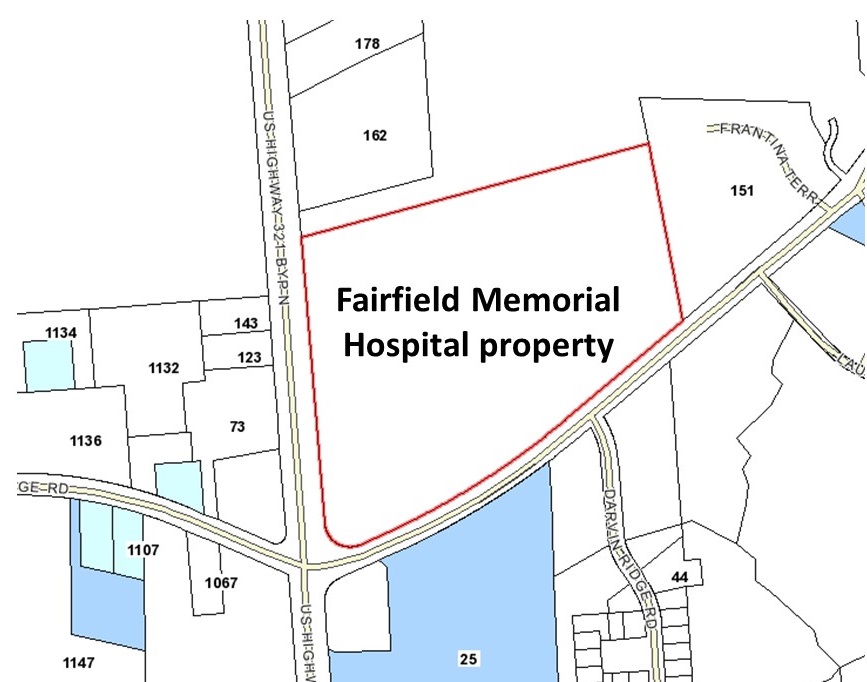
    In addition, Council is expected to discuss, in executive session, a possible acquisition of the hospital property by the County. The executive session agenda includes,” the discussion of the potential purchase of real property identified as Fairfield County TMS 126-03-01-001″ (the hospital property).

    The meeting will be held at 6 p.m. tonight at the Fairfield County government complex council chambers, second floor, 350 Columbia Road in Winnsboro.

  • Providence, County break ground for ER

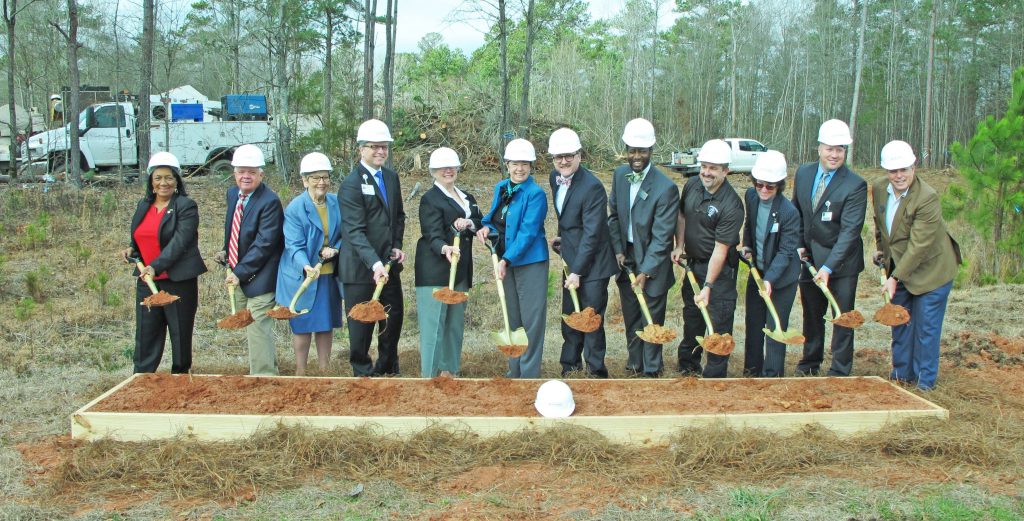
    Breaking ground for the new Providence Health-Fairfield Emergency Room are: Bertha Goins, Vice Chairman of Fairfield County Council; Dr. Roger Gaddy, Fairfield Memorial Hospital Chief of Staff and Mayor of Winnsboro; Susie VanHuss, Chair Board of Trustees Providence Health; Scott Campbell, Market CEO, Providence Health; Catherine Fantry, Fairfield Memorial Hospital Board Chair; MaryGail K. Douglas, Representative District 41; Victor Giovanetti, President Eastern Group LifePoint Health; J.R. Green, PhD, Superintendent of Fairfield County School, Providence Health Board of Trustees Member; Mike Tanner, Director Emergency Medical Services, Upper Midlands Rural Health Network; Suzy Doscher, Fairfield Memorial Hospital CEO; Dr. Cale Davis, Carolina Care; Mark Hood, President and CEO Hood Construction. | Barbara Ball

    WINNSBORO – Ground was broken Feb. 15 for the new Providence Health-Fairfield Emergency Room that will be located on the corner across from BI-Lo Shopping Center at 1810 US Highway 321 Bypass in Winnsboro. Approximately 100 county, town, health care and community officials attended the ceremony and gathered to watch the first dig marking the beginning of construction of the facility.

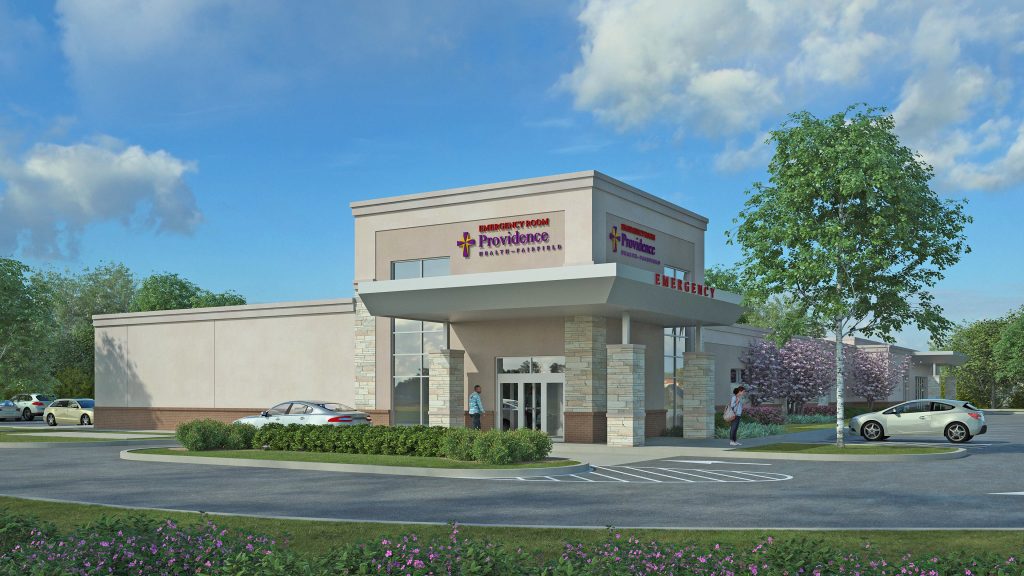
    Exterior rendering of Providence Health – Fairfield Emergency Room

    “We are proud to collaborate with Fairfield Memorial Hospital (FMH) and Fairfield County to preserve critical access to emergency care for residents of this community,” Scott Campbell, Market Chief Executive Officer of Providence Health, said in opening remarks at the invitation-only event. “This new facility will allow you to have access to 24/7 care from board certified emergency room specialists, and we’re excited about that. This Emergency Room will help transform the delivery of local healthcare services to a sustainable model that better meets the needs of this area.” Campbell said.

    The new emergency room will be approximately 20 miles away from Providence Health’s Northeast hospital campus where patients needing more intensive care can be quickly transferred.

    Winnsboro Mayor Roger Gaddy, who serves a Chief of Staff at Fairfield Memorial Hospital and has been on staff at the hospital since 1979, addressed the crowd, reminiscing how, as a young intern, he was recruited to Fairfield County 40 years ago by current fellow FMH Board member William Tuner who was then serving on Fairfield County Council. Gaddy expressed his appreciation to the County, to Providence Health and its partner, LifePoint Health, for bringing the new emergency room to Fairfield.

    “It’s a great day for Fairfield County,” Gaddy told those gathered.

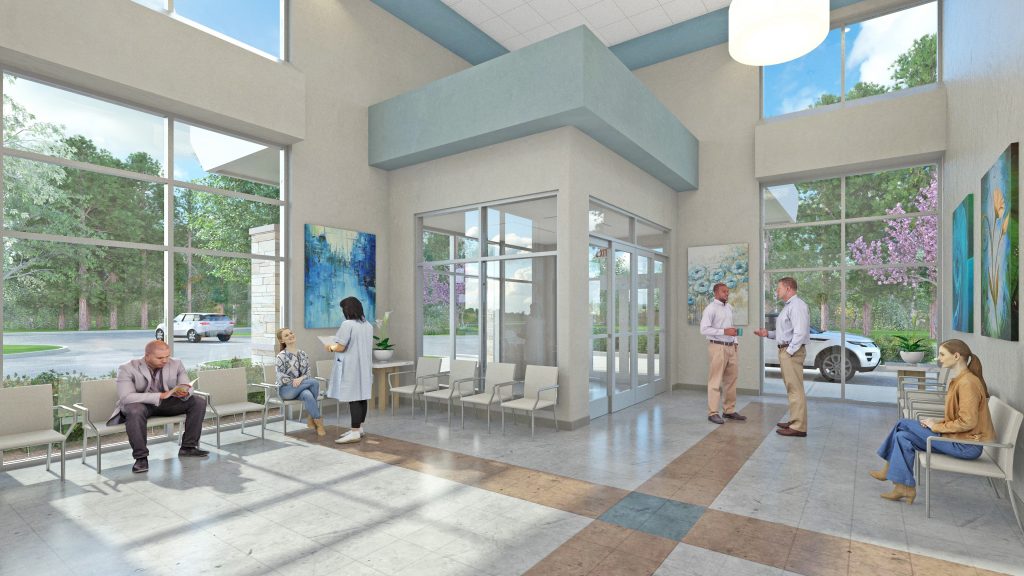
    Interior rendering of Emergency Room in Fairfield County

    The one-level, 18,000-square-foot building will dedicate 12,000 square feet to emergency services and include 6,000 additional square feet of space for future expansion. Plans for the facility include: six exam rooms (including four treatment rooms and two for future expansion), two trauma rooms, an onsite laboratory and imaging services such as a CT scann, ultrasound and x-ray.

    County Council budgets $1.2 million annually to support FMH’s emergency room, and it passed a resolution in May, 2017, stating that it would continue to financially support FMH’s emergency room operations for up to 18 months or until the new Providence emergency facility is open for business. That resolution also stated that the County will provide $1 million annually for 10 years to Providence Health in support of the new emergency room.

    The new emergency room was made possible in part by the state’s Hospital Transformation Program which supports rural access to healthcare resources and has contributed $3.9 million to this project.

    Providing rural access to health resources is a statewide initiative,” Fairfield Memorial Hospital CEO Suzanne Doscher said. “We are pleased to have found a partner that will continue to offer emergency services to the residents of Fairfield County.”

    Until the new facility opens, in-patient hospital and emergency service will continue to be offered at the FMH location. When the new ER opens, emergency services, radiology and lab services will be offered there.

    County Council Chairman Billy Smith said providence will offer employment opportunities to current FMH employees who satisfy Providence’s customary pre-employment screening requirements and are qualified for comparable positions in the new facility to the extent that these positions are available.

    Smith emphasized that Providence Health is committed to providing needed emergency care to all of Fairfield’s residents and that it has a charity care policy that provides support for community members who lack the ability to pay for needed healthcare services.

    Construction on the new emergency room is expected to be completed in the fall of this year.