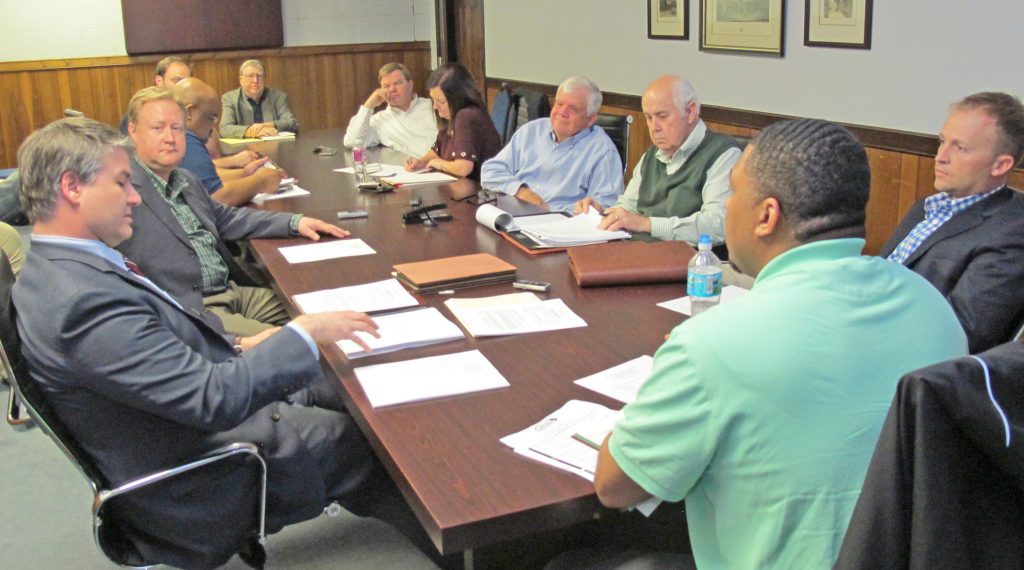
WINNSBORO – Fairfield County is bringing in more experts to
help counter Richland County’s growing opposition to a proposed wastewater
treatment plant.
Meantime, Fairfield County Council is also moving forward
with a proposed capital project sales tax to help pay for the facility that’s
seen as vital to recruiting more industry to Fairfield County.
On Monday night, the council voted 5-2 on the first of three
readings to implement the sales tax. Council members Moses Bell and Mikel Trapp
opposed.
There was no discussion during first reading, but later on
Councilwoman Bertha Goins said the tax is needed to further develop Fairfield’s
infrastructure.
“I know when you say taxes, people start fretting and they
get excited. I can understand that but taxes are how counties and towns are
built.”
County Administrator Jason Taylor said the county’s two
existing treatment plants are nearing capacity, aren’t expandable and
wouldn’t even be approved today by the S.C. Department of Health and
Environmental Control. Additionally, existing underground lines are undersized,
he said.
“While we’ve had a good run with economic development, if we
don’t do something to address our infrastructure capacity, we won’t have
anything left to sell to attract new industry,” Taylor said.
Goins also voiced reservations about Richland County’s
efforts to block Fairfield’s wastewater facility.
“I was very disappointed with the action that Richland
County took with the wastewater treatment plant. It was very discouraging.
That’s not the way to build relationships,” Goins said.
In May, Richland County submitted a report to the Central
Midlands Council of Governments (COG) outlining the county’s opposition to the
Fairfield facility.
The report, produced by Richland County Assistant
Administrator John Thompson at the behest of recently defeated Councilwoman
Joyce Dickerson, outlines well water contamination concerns of Richland County
residents living along Cedar Creek, where wastewater would discharge.
Richland County submitted its report despite DHEC recently
telling The Voice that the agency has no record of wastewater contaminating
water wells in South Carolina. Most contamination of private water wells is
caused by nearby septic tanks, an agency representative said.
In response to the Richland vote, Fairfield County is
retaining an additional engineering and legal firms to counter opposition to the
wastewater plant.
At last week’s Fairfield Joint Water and Sewer Commission
meeting, the group voted to retain American Engineering. Commissioners said
American has more experience working on local projects, which they said would
be needed when Fairfield pitches the plant to the Central Midlands Council of
Governments.
Winnsboro Mayor Roger Gaddy, who chairs the joint
water-sewer panel, also voiced disappointment in Richland County’s opposition.
He said having an engineering firm who has experience presenting to the COG
would be beneficial in explaining the project and countering misinformation.
“We have to have someone help us educate people with
opposition to help them understand the sophistication for the wastewater
treatment plant and the negligible impact it will have on the environment,”
Gaddy said.
The water-sewer commission later voted to retain Willoughby
and Hoefer law firm for the same reason. Fairfield County has previously
budgeted $100,000 to cover anticipated increases in legal fees associated with
the wastewater facility.
“I think a lot of this is an emotional issue. We’ve got to
have some folks who can explain to Richland County, the citizens and the
politicians there, that we’re not trying to do anything detrimental to the
environment,” Gaddy said. “It really isn’t going to be how people have it
pictured in their minds.”
CEDAR CREEK – About a hundred residents of the northeast
section of Blythewood 29016 and the southern part of Fairfield County, many of
whom live along Cedar Creek, met in the Cedar Creek Community Center Sunday
afternoon to discuss a wastewater treatment plant Fairfield County Council has
proposed to locate on a 50-acre property on Syrup Mill and Broom Mill
Roads. The wastewater from that plant is
proposed to be discharged into Cedar Creek.
Fairfield County officials, Administrator Jason Taylor,
Planning Director Chris Clausen and Economic Development Director Ty Davenport
fielded questions.
Fairfield County officials answer questions from Cedar Creek Community residents. | Barbara Ball
The first sore spot brought up by meeting organizers as well
as some in the audience was the feeling that information about the proposed
site had been kept secret by the county and not made public.
“I didn’t know about this until about a week ago.” Shawn
Goff, one of the organizers, told the audience on Jan. 19. “I had no idea this
is coming,” Goff said.
“You understand why we feel blindsided about this,” Cedar
Creek resident Jim Young added. “I didn’t hear about it until a week ago.”
An unidentified woman spoke up to say Fairfield County
residents also didn’t know about the proposed site.
The information about the site location was made public
during a council committee meeting two months earlier on Nov. 11, 2019.
The Voice reported the proposed location on Syrup Mill Road in a front page story on Dec. 5, titled ‘Water Authority Moving Forward.’ The story read, in part, “At an Administrative and Finance committee meeting, also held Nov. 11, county officials said the property being targeted is located off Syrup Mill Road near Big Cedar Creek.”
“We rarely disclose these things until we’re well into the
process with an economic development project,” Taylor said. “We usually give a
code name [until a contract is signed].”
“We found a property, but we weren’t going to announce, ‘Hey
we’re looking at property along Cedar Creek’, because if we do that, the costs
will go up,” Fairfield County Economic Director Ty Davenport said. “Once we put
the property under contract, it was announced at a public meeting.”
Another concern of many at the meeting was whether the
wastewater that would be discharged into the creek would contaminate it.
Both Goff and the county officials disclosed that the creek
is already receiving wastewater from the Ridgeway wastewater plant that is
currently in violation for discharging contaminants into the creek.
Taylor said the Ridgeway plant cannot be modernized. He said
if the county builds a wastewater plant, it could take on the Ridgeway
discharge, effectively cleaning up the creek instead of contaminating it.
John Culbreth, with Thomas and Hutton engineering
consultants, said at the Jan. 13 council meeting that the wastewater discharged
from the Syrup Mill Road facility would be processed by a state-of-the-art
treatment system – a membrane bioreactor (MBR) system – that would not
contaminate the creek. He said it is an advanced level of treatment that would
discharge water of near drinking water quality. He said that discharge is used
to irrigate golf courses and crops and for other uses.
Taylor reiterated Sunday that the discharge would not
pollute the creek. Asked if he would let his children swim in it, he said he
would.
Goff, who lives on Cedar Creek and opposes the discharge
into the creek, agreed that the MBR technology, from his research, is the best
of the best.
“If you have to have one, this is the one you want,” Goff
said. “I can’t tell you that it’s the devil, because it’s the most advanced
wastewater treatment facility that’s available. There are no open pools. It’s
all contained and it has a small footprint, about seven acres. Anyone can
Google and do the research. I was trying my darndest to find some piece of bad
press or something that has happened at one of these plants, and I can’t,” Goff
said. “They say the creek will be cleaner than it is now.”
“Membrane technology is a very clean technology, but it is
highly intensive from a maintenance standpoint,” an unidentified man from the
audience said. “And you’re turning over a very complex treatment facility to
who? To Fairfield County?”
The audience laughed.
Taylor said the county would manage the treatment facility.
Asked if the county had anyone who had experience managing wastewater treatment
plants, Taylor said it does, that he had successfully operated one in Jasper
County for 13 years.
Center Creek resident David Valentine, a civil engineer,
asked why the county is rushing the wastewater treatment facility through and
would the county be willing to put the project on hold for a period of time so
citizens could do the due diligence.
“We are open to looking at other options without question,”
Taylor said. “But I will say it’s not been rushed from our side. I’ve been
working on it for three years and the county’s been working on it since 1997,”
he said. “We have been losing population and jobs. We need to plan for jobs and
to reverse population.”
Taylor said hooking into Columbia is too costly and that
Columbia would then control Fairfield’s future. “Columbia could control whether
we get an industry or not by not making sewer available,” he said. “And going
with Columbia would pull a whole huge amount of money out of Fairfield County and
send it to Columbia to develop their infrastructure. We can build our own
infrastructure in house and control it much cheaper and then keep all the
revenue here.”
Retired Blythewood attorney Stuart Andrews explained to the
residents their legal options to stop Fairfield County from discharging
wastewater into Cedar Creek. He said it could cost millions to mount a legal
campaign against the county but offered that it would be possible to slow the
process down to the point of effectively dismantling the county’s efforts.
Someone in the audience suggested bringing pressure on the
county by boycotting the merchants in Fairfield County.
By the end of the hour and a half meeting, many in the
audience remained convinced that the system would or could, somehow,
contaminate the creek and ruin their water wells.
According to South Carolina’s Department of Health and Environmental Control (DHEC) there is no conclusive evidence that water wells have been contaminated by treated wastewater discharges. Still, members of the audience insisted they want options for the discharged water other than Cedar Creek. Those other options, however, for one reason or another, are not a fit for the county (see ‘What Are The Options?’ below).
Longtime Cedar Creek resident Lynn Robertson is not
convinced. She said that while she wishes Fairfield well in its endeavor to
bring infrastructure and jobs to the county, she is not convinced that the
proposed wastewater treatment plant would not contaminate Cedar Creek.
“There are some other options and I just feel like, I hope and pray that they will look at other options for this rather than dumping it in Cedar Creek,” Robertson said. “I do not want Cedar Creek to be the wastewater pipeline through Richland County to the Broad River. No matter what they say, errors can occur.”
What are the Options?
contributed by the Richland County Conservation Committee
Fairfield County is setting up a new service area to provide
wastewater treatment to Winnsboro, Ridgeway, the Fairfield County Industrial
megasite and for existing and future development along the 1-77 corridor inside
Fairfield County.
This service area would be managed through a joint use
partnership agreement (the new Joint Water Authority) and a management entity
which is currently under development for the new area. This new service area
would require an amendment of the existing 208 (Wastewater) Water Quality
Management Plan for the area as well as a new National Pollutant Discharge
Elimination System (NPDES) Permit which has not been applied for at this point.
More public meetings and informational sessions are being
planned by the County for the proposed site.
The Site
The final site for the wastewater treatment plant has not
been selected, although Fairfield County Council has approved the purchase of a
certain size and price of property. The County has an option agreement on a
50-acre site on Syrup Mill Road at Broom Mill Road.
If this site is selected the new discharge point will be
into Big Cedar Creek.
The plant will need approximately 7 to 10 acres, and will be
designed for an initial capacity of 2 million gallons per day (mgd) and a
maximum with additions of 4 mgd. Twenty-five percent of the waste to be treated
at the new site is projected to come from the megasite with the rest coming
from the Winnsboro and Ridgeway facilities as well as existing and future
development along the 1-77 corridor.
The Winnsboro and Ridgeway treatment facilities have been in
service for a very long time and are very near their flow capacities. The
Winnsboro facility currently discharges to Jackson Creek, and the Ridgeway
facility discharges to Big Cedar Creek upstream of where the new discharge is
currently proposed. Big Cedar Creek flows from Fairfield County into Richland
County and eventually into the Broad River.
The Options
Other alternatives to the proposed plant were discussed at
the Jan. 15 Environmental Planning Advisory Committee (EPAC) meeting. Those
options included revamping the existing Ridgeway or Winnsboro discharge,
providing onsite treatment at the megasite, piping to the Broad River, or land
application.
Revamping the Ridgeway site would be cost prohibitive and
undesirable because of the additional piping needed to cover the new areas
which would be serviced by the new site.
The Wateree is currently unable to accept more Ultimate
Oxygen Demanding (UOD) substances which are present in treated effluents.
Providing onsite treatment at the megasite would also negate
coverage of the new areas and again, treated effluent would end up in the
Wateree after flowing through Dutchman Creek.
Piping to the Broad River would be much more expensive than
the proposed new plant and would be cost prohibitive.
Land application would require an estimated 1,200 acres and
would also be cost prohibitive.
Cedar Creek Option
The plant proposed on Syrup Mill Road would provide tertiary
quality treatment to a re-use level discharging into Big Cedar Creek downstream
of the current Ridgeway discharge. This tertiary treatment discharge would be
of higher quality treated effluent than the existing Ridgeway discharge. In
addition, the megasite would be required to provide pretreatment of any
industrial type effluents to meet discharge standards from industrial sites
before the pre-treated effluent would go to the new plant. The county officials
are also working to find users in the area who could re-use the wastewater for
irrigation, industrial or other purposes. A preliminary engineering report is
projected to be completed for this project within 3 to 6 months.
WINNSBORO – Now that its mission has been defined, the
Fairfield County Joint Water and Sewer System Commission is eyeing how to fund
enhancements to water and sewer lines.
To that end, the commission plans to tap a financial advisor
to help determine the best way to fund those enhancements.
At last week’s commission meeting, commission attorney C.D.
Rhodes said retaining a financial advisor is a critical step in navigating the
intricacies of funding complex infrastructure projects.
“What we need ultimately is a professional who can help us
model all of this stuff and tell us which entity is going to give us the best
rate,” Rhodes said. “Getting to that point is going to be essential in order to
make that ‘ask.’”
Hiring a financial advisor will become particularly critical
when it comes to borrowing funds via general obligation bonds or other means.
“The cost of this wastewater treatment plant and the
connecting lines is going to be more than any single source of funds is going
to be able to meet,” Rhodes said. “It’s going to be a matter of cobbling
together a number of different sources of funds in order to make that happen.”
The discussion last week follows a spending measure that
Fairfield County Council approved on November 11.
Securing plant property
Council members voted 6-1 for a resolution authorizing the
expenditure of up to $300,000 on at least 50 acres of property to serve as a
site for a wastewater plant. Councilman Mikel Trapp voted in opposition.
At a finance committee meeting also held November 11, county
officials said the property being targeted is located off Syrup Mill Road, near
Big Cedar Creek.
It’s at Cedar Creek where two smaller creeks converge about 7 miles south of the megasite property. Underground piping would funnel wastewater from the megasite to the discharge site, county officials said.
“It has to be an appropriate site because you have to have a
discharge point, which means you have to have a long flowing body of water, a
creek in this case,” said County Administrator Jason Taylor.
DHEC has told us there’s enough flow in the creek to handle
two to four million gallons that we are going to be discharging into the
creek,” added Ty Davenport, the county’s economic development director.
The Syrup Mill Road property is actually the most cost effective option. Most of the piping would run along I-77, where right of way already exists.
Taylor said the other option is property along the Broad
River, which adds $30 million to $40 million in extra costs.
“We took this from a $75 to $90 million project to a $50
million project by just finding the location of this discharge point,”
Davenport said.
Even with reduced costs, the joint water authority’s
attorney said employing the services of a financial advisor would help the
county seek additional funding sources.
The Options
For example, one option would be for Fairfield County to
pledge bond money to the commission. Or the commission could pool its
collective resources to issue a bond.
“Whereas the county is limited in its ability to use its own
generated funds to issue bonds, a joint system can use contributions from its
members in lots of different ways,” Rhodes said. “There are lots of different
permutations to this.”
In related business, the commission approved a resolution
establishing the water authority’s procurement policy.
Having such a policy in place is a virtual prerequisite
before the commission can recommend a financial advisor.
Rhodes told the commission that he’s identified two highly
qualified agencies. A third company withdrew at the last moment.
Ideally, he said, the commission should review three
candidates before one is selected, likely in January 2020.
In other business, the commission voted to extend an
invitation to the Town of Ridgeway to join the joint water authority. The vote
was unanimous.
At present, the commission includes representatives from
Fairfield County and the Town of Winnsboro.
The commission was launched in March. Its mission is to
drive more industry to the Fairfield County megasite off I-77.
The state provided $2 million in seed money for
infrastructure for the site.
The new board of the county and town’s joint water/sewer authority met during an organizational meeting to elect officers, discuss incorporation and receive an engineering update. Attending the meeting were C. D. Rhodes, III, clockwise left, attorney with Pope Flynn, who represents the new joint water/sewer authority board; County Administrator Jason Taylor; Deputy County Administrator Davis Anderson; Winnsboro Town Attorney John Fantry; County Economic Development Director Ty Davenport, County Clerk Patti Locklair Davis; Mayor Roger Gaddy; Town Manager Don Wood; Fairfield County resident and engineer Kyle T. Crager, senior project manager of water/wastewater operations for Michel Baker International and County Council Chairman Neal Robinson.
WINNSBORO – Fairfield County is gathering all the trappings to lure big industry and with it, more jobs.
It has interstate access, a megasite roughly equidistant between Columbia and Charlotte and a $2 million state grant targeting infrastructure for that site.
Now the county and town have created a joint water authority – the Fairfield Joint Water and Sewer System – whose mission it is to facilitate infrastructure growth at the I-77 megasite.
“I’m excited because it just shows growth for the town and the county,” said Fairfield County Council Chairman Neil Robinson. “I was told we were delusional just thinking about this, but I think we’re on the right path.”
Appointments of a five-member board were made Monday night and board officers were elected. Plans are to meet monthly, with the next meeting scheduled for March 20.
Winnsboro Mayor Roger Gaddy was named the Authority’s board chairman and Robinson was named vice-chair. Other members include Fairfield County Administrator Jason Taylor (treasurer), Winnsboro Town Manager Don Wood and Fairfield County resident and engineer Kyle Crager, senior project manager of water/wastewater operations for Michel Baker International.
“We have to address water and sewer issues if we’re going to grow,” Taylor said. “Without water and sewer the county cannot realize its full potential.”
Talk of forming a water authority has occurred on and off for the past four years, but gained steam in the past year.
The S.C. Department of Commerce recently pumped $2 million into the megasite, seed money that will fund an engineering study with the ultimate goal of building a wastewater facility at the I-77 megasite.
To that end, the state requested that an authority be formed.
Moving forward, the authority said a critical first step involves mapping out existing infrastructure in the county. The board tentatively plans to review those plans at the next meeting.
“I think it would be important to see all the plans that have been done on the sewer and at the same time work on the water so we’re all up to speed,” Gaddy said. “I think it’s important for us to all be on the same page and prioritize things.”
Taylor suggested reaching out to other water providers as the authority’s work moves forward.
Taylor said at this point, merely mapping the size and location of current water and sewer lines is a prerequisite in developing infrastructure at the megasite.
“With all of these little fractured systems, it’s not necessarily a rational way to provide infrastructure to the county,” Taylor said. “We’re going to start approaching other providers of water and sewer and see if there’s an opportunity to work with them.