Tag: Fairfield County School District

  • Green, Douglas spar over millage

    WINNSBORO – They came to tout their successes as governmental agencies.

    But an emerging kerfuffle over the distribution of property tax revenues quickly became the focal point at a Fairfield County intergovernmental meeting Monday.

    At the previous week’s council meeting, Councilman Jimmy Ray Douglas publicly called out the Fairfield County School District, saying that the district had improperly collected more than $11 million in tax revenues.

    Douglas said inflated millage rates attributed to the school district overages. He noted that the windfall is on par with the $11.5 million price tag associated with renovating the old Mt. Zion institute to serve as a new Fairfield County Administration building.

    “Fairfield County can’t support and pay for the new office complex at Mt. Zion if we can’t control the extra money the school system has been taking from the county funds,” he said. “Since 2012, someone in the school system has secured $11,198,389.90 over the 9.9 school debt millage they should have received.”

    District superintendent Dr. J.R. Green vehemently denied any improper tax collections. Green spent about 10 minutes Monday refuting Douglas’ claim.

    “The suggestion the school district is taking the county’s money is not grounded in fact,” he said. “When you start making suggestions that people are doing things illegal or unethical, that challenges and ques tions someone’s integrity.”

    Other county officials were reluctant to weigh in. County Administrator Jason Taylor deferred comment to Council Chairman Billy Smith. Smith said he understood why Dr. Green defended the district’s position, but stopped short of staking a position on Douglas’ claims.

    “It’s not an issue council is discussing or addressing in any way. It’s just an issue that a councilman raised,” Smith said. “I don’t see anything happening next unless Mr. Douglas develops a compelling argument to get enough people behind him for us to move forward.”

    Douglas said the windfall is the result of a series of millage errors dating to at least 2012.

    A year later it leaped to 32 mils, where it remained for two years. Those are the years following a school board vote to issue a $20 million bond to build a new career center.

    At the time, the bond included $15.6 million for the career center, with the rest reserved for miscellaneous facility and equipment needs.

    Originally the bond called for an increase to 34 mils, but in actuality it only rose from 9.9 mils to 32 mils. Millage then trickled to 23.6 mils in 2015, and then 20.6 mils in subsequent years, according to county tax documents.

    Green said the district was able to issue the bond without a referendum because it met criteria that said local governments are allowed to issue bonds up to 8 percent of the assessed value of all taxable property in the county.

    He also said the debt would be retired in 2025. Debt service would revert to 9.9 mills at that time.

    In a telephone interview Monday, Green said it was always the district’s intent for debt service millage to gradually reduce until the debt is retired.

    The Voice reported in 2013 that the debt service millage would increase for two years before dropping back down.

    “It [millage] is down further than we thought it would come down,” Green said. “It’s not as if you can pay for the career center in two years.”

    Douglas, however, maintains the district is reaping a windfall.

    In an interview with The Voice, Douglas said he was informed by the county treasurer’s office that the district has received $175,000 in the past month alone from the county. He wrote in a memo to Taylor, the county administrator, that he thinks the district isn’t allowed to raise millage.

    “State law gives the school system the right to increase millage by 3 mils each year or the cost of living increase, whichever is the least amount,” the note reads. “The millage cannot be increased at a larger amount without the Fairfield County Council’s approval.”

    Green said Douglas is conflating operating millage and debt service millage. He noted the 3 percent rule Douglas cited refers to operating millage, not debt service millage.

    “People are conflating two things that aren’t the same,” Green said.

  • Virtual learning coming to FCSD

    Winnsboro – They won’t be replacing live teachers.

    But when the Fairfield County School District finds itself in a pinch due to a long-term absence, virtual teachers could help fill the void.

    At the August board meeting, district leaders briefed the school board about a new partnership with Proximity Learning, which would provide virtual instruction to elementary students.

    Implementation could begin as early as Sept. 17, but would be confined to Spanish instruction one day a week in child development through sixth grade, said Dr. Claudia Avery, the district’s deputy superintendent of academics.

    “We are hoping with this opportunity that we will be able to fill short-term and long-term vacancies for certified teachers,” Avery said.

    Virtual teachers would provide customized learning to students’ needs and also provide remediation options if needed. Teachers are certified to teach in South Carolina.

    McCrorey-Liston School for Technology and Geiger Elementary School students are participating in the program, according to district documents.

    “Proximity Learning courses are built around live class sessions delivered via web-conferencing,” district documents state. “The live instruction model mirrors the experience of a traditional brick and mortar classroom setting, but is conducted entirely online.”

    Founded in 2008, Proximity Learning is an Austin, Texas firm that provides online instruction and tutoring services to school districts, particularly in districts facing teaching shortages.

    Evan Erdberg, the company’s founder, started Proximity Learning after observing high numbers of long-term substitutes and teachers with emergency certifications covering classrooms.

    “Evan noted disturbing trends: schools in the most impoverished communities had the highest number of teacher vacancies which quite often exceeded more than half of teacher population in a school,” the district’s website states.

    “Principals in these schools would hasten to explain that their hands were tied, no teachers applied for these positions, and/or, refused to work in their school when placed by the district,” the website continues. “This led to students who suffered inequity two-fold, the students were deprived of highly qualified teachers which in turn reflected an average student pass rate of only 20%.”

    Avery said the Greenville County school district is working with Proximity Learning. Districts in Milwaukee, Wisconsin; Richmond, Virginia; and New York City work with the firm too, she said.

    Virtual learning wouldn’t supplant existing teachers.

    As Dr. Green noted later in the meeting during his superintendent’s report, the district’s staffing status is robust.

    “We are in very good shape in relation to staffing,” Green said. “There are lots of districts that are having tremendous struggles filling positions, but we are in an excellent position and looking forward to an outstanding school year.”

    Avery said existing substitute funds and grants would cover the total cost, which wasn’t specifically stated at the August meeting.

    “We have received preliminary approval that this has been approved through the Title V funds we receive from the federal government,” Avery said. “Those funds will cover the entire cost of our virtual learning program.”

    Board member Paul Hartman asked how virtual teachers would know where students were in the curriculum. Avery said principals already have an idea of a particular class’ progress when there’s advance notice that a teacher will be out long-term.

    “Of course with maternity leaves and long term substitutes, we typically know when that’s going to happen. If we know now a teacher is going to leave in December, we can go ahead and plan now.”

    Live persons would still provide classroom management. It’s just the instructional component that virtual teachers would handle.

    “A teacher assistant or another person within the building will serve as the facilitator,” Avery said. “This person basically is inside the classroom with the students to make sure they are on staying track and following along with the virtual teacher.”

    A media specialist would also provide some support with the technology component, Avery added.

  • FCSD Board approves $2.2M loan

    WINNSBORO – Fairfield County school board members are taking out another line of credit, one of many the district has sought to help pay for building and facilities projects.

    At its July meeting, the board voted 6-1 to borrow $2.2 million to fund a variety of building and facilities projects. Board member Paul Hartman cast the lone dis­senting vote.

    Hartman asked for the record to show that she favored using alternative funding sources as op­posed to seeking a loan.

    “I feel like we should use the re­mainder of what’s left over from the calendar year, finishing up than borrowing money,” she said.

    Superintendent Dr. J.R. Green said the bond was necessary be­cause the district has recurring capital needs.

    “You still have to put roofs on buildings. Air conditioners do not last forever,” Green said. “We’ve not had one single year where we’ve not done things to upgrade our facilities. We’re in a much bet­ter place but we aren’t where we need to be yet.”

    Borrowing has become a com­mon theme as of late for the Fair­field County School District.

    In June, the board approved a $5.4 million loan in the form of a tax anticipation note, a short-term

    loan to help the district cover temporary shortfalls until tax revenue starts rolling in beginning in January 2019.

    The board took out a similar note worth $5 million in 2017, according to district documents.

    Two years ago, they approved a $2 mil­lion general obligation bond to renovate Kelly Miller Elementary School.

    And in 2013, the board approved a $20 million bond to help build a new career center, resulting in a tax increase from 24 mils up to 34 mils that the district, at the time, said would only be for two years.

    The loan included $15.6 million for the building, with the remaining $4.4 mil­lion diverted to finance other facility and equipment needs in the district.

    All told, the sampling of loans totals about $29.6 million, according to district documents and reporting by The Voice.

    The most recently approved bond in­cludes a laundry list of various facility projects, with line items ranging from $16,000 to $300,000.

    Interior and exterior LED lighting and bathroom renovations led the list at $300,000 each, followed by $250,000 from bleacher renovations.

    Also included within the $2.2 million is a district-wide contingency fund of $274,000, school board documents show.

    A breakdown of what contingency funds would cover was not available, and Green couldn’t be reached for follow-up comment as of press time.

    The bond itself would take about a year to repay, and debt millage would remain constant at 20.6 mils, according to district documents.

    The interest rate wasn’t immediately available, though board documents state the district could receive a competitive rate through the S.C. Association of Gov­ernmental Organizations (SCAGO), which the district is utilizing to issue the bond.

    “The SCAGO program pools other school district bond issuances, which results in lower issuance costs and potentially bet­ter interest rates due to increased compe­tition for the purchase,” board documents state.

    In addition to quizzing Green about identifying funding sources other than borrowing, Hartman also asked for the amount of the district’s current outstand­ing debts.

    Kevin Robinson, the district’s director of finance, said he couldn’t provide an exact amount.

    “I don’t know the exact amount. We are still paying on the career center,” Robinson said. “That debt has not been extinguished as of yet. And that’s per the schedule that was initially approved.”

  • FCSD salary debate grows testy

    WINNSBORO – Once again questions over compensation arose during the Fairfield County School District board meeting.

    And once again, discussions got thorny at times.

    For nearly 40 minutes, board member Annie McDaniel sparred with Superintendent Dr. J.R. Green and board chairman William Frick over district salaries during the July meeting.

    At one point, McDaniel, who is running for the District 41 Representative in the State House, suggested board recordings of prior discussions had been removed from the district’s website.

    “Normally we have a tape that reflects the full conversation,” McDaniel said. “For some reason, I didn’t see that tape on there today.”

    “Are you insinuating I’m part of some conspiracy now, Ms. McDaniel?” Frick replied.

    At issue was a motion approved during the June 5 meeting that directed Green to develop options in which every employee makes at least $20,000 a year.

    As of Sunday, video of the meeting was viewable on the district’s website. And on that video, the motion the board approved instructed Green to present options that result in every employee making $20,000 a year.

    McDaniel pressed Green for other options at the July meeting. She grew frustrated over Green’s and Frick’s responses that Green was carrying out the board’s instructions to the letter of the law.

    McDaniel also said she hoped to vote to increase salaries that night. Board members said Green’s plan was presented for information only, and no votes were taken.

    “The concern was the sensitivity and the compassion for people making $13,000, $14,000 a year,” McDaniel said. “Whether I asked for a horse ride, a donkey or a monkey jumping upside down, for you guys not to take this seriously, I can’t even come up with the word for it.”

    “The board directed me to present an option, so I presented an option,” Green replied. “I told you from my professional expertise the only way I can do it is to increase the hourly rate.”

    Frick agreed.

    “That was the motion. It was voted upon,” Frick said. “I asked Ms. McDaniel to clarify. The motion was to bring back options to make sure no employees make less than $20,000 a year.”

    Green’s proposal increases starting hourly wages from $10.67 to $15.45 for Salary Class 1010 employees, which includes bus monitors, food service/cafeteria operators and safety officers.

    Class 1020 employees, including custodians, wouldn’t receive raises. They earn $11.67 an hour with zero years of experience.

    Green said the disparity is due to days worked. Class 1010 employees work 190 days while Class 1020 employees work 250 days, which is why Class 1010 employees earn less, he said.

    Because of the disparity, Green and other board members instead supported a comprehensive overhaul of the district’s salary schedule.

    “The only way you can ensure that there is no employee in the district that makes less than $20,000 is to increase the hourly rate,” Green said. “It is not feasible to say we’re going to have every employee work 245 or 260 days. The question would be what they would do for the 245 or 260 days.”

    Board members Sylvia Harrison and Henry Miller chimed in, both expressing support for a comprehensive salary overhaul.

    “I want to see Dr. Green bring an option back where everybody is considered to get a raise,” Harrison said. “I do like the fact that the support staff need a bigger raise, but I’d like to see an option for everybody because they all deserve a raise.”

    McDaniel opposed waiting for a comprehensive salary, saying it would be too time-intensive when employees are struggling to make ends meet.

    “Are we going to just leave this tonight, or are we going to wait two years down the road after we get a salary study, which is a waste of money?” she said. “We’re talking about people making $13,000, $14,000 a year. That is awful.”

  • All district schools to get SROs

    County will provide vehicles and uniforms

    WINNSBORO – Ridgeway Police Chief Christopher Culp has been the subject of at least 14 complaints from Ridgeway residents and businesses in the past 12 months, according to documents obtained by The Voice. Those complaints recently almost cost him his job.

    One of the complaints, though – that Culp doubles as the de facto school resource officer (SRO) at Geiger Elementary School although he is not certified to do so – will likely be mitigated through action by the Fairfield County School District.

    Superintendent Dr. J.R. Green and Board Chairman William Frick both told The Voice this week that the District’s recently approved budget includes funding for additional SROs.

    “We did budget for additional SROs to go into the elementary schools for the upcoming school year,” Frick said. “That was already in the budget that was approved at the last meeting, so we are looking forward to that.”

    While the the District already provides SROs for the high school and middle schools. Green said the district started feeling the need to add SROs to the five elementary school after the Florida shooting incident.

    “We decided it would be prudent to expand our SRO program to include the elementary schools as well,” Green said. “Obviously, we are committed to providing the safest environment we can as a district. This is just one added step to improving on the environment that we provide students.”

    Frick went on to say that the Fairfield County Sheriff’s Office is hiring for those positions.

    The budget that passed includes $325,000 for five new school resource officers, which works out to about $65,000 per officer. There was no mention during budget deliberations, though, exactly where those officers would be assigned.

    Green has previously said the funding covers the officers’ salaries and benefits, while Fairfield County would cover vehicle, equipment and training costs.

    “Our plan is to have resource officers in place by the fall of this year,” Green said Tuesday. “We’re providing resource officers to our elementary schools. That’s our plan provided we have officers available.”

  • Trustees question Mitford payments

    WINNSBORO—As the Fairfield County Board of Trustees finalizes its upcoming budget, some members are questioning why Fairfield County money is still being spent in neighboring Chester County.

    At issue are state-mandated payments to the Chester County School District covering costs of Fairfield County students, specifically from the Mitford community, who attend school in Chester County.

    Fairfield trustee Annie McDaniel took issue with the payments during a discussion at the April board meeting, citing rising costs.

    Payments – calculated at 103 percent of Chester’s prior year per-pupil cost of Mitford transfer students – are mandated in state law and have been upheld by the S.C. Supreme Court.

    “I don’t think they intended for it to go on and on forever,” McDaniel said. “We need to look at that, we’re sending a lot of money over there.”

    In 2018-2019, student transfers are expected to cost Fairfield County schools an additional $74,150, rising from about $552,000 this year to $626,000, according to budget figures.

    McDaniel called for the district’s legal counsel to review the Chester County payments. She also suggested that Chester is more prosperous than Fairfield County.

    “They’ve got some pretty good industry coming in on their side,” she said.

    Since January 2017, the S.C. Department of Commerce published on its website two announcements about new or expanding industry in Chester County, accounting for 174 new jobs.

    There have been no announcements for Fairfield County, according to the Department of Commerce website. Besides the money the Fairfield School District receives from the state and from County taxes, it also receives more than $18M in property taxes annually from V.C. Summer’s unit one.

    Board member Henry Miller thinks there should be greater accountability of the money Fairfield sends to Chester.

    “Where are the checks and balances? I don’t want anyone fudging the math, so to speak, making us pay more,” Miller said. “I’d just love to see all of them [Mitford students] come back home.”

    When contacted by The Voice, the Chester County school district released a prepared statement attributable to Dr. Angela Bain, the district’s superintendent.

    “We are not privy to any discussions that the Fairfield County School Board is having regarding this matter,” the statement said. “We are aware of the Supreme Court’s decision, and we are complying with that decision.”

    A state law known as Act 294 that passed in 2010 requires the Fairfield County school district to foot the bill for Mitford community students attending Chester County schools, mainly in Great Falls.

    The school district filed suit, challenging the law, but the effort failed when a sharply divided state Supreme Court upheld Act 294 in a 3-2 decision, according to judicial records.

    The voting majority said in its opinion that Fairfield County Schools never showed that the General Assembly “failed to have a logical basis or sound reason” in enacting Act. 294.

    Court documents state an informal agreement facilitating the transfer of Mitford students to Chester County existed since 1972.

    It wasn’t until 2007 that the deal broke down, prompting special legislation to address the issue.

    Following the 2010 legislation, the Fairfield County school district was invoiced more than $1.8 million for the past three years, court documents state, and has been paying the Chester County district ever since.

    In a minority opinion, Justice Donald Beatty said Act 294 is unconstitutional because it conflicts with pre-existing general laws addressing student transfers. Justice Kaye Hearn concurred.

    “In reaching this conclusion, the majority myopically focuses on the procedural posture of the instant case and, in turn, effectively discounts the fundamental question regarding the constitutionality of Act No. 294,” Beatty wrote.

    Beatty further asserted Act 294 provides different processes for calculating the cost of student transfers.

    “Fairfield County has the resources and facilities to provide free public education for all of its resident children,” Beatty said. “I discern no reason why FCSD should now be statutorily required to reimburse CCSD for continued voluntary transfers.”

  • FCSD Board moves parent conferences

    WINNSBORO – Fairfield County school board members will take a second look at the 2018-2019 academic calendar next month, with changes in parent conference days potentially impacting how next year’s calendar unfolds.

    For the 2017-2018 school year, the school district decided to schedule spring parent conferences on Thursday instead of Friday, prompting questions from some board members.

    “This week we’re out on Thursday [for conferences], but come back on Friday. Next year we are doing the same thing,” said board we are doing the same thing,” said board member Henry Miller. “Why did we do that rather than do [conferences] on a Friday?”

    “We felt if we put it in the middle of the week, we’d have better participation,” answered Dr. Claudia Avery, the district’s deputy superintendent of academics. “It wouldn’t conflict with school performances or anything of that nature.”

    Superintendent Dr. J.R. Green concurred.

    “When you plan parent conferences on a Friday afternoon, many parents are busy planning their weekends,” Green said. “Many teachers are not excited about staying until 7 p.m. for parent conferences.”

    Thursday was the first time conferences were scheduled in the middle of the week.

    Board chairman William Frick said the board could use feedback from schools to determine whether to keep or abandon holding conferences on a Thursday.

    “At least that way we’ll have more information to go on,” Frick said. “Surely Dr. Avery can tell us if there was a better participation rate this go-around than in the past. We don’t have that information to make that decision right now.”

    Green cautioned about making too many changes to the calendar, noting it was developed with significant community input.

    “There are lots of people who feel this is preferable. Sometimes we tend to forget that,” he said.

    Board members approved first reading of the calendar by unanimous vote. Second reading will take place in May.

    As it stands, the proposed calendar includes three makeup days for inclement weather in 2017-2018. Makeup days have been scheduled for Nov. 19, Feb. 18 and May 27.

    Other calendar dates of note include:

    • First day for teachers: Aug. 13.
    • First day for students: Aug. 20.
    • Christmas break: Dec. 21 to Jan. 4.
    • Fall break: Nov. 19-23.
    • Spring break: April 15-19.
    • Last day for students: June 7.
    • Graduation: June 8.

    State assessment dates have not yet been released.

  • FCSD Board spars over employee salaries

    WINNSBORO – Next year’s proposed budget includes pay raises for all school district employees, but some Fairfield County Board of Education members want to spend more.

    The board held a lively discussion Tuesday evening before unanimously passing first reading on the $41.2 million budget.

    Among the most vocal was board member Annie McDaniel, who took issue with comparatively high supplements she says some coaches are paid versus salaries of classified employees, such as cafeteria workers and bus drivers.

    “Before we give another supplement, we need to look at it on the table what we’re paying classified people,” McDaniel said. “It was sad looking at the supplements compared to what we were paying employees who work 180 or 190 days a year.”

    The proposed $41.2 million budget is about $2.5 million higher than the one approved last year. Millage would remain at 203.1 mills. Fairfield County Schools hasn’t raised millage since 2010, said Kevin Robinson, the district’s finance director.

    Robinson said the district is anticipating an increase in non-residential property tax revenue. Because of that, the draft budget recommends step increases as well as a 2 percent across the board raise for all employees.

    District Superintendent Dr. J.R. Green said there’s been talk at the state level about budgeting higher pay for educators, but nothing definite.

    “We recognize the state probably won’t mandate 2 percent and they probably won’t mandate the classified employees,” Green said. “We’re doing 2 percent across the board to make salary increases effective for all employees.”

    While board members were happy to increase pay, some took issue with implementing a percentage increase, saying it disproportionately favors higher paying employees.

    “When you’re looking at 2 percent on $20,000 versus 2 percent on $110,000, that’s a big difference,” McDaniel said.

    Board member Paula Hartman agreed.

    “We should do straight amounts. That’s more fair to me,” Hartman said. “The people working in the cafeterias and cleaning up don’t make as much so they don’t get as much.”

    Green said he favored raises by percentages.

    “To suggest we use a specific number instead of a percentage doesn’t seem to be very realistic, in my opinion,” he said.

    Robinson said the budget also includes $325,000 for five new school resource officers, which works to about $65,000 per officer. Green said the funding covers the officers’ salaries and benefits, while Fairfield County would cover vehicle, equipment and training costs.

    “We wanted to have enough money to cover the additional cost of five officers,” Green said.

    Gov. Henry McMaster has said he wants to invest millions of dollars statewide on SROs, a request that comes in the wake of recent school shootings elsewhere in the country, but no bills have been passed.

    “As much as people have talked about that at the state level, the funding of resource officers have filtered down to the local level,” Green said. “It doesn’t look like the state will be providing any money.”

    Board members also reopened debate on an old topic – a 2010 law that allows students in the Mitford community of northeast Fairfield County to attend Chester County schools at Fairfield County school district’s expense. The proposed budget for 2018-2019 estimates student transfer costs at $626,436, a nearly $75,000 increase over this year, according to Fairfield County School District budget figures.

    Some board members said they want more accountability of the money it sends to Chester County. Others want an attorney to take a second look at the Chester ruling.

    “I don’t think they intended for it to go on and on forever,” McDaniel said. “We need to look at that, we’re sending a lot of money over there.”

  • Element gives $30K for chorus trip

    Before being presented with Element’s check, Fairfield District Honors Chorus presented the songs that they will perform at Carnegie Hall. | Barbara Ball

    WINNSBORO – Fairfield County School District’s Honors Chorus learned last September that they are one of five high school bands and choruses chosen to perform next week at Carnegie Hall in New York City. Then, last week, they got more good news when Element TV in Winnsboro donated $30,000 to help finance the $50,000 trip.

    As of last week, the students had only raised $20,000. That’s when Carl Kennedy, Vice President of Human Resources at Element TV in Winnsboro, stepped in. He invited the chorus to perform for the company’s four-year anniversary in Winnsboro on March 9. Following the performance, Kennedy surprised them by presenting them with the check from Element.

    The students will leave by chartered bus on Sunday at 3 a.m., perform Tuesday evening, at 6 p.m., then return to Fairfield County the next day.

    “One of the students told me this morning that they are getting ready to make an impression on the world on the world’s most renowned stage,” Kennedy told the audience. “They are going to make us proud.”

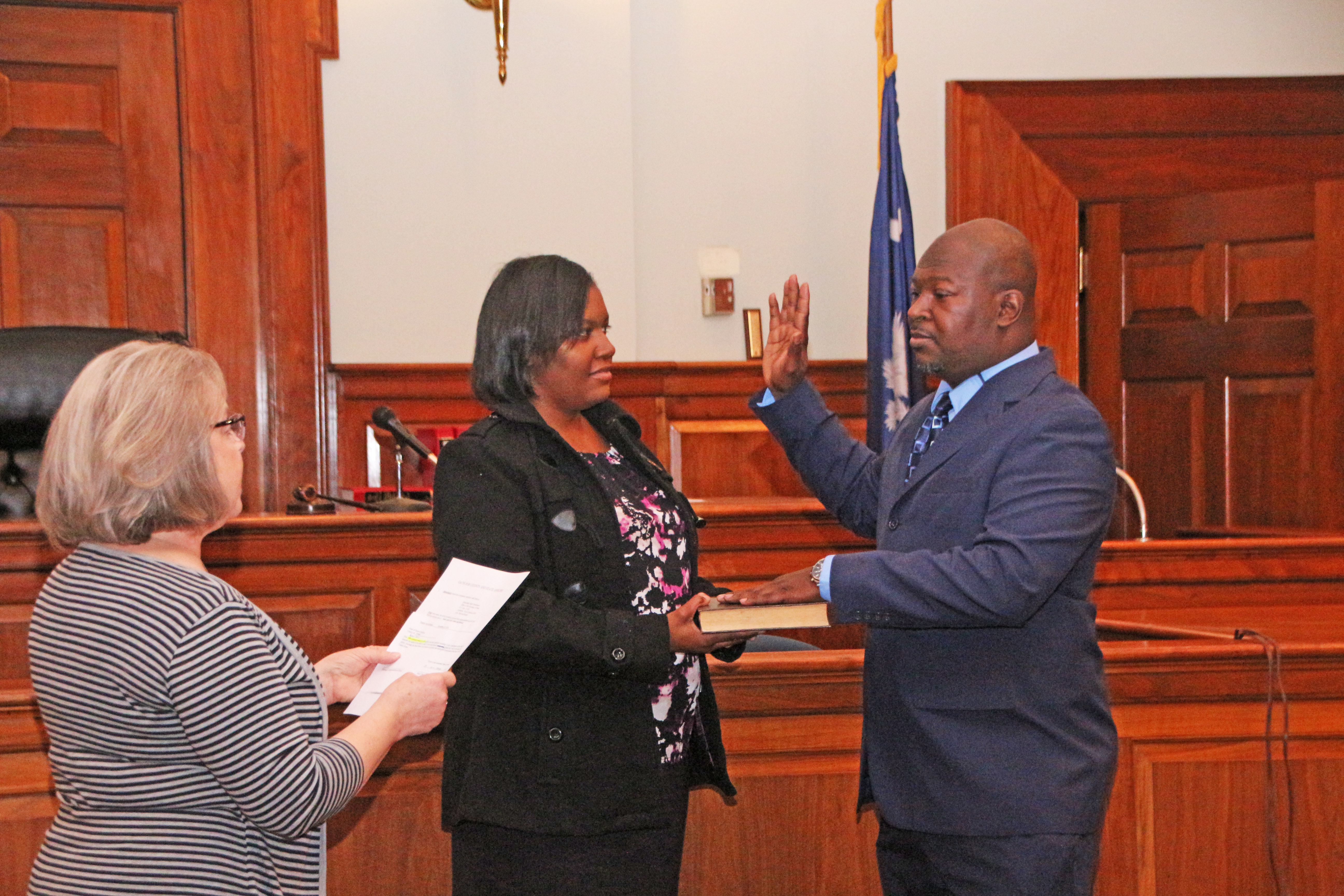
  • Davis sworn in

    Photo: Martha Ladd

    WINNSBORO – Newly elected Fairfield School District school board member Darreyl Davis is sworn into office by Fairfield County Clerk of Court Judy Bonds during ceremonies at the Court House last week. Holding the Bible is Davis’ wife, Tamika.