Tag: Fairfield County School District

  • Teachers Honored

    WINNSBORO – Above, are the Fairfield County School District teachers who are participating in the first year of the District’s two-year program that provides support for teachers interested in pursuing national certification with minimal financial investment. The two year program helps them to achieve their goal of applying for and being awarded national certification, according to presenter Patti Scofield. From left: Jalisa Wright, Michael Lindsay, Emily Johnson, Craig Jones and Robin Gaither.

    Below, School Board Chair William Frick stands with those Fairfield School District teachers who currently hold national certification Back row, from left: Yolanda Singletary, Lori Yarborough, Patti Scofield, Deborah Cooper, Vera Harrison, Teresa Canzater and Tara Blocker. Front row, from left: Jean Masdonati, Marsha Huff and Sheila Beaver. Scofield said this is the first time the District’s nationally certified teachers have been publicly recognized and she thanked the board for the opportunity for allowing that recognition.

  • Town OKs first vote on Teacher Village

    FCSD Board Chair William Frick discusses a zoning map with FCSD Education Foundation president Dr. Sue Rex and fellow board member Henry Miller following Town Council meeting Tuesday night. | Barbara Ball

    WINNSBORO – After the Teacher Village property request for R3 zoning flew through the Winnsboro Planning Commission faster than a speeding bullet, the feat was duplicated at the Town Council meeting Tuesday evening.

    There was no discussion at either meeting, only a motion in favor and a unanimous vote to approve.

    “This will be the first residential teacher village in the state,” Sue Rex, president of the Fairfield County Education Foundation said, addressing Council. “We are asking you to rezone this 22 acres from C-2, commercial, to R3, residential zoning. [The project] will cost $3.6 million, and the developer is putting all that money into it. The developer will then own the land and rent out the homes but only to teachers in the district,” Rex said.

    “If there are several homes not rented to teachers, they will be available to help recruit law enforcement and first responders. This will contribute to the economic stimulus of the Winnsboro community,” Rex told council members.

    To make the project a reality, however, the school district wants a multi-county business park agreement in place and a seven-year, $600,000 property tax abatement for the developer. Both require County Council approval.

    At a special meeting in November between county and school district officials, there seemed to be little common ground. Citing a litany of potential legal issues, county attorney Tommy Morgan called attention to a 2010 attorney general opinion that raised doubts as to whether the county would be protected if litigation were filed over the Teacher Village.

    “It does give some cause for concern in my mind whether the special source revenue credit agreement would be the best way to accomplish what I understand the school district is wanting to do,” Morgan said.

    Dr. J. R. Green, district superintendent, brushed off concerns about potential litigation.

    But procedural and zoning issues represent added concerns for the county.

    Former Council Chairman Billy Smith said the county hasn’t received any formal requests from the developer, only from the Fairfield County Schools’ Education Foundation, a proxy of the school district.

    Smith suggested a list of conditions he’d like met regarding the Teacher Village:

    • An agreement with the developer to indemnify Fairfield County in the Teacher Village project.
    • An agreement to cover Fairfield’s legal expenses incurred in association with the Teacher Village.
    • A legal description of the Teacher Village property.
    • The Town of Winnsboro agreeing to place the property into the multicounty park since it’s in the town.

    Town Council will have a public hearing and final vote on the rezoning of the property on March 5.

  • FCSD makes $35K down payment on Italy trip

    WINNSBORO – Fairfield School District Honors Chorus is $35,000 closer to traveling to Italy.

    At a special called meeting last week, the Fairfield Board of Trustees voted 5-1 to appropriate the funds as a down payment for a trip to Italy for the Fairfield District Honors Chorus.  Board member Paula Hartman voted against the appropriation.

    The trip has an approximately $125,000 price tag, though it was also said the trip would cost about $5,000 per student. Superintendent Dr. J. R. Green said approximately 30 students or students and adults would go on the trip. Students, he said, have raised about $5,000 total so far.

    Green said the students who would travel will fundraise to pay for the trip.

    But under questioning from Hartman, he wouldn’t specifically state that students must raise their own money. He also couldn’t state exactly how many students and chaperones would attend.

    “If they didn’t take part in fundraising, are they going to be excluded?” Hartman asked.

    “We’ll cross that bridge when we get there, Ms. Hartman,” Green said. “The expectation is that students will participate in fundraising.”

    Green went on to say “students will contribute the vast amount of the cost,” but didn’t provide a specific breakdown of the final costs.

    District sponsored trips have become commonplace in recent years, and some have come at taxpayer expense.

    In 2016, Fairfield Middle chorus students traveled to the Bahamas. Also in 2016, the district tapped surplus legal funds to subsidize the chorus performing at Walt Disney World.

    Chorus students traveled to Carnegie Hall last year as well. Several Early College Academy students traveled to the United Kingdom in 2017. Also that year, the board voted to approve two senior trip options – one a cruise to the Bahamas and the other to Orlando, Florida.

    As for the Italy trip, the district voted to transfer $35,000 from the district’s unused salary account for the down payment. The special called meeting to approve the funding was necessary now because of a fast-approaching deadline, district officials said.

    Hartman objected. She didn’t think the district could legally transfer money reserved for teacher salaries to fund student trips.

    “That is false, the board establishes the budget. It is the board’s prerogative if it wants to make transfers,” Green replied.

    A majority of board members supported the expenditure, scoffing at any notions that it is a junket. But none could specifically say how the trip aligns with curriculum standards.

    “When I was a student, education was national. Now it’s global and we are competing with everybody, everywhere,” said board member Rev. Carl Jackson. “Our children should be given an education commensurate with that.”

    Board member Sylvia Harrison said students are gaining exposure.

    “Exposing them to something like that is a win-win for everybody, not just our school [but] for the community too,” Harrison said.

    Green pushed back on any notion the trips constitute wasteful spending.

    “I think there are some people who feel these kinds of opportunities should exist for some kids but not for ours,” Green said. “Because we are a high poverty community there are some people who say, well, they don’t deserve those kinds of opportunities.”

    “When I read some of the comments that are made,” Green said, “there are some who don’t care about the children of this district.”

    He did not reference where these comments were made.

    The Italy trip is scheduled for July.

  • Planning Commission gives Village green light for Feb. 14 vote

    WINNSBORO – In a workshop held last week at the Old Armory to discuss the Fairfield County School District’s application for R-3 zoning for a Teacher Village, the Winnsboro Planning Commissions determined they had sufficient information to move forward with the request.

    Moving forward meant setting dates for a Planning Commission meeting that will include a public hearing followed by a vote on whether or not to recommend (to town council) the zoning change from C-2 to R-3, which permits three homes per acre and would allow cluster housing on 22 acres behind the district office off U.S 321 bypass.

    While there was some discussion as to whether the public would attend a public hearing on Valentine’s Day evening, the Commission decided to set both the public hearing and vote for Feb. 14, at 6 p.m.

    The preliminary site plan for the development does not subdivide the Teacher Village into individual lots. Rather, the entire development consists of one lot, planning documents show.

    R3 has less strict design standards than other residential zones, allowing for reduced spacing between buildings – 25 feet, front to front; 20 feet, front to side; and four feet, side to side – than R1 or R2 zones.

    It also only requires 20 percent of open space, as opposed to 35 percent for R1 and 25 percent for R2.

    Yard sizes are also significantly less, planning documents state.

    Required rights of way in an R3 zone are 6,000 square feet for the first home and 2,500 square feet for each additional dwelling unit. An R1 zone requires 6,000 square feet for all units. In an R2 zone, the minimum square footage is 10,000 square feet.

    Fairfield County educational leaders have touted the Teacher Village as vital in recruiting and retaining teachers.

    At issue during the workshop was whether the school district’s request had met the requirements for moving forward.

    For openers, Building and Zoning Director Billy Castles told Commissioners that, based on the scaled drawings submitted, the house footprints were too large for the spaces allotted.

    Later in the discussion, Vice Chair Sam Johnson concurred that the house footprints were all too large for the rectangle spaces allotted for the houses.

    “Would it have been to our benefit to have had the engineer (who drew the plans) here tonight to help with this?” Commissioner Sonja Kennedy asked.

    “It would have been,” Castles said, but explained that because the engineer is doing pro bono work for the school, he would not be attending the meeting.

    “Dr. Green sent me an email saying if I had any questions, get them to him and he would go to the engineer and get it in writing,” Castles said.

    To move past what was becoming a logjam, Sue Rex, president of the Fairfield County School District Education Foundation, reached the engineer, Josh Rabon, on the phone. After some discussion with Commissioners, he determined that the scale was apparently off and offered to re-scale the drawing and email it to them, which he did. While Castles and Rex went to Castle’s office to print out the new scaled plat, the Commissioners discussed whether they had sufficient information (with the corrected scale drawing) to move forward with a recommendation to Town Council.

    Going over the list of requirements as outlined in the town ordinance, Johnson suggested they should not quibble over details.

    “The real issue,” he said, “is whether they (District) are presenting a somewhat coherent plan that meets the intentions that are laid out for us to make a decision as to whether we can justify making a recommendation to Council to change it from C-2 to R-3. As I see it, it looks like we’re headed in the right direction. At the end of the day, it’s probably not going to look like it does as it was given to us.”

    Commissioner Oliver Johnson agreed.

    “Are these perfect architectural drawings?” Oliver Johnson asked, then answered, “No. It (ordinance) doesn’t say they have to present to us the final detailed plan, just, basically, do they have a plan that looks potentially doable.”

    Johnson said the detailed site plan will be in the permitting process, “when they start to build,” Johnson said.

    The public hearing and vote is set for Feb. 14, at the Old Armory, 301 Park Street, Winnsboro. The Planning Commission’s recommendation for or against the rezoning will go to Town Council for the first of two votes on Feb. 19.

  • R3 zoning sought for Teacher Village

    WINNSBORO – Fairfield County education leaders have amended a rezoning request for the proposed “Teacher Village” from PD-R, Planned Development-Residential to strictly residential.

    The change in zoning plans was presented last week to the Winnsboro Planning Commission, a week after a previously scheduled meeting was canceled to give the Fairfield County School District more time to assemble the required planning documents.

    Now the district is requesting an R3 zone, which permits three homes per acre and would allow for cluster housing on 22 acres behind the district office off U.S. 321 Bypass.

    The planning commission took no action on the Teacher Village at a meeting last week, but did vote to accept the district’s application package.

    Speaking in public comment, Winnsboro resident Shirley Green, a member of the Fairfield County Education Foundation, said the rezoning should be approved.

    “This rezoning is a large step for the Fairfield County School District Education Foundation, and a giant step for the Town of Winnsboro to infuse our community with housing to attract teachers, first responders and their families,” Green said.

    The R3 zone is a strictly residential zone, allowing only residential uses, whereas the PD-R allows a limited amount of non-residential structures as secondary uses, according to town planning documents.

    A preliminary site plan for the development does not subdivide the Teacher Village into individual lots. Rather, the entire development consists of one lot, planning documents show.

    R3 also has less strict design standards than other residential zones, allowing for reduced spacing between buildings – 25 feet, front to front; 20 feet, front to side; and four feet, side to side – than R1 or R2 zones.

    It also only requires only 20 percent of open space, as opposed to 35 percent for R1 and 25 percent for R2.

    Yard sizes are also significantly less, planning documents state.

    Required rights of way in an R3 zone are 6,000 square feet for the first home and 2,500 square feet for each additional dwelling unit. An R1 zone requires 6,000 square feet for all units. In an R3 zone, the minimum square footage is 10,000.

    Fairfield County educated leaders have touted the Teacher Village as vital in recruiting and retaining teachers.

    Billy Castles, Director of the Town of Winnsboro Building and Zoning Department, has set a workshop for the Planning Commissioners to discuss the preliminary site plan at 4 p.m., Thursday, Jan. 24, at the Old Armory, 307 Park Street, Winnsboro.

  • District budgets $5K bonus for teachers

    Dr. Green and William Frick

    WINNSBORO – Hoping it will help recruit and retain teachers, the Fairfield County School District plans to dole out annual bonuses – $5,000 for educators and $3,000 for district and school staff.

    At its monthly meeting Tuesday night, the board voted 5-1 to award the bonuses. Board member Paula Hartman voted against the measure.

    Hartman said she’s not against bonuses, but felt caught off guard by the bonus proposal. She noted the district previously discussed using surplus funds to commission a salary study.

    “I’ve asked for salaries every year I’ve been on the board, and they don’t give it,” she said.

    At $49,288, Fairfield County’s average annual teacher salary ranks 37th out of 82 districts in South Carolina, according to state report card data.

    Richland 2 ranks sixth at $51,802. Lexington 5-Richland leads at $55,023, while Florence 4 is last at $43,087, report card data shows.

    Hartman also expressed reservations about budgeting money that doesn’t exist yet.

    “I thought this was going to come up in the budget. I didn’t think this was going to come up now,” Hartman said. “I feel like it would be more of an incentive for employees who’ve been here three years and have a commitment. That might keep them here.”

    It will cost the district $2.8 million to fully fund bonuses for 2019. Bonuses would be available to any existing full-time employee, no matter the length of employment, as well as future full-time hires, district officials said.

    The first $1 million comes from a surplus carried over from last calendar year, money Superintendent Dr. Jr. Green has previously stated would be applied to boosting teacher pay.

    Green said during the meeting that the general fund would increase by $1.8 million to cover the rest.

    “I am hoping this inspires people who aren’t part of Fairfield County to be inspired to join Fairfield County,” Green said.

    Board chairman William Frick said after the meeting that the source of the $1.8 million comes from presently unbudgeted surplus funds the district anticipates receiving.

    “There is a forecast that next fiscal year we’ll have an additional $2 million that can be rolled over instead of allocating it toward capital projects as we’ve done,” Frick said. “The idea is to take that entire $2 million to fund this.”

    There are no tenure requirements for the bonuses; Green said he plans to make them an annual perk. He said this is an annual program, adding it would take a major economic downturn to cut bonuses, a downturn he thought was unlikely.

    All employees would be eligible, including district office administrators, though board members said they don’t know if Green would qualify for a bonus since he’s a contract employee.

    If Dr. Green did receive a $3,000 bonus, it would bump his annual salary from $182,287 to $185,287.

    Green also has an annuity contribution of $29,165, though district officials still can’t say whether the annuity is paid from the district budget or by Green personally. The Voice filed a public records request for that information on Dec. 19, 2018, and is still waiting for clarification.

    District officials said Tuesday that a bonus is better than a conventional salary increase because the district and employees aren’t required to contribute a percentage into retirement funds for bonuses.

    However, the federal government taxes most bonuses at 22 percent, according to the Internal Revenue Service.

    That means a school district employee receiving a $5,000 bonus would take home $3,900 after federal taxes. A $3,000 bonus translates to $2,340 after federal taxes.

  • Super’s evaluation documents incomplete

    Salary Info Obtained With FOI Request

    WINNSBORO – Fairfield County school board members voted to extend Superintendent Dr. J.R. Green’s contract another year, but individual evaluations remain shrouded in secrecy.

    The district, which has a $43 million budget and whose millage is more than half of a typical property tax bill, released only four evaluations from the seven-member board.

    In addition, the forms that were released were anonymously written, making it impossible to determine how individual board members rated Green.

    On Dec. 18, board members voted 4-1 to extend Green’s contract by one year to 2024. Paula Hartman voted in opposition.

    The Voice requested individual evaluations the following day through the S.C. Freedom of Information Act, but the district didn’t provide the documents – consisting of four pages and a cover sheet – until Monday, Jan. 7.

    Public bodies have 10 business days to respond to FOIA requests, according to state law.

    Jay Bender, a media law attorney with the S.C. Press Association, of which The Voice is a member, said taxpayers are entitled to know precisely how school boards evaluate the superintendent.

    “If the board members are evaluating the superintendent anonymously, that doesn’t seem like much of an evaluation to me,” Bender said. “If they’ve structured a process where the evaluations are all anonymous, it seems to me that that’s worthless.”

    Board chairman William Frick couldn’t be reached for comment late Tuesday to address why only four evaluations were released or why they were conducted anonymously.

    What the evaluations said

    Three of the four evaluations give Green an “exemplary” rating in each of five categories: Community Engagement, Student Achievement, Leadership, Learning Environment and Fiscal Management.

    The fourth form gave Green a “proficient” rating in Leadership and Learning Environment, and exemplary in the other three categories.

    None of the evaluations released to The Voice gave Green a “needs improvement” ranking in any category.

    Only two evaluations include written comments.

    One board member praised Green for his “excellent fiscal management” and “continued improvements” in student achievement.

    “I enjoy working with Dr. Green,” another board member wrote. “We need make it harder [sic], going too good!”

    The glowing comments align with what a majority of board members stated publicly at the December board meeting.

    “I’m glad we can essentially tie him down one additional year,” Frick said.

    Board member Henry Miller said that Green is a heavily recruited superintendent, claiming that Richland One previously was interested in hiring him.

    “They were definitely wanting him to leave us,” Miller said. “I’m just glad we have him. He’s a hot commodity all over the state.”

    Hartman, who cast the lone dissenting vote, didn’t think extending Green’s contract was necessary. She said three-year contracts are standard in most school districts.

    “I don’t think whether it’s three years or six years, it’s telling someone that we don’t want them,” Hartman said. “I don’t understand why we continue to keep it at six years.”

    Frick said maintaining continuity with the superintendent is critical.

    “We had a slight history in this district of superintendents not necessarily staying,” he said. “That was I believe a serious destabilizing effect on the community.”

    Superintendent’s salary

    Green said the contract extension is important to him because he interprets it as a vote of confidence from the board. He added that he has not asked for a salary increase.

    That prompted Hartman to ask Green to publicly state his salary, but Green stated that he didn’t know it.

    In response to The Voice’s FOIA request, the district listed Green’s annual salary at $182,287. His current annuity contribution is $29,165, documents state.

    Green’s salary ranks toward the high end of Midlands area school districts, according The State newspaper’s online salary database.

    Richland One Superintendent Craig Witherspoon makes the most at $222,895.29, followed by Lexington One Superintendent Gregory Little at $204,373.

    Dr. Baron Davis, superintendent of Richland Two, makes $193,903, followed by Green, according to the database.

    Christina Melton, superintendent of Lexington-Richland 5, follows at $175,000. The superintendents of Lexington 2, 3, and 4 make less than $169,000, the database states.


  • Bush stocks closet for homeless students

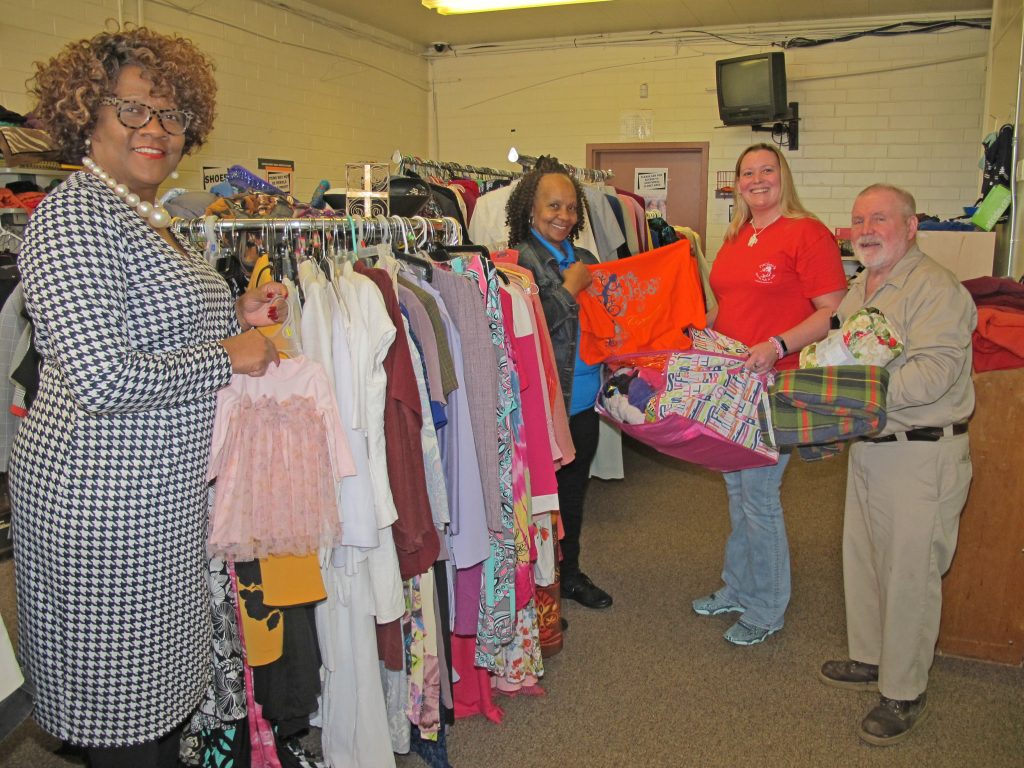
    Belva Belton, left, and Sandra Cammon, who operate Closet to Closet, receive donations from Leah Branham and her dad Eddie, located at the Learning Center. | Barbara Ball

    WINNSBORO – A Ridgeway woman is being heralded as an inspiration for her enduring work to provide resources and support to local students and families in need through Closet to Closet, a program supplying a variety of gently used school uniforms, clothing and shoes for the family, bedding and other household items.

    Belva Bush Belton, the registrar and attendance supervisor at Fairfield County School District, initiated the program four years ago when a state law was passed requiring school districts to provide a liaison to identify students experiencing homelessness. Belton and volunteer Sandra Cammon, a bus driver for the school district, operate the Closet, located in the Learning Center at 250 Roosevelt Street (behind the former Fairfield High School).

    While the Closet initially served only homeless students, Belton has since opened it to all families in the community who are in need, especially those who are victims of house fires and other crisis events.

    During the last four years, Belton has worked tirelessly to reach out to students and families within that scope, but more recently her actions have far surpassed just identifying the need.

    “I guess you could say I go above and beyond, but really I do what I know is needed,” Belton stated.

    Each year at the start of the new school year, Belton is tasked with identifying any students who qualify as “in need”. Those needs, she said, may include a lack of transportation to or from school, assistance with covering fees for field trips or school supplies, or even purchasing school pictures. Others, she said, may have far greater needs.

    “Through the years I have learned that helping students with just their school needs was not nearly enough,” Belton stated.

    Belton said she has found that the families of many of the students need food and housing. Most, she said, are in a “doubled-up” situation, where families are living with other families in a home that is not their own, such as a mother and her children moving in with the grandmother. Others, she said, were without any home at all.

    “Occasionally, I find families who are living in a vehicle. That’s when I start making emergency calls and get them in a hotel and connect them with groups for food and clothing,” she stated.

    Having grown up in Fairfield County herself, Belton said her greatest strength is her connection with the community. She said those connections make resources far more accessible.

    In 2011, Belton was awarded the WIS/Mungo Homes Community Builders award after she successfully turned an unused room in the Learning Center into a thrift-type store for her families. Operating every Wednesday, the store, through continuous donations from the community, has grown to now include furniture.

    Other organizations have set up an Angel Tree program in which Belton’s students or families can be adopted anonymously by local residents who provide them with Christmas gifts.

    That support, Belton said, has helped her continue her efforts year after year. During the 2017-2018 school year, she assisted 114 families. For the 2018-2019 year, she has already helped 104 families with five months still left on the school year.

    “It gets tough at times, when the numbers are so high, but when the community joins me in supporting these families, it just reignites my motivation,” she stated.

    “It would be impossible for me to do what I do without help. Area businesses, churches, civic organizations and families in the community have helped me in a big way.”

    Still, she said her work is never done.

    At the end of the school year, Belton will begin contacting those families on her list to determine if they can be removed from her program. It can be the most rewarding time of the year for her, she said, but it can be one of the hardest as she sees some families continuing to struggle with their same vices.

    That is where she has laid plans for the second chapter of her work. Even though retirement for her is still years down the road, Belton said she hopes, after retirement, to continue this work by creating a long-term “transitional housing” facility within the area.

    “There are some families who find themselves in a tough situation more than once because they have never been taught how to handle finances, or they return to the same temptations that put them in a bad position in the first place. With transitional housing, I would be better able to control their surroundings and prepare them for success,” Belton stated.

    Belton said she plans, after her retirement, to seek out grants that would make her transitional housing dream a reality.

    “This work is my passion. It has been the most rewarding job I have ever had, and I certainly do not intend on stopping any time soon,” she said.

    The Closet is open each Wednesday from 9 – 11:30 AM but also opens up by appointment for those who may be in immediate need. For more information contact Belva Bush Belton at Fairfield County School District Office (803)635-4607.

  • Auditor: FCSD fund balance at $10.5M

    WINNSBORO – To be or not to be debt free.

    That was the question driving a discussion of the Fairfield County School District’s annual audit at last month’s board meeting.

    Andrew Dobson, an accountant with McAbee, Schwartz, Halliday & Co., the financial firm that conducted the audit, was on hand to present the audit. He praised the district for maintaining a higher than standard fund balance.

    Dobson said the district’s fund balance of about $10.5 million represents 27.6 percent of the annual budget. He called that ratio “excellent,” noting the typical district’s fund balance to budget radio is 16 to 18 percent.

    “That gives you three months of short-term funding if something were to happen,” Dobson said. “You have your fund balance perfectly placed for any state cuts, unanticipated events, or any additional spending you might want to do in the future.”

    The presentation soon dovetailed into a discussion about debt.

    Superintendent Dr. J.R. Green touted what he characterized as relatively low long-term debt that’s tied to the Fairfield Career and Technology Center.

    “For the district to have only $7 million in long-term debt is almost unheard of,’ Green said. “When you look at our debt relative to other districts, we have relatively low debt.”

    Audit documents actually list the district’s total long-term debt as closer to $8.49 million.

    The district owes $7,010,000 in general obligation principal and $353,053 in capital lease principal, but also owes $1.24 million more in interest.

    According to audit documents, the district anticipates spending between $1.15 and $1.17 million annually on principal and interest. The final payment in 2024-2025 is a little more than $2.3 million, documents show.

    Board member Paula Hartman thought it would be more prudent to accelerate debt payments so the district could be debt free sooner.

    “For anybody from families to companies, if you don’t owe on it, it’s better,” she said. “That’s the better situation.”

    Green responded by expressing his desire to maintain a rainy day fund.

    “I feel a little better about having more in the bank, just in case,” Green said.

    “I’d feel better if we weren’t in debt for anything,” Hartman responded.

    As of June 30, the district’s debt limit had a borrowing capacity of about $3.8 million, according to the audit.

    State law sets a school district’s credit limit at no more than 8 percent of all assessed value within the district.

    The audit says the district’s assessed property valuation is $146.5 million for debt service. Eight percent of the assessed value works to $11.7 million, the audit states.

  • Fairfield schools Report Card released

    How Area School Districts Compare

    WINNSBORO – A major talking point Fairfield County education leaders have been making about the 2018 state report cards is that no Fairfield school rated Unsatisfactory.

    “We were competitive,” said Dr. J.R. Green, district superintendent, said of the results at a recent Board of Trustees meeting. “Virtually every district that adjoins Fairfield County had at least one unsatisfactory school.”

    That ratio is actually closer to 50-50 for the six surrounding districts, with three districts reporting no Unsatisfactory schools and three others reporting at least one Unsatisfactory school. Union, Newberry and Lancaster counties didn’t report any Unsatisfactory schools, according to report card data. Chester, Kershaw and Richland Two reported at least one Unsatisfactory school.

    Additionally, Green’s comparison includes some districts substantially larger than Fairfield County, which has seven schools, excluding the state-run Midlands Stem Institute which has two schools.

    Chester has 13, Newberry has 14, Kershaw has 18 and Lancaster has 20. Richland Two is the largest adjoining district with 32 schools.

    Fairfield

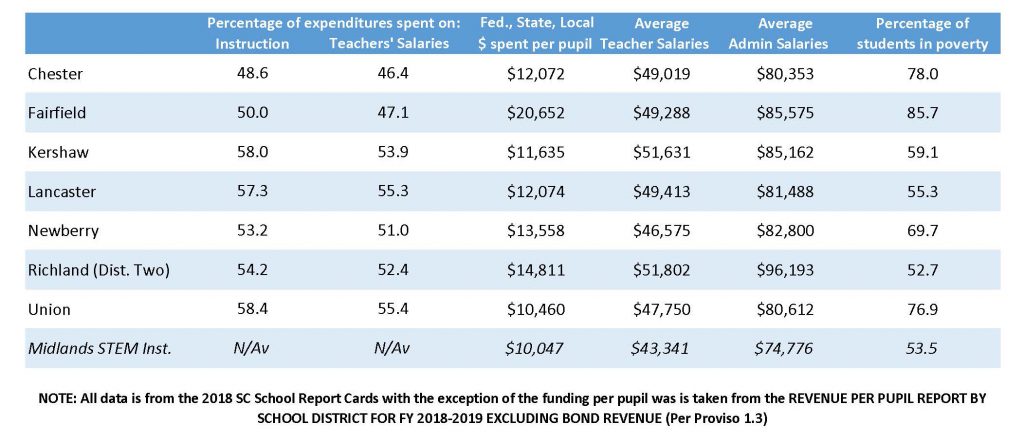
    With the highest federal, state and local funding per pupil ($20,652), the highest percentage of students in poverty and the smallest average number of students per teacher ratio, Fairfield County had one school rated as Excellent, and another received a Good rating on the 2018 SC school report card. Three others were rated Average and two were rated Below Average. None were Unsatisfactory, the lowest rating.

    Here’s a breakdown of how each school performed:

    • Fairfield Magnet School for Math & Science (Excellent)
    • Kelly Miller Elementary (Good)
    • McCrorey-Liston Elementary (Average)
    • Geiger Elementary (Average)
    • Fairfield Central High School (Average)
    • Fairfield Middle (Below Average)
    • Fairfield Elementary (Below Average)

    Chester

    Chester, with the highest average student to teacher ratio (25.4 students per teacher), second highest percent of students in poverty (78.0) and third lowest average teacher salary ($49,018), struggled the most among the seven districts. Chester had one Excellent school, three Average schools, six Below Average schools and three schools receiving the state’s lowest rating of Unsatisfactory.

    Kershaw

    Aside from reporting one Unsatisfactory school, Kershaw’s 18 schools performed well, with five schools earning Good ratings, nine rated Average and three rated Below Average.

    Lancaster

    In Lancaster County, eight schools scored either Excellent or Good. Seven were rated Average and five received a rating of Below Average. Lancaster had no Unsatisfactory schools.

    Newberry

    Newberry County, with the lowest average pay for teachers ($46,575) of the seven districts, and the fourth highest percentage of students in poverty (69.7), reported three schools with Excellent ratings, five schools with a Good ranking, five schools with an Average rating and only one school with a Below Average rating, report card data shows. Newberry had no Unsatisfactory ratings.

    Richland Two

    In Richland Two, about one-third of schools (11) scored Good or Excellent on the report cards. Of the nine Blythewood area Richland Two schools, six were among the 11 top schools:

    • Langford Elementary (Excellent)
    • Round Top Elementary (Excellent)
    • School for Knowledge Elementary – housed in Muller Road Middle (Excellent)
    • Bethel-Hanberry Elementary (Good)
    •  Sandlapper Elementary (Good)
    •  Blythewood High (Good)

    Westwood High, Blythewood Middle and Muller Road Middle (grades 6 – 8) schools received an Average rating,

    The Center for Achievement elementary magnet school housed in the Kelly Mill Middle school, is the only Blythewood area school to receive an Unsatisfactory rating. Two other Richland Two schools also received Unsatisfactory ratings.

    Union

    Union County, which has eight schools, reported one Excellent school, six Average schools and one Below Average school. Union has the third highest percentage of students in poverty (76.9) and allocates the highest percentage (55.4) of its expenditures to teacher salaries which, at an average of $47,750, are the second lowest of the seven districts.

    Midlands Stem Institute

    The report cards list the Midlands Stem Institute, or MSI, of Winnsboro under the S.C. Public Charter School District. The state issued two report cards for the K-8 school – one for elementary grades and one for middle school grades:

    • MSI, elementary (Below Average)
    • MSI, middle (Average)

    The school added ninth grade last fall which was not included in the 2018 ratings. MSI receives $10,047 in federal, state and local funding per pupil, about half the amount the Fairfield District receives and the least of any of the other seven comparison districts.
    Comparing the seven districts

    In 2018, the state revamped the report cards into two main categories: Academics and School Environment. There are six subcategories under Academics and four under School Environment.

    At the Dec. 18 school board meeting, Green stated that the new report cards create a “forced distribution” of schools.

    According to the model, only the top 15 percent of schools are rated Excellent. The next 20 percent receive a Good rating, while the middle 35 percent receive Average ratings.

    Below Average schools make up the next 20 percent while the bottom 10 percent are Unsatisfactory.

    “This system has negatively impacted all kinds of districts with all kinds of populations,” Green said at the meeting. “It creates a ‘Hunger Games’ mentality. Everyone is scrambling to the top and to reach the top.”

    Class sizes

    Fairfield County’s student to teacher ratio of 16.9 to 1 is the smallest [number of students per teacher] ratio compared to the six districts surrounding Fairfield.

    Richland Two has the next lowest ratio at 19.7 to 1. Chester has the highest at 25.4 to 1.

    Teacher Retention

    Statistically speaking, teacher retention appears to be an issue for Fairfield, according to report card data.

    Fairfield’s percentage of teachers on continuing contract is lowest (63.2 percent) of the seven districts. The six surrounding districts range between 75 percent and 81.6 percent, with Union County leading the pack even though it has the third highest percentage of students in poverty and the second lowest average teacher salaries according to report card data.

    Fairfield falls in the middle in average teacher salaries at $49,288. Richland Two leads at $51,802, followed by Kershaw at $51,631.

    Newberry trailed all seven at $46,575 despite its schools receiving comparatively high ratings.

    Other average salaries by district include: Union, $47,750; Chester, $49,019; and Lancaster, $49,413.


    All Report Card data is available online at https://ed.sc.gov/data/report-cards/sc-school-report-card/