Tag: Fairfield County School District

  • Hartman questions FCSD trip spending

    WINNSBORO – Fairfield County Board of Trustees voted to approve its nearly $46.3 million budget Tuesday night, but it was a discussion over comparatively less money that ignited the fireworks.

    At one point, one board member hollered at another amid questions over her own travel expenses, eventually prompting the board chairman to angrily slam his gavel several times to restore order.

    It all started when board member Paula Hartman started quizzing district Superintendent Dr. J.R. Green about travel expenses and policies, both by students and the board.

    Specifically, Hartmann asked about the district’s Griffin Bow Tie Club’s recent trip to Churchill Downs in Louisville, Kentucky.

    The Bow Tie Club “is a comprehensive group mentoring program for middle and high school male students,” according to the school district’s website.

    “When they go on trips, don’t we still have to approve it if they go out of state?” Hartman asked. “Didn’t the Bow Tie Club go to Churchill Downs? When was that approved?”

    Green said the Bow Tie Club’s budget falls under the superintendent’s discretionary account, though he couldn’t say when the Churchill Downs trip was approved or how much the trip cost. Typically it’s approved at the beginning of the year, he said.

    “I’d have to go back and check. It very well could’ve been an oversight,” Green said.

    Green later defended the Churchill Downs trip, saying students benefited greatly from it.

    “That was an absolutely wonderful experience for our young people,” he said. “This is an absolutely ideal way to use district resources, to expose our young people. They saw some things they otherwise would not have seen.”

    Then Hartman asked whether approval has been given for the Fairfield District Honors Chorus’ upcoming trip to Italy. Green said it has been approved, and that about 20 students and five or six chaperones are going.

    Hartman’s next question lit the fuse.

    “What’s the board policy on board members going?” Hartman asked. “I understand that [board member] Sylvia Harrison is going, to support them.”

    Board chairman William Frick quickly interjected.

    Frick said Harrison is receiving $600 to cover her per diem expenses in Italy. He also defended Harrison’s travel habits while criticizing Hartman’s.

    “What it’s paying for is the per diem amount, and I approved that,” Frick said. “Just ask me when you want to go to Myrtle Beach for a finance conference then, Ms. Hartman.”

    “That was actually to learn something. It’s still something to learn about the budget,” Hartman replied.

    Harrison angrily defended her travel spending, stating that she pays for her travel.

    “I know you’re saying this so [The Voice] will write it in the paper. My trip to Italy is paid out of my pocket,” Harrison said. “When we went to Myrtle Beach, when all the board stayed in a regular hotel, did you tell [The Voice] you stayed in a hotel that cost $500 a night? Don’t worry about where I’m going because my trips are paid for out of my pocket.”

    Harrison later apologized for the outburst before the meeting adjourned.

    The Voice couldn’t immediately verify Harrison’s claim about Hartman spending $500 for a hotel room because school board agenda documents don’t itemize expenses.

    Public records, however, show that Harrison’s travel expenses outpaced Hartman’s by $4,300 during the 2018 calendar year.

    In 2018, Harrison took five trips totaling 23 days at a cost of $9,742.82. Board documents state she traveled to San Antonio, Texas; Washington, D.C.; Hilton Head, Charleston and Myrtle Beach for various conferences.

    Hartman took four trips totaling 14 days at a cost of $5,442.38. She traveled to two conferences in Myrtle Beach and one each in Hilton Head and Charleston, records show.

    Debate finally ended with several swings from Frick’s gavel. The board promptly voted to approve the budget 6-1, with Hartman opposing.

    As to Hartman’s original question about travel policies, Green said the board has none.

    “There is no board policy. So Ms. Harrison or any other chaperone would attend the trip. Ms. Harrison would be no different,” Green said.

    The board, however, did enact a policy in 2013, according to a story in The Voice.

    Former board chair Beth Reid announced the policy at a July 2013 meeting. At the time it was decided to place all board travel of $600 and above as an agenda item under the Chairman’s Report, where it is today.

    Board members are required to report travel, though board approval is not needed for trips.

    The policy was enacted “for knowledge of other Board members, so we know who’s going and who’s not, who’s going to be in attendance and who can report back to us after attending a conference,” Reid said at the time.

    It was also enacted “so we know we’re not stepping all over each other,” Reid continued. “We don’t necessarily need for all Board members to be at all conferences.”

  • County, school district fund tuition ‘promise’

    WINNSBORO – Fairfield County’s school superintendent says a newly funded program will allow Fairfield County students to attend Midlands Technical College at no cost.

    Critics, however, say the money would be better spent elsewhere.

    Last month, the Fairfield County Board of Trustees voted 6-1 to approve second reading of the district’s $45.2 million budget for 2019-2020. Board trustee Paula Hartman cast the lone dissenting vote.

    The budget does not include a tax increase.

    Included in the budget is $75,000 for the Fairfield Promise Program. On Monday night, the Fairfield County Council approved a similar appropriation.

    It approved a budget amendment to match the $75,000, yielding $150,000 for Fairfield Promise.

    Council members Douglas Pauley and Jimmy Ray Douglas voted in opposition.

    Dr. J.R. Green, district superintendent, described the Promise Program as an initiative that would allow Fairfield County students to attend Midlands Technical College-Fairfield campus at no cost.

    After qualifying students receive any federal and state financial aid, “the Promise revenue would cover the balance,” Green said.

    To qualify, students would need to be a Fairfield County student – it wouldn’t be limited to the traditional public school system – and earn a GPA of 2.5. Green said the Fairfield Promise would resemble a similar program in Greenwood County.

    “It is for any student that is a resident of Fairfield County that graduates from high school,” Green said. “We’re extremely excited about this.”

    The Greenwood program, however, doesn’t fully fund college tuition for every student in the county. It uses a sliding scale that bases scholarship awards on length of residency, according to the Greenwood Promise website.

    For example, qualifying students attending county schools from grades 9 to 12 receive 65 percent funding, while students who began in Grade 5 receive 85 percent. Students starting in grades 10 or later get nothing.

    Only students attending school in the district since kindergarten receive a 100 percent award, the website states.

    Green said the $150,000 appropriation only leaves enough money for the 2019 school year.

    “Obviously with more funding we could go back to the class of 2016 or 2015,” he said.

    District officials said the $75,000 appropriation is not an additional budget item.

    Kevin Robinson, the district’s finance director, said funds were freed up by adjusting other budget expenditures.

    Fairfield County funding, however, is less certain.

    The county funded its share via budget amendment, essentially a one-off that’s not guaranteed year-to-year.

    Pauley said he didn’t oppose the program, but thought it should be funded from municipal grant funds.

    “I’m inclined to vote in favor of it, but we need to pull the money for it from somewhere else in the budget,” Pauley said. “I believe it is important and can be a big help to our youth.”

    Councilman Jimmy Ray Douglas saw the expenditure as taxpayer waste, questioning the value of Midland Technical College’s Fairfield campus.

    “That’s a waste of money. They’ve wasted money ever since they’ve been there. They’ve done nothing for the use of Fairfield County,” Douglas said. “They have tried to get nobody there to take classes and its called Midland Tech campus in Fairfield County, and they haven’t taught anything.”

    Paula Hartman, the Fairfield school board member who voted against the budget, said she didn’t oppose the Fairfield Promise expenditure per se, but did voice concerns about its viability.

    “If it’s something we don’t know we’re going to have, how are we going to budget for it?” she asked.

    Teacher Village update

    In other business, Dr. Green briefed trustees on the progress of the Teacher Village, a proposed housing project designed to lure and retain teachers by building a low-rent subdivision in Winnsboro.

    So far, the district has spent $12,500 in taxpayer money on the project, including $8,500 for surveying costs and $4,000 in legal expenses.

    Hartman questioned why the expenditures were necessary, noting that the Fairfield County School District Education Foundation created to head up the Teacher Village, had $9,100 in its own bank account.

    She also wanted to know why staff didn’t seek board approval for the expenditures.

    Green said a survey was needed to determine the boundaries of the 22 acres.

    “The district absorbed that cost,” Green said.

    As for the legal fees, Green said he previously said there would be legal fees associated with setting up the foundation. He said he provided an estimate, but not a final cost.

    “That was shared with the board,” he said.

    In November 2016, when the board voted to establish the foundation, Green told The Voice that the district would pay roughly $1,000 to register the foundation as a 501(c)(3) organization.

    It was not immediately clear why it cost $4,000 instead.

    The Teacher Village proposes building 30 homes on 22 acres the district owns off U.S. 321 Bypass, behind the district office. Teachers living there would receive taxpayer funded rent subsidies, cutting rent by about $300 a month.

    Gorelick Brothers Financial, a Charlotte, North Carolina firm that would build the development, is also seeking a $600,000 property tax waiver.

  • FCSD’s Chanda Jefferson named South Carolina Teacher of the Year

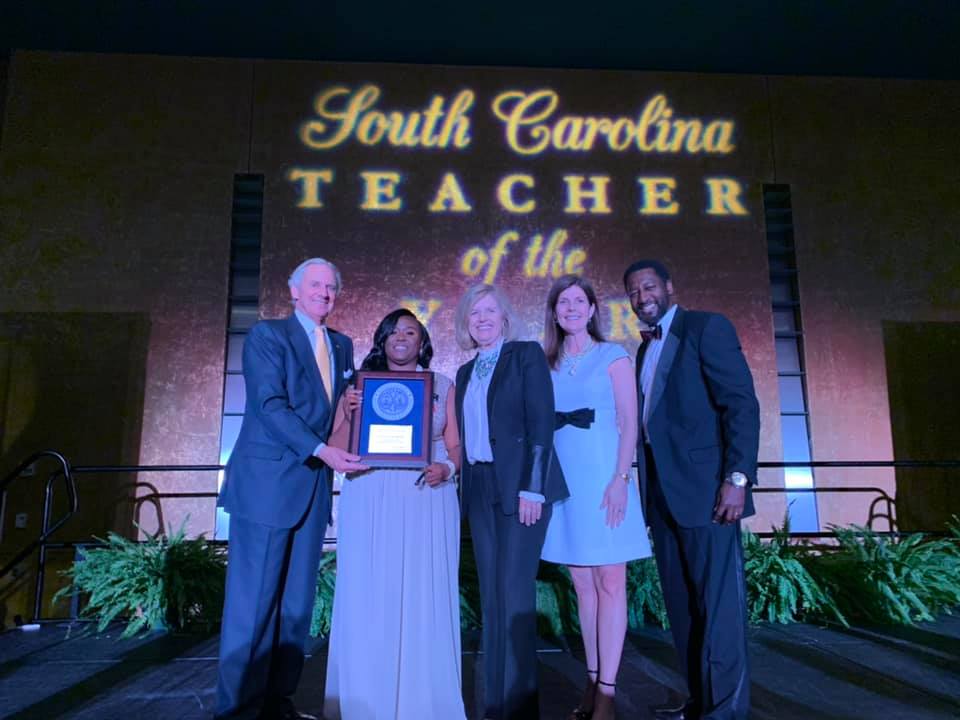
    Gov. Henry McMaster presents the S.C. Teacher of the Year plaque to Chanda Jefferson. Looking on are S.C. Superintendent of Schools Molly Spearman, Lt. Gov. Pamela Evette and Fairfield School District Superintendent Dr. J.R. Green. Photo: South Carolina Department of Education

    WINNSBORO – When Chanda Jefferson was named South Carolina’s 2020 Teacher of the Year last week, she made more than her mother proud. All of Fairfield County was bursting at the seams with pride for one of its own.

    A native of Beech Island, SC, Jefferson has been teaching for eight years, the last three as a Biology teacher at Fairfield Central High School. Prior to that Jefferson was named S.C. Outstanding Biology Teacher in 2014, and was one of 20 teachers to receive the Princeton University Fellowship for Teachers. Other honors during her career include being invited by a Harvard University professor to speak to world-renowned scientists and researchers at the 74th Annual Society of Developmental Biology Conference in Utah.

    “This has been a crazy adventure and a blessing at the same time!” Jefferson posted on her Facebook page.

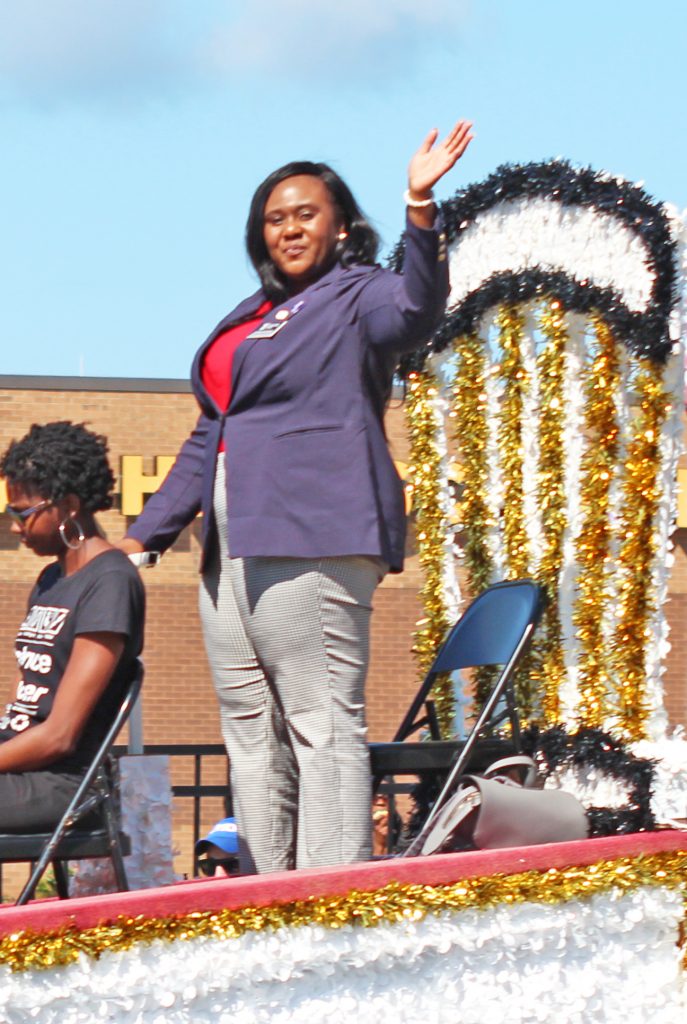
    FCSD honored Jefferson in a parade in front of Fairfield Central on Monday. Other District Teachers of the Year and 2019 Dual Enrollment graduates were also honored during the parade. | Martha Ladd

    The day after being named the top teacher in South Carolina, Gov. Henry McMaster honored the state’s new 2020 Teacher of the Year, and on Monday, the Fairfield County School District held a parade on Highway 321 in Winnsboro in Jefferson’s honor.

    A graduate of the University of South Carolina, Jefferson traces her love for teaching to her childhood.

    “As a child, I enjoyed playing school with my nieces, nephews, and cousins. I always took the role of teacher,” she said.

    Jefferson said she is thrilled to be honored and that the work of every teacher is something to be recognized on a regular basis.

    “Each day that we walk through the doors of our schools and classrooms, we positively impact the lives of students and that deserves to be celebrated every day, every day,” Jefferson said. “I am so thankful, honored, humbled and blessed to stand before you as the 2020 South Carolina Teacher of the Year.”

    Jefferson has said her goal is forming relationships and lighting the way towards achievement for her students and the students across South Carolina.

    “Each year, teachers receive students from all walks of life, and it is our job to teach them. Some students enter our classrooms with a village of support, while others enter alone,” she said. “Yet no matter how they arrive to our classrooms, we must build relationships with them, engage them, and show them that we care. All students will face challenging situations, hardships, and confusion, but in the midst of varying degrees of adversity, teachers have the power to show them how knowledge, uniqueness, and individual interests can empower them and create endless possibilities in life.”

    Jefferson will receive a total of $25,000 and the keys to a new BMW to use while serving a one-year residency at the Center for Educator Recruitment, Retention, and Advancement. Jefferson will be a roving ambassador providing mentoring, attending speaking engagements and other duties as she serves as the spokesperson for 50,000 teachers.

    Her winnings will also include a set of new tires – for when she’s finished with her new ride – and a Jostens ring.

  • 6th Annual Hall of Fame Induction

    WINNSBORO – The 6th annual Fairfield County School District Hall of Fame gala was held April 27 in the school gym. A welcome by Tracie Swilley, Principal of FCHS and the introduction of the inductees was followed by dinner and entertainment by Seven Show Band. This year’s inductees include Russell N. Feaster, Sr., Jessie C. Gaston, Lloyd J. McGriff, Carolyn P. Pierce,  James E. Smalls (posthumously) and Gloria B. Thomas.

  • School district proposes $45.3M budget

    WINNSBORO – No tax increase is anticipated in next year’s school district budget, though property owners still may wind up paying higher school taxes.

    At last week’s school board meeting, Chief Financial Officer Kevin Robinson said the proposed $45.3 million budget includes about $4 million in additional revenue, with $2.9 million attributed to increased tax collections.

    Robinson attributed the revenue increase to increases in property values.

    “The bulk of it is really due to increases in the property tax value, particularly with business property tax values,” Robinson said.

    The Board of Trustees voted 6-1 to approve first reading of the budget, with Paula Hartman casting the lone opposing vote. Two more readings are required before the budget takes effect.

    Hartman said she preferred using the windfall to lower debt service millage.

    “We made reference that, if down the road we had extra money, we would reduce the millage,” she said. “That’s what I suggest the board think about doing.”

    As proposed, the budget contains several moving parts, though most address teacher and employee salaries.

    The draft spending plan calls for appropriating $2.8 million for retention bonuses and associated fringe benefits. One million of that amount will come from the fund balance as a transfer to the general fund, with the rest coming from increased tax collections, Robinson said.

    In January, Superintendent Dr. J.R. Green announced a plan to offer every certified employee a $5,000 bonus to attract and retain teachers. Non-certified employees would receive $3,000.

    At $49,288, Fairfield County’s average annual teacher salary ranks 37th out of 82 districts in South Carolina, according to state report card data.

    Fairfield’s budget also reflects state mandated teacher raises recently approved by the S.C. General Assembly, which approved increasing teacher pay by 4%.

    However, the state is only funding a portion of the 4% (about $700,000) with Fairfield funding the rest, according to budget estimates.

    Board trustee Henry Miller expressed frustration over what he called an unfunded mandate.

    “They do it all the time,” Miller said. “In Washington, D.C., they just send it down and call it an unfunded mandate. That’s what the state just did to us.”

    The budget also shows an increase of $38,141 in student transfer payments to the Chester County School District, traditionally a major rub of the Fairfield school board.

    In 2012, a judge ruled that the Fairfield school district must subsidize students transferring into Chester County. The ruling impacts mainly students living in the Mitford area.

    Ironically, the Chester transfer payment is rising because the district there anticipates increasing revenues, Robinson said.

    “Let’s say, hypothetically, a giant tire manufacturer appears in Chester and has a huge economic impact, and it increases their tax rolls,” board chairman William Frick said. “Because they’re now receiving more taxes, we’ve got to pay them more money?”

    Robinson said that’s correct because while Chester County receives state per pupil funds for Mitford students, it doesn’t receive local support.

    “We’re paying the portion of local taxes that would be attributable to [transfer] students if they were in Chester, which means we’re basing the payment on Chester’s local tax revenue,” he said. “If their local tax revenue goes up, that means the amount we’re paying per student will go up.”

    “So if their economy does better and they get more taxes, we have to pay Chester more money?” Frick asked, drawing chuckles from the board.

    “Unless we have a dramatic decrease in the number of students,” who transfer to Chester, Robinson replied.

  • Readers Turn Out

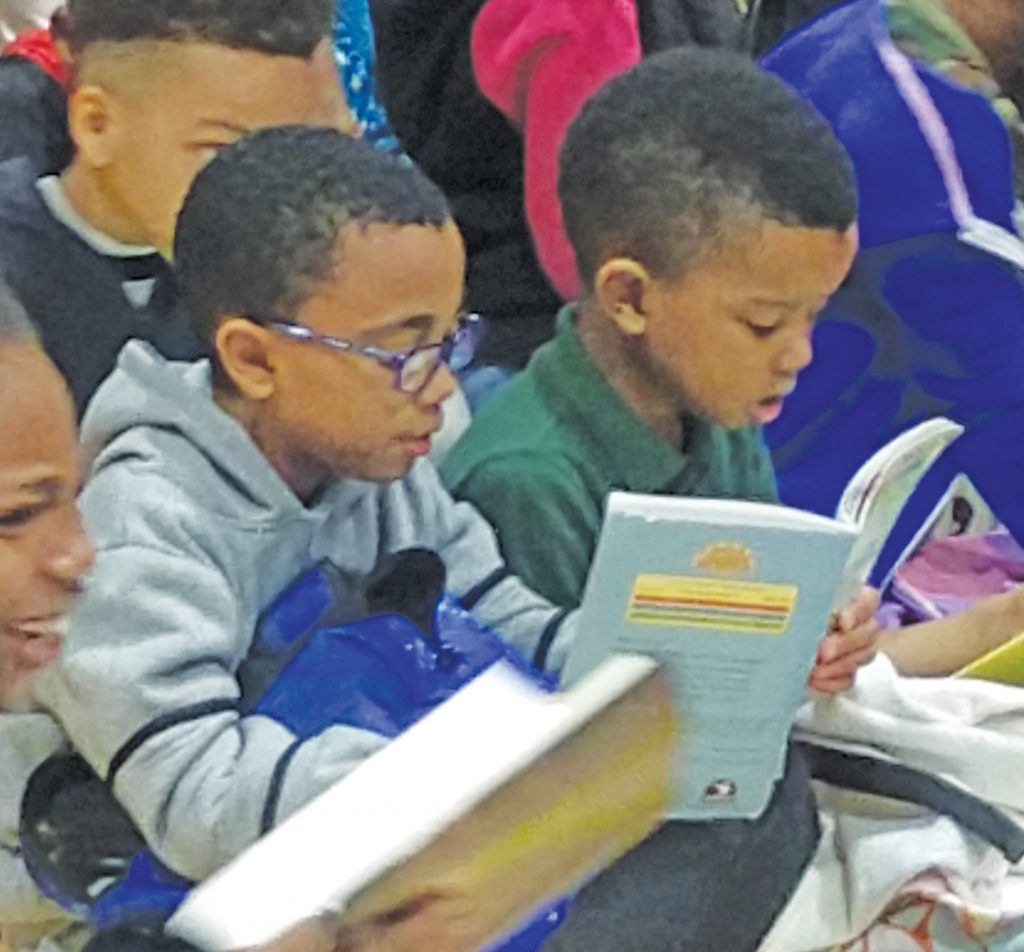
    WINNSBORO – About 250 children and 50 adults attended the Winnsboro Library’s annual read-in held at the Fairfield County Recreation Center on March 29. The program lasted from 9 – 12 a.m. and was followed by lunch.

  • Supers take home top pay, benefits

    COLUMBIA – Public education isn’t the most profitable profession in South Carolina.

    For a select few, however, the field can be quite lucrative.

    In a state where the governor earns $106,078 a year and agency heads like the state superintendent of education make $92,007, many district level school superintendents rake in two to three times that amount.

    That’s the case in Fairfield and Richland counties, where superintendents take home considerably more compensation than state agency heads accountable to 5 million South Carolina residents.

    Throw in generous retirement plans, copious car allowances, travel and other high end perks, and total superintendent annual compensation pushes well past $200,000. For Fairfield Superintendent Dr. J. R. Green, with responsibility for eight schools, it’s in the neighborhood of $225,000. For Richland Two Superintendent Dr. Baron Davis, with the responsibility of 32 schools, the pay and benefits bring in about $260,000.

    And it’s all subsidized with taxpayer money.

    Meantime, teacher pay has continued to lag.

    In 2018, Fairfield County School District teachers averaged $49,288 and Richland Two teachers averaged $51,802, South Carolina district report cards state.

    Teachers’ salaries in both districts fall well short of the national average of $58,950, according to figures from U.S. Department of Education.

    Swelling superintendent pay has become a nationwide trend, with some superintendents being paid close to $400,000, according to a January 2019 report by the American Association of School Administrators, or AASA.

    Salary Rises, Attendance Falls

    “Often times the superintendent is the highest paid member in the community,” Noelle Ellerson, an associate executive director with AASA, said in a video on the group’s website.

    Since 2012, salaries of superintendents in the Midlands have risen considerably faster than student growth.

    Green has seen his base salary climb 23 percent since 2012, rising from $140,000 to $182,287, contract documents show. In the same period, the district’s student population has dropped 15 percent, decreasing from 3,108 to 2,641, according to South Carolina school report cards.

    Richland Two’s student population has increased since 2012, but at a notably slower rate than superintendent salaries, public records show.

    Davis’ starting base pay was $186,312, according to his initial superintendent contract dated July 25, 2016. He now earns $191,904. The pay increase is more than double the Richland Two student enrollment growth of 9.85 percent (25,964 to 28,503) in the same period.

    Davis’ contract says as of July 1, 2018, he was entitled to annual salary increases equal to the “average rate of percentage increase” that the district’s certified employees receive.

    The board awarded him a 2.5 percent increase in September 2018.

    Green is among the highest paid superintendents nationwide for districts of Fairfield’s size, according to the AASA report. His base salary of $182,287 is well above the AASA median of $167,444 for male superintendents in districts with 2,500 to 9,999 students. But Fairfield’s 2,641 student population is near the bottom of that AASA range of student enrollment.

    Green’s pay is closer to the 75th percentile of education chiefs who make at least $193,000, according to the AASA report.

    Davis’ base salary technically falls below the median for large districts based on AASA findings. However, the AASA classifies any district with more than 25,000 students as large, lumping Richland Two, at 28,503 students, with the nation’s largest districts, many of which have between 100,000 and 1 million students. These upper echelon districts pay between $340,000 and $400,000 a year, according to U.S. Department of Education figures.

    According to a March, 2018, report in the New York Daily News, the New York City school district, the nation’s largest, pays its superintendent $353,000, about $100,000 more than Davis is paid. In South Carolina, the state’s largest three districts – Greenville (75,471 students) Charleston (48,937) and Horry (44,669) – are substantially larger than Richland Two and pay their superintendents around $225,000 a year in base pay, according to S.C. Ethics Commission filings.

    Defending Supers’ Pay

    William Frick, chairman of the Fairfield County school board of trustees, said Green is fairly compensated. He said Green brings a long list of qualifications to Fairfield County.

    “[Superintendents] are paid well, but they have a difficult job to do,” Frick said. “They are compensated accordingly.”

    Richland Two board chair Amelia McKie couldn’t be reached for comment about Davis’ compensation package. However, in a Sept. 15, 2018 letter summarizing Davis’ performance, McKie spoke very highly of him.

    “You have done an excellent job developing the District’s culture and creating the expectation that the District and all of our schools will be ‘premier,’” McKie wrote. “You exhibit excellence at all times, and we would like to see all departments throughout the District reflect your commitment to excellence, professionalism and customer service.”

    Evaluating Green

    The board voted on Dec. 18 to extend Green’s contract to 2024. Board member Paula Hartman raised concerns about extending it so far into the future.

    “I really don’t understand the reasoning – not saying there are any objections – but most districts have three-year contracts,” Hartman said. “I don’t understand why we continue to keep it at six years.”

    Frick said prior to hiring Green, the district has had a history of struggling to retain superintendents.

    “I’m happy that we have the opportunity to have an amendment to extend it out one more year. I’m glad we can essentially tie him down for another year,” Frick said.

    Green said he views the board’s extending of his contract as an affirmation of his performance.

    “When the board says it wants to extend my contract, that says you’re interested in having me for the long haul,” Green said.

    The superintendent went on to say that a year ago, he put a letter into his file saying that regardless what the board did, his salary should remain the same.

    “I felt that I was fairly compensated,” Green said. “I wanted the focus at this point to be on salaries of the staff.”

    However, Green’s contract states that he is automatically entitled to salary and benefit increases every time his contract is extended, provided he receives at least a “satisfactory” rating on his performance evaluations.

    The superintendent evaluation form the Fairfield board of trustees currently uses, and which contains only five two-word categories to be evaluated, doesn’t feature “satisfactory” as a rating, but instead uses “needs improvement,” “proficient” and “exemplary.”

    In December 2018, Fairfield board members rated Green as “exemplary” in almost every category. One board member rated Green as proficient in Leadership and Learning Environment, but exemplary in the others.

    “I enjoy working with Dr. Green,” one board member wrote. “We need make it harder [sic], going too good!”

    Green’s raises started at 3 percent in 2013, increased to 4 percent in 2014, and rose to 5 percent in 2015, documents show.

    Green can now receive an automatic 5 percent pay increase every year forward so long as he receives at least a “satisfactory” rating, according to his contract.

    Neither his salary or benefits are tied to student performance, test scores or enrollment.

     R2 Evaluations Mixed

    Davis’ second contract, a three-year contract, took effect July 1, 2017 and expires June 30, 2020. In September 2018, after his most recent annual review, Davis’ contract was extended a year to 2021 to keep it at three years. Davis received generally positive reviews during his evaluation.

    Collectively, the board gave Davis a score of 142 out of 150 possible points, earning him a “distinguished” rating, the highest rating possible.

    Two board members opted to submit individual evaluations.

    Board member James Manning gave Davis a perfect score of 150, according to district documents obtained through the S.C. Freedom of Information Act.

    Board member Lindsay Agostini was more critical.

    Her individual evaluation marked Davis down in several areas, characterizing him as defensive, antagonistic and expressing “difficulty recognizing a problem or concern with constructive criticism,” evaluation forms state.

    One area of defensiveness Agostini raised involved a disagreement over the elimination of keyboarding as a class.

    Agostini also said Davis gave “antagonistic responses” during a bond referendum presentation at an event sponsored by the Bethel-Hanberry Alumni Association.

    “The following day, prior to the start of executive session on August 28, 2018, the superintendent acknowledged and apologized to the board for his actions,” the evaluation stated.

     Benefits Boost Pay

    Superintendent compensation extends well beyond base salary.

    In Fairfield, Green’s original contract called for the district to provide an annual annuity contribution equal to 4 percent of his salary, which in 2012 amounted to $5,600.

    In 2014-2015, the board amended Green’s contract to increase the annuity contribution to 8 percent. Now it automatically increases 2 percent every year the contract remains in effect.

    Today the district pumps $29,165 per year into Green’s annuity, documents state.

    Besides the usual perks of paying for moving expenses, other benefits include $100,000 of term life insurance, free cell phone use and free use of an automobile that’s fully maintained by the district. The invoice for the last full maintenance on his automobile last fall came to $1,800 according to district records.

    The district also pays Green’s car insurance, and he receives two weeks of paid vacation on top of legal holidays and other school holidays. The district also paid for his professional memberships into the AASA, the South Carolina Association of School Administrators (SCASA) and other professional groups and local service clubs.

    In the event the board terminates the contract, Green is entitled to 18 months pay which would currently come to about $275,000.

    R2 Benefits Add Up

    In addition to Davis’ base salary of $192,104, the district makes an annual retirement contribution of $43,261 on Davis’ behalf. The district also pitches in $6,717 in annual annuity payments calculated at a rate of 3.5 percent of his annual salary based on a “satisfactory” evaluation, documents state.

    Davis essentially doesn’t pay for travel. Richland Two covers $18,000 a year in travel payments for Davis, covering commutes to virtually anywhere in the Midlands, essentially backfilling his take home pay with compensation not available to most other employees.

    Davis can also request reimbursement from the district for travel outside the Midlands or out of state if it’s for reasons benefiting the district.

    Other perks include $760 in payments for a $250,000 term life insurance policy and $768 for cell phone use, both funded annually by the district.

    Counting these benefits, Davis’ total compensation is in excess of $261,000.

    Beyond that, Davis receives other perks – 20 vacation days per year, plus legal and other holidays recognized by the district. He’s also entitled to receive pay for unused sick leave, annual leave and vacation days in an amount that’s “consistent with Board policy.”

    In addition, the district pays for Davis’ memberships in the AASA, SCASA, the Rotary Club, “and any other reasonable and customary professional group memberships for which the Superintendent believes is necessary to maintain and improve his professional skills.”

    Davis’ contract has been amended twice.

    In July 2017, his monthly automobile allowance increased by $1,500 a year.

    A year later, Davis’ salary increased to its current figure. His annuity contribution also rose from 1.5 percent to 3.5 percent of his annual salary, and this September it will increase again to 6 percent.

    Salary, Benefits and Ethics

    Documents showing the salaries and compensation of Green and Davis were obtained through S.C. Freedom of Information Act requests.

    In requesting the documents, The Voice asked not only for both superintendents’ salaries, but also their contracts, any amendments, and documents listing total compensation, including retirement benefits, vehicle allowances and other supplemental income backfilling personal expenses a typical person would ordinarily incur.

    Green’s contract has been amended six times in seven years (since 2012), most recently in December 2018. Dr. Davis’ contract has been amended twice during his nearly three-year tenure.

    S.C. superintendent salaries are available for public inspection on the S.C. Ethics Commission’s website.

    State law requires superintendents to file annual Statements of Economic Interest, or SEI, forms. The forms are supposed to document the “source, type, and amount or value of income received from a governmental entity by the filer or a member of the filer’s immediate family,” according to the ethics commission website.

    Citing state law, an ethics commission spokesperson further defined “income” as “anything of value received, which must be reported on a form used by the Internal Revenue Service for the reporting or disclosure of income received by an individual or a business.

    “Income does not, however, include retirement, annuity, pension, IRA, disability, or deferred compensation payments received by the filer or filer’s immediate family member,” the law states.

    Some superintendents are thorough in their filings.

    Burke Royster, the superintendent of Greenville County Schools, and one of the highest paid education chiefs in the state, reported his $247,000 salary and several benefits on his SEI form.

    Other superintendents, however, don’t report their total compensation to the ethics commission.

    On his SEI forms, Green only reported his base salary from year to year. He didn’t list any annuity payments, his district-provided automobile or other perks.

    Davis listed his travel compensation, but nothing relative to retirement payments.
  • Board spat erupts over notification

    WINNSBORO — A dispute over which members of the school board were notified ahead of the surprise presentation of a major teaching award caused tensions to flare at Monday night’s Fairfield County board of trustees meeting.

    Board member Paula Hartman voiced her displeasure that she was not informed in time to attend the surprise announcement – that Fairfield Central High School teacher Chanda Jefferson had been named a state teacher of the year finalist.

    State Superintendent Molly Spearman personally delivered the news to Jefferson during a surprise visit earlier last week.

    A majority of Fairfield school board members were also on hand, posing for photos. Hartman, however, was not there.

    “How was the board notified that Molly Spearman was coming out?” Hartman asked.

    District Superintendent Dr. J.R. Green said he sent a text and an email about a “special announcement” at the school.

    “She [Spearman] wanted it to be a total surprise so nobody knew about it,” Green said.

    “I’ve looked through my emails and I have not seen anything,” Hartman replied. “Can you send a copy that I received it? I’d like to have a copy. To my knowledge, I did not get notified.”

    The S.C. Department of Education routinely distributes news releases in advance of major announcements, such as teacher of the year finalists, though they’re usually embargoed until the event.

    Agency spokesman Ryan Brown said there’s no requirement that school board members receive advance notice about superintendent visits.

    “They are surprise visits and we only notify the district superintendent (for planning purposes) and media,” Brown said via email. “The district superintendent works with the principal to set up the surprise announcement at the school.”

    Green praised Jefferson for her distinction.

    “Ms. Jefferson is an example of the excellent education you can expect here in Fairfield County.”

    In other business, the board received a preliminary report about the status of the current budget.

    Documents included in the agenda packet list a current revenue shortfall of about $3.47 million, largely due to nearly $5.16 million in state funds that haven’t made it into district coffers yet.

    Total expenditures are down about $17.76 million, leaving a net windfall of $14.28 million, documents show.

    Board chairman William Frick cautioned that the budget report is a snapshot of district financials as they stand right now.

    Frick noted that figures will likely change as more revenues and expenditures are accounted for, though he said the district still anticipates a windfall from which teacher sign on bonuses, approved earlier this year, would come from.

    Earlier in the meeting, Frick said the district benefits greatly from the V.C. Summer Nuclear Plant, which provides the district with needed revenue.

    “I’m not sure folks realize how lucky we are in Fairfield County,” Frick said. “We’re not a wealthy community. If not for that facility [V.C. Summer], we would not be able to do it.”

  • FCHS teacher finalist for SC’S Top Teacher

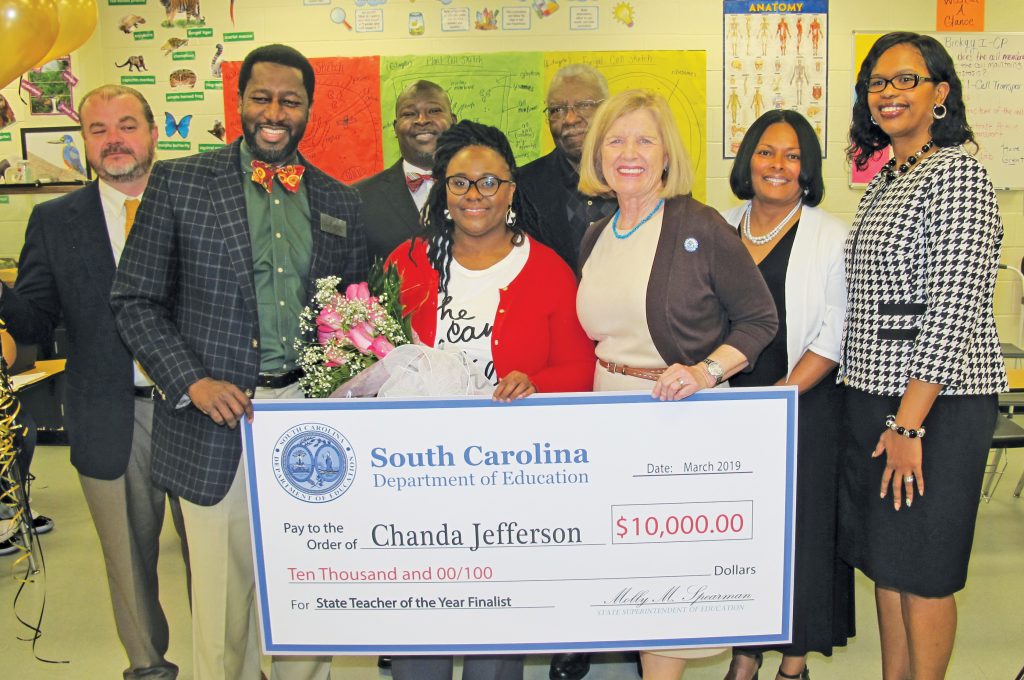
    WINNSBORO – Fairfield Central High School teacher Chanda Jefferson was surprised at her school today when State Superintendent of Education Molly Spearman arrived unexpectedly in Jefferson’s room to announce that she has been selected as one of five finalists for the South Carolina Teacher of the Year award.

    Jefferson was then presented with a bouquet of flowers, another bouquet of balloons and a check for $10,000.

    “Chanda is an exceptional educator who has not only worked to ensure her own students are successful but has also given of her time and energy so that students across our state have high quality Biology opportunities,” Spearman said. “Chanda’s commitment to increasing the rigor in both her classroom and classrooms across South Carolina should be commended.”

    A ninth through twelfth grade Biology teacher at Fairfield Central, Chanda has worked on both the local and state levels to increase student performance of the South Carolina Biology I End-of-Course exam. In 2014, she received the Outstanding Biology Teacher for South Carolina Award presented by the National Association of Biology Teachers. She was one of twenty teachers to receive the Princeton University Fellowship for Teachers and one of three teachers to receive the Amazon Educator Academy Scholarship. Harvard University invited Jefferson to be a guest speaker for the 74th Annual Society of Developmental Biology Conference.

    Outside of the classroom, Jefferson has served as an Education Network Partner for the National Human Genome Research Institute, helping to plan a National DNA Day Celebration in South Carolina.

    Spearman praised Jefferson for catering to each student’s individual learning style and using hands on activities; incorporating social media, scientific modeling, inquiry, and STEM techniques in her lessons.

    Jefferson will next compete for South Carolina Teacher of the Year at the annual Gala, to be held on May 8 in Columbia where the overall winner will be crowned.

  • Seibles takes one-man election

    WINNSBORO – Former Geiger Elementary Principal Joe Seibles was elected to the FCSD board of trustees, representing District 4, on Tuesday. Seibles had no opponents in the race.

    Seibles

    Of the 2,323 voters in District 4, 61 cast votes for Seibles, and there were no write-ins, Director of Voter Registration for Fairfield County Debbie Stidham said.

    Seibles, who spent his entire 36-year teaching career in Fairfield County, fills the seat vacated by longtime board member Annie McDaniels, who was elected to the House of Representatives in November.

    “I ran for the seat because the district needed to be represented by someone who has experience and knows how the district operates,” Seibles said. “I’m looking forward to serving the County’s schools.”

    The vote breakdown for District 4 precincts includes:

    Greenbrier – 24, Jenkinsville – 15, Horeb-Glenn – 5, Monticello – 10 and 7 absentee ballots.

    Stidham said the votes will be certified on Friday.

    “We used two different types of voting equipment from Hart,” Stidham said, “one being a ballot marking system and the other a hand marked system. Both have the paper verifiable rail that the state is looking for.”

    Stidham said the machines are the first two to be tested by the state as they look for voter machines to replace the current machines.