Tag: Fairfield County School Board

  • Chairwoman Chastised in Secret Session

    An executive session during the July 17 meeting of the Fairfield County School Board may have violated the state’s open meetings law and thwarted efforts of one Board member to discuss a recent Atlanta field trip in open session.

    Board member Marchella Pauling (District 6) said she had asked for the Atlanta field trip to be placed on the agenda prior to the meeting. When, arriving shortly after the meeting was under way, she found it had not been included on the agenda, Pauling attempted to amend the agenda to include discussion of the trip.

    Ken Childs, the District’s attorney, advised the Board of a recent Appellate Court decision that states agendas cannot be amended after meetings have begun and Pauling’s efforts were unsuccessful.

    Board member Henry Miller (District 3) suggested the matter be discussed in executive session; however, the S.C. Freedom of Information Act (FOIA) is quite clear on what can and cannot be discussed in executive session.

    “I cannot think of an exemption that allows discussion of a tax-payer funded trip to be held behind closed doors,” said Bill Rogers, executive director of the S.C. Press Association, an advocate for open government. “The exception would be if they were discussing discipline of a student, and they must state this purpose in advance as the reason for the executive session.”

    Board member Beth Reid (District 7) said last week that there was no discussion of student behavior during the closed session. The S.C. FOIA allows for the discussion of personnel issues, legal matters and contractual negotiations in executive session, and states that the specific nature of the discussion must be stated prior to entering into an executive session.

    After the Board had voted to enter into executive session, and before they retired into the closed session, The Voice reminded Board Chairwoman Andrea Harrison that discussion of a field trip was not executive session material under the law.  Harrison affirmed that she was aware of that fact.

    However, according to one Board member who telephoned The Voice the following morning, the Atlanta field trip was discussed in great detail during the Board’s executive session.

    “The Atlanta field trip was discussed in executive session,” Pauling said.

    Pauling’s statement was confirmed by Board member Bobby Cunningham.

    “We hit on it (the field trip) pretty good,” he said.

    According to Pauling, the Atlanta field trip was never approved by the full Board or even brought to the attention of the full Board before the trip was undertaken. Harrison reportedly initiated the June 28-30 trip to the Hilton hotel in downtown Atlanta, which was to attend a conference on school bullying, and selected four Fairfield students to participate.

    Pauling said she wants to know who paid for the trip. There was no money at that time in the high school’s budget for such a trip, Pauling said. Furthermore, Pauling said she wants to know who paid for the rental of the SUV and who approved the use of a District car.

    Sources told The Voice last week that Harrison reportedly sought to obtain a District bus for the trip, but was denied by the Director of Transportation when he learned that the Board had not approved the outing. Harrison said that was not true.

    “It was not that we couldn’t get a bus,” Harrison said, “but that a bus was not cost effective. We only had four students going on the trip.”

    Harrison said the District’s social worker rented an SUV for the trip and Harrison used her District mileage to provide gas.

    Harrison said the high school did not have the necessary funds in its budget to pay for the trip and that she asked Dr. David Eubanks, who was serving as the District’s interim superintendent at the time, “if we could find funding.”

    “It slipped through the cracks about bringing it to the full Board,” Harrison said. “But there was no malice. I think the intent of the executive session was to show that I had not done this with malice.”

    Harrison said she did not know how the trip was ultimately financed.

    “The money may have come out of the Board’s contingency fund. I’m not sure,” Harrison said. “I asked Dr. Eubanks if he could locate funds and I didn’t follow through with any details on it.”

    Dr. Eubanks, however, said he did not recall anyone asking him if money was available for the Atlanta trip.

    “I don’t recall anyone asking me ever if the money was there,” Eubanks said. “Board members do not ask permission of a superintendent to do anything. That’s not just in Fairfield County. That’s across the board.

    “I was aware of the trip,” Eubanks continued, “and I think the subject matter of the trip was very timely. Bullying is a problem. But students were not part of the trip when the original discussion came up. The superintendent’s job is not to police Board members in terms of what they can or should not do.”

    The trip, according to several sources, did not go quite as planned. Two of the students who attended the conference got into an altercation, while one of the female students was caught with a 27-year-old man in her hotel room. After only one day at the conference, Harrison’s party was ready to wrap it up and return to Fairfield. At that time, Board member Danielle Miller (District 2) arrived at the hotel, having acquired a District car for the trip, and tried to convince the group to stay another night.

    The group reportedly returned home in spite of Miller’s efforts.

    “It was a good conference, until the trouble started,” Harrison said.

    Harrison described the altercation between the two students as “hair-pulling,” and said the 27-year-old man was only in the other student’s room for “a few minutes” before being detected and escorted out.

    “All of that was handled,” Harrison said.

    Harrison said the Atlanta police were never involved, but things had gotten to a point that the trip was cut short. On their way out, she said, she saw Danielle Miller for the first time.

    “We got up to leave on Saturday (June 30), and on our way out, Miss Miller was coming in,” Harrison said. “She was supposed to have been there Thursday.”

    Miller said she had been at the conference since Thursday, attending different sessions.

    “I went separately from Miss Harrison,” Miller said. “I was down there as a Board member and didn’t do anything with Miss Harrison’s group. I ran into them Saturday.”

    Miller said Dr. Eubanks approved the use of the District car, which Eubanks confirmed.

    Pauling said she has requested all documentation of the trip. In addition, she said, the matter should have been discussed in open session.

    “This was not an executive session item,” she said, but it appears from District emails that discussion of the field trip in executive session had been predetermined well before the July 17 meeting.

    Just before 3 p.m. on July 13, Pauling sent out an email reiterating her request for the item to be placed on the agenda. This set off a string of emails between Board members between 3:27 and 5:45 p.m. July 13, beginning with Harrison’s denial of Pauling’s request to have the item placed on the agenda.

    “After consulting with (J.R. Green, the District’s new superintendent) in regard to the Atlanta trip, it was agreed that the issue had no direct impact on student achievement, therefore I chose not to place the item on the agenda,” Harrison wrote. “I have advised Mr. Green that it would be in the best interest to provide the documentation in an attempt to answer any questions surrounding the policy and process which was followed. As I have stated, I will be willing to accept any responsibility for any actions which were not in alignment with protocol. If there are any questions that I need to answer or any action that any Board member would like to take against myself after the information has been received, that is your right. Thanks for your understanding.”

    Reid then injected the secret session suggestion.

    “Perhaps that discussion could take place in Exec. Session,” Reid wrote.

    Harrison’s reply appears to indicate a contradiction with what she said she knew was not executive session material July 17.

    “That is certainly fine with me Mrs. Reid, if that is the desire of the Board,” Harrison wrote. “Thanks so much. Have a great weekend.”

    Board member Annie McDaniel (District 4) summed up the conversation in a single sentence: “(I)t appears that we need (a) retreat real soon, so everyone knows their role and which lane to stay in,” McDaniel wrote.

    The emails also appear to contradict what Harrison says now about the closed-door meeting.

    “I was more than willing to discuss the trip in open session,” Harrison said. “Then Mr. Miller said he would like to discuss it in executive session. Probably because it was an assault on me. Maybe it was to protect the image of the Board, because there were some harsh things said.”

    Henry Miller said he felt the need to discuss the matter in secret so that rumors about the trip could be properly dispelled.

    “I wanted to hear it from the person who took the trip,” he said. “It wasn’t secret. I just wanted to know the truth. Sometimes it’s better if you can sit down and ask questions and not have it blow out of proportion.”

    “There were several Board members who were involved in it,” Reid said. “It was an inter-Board discussion on a field trip and we didn’t think it needed to be public.”

    In spite of the emails, Harrison maintains that she would have preferred to have the matter aired out in public.

    “I wish it could have taken place in open session,” she said, “so I could have addressed some of the misconceptions.

    “I cannot wait until November,” Harrison added, “so I can give up this seat (as Chairwoman). Because it is a very hot seat.”

    Although the Board has not asked her to do so, Harrison said she would be willing to reimburse the District for the trip, if necessary.

    “I’m willing to bight that bullet,” Harrison said. “I am willing to take responsibility. I don’t want (the District’s social worker) to get into trouble. She was just trying to do something good for students. I’m not going to let her take the fall for it.”
  • Teen to be Charged in FCHS Summer School Assault

    The Fairfield County Sheriff’s Office said a male juvenile will be charged with assault and battery  after a female student claims she was sexually propositioned and inappropriately touched earlier this month during summer school sessions at Fairfield Central High School. The juvenile in the case is reportedly one of the three young men who pleaded guilty in March following an assault of a sexual nature in a Fairfield Central classroom.

    According to the Sheriff’s Office, a 15-year-old female student was in the Fairfield Central High School cafeteria July 2 when she was approached by three 15-year-old male students, two of whom reportedly offered her $5 to perform a sexual act on them. According to the incident report, the victim said she was hindered from leaving the area by one of the suspects. The Sheriff’s Office said that while none of the male subjects physically restrained the victim, she was sitting at a corner table in the cafeteria and the subjects had her boxed in at the time.

    The victim also stated that one of the male subjects touched her inappropriately on her thigh in her private area, according to the incident report.

    A second female student later told investigators that she was also approached by one of the same 15-year-old male students in the cafeteria at Fairfield Central on July 2 and was also asked by the suspect to perform a sexual act. The second victim did not wish to pursue charges, the Sheriff’s Office said.

    The Sheriff’s Office said Wednesday that charges will been filed against the male juvenile who had actually touched the victim. The 15-year-old will be charged with third-degree assault and battery through the Department of Juvenile Justice (DJJ), the Sheriff’s Office said. The other two juveniles will not be charged.

    The juvenile expected to be charged in the July 2 incident was also involved in a March 12 incident that cost a teacher his job and triggered a civil lawsuit. All three of the juvenile males who later pleaded guilty to the March 12 classroom assault are back in the school system, School Board Chairwoman Andrea Harrison confirmed last week, after serving a suspension and being reassigned to Gordon Odyssey Academy.

    “Of course, we don’t want to have children out of school,” Harrison said. “We do try to follow the Code of Conduct, while at the same time not take children away from a learning atmosphere.”

    The District’s Code of Conduct states that the District “will exercise a zero-tolerance for all Level 3 disciplinary infractions,” which, according to the policy, includes sexual offenses and assault and battery. Action taken for Level 3 offenses includes a referral to administration, contacting parents, suspension pending expulsion hearing and notification of the School Resource Officer and appropriate citation.

    On March 12 a teacher at Fairfield Central High School left his classroom unattended for several minutes, during which time a 14-year-old male student and two 15-year-old male students reportedly assaulted a 14-year-old female student, touching her inappropriately, pulling her shirt down and taking pictures of her exposed body with their cell phone cameras.

    An incident report from the event states that the victim attempted to get away from the suspects, moving from her desk to sit on the floor against the wall. The suspects reportedly followed and physically restrained her on the floor, again pulling her shirt down. One suspect allegedly placed his mouth on the victim’s exposed body while the other suspects reportedly continued touching her inappropriately.

    The suspects were arrested March 14 and charged with first-degree assault and battery.

    All three students went through the legal process, Harrison said, through DJJ. The students pleaded guilty in Family Court in late March and received probation. After serving 10 days of suspension, the students were enrolled in Gordon Odyssey.

    Before reinstatement, the students appeared before the District’s Disciplinary Committee, which consists of Harrison and Board Member Henry Miller.

    “Zero tolerance means zero tolerance,” Harrison said. “It could be that we didn’t enforce zero tolerance. It could be that I didn’t know it was listed as a zero-tolerance issue. It may be something we will have to go back and look at. I won’t say we made a mistake, because our ultimate goal is to make sure our children get an education.”

    Harrison said the Disciplinary Committee has not, in the last year, made reports of their activities to the full Board.

    “The students know who has come before the Committee,” Harrison said, “so, for me, it is a confidentiality issue.”

    Harrison also said that, with a new superintendent installed, she hopes to dissolve the Disciplinary Committee and relegate those issues to a Disciplinary Officer.

    On April 16, the family of the female victim in the March 12 incident filed a lawsuit against the District, claiming that the victim has suffered emotional distress as a result of the assault. The suit claims that the victim returned to school shortly after the incident but was verbally harassed by other students. As a result, the lawsuit states, the victim went on home-bound status. Prior to the assault, the lawsuit notes, the victim had been an honor roll student at Fairfield Central High School.

  • Judge Rules for Chester in Mitford Case

    After more than two years of litigation and nearly $2 million in invoices from the Chester County School District, a Fifth Circuit Court judge handed down a ruling Monday afternoon in what has commonly become known as the “Mitford Case.”

    Judge J. Ernest Kinard ruled Monday in favor of Chester County Schools and against the Fairfield County School District in the two-year battle over who should pay for students living in the Mitford area of Fairfield County and attending schools in the Great Falls area of Chester County. Judge Kinard also authorized the Fairfield County Treasurer to release to Chester County Schools nearly $2 million in funds, for which Chester has invoiced Fairfield since the 2009-2010 school year and which had been held by the Treasurer by order of the Court.

    The lawsuit was brought by the Fairfield County School District in June of 2010 following an act of local legislation providing for the continued funding of the approximately 200 Mitford area students who attend Chester County Schools. The District’s lawsuit claimed the legislation, introduced and passed by Sen. Creighton Coleman and Rep. Boyd Brown in the spring of 2010, was unconstitutional in that it conflicted with general law as set forth by Article III, Section 34 of the S.C. State Constitution.

    In his ruling Judge Kinard noted that Article III “generally prohibits special legislation where a general law can be made to apply,” but also said that “the prohibition of special legislation is not absolute, and special legislation is not unconstitutional where the General Assembly has a logical basis and sound reason for resorting to special legislation.”

    Kinard’s ruling stated that the Fairfield County School District “presented no evidence” that the General Assembly had abused its discretion in enacting this special legislation. The ruling also stated that the General Assembly did, in fact, have “a logical basis and sound reason” for enacting the special law.

    “I think it’s a fair ruling,” Coleman said Tuesday afternoon. “It seems to me that the Fairfield County School District could have come to the table and could have resolved it a lot easier and a lot cheaper for the taxpayers, but they chose to litigate it.”

    The ruling details some of the circumstances that led up to the litigation, particularly that, for several decades between 100 and 200 students living in the Mitford area have attended Chester County Schools and, since at least 1973, the two districts had agreed upon a financial arrangement in order to cover the cost of educating those students. That agreement began breaking down in 2007, the Court document states, and finally ended in the 2009-2010 school year when no agreement was reached. Prior to that time, the Fairfield County School District had transferred $25,000 annually to Chester County Schools to help offset the cost of educating Mitford students.

    The ruling also notes that, on May 21, 2010, Annie McDaniel, then Chairwoman of the Fairfield County School Board, wrote to Sen. Coleman “and made clear (the Fairfield County School District) had no agreement with (Chester County Schools) for payments to educate the Mitford students and that (the Fairfield County School District) ‘does not pay tuition for students desiring to attend schools out of the District’.”

    Because of that stance by the Fairfield County School District, the court document states, the General Assembly enacted special legislation to provide for the Mitford students.

    Kinard’s ruling also stated that, based on Fairfield County’s local per student funding level of $8,875 versus Chester County’s local per student funding level of $3,452, Chester County Schools are “not unduly profiting” from the arrangement and Fairfield County Schools are not being “unreasonably burdened.”

    “(The Fairfield County School District) is actually spending over $5,000 less per student than its per student revenue,” the ruling states.

    Under the Coleman-Brown special legislation, the Chester County School District is to be reimbursed by Fairfield County Schools based on Chester County’s level of local per pupil funding.

    Andrea Harrison, current Chairwoman of the Fairfield County School Board, declined comment on the ruling at press time.

  • Community Turns Out to Meet New Superintendent

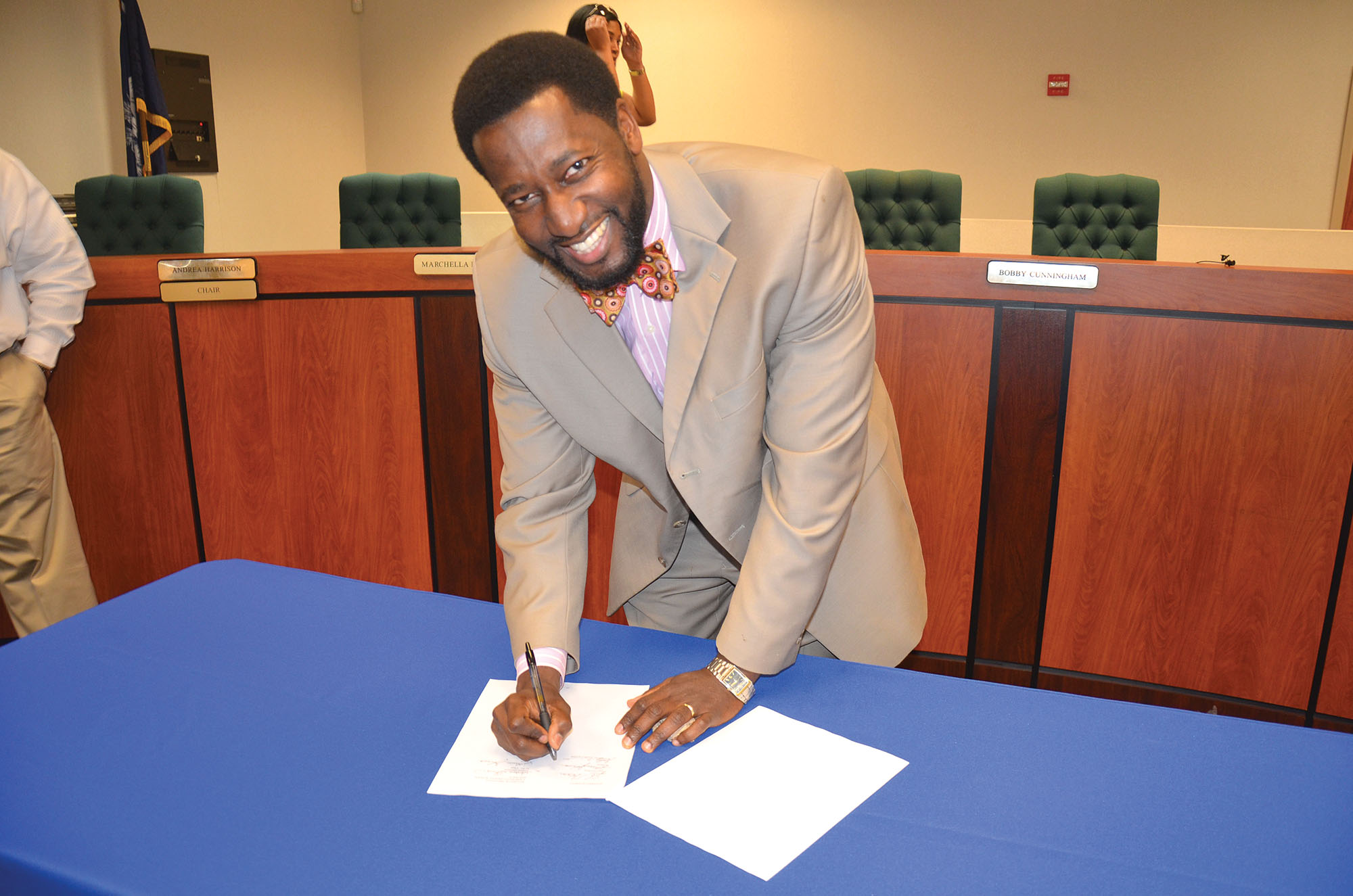
    J.R. Green puts his name on the dotted line at a ceremony held last week at the Fairfield County School District Office.

    After more than seven months of interim leadership, the Fairfield County School District finally has some new blood at the top. Last week, just one day after America celebrated its independence, the District celebrated the arrival of their new superintendent and introduced J.R. Green to the community.

    More than 70 people turned out at the District Office to meet Green and hear his vision of what he hopes the School District can accomplish.

    “He’s a breath of fresh air,” Andrea Harrison, Board Chairwoman, said. “Hopefully, he can help us get things back on track. Now, if we (the School Board) can only do our job and stay out of the way . . .”

    Green shook a lot of hands during the informal meet-and-greet and said he has plans to shake up the culture of a school district that has earned a reputation of being a graveyard for superintendents.

    “My goal is to change that culture,” Green said. “I am committed to being here long-term and forging a new path for the Fairfield County School District.”

    Green said his first goal is to bring the entire community together to educate Fairfield County students.

    “I want to get everyone on board to change the culture and to meet the needs of students in Fairfield County,” Green said. “Everyone will have a part to play – the faith-based community, family, students, teachers – everybody will have to pull together. Through teamwork, and only through teamwork, can we achieve excellence.”

    Green said he plans to increase focus on early childhood education and, in addition to giving increased attention to students who are not performing up to standards, making sure students who are performing at or above grade level are adequately challenged.

    “One of the more frequent complaints I have heard is ‘My child is not being challenged’,” Green said. “We want to evaluate how we are challenging students who are prepared. Too often, we focus all of our attention on students who are not prepared and overlook those who are performing above grade level.”

    Green formally signed his contract with the District July 2. The Board voted 6-1 to authorize the hire June 27. Board member Annie McDaniel cast the lone dissenting vote.

    Green replaces Dr. Patrice Robinson, who was fired by the Board in December of 2011. Robinson was hired by the District in January 2010 and was placed on administrative leave in October of 2011. Dr. Floride Calvert, and later Dr. David E. Eubanks, helped lead the District in the interim.

    Green comes to Fairfield County from the Chesterfield County School District, where he has, since 2008, served as Assistant Superintendent for Curriculum and Instruction. Prior to that, he served a four-year stint as principal of Central High School in Pageland.

    In 2010, nine of the 16 Chesterfield County schools met No Child Left Behind standards. In 2011, the district had no schools rated lower than “Average.”

    During Green’s term at Central High, the school rose from “Unsatisfactory” to “Good” on S.C. Department of Education report cards and met their Annual Yearly Progress (AYP) goals for three consecutive years. The school also earned three consecutive Palmetto Gold Awards and was twice named a Palmetto Finest finalist.

    Green began his career in education as a Business Education teacher, first at Wade Hampton High School in Hampton in 1994 and then at Spring Valley High School, from 1995 to 1996. In 1996, Green was named an assistant administrator at Spring Valley, where he implemented the District Strategy 18, an initiative to increase test scores among black males.

    Green was also an assistant principal at Keenan High School from 1998 to 2004 before moving on to Central High.

    Green earned a B.S. degree in Personnel Management from the University of South Carolina in 1991 and a M.A. in Teaching Business Education from USC in 1994. In 1999, he received his Master’s in Education Administration degree from USC and earned his School Superintendent Certification through the University of the Cumberland’s Williamsburg, Ky. program. Green is currently pursuing a Ph.D. in Education Leadership through USC.

  • Fairfield County School Board names new superintendent

    After a one-hour executive session during a special called meeting June 27, the Fairfield County School Board named J.R. Green as the next superintendent of the Fairfield County School District. The motion to execute a contract with Green passed on a 6-1 vote. Board member Annie McDaniel cast the lone dissenting vote on the hire.

    “It really saddens my heart to see this Board behave in the manner in which it has behaved in negotiating this contract,” McDaniel said after the vote. “It is this kind of stuff that keeps us from getting and keeping a superintendent and moving forward.

    “I am also deeply saddened that we would negotiate two contracts with two individuals at the same time,” McDaniel continued. “We should have resolved one before moving on to the other.”

    Vernie Williams, an attorney for Childs and Halligan, which represents the school district, said there was nothing inappropriate about the way the Board conducted the negotiations.

    “We’ve advised the Board throughout the process and there was nothing illegal or improper about the process,” Williams said.

    Board member Marchella Pauling, while voting in the affirmative, said she was not entirely happy with how the process played out.

    “I am disheartened that our attorneys negotiated the contract (with Green) and not the Board,” Pauling said prior to the vote, “and we negotiated with Mr. (Dennis) Carpenter almost line by line.”

    Carpenter, Deputy Superintendent of Operations at Newton County Schools in Georgia, was one of the three finalists for the Fairfield County top job.

    McDaniel appeared to be hung up about Green’s buyout option in the contract, which had been negotiated down to nine months’ pay.

    “We had decided on eight months,” McDaniel said, “and we gave him nine?”

    Harrison later said that, during the negotiation process, the majority of the Board became more and more comfortable with Green as there appeared to be fewer issues to resolve in his contract than in Carpenter’s. Pauling added that there were seven sticking points in Carpenter’s conditions, while Green only presented the Board with three matters to resolve.

    “He’s a people person and a better fit for our district,” Harrison said after the meeting.

    “He has a good track record as far as curriculum and instruction,” Board member Beth Reid added, “and he has experience as a high school principal.”

    Green has, since 2008, served as Assistant Superintendent for Curriculum and Instruction for the Chesterfield County School District. Prior to that, he served a four-year stint as principal of Central High School in Pageland.

    In 2010, nine of the 16 Chesterfield County schools met No Child Left Behind standards. In 2011, the district had no schools rated lower than “Average.”

    During Green’s term at Central High, the school rose from “Unsatisfactory” to “Good” on S.C. Department of Education report cards and met their Annual Yearly Progress (AYP) goals for three consecutive years. The school also earned three consecutive Palmetto Gold Awards and was twice named a Palmetto Finest finalist.

    Green began his career in education as a Business Education teacher, first at Wade Hampton High School in Hampton in 1994 and then at Spring Valley High School, from 1995 to 1996. In 1996, Green was named an assistant administrator at Spring Valley, where he implemented the District Strategy 18, an initiative to increase test scores among black males.

    Green was also an assistant principal at Keenan High School from 1998 to 2004 before moving on to Central High.

    Green earned a B.S. degree in Personnel Management from the University of South Carolina in 1991 and a M.A. in Teaching Business Education from USC in 1994. In 1999, he received his Master’s in Education Administration degree from USC and earned his School Superintendent Certification through the University of the Cumberland’s Williamsburg, Ky. program. Green is currently pursuing a Ph.D. in Education Leadership through USC.

  • School Board Green-Lights Budget, Contract Negotiations

    The Fairfield County School Board gave the final OK for their 2012-2013 budget of $32,898,265 on a 7-0 vote Tuesday night. The Board avoided a millage increase by taking $109,125 from the fund balance to cover additional expenses for the coming fiscal year.

    An amended version of the motion, which would have required another public hearing after a budgetary review by a new superintendent, failed to garner more than two votes. The motion, put forth by Board member Annie McDaniel, drew only her vote and that of Marchella Pauling, who seconded the motion, in support.

    “This is only so we don’t tie the hands of the new superintendent,” McDaniel said during the discussion, “so he can change what needs to be changed and take the District where he wants it to go.”

    McDaniel repeatedly stressed that she felt there were problems with the new salary scale, which the Board approved as part of the budget last week. She said she also felt the public had not had adequate time to review the budget prior to Tuesday night’s public hearing, something also expressed by Thomas Armstrong, a parent and member of the public in attendance.

    “I would like to ask that the Board table the public hearing until the public can have time to review the budget and ask intelligent questions,” Armstrong said during the hearing. Armstrong said he has requested a copy of the budget for weeks but only received a copy just prior to the hearing.

    The Board did not honor his request to table the hearing, noting that the deadline for the District to present their budget to the County had already, in fact, passed on June 15.

    A new superintendent for the District, meanwhile, remains undecided. After nearly two hours in executive session Tuesday night, the Board voted 6-1 to authorize the District’s attorneys to begin contract negotiations with “one or more of the candidates as discussed in executive session,” Board member Beth Reid stated in her motion.

    Andrea Harrison, Board Chairwoman, voted against the motion.

    Harrison later told The Voice that the discussion had been to negotiate with candidate number one, then move on to number two should those negotiations not come to fruition.

    “I was opposed to candidate number one,” Harrison said. “My decision was my decision.”

  • Tax Plan Rankles School Board

    The concept of a level playing field in funding education in South Carolina may be an idealistic one, but it didn’t go over well with the Fairfield County School Board during their June 5 meeting.

    Scott Price, of the State School Boards Association, and William F. Halligan, of the Columbia law firm Childs and Halligan, presented to the Board an overview of the S.C. Education Finance Restructuring Act, an act that Halligan’s partner, Ken Childs, said was lingering in a skeletal form in a State House committee.

    The plan has no chance of passing this year, Childs said, adding, “If and when it does, the Fairfield County School District will be swimming in money. Literally swimming in it.”

    But that is not how Board members saw it June 5, as they assailed Halligan and Price with questions and concerns about the plans call to phase out local funding of education and distribute tax dollars out of a central state pool.

    “One of our concerns is that this legislation was purposely put together to redistribute V.C. Summer tax dollars that will come into Fairfield County,” Board Chairwoman Andrea Harrison said at the outset of the Price-Halligan presentation. “It may be good for the state overall, but it would, in so many words, hurt Fairfield County if our tax dollars from V.C. Summer were going to plug in the gaps in other portions of the state.”

    “I hope this presentation will assure you that this is not the case,” Halligan said.

    The proposal would equalize state funding, Halligan said, on a per-pupil basis, regardless of where the pupil lives. Fifty-five school districts in the state (60 percent) would get an increase in funding; funding for the remaining districts would stay the same, Halligan said. It would also provide a stable source of funding over time, he said, one that would not fluctuate with the economy. The pool would be distributed based on a formula of weighted pupils per district multiplied by $5,295.

    The state pool would be fed by a taxable base of 100 mills, Halligan said, which would deliver significant property tax relief. The plan would also vanquish the myriad of local legislation laws that govern school districts and their power to tax, giving local school boards the power to assess an 8 percent tax on taxable property. Boards would also have the power to place a referendum before voters, asking for the authority to levy an even higher tax. Should a referendum pass, homesteads would come back into the tax base, Halligan said. Currently, no owner-occupied home pays taxes into education funding in South Carolina.

    The Fairfield County School District, which operates on local funds assessed at 203.1 mills (well above the state average) and receives $7,802 per weighted pupil under the current system, would phase out more than $10.6 million over the next 25 years ($424,858 per year). However, with the new 8 percent tax authority, the Board could bring in an additional $7.7 million each year.

    “How many times have we seen the state do something, grant you harmless money, then in a few years they don’t have enough money and they cut it,” Halligan said. “No plan. Inequitable every time. It hits different districts different ways. This way we have a planned thing that everybody could count on, plan for it, take it into account and have local authority to deal with it.”

    The plan will be introduced next fall, Halligan said. In the meantime, it is still open to input and improvements.

    But some members of the Board, as well as of the audience, smelled a conspiracy to rob Fairfield County of V.C. Summer tax dollars. Currently, the District takes in nearly $13 million in local revenues from the Jenkinsville nuclear facility. That figure is expected to rise dramatically, as two new reactors at the plant come online over the next five years.

    Board member Marchella Pauling specifically asked why no representative of the Fairfield County School District was included in the group putting together the plan. Halligan said the plan has been under construction for several years, and at the time the Fairfield County School District did not have a finance director. However, Halligan said, districts with similar demographics were included, as well as financial information directly from the Fairfield County School District. Price noted that there are 85 school districts in the state, and to have a representative from each one involved in the process was unrealistic.

    “It appears to me like the state is shucking their responsibility, trying to get on the piggy back of folks like us who . . .  we have the problems that a nuclear power plant can multiply, and we’re doing that times three now,” David Ferguson, Chairman of the Fairfield County Council, said from the audience, “and it seems kind of suspicious that the folks in Columbia are jumping to run at Fairfield County – they didn’t jump to run at BMW when BMW was opening, they didn’t jump at Boeing, but all of a sudden, the guys in Columbia are jumping at Fairfield County because we’ve got these new reactors coming.”

    The timing of the plan in relation to the nuclear plant was coincidental, Price said. When BMW came on line, he said, the state didn’t have the funding problems that it has now. And, Halligan reiterated, the Board would still have the power to tax the nuclear plant at up to 8 percent of its assessed value.

  • Finalists to Lead School District Announced

    The Fairfield County School Board announced the three finalists to take the helm as superintendent Tuesday night and said they would formally introduce the candidates to the community Saturday morning at a public forum, beginning at 9:30, at the Fairfield Central High School auditorium.

    The finalist being introduced to the community Saturday are: Dr. Dennis Carpenter, of Ga.; J.R. Green, currently an assistant superintendent in Chesterfield County; and Fairfield County native Donald Kennedy, a consultant in Conn.

    The School District did not comply with numerous requests for biographical information on the finalists, but research by The Voice revealed that Green serves as Assistant Superintendent of Curriculum for the Chesterfield County School District. Carpenter is the Deputy Superintendent for Operations with the Newton County School System, a district of 19,000 students 35 miles east of Atlanta in Covington, Ga. Carpenter has previously served Newton County as Associate Superintendent of Human Resources. No information was available for Kennedy.

  • Board Avoids Tax Increase

    The Fairfield County School Board worked through the final stages of their 2012-2013 budget Tuesday night and avoided a 3 mill tax increase by authorizing administration to take the additional $109,125 in expenditures out of the fund balance.

    “It’s not unusual to use cash to balance a budget, particularly when it’s a small amount of cash,” interim superintendent Dr. David Eubanks said. “I’m optimistic that, as we close out the year, we’ll have over-collections and under-expenditures, so I am confident about your fund balance. If it were a half a million dollars, I’d say don’t do it.”

    The Board also approved the revised salary schedules as part of the budget on a 6-1 vote. Board member Annie McDaniel voted against the salary schedule, which will provide a wage increase for the majority of District employees.

    “This has been a tremendous task, no doubt about it,” Board member Bobby Cunningham said. “We have discussed this many times. We have so many people on the lower echelon of this scale. We are showing these employees who have been sitting here for years and years and years that we are trying to make an improvement in their lifestyles.”

    McDaniel questioned the efficacy of the scale, including the step increases and asked for an example of where a lower-paid employee was actually benefiting from the new scale.

    “A bus driver with zero years’ experience will start out at $11.63,” Eubanks said. “It’s currently $8.79.”

    While McDaniel urged the Board to go through the scale, salary by salary, before approving, Board member Beth Reid moved to approve the administration’s work.

    “I think it’s time to move on with it,” Reid said. “It’s not our job to break it apart. That was their (administration’s) directive.”

    Henry Miller seconded the motion.

  • Winnsboro Man Ejected from Schol Board Meeting

    A Winnsboro man was ejected from a May 29 School Board meeting after his end of an exchange with the interim superintendent, Dr. David Eubanks, grew heated.

    Andrea Harrison, Board Chairwoman, asked Thomas “Tony” Armstrong to calm down or she would have him removed after Armstrong became visibly agitated during a discussion with Eubanks.

    “You don’t have to remove me. I’ll remove myself,” Armstrong said before being escorted from the Board room by a Fairfield County Sheriff’s deputy.

    Armstrong, a mainstay of the public comment session of Fairfield County School Board meetings for many years, addressed the Board earlier that evening on what he said was the “Buddy-buddy system,” which he claimed prevented the hiring of a more experienced Fairfield County native to a principal position at a District elementary school. Instead, he said, someone with connections to a high-level District employee got the job.

    At the end of Armstrong’s comments, Harrison asked Armstrong to provide Eubanks with whatever information he had regarding the hire and that Eubanks would investigate the matter. A review of the video recording of the meeting shows Armstrong approach Dr. Eubanks just as the Board was preparing to retire into executive session. After a brief conversation between the two men, Armstrong began raising his voice.

    “I heard Mr. Armstrong say, ‘We brought you into this District and we can take you out. I’m your boss’,” Harrison told The Voice. “I asked him to calm down or he would be removed.”

    “I told him how I felt as a taxpayer,” Armstrong said later.

    Harrison said she did not know if the Board could prevent Armstrong from speaking at future Board meetings, but she did say the Board would have to monitor what he had to say.

    “If he gets off track or says something that isn’t true, we’ll have to call him on it,” she said.

    As for Dr. Eubanks, he said he had already forgotten about the matter.

    Armstrong took to the podium again June 5, this time to announce his candidacy for the District 6 School Board seat, which is currently held by Marchella Pauling. His announcement was ruled out of order by Harrison at the behest of Board member Beth Reid.