Training Targets Disadvantaged Women, Minorities in Fairfield
WINNSBORO – “We’re looking to provide free training for 10 Fairfield County individuals over 18 who are interested in careers in highway construction,” Larry Salley with the Benedict Allen Community Development Corporation said in his address to Council Monday evening.
“But for the last eight weeks we’ve been working with the County’s WIOA, DSS, the Fatherhood Coalition, the Good Samaritan House and we’ve sent 85 letters to churches, and we have only gotten three applications. We need someone to help us get the word out,” Salley said.
“We are targeting counties with high unemployment rates, and we’re looking for individuals – women and minorities – who traditionally would not be in these kinds of jobs,” Salley said. “We’re looking for current residents of Fairfield County who are economically disadvantaged.
The training is being offered through the Corporation’s Transportation Careers Training Program and will be conducted at the Fairfield Central High School’s adult education facility.
The training, Salley said, consists of three phases:
appointment or pre-employment training (soft skills, resume writing, flagger training, etc.),
commercial driver’s license (CDL) training – permit only and
heavy equipment operator training for bulldozers, back hoes, etc.
Applicants must have a high school diploma or a GED and a valid driver’s license. The training lasts 8 – 9 weeks and, upon the successful completion of the program, Salley said the program’s staff will help the graduates find employment.
“We work with a number of SCDOT contractors to help place our graduates” Salley said.
“We pay for all the training except for the pre-employment drug screening,” Salley said. “We pay for physicals, materials, safety equipment and training.”
Salley said individuals with a criminal history may apply for the program, but applicants must be unemployed or underemployed (part time or temporary).
“We are trying to get the first training classes filled by the second week in May,” Salley said. “So we are really pressed to find at least 25 applicants.”
While Salley said that transportation is a problem for applicants in Fairfield County, County Administrator Jason Taylor offered the County’s transportation system to help get individuals in the program to and from training classes.
Applications can be completed online, however, all submissions must include the requested documentation at the time of application to determine eligibility for the program.
For more information, contact Venus Sabb at 803-705-4631 or via email at venus.sabb@benedict.edu or Salley at 803-705-4682 or email at larry.salley@benedict.edu.
WINNSBORO – It’s called The Hideaway at Lake Wateree.
Situated on the secluded shores of Lake Wateree, 22 miles east of downtown Winnsboro, the 3,513-square-foot Airbnb get-a-way sleeps nine, has over 200 feet of lake frontage, and its own boat dock
“The sun neither rises nor sets facing the front,” a listing on www.zillow.com states. “It’s a very quiet neighborhood. Most nearby homeowners only visit on weekends in the summer.
The home is an idyllic setting for a summer getaway. It’s also the site Fairfield County Council Chairman Neil Robinson has decided on for the county’s annual budget retreat.
Officially, the retreat meeting, which is open to the public, is scheduled for Saturday, April 13, from 10 a.m. – 2 p.m.
However, because the home requires a minimum three-night stay, reserving the home will cost Fairfield County taxpayers about $900 [with a possible $150 refund upon departure]. This prompted protest from at least one council member.
“The County owns plenty of facilities where we could hold whatever meetings we need to at no cost,” Councilman Douglas Pauley said in a prepared statement at Monday night’s council meeting.
“The expenditure of over $900 to rent the house for the weekend, in my opinion, is not a prudent use of our citizens’ money,” he said.
Pauley also worried the retreat’s time and location would make it inaccessible for constituents who may wish to attend. “Meetings like this should be held in locations familiar to the general public and citizens who regularly attend our meetings,” he said. “Holding meetings like this in locations that people aren’t familiar with is a barrier to them attending.”
Robinson said he worked with county administration to find a location that’s affordable and accessible.
He said the intent is to meet in a setting “without a shirt and tie on,” and discuss county business openly in a relaxed setting.
“Sometimes we have writer’s block, so to say,” Robinson said. “Sitting here behind this desk, you may not have the idea at this time.”
Robinson said he’s paying for the food, which consists of a cookout for attending council members. Citizens attending will be on their own for lunch. As for the $900, Robinson didn’t see any issues with the expenditure.
“It is only money council members have not gone to class to educate themselves that we’re using,” Robinson said.
For those attending the meeting, the address is 1253 Westshore Drive (Lot 4-B), Ridgeway.
In other business Monday, council members postponed third reading of an ordinance authorizing a lease agreement between the county and the Community Health Foundation of Fairfield County.
According to a draft ordinance, the foundation would lease some of the former Fairfield Memorial Hospital property from Fairfield County. The county purchased several parcels in 2018.
County Attorney Tommy Morgan said the foundation contacted the county a few hours before Monday’s vote, saying they’d like to include additional provisions in the lease agreement.
Morgan said delaying the vote would give council members more time to review the foundation’s proposed changes.
Provided both sides agree to proposed changes, the lease agreement could come back to the council for a vote later this month.
WINNSBORO – Bertha Goins is used to being in hot water with the Jenkinsville Water Company.
A frequent critic of the organization, the Fairfield County Council vice-chair has called out the JWC on a variety of issues, ranging from finances to transparency.
Goins has also publicly stated she thinks the JWC should be absorbed by a recently formed joint Fairfield County-Town of Winnsboro water authority.
And recently, in interviews in The Voice and The State about JWC’s water woes, she’s taken aim at Jenkinsville water quality.
A JWC attorney is fighting back, challenging her assertions that there’s sediment in the water and issuing a cease and desist order to block Goins from further criticizing the water company.
On March 28, T. Jeff Goodwyn, an attorney with the Goodwyn Law Firm, which represents the JWC, issued the cease and desist letter threatening to sue Goins.
“If you continue to make such false and defamatory statements, I have been instructed to take all legal steps to enforce my client’s rights including filing suit against you, for injunctive relief, slander and defamation seeking all damages allowed by law,” the letter states.
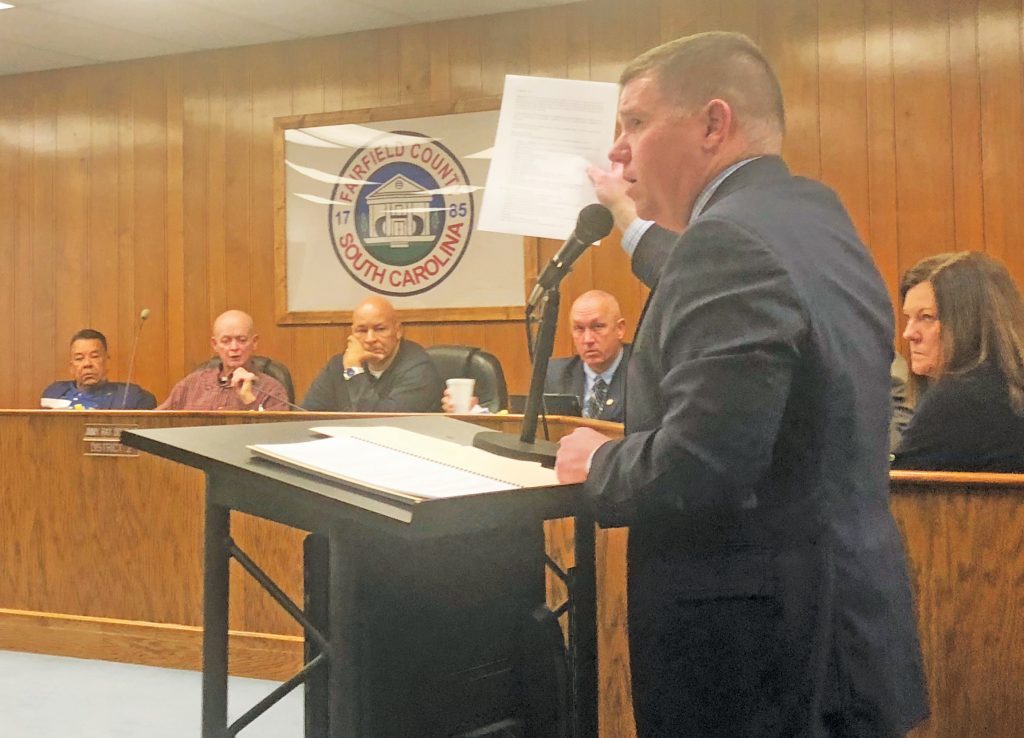
At Monday night’s Fairfield County Council meeting, Goins said the letter is an attempt at intimidation. Speaking via speakerphone, Goins was defiant and doubled down on her criticisms of the JWC.
“I’m going to send a copy of this letter to many people, but I’m going to first send it to the attorney bar association to find out if this is an ethics violation,” Goins said. “Is this a freedom of speech violation to stifle my rights or is it a personal threat?”
Goins went on to say her husband has been ill for two months, and questioned whether Jenkinsville water quality might be to blame. As for the cease and desist letter, she said it only emboldens her.
“I want to thank you because you’ve given me a megaphone,” she said.
Jeff Schafer, a Fairfield County resident speaking during public input at Monday evening’s Council meeting, also questioned the logic of threatening litigation.
“He [Board chairman Greg Ginyard] is an elected official and our elected officials [the JWC board] have a monopoly on the town of Jenkinsville,“ Schafer said. “We all have a constitutional right to free speech.”
Jay Bender, an attorney with the S.C. Press Association, said it’s it illegal to take public bodies like the Jenkinsville Water Company to task over issues of public importance.
“You can criticize a governmental body all you want without being subject to liability,” Bender said.
The JWC has routinely claimed it’s not a public body despite being formed by an act of the state legislature and receiving hundreds of thousands of dollars from the local, state and federal governments.
In a 2010 opinion, S.C. Attorney General asserted that the JWC is a public body. In recent court filings, the Jenkinsivlle Water Authority has claimed that it’s not a public body.
“They’ve been confused for years up there,” Bender said.
The JWC pushback comes following dual investigative reports in The Voice and The State newspapers.
According to public records obtained by The Voice, the JWC was cited three times in a five-year period by the S.C. Department of Health and Environmental Control.
In a letter to its members, the JWC disputed media reports about water quality, saying that Jenkinsville water is among the best in the state.
The letter also pushed back on the recently created joint Fairfield County, Town of Winnsboro water authority.
It accuses government officials of trying to jack up water rates by 100% to 150%, and says further that Jenkinsville will never join the authority.
“JWC has no interest in being absorbed by a bigger water system,“ the letter says. “When smaller water companies are taken over by a larger water system, that historically results in rate increases between 100% and 150%. We are committed to not letting this happen to JWC members.”
County and town officials have never stated any desire to absorb the JWC. The authority’s stated purpose is to enhance infrastructure at the I-77 mega site as a means to attract more major industry.
As for water rates, growing the water authority would actually cause them to decrease, Goins said.
“That is a foolish thing that anybody could say,” Goins said. “The more people involved, the lesser the cost and the better the benefits.”
WINNSBORO – In a series of 4-1 votes, County Council members approved final readings of ordinances that establish a new tourism development fee, a hospitality tax and business registration fee. The ordinance taxes and fees will not go into effect until summer.
Councilman Douglas Pauley voted against all three measures, including amendments that deferred implementation until July 1.
Council members Bertha Goins and Mikel Trapp were absent for the vote.
After the meeting, Pauley said he didn’t oppose implementing the taxes.
However, he felt there was room for more discussion about the ordinances, including attentional impacts on residents and local merchants.
“I just think that there was still a lot of uncertainty,” Pauley said. “I think there were two citizens who came to speak in public input at the last meeting, and they were here again tonight seeking clarification on how the money would be spent.“
The tourism development fee increases by three cents the sales tax on stays at hotels, motels and other lodging in the unincorporated areas of Fairfield County. It will remain in effect for the next 20 years, according to the ordinance.
Money raised by the tax, which functions more like an accommodations tax, can be spent for the following purposes:
Investigating the feasibility of the construction of public meeting facilities
Construction of public meeting facilities
Other enhancements to services used by tourists delegates within or outside the County of Fairfield
The local hospitality fee adds two cents of tax to prepared foods, such as restaurants. It will also last for the next 20 years.
Revenues will be spent on the following purposes:
Tourism related capital projects
The support of tourism and tourist services in a manner that will best serve the tourists from whom it was collected.
Money can also be used “as a funding source to pay indebtedness issued by the County for public purposes,” the ordinance states.
Fairfield County’s business registration fee adds a nominal flat fee of $15 that businesses will pay annually.
The fee’s purpose is mainly one of accountability, giving county leaders a more accurate accounting of who’s doing business in Fairfield.
Residents continued to express mixed feelings about the new taxes and fees at Monday’s meeting.
Fairfield County resident Chris Griffiths thought the county should be doing more to market I-77 as a way to attract industry. He questioned whether there is sufficient workforce to support all of the industry the county is trying to attract.
“I have nobody coming to my business asking for work, even for a minimal, push a broom [job],” he said. “With a hospitality tax, you’re taxing the citizens of the county; you’re not taxing the tourists.”
Ridgeway resident Randy Bright said he agreed there was some lingering confusion over the taxes, but still believed they were needed to help Fairfield County to combat blight.
“In concept I support these ordinances because we have to do things differently in Fairfield County,” Bright said. “Investment through revenue is the way to go.”
Council members have said similar taxes already exist in most other South Carolina counties.
“Fairfield County is one of the very few counties in the state that does not have a hospitality tax,” said Councilman Jimmy Ray Douglas. “We need it because of industry. We are not going to have industry until we get a sewer plant built.“
Councilwoman Bertha Goins, who later joined the meeting via speakerphone, said enhancing water and sewer services is the foundation of improving quality of life and attracting industry. She thinks the new fees will help Fairfield achieve those goals.
“We have to start using what we have now to get to that point,“ Goins said. “It is necessary and it will work if we allow it. New changes are sometimes hard to do but they can be extremely beneficial and they work if we allow them to.“
WINNSBORO – Fairfield County is one meeting away from enacting a pair of tourism-related taxes aimed at growing tourism and combating blight.
Council members voted unanimously Monday night on two ordinances – a 3 percent tourism development fee and a 2 percent hospitality tax.
The council also passed second reading of an ordinance establishing a business registration fee.
Several residents spoke about the new taxes and fees during public participation and public hearings.
Brad Hoffman of Blair raised concerns that the ordinances lacked specificity.
Carol Turner of Mitford also thought the tax ordinances were ambiguous.
“We need details on this. I too am a farmer, trying to make ends meet. We’d like to know just a little bit more about it,” Turner said. “These are issues that are a little bit cloudy. I know the idea is to get folks from outside of our county, but how will this affect people who already live in our county.”
Randy Bright of Ridgeway, a supporter of the taxes, said they are needed to rejuvenate Fairfield County and make it more attractive.
“The diagnosis is in. Fairfield County has been caught up in an epidemic,” Bright said. “Our property taxes have plummeted. County services are strained. Our attractiveness for new business has declined.”
County Council retained the title “tourism development fee” in the 3 percent tax on accommodations, despite confusion over similar fees elsewhere in South Carolina.
Tommy Morgan, county attorney, said several communities including Greenville, Lexington and Charleston counties, refer to their room tax as a tourism fee, even though it’s based on the accommodations tax law.
Fairfield County would be no different, he said.
“It doesn’t mean there’s anything wrong with that,” Morgan said. “That’s just a different way to provide a name for it. It’s trying to develop tourism by that fee.”
In 2009, the City of Myrtle Beach adopted a tourism development fee.
There, an extra 1 percent of tax was added on top of local accommodations taxes. It required a referendum to pass and included a property tax credit for locals as prescribed in state law.
Morgan said the Myrtle Beach fee is unique, applying only to the Grand Strand tourism hub. He said state law was written specifically for Myrtle Beach.
“It requires $14 million in sales taxes [and doesn’t] apply anywhere in the state,” Morgan said. “That’s not an issue that’s before the council today.”
Fairfield County only collected about $37,000 to $38,000 in sales taxes last year, Morgan added.
Some residents also questioned the hospitality tax, which adds 2 cents of tax to prepared foods.
“We need to clarify what we have to charge and why our rates are going up,” Hoffman said.
“I know the idea is to get people traveling thru our county to help fund some of the expenses of our county,” Turner added. “But this is focused on the unincorporated areas. I live at Exit 48, and there are a lot of locals who eat there.”
Third reading could take place as soon as the council’s next meeting, tentatively scheduled for March 25.
The third fee – a business registration fee – imposes a nominal $15 fee per business.
Council members have said the reason for the fee is designed to help get an accurate count on existing businesses while also cracking down on businesses operating illegally.
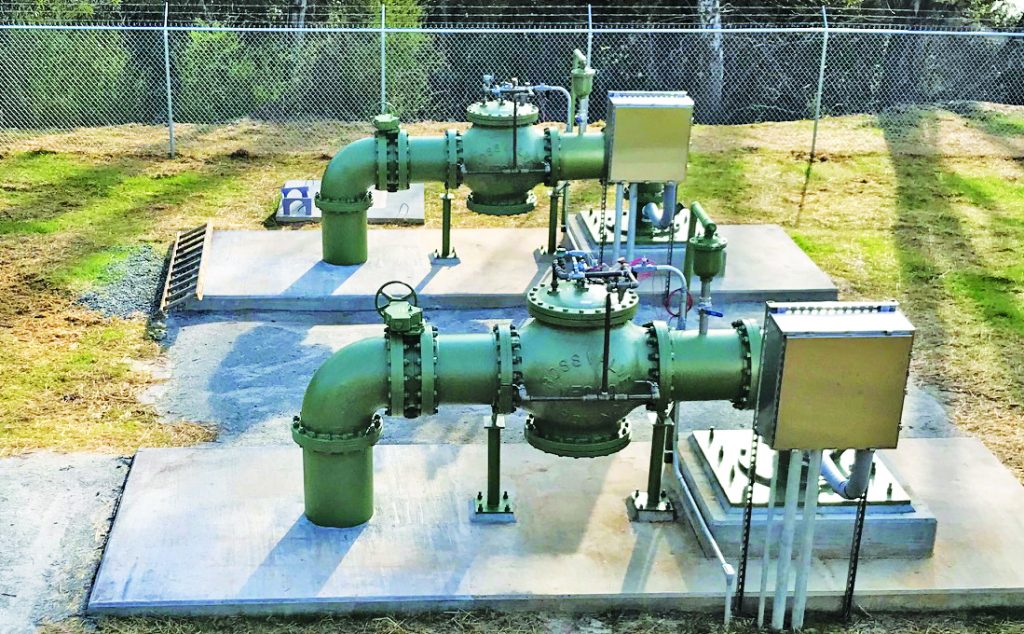
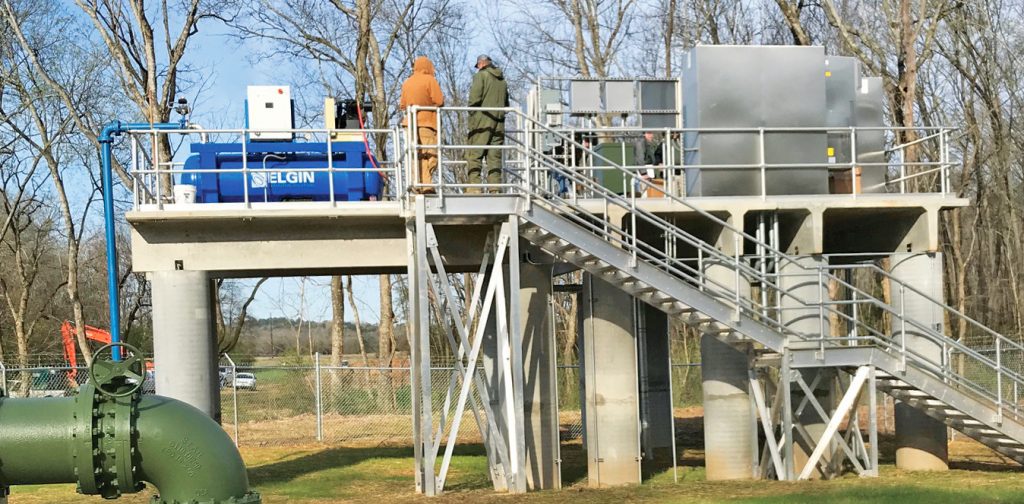
On March 13, the Town of Winnsboro’s new Pump Station on the Broad River was turned on for testing. The Town of Winnsboro funded this approximately $12 million dollar project, encompassing a new raw water intake pipe and construction of this pump station, with a State Revolving Fund State Drinking Water loan through the EPA.
WINNSBORO – Now that the initial paperwork is mostly finished, Fairfield County’s water and sewer plan is flowing closer to completion.
At the second meeting of the Fairfield Joint Water and Sewer Authority on Monday, the group received detailed reports covering everything from environmental impacts, roads to laying water and sewer pipes.
“They’re not in as [bad] shape as I thought,” said Neil Robinson, chair of Fairfield County Council and an authority board member. “They’re still going to need a lot of improvements.”
Formed earlier this year, the authority’s goal is to bolster the county’s water and sewer system, particularly at the mega-site, a 1,113-acre parcel east of I-77 at exit 41 that the county has designated as an industrial hub.
By installing proper infrastructure, Fairfield County and Winnsboro town officials believe it will make the megasite more enticing to industries interested in launching operations here.
The authority predicts flow demand at the megasite to be about 1.11 million gallons per day.
Another 1.09 million gallons per day would be needed to serve the Weyerhaeuser property to the north, totaling 2.2 million gallons per day for both properties, according to engineering estimates.
The Town of Winnsboro, the area’s largest water provider, is currently permitted for 1.6 million gallons per day, but only has an available capacity of about 540,000 gallons, roughly half the projected capacity needs at the megasite.
Prepping the megasite for industry will require a two-step process, officials said.
In the early stages, the Town of Ridgeway would facilitate the construction of temporary water service while an outside party would use a “pump and haul” method to transport wastewater to an outside location for disposal.
DHEC approval would be required for the latter process.
“Initially temporary service is needed for what we call trailer city,” said Lisa Muzekari, also with Thomas & Hutton. “We are going to have a significant amount of workers on site, therefore water and sewer service needs to be provided for those employees while they are on site working.”
Long-term, the Town of Winnsboro would play an integral role in establishing permanent infrastructure, Muzekari said.
Water service would be provided by the Winnsboro water treatment plant. New distribution lines and an elevated water tank would be needed.
The Town of Winnsboro wastewater plant would initially handle sewer services, but only temporarily.
“A future wastewater treatment plant would be needed to accommodate the full build out of the mega site and any other development in the area,” Muzekari said.
While ensuring sufficient infrastructure needed to entice industry is in place, expanding water and sewer also lays the foundation for potential residential growth, Muzekari noted.
“Right now the proposed lines are to serve the megasite,” she said. “But the plant capacity is up to 2 [million gallons per day] with potential for 4 [million gallons per day]. Expanding for 4 [million gallons per day] would allow for that additional development.”
Cost estimates for the proposed upgrades weren’t available, though Muzekari said she’s using a 2 million gallon per day facility as a baseline.
Roads are another component of the megasite infrastructure formula.
The site already benefits from interstate access; it’s located off I-77 between exits 34 and 41. A proposed interchange could improve that access.
Brad Sanderson, also with Thomas & Hutton, said one interchange option is a divergent diamond pattern. The other would be a cloverleaf design, which he said would be built in the vicinity of Old Camden Road.
There haven’t been any glitches from an environmental standpoint. Sanderson said a preliminary review looking at the Weyerhaeuser tract just north of the megasite found no problems with wetlands or negative impacts on protected species.
He also said Thomas & Sutton is continuing with evaluating site work, utility and transportation costs.
“We’re just trying to figure out the overall development cost for a large development at this site,” Sanderson said.
Monday’s meeting also comes on the heels of recent investigative reports about the state of South Carolina’s water system.
Officials at Monday night’s water and sewer authority meeting noted that Winnsboro’s water is of high quality.
County Administrator Jason Taylor said statewide, authorities like the Fairfield group are becoming more common.
“The state itself is pushing hard and heavy to move from small individual systems,” Taylor said. [The state is] “trying to more rationally provide water and sewer services.”
In other business, the authority also voted to continue an agreement with the Pope Flynn Group law firm. Attorney C.D. Rhodes with the firm has been assisting the authority.
Since the authority has yet to collect revenues, the deal approved Monday night continues the existing arrangement in which the county pays 75 percent and the town 25 percent.
“It’s a basic continuation of the arrangement,” said authority chair and Winnsboro Mayor Roger Gaddy.
WINNSBORO – Fairfield County did well managing its finances following the nuclear plant and hospital closings, but faced challenges over rising retirement costs, the county’s annual audit states.
“In our opinion we think the county is in good financial position as of June 30, 2018,” said Brian D’Amico, an auditor with Elliott Davis, at Monday night’s Fairfield County Council meeting.
The 2018 audit found no material weaknesses, though it did list a “significant deficiency,” a less severe rating.
Specifically, the audit said the Fairfield County Family Court and Treasurer’s Office didn’t “perform timely preparation and review of the reconciliation of bank accounts held by the County.”
Fairfield County outsources the preparation of bank account reconciliations to a third party service for some accounts, according to the audit.
But there aren’t any policies to ensure reconciliations are handled in a timely manner, the audit states.
As a result, the county exposes itself to increased “risk of not identifying potential fraud or material errors in a timely manner,” the report continues.
The audit recommends that the county establish a formal policy to review bank statements in a timely manner, and also that it reviews third party services.
“This issue has been discussed with the third party service provider. If improvement is not made, the Clerk of Court will consider changing providers,” the auditor stated.
“Moving forward, the Treasurer’s Office will implement policies and procedures to timely receive and review all bank reconciliations,” the audit continued.
Councilman Jimmy Ray Douglas expressed frustration that copies of the audit hadn’t been circulated sooner to council members.
“I would suggest we get this information before he [the auditor] comes up to speak,” Douglas said. “We haven’t had a chance to look at this information. I would’ve liked to look at it first before he made his talk.”
Council members didn’t discuss the significant deficiency designation during the meeting. Councilman Moses Bell, though, asked D’Amico what the county was doing right and wrong.
D’Amico responded that the county did a great job managing finances after construction ended on nuclear reactors at the VC Summer nuclear plant. He also commended officials for how they handled the closure of Fairfield Memorial Hospital.
Last summer, the county purchased several parcels of the former hospital property for $1.3 million, with an option to acquire the rehabilitation center for an additional $285,000.
The intent was to preserve the properties long enough to find a private buyer willing to purchase them.
On Monday night, council members voted unanimously to approve a sales listing agreement for the properties. County attorney Tommy Morgan said it’s too soon to say when the county would formally list the properties.
In addition to the significant deficiency rating, the county weathered some increased costs and decreased revenues, largely due to escalating retirement costs.
D’Amico said changes in accounting standards in how Other Post Employment Benefits are calculated caused OPEB liabilities to climb from $2 million to nearly $4.9 million.
In addition, net pension liabilities rose from $23.1 million to $25.2 million.
“That number is out of your control,” D’Amico said of the net pension liability. “That number is dictated based on South Carolina retirement system and police officer retirement system, and that is controlled by the legislation of the state.”
Fairfield’s general fund balance also shed $400,000 as of June 30, 2018, falling to $21.5 million. About $13.2 million of that amount is designated as “unassigned,” according to the audit.
“That money can be spent in any way council sees fit,” D’Amico said.
Fairfield currently has enough in reserve to cover about 5 ½ months of expenses. Last year at this time, the county had seven months in reserve funds available, D’Amico said.
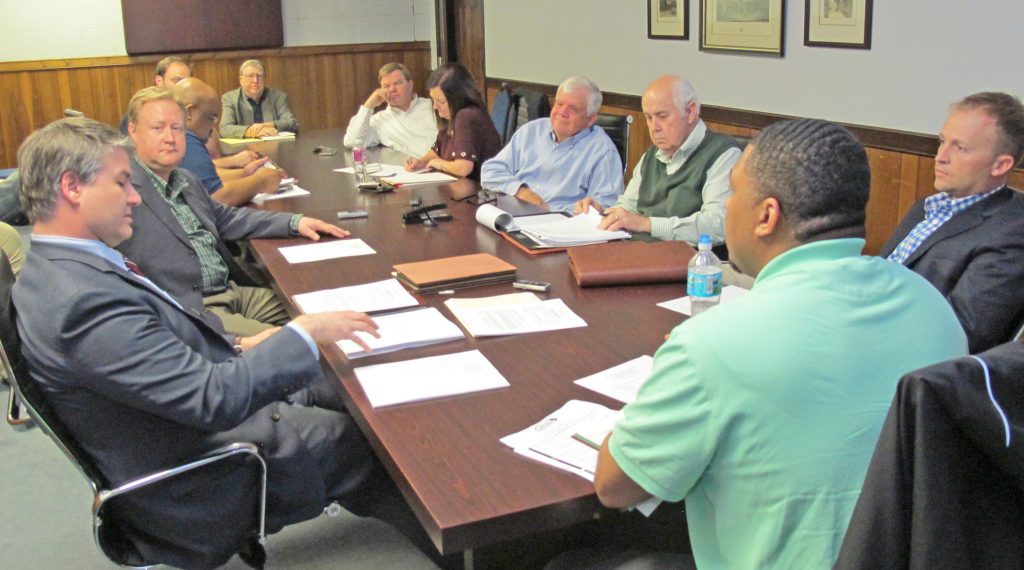
The new board of the county and town’s joint water/sewer authority met during an organizational meeting to elect officers, discuss incorporation and receive an engineering update. Attending the meeting were C. D. Rhodes, III, clockwise left, attorney with Pope Flynn, who represents the new joint water/sewer authority board; County Administrator Jason Taylor; Deputy County Administrator Davis Anderson; Winnsboro Town Attorney John Fantry; County Economic Development Director Ty Davenport, County Clerk Patti Locklair Davis; Mayor Roger Gaddy; Town Manager Don Wood; Fairfield County resident and engineer Kyle T. Crager, senior project manager of water/wastewater operations for Michel Baker International and County Council Chairman Neal Robinson.
WINNSBORO – Fairfield County is gathering all the trappings to lure big industry and with it, more jobs.
It has interstate access, a megasite roughly equidistant between Columbia and Charlotte and a $2 million state grant targeting infrastructure for that site.
Now the county and town have created a joint water authority – the Fairfield Joint Water and Sewer System – whose mission it is to facilitate infrastructure growth at the I-77 megasite.
“I’m excited because it just shows growth for the town and the county,” said Fairfield County Council Chairman Neil Robinson. “I was told we were delusional just thinking about this, but I think we’re on the right path.”
Appointments of a five-member board were made Monday night and board officers were elected. Plans are to meet monthly, with the next meeting scheduled for March 20.
Winnsboro Mayor Roger Gaddy was named the Authority’s board chairman and Robinson was named vice-chair. Other members include Fairfield County Administrator Jason Taylor (treasurer), Winnsboro Town Manager Don Wood and Fairfield County resident and engineer Kyle Crager, senior project manager of water/wastewater operations for Michel Baker International.
“We have to address water and sewer issues if we’re going to grow,” Taylor said. “Without water and sewer the county cannot realize its full potential.”
Talk of forming a water authority has occurred on and off for the past four years, but gained steam in the past year.
The S.C. Department of Commerce recently pumped $2 million into the megasite, seed money that will fund an engineering study with the ultimate goal of building a wastewater facility at the I-77 megasite.
To that end, the state requested that an authority be formed.
Moving forward, the authority said a critical first step involves mapping out existing infrastructure in the county. The board tentatively plans to review those plans at the next meeting.
“I think it would be important to see all the plans that have been done on the sewer and at the same time work on the water so we’re all up to speed,” Gaddy said. “I think it’s important for us to all be on the same page and prioritize things.”
Taylor suggested reaching out to other water providers as the authority’s work moves forward.
Taylor said at this point, merely mapping the size and location of current water and sewer lines is a prerequisite in developing infrastructure at the megasite.
“With all of these little fractured systems, it’s not necessarily a rational way to provide infrastructure to the county,” Taylor said. “We’re going to start approaching other providers of water and sewer and see if there’s an opportunity to work with them.
WINNSBORO – New taxes and fees aimed at sprucing up Fairfield County’s tourism and business image received unanimous support at Monday night’s county council meeting.
Council members approved 5-0 the first reading of three draft ordinances which if approved, would institute a tourism development fee, a hospitality fee and a business registration fee.
Council members Bertha Goins and Mikel Trapp were absent for the vote. Two more readings are required before the fees take effect.
“If you don’t have an attractive town, if you don’t have an attractive community, it is hard to attract tourists,” County Administrator Jason Taylor said.
Tourism Development Fee
If enacted, the tourism development fee would add a three-cent tax on hotels, motels and lodging.
Fairfield County attorney Tommy Morgan said funds could be used for a variety of purposes, including promoting the arts, music, farmer’s markets, agro-business tours and construction of facilities used in tourism.
“Some parts of the state have used it for waterfront erosion [control],” he said. “They can use it in a lot of different ways.”
Asked later about the tourism development fee, Morgan said the county’s proposed fee is more accurately defined as a local accommodations tax.
“The Council may wish to change the title of the Ordinance to reference ‘accommodation tax’ instead of ‘tourism development fee’ in order to minimize any future confusion,” he said.
Hospitality Fee
The hospitality fee would add two cents on prepared meals and beverages in the county.
Funds would be spent on “improving services and facilities for tourists,” according to the ordinance. Examples include everything from advertising and promoting tourism to building and upgrading roads used by tourists or for tourism-related purposes.
Business Registration Fee
Fairfield County is also looking at a $15 flat fee that would be levied to businesses operating in the unincorporated areas of Fairfield County. Municipal businesses would not pay the fee. The fee is not designed to be a major revenue generator.
Rather, it’s designed to make it easier for the county to identify and regulate existing businesses, and also police illegal business activity, Morgan said.
Infrastructure tax update
The three fees are separate from county plans to pursue a local option sales tax to help fund infrastructure.
Unlike the three county fees, which only require two more council readings, the local option sales tax would require approval in a voter referendum.
Taylor said the proposed tax is still several months away.
“What we are looking at are targeted taxes to invest in the county as far as water and sewer services,” Jason Taylor said. “That could fund crucially needed, critically needed water and sewer infrastructure, which would support future growth.”
Fairfield County is primarily focused on the mega site off I-77, which lacks sufficient sewer capacity. The county was recently awarded a $2 million grant from the state to help, but several more millions are needed.
Taylor said the county isn’t looking at increasing property taxes.
“Without water and sewer we cannot have future growth,” Taylor said. “That’s just foundational infrastructure.”
At the Feb. 11 meeting, Councilman Jimmy Ray Douglas proposed re-evaluating state tax breaks awarded to properties classified for agricultural use.
In South Carolina, agricultural real property is taxed at 4 percent of its fair market value. Non-agricultural property is taxed at 6 percent.
“I have ag land that I own and I’m paying next to nothing,” he said. “Everyone else who has less than five acres is paying a lot more taxes. I feel like every acre in Fairfield County needs to have an extra dollar in taxes on it.”
Taylor said Douglas’ idea has potential, but he also said it presents legal challenges that must first be ironed out.
WINNSBORO – Fairfield County leaders say that a proposed business registration fee is about getting a more accurate count of businesses operating in the unincorporated areas of Fairfield County.
“It’s not based on the revenue of the business. It’s not based upon the sales, income or number of employees, whether you have one employee or 5,000 employees,” county attorney Tommy Morgan said during an Administration and Finance Committee meeting Monday.
“Now you know what businesses are doing what in the unincorporated parts of the county,” he said.
Later, council members voted 5-0 for first reading by title only of the business registration fee. Council members Mikel Trapp and Bertha Goins were absent.
Two more readings are required for passage.
The proposal was among several fees the county is considering. Unlike the others, which consist of various sales taxes or fees, the business registration fee would institute a flat $15 fee per business.
“It’s not a business license fee, it’s a business registration fee,” Morgan said, noting business licenses have more administrative requirements and usually more costly than registration fees.
Council members voiced support for the business fee.
Councilman Douglas Pauley said the fee would help the county to eliminate blight. He also proposed charging transient businesses, such as food trucks, a higher fee as a means of promoting local businesses.
“It is not about making money,” Pauley said. “This information can greatly help us market ourselves, market our businesses and can also come into consideration for grants and other opportunities for assistance,” Pauley said.
Council chairman Neil Robinson agreed.
“It’s definitely a regulation that we need,” Robinson said. “We don’t have a count of businesses that we have [operating] now. It would help with the clean up of blight. Blight is a big issue in this county.”
Two members of the public addressed the fee during public input, each expressing opposing viewpoints.
Jeff Schaffer thought the fee should be a referendum decided by voters.
“Whose bright idea was it to have this ordinance put on the books and have the taxpayers implement this. Who thought of this?” Schaffer asked. “Why is this so damned important to get this on the books? Ultimately where will this lead us?”
Randy Bright of Ridgeway backed the fee, but cautioned council members not to exceed $15.
“Blight is holding us back. Blight is holding us back from getting new residents and new industry. Let’s make a good first impression and move forward,” Bright said. “Let’s make this a prudent investment, not a blind investment. The $15 is no big deal.”
 Formed earlier this year, the authority’s goal is to bolster the county’s water and sewer system, particularly at the mega-site, a 1,113-acre parcel east of I-77 at exit 41 that the county has designated as an industrial hub.