RIDGEWAY – The town council of Ridgeway learned last week that it must pay a lease fee to access the town’s own Cotton Yard it purchased earlier this year, essentially making its purchase and control over the property a hollow accomplishment.
According to information presented during the town council meeting on Nov. 8, the town received an invoice from Norfolk Southern Railroad in the amount of $320. Mayor Heath Cookendorfer told council that upon his request for further explanation of the invoice, he was told that the town is being required to enter into a leasing agreement with the railroad every year from now on to gain access to the Cotton Yard which the town purchased in May at the price of $80,000.
Whether attorney Kathleen McDaniels, who handled the closing on the property for the Town, knew at the time of the purchase that the easement was not included in the property purchase is now a hot subject of inquiry for the town.
“This is a situation where we kind of all inherited this issue, so at this point in time I am going to go to the next level to find out why this information was not a part of the (purchase) discussion,” Cookendorfer stated Thursday night.
The purchase of the .6 acre cotton yard property was a process begun in 2014 by former mayor Charlene Herring. For decades, the town was allowed unrestricted use of the cotton yard, but in 2014, Herring began corresponding with Norfolk Southern about the limitations of its use – without the approval of town council.
Through the course of 2014 through 2016, Herring contacted the railroad directly regarding a sod truck and several ‘for sale’ vehicles that parked on the property. All contact made by Herring was done against the advice of council, actions that were repeatedly condemned by the panel.
Because one such user of the property was Rufus Jones, a former political opponent of Herring’s, some openly questioned the motives of Herring’s contact with the railroad. Herring, however, said at the time that she had received questions from members of the community about the vehicles parking on the lot.
Despite warnings from then-council member Cookendorfer and others on council that Herring was “poking a sleeping giant” by making repeated contact with the railroad about the property, Herring continued.
In 2016, railroad officials responded to the town with an ultimatum; purchase or get off the property. Norfolk Southern threatened to install a fence to ensure the town could not utilize the property without purchasing it.
With only three votes from the five-member council in favor of the motion, Herring pushed forward with the purchase just weeks before the election for a new mayor.
The total cost of the property included approximately $20,000 in survey costs and legal fees which were paid by the town to McDaniels to close the deal. Cookendorfer told the Voice that his office will be drafting a letter to send to McDaniels for clarification on the purchase details.
In addition, the town has yet to receive the deed to the property, something that McDaniels had said the council would have further information on within 30 days after closing in June. Cookendorfer said his letter to McDaniels would request information on both issues.
RIDGEWAY – Mayor Heath Cookendorfer called a special council meeting Monday evening to put the Cotton Yard purchase to bed – to either move forward to purchase it or to back out of the purchase.
Cookendorfer said he wanted both residents and Council members to have the chance to speak their minds in public about the pending purchase from Norfolk Southern. Two members of the audience, Tina Johnson and Vicki Maass, spoke in favor of the purchase. Council members then had their turns.
“The Cotton Yard is the center of our town and is an asset,” Councilman Dan Martin said. “Nobody likes the price, but my feeling is that if we pull out now, we’re going to lose $15,000 up front,” Martin said. “It would be good to have control of it. That’s my thinking.”
“No doubt we need to buy it,” Councilman Rufus Jones agreed, but with a caveat. “I hate to be forced to buy it and that’s what we have to do because of the last administration. We used it for years for free, and they kept messing with the railroad till they got ticked off and I don’t think we have a choice but to buy it. The amount is ridiculous, but I don’t see where we have a choice,” Jones said.
“I voted against it in the previous administration, and I vote against it now,” Councilman Don Prioleau said. “I felt $73,000 plus all the other fees was too much. As Councilman Jones said, we always used this property at no cost. I voted against it, and today I vote against it.”
Councilwoman Angela Harrison passed on speaking, and Cookendorfer took his turn.
“As part of the previous administration, I thought the first price was a fair, economical decision,” Cookendorfer said. “Then we got the second one and I was against that. But I’ve also been one to say I hate losing money. At this point, we’ve spent $15,000 on the earnest money, the survey, legal fees and phase one of the environmental study. The Cotton Yard is a big part of our downtown, so I agree that we need to move forward with the purchase.”
Jones said he would like to see the fire station and police station on the property renovated for use as spaces for merchants.
“Maybe we could get a grant to help pay for it,” Jones said.
“So am I to understand that there have been discussions about what to do with the buildings in the Cotton Yard that I’ve not been privy to?” Harrison asked.
“I’ve mentioned in open session that I would like to see something go there as rental space,” Cookendorfer said. “I’ve been more than forthcoming that that is something I would like to see.”
“In the past we did discuss buying the property under the buildings. Just a discussion. We talked about taking the space next to the (old) post office and making that into public restrooms…” Prioleau said before Harrison interrupted.
“Well that’s not what’s up for discussion tonight and it wasn’t on the agenda for discussion…”
“We’re just discussing buying the property and what we’ll do with it if we buy it…,” Prioleau said.
After further discussion about boundaries of the Cotton Yard and the railroad’s 65-foot right of way,
Cookendorfer closed in on the purchase.
“It sounds like Council would like to move forward except for Councilman Prioleau,” Cookendorfer said. Council agreed that the mayor would contact the Town’s attorney for the contract and move forward with the closing on June 22.
Following the meeting, Cookendorfer said he would like to see the former Just Around the Corner consignment shop (behind Olde Town Hall Restaurant) renovated for use as public restrooms.
“I think that would be helpful to the merchants and a good use for the building,” Cookendorfer said. “It’s all about funding. That’s where we stand now.”
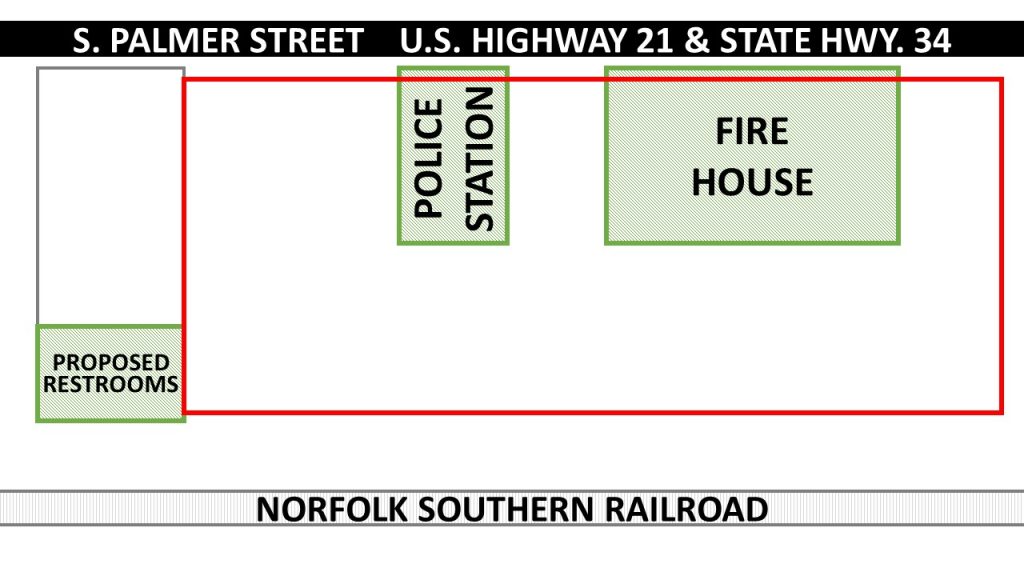
The property inside the red line is the .65 acres the Ridgeway Town Council is purchasing from Norfolk Southern Railroad.
RIDGEWAY – After a controversial 3-1 vote by the Ridgeway Town Council on Dec. 14, 2017 to purchase the Cotton Yard from Norfolk-Southern Railroad for $73,000 plus an estimated $11,000 for associated costs, that vote is now under the microscope with the possibility of being rescinded.
That possibility was raised at the Jan. 11 council meeting when Mayor Charlene Herring called for approval of the Dec. 14 meeting minutes. Councilman Heath Cookendorfer, citing a potential economic interest on the part of Herring when she voted for the Cotton Yard purchase, called for those minutes to be tabled and for the Dec. 14 Cotton Yard vote to be rescinded and re-discussed at the Feb. 8 meeting. Herring’s vote was one of the majority three votes for the purchase.
Cookendorfer, who voted against the purchase, said Herring’s home, The Ivy Veranda, which is directly across the street from the Cotton Yard, was registered as an event business with the S.C. Secretary of State in June, 2017. He made the argument that Herring’s event business depends on the Cotton Yard for parking, thus giving Herring an economic interest in the vote.
As he began his presentation to Council last week, Cookendorfer said he had contacted [Steve] Hamm, an attorney with the South Carolina Ethics Commission, who, “confirmed that, based on the information I provided him, that the motion [to approve the Cotton Yard purchase] included a vote that violated S.C. law, Section 8-13-700 which talks about someone voting that has a potential economic interest. Section A & B talks about a…”
Councilwoman Angela Harrison interrupted Cookendorfer, asking for a copy of the document.
Cookendorfer said he would give her one.
“Can I ask, what’s the conflict of interest?” Harrison asked, again interrupting.
“I’m getting ready to…” Cookendorfer said before being interrupted by Harrison a third time.
“Who has a conflict of interest?” Harrison demanded.
“I’m sorry, we’re…”
Harrison and Herring began talking over Cookendorfer.
“I’m getting ready to tell you…” Cookendorfer continued before being interrupted again.
“Well, we don’t need you to. I can read, so…” Harrison countered.
“Anyone who has a business can park there,” Herring interrupted.
“Right,” Cookendorf said. “If I can get through this, I’ll be more than happy to answer any questions. Mr. Hamm asked me if the mayor had parking space for her business,” Cookendorfer said. “The answer was ‘No.’
“Yes, I do,” Herring interrupted.
“Do you have spaces for 40-50 cars?” Cookendorfer asked.
“Probably not 40-50,” Herring said.
Cookendorfer read from documents that he said were submitted to Hamm who, Cookendorfer noted, is a close friend of Herring’s. Herring acknowledged that he is.
Those documents contained two pieces of information Cookendorfer said supported his claim that Herring had an economic interest in the Cotton Yard vote:
1) an event advertisement from the Ivy Veranda Facebook page stating that, “Plenty of parking is available in the adjacent Cotton Yard,” and
2) a copy of a statement that Herring submitted to Council on Dec. 8, 2016, recusing herself from voting on an ordinance to rent portable restrooms for the Cotton Yard for a special town event, in which she cited her economic interest.
That recusal stated, in part, “I, Charlene Herring, Mayor of Ridgeway, recuse myself from voting because of conflict of interest. My husband and I are members of the Merchants Association.”
Cookendorfer said the Dec. 8, 2016 recusal set a precedent for Herring to recuse herself on the Dec. 14, 2017 Cotton Yard vote.
A brochure advertising The Ivy Veranda states that it is the “ideal place to host your intimate Southern style wedding reception.”
“He [Hamm] asked, ‘By purchasing that land, will it be used for her business and other businesses?‘ I said, ‘Yes.’”
“He then asked if anyone parks [in the Cotton Yard] currently. I said, ‘Yes,’” Cookendorf said.
“If Ridgeway ever decides to discontinue its [Cotton Yard] leasing agreement, then that could potentially affect parking spaces available for your business,” Cookendorfer said to Herring. “So, because it could affect parking for your business, it could affect your business,” Cokendorfer said. “This means there’s an economic interest.”
Cookendorfer said Hamm referred to S.C. Statute, Sec. 8-13-700 which states:
(A) No public official…may knowingly use his official office…to obtain an economic interest for himself, a family member, an individual with whom he is associated or a business with which he is associated.
(B) No public official…may make, participate in making or in any way attempt to use his office…to influence a governmental decision in which he…is associated, or a business with which he is associated has an economic interest.
The statute continues with step–by-step details of how a public official with an economic interest should recuse him/herself.
“Again, this is something that he [Hamm] concluded from the same information I’m handing you. He [Hamm] recommends that we rescind the vote and bring it back up for discussion. You’re welcome to talk to him,” Cookendorf said. “We can ask Mr. Hamm for a written recommendation. In the meantime, we can talk about this in open session.”
“We’re not going to have this discussion, ok?” Harrison snapped. “The discussion will be, let’s call our attorney. We have legal advice for a reason, so let’s just take it from here. We don’t need to rescind the motion,” Harrison repeated.
“We don’t need that parking,” Herring interrupted, “and I can take that out [of the advertising].”
“So you’re going to leave the motion and contact our attorney?” Cookendorf asked.
“Yes,” Harrison snapped again. “They’ll understand it.”
While Harrison, Herring and Porter fought on against tabling the Dec. 14 meeting minutes, in the end, Councilman Donald Prioleau made a motion to table them until the Feb. 8 meeting, and Council voted 5-0 to do so.
Harrison added, however, that she wanted to correct a line in the Dec. 14, 2017 minutes from, “Councilman Prioleau left for an emergency…” to “Councilman Prioleau ‘said’ (Harrison’s emphasis) he left for an emergency.”
Following the meeting, The Voice asked Herring if she had already signed the Cotton Yard contract, as authorized by Council on Dec. 14.
“Some of us have,” Herring answered after thinking about it for a few seconds.
However, contacted by email and phone, the other four council members, Harrison, Cookendorfer, Prioleau and Doug Porter told The Voice that none of them had signed the contract. That only the mayor was authorized to sign it.
The Voice emailed Herring last week, asking if she planned to contact the Ethics Commission about whether her business constituted an economic interest in the Cotton Yard vote or to only contact the Town government’s attorney for advice about the issue. At press time, Herring had not answered the email.
RIDGEWAY – Town Council will will hold a public hearing and take a final vote Thursday night to amend the budget for the 2017-2018 fiscal year by 30.46 percent.
The Town’s current revenue will be amended from $744,200 to $970,900. However, the difference of $226,700 is not newly generated revenue, administrative consultant David Hudspeth told The Voice on Tuesday.
“This money is currently in the Town’s bank account, but not allocated in the budget,” Hudspeth said. The transfer was necessary, he said, to put it into the Town’s budget so it could be used.
Much of this additional revenue comes from the Town’s savings account. At the Dec. 14 meeting, Hudspeth recommended cashing in the Town’s CD’s and moving the proceeds into the general fund.
While Ridgeway Town Council voted 3-1 last month to purchase the Cotton Yard for $73,000 +, Councilman Donald Prioleau told The Voice afterward that, had he been present for the vote, he would have joined Councilman Heath Cookendorfer in voting against the purchase.
Prioleau said because of a prior commitment he had to leave the meeting before the executive session and had not thought the issue would come up for a vote that night since it was only on the agenda for executive session.
“I don’t think we need to be spending that kind of money right now,” Prioleau said. “And when we spend that kind of money, we need to give the public better notice. I understand that there has since been talk that the Pig on the Ridge steering committee is all for this and is considering throwing a lot of money into it, but that’s not exactly correct,” Prioleau said. “We said we would be interested in helping out on a depot-style building with an outdoor platform and maybe room inside for community gatherings, but the library thing came up much later. The only sketch I’ve seen of a library is not a depot-style building. And I am not interested in that,” Prioleau said.
“I also want to weigh in on the library location,” Prioleau added. “I’m all for a new library but as much as we need merchant space downtown and as congested as Palmer Street already is, we need to think about moving the library next to the park and ball field. A lot of children use the library and that would be a better location, near the park and it would not take up merchant shopping and parking space.”
Another member of the POR steering committee, Tom Connor, agreed that the park would probably be a better location for the library.
“I think the steering committee is most interested in a depot style building and also we would like to see a nice clock built in the downtown, in the Cotton Yard area,” Connor said.
The next Town Council meeting is set for Thursday, Jan. 11.
RIDGEWAY – Following executive session at the Dec. 14, 2017, Town Council meeting, Ridgeway Council voted 3-1 to purchase the Cotton Yard property from Norfolk Southern Railroad for the contracted price of $73,000. However, that price does not include surveying, attorneys’ fees and other fees that could bring the total cost of the property closer to $90,000, a source with knowledge of the transaction told The Voice.
Councilman Cookendorfer voted against the purchase, and Councilman Donald Prioleau left the meeting prior to the vote. Mayor Charlene Herring, Councilwoman Angela Harrison and Councilman Doug Porter voted for the purchase.
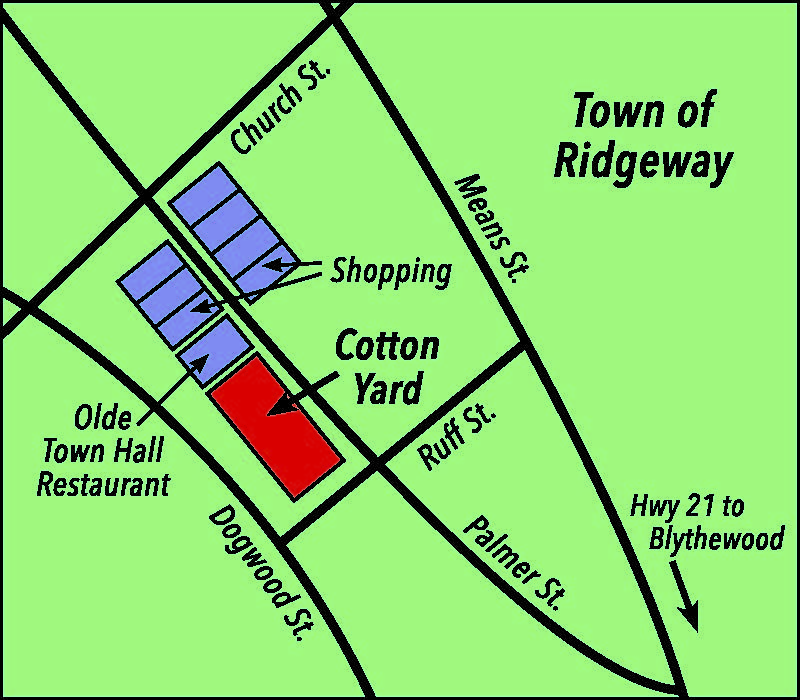
The approximately 1/2 acre Cotton Yard lies just off Palmer Street and between Olde Town Hall Restaurant & Pub and Ruff Street. | Graphic/Ashley Ghere
How the Town came to be staring down the barrel of a $73,000+ purchase price of a property that it had utilized for free for decades dates back to 2014, when then-Councilman Russ Brown and other council members accused Mayor Charlene Herring of officially contacting Norfolk-Southern about a company parking trucks on the lot without notifying Council. The lot is directly in front of her residence.
Rufus Jones, former mayor of Ridgeway and a political opponent of Herring told The Voice that he sometimes parks his sod truck on the lot.
Herring said she had received questions from members of the community about trucks parking on the lot. She did not identify those community members.
“But there were also citizens who were against contacting Norfolk-Southern, and Council members here were against contacting Norfolk-Southern,” Brown told Herring.
It was reported in the Dec. 19, 2014 issue of The Voice that Cookendorfer said that Council had, indeed, agreed to break off discussions with the railroad at a previous meeting.
Mayor Accused of Poking Giant
“We were done with it,” Cookendorfer said, accusing Herring of contacting Norfolk-Southern against council’s wishes.
“That’s what woke the sleeping giant to where we’re at today with basically [Norfolk-Southern’s] demand to take on [a] lease. That’s something we should have discussed as a council,” Cookendorfer said.
Herring countered that she made initial contact with Norfolk-Southern several months earlier after unnamed citizens came to her with concerns about cars for sale parked on the property as well as a truck on the lot.
“If citizens contacted you, under protocol you should have brought that to the council and council would say if we were going to contact Norfolk-Southern,” Councilman Donald Prioleau said.
Herring said that in the future, she would adhere to protocol, but followed that by asking, “As a right of a citizen or a mayor, why can’t you contact the railroad? This is in the heart of our town.”
“September [2014] it was brought up in this room we said ‘do not bother Norfolk-Southern anymore, because they will put up a fence’.” Brown said. “They’ve threatened to do it before, and they’ll still do it if you bother them. Don’t toy with the railroad.”
Herring said she told Council at the September meeting that she would be pursuing questions about leasing the property from the railroad and no one objected.
“In September you didn’t have the lease,” Brown said. “The lease was presented in October. But that had already got to the point where Norfolk-Southern sent a lease because there was communications back and forth.”
Herring said the Town had to have a copy of the proposed lease in order for the document to be reviewed by an attorney.
“Again, in the capacity of mayor, you went to an attorney without Council (knowing about it),” Brown said.
But Herring said she also informed Council that an attorney would be reviewing the lease, and no one had objected to that either.
Don’t Bother Norfolk-Southern
“But this conversation came from you, in the capacity of mayor, (talking) to Norfolk-Southern, which led to them providing a lease,” Brown said. “We, at every single meeting when Norfolk-Southern was brought up, we all said don’t bother Norfolk-Southern.”
Brown said the proposed lease had sat idle with the Town for a month. Then, during the October meeting, Council reviewed the document and opted to not move forward with the lease. The day after the meeting, Brown said, Herring contacted Norfolk-Southern via email.
“Telling them we were not going to pursue a lease,” she said.
“After we said not to communicate,” Brown said. “And then they sent their email back, basically giving the Town the ultimatum that if we do not lease the property, accept responsibility for the lot, accept liability for the property, then they will have the lot fenced off and the buildings removed.”
Herring said Norfolk-Southern is currently reviewing all of their properties, and eventually Ridgeway would have been forced into an official lease. Several buildings, including the world’s smallest police station and the fire station, had been constructed on the property without permission from the railroad, and Herring said it simply was not right for the Town to continue to use the property without the blessing of Norfolk-Southern.
“Eventually this would have happened,” Herring said. “And this came sooner because I did ask some questions. But eventually it would have happened.”
Herring said the railroad company needed an answer as to the Town’s choice of direction on the lease, and she was only doing the courteous thing by letting them know Ridgeway was not interested in signing a lease.
“Again, back to the form of government discussion we just had,” Brown said, “we’re not a strong mayor form of government, and as a council we chose to let it lie.”
Cookendorfer said it would have been preferable to let the railroad force the issue instead of the Town taking the lead.
“I think ya’ll are making the issue at the wrong point,” Herring said. “You made an issue about the form of government and I understand that, and I will tell you sometimes Charlene Herring errs because she is very compassionate about this town and wants to get things done. And I agree, we are a council and we will act as council. I think you’re pulling at straws now and you’re trying to blame (me) instead of doing the right thing. I’ve got the point and I think we need to move on. If you don’t want to sign the lease, don’t sign the lease.”
“You call it compassion, I call it total disregard for Council,” Brown said. “It’s not the end of the world that we’re going to have to lease the lot, but how it was handled…”
Herring reiterated her point that had she not received questions from citizens about the lot she never would have contacted Norfolk-Southern in the first place. But Brown once more pointed out that an entirely different group of citizens had urged the Town to keep mum on its use of the property. At that point, Roger Herring had heard as much as he could stand from his seat in the audience.
“The Rufus Joneses of the community!” Roger Herring, a former Council member and husband of the mayor, erupted. Brown told Roger he was speaking out of order, but Herring continued his defense of the mayor.
“You don’t do the community organization she does,” Roger Herring said, even as the mayor brought down the gavel. “You (Council) don’t do what you’ve already agreed to do!”
As the mayor attempted to restore order to the small Council chambers, Roger Herring stormed out, slamming the door of the Century House behind him.
“Now, do we need any further discussion on it?” the mayor asked.
“I just wanted to bring it up now,” Brown said, “so the people who are going to be paying for that insurance and paying for that lease when they pay their taxes and their water bills, they know where their money is going and why.”
From Lease to Purchase
Since 2014, the Town has paid Norfolk-Southern $1,000 annually for insurance and lease of the Cotton Yard. Recently, however, Council changed its position on the Cotton Yard. It hired an attorney last year to approach Norfolk Southern about purchasing the front portion of the Cotton Yard property where the police and fire stations are located.
The railroad company’s answer came in the form of an email on April 12, 2017, from a Norfolk representative to the Town’s attorney in the matter, Jim Meggs.
“Would the Town of Ridgeway be interested in purchasing the whole parcel shown on the attached [exhibit]? It is not in the best interest of Norfolk Southern to sell only the front of the parcel, losing the street frontage. We could agree to letting the whole parcel go for $35,000,” the representative wrote.
After considering the offer during executive session on April 13, 2017, Council voted in public session to go forward with the offer. However, while it was noted in the June, 2017 Council meeting that the town had allocated $40,000 for the railroad purchase, survey and legal fees, the sale has never materialized.
Purchase Price Jumps
The railroad company has now jumped the price to $73,000 and it is estimated that legal fees, surveying and other extras could increase the total cost of purchasing the property by another $15,000 – $20,000.
While Council has held numerous executive sessions on the purchase of the Cotton Yard, there has been no public comment about why the price has more than doubled.
Councilwoman Angela Harrison reported to The Voice in an email on Thursday that no further vote, ordinance or resolution is needed on the purchase, that the vote on Dec. 14 was the final vote. The next Council meeting is scheduled for 6:30 p.m., Thursday, Jan. 11 at The Century House.
NOTE: This story includes excerpts from another story that appeared in a December, 2014 issue of The Voice.