Tag: Blythewood Town Council

  • Council sends Red Gate back to PC

    BLYTHEWOOD – Approximately 60 residents filled the Blythewood Town Council chambers Monday night in Doko Manor to protest myriad aspects of a proposed rezoning of 143 acres, referred to as the Red Gate property, located along Blythewood Road between Syrup Mill and Muller Roads. The property lies across Syrup Mill Road from Cobblestone Park and in an area of horse farms and large acre residential properties.

    The rezoning was recommended to Town Council for approval by the Planning Commission on June 3.

    Originally zoned PDD (Planned Development District) in 2007 under the jurisdiction of Richland County, the property was subsequently annexed into the Town of Blythewood as a PD (Planned Development) zoning designation. That PD, which is still in place, allows for 232 single family units, 300 multi-family apartment units and 36 acres of general commercial.

    Before it was developed, the property went into foreclosure, and is currently owned by Arthur State Bank. Hoping to now develop the property, developer Harold Pickrel has requested an amendment to the property’s current zoning map that would actually reduce the density – from 232 to 138 single family homes, from 36 to 28 acres of commercial use and eliminate the 300 multi-family dwellings.

    But even that density seemed, Monday evening, to be a world away from what surrounding rural residents said they feel is appropriate for the area.

    Fifteen of those neighbors attending the meeting came to the microphone to ask council to send the rezoning request back to the planning commission for a re-do that would be more in character with rural properties in the area. In general, they called for ‘smart planning’ that would better transition the housing development to the rural area around it. Specifically, they asked for minimum 20,000 square foot lots, thus reducing the housing density further than 138 homes. They also asked for the addition of buffering around the development to protect the privacy of the surrounding properties.
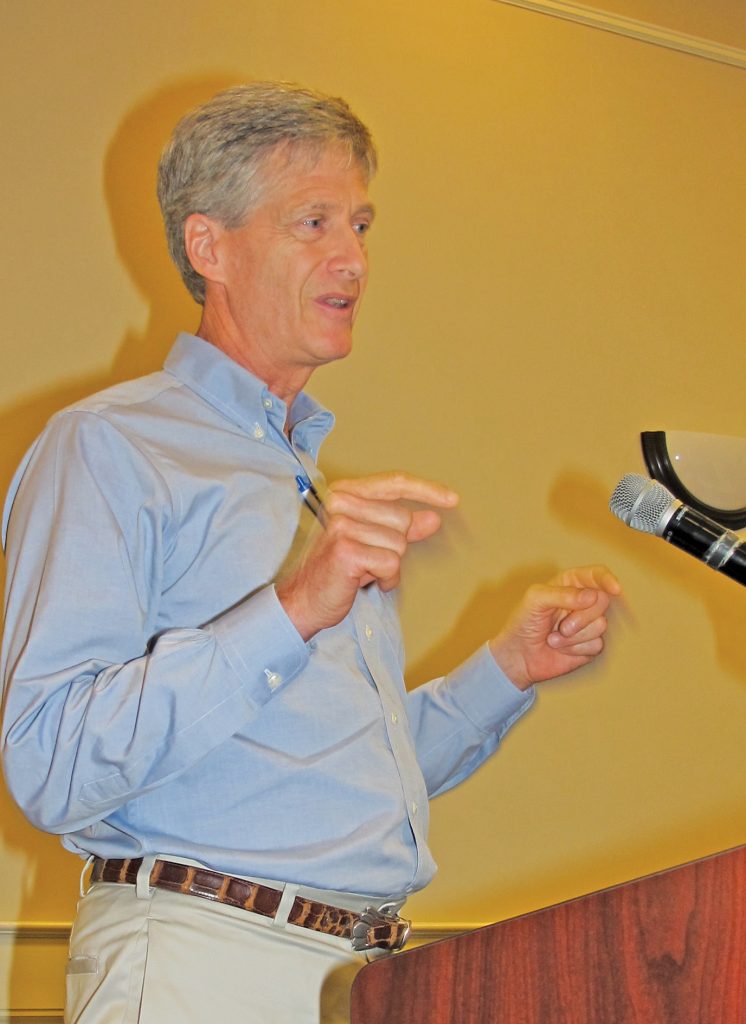
    George Walker

    “We’ve been blessed with [large acre neighborhoods] like Surrey Woods, High View Farms, Camry Farms, Birch Springs and Center Creek that value trees and set the stage to create the kind of environment that makes people want to keep coming back,” Persimmon Fork Road farm owner George Walker said, addressing council.

    “We aren’t opposed to development and we appreciate that this developer has already made concessions in regard to multi-family units,” Walker said. “We aren’t trying to drive him [Pickrel] away, but we are trying to come up with a plan that is farsighted and works for everybody.”

    Walker reminded council that they had set a 20,000 square-foot minimum on lots in the town, and he urged them to honor that in the PD as well.

    “Backing homes on 10,000 square-foot lots up to a property that the town annexed under a Rural (RU) designation is overly aggressive,” Walker said.

    Another Persimmon Fork resident, Attorney Stuart Andrews, said he counted 15 areas of discretion in the project that are open to the developer.

    “He could make modifications on the plans that are presented with regard to boundaries and actually in changing the density of houses without any input from town council, the planner or the community,” Andrews said. “I suggest having a thorough study of this proposal before the plans are adopted, and then have the plan and the rezoning meet [requirements] that would be consistent with the rural character of the community.”

    John Moore, a resident of Cobblestone Park and a former planning commissioner, said the plan was one of the poorest he had seen.

    “There’s no mention of price points or the homes’ square footage,” Moore said. “Why are the 10,000 square foot lots even in this document?” Moore asked. “There should be a traffic study before the development is approved and it should be conducted during the school year when school is in session,” he said.

    Rue, who owns a horse farm in the area, asked council to protect her “little slice of heaven.”

    Mayor J. Michael Ross defended the planning commissioners’ decision to recommend approval of Pickrel’s rezoning request, noting that the current zoning allowing 232 homes, 36 acres of commercial and 300 apartment units could be built today without town council’s consent.

    “The commissioners probably thought they were doing a pretty doggone good thing to get the 300 apartments taken out and get some 20,000 square foot lots,” Ross said. He also said he empathized with the residents.

    “I thank all of you for coming, and I hear your passion,” Ross told the crowd, “and I understand it. I’m just like you. I used to live on Dennis Lane. So if I was there now and this [development] was coming in, I would be one of you sitting out there, too. But this land has been there since 2007, and it has been zoned so that if [a developer] came in, he could build on 5,000 and 8,000 square-foot lots. That’s what’s approved right now,” Ross said. “So there is a risk that if somebody else came in here and wanted to develop this property as it is now, then that is how it is zoned. This requested zoning is a new PD. The old PD that was established in 2007 is still on the books,” he added.

    “That being said, we don’t want that either, so we hear you. I do think a lot of the things you said are very important – a traffic study before action is taken, traffic and other safety issues,” Ross said.

    Council voted unanimously to send the rezoning request back to the planning commission for reconsideration.

  • PC proposes allowing sandwich signs, prohibiting feather signs

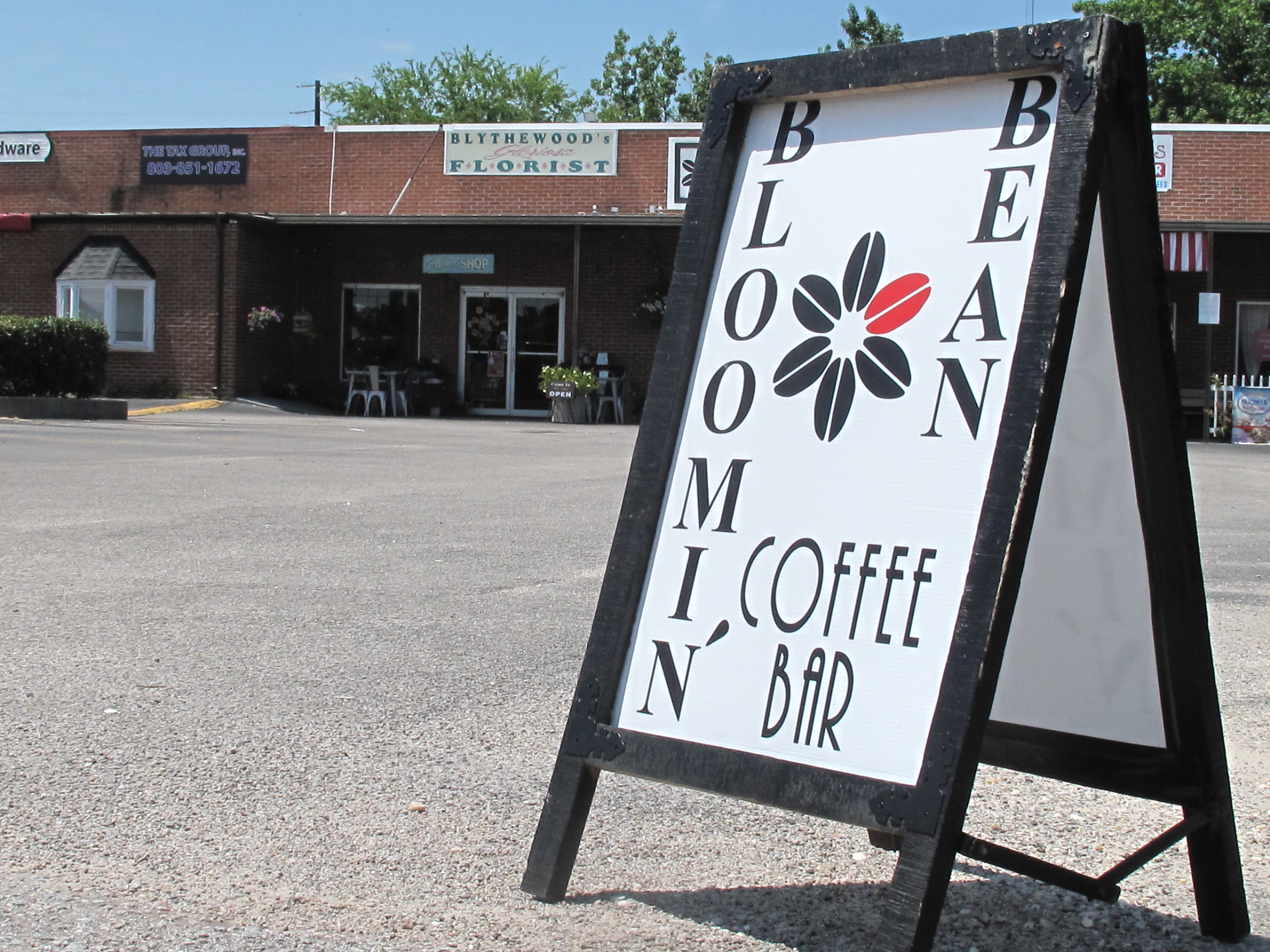
    Planning Commissioners recommend allowing sandwich board signs in town.

    BLYTHEWOOD – The prohibition of sandwich board signs in the town has long been the bane of many shop owners in Blythewood. Those days may be over if a recommendation made to Town Council last week by the Planning Commission comes to fruition.

    At the June 3 Planning Commission meeting, Town Administrator Brian Cook proposed an amendment to the current sign ordinance for options that would allow all the town’s businesses to advertise with sandwich boards so long as the signs meet certain size requirements and are set up and taken down at specified times.

    The signs can be any A-frame sign consisting of two boards hinged at the top hanging back to back.

    Sandwich board sign regulations were added under a section for exempt signs. One sandwich board sign can be permitted to an onsite commercial owner/operator only during the hours when the establishment is open. The sign can be no larger than three feet tall and two feet wide, with a maximum of two sign faces.

    Town’s PC recommends prohibiting feather flags.

    Cook said the town can remove any sign that causes interference with vehicular or pedestrian traffic, or in the event of any emergency situation, or that interferes with any work that is to be performed on the public sidewalk and/or right-of-way by or on behalf of the town.

    In all instances, the amendment specifies that the sign shall be placed on the business’ lot, at least five feet outside of right of way, shall be constructed of a material and weight to ensure general stability and shall not block visibility.

    While sandwich signs are currently prohibited, many businesses such as Bloomin’ Bean Coffee Bar and others have set them out for the last few years with little interference from Town Hall.

    That’s not to say that a business can stake out other types of signs in front of the business.

    Cook clarified that feather flags, which have been popping up around town the last couple of years, are prohibited under the amendment.

    Other prohibited signs, according to the proposed ordinance, include “any sign (other than a government sign), banner, feather flag, festoon, or display placed on any curb, sidewalk (except where otherwise permitted in this subchapter), post, pole, hydrant, bridge, tree or other surface located on, over or across any public street or right-of-way, or any banner, placed on stakes on a property, unless a permitted temporary or grand opening banner, otherwise permitted.

    The proposed sign amendment was approved unanimously and will now move to Town Council for the first of two votes on June. 24 at The Manor.

  • Council asks for 20% pay hike beginning next term

    BLYTHEWOOD – When council members are seated after the November elections, they will be receiving a pay increase if Mayor J. Michael Ross’ proposed pay increase for council members and mayor is voted into the budget for fiscal year 2019-20.

    Ross suggested at the May 23 budget meeting that the mayor’s annual salary be increased from the current $9,000 to $12,000 and council members’ salaries be increased from $6,000 to $9,000.

    “I will not get a dime of that money,” Ross joked. The town ordinance limits Blythewood elected officials to two terms, and Ross’ second term will end in November.

    “For eight years the salaries of the governing body has been the same,” Ross said. “When I was elected, the mayor’s salary was $18,000 and council’s was $12,000. Our council voted to reduce that by 50 percent,” he said.

    “When you think about everyone else making more money, no one does this job for money. I was going to kick around that we are in excellent financial condition and have money to spare,” Ross said.

    Former town councilman Tom Utruska reminded Ross from the audience that it is the staff who does most of the work.

    “They are the ones who should get the pay increase,” Utroska said, also reminding council of the insurance and retirement perks they also receive.

    And Ross conceded that the town does not have fire, water and other departments that council and the mayor have to supervise and maintain like other towns.

    When Ross brought the issue up again at the May 28 council meeting, Utroska suggested a 20 percent increase for both the mayor and council, increasing the mayor’s annual salary to $10,800 and council members’ to $7,200.

    “I think that’s fair and shows we’re moving forward,” Ross said. Second and final reading of the budget will be held June 24.

  • Frye: Chamber will be transparent

    Meggs: Town Bailout of Chamber is Unlawful

    BLYTHEWOOD – After it was revealed last week that the Greater Blythewood Chamber of Commerce is $22,000 in the red and is currently operating on a $20,000 line of credit, Interim Chamber Director Phil Frye raised eyebrows on Council when he announced the Chamber would no longer request the $17,500 grant from the Town’s general fund that it has requested and received annually for several years.

    “You are down $22,000! How can you not ask [for the grant]?” Mayor J. Michael Ross asked. “You’ve overspent, it looks like, and now you don’t need our money? I guess this is the fiscal responsibility we’ve been talking about over, over and over.”

    Town Attorney Jim Meggs made it clear where Council should be standing on the issue of funding for the Chamber.

    “You’re not a bank,” Meggs said to Ross. “Anything you do with public money has to go to a lawful public purpose. Being a bailout source is not an appropriate public purpose.”

    “But they aren’t asking for the $22,000,” Ross said. “That [grant] is the same thing they’ve been asking for every year.”

    Meggs shrugged, standing by his advice.

    Ed Parler, Council’s liaison with the chamber board, offered his explanation concerning the Chamber’s numbers.

    “The $22,000 is the profit and loss from July 1, 2018 to the projected end of the current fiscal year,” Parler said. “It is not the bank balance. [The Chamber] is anticipating taking a hit of $22,000 from the previous year. We are now operating on a line of credit until the membership dues begin coming in. With sound management, we are working toward a balanced budget.”

    “That’s a big hallelujah,” Ross said, drawing laughter from the audience.

    “The Chamber board voted unanimously against coming to Council for a bailout,” Parler said.

    “My hat’s off to you,” Ross said. “I think you’ll get the confidence of the community back that you have somewhat lost. It’s a great step forward.”

    Councilman Eddie Baughman thanked Frye for providing the Town with the financials.

    “Mike and I have talked. It is what it is and it showed what it showed,” Baughman said. “I appreciate you tightening the boot straps. It shows a lot of character.”

    “The good thing, Phil, is that if we don’t give you any money, you ain’t gotta tell us anything [about your finances],” Ross joked in an apparent reference to the requests The Voice has made for the Chamber’s financials over the past two years.

    Frye said the Chamber did, however, want to request that Council continue to purchase a $2,500 premiere membership with the Chamber, an amount that is in the Town’s proposed budget.

    Frye also asked for $14,000 for the Chamber for a fall fundraiser event. Frye said the Chamber hopes to net $10,000 from the event.

    Frye assured Council that the Chamber would be more transparent with its finances in the future.

    While praising the Chamber’s promise to be financial responsible in the future, no one on Council asked questions about the Chamber’s vague financials from this fiscal year or lack of financials from prior years. According to CPA Bob Massa, formerly both a Council member and member of the Chamber board, the financial documents submitted last week and last year by the Chamber are vague and do not show with any clarity as to where some of the money that came into the Chamber ended up.

    “Those financial records absolutely can’t be followed with any accuracy,” Massa said. “It’s anybody’s guess what was going on. They apparently kept no books on the chamber until someone started asking for them last year. And Mr. Switzer is apparently no longer available to comment on those financials. It’s hard to follow.”

  • Mayor questions how A-Tax and H-Tax awards are spent

    BLYTHEWOOD – The focus of Town Council’s third and final budget workshop on Thursday, May 23, centered on expenditures from the accommodations and hospitality tax funds.

    In recent months, Mayor J. Michael Ross has warned event organizers that he expects those who are awarded funds from the Town to spend those awards on advertising that will actually bring out crowds of people.

    “I feel like a broken record,” he said at Thursday night’s meeting. “We want these events to be successful.”

    He was addressing the organizers of the Bravo Blythewood Spring Market which organizer Sue Pence said brought in about 400 visitors over three days. The town awarded Bravo $4,000 for the event.

    Of that $4,000, Pence said, the group spent $1,250 on digital billboards in Columbia and $400 in The County Chronicle and none in The Voice.

    “Spending $1,200 of your advertising dollars on billboards in Columbia was a chance. If I see that on the next request for funding, I’m not going to approve it. I’m going to turn you down. If you had $1,250 to spend on billboards, you had money to advertise in the local papers,” Ross said.

    “We sit here and talk about we want to support our local businesses, want to shop local and that’s what we promote here in our town,” Councilman Eddie Baughman said. “To shop local, we need to advertise local. We see time and time again where the money is spent elsewhere. I think our event organizers should spend their money locally also.”

    Ross suggested advertising to the local community and then using Facebook to share outside the community.

    Ross said on Thursday evening that an arts immersion class that Bravo Blythewood is requesting funds for in the fall does not qualify for accommodation tax funds. However, on Monday, May 28, Council voted unanimously to fund the class for $1,500 of the $2,500 Bravo requested.

    Bravo organizers also sought $4,000 for their annual Holiday Market, but said it will no longer be held in the town of Blythewood but at the Columbia Country Club.

    “We’ve already contracted with Columbia Country Club and had to put down a $500 deposit,” a representative of Bravo said from the audience.

    Criticizing the town’s signage restrictions, the representative said the location outside of town would make advertising the location much easier.

    But Ross balked at funding an event outside the town limits, saying it would not bring business into the town, which is the intended use of the accommodation and hospitality tax revenues.

    “You take a tremendous risk doing that when you don’t already have the funds approved [from the Town],” Ross said. “It’s a hard sell when you take [the event] out of the town of Blythewood.”

  • Reception to honor Judge Robinson

    BLYTHEWOOD – The community is invited to a farewell reception prior to the May 28 Town Council meeting to honor Blythewood’s magistrate, Judge Josef Robinson, and his staff.

    Robinson, who was serving his second term after being appointed to the bench by Sen. Joel Lourie in 2014, said he was notified by Sen. Mia McLeod last month that he would not be reappointed. McLeod was elected to serve after Lourie decided not to run for re-election.

    “We are going to truly miss Judge Robinson,” Mayor J. Michael Ross said. “We couldn’t have had a better judge to serve as Blythewood’s first magistrate. He did a great job in the Courtroom and I think most everyone regarded him as fair and compassionate, a fine example of a public servant and our community benefited greatly from his service.”

    Robinson will be returning to law enforcement as a deputy sheriff, serving as a public information officer under Sheriff Leon Lott.

    The reception for Judge Robinson and his staff will at 6:30 p.m., Tuesday, May 28 at the Doko Manor in Blythewood. Town Council will convene for a budget workshop at 7 p.m.

  • TC proposes $1,670,875 budget

    BLYTHEWOOD – Last week, Council held the first of two budget workshops scheduled for the proposed $1,670,875 budget for fiscal year 2019-20. It exceeds last year’s budget by $105,761.

    The discussion on the budget was led by Town Administrator Brian Cook.

    Reviewing the General Fund revenue, Cook said building permits and fees are projected at $180,679, down slightly from the $202,111 budgeted for 2019. Building and permit fees came in at $173,389 in 2017; $200,437 in 2018 and the actuals at the end of April were $150,565.

    Cook said fees for business license from both inside and outside the town are expected to be slightly higher than the current year, and that revenue for franchise fees next year is looking good, projected to be $273,457, up from $250,000 in 2019.

    Revenues and expenses for the governing body for 2020 are on par with 2019, Cook said. Total administration budget is projected to increase almost $45,000, going from $396,096 to $441,978, with almost $40,000 of that increase allocated for a 2.5 percent cost of living raise and a 3 percent merit increase for town employees.

    Mayor J. Michael Ross said he requested a $5,000 increase in community promotions from $7,500 to $12,500 for advertising and other promotions that he said might come up during the year that are not budgeted for.

    Costs for VC3, the Town’s computer software company, that Cook said maintains the town’s computer systems, will increase from $46,350 to $58,320. Some of that cost, he said, is a one-time cost that will go down some next year.

    In anticipation of updating the Town’s comprehensive plan, contracted services with the Central Midlands Council of Governments will increase from $20,000 to $35,000.

    The increase from $261,820 to $268,444 for Public Works is attributable to increased costs in contracted services for additional irrigation and landscape beautification projects in the Town. The Christmas committee also received an increase of $1,000 over 2019, and inspections and code enforcement expenses are expected to increase about $10,000.

    The budget for Parks and Recreation will be reduced by about $40,000 in 2020 due to an annual cost savings of $19,000 as the result of eliminating the park mowing contract and purchasing a mower for Town Hall to do the mowing inhouse.

    Cook said there will be some increase in the Parks and Recreation budget, however, to allow for the purchase of a new piece of playground equipment and the addition of benches and possibly a shade in the playground area.

    Ross said council will discuss at the 6 p.m., May 23 workshop how to better allocate Accommodation and Hospitality Tax revenues. Council will also address the Blythewood Chamber of Commerce’s financials at that meeting, and the Chamber is expected to request $20,500 – $17,000 for an economic development work subsidy (previously called a grant by town officials) and $3,500 for an ‘elite partner’ chamber membership for the Town government at the premiere level.

    Council will take the first vote on the budget on May 28 and the second on June 24. Both meetings will be held at 7 p.m. at the Manor.

  • Doko title snafu cleared, but costly

    BLYTHEWOOD – During its first budget workshop for the fiscal year 2019-20 last week, Mayor J. Michael Ross asked Town Administrator Brian Cook to confirm that the $39,000 listed under capital improvement expenditures is the year-to-date amount the Town has spent on legal and professional fees associated with the sale of the Doko Depot building in 2019.

    Cook confirmed that it is.

    “So that should be enough to carry us through to closing?” Ross asked

    Cook said an additional $2,500 is budgeted for the closing.

    The sale of the Depot has been delayed since December, 2017, for myriad reasons. In September, 2018, Ross announced a new, more serious delay – this one caused by the discovery that property title restrictions had not been disclosed to the Town in prior financing efforts with Santee-Cooper.

    At last week’s council meeting, Ross said the title is now clear, but because the process took so long, the bank is requiring the purchaser to get new financing.

    “They are in the process of doing that now,” Ross said.

    Ross said the delay in the sale has also caused extra costs for the Town, including taking insurance out again on the building.

    “Hopefully, we’ll soon be able to announce a closing,” Ross said. But he said he could not yet estimate when that would be.

    Freeway Music and a second location for a popular Lexington restaurant, the Old Mill Brew Pub, are expected to be the eventual tenants of the building.

  • Council adopts RC animal ordinance

    BLYTHEWOOD – Town Council voted last week to amend its animal care ordinance to be compliant with the Richland County animal care ordinance.

    In a memo to Council, Town Administrator Brian Cook commented that because the Town contracts by intergovernmental agreement (IGA) with Richland County for animal care, the town would have to operate under the County’s animal control agreement.

    “To secure the enforcement and uniformity of animal control regulations within the Town [and be] in compliance with the animal control ordinances of Richland County and in accordance with the laws of the state of South Carolina,” it would be necessary to adopt the County’s animal care ordinance into the Town’s.

  • Council to relook at H-Tax allocations

    BLYHEWOOD – Town Administrator Brian Cook gave an overview of the Town’s proposed FY 2019-20 budget last week and announced a workshop schedule for council to work out the details of the $1,621,696 budget, which is up from $1,565,114 last year.

    Looking at possible changes in budgeting for the coming year, Cook said council will be giving some attention to how it allocates hospitality funds in the future. He said there are several ways council might want to make changes.

    “In the past, we’ve allocated sporadically without knowing at any one time how many groups we are allocating money to for the entire year,” Cook said in an interview with The Voice. “I would like to see us look at the allocations for the whole year at one time so we don’t spend it all before we get to an event or project that we really want to do and then realize we don’t have any left for something that  we feel is important. Council is going to look at the best use of the money.”

    Cook said he would like to also look at specific projects that can be paid for with hospitality tax funds but that have been overlooked in the past. The new budget includes $10,000 for re-sodding and landscaping plantings and $500 for a new weed eater. About $7,000 was allocated from the current budget for a lawn mower, Cook said.

    “We are going to do the mowing of the park and town hall area in-house now and discontinue the contract we currently have for mowing the park. We’re going to be saving money right out of the gate,” he said. “We’ll pay for the lawnmower in the first year.”

    “There are a lot of things we can use hospitality funds for that are not event based,” Cook said.

    “This [hospitality] money can be used to beautify the town and landscaping,” Cook said. “The entrances to the town, maybe lay some new sod at the entrance to the park, places that are weedy and pretty much dying. When you go around to other places like Killian’s Crossings and look at the medians planted with color, we could be looking at doing some of that.”

    “Once we get to the May workshop, that’s when we will really get down to it,” Cook said.

    Cook said council will also be looking at other ways they allocate hospitality tax money – where it’s going and how it’s being used.

    At the April council meeting, Mayor J. Michael Ross told one event group that if they did not turn out better attendance numbers, the town might not continue to allocate hospitality funds for that event. He addressed the lack of local advertising by the event organizers.

    At the April meeting, council heard requests for event funding from Blythewood Bikes & Beers for $8,750; from The Red Barn for $12,051.20, and The Blythewood Chamber of Commerce withdrew a request for $20,500 that Chamber Chairman-elect Phil Frye said would be requested at the May 9 workshop.