Tag: Blythewood Town Council

  • Council considering $56K for Chamber, Visitor’s Center

    BLYTHEWOOD- Asking for more accommodation tax and general fund money has become a common theme for the Greater Blythewood Chamber of Commerce, and Council continues to up the numbers every year.

    In 2017, Chamber Executive Director Mike Switzer sought additional funds of nearly $71,000 before scaling that number back amid town council protest.

    Of the $71,000, $33,000 was earmarked for the Blythewood Visitor’s Center which operates under the Chamber. Switzer ultimately received $18,500 which was to be dedicated to pay for an employee for the Center. And just last month, the chamber requested and received an additional $7,643 for the visitor’s center, citing projected deficits due to increases in hours worked, but no specifics.

    Now, Switzer is asking Council to increase the economic development grant the chamber receives from the Town from $15,000 to $20,000 in next year’s town budget. He also wants the Town to increase the annual accommodation tax funding for the visitor’s center from $18,500 to $25,000 and an increase in funding for the Big Grab from $8,750 to $12,500.

    Blythewood Town Council, initially at least, wasn’t willing at all to entertain $25,000 for the visitor’s center, preferring instead to leave funding at the current $18,500.

    “I kind of get tired, and there’s not many people who come in and do this, when you keep coming and asking,” Mayor J. Michael Ross said during the May 10 budget work session. “When you don’t get to a certain number, you want more. That doesn’t seem fiscally responsible to me,” Ross continued. “You have to look from within.”

    As the meeting proceeded, however, council member’s tone changed. They soon tentatively agreed to increase the annual visitor’s center funding to $20,500, with the potential for an additional windfall of $10,500 ($3,000 discovered in unspent accommodations tax revenues plus $7,441 that was returned unexpectedly by The University of South Carolina from a recent equestrian competition for which the town provided funding.)

    If the proposed funding is approved, the chamber will end up receiving a total of $57,500, an increase of $15,250 over current funding.

    The appropriations making up the $10,500 funding came from what’s called the “30 percent” fund. State law requires that 30 percent of accommodation tax revenues be spent specifically on an agency to promote tourism. It can’t be spent on salaries or operational expenses, the Town’s assistant town administrator, Chris Keefer, cautioned council members during the work session.

    “This is where the TERC dings us every year,” she said. “That money is supposed to go to some organization that has some existing tourism marketing program.”

    TERC, or Tourism Expenditure Review Committee, operates under the S.C. Department of Revenue. Its job is to review a-tax expenditures to ensure they comply with state law.

    For the visitor’s center to receive both the $20,500 funding and the $10,500 accommodation tax windfall, Ross said the chamber would have to submit a marketing plan by June 15, showing how funds will be spent. If the funds do not go to an agency that promotes tourism by June 30, Ross said, the town must return them to the state.

  • Chamber financials reflect inconsistencies

    BLYTHEWOOD – Whenever the Greater Blythewood Chamber of Commerce Executive Director Mike Switzer requests additional funding for the chamber, council members generally have been willing to cough up more money.

    As Blythewood council members plan to discuss increasing the total annual funding to the Chamber by more than $15,000 to $57,500, during a budget workshop Thursday, May 24, a review of public records, as well as a former chamber employee, signal several inconsistencies in chamber financials, raising questions about how accommodation tax funds and a town hall grant are actually being spent.

    At Town Council’s April 23 meeting, for example, the Greater Blythewood Chamber of Commerce Executive Director, Mike Switzer, said the chamber needed additional funding to cover non-specific, additional costs incurred in running the visitor’s center.

    “A lot of this deficit is startup costs of putting the extra hours into getting it (the center) up and running,” Switzer said. “The situation we have is the doors are open from 9-5. Before we signed the lease, we were already in there a year and our hours were 10-2. That’s what we could afford.”

    According to its most recent federal tax return, the chamber claimed a deficit of $4,885 just months after reporting a $5,755 surplus.

    Switzer called the numbers and their relation to visitor’s center finances “apples and oranges.”

    Payroll doesn’t add up

    In May 2017, Switzer requested $33,000 to run the visitor’s center, telling council members that $18,000 of that money would be spent on a part-time employee at a cost of $15 per hour for 20 hours plus FICA.

    Council voted to approve the $18,500 specifically for that employee.

    When contacted by The Voice, that employee, who is no longer employed at the visitor center, said she was only paid $10 per hour, not $15, for an annual payout of only $10,400.

    A visitor’s center report provided to council last January raises more questions.  The report, which is broken down into two columns (2017 July 1 – Dec. 31) and (2018 Jan. 1 – June 30), shows a total revenue for fiscal year 2017-18 of $18,500 and expenses of more than $26,000 causing a deficit of $4,885 for July 1 – Dec. 31, 2017 and an anticipated deficit of $2,758 for Jan. 1 – June 30, 2018 for a total of $7,643. A $300 addition error in each column of expenses would, if corrected, bring the deficits even higher. Council voted 4-1 on April 23 to give the Chamber the additional $7,643 to cover the two deficits.

    That’s where the report becomes difficult to follow. The visitor’s center payroll expenses are listed at $8,332 in each of the half-year columns. But the former visitor’s center employee said she only received $5,200, not $8,332 for the six month period ending Dec. 31, 2017. And the report anticipated another $8,332 the first half of 2018, leaving $3,132 in employee payroll unaccounted for in each half of the year for a total of $6,264.

    When asked by The Voice, Switzer was unable to provide a breakdown of the $8,332 listed for payroll. There is also no explanation of how a fourth of the Chamber’s rent, insurance utilities, accounting and other expenses including office supplies and other items that were previously charged to the Chamber are now charged to the $18,500 that was earmarked for the visitor’s center employee.

    In another instance, the chamber received $8,750 in accommodation tax funding for The 2017 Big Grab. Switzer charged $4,318 to staff expenses, breaking it down among three employees: the visitor’s center employee, $426; Switzer, $1,558 and Kitty Kelly (Switzer’s assistant), $2,234. But when contacted by The Voice, the visitor’s center employee said she was never paid the $426.

    Budget incongruities aren’t limited to visitor’s center funding. Mismatching revenue figures provided by the Chamber are apparent in funding to promote the 2017 solar eclipse.

    Eclipse the Park budget records list T-shirt revenues at “$5,000 (approximate),” although financial data obtained by The Voice pegs that figure at $9,991.

    Sponsorship revenues showed a similar gap, with $750 listed in budget records and actual revenues of $4,500, documents show.

    On May 4, The Voice issued a Freedom of Information Act request for annual budgets and profit and loss statements for the visitor’s center and chamber for the past five years.

    “There will be costs associated and I will get those to you as soon as time allows,” Switzer said via email on May 8. “We have, as always, a lot of work going on right now.  I will bring all of this to our next board meeting on the 15th and get back to you after that.”

    The Voice had not received the requested documents at press time.

  • Switzer requests $7,643 for Visitors

    BLYTHEWOOD – After receiving $18,500 earlier this year to operate the town’s Visitor Center, the Greater Blythewood Chamber of Commerce says it needs nearly $7,700 more.

    In April, the chamber asked the Town of Blythewood for $7,643 in additional funding to cover expenses associated with the Visitor Center which opened a year ago.

    Blythewood Town Council approved the appropriation at the April 23 meeting, designated state accommodations tax revenue as the funding source.

    The funding request comes on the heels of the chamber claiming a deficit of $4,885 months after reporting a $5,755 surplus, according to federal tax records obtained by The Voice.

    Mike Switzer, executive director of the Blythewood chamber, told council members last week that the deficit is due to additional costs incurred in running the visitors center.

    Switzer, however, characterized the $5,755 surplus and $4,885 deficit as “apples and oranges” in a subsequent email exchange with The Voice.

    “The numbers from last night were strictly visitor center numbers, not total chamber numbers,” Switzer said.

    On April 23, Switzer told council members the $4,885 deficit has accumulated over the past six months. He anticipates an additional shortfall of $2,758 in the next six months, accounting for the $7,643 request.

    “A lot of this deficit is startup costs of putting the extra hours into getting it (the center) up and running,” Switzer said. “The situation we have is the doors are open from 9-5. Before we signed the lease, we were already in there a year and our hours were 10-2. That’s what we could afford.

    “When we were asked to take over the Visitor Center, we were asked to operate it 9-5,” Switzer continued. “We’re just three part-time people rotating it. We’re trying to keep it open.”

    Council members approved the full funding request by a 4-1 vote. Mayor J. Michael Ross dissented.

    Ross said he supported funding the chamber, but only enough to cover the existing deficit of $4,885.

    “I support you, I just don’t support the total number here,” he said. “I’ve always been on the conservative side.”

    Other council members were generally supportive of granting the chamber’s full request, though some expressed a desire for the chamber to be more self-sustaining.

    “You can’t get bailed out every year,” said Councilman Eddie Baughman. “That money, I’d like you to stay within that working frame.”

    From surplus to deficit

    No visitors center expenses are listed on the chamber’s 2016 federal tax return obtained by The Voice. The reporting period is from July 30, 2016 to July 1, 2017, prior to the chamber taking over the center.

    But tax records also show a surplus of $5,755 in 2016, with total annual revenues of $75,477 and expenses of $70,381. Net assets carried over from 2015 accounted for the remaining $689, tax records state.

    Although Switzer characterized chamber and visitors center finances as separate, council documents do not make that distinction.

    A memo included in the April 23 agenda packet states the Town of Blythewood already provides $18,500 to the chamber “for the purpose of operating a Visitor Center.”

    The $18,500 in funding also comes from a-tax revenues collected within the city limits. South Carolina charges a 2 percent accommodation tax on hotel rooms and vacation rentals.

  • County plans to move forward with traffic circle

    BLYTHEWOOD – After multiple community and council meetings over the last year about a proposed controversial double-lane traffic circle that would impact the entrance to Cobblestone Park and the retail, restaurant and office businesses located on University Village Drive in Blythewood, the pot was still boiling Tuesday during a Blythewood Town Hall meeting held on the issue at The Manor.

    With more than 50 people in attendance and many of them addressing the issue, the problem is not solved, but   Richland County government appears to be digging its heels in to proceed with construction of the traffic circle as well as widening Blythewood Road to five lanes.

    The proposed $10.5 million project is part of the Richland Penny Tax program and extends less than a mile along Blythewood Road from Syrup Mill Road East to the Southbound I-77 ramps.

    The posted project overview on the richlandpenny.com website shows the existing roadway would be widened to a five-lane section with two travel lanes in each direction and a two-way left turn lane, which is a paved 15-foot median.  Ten-foot shared-use paths are proposed on each side of the roadway for the length of the project to accommodate bicyclists and pedestrians.  A double-lane traffic circle is proposed near the intersection of Community Road and the entrance to Cobblestone Park.

    During a public project meeting held at Muller Road Middle School on March 22, by representatives from the Penny Tax Program, a large group of residents, primarily from Cobblestone Park, turned out to question the safety and effectiveness of the traffic circle.

    Responding to a phone call from The Voice inquiring about the results of resident input on comment cards after the Muller Road meeting, Project Manager Ben Lewis was clear.

    “The plan is to move forward with Option A – the 5 lane, offset, shared use option,” Lewis said.

    Twelve residents spoke at the Tuesday night meeting with the majority being Cobblestone residents speaking out against the creation of the traffic circle.

    “It appears the Penny Tax Committee has chosen an inadequate, short term fix for a longer term issue,” Cobblestone resident and former Town Councilman Tom Utroska said, reading from a two page letter in which he addressed a number of issues including how tractor-trailers would negotiate 270 degree turns on the circle without causing major backups.

    Another Cobblestone resident, Bethany Parler, said she was concerned about the large number of out-of-area visitors to the Cobblestone golf club and restaurant who would not be familiar with how to negotiate the traffic circle which requires drivers leaving Cobblestone Park to cross two lanes of traffic on the circle before turning left toward I-77.  She urged the Town of Blythewood concentrate on the McNulty Road to Main Street, Langford Road traffic problem and move the Blythewood Road project to number two on the agenda.

    There was a moan from the audience when Mayor J. Michael Ross suggested the hypothetical possibility of a fatal traffic accident happening while the project was on hold.

    Courtney Levett, another Cobblestone pointed to the traffic circle installed on Piney Grove Road in Columbia where, he said, there had been a lot of damage to the curbing and 3 foot tall reflective sticks by traffic trying to negotiate the turns.

    “I would like Richland County to delay their decision until this can be further explored,” he said, indicating that he felt that the issue had divided the town.  His suggestion to let the Town vote on it was met with applause from the audience.

    But Ross countered.

    “Almost three thousand people live in the town limits,” Ross said, “and the only people who’ve called me have been my [Cobblestone] neighbors.  These projects are to better the whole town of Blythewood,” Ross said.

    Former Blythewood High School teacher of the year Allison Byrd cautioned the County about how they use tax dollars.  She suggested pausing the traffic circle project until a study could be done on the installation of a traffic light at Syrup Mill Road to slow down traffic.

    Larry Sharpe, who owns large parcels on each side of the section of Blythewood Road that would be impacted by the traffic circle an opposes the project, talked about the influence that industrial growth on Community Road and near Syrup Mill and H.R. Horton’s continued building in Cobblestone would have on the traffic circle.  He also talked about the problem that would be created with motor homes or trailers and boats trying to navigate the circle.

    But not all Cobblestone residents were opposed to the project, including Buddy Price, a 19-year Blythewood resident.

    “Every year it has gotten worse, and it is getting less and less safe,” Price said.   He said he would have preferred a stop light be installed but he expressed support for the plan and encouraged the council to move forward quickly.

    Mike Switzer, Executive Director for the Blythewood Chamber, said he hopes the plan will go forward.  He said he had spoken with the businesses on University Blvd. Drive and the Food Lion Shopping Center and that they were concerned with their customers being able to get out onto Blythewood Road.

    “Cobblestone residents have a back way to those merchants,” Switzer said. “How would you feel if the merchants closed?” he asked.  “The Town will lose a lot of revenue if that happens.”

    At the suggestion of Ross, David Beatty and Ben Lewis from the Transportation Penny project followed up on questions that had been raised during the meeting.

    Beatty shared the history of the Penny Tax Resolution all the way back to its inception in 2012.

    “There were just 2 projects for this area and it is very restricted. We can’t create new projects beyond those covered in the referendum,” Beatty said.  “The current DOT traffic count is 11,000 a day and is projected to be 16,000 a day in 20 years.”

    Ben Lewis, the project manager for the Blythewood project, said that federal standards don’t currently warrant a signal at the intersection of Syrup Mill Road and Blythewood Road as previously suggested.  He also said it is not possible to put a signal instead of a traffic circle at the Community Road and Blythewood Road intersection because there is a minimum spacing requirement between signals of 1300 feet and it is only 730-750 feet to the traffic circle area from the signal at the I-77 ramp.

    “The benefit of a roundabout [traffic circle] is that it slows speeds,” Lewis explained.  “It reduces severity of accidents by 80% according to DOT statistics and 100% in South Carolina.”

    Regarding Utroska’s suggestion to restrict tractor-trailer traffic, Lewis said SCDOT makes those calls and that the heavily populated urban areas are most likely to be qualified.

    Richland County Council Chair Joyce Dickerson encouraged the Blythewood Town Council to be open-minded regarding the traffic circle.

    “When projects go on hold,” Dickerson warned, “the money will be spent somewhere else.”  She cited an Irmo area traffic circle project that had citizen concerns when proposed, but that, she said, had turned out to be very successful.

    “As Richland County grows, what you put in place now will work down the road,” she said.

    Looking back to the council meeting in May of 2012, Ross suggested that if they had known how things would have turned out, that council would likely have taken the McNulty Road project as their first choice.

    “But that isn’t possible now,” he said.

    The next step, Lewis said, is be to begin rights-of-way acquisitions.  He said plans are still to begin construction in the fall or winter of 2019.


    Related articles:  Traffic circle opposition picks up speedBlythewood traffic circle causing angstTraffic Circle Talks Continue 

  • Builders push back over tree clearing

    BLYTHEWOOD – Talk about a frog strangler.

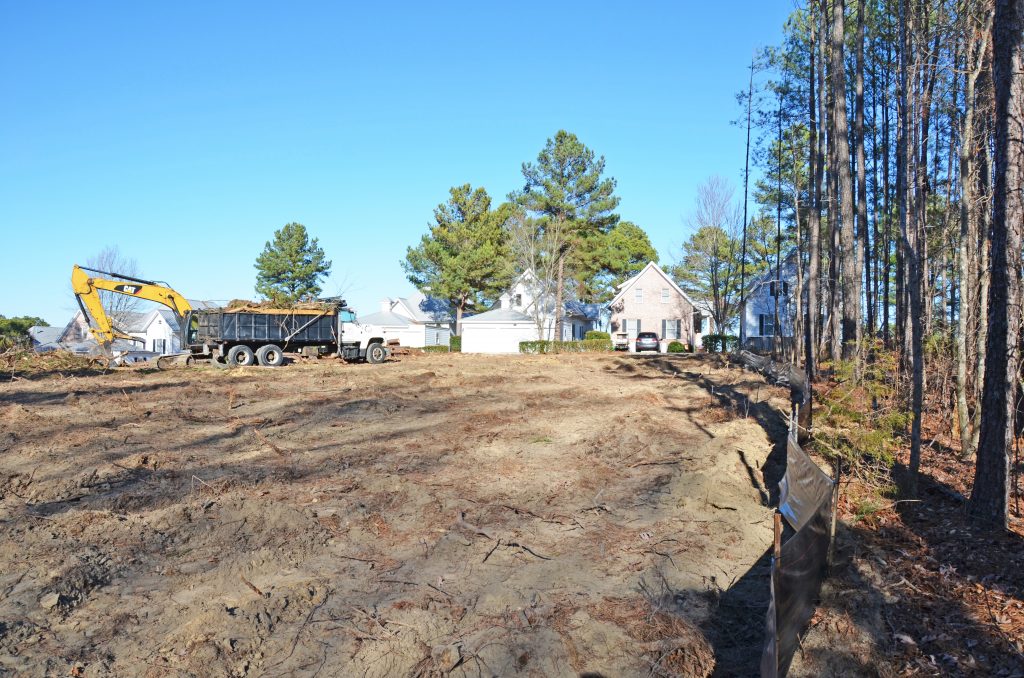
    As rain pelted Blythewood on Monday, stormwater gushed into the streets and onto lots in the Cobblestone Park neighborhood in Blythewood, causing several lots to flood. It’s become a common theme after any heavy rainstorm, residents say.

    Some homeowners think the root cause is traced to trees they say homebuilder D.R. Horton has been clearcutting in preparation for additional home construction.

    “We really don’t want to see any more lots that are left with zero trees,” said Bob Zedosky, who addressed Blythewood Town Council during public input Monday evening. “What happens when you cut down all the trees is, if you’re brave enough, put on your hip boots and go on these lots,” Zedosky said. “Be prepared to sink in … with mud and stuff. It’ll be a nice, muddy mess.”

    Zedosky and other Cobblestone Park residents want council members to reverse a section of the town’s landscape and tree preservation ordinance that, the town attorney says, can be interpreted to exempt developers from the town’s tree preservation requirements. Council members already have passed first reading on an ordinance repealing the exemption.

    On Monday, Council voted 4-1 to postpone second reading until May 10, with Councilman Bryan Franklin dissenting.

    Developers, however, oppose lifting the exemption. They sympathize with the flooding issues, which they characterize as temporary, but also insist lifting the exemption impedes their ability to do business.

    Jesse Bray with D.R. Horton, the developer building out Cobblestone Park, said the proposed ordinance singles out the homebuilder.

    “Developers and others will start looking elsewhere before doing business,” Bray said. “They want to know what the rules are from the start.”

    Shane Alford with Essex Homes took things a step further, playing what he said were audio recordings of council members showing support for the original ordinance that allowed the exemptions.

    Alford likened the effort to rescind the exemption to “finding soccer goals on the field at the end of a football game. We do not want rules to change halfway through the game. It may jeopardize the investment that we have,” he said. “It is our opinion that for the town to operate in a principled and thoughtful manner, repealing this covenant between it and the public would be wrong.”

    Blythewood Mayor J. Michael Ross, who supported removing the exemption, responded with a sporting analogy of his own.

    “So much water came from those lots because there’s no vegetation there. It ran into the drain on the opposite side of the street,” Ross said. “The fields have been torn up and there are no fields for anyone to watch any sport.”

    Tensions have been simmering for years since the ordinance exempting developers was enacted in March 2015.

    In 2017, two Cobblestone Park families sued D.R. Horton and the town, saying prior covenants were breached when D.R. Horton began subdividing lots near their homes for residential development.

    The suit contends that their properties were supposed to border a nine-hole golf course or greenspace if a golf course wasn’t built.

    The suit is still pending. On March 1, a circuit judge issued a temporary injunction barring development of the lots as the case proceeds.

    As for the landscaping and buffer ordinance, council members said they plan to revisit the issue during the council’s budget work session May 10.  An executive session for the receipt of legal advice concerning the proposed ordinance is likely to be added to the agenda, Ross said.


    Related Articles:  Town threatened over tree law

  • Council refinances BFC bond

    BLYTHEWOOD – Town Council voted during a special called meeting last week to refinance the 2010 $5M Blythewood Facilities Corporation (BFC) bonds for a savings of $51,000 the first year and $25,000 annually, thereafter, for a total savings of $470,000 over the life of the bonds.

    The Town’s payments on the bonds currently run about $350,000 annually. The refinancing is through BB&T bank, which is offering a 3.65 percent interest rate that is 8.7 percent lower than the bond’s current interest rate of 4.33 percent.

    The more favorable refinancing is predicated by the release (refunding) of a $358,475 debt service reserve fund or escrow that the Town had to set aside for security at the time of the bond’s issuance in 2010. That $358,475 will now go toward reducing the loan.

    That debt service reserve fund, which represented principle and interest on the loan for one year, was initially required for security on the loan for two reasons, Parker Poe representative Brent Robertson said.

    “The assets being financed by the bond were not essential for governmental purposes such as an administration building or jail, but for Doko Manner and Doko Meadows. Plus, it was a brand new credit for a public offering. So investors were looking for additional security,” Robertson said. “We’re now in an environment with a private placement where an individual purchaser (BB&T) is buying the bonds. Now that it has a history of repayment, the Town is able to negotiate the release of that debt service reserve fund.”

    By moving forward with the refunding (release) of the reserve fund, it can be used to downsize the amount of bonds that the Town has outstanding.

    “With that reduction, the cash flow savings benefit runs about $25,000 a year with the initial year estimated at $51,000,” Robertson said.

    Council authorized the refunding last fall when it decided, ultimately, not to go ahead with the refinancing at that time, so from now forward, Council will not have to take any additional action to authorize the release of the debt service reserve funds.

    The bond is scheduled to be paid off in 2035.

  • Pub-type restaurant to open in Doko Depot

    Doko Depot

    BLYTHEWOOD – In a special called Town Council meeting Monday evening, it was announced that the owners of the Old Mill Brew Pub in Lexington will be leasing half of the Doko Depot building for a similar restaurant to open under the name of Doko Station.

    “I’m very excited about the restaurant,” the Town’s economic development consultant said. “It will offer a full menu including salads, sandwiches, steaks and a number of craft beers.”

    The other half of the building will house Don Russo’s Freeway Music, Jeff Wheeler of Wheeler & Wheeler, LLC, a Columbia development company, told Council. It was also announced that Russo will now be purchasing the building, not Wheeler & Wheeler, who signed a contract with the Town last December to purchase the building for $325,000.

    By late January 2018, Wheeler asked for and was granted a more favorable earnest money arrangement and an extension on the purchase contract. At the same time, Freeway Music owner, Don Russo, told The Voice in an exclusive interview that he planned to lease the building from Wheeler and Wheeler. That extension ended last month without a closing.

    On Monday night Wheeler appeared before Council to ask for an additional 90-day extension of the contract and for Council’s approval of an assignment of Wheeler & Wheeler’s interest in the contract to Russo’s company, Blythewood Depot Property, LLC.

    Council voted unanimously to approve the assignment and to extend the inspection period of the contract for 90 days.

    “I don’t expect it to take nearly that long,” Mayor J. Michael Ross told council members. “But I don’t want to have to come back and approve another extension.”

    The Doko Station restaurant is expected to open in about three months, Wheeler said.

  • Town Hall meeting to address traffic circle

    BLYTHEWOOD  –  Blythewood Town Council has scheduled a town hall meeting concerning a traffic circle proposed for Blythewood Road to be constructed through the Richland Penny Tax program. Controversy has picked up over the proposed traffic circle that would impact the Blythewood Road entrances to Cobblestone Park, Palmetto Citizens Bank, the Food Lion shopping complex and two properties owned by Blythewood businessman Larry Sharpe.

    “Council is going to be discussing the circle and proposing some solutions to possible traffic problems associated with the circle, and we hope residents will attend the meeting and provide their input,” Mayor J. Michael Ross said.

    The meeting is scheduled for Tuesday, April 24, at 6 p.m. at the Manor. For more information, call Town Hall at 754-0501.

  • Planning Commission sides with developers against tree law amendment

    This photo was taken on Jan. 14, 2018, shows a clear cut in progress on five contiguous wooded lots between Links Crossing Drive and Golden Spur Lane in Cobblestone Park. | Michael Criss

    BLYTHEWOOD – During its February meeting, Town Council voted to adopt an amendment to the town’s tree preservation ordinance that would remove an exemption that Town Attorney Jim Meggs suggested is being interpreted by developers as permission to clear cut lots without a tree removal permit from town hall.

    On Monday night, the Planning Commission saw things from the developers’ perspective and unanimously recommended that Council reverse its decision and vote against adopting Meggs’ amendment when it takes a second and final vote on the issue at its April meeting.

    For years, Blythewood’s town administrator, with input from the town attorney, planning consultant and planning commission, has been interpreting the town’s tree preservation code to mean the town government can enforce tree removal permits on undeveloped, platted, single-family residential lots in established subdivisions or new neighborhoods like Abney Hill Estates, Phase 2.

    But when Michael Criss, the town’s planning consultant, recently tried to stop developer D.R. Horton from clear cutting five lots in Cobblestone Park next to the mayor’s home, the town’s attorney, Jim Meggs, examined the town’s tree preservation ordinance more closely and decided the ordinance contained a weakness that allowed another interpretation of the ordinance, one that developers were using to clear cut lots without a permit from town hall.

    That weakness, Michael Criss told the Planning Commission on Monday evening, is found in section (H) of the ordinance and states that, those projects are exempt from the permitting process for tree removal if they have received major subdivision or site plan approval prior to the effective date of this subchapter and amended major subdivision and site plans.

    “If Mr. Meggs’ interpretation of the current code is correct and would prevail,” Criss told the Commissioners, “the town’s hands are tied in enforcing permits for tree removal on undeveloped lots in most of our neighborhoods in the town – Ashley Oaks, Abney Hill Estates, Cobblestone Park, Blythe Creek, Lake Ashley, etc.”

    To remedy what Council termed a loophole in the ordinance, Meggs’ drafted amendment surgically removes exemption (H) from the ordinance.

    Jesse Bray, representing D. R. Horton, pushed back against that amendment.

    “We’ve cleared [clear cut] dozens of acres in Cobblestone and it wasn’t an issue, but now it seems to be an issue because it’s next to the mayor’s house,” Bray told the Commissioners. “You throw around ‘flaw’ and ‘loophole’. It’s not a loophole. It’s in your ordinance. D. R. Horton is not trying to get away with anything. We’re the largest builder in the U. S. We don’t skirt rules,” Bray said.

    “Look at the plot plans…we have a 60-foot x 120-lot, the average lot size in Cobblestone. It has a 15-foot setback, a five-foot side set back and we’re allowed to clear a 20-foot buffer around the 50-foot x 50-foot home site. That leaves you ten feet in back. If we have a swale for drainage, that comes out of the ten feet,” Bray told the Commissioners.

    Complicating the issue is that the current tree preservation ordinance, which was adopted in 2015 with the intent of preserving trees, would have done just that had the General Assembly not interfered.

    “In its wisdom, the General Assembly voted in 2010 and again in 2013 to protect developers hard hit by the 2008 recession by extending the life of the existing local development permits for nine years,” Criss said.  “That kept permits alive that dated as far back as 2007. Since then, Blythewood has adopted stricter tree preservation regulation and stricter storm water management regulations. But just about all of the town’s projects now fall under the General Assembly’s grandfathered rules,” Criss said. While the grandfathered rules continue projects previously permitted for roads and infrastructure, they can also thwart the town’s current ordinance by enabling previously permitted mass-graded projects to remove all trees from individual lots as well as roadways, storm drainage areas, etc.

    “Under the current ordinance, we felt the individual lots were protected from clear cutting in Cobblestone Park,” Criss said. “The town attorney felt there was a weakness in the ordinance and he is trying to fix it with this proposed text amendment.”

    Town Council is expected to take its second and final vote at the April meeting.

  • Town threatened over tree law

    BLYTHEWOOD – Town Council held a public hearing Monday night concerning Council’s desire to amend Ordinance 155.390 (Landscaping and Buffer Requirements) by repealing section (H) which exempts certain projects from the ordinance requirements.

    Council and residents say section (H), which was adopted in 2015, is an unintended loophole in the ordinance that allows developers to abuse the ordinance to the point of clear cutting lots.

    Earl McLeod, Executive Director of the Building Industry Association of Central South Carolina said the amendment would be tantamount to changing rules in the middle of the game and threatened to lawyered up if the ordinance is amended.

    Section (H) states that those projects are exempt “which have received major subdivision or site plan approval prior to the effective date of this subchapter and amended major subdivision and site plans.”

    Council is reviewing the ordinance to be sure it is clear in regard to section (H).

    The issue arose recently over lots that D.R. Horton clear cut in Cobblestone Park. Residents there said they woke up one morning to find the trees on lots next door to them gone.

    “This was not the intent of our ordinance which was to protect the trees and landscaping in our town,” Mayor J. Michael Ross said.

    The stated purpose of the ordinance is to prevent “indiscriminate, uncontrolled and excessive destruction, removal and clear cutting of trees upon lots and tracts of land…”

    The intent of the subchapter is long and detailed: “to promote the health, safety and general welfare of the public; to facilitate the creation of a convenient, attractive and harmonious community; to conserve natural resources including adequate air and water; to conserve properties and their values; to preserve the character of an area by preserving and enhancing the scenic quality of the area; and to encourage the appropriate use of the land…and to provide shade,” among other things.

    All residential, commercial or industrial lot owners wishing to remove trees of certain kinds and sizes must comply with a list of rules and regulations, the ordinance states.

    But representatives of the building industry were on hand to push back against the proposed amendment.

    Shay Alford with Essex Homes said he is concerned about implications on a broader scope, to projects already permitted and in existence.

    “We go through a strenuous process to achieve permitting. That is an agreement we have with the Town. If you change the rules of the game, that creates a series of complications and hardships for us that were unintended, perhaps, but still exist,” Alford said.

    While Jesse Bray with D.R. Horton chose not to speak, he said he agreed with Alford.

    McLeod was blunt, telling Council that they might want to consider the consequences of amending the ordinance.

    “State law provides for vesting for a project once it is permitted in that a developer can rely on the rules in place at the time of permitting,” McLeod said. “That’s an issue you need to be concerned with…To change that midstream would certainly be open to litigation and none of us want to go there,” he said.

    While town attorney Jim Meggs suggested to Ross, “We would want to talk about the legal aspects in executive session,” the mayor didn’t back down from defending the Town’s reasons for wanting to abolish the exemption.

    “The people of Blythewood who live here in these developments are the ones who are not happy seeing all the trees taken down,” Ross said. “When we adopted this ordinance, we did not think there was an exemption in there. We missed that. But when the public comes to you from whatever neighborhood and says, ‘We don’t like the lots being clear cut,’ we have let them down. We answer to them, too. There are two sides to this.”

    The issue has been sent back to the Planning Commission for a recommendation before Council holds second reading.