Tag: Blythewood Planning Commission

  • Lack of quorum delays hotel vote

    BLYTHEWOOD – For the second time since March, the Blythewood Planning Commission didn’t come up with a quorum for their regular monthly meeting.

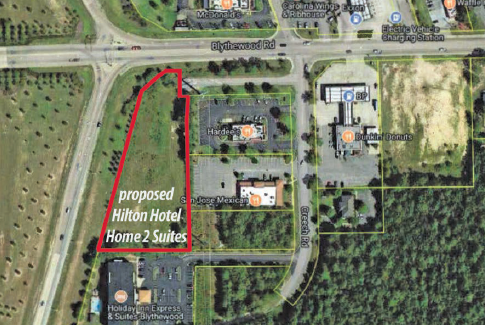
    On Tuesday evening, representatives for Hilton Hotel’s Home 2 Suites came before the commission to resolve commissioners’ earlier questions concerning traffic access to a 1.93 acre site where representatives of the hotel chain are requesting to build a four-story, 88-bed hotel building. The site is adjacent to I-77 and sits behind San Jose’s restaurant.

    But only three members of the commission, Chairman Donald Brock, Marcus Taylor and Rich McKenrick, showed up to hear what applicant Jeff Carter, an engineer with Georgia-based Carter Engineering Consultants, had to say. Carter had traveled from Atlanta for a second appearance before the commission. Ross Wagers, a part-owner of the hotel, was also present and had traveled from Anderson for the meeting.

    The meeting was delayed for half an hour while the commission chairman and town clerk tried to reach Commissioner Robert Cappadona, who had confirmed earlier that day that he would be at the meeting. Without Cappadona’s presence, there was no quorum for the seven member commission.  When Cappadona did not answer or respond to the calls, the meeting was cancelled.

    Mayor J. Michael Ross commented on the lack of a quorum, saying his feelings could be summed up in one word – “Disappointing.”

    Three other board members, Cynthia Shull, Michelle Kiedrowski and Matt Hulett, had earlier confirmed that they would not be attending the meeting.

    The Commission, which meets the first Monday of the month, it has only met four times this year and in March was unable to muster a quorum.

    Because the applicant must also appear before the Board of Architectural Review (BAR) for a Certificate of Appropriateness, a special called meeting of the Planning Commission has been scheduled for Sept. 17, to coincide with a BAR meeting that same evening in order to eliminate an extra trip for the applicant.

    The request first came before the commission in early August but was deferred by the commission until Tuesday evening so the commissioners’ concerns regarding what they considered problematic traffic access to the hotel off Blythewood Road could be resolved.

    Town Administrator Brian Cook said last month that Town Hall staff had been working with SCDOT on the issue and that SCDOT had conditionally granted access to the site using SCDOT’s right of way.

    While those attending the Tuesday evening meeting were waiting for Cappadonna to arrive, Carter reviewed for the commissioners the conclusions of a traffic study conducted by Seneca engineer Roger Dyar which stated that the overall effects on the peak hour traffic flow on the hotel access are minimal.

    The report recommended that the proposed site’s access plan should be approved since the site will result in only very minor additions to delay and queues in the study network.

  • Hilton’s Home 2 Suites eyes Blythewood site

    A new hotel brings site plans to Blythewood Planning commission.

    BLYTHEWOOD – Hilton Hotel’s Home 2 Suites is considering putting down roots in Blythewood. The hotel’s owners are seeking permission from the Town to build a four-story, 88-bed hotel building on a 1.93 acre vacant lot adjacent to the I-77 ramp. But without considerable adjustments to the entrance to the property, the 55,672 square foot building would have no direct access to Creech Road.

    The parcel is tucked between I-77, the Holiday Inn Express & Suite, Hardees and San Jose’s Mexican restaurant. A site map shows access to the parcel off Creech Road across from the west side of the Sharpe BP Service Station.

    But that access doesn’t meet SCDOT standards.

    Civil Engineer Jeff Carter, of Georgia-based Carter Engineering Consultants, presented Paragon Hotels’ plans to the Blythewood Planning Commission Mon­day night.

    Consensus of the Commission members was that it is a good project for Blythewood but the access is problematic.

    Commission Chair Donald Brock ad­dressed the lack of a traffic study and said traffic access to the site presents problems.

    “Ingress and egress to the site is a prob­lem,” he said. “I see that the right-in and right-out onto Creech Road is going to send everyone down a dead end street. What are drivers supposed to do when they get there and have no place to go?” Brock asked.

    Town Administrator Brian Cook said staff has been working with SCDOT on this issue, and that SCDOT has conditionally granted access to the site using SCDOT’s right-of-way.

    “The existing service road would have to be removed and replaced to enable two-way traffic,” Cook told the commissioners. “The access road would need to be a mini­mum of 24’ wide with an appropriately designed connection to Creech Road so as not to negatively impact Creech Road or Blythewood Road which is directly adja­cent,” Cook said.

    Cook said the design would need to in­clude proper radii and an approximate median enforcement to satisfy the SCDOT requirement that this access be a right-in, right-out due to the proximity to Bly­thewood Road.

    Carter expressed his concern that even after doing a traffic study the options would still be very limited and driven by what SCDOT would allow. He said he felt that the developer would agree to install­ing a turnaround at the end of Creech Road where it dead ends.

    Councilman Rick McKenrick asked Carter whether the hotel owners were considering buying additional lots around the site to improve the traffic pattern. Carter said he felt they are still considering that possibility.

    Councilman Marcus Taylor cited the ex­treme traffic problems that already exist on Blythewood Road during high traffic times and said this would significantly add to the problem.

    After lengthy debate and persistent ad­monition by Brock that even conditional approval would not be the best way to proceed, a motion was made to defer the agenda item until the Sept. 4 Planning Commission meeting. The motion was seconded and all council members voted in favor of deferral.

    Cook told the commissioners that he would continue to work with SCDOT and the engineers to address the traffic pattern concerns.

    Blythewood Consultant Michael Criss announced that his services to the Town would end on Aug. 31, 2018 and expressed that he had enjoyed working with the Commission members.

  • Commision endorses vendor ordinance

    BLYTHEWOOD – After more than a year of handwringing over whether to allow temporary vendors in the Town Center District, the Planning Commissioners voted Monday night to recommend that Council adopt the City of Columbia’s vending ordinance, presented by Town Administrator Brian Cook, with a few tweaks. That modified ordinance, basically, allows temporary vendors and food trucks the same rights and privileges as brick and mortar buildings, but with almost none of the costly architectural or other restrictions imposed on brick and mortar buildings.

    That modified vendor ordinance would allow vendors to sell merchandise, goods, services, or forms of amusement from a temporary structure, such as a tent, awning, canopy, umbrella, stand, booth, cart, trailer, from a vehicle, or from his person. A temporary vendor does not include a person who conducts the majority of his business from within a permanent and enclosed building located upon the same lot.

    Unlike brick and mortar buildings, vendors would not be required to provide handicap restrooms or any restrooms at all.

    While the Commissioners initially worried that aesthetics of temporary vendor’s vehicles, tents, trailers, etc, could become a problem, they concluded that aesthetics for vendors would be too difficult to regulate by ordinance and moved on. Brick and mortar buildings in the Town Center District are required to adhere to certain types, quality and colors of building materials, architectural styles, signage, lighting and landscaping. There are no such restrictions on vendor vehicles, tents, trailers, etc.

    Cook said he presented the same modified ordinance to the Board of Architectural Review two weeks ago and they expressed concern regarding the fairness issue when it came to food trucks locating within 100 feet of a brick and mortar food establishment.  The Commissioners responded by requiring a distance of 250 feet between vendors and certain businesses.

    Commission member Rich McKenrick suggested that multiple temporary vendors might want to set up on a single property.  Cook indicated that the ordinance itself did not prohibit that but that other restrictions regarding number of parking places, safety regarding ingress and egress would apply.  The modified ordinance also restricts vendors from operating within 400 feet of residences.

    After flirting with a few concerns, the Planning Commission voted unanimously to adopt the modified City of Columbus ordinance with the following tweaks:

    Allow the Town Administrator to have sole authority to give written permission for a temporary vendor to operate in the Town Center District,

    Increase the distance between a vendor and the front door of a lawfully established restaurant from 100 feet to 250 feet, and

    Limit occupancy of a vendor to no more than 10 hours a day (24 hours). At all other times the vendors must vacate the parcel they occupy.

    It was confirmed by the Planning Commission Chairman, Donald Brock, that the modified ordinance would not affect Grace Coffee. After Grace Coffee refused to continue moving its trailer off the parcel every night as it had initially agreed to do, Cook interpreted the Town’s zoning laws to confirm that Grace Coffee is now a business in good standing, compliant with the Town’s necessary zoning approvals.

    Town Council will vote on the Commission’s recommendation on the vendor ordinance at its next regular meeting on June 25.

  • Planning Commission sides with developers against tree law amendment

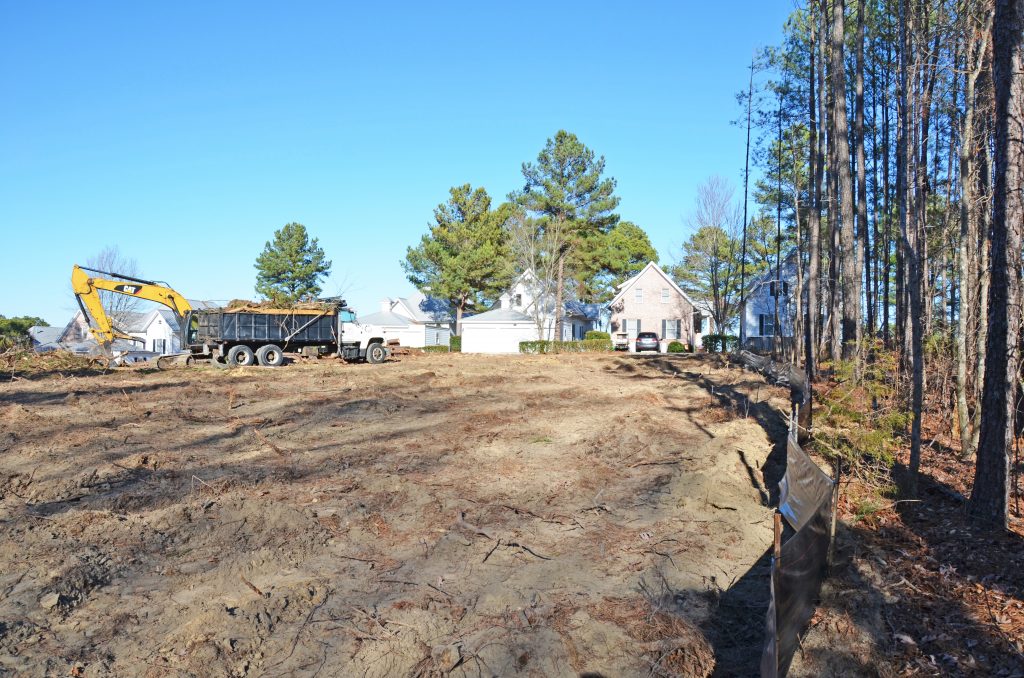
    This photo was taken on Jan. 14, 2018, shows a clear cut in progress on five contiguous wooded lots between Links Crossing Drive and Golden Spur Lane in Cobblestone Park. | Michael Criss

    BLYTHEWOOD – During its February meeting, Town Council voted to adopt an amendment to the town’s tree preservation ordinance that would remove an exemption that Town Attorney Jim Meggs suggested is being interpreted by developers as permission to clear cut lots without a tree removal permit from town hall.

    On Monday night, the Planning Commission saw things from the developers’ perspective and unanimously recommended that Council reverse its decision and vote against adopting Meggs’ amendment when it takes a second and final vote on the issue at its April meeting.

    For years, Blythewood’s town administrator, with input from the town attorney, planning consultant and planning commission, has been interpreting the town’s tree preservation code to mean the town government can enforce tree removal permits on undeveloped, platted, single-family residential lots in established subdivisions or new neighborhoods like Abney Hill Estates, Phase 2.

    But when Michael Criss, the town’s planning consultant, recently tried to stop developer D.R. Horton from clear cutting five lots in Cobblestone Park next to the mayor’s home, the town’s attorney, Jim Meggs, examined the town’s tree preservation ordinance more closely and decided the ordinance contained a weakness that allowed another interpretation of the ordinance, one that developers were using to clear cut lots without a permit from town hall.

    That weakness, Michael Criss told the Planning Commission on Monday evening, is found in section (H) of the ordinance and states that, those projects are exempt from the permitting process for tree removal if they have received major subdivision or site plan approval prior to the effective date of this subchapter and amended major subdivision and site plans.

    “If Mr. Meggs’ interpretation of the current code is correct and would prevail,” Criss told the Commissioners, “the town’s hands are tied in enforcing permits for tree removal on undeveloped lots in most of our neighborhoods in the town – Ashley Oaks, Abney Hill Estates, Cobblestone Park, Blythe Creek, Lake Ashley, etc.”

    To remedy what Council termed a loophole in the ordinance, Meggs’ drafted amendment surgically removes exemption (H) from the ordinance.

    Jesse Bray, representing D. R. Horton, pushed back against that amendment.

    “We’ve cleared [clear cut] dozens of acres in Cobblestone and it wasn’t an issue, but now it seems to be an issue because it’s next to the mayor’s house,” Bray told the Commissioners. “You throw around ‘flaw’ and ‘loophole’. It’s not a loophole. It’s in your ordinance. D. R. Horton is not trying to get away with anything. We’re the largest builder in the U. S. We don’t skirt rules,” Bray said.

    “Look at the plot plans…we have a 60-foot x 120-lot, the average lot size in Cobblestone. It has a 15-foot setback, a five-foot side set back and we’re allowed to clear a 20-foot buffer around the 50-foot x 50-foot home site. That leaves you ten feet in back. If we have a swale for drainage, that comes out of the ten feet,” Bray told the Commissioners.

    Complicating the issue is that the current tree preservation ordinance, which was adopted in 2015 with the intent of preserving trees, would have done just that had the General Assembly not interfered.

    “In its wisdom, the General Assembly voted in 2010 and again in 2013 to protect developers hard hit by the 2008 recession by extending the life of the existing local development permits for nine years,” Criss said.  “That kept permits alive that dated as far back as 2007. Since then, Blythewood has adopted stricter tree preservation regulation and stricter storm water management regulations. But just about all of the town’s projects now fall under the General Assembly’s grandfathered rules,” Criss said. While the grandfathered rules continue projects previously permitted for roads and infrastructure, they can also thwart the town’s current ordinance by enabling previously permitted mass-graded projects to remove all trees from individual lots as well as roadways, storm drainage areas, etc.

    “Under the current ordinance, we felt the individual lots were protected from clear cutting in Cobblestone Park,” Criss said. “The town attorney felt there was a weakness in the ordinance and he is trying to fix it with this proposed text amendment.”

    Town Council is expected to take its second and final vote at the April meeting.

  • Deadlines tighten on vendor regulations

    BLYTHEWOOD – On Monday night, the Planning Commission once again tackled the question of what policies, procedures and guidelines the Town government should put in place for itinerant vendors who want to set up shop in the Town Center District.

    And, once again, the Commission punted.

    Commission Chair Donald Brock opened the issue by questioning whether the discussion should be put off until the Blythewood Chamber members could have a seat at the table.

    Commissioner Rich McKendrick, however, questioned whether it is appropriate that the Chamber be in the mix during a regular meeting of the Commission. He suggested a workshop might be the more appropriate place to include so-called stakeholders on the issue.

    “I’d say the Chamber position would be to get as many businesses into town as possible for more revenue,” Brock said. He also suggested earlier in the meeting that the Commission should question whether they, ultimately, even want itinerant merchants doing business in the town.

    “Once that question is answered, it will steer us in the direction of where we want to go,” Brock said.

    While Town Planning Consultant Michael Criss listed some of the pluses of street vendors (they add interest and pedestrian traffic to the TCD), he also said there are concerns about the aesthetics of unregulated vendors and referenced Grace Coffee.

    “However, the coffee vendor (Grace Coffee) was approved for a Certificate of Approval (COA) last year [April, 2017], by the Board of Architectural Review (BAR),” Criss said.

    A loophole in the Town’s code of ordinances paved the way for Grace Coffee, a vendor housed in a small turquoise and white mobile home on Main Street in downtown Blythewood, to do what no other business in town has been able to do – receive a COA without meeting the Town’s architectural review standards.

    It appears the Town’s ordinance regulating architectural review in the Town Center District (TCD) did not have well-defined regulations for mobile vendors.

    “We were asked to give a COA without guidelines,” BAR [then] Vice Chairman Jim McLean told The Voice. “We (the BAR) did not want to do that because a COA is permanent. We grappled with it, and we did all we could do, considering the Town has no architectural review standards in place for mobile vendors,” McLean said. “The Town was caught off guard.”

    Instead, the BAR agreed to grant a one-year conditional COA to the business to give the Town Council time to draw up standards and an ordinance for mobile vendors. That year will be up on or about April 17, 2018 and the Commission is no closer to forwarding a draft ordinance on the issue than it was a year ago.

    At issue, according to Criss, is the definition of ‘structure’ in the Town’s code of ordinances.

    “Structure’ is very broadly defined in the code, yet this mobile vendor is a ‘structure,’ and because it is in the TCD, it must have a COA from this Board for its exterior appearance,” The Town’s Planning Consultant Michael Criss told the Board in April, 2017.

    While brick and mortar buildings in the Town Center District must adhere to guidelines for paint color, lighting, whirly gigs and other exterior architectural features, Grace Coffee was not required to meet any of those standards, Criss said.

    However, McLean said the coffee vendor’s COA is based on how it currently stands and that it cannot make further (substantive) changes in its appearance going forward without coming back to the BAR.

    Newly installed Board Chairwoman Pam Dukes then asked how the sign allowances would be applied to Grace Coffee.

    That, too, turned out to favor the vendor over the town’s brick and mortar businesses.

    “It’s clear what the regulations are for permanent structures that are affixed to the ground,” Criss said. “The landlord gets one monument sign freestanding out in the front yard and one wall sign on the facade facing the street.”

    Those signs, according to the Town’s code must meet specific size and quantity guidelines.

    “But it’s not crystal clear what the sign limitations are on a mobile unit such as a trailer,” Criss said.

    Grace Coffee usually has four signs displayed – one at each entrance, one on the trailer and a menu sign in front of the trailer.

    “Suppose they were frying chicken in there,” McLean asked, referencing a discussion the Board had earlier in the meeting with Kentucky Fried Chicken officials who are looking to make major exterior renovations of the KFC in downtown Blythewood.

    “I’m trying to go back and grab the fairness. We just turned down Kentucky Fried Chicken about what they can and can’t do (with signage),” McLean said, pointing out that brick and mortar businesses in the Town are held to higher standards.

    The discussion has been ongoing ever since Grace Coffee pulled in to town in December, 2016 and set up shop in the parking lot of Bits and Pieces consignment store.

    “When we initially talked with them (Grace Coffee), they said they were going to take the trailer away each night. But now it sits there,” Mayor J. Michael Ross told Council in January of last year. “It’s another example of how a vending stand comes in and is just left there. It’s frustrating.”

    At the February, 2017 meeting, Grace Coffee’s owner Bret Beyer added another dimension to the mobility issue, telling Council members that the stand was no longer mobile, that it could not be moved.

    While a one-year temporary vender ordinance was passed in March, 2017 and Grace Coffee’s one-year COA is set to expire in April, and the Planning Commission is charged with coming up with draft standards [ordinance] for mobile vendors for recommendation to Town Council before those one year terms expire, expectations are growing slim that a new, permanent vending ordinance will be in place to meet those deadlines. The issue is not expected to be brought up for discussion again until Town Council’s annual retreat on March 10.
  • Horton cottages fail PC rezoning criteria, Brock elected PC Chair

    BLYTHEWOOD – The Planning Commission members unanimously elected Donald Brock to chair the Commission Monday evening. Brock replaces Brian Franklin who was elected to Town Council last month. Brock is a resident of Oakhurst neighborhood.

    Brock

    Developer D. R. Horton was back on the Commission’s doorstep Monday evening requesting the rezoning of 4.76 acres near the Cobblestone Clubhouse from Planned Development/ R-3 (PDD, R-3), single family attached townhomes to Planned Development/R-2 (PDD, R-2, single family detached residential).

    A Horton representative said Horton plans to build 12 to 13 cottage-style homes on the parcel.

    In October, the Commission recommended that same rezoning request based on several residents’ expressed desires to have cottages over townhomes.

    However, when the issue came before Council, the residents switched gears, telling Council they were afraid the cottages were not going to come up to neighborhood standards and asked Council to turn Horton’s request down.  Council obliged.

    When Horton came back to the Commission Monday night asking for a re-do of the October vote, the Commissioners weren’t as eager to comply.

    New chair Brock cited a memo from Town Attorney Jim Meggs stating that generally the same rezoning can’t be resubmitted for a year unless the Commission determines either: 1) there has been a substantial change in the character of the area or 2) factors exist which were not considered in the previous deliberations which might substantially alter the basis for the Commission’s recommendation.

    Brock said neither was the case, and the Commission voted unanimously against recommending the rezoning.

  • PC briefed on sketch plan approval

    BLYTHEWOOD – Planning Commissioners were briefed at their November meeting on proposed changes to the Town’s subdivision ordinance designed to give developers greater certainty about the Town’s subdivision review and approval process. Sketch plan approval would be given to the Commission rather than being optional.

    Currently, the town’s planning consultant and administrator approve sketch plans. By the PC doing it instead, before developers commit to expensive engineering and to drafting a preliminary plat, they’ll know that their project’s basic design is acceptable to the Commission with regard to zoning conformance, lot count and layout, road geometry, utility services, sidewalks, trails, open space, tree preservation, etc .

    The Planning Official will prepare a report and recommendation on the sketch plan to the Commissioners when the PC first reviews it.

    Under State Code 6-29-1130.  the Commission will make a recommendation on the proposed changes to Council, who has already had first reading on it.

  • McLean Resigns from Planning Commission

    Neil McLean

    Blythewood planning commissioner Neil McLean resigned his seat on the commission at the end of the Aug. 6 meeting.

    McLean said it was time to step down due to business opportunities and family commitments. Two years remained on his current four-year term. The position is appointed by the Town Council.

    In other business, town administrator John Perry told the commission that changes would need to be made in the town’s tree and landscape ordinance to reflect the
    Attorney General’s opinion that the town does not have jurisdiction over the clear cutting of trees in buffering areas along right-of-way areas.

    Perry said that in that instance, “We do not have the authority to enforce rules that are set forth in our town ordinance.”

    “If land is assessed by the County,” Perry said, “then it is governed by the forestry rules.”

    Perry discussed the need to look at  the town’s sign ordinance again in terms of window signage. Perry said that while some businesses want to put signs in their windows, the commission might want to look at balancing businesses’ desires for the signs with the architectural standards of the town. Perry also announced that the Town had contracted with Wayne Schuler at the Central Council of Governments (COG) to be the project manager for the updating of the Town’s Comprehensive Plan.

    Perry discussed the Town’s and SCDOT’s joint beautification project at the I-77 interchange.

    “We will be planting 100 live oak trees and other landscaping,” Perry said. He also said construction had begun on new decorative signal lights on the west side of I-77. The landscaping of the interchange is expected to be completed by December of this year.