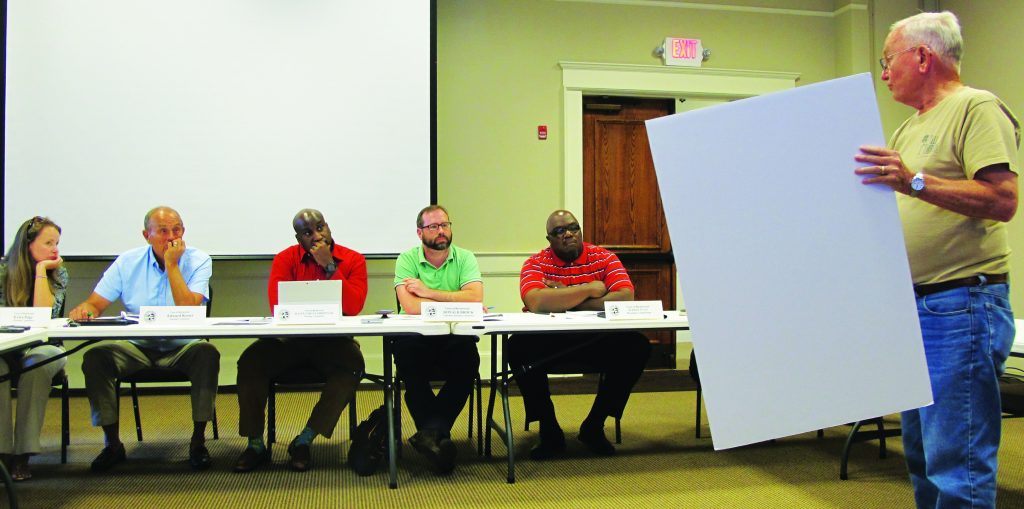
BLYTHEWOOD – As was expected, the Blythewood planning commission voted 5-0 Tuesday evening to recommend that Town Council rezone the Red Gate property and a smaller adjoining property from Planned Development (PD) zoning designation to Development (D-1) zoning.
But the properties’ owners, who sat in the audience during
the commission’s proceedings, say they are not happy with the commission’s
recommendation, and that it will keep them from developing their properties as
they had planned.
The rezoning of the 143-acre property has been discussed by
Blythewood town government for the last couple of years. Annexed into the town
in 2007 from Richland County where it had been zoned Planned Development
District (PDD), the property was subsequently zoned PD by the Town. Before it
could be developed, however, the property went through several transitions.
After the larger parcel (Red Gate) went into bankruptcy, its ownership was
assumed by Arthur State Bank. It was purchased last month by Blythewood
resident Byron Dinkins.
The 2.41-acre corner parcel was purchased by Larry Sharpe,
who said he had planned to construct a service station and convenience store on
the property.
“I don’t know what’s been going on over the years. It seems
like it’s always one thing or the other,” Sharpe told the commission.
“At first, Winnsboro couldn’t supply us with water. Now we
don’t have the sewer. We’re trying now to work with DOT (SC Department of
Transportation). The curb cuts have already been approved, but they can’t tell
us exactly where the new road is going to be,” Sharpe said. “I’ve already
cleared the property and brought it up to subgrade and built a detention pond
off site according to the recommendation of the engineers. Everything is
approved on that site, except we still don’t have sewer. That’s the only thing
that’s actually holding us back – that and the DOT recommendations. So, if
those things were in place, I would be ready to move forward.
“I would like to see the zoning stay as it is, because the
property is already predesigned for that use,” Sharpe said.
But the Town of Blythewood code of ordinances places a
time-specific condition upon the established PD zoning district, with a mandate
for the planning commission to initiate a rezoning under certain circumstances.
The commission determined at its Aug. 3 meeting that the Red Gate property
fails under those ‘certain circumstances,’
Town Administrator Brian Cook confirmed that if the zoning
were changed to D-1, and Sharpe planned to construct the service station and
convenience store, he would have to apply to rezone that corner parcel.
Dinkins attended the meeting with commercial real estate
broker Tom Milliken, who told The Voice following the meeting that Dinkins had
purchased the property with the intent of developing it according to the
original PD plans, and that the rezoning to D-1 would make it impossible for
him to do that.
The original PD zoned property was to be comprised of 232
single family units, 300 multi-family apartment units and 36 acres of general
commercial.
The D-1 zoning designation provides for large tracts of land
located primarily on the fringe of urban growth where the predominant character
of urban development as not yet been fully established, but is predominately
residential or agricultural with scattered related uses.
Council will met at 7 p.m., Monday, Sept. 28, at Doko Manor
for the first of two votes on the zoning fate of Red Gate.
BLYTHEWOOD – The Blythewood Planning Commission has begun the process to rezone a 143-acre undeveloped site across the interstate from downtown after developers failed to initiate construction of a planned mixed-use development.
The large wooded site, which is known as Red Gate Farms,
sits on Blythewood Road between Syrup Mill and Muller Roads. It lies across
Syrup Mill Road from Cobblestone; across Muller Road from Muller Road Middle
School and across Blythewood Road from Fairfield Electric Cooperative.
The property is currently zoned PD (Planned Development),
the town’s site-specific zoning designation for planned or mixed-use
development.
It was given that classification years ago, explained Town
Administrator Brian Cook, after a developer presented a plan for a mixed-use
development that was to include 233 single-family homes, 300 apartments, and 36
acres of commercial development.
The zoning for this property has been on the books since the
town annexed it in the mid-2000s, Cook said, but the project – and other,
subsequent proposed variations – never occurred. According to county records,
the bulk of the land is now owned by Arthur State Bank.
In its Monday night meeting, the Blythewood Planning
Commission discussed rezoning the property based on a provision in the town’s
zoning ordinance that mandates rezoning when a project with the PD
classification fails to progress within two years.
After some discussion, the commission voted unanimously to
direct town staff to craft a proposal to rezone the property to D-1, a
development district designed for large tracts of land on the fringe of the
town’s developed core.
“It puts the power back in our hands, especially since we
don’t know what the uses are going to be for this particular parcel of land,”
said Planning Commission Member Dereck Pugh, speaking in favor of classifying
the property as D-1. “It will give us the opportunity to review it again once
the [future] developer puts in the application.”
Cook said the commission discussed the issue of this
property in 2018 and again in early 2019, when a new proposal for a zoning
amendment and lower-density development was made but never moved forward.
“The applicant withdrew the application before town council
could take a vote on the proposed project,” Cook said, “and it stands today
with nothing happening on the property from a permitting or development
standpoint.”
The D-1 zoning classification, Cook said, is a kind of
holding pattern for land that’s likely to be developed in the future, allowing
for uses like single-family residential, parks and recreation, and religious or
government buildings, but requiring zoning approval for more intense types of
development.
“The district is intended to provide for large tracts of
land located primarily on the fringe of urban growth where the predominant
character of urban development has not yet been fully established, but where
the current characteristics of use are predominately residential or
agricultural with scattered related uses,” according to the town’s zoning
ordinance.
“It is further recognized that future demand for development
will generate requests for amendments in zoning designations to remove land
from the D-1 classification and place it into other more intensely developed
classifications as a natural consequence of urban expansion,” the ordinance
states.
Planning Commission Chairman Rich McKenrick said intentions
are to hold next month’s meeting in person with social distancing measures in
place with the option to participate via Zoom for commissioners and members of
the public who are uncomfortable attending in person, with social distancing
measures in place with the option to participate via Zoom for commissioners and
members of the public who are uncomfortable attending in person. The current
property owners will be informed of the meeting and invited to speak.
Cook said the town is currently undergoing a technology
upgrade that should make it possible to facilitate this plan from a technical
standpoint.
“We should’ve done something about this long ago,” said
McKenrick of the need to address the zoning at Red Gate, referring to the
property as a “golden nugget” on the edge of town. “The PD has sat out there
for way too long and is probably more dense than we would even want to approve
at this point.”
Cook said there is no rush to complete the rezoning, and the
town will follow the process required.
“I think that D-1 probably brings it back to the intent of
the master plan and comprehensive plan,” said commissioner Malcolm Gordge.
“Let’s hear what the immediate property owners have to say
about that,” Gordge said, “as well as the residents of the town.”
BLYTHEWOOD – Blythewood Planning Commission disregarded Town Administrator Brian Cook’s recommendation to vote against a request to rezone a Rural (RU) zoned property on Wilson Boulevard for commercial use. The commission voted unanimously Monday evening to recommend that town council rezone the property to a commercial zoning designation – Multi-Neighborhood Office (MO) District.
The property in question, located at 10715 Wilson Blvd. is
zoned RU, with Neighborhood Commercial (NC) zoning on one side, MO zoning on
the other side and RU zoning to the north, the rear and across Wilson Boulevard
to the east, according to Cook. The property backs up to a neighborhood of
residential properties, all zoned RU.
Cook explained that the future land use map in Blythewood’s
Comprehensive Plan currently designates the property for rural residential use.
“The idea for a rezoning in Blythewood is to discourage
urban sprawl down our corridors that enter our Town of Blythewood. We want to
encourage commercial zoning in pockets [in designated areas] and discourage
sprawl along roadways,” Cook said.
“Based on that and where the property is located, staff would not recommend the rezoning request at this time,” Cook said. “The potential would be to piggyback down the corridor with the same [commercial] zoning.”
Applicant Taricka Taylor appeared virtually before the
commission Monday evening to request rezoning of the property, which she owns,
to MO, telling commissioners that at least five properties on either side of
her property are all currently zoned commercial – “the day care, Dan Creed’s,
the property I own, the property I rent now and the horse farm.”
While only two properties in that segment of properties she
referred to are zoned commercial – one is zoned Neighborhood Commercial (NC)
and one is zoned MO – commissioners chose Taylor’s interpretation of the
zoning.
“It sounds like a reasonable request to me,” Commissioner Malcolm Gordge told his fellow commissioners. “I realize our intent is to avoid cluster development along our corridors into our town. But a business is already there [next to the property requesting MO zoning.] To me it seems perfectly in keeping with other businesses along there zoned for commercial use. I would favor granting the request on further down, there’s a little school enterprise and three businesses operating there.”
Commissioner Ed Kesser agreed.
“There’s a lot of commercial properties on that side of the
road,” Kesser said. “I think it’s a great commercial site and should be
rezoned. I recommend the property rezoning be approved.”
And with that, it was – unanimously – with no further
discussion.
The two properties in that block that have actual commercial
zoning designations are the one Taylor currently leases with MO zoning, and
another property that has a more restrictive NC zoning. The horse farm and day
care are zoned RU and are permitted in RU zoning.
Taylor said she currently operates an interior design
business at the MO zoned property at 10711 Wilson Boulevard, but purchased the
property next door for which she is requesting the commercial rezoning for her
current business.
Asked by The Voice about the zoning requirements for
Taylor’s business, Cook said MO zoning is a higher use zoning than Taylor’s
current business would require. NC and NO zoning, he said, would accommodate
her business as it is now. Both NC and
NO are more restrictive, allowing only light commercial uses and building
footprints are restricted to 5,000 square feet in NO and up to 10,000 square
feet for NC zoning under certain conditions. MO zoning jumps to medium
commercial uses and up to 15,000 square foot buildings under certain
conditions.
The property requested to be rezoned is in proximity to a
residential neighborhood in the rear and around the corner from Rimer Pond
Road, where residents have long fought against commercial zoning.
In March of 2015, as then chairman of the planning
commission, Gordge, championed commercial zoning on a nearby parcel on Rimer
Pond Road. In response to a request from an out-of-town owner for commercial
rezoning of his Rimer Pond Road RU zoned property, Gordge, on behalf of the
town, sent a letter that was obtained by The Voice. The letter read in
part: “The Mayor and I have discussed
your desire to amend the zoning of the property in question from Rural to
Commercial and we would like to help you if at all possible.”
Gordge went on to write that, “the staff at Town Hall and
myself would welcome the opportunity to chat with you informally and under no
obligation about your plans and how the Town might help.”
Gordge advised Warren that in order for the Town to help him
he would need to annex the property into the Town. Gordge further stated that
Warren could “feel free to write, call or e-mail me in confidence at any time.”
After a number of Rimer Pond Road residents opposed the
rezoning request during a planning commission meeting, the issue did not come
up again.
Because council’s next regular meeting falls on Memorial
Day, the rezoning request will be heard by Town Council at 7 p.m., on Tuesday,
May 26.
The proposed 2.86 acre apartment complex would be located next to IGA. | Graphic: Ashley Ghere
BLYTHEWOOD – The site plan of a 48-unit apartment complex proposed next to the IGA in downtown Blythewood was tabled Monday night by the Planning Commission over concerns about the amount of traffic the complex would foist upon Blythewood Road near the I-77 on/off ramps.
If the site plan for the complex, called The Park, is
approved and built, it will be the second apartment complex Prestwick Companies
of Atlanta has brought to Blythewood. Prestwick built The Pointe, a low-income
apartment complex, in October, 2017 on Main Street.
“So, you’re aiming for similar clientele at The Pointe?”
Commissioner Malcolm George asked Devin Blankenship, Senior Development Manager
for Prestwick Companies.
“This one [The Park] is a senior housing facility,”
Blankenship said, “but it’s financed through the low-income tax credit program,
so we consider it workplace housing. Same product.”
Town Administrator Brian Cook told The Voice that Prestwick
is not restricted to use the property as a senior living use.
“They can use it for senior living or other uses,” Cook
said. “It’s still multi-family housing that is permitted in the Town Center
District no matter whether it’s low income housing or senior living.”
Asked by Commissioner Ed Kessler who Prestwick would be
marketing the complex to, Blankenship said it would be marketed to seniors age
55 and older. He also suggested that because most of the residents would not be
driving to work, the traffic from the complex would be about 25 percent of
normal traffic.
“Most 55- and 65-year-olds I know are working,” Commissioner
Ernestine Middleton said. “They are working because they have to work for one
reason or another. It’s not like it was 25 years ago.”
Cook said that because the complex will have less than 150
units, it will not require a traffic study.
The complex has only one access point – Creech Road – which
empties onto Blythewood Road where vehicles from two hotels, McDonald’s, San
Jose, Hardee’s, Carolina Wings and several other restaurants and businesses already
come together in a traffic whirlpool a short distance from the on/off ramps of
I-77. In addition to the proposed apartment complex, an 88-room Hampton Inn is
under construction across Creech Road from the apartment complex and will add
to the traffic congestion.
The hotel traffic will have to pass twice in front of the
entrance of the apartment complex to reach Blythewood Road.
Planning Commission Chair Rich McKenrick said the traffic
out of the Hampton Inn’s parking lot, under an agreement with the Town, will
have to turn right on to Creech Road, go past the apartment building, then
around the cul de sac at the end of the road and back up Creech, past the
apartment building a second time to reach Blythewood Road.
“The difficult part is going to be trying to make a left
turn onto Blythewood Road from Creech Road to get to I-77,” Commissioner Derrek
Pugh said. “As we speak right now, there are probably people sitting there
trying to get out on to Blythewood Road.”
“We’re making a big mistake here,” Commissioner Ed Kessler
said. “We have a major traffic problem at that intersection today without the
traffic that will come from the new hotel and apartment building. We need to
get the infrastructure in place first before we commit to putting more cars on
Blythewood Road. The citizens of Blythewood are upset now and we don’t even
have the hotel and apartments built. It’s going to be a mess,” Kessler said.
“I think the only way we’re going to have any success is to
enforce a right turn only from Creech road to Blythewood Road,” Gordge said. He
suggested that Prestwick collaborate with the S.C. Department of Transportation
regarding a traffic study that was required for the Hampton Inn and come up with
a feasible plan to move traffic more efficiently from Creech Road to Blythewood
Road and on to the interstate.
If the site plan is not approved by the Commission it can be
appealed to General Sessions Court.
McKenrick said he would hate for the project to not go
forward, that Blankenship had worked so hard on it. He suggested the applicant
follow Gordge’s suggestion, but stated that any expense for a traffic study
would have to be borne by Prestwick.
Gordge made the motion to table the plan until Prestwick
could get with SCDOT to come up with an acceptable answer for the traffic
issue. The commission voted 5-0 in favor of the motion.
Prestwick is expected to come back before the commission in
June.
BLYTHEWOOD – The Blythewood planning commission voted
unanimously Monday night to approve a sketch plan for the fourth and last phase
of the Abney Hills subdivision off Fulmer Road.
Town Administrator Brian Cook said the 131.94-acres,
formerly owned by Essex Homes and recently purchased by Stanley Martin Homes,
will be divided into 174 lots with an average lot size of 18,097 square feet.
The lots are zoned R-12 (single family residential
district.)
As discussed during the preliminary plat approval for Phase
3 last year, a secondary access onto Valley Estates Drive from Mount Valley
Road will continue to be an ‘Emergency Only’ access point.
Cook explained that if the commission approved the plan
Monday night, Martin Homes can move ahead with construction drawings, but Cook
said there are some wetlands that will be reviewed by Richland County before
construction of the subdivision can proceed.
Also, approval of the sketch plans by the commission will be
contingent upon the results of the traffic study that currently requires an
auxiliary lane at Turkey Farm and Fulmer Road. But that lane would not be
required until 2025. According to Martin Homes Project Manager Shane Alford, a
final determination on the necessity of auxiliary lanes will be made by the
South Carolina Department of Transportation.
Cook suggested that the planning commissioners might want to
look more closely or have suggestions regarding open space reserved for active
or passive recreation as well as any potential for sidewalks and street trees.
The build out for Phase 4 is expected to be between three
and five years. Total lots in the completed subdivision will be 347.
The commission voted 6 – 0 to approve the sketch plan.
BLYTHEWOOD – A request for approval of a sketch plan that
was previously approved by a former planning commission was recommended for
‘approval with conditions’ Monday evening by the current planning commission.
The vote was 2-1 with Commission Chairman Donald Brock, who is the Oakhurst
Home Owners Association president, abstaining.
Bucky Drake of Drake Development and property owner Jim
Perryman requested sketch plan approval for Oakhurst Place Phase III, a
12-parcel, eight-acre site located in the rear of the existing Oakhurst
Subdivision off Oakhurst Road.
Town Administrator Brian Cook explained that the previous
approval for the property was given in May of 2017 as Cambridge Point. That
proposed subdivision included the lots reviewed Monday night, but also numerous
other lots across a stream and going back toward Boney Road.
Because the approved Cambridge Point subdivision was never
started, the former approvals have expired.
At issue Monday evening were four flag lots – lots with
narrow strips of driveway extending back to the buildable portion of the lot.
In a memo to commissioners, Cook said those driveways would
connect two cul-de-sacs in the established Oakhurst subdivision to the four
parcels landlocked by wetlands on the backside and otherwise surrounded by
current Oakhurst residential properties.
Four Oakhurst residents spoke during open comment time
objecting to the flag lots saying they posed numerous problems.
“I don’t have any issues with the proposed eight conforming
lots, but I am concerned with four of the lots I consider non-conforming…you
usually see these in rural areas, not in planned neighborhoods,” Oakhurst
resident Chris Shull, a realtor, said. “I’m also concerned about emergency
vehicles being able to get down these long driveways.”
Resident Danielle Andes expressed concern that traffic would
be a nuisance since the long driveways would border existing Oakhurst
properties and allow homes to be built behind current homes. She cited what she
felt were topography issues (steep inclines) that would allow runoff from the
steeper flag lots to drain onto her property below. She also suggested wetlands
could be an issue in the development of the flag lots.
“We can address emergency access to these driveways by
increasing their width and working with the fire department regarding
requirements,” Engineer Derrick Boyt said. “And we are staying out of the
wetlands area. We’ve had some flooding, but I design it so that it doesn’t
flood under normal conditions.”
“This is a topo
(topography map) of the land and the topo runs away from any other lots,”
Perryman said. “The wetlands have been delineated, so the proposed homes will
be away from and in compliance with the wetlands.”
Perryman said he didn’t know why these issues were being
raised now. He said that he and Drake had met with Brock, then a commissioner,
the (then) Town Planning Consultant Michael Criss and the (then) commission
chair about two years ago to redesign a plan and that was ultimately approved
by the commission.
But the original plan [proposed in December of 2016] did not
include flag lots. Instead, the town’s masterplan called for an internal street
connection system between the established Oakhurst subdivision and the proposed
new subdivision. That interconnectivity, home density and traffic didn’t sit
well with the Oakhurst homeowners who objected to their neighborhood serving as
a cut-through for the proposed neighborhood.
The developer came back to the commission on May 1, 2017
with a reduction in the number of lots, larger sized lots and the removal of an
internal bridge and the internal street connection system that connected
Oakhurst to the proposed subdivision.
Lots on the west side of the project would have access to Boney Road,
and lots on the east side would be connected to the Oakhurst subdivision.
However, Criss noted that the new plan also included a
number of flag lots.
“[Flag lots] are discouraged in your code but not
prohibited,” Criss said, “so the question is how many flag lots are too many.”
“The flag lots would make it easier for occupants to get in
and out of the lot without facing such steep inclines,” John Thomas, the
developer’s engineer at the time, said.
“The shape of the lots and the way it has turned out had to
do with the terrain on that side of the creek; it’s extremely steep coming off
the back of Oakhurst,” Thomas said. “So that’s why we put the flag lots there,
to utilize land where the accesses are at a fairly level place, so that you’re
not going down a real steep slope to try to get in and out of the lot.”
Using flag lots will allow developers to keep more of the
tree cover in the area, and preserve more of the natural environment along the
creek bed, Thomas said.
Brock said at the May, 2017 meeting he was not concerned
with the use of flag lots. “I understand Mr. Criss’s concerns about flag lots.
It looks to be four of 12 lots where you have that, not a big cause of concern
in my opinion,” Brock said.
The Commission unanimously granted approval to the changes.
“Is there anything in this presentation that is not
according to code?” Perryman asked Cook just prior to Monday night’s vote.
“Well, yes,” Cook said, citing Code 153.073(j) that says
flag lots are to be discouraged as a land development practice.
“Planning commission has the authority under certain
circumstances to vary design standards due to the physical shape or topography
of a track of land or other unusual conditions,” Cook said. “So the planning
commission has some leeway as to how they want to design the property. That is
what it is.”
The commission voted for approval of the sketch plan with
the condition that the four flag lots (69, 71, 74 and 75) be removed.
“If there are only going to be eight lots, I don’t think
we’re going to try to move forward with it,” Drake told The Voice following the
meeting. “We’ve already spent $200,000 trying to develop this property. I’m not
going to say we’re absolutely not, but I’m not going to spend a lot more money
on it. We’ll see.”
BLYTHEWOOD – Town Council made five reappointments to the town’s boards and commission last week as well as a new appointment.
Frierson
Sam Frier, who lives in Cobblestone Park, was appointed to
the Board of Zoning Appeals. Frier moved to Blythewood four years ago and works
in Lexington for a power tool company.
Reappointments included Planning Commissioners Donald Brock
and Rich McKenrick; Board of Arcitectural Review (BAR) board members Deborah
Humphries and John Miles and Board of Zoning Appeals (BZA) member Marion Hinds.
There is one remaining vacancy on the BZA and one on the
BAR.
Board and Commission members must live in the town limits.
Residents interested in serving on the board can contact
Town Hall at 803-754-0501.
BLYTHEWOOD – Former Planning Commission member Ernestine
Middleton has been re-appointed to the Commission by Town Council after a
three-year absence. Middleton has also run for a Town Council seat and the
Richland District Two School Board.
Middleton is a talent acquisition manager for the S.C.
Department of Mental Health in Columbia and previously served as the Director
of Internal Operations and Vice President of Administration for the Arkansas
Scholarship Lottery in Little Rock, Arkansas.
A resident of the Lake Ashley area of town, Middleton is
working on her first book as well as a children’s book based on Proverbs.
She will begin her service on the Commission at its next
meeting on Tuesday, Sept. 3 at 6 p.m. at the Manor.
BLYTHEWOOD – The Town of Blythewood has vacancies on three
government boards and is seeking volunteers to fill the positions.
“It’s a great way to serve your community,” Mayor J. Michael
Ross said. “We have many individuals who, each year, dedicate their time and
expertise to shape the future of boards and commissions and nonprofit
organizations in our town through board service. Board members provide the
critical intellectual capital and strategic resources necessary to strengthen
communities,” Ross said.
The current vacancies include: Planning Commission – 1
vacancy; Board of Zoning Appeals – 2 vacancies and Board of Architectural
Review- 1 vacancy.
The planning commission makes recommendations to Town
Council on zoning and annexation issues; reviews and approves all new
subdivisions and is involved in comprehensive planning to improve the health
and welfare of the public.
The board of zoning appeals reviews land use issues,
including proposed variations from the Town’s zoning ordinance; special uses
that require review to determine compatibility with adjacent properties and
appeals of decisions made by the zoning administrator.
The board of architectural review reviews applications for
certificates of appropriateness in the Town Center and Architectural Overlay
zoning districts.
To express interest in serving on a Blythewood board, email
contact information along with the board being applied for to:
cowanm@townofblythewoodsc.gov.
County’s $26M Blythewood Land Purchase Hinges on Rezoning of 1,300 Acres
BLYTHEWOOD – In a cliff hanger vote Monday night, the Blythewood planning commission failed in its effort to make a recommendation to town council regarding a request from Richland County to rezone 163 acres west of I-77 to Limited Industrial Two (LI-2) zoning. The three parcels that make up the 163 acres are currently zoned Development District (D-1).
The 163 acres are part of 1,300 acres that Richland County
is proposing to purchase for about $26 million for use as an industrial park it
has dubbed ‘Blythewood Industrial Park.” Three years ago, Blythewood council
rezoned about 600 of the 1,300 acres from LI-1 zoning to LI-2 at the county’s
behest. Approximately two-thirds of the 1,300 acres is located in the town
limits of Blythewood and one-third in Richland County.
Because the vote ended in a 3-3 tie, the motion by
Commissioner Rich McKendrick to recommend approval of the rezoning failed and
the issue will now go forward to council with no recommendation for or against
the rezoning.
McKendrick’s motion followed a motion by Commissioner Ed
Kesser to defer the issue until town officials could sit down with Richland
County officials and determine what he called appropriate restrictions and
traffic patterns for the park that would be beneficial to Blythewood.
That motion died for lack of a second.
Cobblestone resident Philip Martin holds the schematic of the planned industrial park (see below) as he questions proposed traffic patterns into the industrial park that would affect the proposed traffic circle on Blythewood Road at the entrance to Cobblestone Park. | Barbara Ball
Tim Duerr, Manager of Research for the County’s Economic
Development Department, addressed the rezoning Monday night, saying the county
has been working to bring an industrial park to this site for several years.
“This is one of the last untapped labor-draw areas in the
state for OEMs (Original Equipment Manufacturers),” Duerr said. “If this is not
developed, there are two other counties that will capitalize on it.”
A statement released by Richland County simultaneously with
the Planning Commission meeting said the proposed industrial site is one of the
largest in the area and would give the county a competitive advantage in
attracting big-name companies.
Duerr said the park, as proposed, would accommodate 5.9
million square feet of office and class A technology and manufacturing space.
The press release went further, saying the Blythewood Business Park could be
transformative for the Columbia region – creating jobs, providing controlled
growth and increasing tax revenue.
Ed Parler, the town’s Director of Economic Development, said
that while he believes the industrial park is the highest and best use for the
property, he pointed out that only the county would benefit from the tax
revenue, since the Town of Blythewood does not have a millage.
The statement issued by Richland County said the park has
been 20 years in the making. Lucent Technology considered it for a premier
campus beginning in about 1999.
“For reasons not related to the site, the project did not
advance, but the state and region knew that this was an asset that should be
pursued when the time was right,” the statement said. “The right time arose
several years ago and the Richland County Economic Development Office began
working to gain control of the property and perform the critical due diligence
necessary to evaluate the merits of the site…the site remains a premier
location for businesses and industry because of rapid residential growth in
Northeast Columbia, robust infrastructure, availability of large tracts of land
and success of other business and industrial parks in and around Blythewood. It
is accessible from two interchanges on Interstate 77,” according to the
statement.
Duerr said the park is fully master planned, incorporating
green spaces, natural areas and large buffers between it and the Ashley Oaks residential
neighborhood.
Kesser asked why the county prefers LI-2 zoning over LI-1
for the proposed industrial park.
“The LI-2 zoning district allows a wider variety and greater
intensity of manufacturing uses than the LI-1 zoning district,” Town Administrator
Brian Cook said.
It is those more intense uses that Kesser and several
citizens expressed concern about Monday night.
“You open it up to LI-2 and you’re opening it up to lots of
kinds of manufacturing,” Kesser said.
Attorney Stuart Andrews, who lives in the Middlefield Lane
area, was one of seven members of the community who addressed the
commissioners.
“There is not general opposition to the park from my
neighbors if it has lots of green space and heavy buffers,” Andrews said. “But
I would urge you to exercise care about many of the uses listed. Let’s not just
open the door to everything. Some of those allowed [uses], we don’t consider
good neighbors – textile mills, steel fabrication, wood product manufacturing,
copper recovery, sheet metal, small arms manufacturing, aircraft manufacturing
…”
Andrews suggested the zoning content of LI-2 should be
changed to eliminate the more intense manufacturing uses.
“To be a first class project, it has to have a first class
process,” Andrews said. “Richland County has not been open with you. At the
January, 2019 county council retreat, Jeff Ruble, Director of Richland County’s
Office of Economic Development, was a lot more specific and informative than
they have been in either of their presentations to you,” he told the
commissioners. “It’s really a disservice. At the retreat, Ruble identified the
Blythewood Industrial Park as the signature project for Richland County for the
last 5-10 years. And it’s going to be in our back yards.”
The issue was tabled by a 4-2 vote in July after
commissioners and the public complained that while the county’s economic
development staff had presented detailed plans for the industrial park to town
council in executive session, it had failed to adequately apprise the commissioners
and public of those details.
Commission Chairman Donald Brock asked Town Administrator
Brian Cook to pull Ruble’s retreat speech up on the overhead screen. In the
12-minute clip, Ruble likened the prospects of the park to Volvo – a company
with 4,000 employees in two million square feet of office space.
“If we’re looking at six million square feet of office space
[in the Blythewood Industrial Park]
, we could be looking at even more
employees,” Andrews said. “You can’t have that kind of impact on an area
without it effecting everywhere else. We want to be involved in the process. We
think it’s important to be at the table.”
Andrews said he wants the town government to look at ways to
protect the community’s interest.
“The property should not be rezoned, then have negotiations
about restrictive covenants afterwards,” he said. Andrews also recalled the
incentive-rich Mack Truck deal in Winnsboro.
“After all the incentives were used up, Mack Truck walked
away. I understand that Richland County would like to have an ideal list of
recruitment targets. But if we change the zoning and then try to restrict
covenants, Richland County doesn’t have to participate,” Andrews said.
Duree insisted that the kind of manufacturing the county
wants to recruit is smart, clean manufacturing with high paying, technical
jobs.
“All these jobs are what most communities are trying to
recruit,” Duree said. “
“Industrial parks can
be done in a first class way if that expectation is built in to it,” Andrews
said. “Let’s not chase industry we don’t want.”
Sandy York of Ashley Oaks neighborhood questioned whether
the alternative to the industrial use of the 1,300 acres would be another 3,000
homes.
“Get the town’s tax base up first, then a commitment from
Richland County,” Roberta (Bobbie) Young said. “We have to make sure the rules
and regulations are in place.” Young said she would like to see the commission
slow the process down for now.
“I’m in favor of LI zoning, but before I’m ready to commit
to a specific zoning,” Kesser said, “I think there needs to be some more work
done on the front end with regard to convenants, restrictions, traffic, etc.
I’m fearful that if we don’t, we’ll get in a position where, yes, we go to the
table, but we’re not the 800 pound gorilla here in Blythewood.”
An unidentified woman said she moved to Blythewood from
Summerville, about 10 miles from the Volvo plant.
“You would not believe the explosion of houses and road
deterioration, four-story storage units on every corner and houses all over the
place. Please, be careful in making a decision that could turn Blythewood into
Summerville,” she said. “Backed up traffic at 9 and 10 in the morning and at 2
in the afternoon.”
After Kesser’s motion failed to get a second, Rick
McKendrick made a stand for the rezoning.
“I think there’s a
level of comfort doing nothing. But until we rezone this, to a zoning it is
contiguous with and that Richland County has spent time and treasure studying,”
McKendrick said, “I think there is a flip side to ‘pump the break’ and ‘make
sure we have a seat at the table.’ We have a seat at the table. This is a
fantastic opportunity that might take 30 to 40 years to build out. But if we
don’t rezone the property, we might be here a year from now fending off D.R.
Horton that wants to put a lot of houses here.”
“So I’m going to make the motion to recommend approval of
the rezoning,” he said.
The nays rolled out first – Erica Page, Ed Kesser and Sloan
Griffin. The yays came from the other end of the table from Brock, Derrek Pugh
and McKendrick.
Town Council will take the first of two votes on the rezoning on Monday, Aug. 6, at The Manor.