JENKINSVILLE – The Jenkinsville Water Company (JWC) board of directors spent more time behind closed doors Monday evening than in open session, but it’s what happened after executive session that ignited fireworks.
At its monthly meeting Monday, the JWC board of directors voted to accept three items merely dubbed “Items A, B and C” as discussed in executive session.
Board members refused to specify the nature of Items A, B and C, and scolded audience members who challenged the vote.
The meeting adjourned immediately after the votes, and board members promptly exited the building.
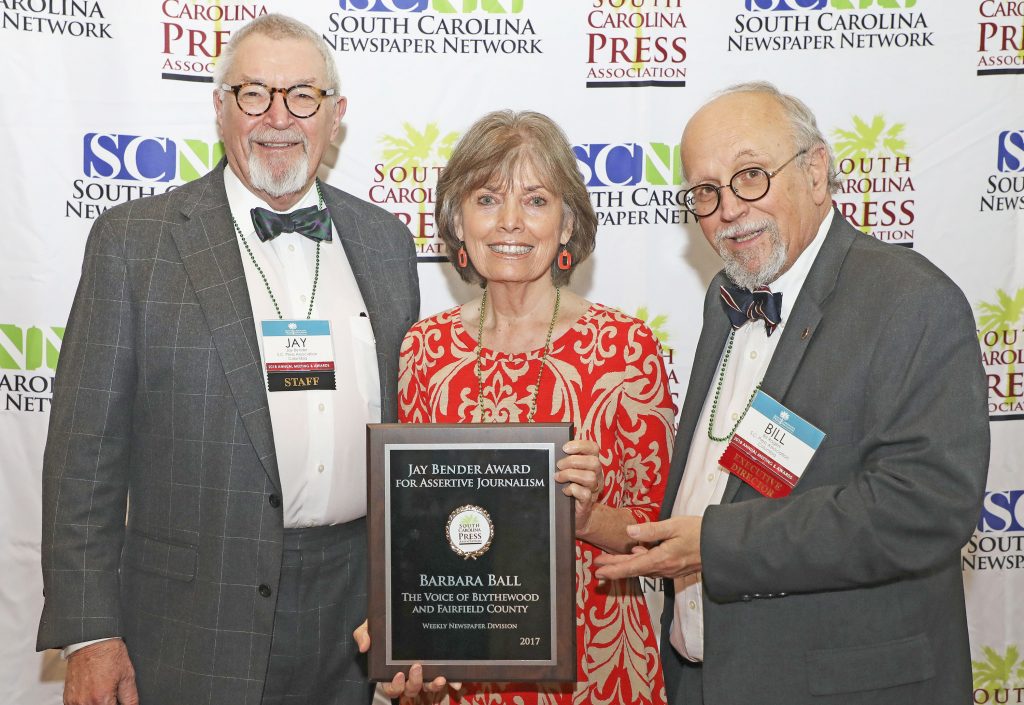
Bill Rogers, executive director of the S.C. Press Association, said conducting votes without specifying what they’re about is in violation of the state’s Freedom of Information Act, or FOIA.
“How can they vote on something without saying what you’re voting on?” Rogers said Tuesday. “It’s an illegal vote. They’re really out of control. They’re flying in the face of logic and the law.”
The Voice pressed board president Greg Ginyard as he and other board members were exiting Monday’s meeting. Ginyard said the votes involved, “items brought up that the members requested.”
When The Voice asked if Ginyard could be more specific, he declined to answer and the interview ended. Exiting board members referred The Voice to the water company’s attorney for further remarks.
Reggie Belcher, a Columbia attorney representing the water company in a pending FOIA lawsuit, could not be reached for comment Tuesday.
A telephone call had not been returned as of press time. An email auto reply stated Belcher would be out of the office until Monday, April 2.
At Monday’s meeting, Ginyard scolded The Voice and Fairfield County businessman Donald Melton for openly challenging the secret vote.
“You can’t blurt out in the middle of a meeting,” Ginyard said. “We’re past the public comment period so please don’t blurt out.”
“We’re just asking for transparency,” Melton answered.
Ginyard said public input is the proper time to address the board. Public input is scheduled before executive session, which prohibits the public from challenging the vote until the board’s next meeting on May 7.
Melton sued the water company in 2016, citing multiple FOIA violations. The case is pending.
According to the suit, the water company has claimed that it’s not a public body and not subject to FOIA. The S.C. Attorney General’s office said otherwise in a 2011 opinion.
The eight-page opinion states the JWC formed in 1970 when the U.S. Department of Agriculture provided a loan as seed money.
The JWC received $34,751 in government grants in 2007 and in 2011, the S.C. Budget and Control Board approved grants of $73,000 and $132,500 to the water company.
It’s further stated in the attorney general opinion that Fairfield County also provided public funding for the JWC.
“There is considerable evidence, based upon the information which you have provided, that the Jenkinsville Water Company has received and currently receives both federal and state grand funding,” the opinion states.
The JWC’s retreat into executive session Monday also prompted a protest from The Voice.
Ginyard initially stated the purpose of the executive session was for “contractual and personnel matters.”
When pressed by The Voice for the specific purpose, a requirement under state law, Ginyard responded that the private meeting was to discuss a new well being installed and “employees.”
State law requires public bodies to state the specific reason for entering executive session. Violating this statute has proved costly for other public bodies that have disregarded it.
In 2016, an Aiken County judge ordered the City of North Augusta to pay $14,724 to a North Augusta resident who filed a lawsuit that said the city wasn’t specifically stating the reason for entering executive session.
A year later, the city of Newberry was ordered to pay $13,708 for a similar violation in not stating a specific reason for executive session.