Blog

  • Tax Plan Rankles School Board

    The concept of a level playing field in funding education in South Carolina may be an idealistic one, but it didn’t go over well with the Fairfield County School Board during their June 5 meeting.

    Scott Price, of the State School Boards Association, and William F. Halligan, of the Columbia law firm Childs and Halligan, presented to the Board an overview of the S.C. Education Finance Restructuring Act, an act that Halligan’s partner, Ken Childs, said was lingering in a skeletal form in a State House committee.

    The plan has no chance of passing this year, Childs said, adding, “If and when it does, the Fairfield County School District will be swimming in money. Literally swimming in it.”

    But that is not how Board members saw it June 5, as they assailed Halligan and Price with questions and concerns about the plans call to phase out local funding of education and distribute tax dollars out of a central state pool.

    “One of our concerns is that this legislation was purposely put together to redistribute V.C. Summer tax dollars that will come into Fairfield County,” Board Chairwoman Andrea Harrison said at the outset of the Price-Halligan presentation. “It may be good for the state overall, but it would, in so many words, hurt Fairfield County if our tax dollars from V.C. Summer were going to plug in the gaps in other portions of the state.”

    “I hope this presentation will assure you that this is not the case,” Halligan said.

    The proposal would equalize state funding, Halligan said, on a per-pupil basis, regardless of where the pupil lives. Fifty-five school districts in the state (60 percent) would get an increase in funding; funding for the remaining districts would stay the same, Halligan said. It would also provide a stable source of funding over time, he said, one that would not fluctuate with the economy. The pool would be distributed based on a formula of weighted pupils per district multiplied by $5,295.

    The state pool would be fed by a taxable base of 100 mills, Halligan said, which would deliver significant property tax relief. The plan would also vanquish the myriad of local legislation laws that govern school districts and their power to tax, giving local school boards the power to assess an 8 percent tax on taxable property. Boards would also have the power to place a referendum before voters, asking for the authority to levy an even higher tax. Should a referendum pass, homesteads would come back into the tax base, Halligan said. Currently, no owner-occupied home pays taxes into education funding in South Carolina.

    The Fairfield County School District, which operates on local funds assessed at 203.1 mills (well above the state average) and receives $7,802 per weighted pupil under the current system, would phase out more than $10.6 million over the next 25 years ($424,858 per year). However, with the new 8 percent tax authority, the Board could bring in an additional $7.7 million each year.

    “How many times have we seen the state do something, grant you harmless money, then in a few years they don’t have enough money and they cut it,” Halligan said. “No plan. Inequitable every time. It hits different districts different ways. This way we have a planned thing that everybody could count on, plan for it, take it into account and have local authority to deal with it.”

    The plan will be introduced next fall, Halligan said. In the meantime, it is still open to input and improvements.

    But some members of the Board, as well as of the audience, smelled a conspiracy to rob Fairfield County of V.C. Summer tax dollars. Currently, the District takes in nearly $13 million in local revenues from the Jenkinsville nuclear facility. That figure is expected to rise dramatically, as two new reactors at the plant come online over the next five years.

    Board member Marchella Pauling specifically asked why no representative of the Fairfield County School District was included in the group putting together the plan. Halligan said the plan has been under construction for several years, and at the time the Fairfield County School District did not have a finance director. However, Halligan said, districts with similar demographics were included, as well as financial information directly from the Fairfield County School District. Price noted that there are 85 school districts in the state, and to have a representative from each one involved in the process was unrealistic.

    “It appears to me like the state is shucking their responsibility, trying to get on the piggy back of folks like us who . . .  we have the problems that a nuclear power plant can multiply, and we’re doing that times three now,” David Ferguson, Chairman of the Fairfield County Council, said from the audience, “and it seems kind of suspicious that the folks in Columbia are jumping to run at Fairfield County – they didn’t jump to run at BMW when BMW was opening, they didn’t jump at Boeing, but all of a sudden, the guys in Columbia are jumping at Fairfield County because we’ve got these new reactors coming.”

    The timing of the plan in relation to the nuclear plant was coincidental, Price said. When BMW came on line, he said, the state didn’t have the funding problems that it has now. And, Halligan reiterated, the Board would still have the power to tax the nuclear plant at up to 8 percent of its assessed value.

  • Finalists to Lead School District Announced

    The Fairfield County School Board announced the three finalists to take the helm as superintendent Tuesday night and said they would formally introduce the candidates to the community Saturday morning at a public forum, beginning at 9:30, at the Fairfield Central High School auditorium.

    The finalist being introduced to the community Saturday are: Dr. Dennis Carpenter, of Ga.; J.R. Green, currently an assistant superintendent in Chesterfield County; and Fairfield County native Donald Kennedy, a consultant in Conn.

    The School District did not comply with numerous requests for biographical information on the finalists, but research by The Voice revealed that Green serves as Assistant Superintendent of Curriculum for the Chesterfield County School District. Carpenter is the Deputy Superintendent for Operations with the Newton County School System, a district of 19,000 students 35 miles east of Atlanta in Covington, Ga. Carpenter has previously served Newton County as Associate Superintendent of Human Resources. No information was available for Kennedy.

  • MID Takes Aim at Downtown Blythewood

    While the plan is still in its infancy, Blythewood Town Administrator John Perry offered the Planning Commission an overview on just what a Municipal Improvement District (MID) could do during their June 6 meeting.

    “This is just half-baked bread, which you know never tastes good,” Perry said after the meeting. “At any time, the Planning Commission could tell me to stop and that would be it.”

    Perry said it was still not known exactly how much money a MID could generate to fund improvements, nor was it clear on how the properties inside the MID would be assessed.

    “Per parcel seems way too arbitrary,” Perry said.

    But according to the work in progress Perry presented to the Planning Commission, the Town has roughed out a budget of $1.5 million to be spent inside the District over the next three years. The largest portion of that sum — $300,000 – is dedicated to the acquisition of rights of way. The MID budget calls for $100,000 each for the acquisition of rights of way from Creech Road to Main Street and for a new road behind the Community Center. For an additional Community Center road, as well as for a right of way on Boney Road from the southern I-77 exit to the IGA, the MID has allocated $50,000 each.

    The Creech Road to Main Street acquisition would make way for a proposed new road, “IGA Boulevard,” that would run roughly parallel to Blythewood Road between the IGA and the First Citizens Bank, and which is part of the Town’s Master Plan, Perry said.

    Along McNulty Road and running to Main Street, the MID plan calls for $152,000 for lighting, street trees and sidewalks, as well as a small contingency fund of $25,000 included in the $152,000. Sign posts, traffic controls and directional signs would cost an estimated $75,000. Traffic signals on Boney and McNulty roads would cost an estimated $100,000. The MID also includes $40,000 to make the District a Wi-Fi hotspot.

    Perry also told the Commission that the Town’s Christmas decorations have just about outlived their usefulness, and the MID wish list includes $15,000 to replace them. Another $15,000 is included for announcement and event banners and their corresponding hardware.

    A part-time staff person at the Town’s Welcome Center would consume $25,000 from the MID funds, while a proposal for flowering baskets ($10,000), litter control ($10,000) and Welcome Center operations ($25,000) could possibly be paid out of the Town’s hospitality tax, according to the MID worksheet.

    Finally, the MID sets aside $15,000 of its budget for a “sinking fund,” for incidental maintenance and other unforeseen upkeep.

    The next step for the plan, Perry said, would be to determine a methodology by which to assess the properties in the proposed MID. The current options, apart from the per-parcel assessment that Perry said he did not favor, could be a per-acre assessment, an assessment based on the linear feet of street frontage or a value added assessment.

    Perry said a subcommittee would be meeting again on the MID in July. If this MID is successfully implemented, Perry said, it could pave the way for similar improvement initiatives in the future.

    “This is really our test,” Perry said.

  • Town Taps Columbia Group for Tree Ordinance Help

    Although a revised tree ordinance may still be many months away from completion, the first step toward achieving that goal was announced at Wednesday night’s meeting of the Blythewood Planning Commission.

    John Perry, Town Administrator, told the Commission that Land Plan Group South (LPGS), of Columbia, had been awarded the bid to consult with the Town on the revision of the ordinance.

    LPGS came in with a winning bid of $5,300 – $5,500, well under the $8,500 – $9,500 offered by Sustainable Designs, of Blythewood, and the $9,500 by HPG Engineering, of West Columbia.

    The announcement sparked comments from the audience, who urged the Commission to move forward with the ordinance revisions as quickly as possible.

    Malcolm Gordge, secretary of the recently formed Ashley Oak Homeowners Association, suggested the Commission consider a separate ordinance for residential lots.

    “The key is to act quickly,” said Gordge, who lives on Winding Oak Way, “because at the rate these developers are bulldozing lots, there won’t be a tree left before long.”

    Henry Lovett, also of Winding Oak Way, said he, too, was concerned with the rate at which the trees were coming down, and not just in Ashley Oaks.

    “This is not a request just to protect Ashley Oak,” Lovett said. “This is a request to protect all residential properties within the town limits.”

    Jack Davis, a member of the Planning Commission, said he also lives in Ashley Oaks and has seen the rampant clearing of lots first-hand.

    “To say that clear-cutting is not taking place just because they leave three trees on the lot – that’s as close to clear-cutting as you can get,” Davis said.

    Mike Switzer, Chairman of the Commission, told the audience that the Commission shared their concern and was moving forward with a revised ordinance as quickly as possible.

    “I would like to interject that time is of the essence,” Lovett said. “They’ve got bulldozers sitting on properties clearing lots every day.”

  • County Reacts to Tax Plan

    County Council reacted Monday night to a recent Fairfield County School Board meeting where a presentation was given by Scott Price, an attorney for the S.C. School Board Association and William Halligan of Childs and Halligan, P.A. on a proposed South Carolina Education Finance Restructuring Act.

    The act, which proponents plan to bring to the state legislature in January, would equalize state funding for all students, no matter where they live in South Carolina.

    Council members Ferguson, Kamau Marcharia and Kinley attended the school board meeting, and were opposed to the proposal.

    “The School Board Association hired Fairfield County School District’s attorney Ken Childs to come up with a plan with the help of 16 school board members across the state, not including our own, to take tax money from V.C. Summer nuclear plant,” Ferguson said. “Why didn’t this happen with BMW, Michelin or Boeing? The school board was told they wouldn’t have to go by the County’s millage anymore.”

    “It was a two year study paid for by the S.C. Senate and prompted by representatives in Aiken,” Ferguson continued. “No contact was made during this study with the S.C. Association of Counties. I was disappointed that our senator didn’t mention that this study was going on. If money was expended for over a period of two years — that our delegation didn’t know this was going on — expenditures are supposed to be seen by every senator in the state.”

    “I would like to talk to Senator Coleman,” Council member Dwayne Perry said, “to see what he thinks about taking the power plant money out of Fairfield County. What is his stance?”

    “They think they can come and hire a bunch of high paid lawyers and run ripsaw over us,” said Brown. “They couldn’t go to an Aiken or Charleston County and try to do this.”

    “Let the people who decided not to have nuclear reactors in their county decide how they will get money,” Ferguson said. “People are going to come at us and do their dead level best to get our tax money.”

  • Economic Development, Event Consultants Join Town of Blythewood

    The Town of Blythewood announced this week the addition of two new consultants to their arsenal to guide the Town in its pursuit of economic development and to organize and manage special events.

    Ed Parler, a Lancaster native now living in Cobblestone Park in Blythewood, will lead the Town’s economic development efforts. Parler has 30 years of experience in that arena, most recently as the head of his own consulting firm, Palmetto Governmental Assistance. Prior to that, Parler worked for the Central S.C. Economic Development Alliance from 1995 – 2008.

    “I have a huge stake here,” Parler, who has lived in Blythewood for the last five years, said. “Goal number one is to make sure this doesn’t turn out to be like Harbison Boulevard in Irmo.

    “We need to compliment the efforts that are already there,” Parler continued, “and keep to the vision that’s already been established. We want to see what the commercial and other types of needs are that the community wants and see if they want to invest here, while not forsaking those who have already invested here.”

    Martha Jones, meanwhile, will organize and manage events held by the Town, as well as act as concierge for community business and organizations. She will organize events currently on the books with the Town and also establish new events. She will continue her volunteer work with Bravo Blythewood, the Town said.

    Mayor Michael Ross said the new consulting positions replace two former full-time positions with the Town – Director of Economic Development and the Events, Annexation and Tourism director.

    “We eliminated two full-time Town positions,” Ross said, “but we knew we could not go without help in economic development. We believe there are a lot of economic development opportunities on the horizon here, and it’s great to know we have expert help from local people.”

    Parler will earn $35 an hour on an as-needed basis, compared to the $50 an hour paid to his predeccessor, Phil Hamby. Jones will earn $25 an hour for 20 hours of work per week.

    The positions become effective July 1, the Town said.

  • Board Avoids Tax Increase

    The Fairfield County School Board worked through the final stages of their 2012-2013 budget Tuesday night and avoided a 3 mill tax increase by authorizing administration to take the additional $109,125 in expenditures out of the fund balance.

    “It’s not unusual to use cash to balance a budget, particularly when it’s a small amount of cash,” interim superintendent Dr. David Eubanks said. “I’m optimistic that, as we close out the year, we’ll have over-collections and under-expenditures, so I am confident about your fund balance. If it were a half a million dollars, I’d say don’t do it.”

    The Board also approved the revised salary schedules as part of the budget on a 6-1 vote. Board member Annie McDaniel voted against the salary schedule, which will provide a wage increase for the majority of District employees.

    “This has been a tremendous task, no doubt about it,” Board member Bobby Cunningham said. “We have discussed this many times. We have so many people on the lower echelon of this scale. We are showing these employees who have been sitting here for years and years and years that we are trying to make an improvement in their lifestyles.”

    McDaniel questioned the efficacy of the scale, including the step increases and asked for an example of where a lower-paid employee was actually benefiting from the new scale.

    “A bus driver with zero years’ experience will start out at $11.63,” Eubanks said. “It’s currently $8.79.”

    While McDaniel urged the Board to go through the scale, salary by salary, before approving, Board member Beth Reid moved to approve the administration’s work.

    “I think it’s time to move on with it,” Reid said. “It’s not our job to break it apart. That was their (administration’s) directive.”

    Henry Miller seconded the motion.

  • Primaries: McDaniel, Douglas Face Runoff for House 41 Seat

    MaryGail Douglas

    The race for State House of Representatives District 41 two-year term has boiled down to a contest between the ladies. On Tuesday, Fairfield County voters, along with voters in a portion of Chester and Richland counties, narrowed the contest to two of five candidates.

    Winning 37.44 percent of th

    Annie McDaniel

    e votes in Fairfield and parts of Richland and Chester areas of the district was Annie McDaniel, a Fairfield County School Board member and payroll clerk for the Charleston County School District. MaryGail Douglas, who worked for many years at the Fairfield County Council on Aging, won 28.19 percent of the vote.

    “One candidate must win 51 percent of the vote,” said Fairfield County Voter Registration and Elections Director Debby Stidham. “Therefore, there will be a runoff election on Tuesday, June 26 to determine the winner.”

    The other candidates included Paul Dove, who garnered 13.64 percent, Palmer Nicholson with 15.92 percent and E. Sutton with 4.80 percent. The winner of the June 26 runoff will face Republican candidate William Gray November 6 in the general election.

    Voters will also see a runoff for the County Sheriff’s race. Candidates Will Montgomery, who won 30.05 percent of the vote will challenge current Sheriff Herman young, whose votes totaled 40.88 percent. Eddie L. Big Ed White received 29.08 percent.

    Fairfield County Clerk of Court incumbent Betty Jo Beckham will retain her position, besting challenger Dorothy Boyd Belton 56.45 percent to 43.55 percent.

    The voter turnout in Fairfield County was 32.31 percent. Of the 15,424 registered voters, 4,983 ballots were cast.

    Two employees from the Department of Justice were assigned to Fairfield County for Tuesday’s election. The department routinely monitors elections in Southern states to ensure compliance with the Voting Rights Act of 1965. That act prevents discrimination on the basis of race and color.

    “Two people from the Department of Justice came to the Fairfield County elections office Monday and asked general questions about how we run the elections — how many poll workers do we have, fail safe procedures — nothing out of the norm,” Stidham said. “It was information right out of the Poll Watchers Handbook. They didn’t ask anything specific. They said they would be going around to the precincts to monitor the polls.”

  • Dutchman Creek VFD Dedicates New Substation

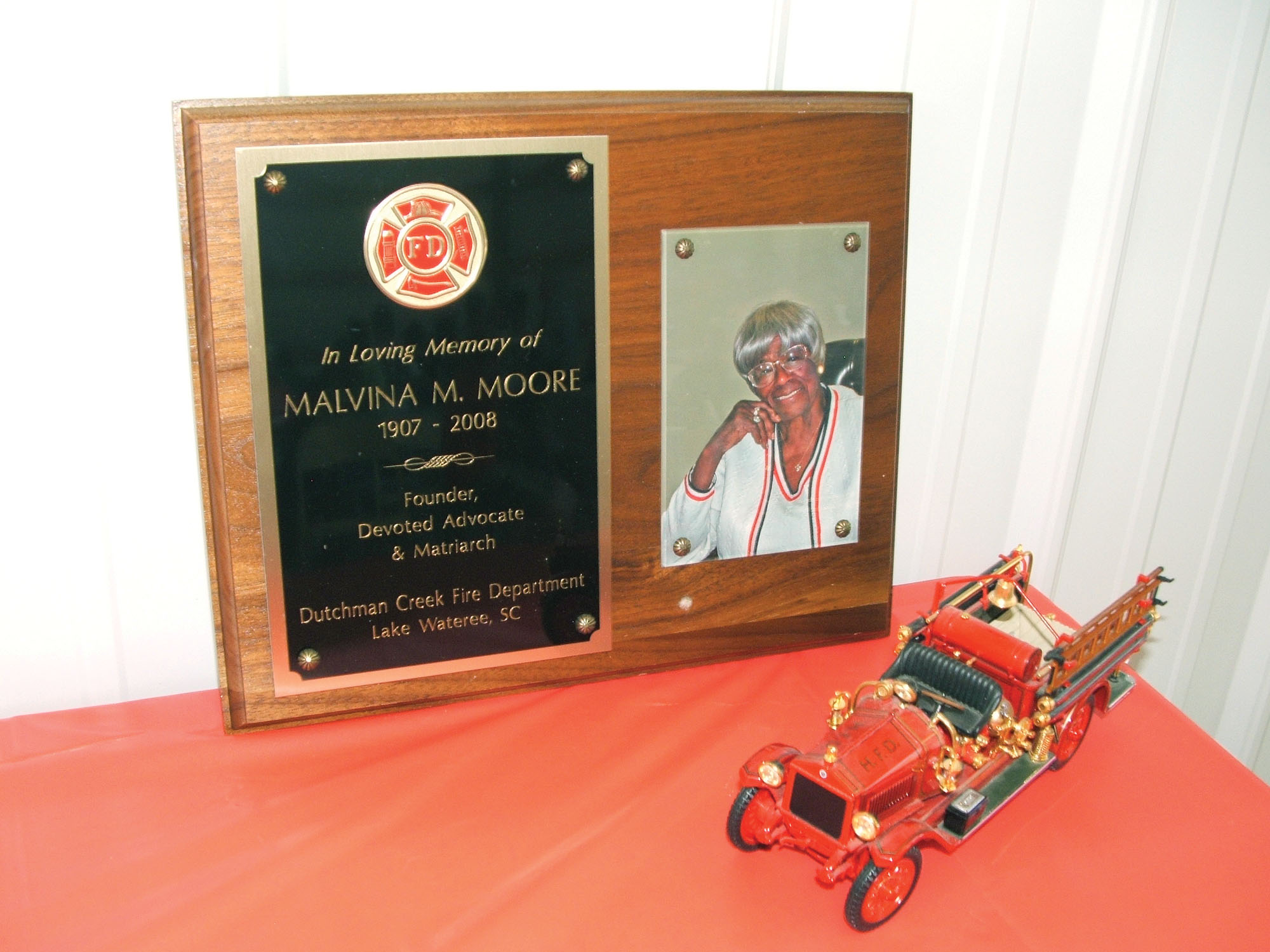
    A very special event took place June 3 at Lake Wateree. After years of planning, the Dutchman Creek Volunteer Fire Department’s new substation, at the junction of River Road and Wateree Road, was completed and a dedication ceremony took place. The station was dedicated to the memory of one of the original founders of the DCVFD, Malvina Moore. Most of you living in the Lake Wateree area either knew Miss Malvina personally or were aware of her and her accomplishments. For those who did not have the pleasure of knowing this remarkable woman, let me tell you a little about her.

    Moore was born in Columbia in November of 1907 to Malvina Burns Washington and George Washington into a family of 14 children. She was daughter number seven and child number 13 born to the couple. Her father was employed by Southern Railroad as a Pullman porter. He moved the family to Asheville when Malvina was 8 years old, and three years later to Fairfield County where Moore spent the rest of her life. She graduated from Benedict College in Columbia with a Bachelor’s degree in elementary education and did post-graduate studies at the state college in Orangeburg and USC.

    Malvina met her husband Roosevelt Moore when she was age 14 and he was 18 and they married six years later on Valentine’s Day in 1927. They were married for 56 years, until Roosevelt’s death in 1983. Miss Malvina was a teacher and principal for 10 years at the Biddle School, for six years she taught at Camp Welfare, 12 years at Griffin School, 13 years at Mitford and two years at Great Falls Elementary in Chester. She retired after 43 years of teaching but continued as a substitute teacher for eight more years. She was a devoted Christian and longtime member of the Rock Hill Baptist Church.

    Moore was one of the founders of the DCVFD, incorporated April 1, 1985, was on the steering committee and a member of the board. She was a volunteer and a member of many organizations in Fairfield County, among them the Homemakers Club, a charter member of the Wateree Home Owners Association and a key figure in having a voting precinct established at Dutchman Creek. Moore was well known for her involvement in civic, political and church activities. She served barbecue at the July fourth DCVFD fundraiser for many years and was voted 2008 all-time volunteer. As busy as this lady was, she still found time to be an Avon salesperson for 30 years. In 1991, the Wateree Home Owners Association nominated her as the most influential black female in the lake area. Moore passed away Jan. 2, 2008, just two months past her 100th birthday.

     The 3 p.m. ceremony began with a welcome to all, the introduction of elected officials and the Pledge of Allegiance. Honored guests in attendance were County Council Chairman David Ferguson, vice chairman Dwayne Perry and Mr. Tony Hill. Others representing Fairfield County were Shirley Greene, Chairperson of Fairfield County Disabilities & Special Needs Board and Terry Vickers, President of the Fairfield County Chamber of Commerce. Greene surprised Chief Ned Gwin with a plaque of thanks for the firefighters at DCVFD. Chief Gwin introduced each of the volunteer firefighters from the Dutchman Creek station. Pastor Ronald Gregory of the Lake Wateree Baptist Church gave the invocation and blessing. Many of the family members of Malvina Moore were in attendance and introduced; some came from as far away as New Jersey. The cutting of the ribbon was done by Chairman Ferguson, Vice Chairman Perry, Chief Gwin and the Dutchman Creek firefighters.

    A cake decorated by Sweet Dreams Custom Cakes at Bi-Lo, with the fire department logo, was served with soft drinks. A table held Moore’s plaque and miniature fire trucks belonging to the father of fireman Dick Lehnhoff, some dating back to the early 1920s. Her plaque reads: “In loving memory of Malvina M. Moore, 1907-2008. Founder, Devoted Advocate & Matriarch. Dutchman Creek Fire Department, Lake Wateree, SC.”

    A study showed the new substation will take approximately 170 structures from an ISO rating of 10 to a rating of 5. Only 10 percent of the fire departments in the United States have a better rating than that of a 5. It will also result in improved response time for those living north of the Dutchman Lane station. The time line for the new station started in June of 2008 with a completion date of May 8, 2012. The new station has space enough for the new pumper tanker and a 2,500-gallon water tank with enough space for a future ladder truck. Later it is hoped that a bathroom, kitchen and multipurpose room will be added. The cost of the building was $72,000, of which $32,000 came from Fairfield County, $10,000 from Fairfield Electric Co-op and $30,000 from the Lake Wateree community.

    “This was a joint venture of the county and the community,” Chief Gwin said.

    It was a special day for the DCVFD, the residents of Lake Wateree and the family of Miss Malvina Moore. There were close to 100 people attending the dedication ceremony. And now with the new substation the firefighters are spread thin and more of them are needed. If you feel an interest in helping out, please contact Chief Gwin at the Dutchman Creek Fire Department.

    In an interview I did with Miss Malvina many years ago she said to me, “It is my sincere desire to be known only as a dedicated servant of God who lives each day in love and service.”

    She certainly lived her life that way and so this dedication ceremony was a fine tribute to this special lady.

  • Winnsboro Man Ejected from Schol Board Meeting

    A Winnsboro man was ejected from a May 29 School Board meeting after his end of an exchange with the interim superintendent, Dr. David Eubanks, grew heated.

    Andrea Harrison, Board Chairwoman, asked Thomas “Tony” Armstrong to calm down or she would have him removed after Armstrong became visibly agitated during a discussion with Eubanks.

    “You don’t have to remove me. I’ll remove myself,” Armstrong said before being escorted from the Board room by a Fairfield County Sheriff’s deputy.

    Armstrong, a mainstay of the public comment session of Fairfield County School Board meetings for many years, addressed the Board earlier that evening on what he said was the “Buddy-buddy system,” which he claimed prevented the hiring of a more experienced Fairfield County native to a principal position at a District elementary school. Instead, he said, someone with connections to a high-level District employee got the job.

    At the end of Armstrong’s comments, Harrison asked Armstrong to provide Eubanks with whatever information he had regarding the hire and that Eubanks would investigate the matter. A review of the video recording of the meeting shows Armstrong approach Dr. Eubanks just as the Board was preparing to retire into executive session. After a brief conversation between the two men, Armstrong began raising his voice.

    “I heard Mr. Armstrong say, ‘We brought you into this District and we can take you out. I’m your boss’,” Harrison told The Voice. “I asked him to calm down or he would be removed.”

    “I told him how I felt as a taxpayer,” Armstrong said later.

    Harrison said she did not know if the Board could prevent Armstrong from speaking at future Board meetings, but she did say the Board would have to monitor what he had to say.

    “If he gets off track or says something that isn’t true, we’ll have to call him on it,” she said.

    As for Dr. Eubanks, he said he had already forgotten about the matter.

    Armstrong took to the podium again June 5, this time to announce his candidacy for the District 6 School Board seat, which is currently held by Marchella Pauling. His announcement was ruled out of order by Harrison at the behest of Board member Beth Reid.