Blog

  • Water Boil Alert Issued Late

    A boil water notice issued by the Jenkinsville Water Company last month was late in coming, the S.C. Department of Health and Environmental Control (DHEC) said last week, putting the public at a potential health risk and the company in jeopardy of possible penalties.

    The Jenkinsville Water Company issued the boil advisory July 9 after lab tests revealed the presence of E. coli bacteria in samples taken from a home in the Feasterville area of Fairfield County. Follow-up tests found the sample actually came from a private well outside a home, company president Gregrey Ginyard said, which was not part of the company’s water system, and the boil was lifted by the end of the week. The problem, DHEC said, was the timeliness of the initial alert and when they were brought into the picture.

    According to DHEC, the original samples were collected July 3 and submitted to Data Resources, a private laboratory, the same day. After finding E. coli present in one of the samples, Data Resources e-mailed those test results to the Jenkinsville Water Company July 5 at 2:20 p.m.

    A public water system, DHEC said, is responsible for issuing public notice within 24 hours after it learns of a violation, which means the Jenkinsville Water Company should have sounded the boil water alarms by July 6. Furthermore, DHEC said, a public water system should notify DHEC by the end of the day when the system is notified of an E. coli positive test result, unless the system is notified after the department is closed, then they notify the department the next business day.

    “A Jenkinsville water system representative sent an email to DHEC on Friday July 6 at 3:09 p.m.,” DHEC said, more than 24 hours after the water company learned of the lab results. “The person receiving the email was not in the office at that time, but this does not relieve the (Jenkinsville Water Company) of the responsibility for making public notice. Monday morning (July 9) Jenkinsville called the Department. At that time they were told to issue a Boil Water Notice and the notice was issued.”

    Ginyard said the oversight was simple human error.

    “Our operator (James Green) pretty much dropped the ball,” Ginyard said. “I was out of town that weekend on vacation. Instead of getting notice out that day, it went out that Monday (July 9). We were supposed to get notice out within 24 hours and we didn’t. Mr. Green just made a mistake. He’s just a human being. He’s a great guy and I put my trust in him completely, but he just dropped the ball on it.”

    “DHEC has issued a Notice of Violation to Jenkinsville (July 25) for failure to issue public notification within 24 hours of learning of an e-coli positive sample,” a DHEC spokesperson said last week. “There has been no decision made on whether a civil penalty will be assessed. That decision is made near the end of the enforcement process.”

    According to the S.C. Code of Laws, Section 44-55-90, failure to properly notify the public of drinking water violations could result in a fine of up to $10,000, a year in jail or both, if convicted. The law also carries a civil penalty of a $5,000 per day fine, per violation.

  • Councilman airs frustrations over newspaper’s report on council’s, administrator’s handling of contract

    PUBLISHER’S NOTE: The following transcript (in its entirety) was delivered by Town Councilman Jeffery Branham to Town Council Monday and later that evening e-mailed to The Voice for publication. It is in response to The Voice reporting on: 1) Mr. Branham’s failure to properly recuse himself (according to state ethics rules for government officials) when council recently voted to give Mr. Branham’s father a $25,000 contract to clean up the railroad right of way in; 2) Mr. Branham’s, the town administrator’s and the council’s failure to disclose that the bidder was Mr. Branham’s father;  3) that, of the three bids voted on at that meeting, the bid awarded Mr. Branham’s father was the only one for which specific amounts and names of the losing bidders were not disclosed and 4) the great disparity in the bid range. The following letter was copied and not retyped or edited.

    My apologies to the Council, Mayor, and citizens of Blythewood for not writing a letter to the Mayor about my recusal at a recently special called meeting. I reviewed my Municipality Handbook and learned the err of my ways and will do better in the future.

    • As a professional I am called upon to write reports. These reports are released to management and the leaders of the R&D group and are used to guide the direction of the company based on performance of products during testing. I base these reports off of facts and at times I am called upon for my opinion. I have learned that my opinion is often times not a good conclusion, because I don’t have all the facts. My point is this: If I don’t have all the facts I don’t share my opinion because it leaves me open to be discredited in the future. Although, in my reports I am not selling blocks of advertising, so I also realize that making assumptions or conclusions without all the facts is of no benefit. After all, I am not trying to sell my reports. I also do not share my opinion in my reports because when opinion is inserted it loses the integrity of being called a report. This is what I call an editorial. A report shares facts and does not include bias. If I don’t have the facts I ask for them.

    • As I have said before, I did not know anything of the bids that were being taken on the RR project. That is why the Town has a Town Administrator. Mr. Perry knew of the potential issue, and asked a landscape architect to write the bid description and review the bids individually with each bidder. The Architect made his recommendation to Mr. Perry, who, in turn made the recommendation to Council. We received three bids from people that I know have worked for the town before. Two of the bids were from companies that are currently working for the town. I learned years ago to stick to the business that I am in and not cast stones on business that I don’t understand or know anything about. I spent my high school and college years in the landscaping/clearing and grading business. After having worked for several both in the private and government sectors I learned the bidding process. My experience is that smaller businesses typically have the better price on project bids.

    • When you work regularly with a company it is not out of the ordinary for them to be contacted directly about upcoming projects. If you are looking to buy tires and you shop around at four places and Pope-Davis in Blythewood has the best price do you believe them, or do you call everyone back again and ask them to give you the price again? Common sense doesn’t say get new quotes – common sense would tell you that you are getting a great price for the work. Say you buy tires at Pope-Davis in Blythewood and have a good experience, the price is cheap and the tires last a long time, are you going to consider them the next time you buy tires? Of course you will! They are local, they do good work, and you are satisfied. I learned to grade people on their work. That is the job of the town citizens. If work is done and it isn’t satisfactory to the citizens, then the council and mayor should know about it.

    • RABCO is a company that is owned by my father. In the summer of 2010 Billy Raines was required to undergo surgery and was unable to perform his duties with the town for the period of several months. RABCO was hired then to maintain the grounds in the town and including the grounds around the building we are sitting in. The point being RABCO has been employed by the town before Jeff Branham, Town Councilman, even came into the political spectrum. For the record it is not appreciated that RABCO or Richard Branham is made in to bait to sell newspapers. Richard Branham served this community tirelessly as the fire chief here before the new fire station was built. He and his firemen were the only people that protected this town for many years before Richland County built a station here. They did it because they cared for their community and knew that somebody had to step up and protect it as it related to fire protection. Blythewood was selected as the site for Dixie Youth All-Stars baseball in the mid 90’s. The fields were beautiful and in pristine condition. Few people know that this was because Richard Branham spent his time and money from his pocket to fertilize the fields and make sure they received the care needed so that people visiting Blythewood would receive a positive impression of our community. One spectator was heard to say, “man this looks like a professional field.” USC Football coach Brad Scott had a son playing in the tournament and was there to watch. He found out that Richard had been maintaining the fields and pulled him to the side and inquired as to whether he would be interested in working for the University. He politely replied that he was happy with his company and the time that it allowed him to spend in his community and more importantly – his family. If there are any issues with dealings to do with Jeff Branham, Town Councilman I am available, there is no need to tarnish the reputation of a devoted servant of this town with non-existent conspiracies.

    • As for doing anything wrong or illegal- you can dig to the People’s Republic and not find anything illegal, immoral, or unethical with any of my dealings, including the RR bid deal. Or should I say the artist formerly known as the People’s Republic can dig to wherever they want and find nothing. It should be an easy dig- after all, digging where there’s no dirt sounds simple. It may be hard to believe, but there are good • people in government with good intentions to help their communities and protect the freedoms that we all enjoy as Americans. I do not think that anyone in this country that has given the ultimate sacrifice would appreciate those that work hard to do what is right in government being demeaned and put down publicly due to personal bias and personal gain.

    • The entire council received an email today with the bid amounts and they are as follows:

    • Southern Vitas – $90,215.68

    • RABCO – $24,735.00

    • Keeler Landscape – $133,883.00

    • Conder Construction – $45,200.00

    • If you want to know what the bids are just ask. They are public knowledge. Calling for the town to release the bids at once is deceiving and leads town citizens to believe that something that is public knowledge is being hidden. Some people call it being careful with the truth, I call it a lie. Just because you fail to ask for it does not mean that the town is hiding anything.

    • The good news is if a slow news week comes where there are no possible ethical or legal challenges to talk about from the local elected officials- you can always run that article about how the moon landings were a scam.

    • As a well know radio host says, “Now you know, the rest of the story.”

  • Municipal Improvement District Proposed for Downtown Blythewood

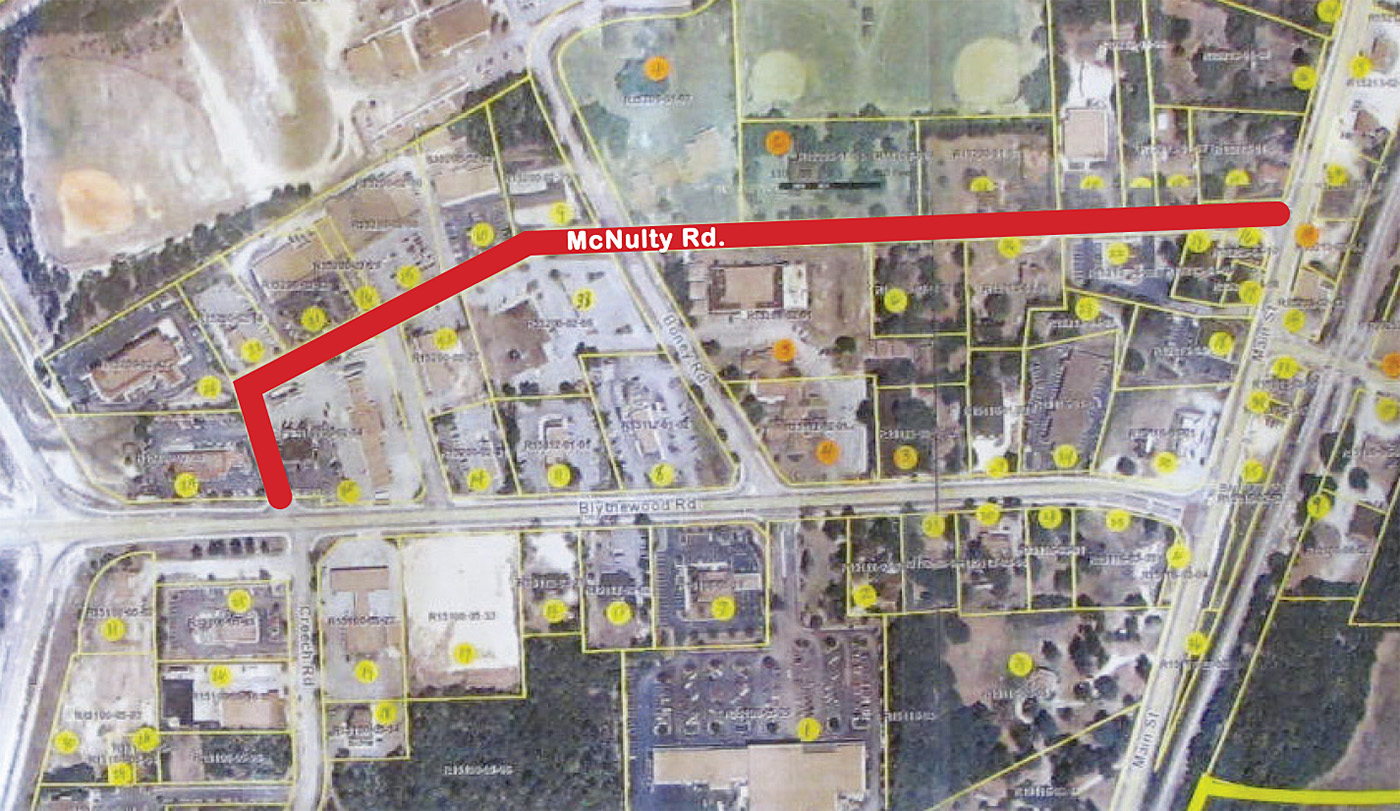
    At its regular meeting Monday, Town Council passed a resolution declaring the town’s intent to reimburse itself for certain expenditures made prior to the town’s consummation of federally tax-exempt financing (bonds) of a Municipal Improvement District (MID) for business properties along McNulty Road.

    The resolution stated that the town anticipates incurring expenditures not to exceed $1 million for the project.

    The source of funds for the expenditures with respect to the project will be the town’s general fund.

    Town administrator John Perry said that bonds used to pay for an MID would be paid back through a property tax on the commercial property owners within the MID, not the residential property owners in the town. Perry said the tax would be collected by the County. The assessment would become a lien on the property.

    Perry said Municap, Inc. a financial consulting firm, has been contracted, at a cost of $10,000 – $15,000, to conduct Phase I of the project to determine the methodology and property assessments of each property in the project. He said this phase should take four to six weeks and will determine whether the town should move forward with the project.

    If council goes forward, then bonds will be issued to cover the cost of the project, which should take about a year and a half to complete according to Perry.

    The project encompasses the business properties along all of McNulty Road to the visitor center and includes street trees, landscaping, signage and sidewalks, as well as funds for staffing the  town’s visitor center and painting the water tower.

    Members of the MID committee are Charles L. McCallum, Ken Parnell, Larry Sharpe, Kem Smith, Mike Switzer, John Perry, Michael Criss and Robert Cappadona.

    Perry said the Town Council will hold a series of public hearings prior to the issuance of bonds. He said if the project goes well, then he would expect to move forward with the remainder of the town’s business district.

  • CPA Wants Tougher Rules for Town’s Hospitality Tax Collectors

    In a report to the Town Council Monday, the town’s accounting consultant, CPA Kem Smith, said the mayor had asked her to research and come up with improvements to the town’s hospitality tax ordinance that requires businesses in the town who serve prepared meals and beverages or have on-premises consumption of alcohol, beer or wine, to collect for the town a two percent hospitality tax.

    Smith said changes to the ordinance would give the town more recourse for non-payers and would clarify rules and penalties.

    Smith said she found that, when comparing sales tax reported to the town by the town’s hospitality businesses with the sales those businesses report to the Department of Revenue, “we have a lot of discrepancies. The discrepancies are usually under-reporting to the town.”

    She said she would like to get a copy of each businesses’ Department of Revenue’s sales report at the time that businesses turn in their local hospitality tax returns to the town.

    “Then we can see if there are discrepancies,” Smith said. “We don’t have a lot of teeth in our [current] ordinance so even if there are discrepancies, there isn’t a lot we can do about it.”

    Smith suggested that other towns have penalty clauses that “will spank somebody for not doing the right thing. A 5 percent penalty is common and some charge up to 20 percent. And that can be for being even one day late.”

    The proposed ordinance states that Town Council would be the only entity allowed to waive a penalty.

    Council members discussed penalties, including any or all of the following:

    •  A business’s license would not be renewed if that business has outstanding taxes or penalties,

    • The Town would not conduct business with offenders, and

    • Up to 25 percent penalties after two offences, and 25 percent more for each subsequent offence.

    Council passed first reading of the ordinance. The hospitality tax is a major source of the funding for construction of the town park.

    In other business, Council passed a resolution opposing funding cuts to Ft. Jackson and McEntire Joint National Guard Base; authorized delivery of deeds and easements for water and sewer utilities for the park;  authorized the mayor to execute an encroachment agreement for the city of Columbia water connection and passed first reading to annex a property owned by Councilman Jeffery Branham into the Town.

  • New home improvement store opens in Blythewood

    The Graham family: Renee, her husband Skip and their son, Matt.

    The sign in front of the store says it all: 3G Windows and Doors . . . and a Whole Lot More.

    It’s Blythewood’s new in-town home improvement store, opened recently by Blythewood residents Skip and Renee Graham and their son Matt.

    Whether you’re looking for new kitchen cabinets or a whole-house makeover, forget the ‘Big Boxes’ in Columbia; 3G Windows and Doors is your one-stop shop for great products and over-the-top customer satisfaction – right here in Blythewood.

    Really!

    Located at 10711A Wilson Boulevard (at Rimer Pond Road), the newly renovated building is, literally, a traffic stopper. It features a bungalow-inspired exterior with white clapboard siding and hunter green cedar shake shingles on the walls, charming cottage-style windows and porch post planters ablaze with bright red petunias. It leaves passers-by wondering why they aren’t living in a home that looks like that.

    Inside, a bright, open showroom displays cabinets, flooring, trims, mouldings, lighting, plumbing fixtures and much more for home or business.

    Outside, a pergola/kitchen/deck display featuring various styles and materials allows customers the opportunity to visualize the possibilities for outdoor living areas as well.

    The showroom is a natural progression of the family’s business which began in 2004 out of their home office in the Blythewood backwoods on family land along Claude Bundrick Road. Skip and Renee, both born and bred in Blythewood, descend from longtime local families – Renee from the Lails and Skip from the Bundricks. Claude Bundrick, famously depicted driving his tractor to town in Harold Branham’s painting of De Sto, was Skip Graham’s uncle.

    After 20-plus years installing glass windows and doors for a major glass company in Columbia, Skip, who has both commercial and residential contractor’s licenses, decided to parlay his skills into a home improvement business in Blythewood.

    The result is 3G. While conventional wisdom would tell you 3G stands for the three Grahams – not so. Renee Graham said the moniker stands for a principle that the family lives by: Give God the Glory.

    As the administrator for the new company, Renee also handled customer service while Matt headed up sales. Skip oversaw construction and installation.

    But the business needed a showroom for more visibility. After two years of searching, the Grahams found the perfect location, a vacant cinder block building owned by Billie Maples (of Blythewood and Lugoff) on Wilson Boulevard. Off and on over the last 50 years, Maples has run several businesses out of the building, including a popular bakery. In recent years, however, Maples was looking for a long-term tenant. 3G was a match.

    “Billie is the perfect landlord,” said Renee. “He has been patient, supportive and encouraging in all our endeavors here. We couldn’t have asked for more. We truly have his cooperation in everything we’ve done here. He’s been wonderful.”

    The Grahams’ products and service are increasingly visible in Blythewood’s  homes and offices – as well as beyond, including Williams Brice stadium where 3G replaced all the glass in the luxury suites. But the Grahams say their focus is local.

    “We’re here to provide not only great design and products for the community, but the best service imaginable,” said Skip.

    “We don’t charge for estimates, and our customer service is as immediate as it gets. At the big boxes, you’ll get help from whoever happens to be on the floor at the time, no matter their level of knowledge and experience,” he explained. “With us, you’re going to get an expert with an honest, experienced assessment every time. Our goal is quality products and efficient service at affordable prices. And that’s what we’ll deliver.”

    The showroom’s grand opening sale prices have been extended through Aug. 11. But the company’s guarantee is good all the time. “We invite our customers to bring in their big box estimate,” Skip said, “and we’ll beat it or we’ll give them a $25 gift card to the Blythewood store of their choice.”

    Showroom hours are 9-6, Monday-
    Friday and Saturdays by appointment. For more information, call 803-754-1357 or see the flyer in this issue of The Voice.

  • ‘Angels’ Descend on Ridgeway for ‘Aimwell Action Week’

    The anonymous ‘angels’ in Ridgeway.

    There are angels all around us. You know who they are. We see them everywhere, doing God’s work, helping those less fortunate, seeing where there is a need and doing something about it without fanfare or praise of any kind. Hearing of such a group, I went to where they were working to talk to them and find out what makes some folks give of themselves and their time in this way.

    The week’s activity was called “Aimwell Action Week.” This particular group of volunteers was made up of church members from the Aimwell Presbyterian Church, Bethlehem Baptist Church, St. Stephen’s Episcopal Church and the Lebanon Presbyterian church, all in Ridgeway. These are some of the oldest churches in the area. Aimwell was established in 1790, Lebanon in 1875 and St. Stephen’s was built of wood in 1854, covered with brick veneer in 1920 and added a wing in the 1940s. The Lebanon Church was organized in 1872. The folks were from all walks of life and different ages. There were Deacons and Elders from the different churches, consultants, students and a master gardener, to name just a few. Teens were working alongside seniors, everyone having a certain job. The day’s repairs went like clockwork, well thought out and planned.

    The home of a family in Ridgeway was in dire need of repairs. This group of church people heard of the need by word-of-mouth and, using donated supplies, as well as their own money and that of other church members, worked for three days on the home. They repaired windows, fixed structural damage, replaced siding, painted, fixed gutters and sewer lines, plumbing and waste drainage. Yard work was also done – raking, planting of plants taken from their own gardens, the removal of trees and trimming, and an unused pile of bricks on the property became a decorative walkway at the front of the house.

    You might notice that there are no names under the picture, identifying the workers. That was one of the conditions of my being allowed to photograph them. They all feel that what they do is the Lord’s work and they are only the instruments and that all the glory belongs to Him. This is a hard working but humble group that enjoys what they do, but does not feel they should get any recognition for the work.

    One of the men said, “The best aspect of the project was the opportunity to work and fellowship together as members of multiple community churches to meet the needs of a local family.”

    Not all the workers were around continually and so those in the picture represent a small number of those who participated. The homeowners also wished to remain anonymous but were very thankful for the work being done for them.

    The workers stopped for lunch each day under a tent erected at the site where they discussed what was to be done next and have fellowship and prayers. The lunch was prepared by church members and in the evenings they met back at the church with the pastor for devotions.

    I would like to think that by reading about this project, it would be an incentive to other churches in the area to do God’s work in this way. Not everyone can do the physical labor, but can help in other ways: Planning, transportation, running errands for supplies or preparation of food. This is similar to the work done by Habitat for Humanity and the work of the Salkehatchie youths and adults who worked in Fairfield County recently, but on a much smaller, local scale. As Patrick Henry said, “Only one life, ‘twill soon be past. Only what’s done for Christ will last.”

    God bless this group and others like them.

  • Filing Closes for 2012 Candidates

    Incumbents on both County Council and the Fairfield County School Board face challengers in November, the Fairfield County Voter Registration Office confirmed last week, as a full slate of candidates filed their paperwork for local offices before the July 17 deadline.

    County Council

    District 2: Carolyn Robinson (I); Vernon Pylant.

    District 4: Kamau Marcharia (I); Mary Brown.

    District 6: Mary Lynn Kinley (I); John McMeekin.

    School Board

    District 2: Danielle Miller (I); Paula Meisner Hartman.

    District 4: Annie McDaniel (I); Arthur Lathan; Carrie Suber-O’Neal.

    District 6 (No incumbent): Thomas Armstrong; William Frick.

    Soil & Water

    (No challenger): Kerry Matthews.

    The Voice will publish a profile of the candidates in early October.

  • Winnsboro Town Council OK’s Voting Districts

    Winnsboro Town Council approved the second reading July 17 of an ordinance to approve and put into place a redistricted voting map for the single-member district inside the Town limits. The redistricting aligns Winnsboro’s voting districts with Federal Census data collected in 2010.

    The ordinance is the next step in a process that began May 15 when Council heard a presentation on the process delivered by Wayne Gilbert of the S.C. Office of Research and Statistics.

    The process of redistricting, or redrawing the lines that separate elected representative’s districts, takes place every 10 years following a census cycle. Based upon that data, new lines are drawn that must adhere to federally mandated criteria set in the Voting Rights Act of 1965 to prevent the “cracking” and “packing” of minority districts. These criteria include creating equal populations, districts that do not dilute minority voting strength or communities of interest.

    The ordinance will now face a public hearing, and the scrutiny of the U.S. Department of Justice. Gilbert said in May that the U.S. Department of Justice, which must eventually approve the plan, will have up to 60 days to review and clear the plan.

    Gilbert said in May that based upon a town census of 3,550 persons, each of the Town’s four districts would need to target a number of 888 persons, which the plan presented May 15 would do. Currently, Gilbert explained, there are 689 people in District 1, 1,338 in District 2, 758 in District 3 and 765 in District 4.

    “The overall district plan now is way out of balance,” Gilbert said. “The overall balance should be within a 10 percent deviation between districts.”

    According to the Census data, District 1 (represented by Danny Miller) gained 15 voters, while District 2 (represented by Bill Haslett) lost 15. District 3 (represented by Clyde Sanders) picked up six voters, while District 4 (Jackie Wilkes) lost eight.

    Municipal Court

    After an executive session July 17, Council voted to preserve its Municipal Court system of three judges. In order to do so, Council approved the hire of two new judges to serve as associate judges under the current Chief Judge.

    In June, Council had approved first reading of an ordinance that would have dissolved their relationship with the Municipal Court, handing over that department to the Fairfield County Magistrates Court. At that time, the County had agreed to provide Magistrate Judge William F. Pope to the Town of Winnsboro for a contracted sum of $6,000 plus FICA and retirement annually for each of six judges that would have been contracted to the Town of Winnsboro. The July 17 vote put an end to that proposal.

    Other Business

    Council voted July 17 to purchase three new truck for the Town’s meter reading department at a total cost of $54,000 from Wilson Chevrolet, which Council said was the lowest bidder. Council also approved the replacement of the air conditioning system at the Old Armory by Smarr Heating and Air at a cost of $7,600.

    Freddie Lorick, Chief of Public Safety, was authorized to hire a new police officer to replace Ed White, who passed away last month. Council also OK’d the hire of one new staff member for the Gas, Water and Sewer Department. The department currently has three vacancies, Council noted. Council had previously approved the hire of a staff member for the department during their July 10 meeting.

  • Task Force Wipes Out Grow-Op

    A multi-agency operation targeting marijuana grow operations in four counties located and eliminated more than 3,500 marijuana plants from Fairfield County last week.

    According to the Fairfield County Sheriff’s Office, agents from their office were joined by forces from the Chester County Sheriff’s Office, Lancaster County Sheriff’s Office, York County Drug Enforcement Unit, S.C. Law Enforcement Division (SLED), S.C. Department of Natural Resources, S.C. Forestry Commission, S.C. National Guard and the U.S. Drug Enforcement Administration (DEA) Midlands HIDTA Group in an operation that covered Fairfield, Chester, Lancaster and York counties from July 17 – 19.

    During the operation, officers located and destroyed a marijuana field containing more than 3,500 marijuana plants near the area of I-77 and Highway 200 in Fairfield County. Evidence suggests that individuals cultivating these plants were living, at least part-time, in the fields. No arrests have been made at this time, the Sheriff’s Office said, and no connection has been made between this operation and local dealers. However, officers are continuing this investigation and are following several leads.

    “This four-county area is a prime location for these kinds of operations,” Capt. Brad Douglas of the Fairfield County Sheriff’s Office said. “These are rural areas, away from any houses, which allows operators to deploy people and supplies without being seen by neighbors.”

    Douglas said the operation eradicated last week was 1- to 2-acres in size and contained plants in an advanced stage of maturity.

  • Chairwoman Chastised in Secret Session

    An executive session during the July 17 meeting of the Fairfield County School Board may have violated the state’s open meetings law and thwarted efforts of one Board member to discuss a recent Atlanta field trip in open session.

    Board member Marchella Pauling (District 6) said she had asked for the Atlanta field trip to be placed on the agenda prior to the meeting. When, arriving shortly after the meeting was under way, she found it had not been included on the agenda, Pauling attempted to amend the agenda to include discussion of the trip.

    Ken Childs, the District’s attorney, advised the Board of a recent Appellate Court decision that states agendas cannot be amended after meetings have begun and Pauling’s efforts were unsuccessful.

    Board member Henry Miller (District 3) suggested the matter be discussed in executive session; however, the S.C. Freedom of Information Act (FOIA) is quite clear on what can and cannot be discussed in executive session.

    “I cannot think of an exemption that allows discussion of a tax-payer funded trip to be held behind closed doors,” said Bill Rogers, executive director of the S.C. Press Association, an advocate for open government. “The exception would be if they were discussing discipline of a student, and they must state this purpose in advance as the reason for the executive session.”

    Board member Beth Reid (District 7) said last week that there was no discussion of student behavior during the closed session. The S.C. FOIA allows for the discussion of personnel issues, legal matters and contractual negotiations in executive session, and states that the specific nature of the discussion must be stated prior to entering into an executive session.

    After the Board had voted to enter into executive session, and before they retired into the closed session, The Voice reminded Board Chairwoman Andrea Harrison that discussion of a field trip was not executive session material under the law.  Harrison affirmed that she was aware of that fact.

    However, according to one Board member who telephoned The Voice the following morning, the Atlanta field trip was discussed in great detail during the Board’s executive session.

    “The Atlanta field trip was discussed in executive session,” Pauling said.

    Pauling’s statement was confirmed by Board member Bobby Cunningham.

    “We hit on it (the field trip) pretty good,” he said.

    According to Pauling, the Atlanta field trip was never approved by the full Board or even brought to the attention of the full Board before the trip was undertaken. Harrison reportedly initiated the June 28-30 trip to the Hilton hotel in downtown Atlanta, which was to attend a conference on school bullying, and selected four Fairfield students to participate.

    Pauling said she wants to know who paid for the trip. There was no money at that time in the high school’s budget for such a trip, Pauling said. Furthermore, Pauling said she wants to know who paid for the rental of the SUV and who approved the use of a District car.

    Sources told The Voice last week that Harrison reportedly sought to obtain a District bus for the trip, but was denied by the Director of Transportation when he learned that the Board had not approved the outing. Harrison said that was not true.

    “It was not that we couldn’t get a bus,” Harrison said, “but that a bus was not cost effective. We only had four students going on the trip.”

    Harrison said the District’s social worker rented an SUV for the trip and Harrison used her District mileage to provide gas.

    Harrison said the high school did not have the necessary funds in its budget to pay for the trip and that she asked Dr. David Eubanks, who was serving as the District’s interim superintendent at the time, “if we could find funding.”

    “It slipped through the cracks about bringing it to the full Board,” Harrison said. “But there was no malice. I think the intent of the executive session was to show that I had not done this with malice.”

    Harrison said she did not know how the trip was ultimately financed.

    “The money may have come out of the Board’s contingency fund. I’m not sure,” Harrison said. “I asked Dr. Eubanks if he could locate funds and I didn’t follow through with any details on it.”

    Dr. Eubanks, however, said he did not recall anyone asking him if money was available for the Atlanta trip.

    “I don’t recall anyone asking me ever if the money was there,” Eubanks said. “Board members do not ask permission of a superintendent to do anything. That’s not just in Fairfield County. That’s across the board.

    “I was aware of the trip,” Eubanks continued, “and I think the subject matter of the trip was very timely. Bullying is a problem. But students were not part of the trip when the original discussion came up. The superintendent’s job is not to police Board members in terms of what they can or should not do.”

    The trip, according to several sources, did not go quite as planned. Two of the students who attended the conference got into an altercation, while one of the female students was caught with a 27-year-old man in her hotel room. After only one day at the conference, Harrison’s party was ready to wrap it up and return to Fairfield. At that time, Board member Danielle Miller (District 2) arrived at the hotel, having acquired a District car for the trip, and tried to convince the group to stay another night.

    The group reportedly returned home in spite of Miller’s efforts.

    “It was a good conference, until the trouble started,” Harrison said.

    Harrison described the altercation between the two students as “hair-pulling,” and said the 27-year-old man was only in the other student’s room for “a few minutes” before being detected and escorted out.

    “All of that was handled,” Harrison said.

    Harrison said the Atlanta police were never involved, but things had gotten to a point that the trip was cut short. On their way out, she said, she saw Danielle Miller for the first time.

    “We got up to leave on Saturday (June 30), and on our way out, Miss Miller was coming in,” Harrison said. “She was supposed to have been there Thursday.”

    Miller said she had been at the conference since Thursday, attending different sessions.

    “I went separately from Miss Harrison,” Miller said. “I was down there as a Board member and didn’t do anything with Miss Harrison’s group. I ran into them Saturday.”

    Miller said Dr. Eubanks approved the use of the District car, which Eubanks confirmed.

    Pauling said she has requested all documentation of the trip. In addition, she said, the matter should have been discussed in open session.

    “This was not an executive session item,” she said, but it appears from District emails that discussion of the field trip in executive session had been predetermined well before the July 17 meeting.

    Just before 3 p.m. on July 13, Pauling sent out an email reiterating her request for the item to be placed on the agenda. This set off a string of emails between Board members between 3:27 and 5:45 p.m. July 13, beginning with Harrison’s denial of Pauling’s request to have the item placed on the agenda.

    “After consulting with (J.R. Green, the District’s new superintendent) in regard to the Atlanta trip, it was agreed that the issue had no direct impact on student achievement, therefore I chose not to place the item on the agenda,” Harrison wrote. “I have advised Mr. Green that it would be in the best interest to provide the documentation in an attempt to answer any questions surrounding the policy and process which was followed. As I have stated, I will be willing to accept any responsibility for any actions which were not in alignment with protocol. If there are any questions that I need to answer or any action that any Board member would like to take against myself after the information has been received, that is your right. Thanks for your understanding.”

    Reid then injected the secret session suggestion.

    “Perhaps that discussion could take place in Exec. Session,” Reid wrote.

    Harrison’s reply appears to indicate a contradiction with what she said she knew was not executive session material July 17.

    “That is certainly fine with me Mrs. Reid, if that is the desire of the Board,” Harrison wrote. “Thanks so much. Have a great weekend.”

    Board member Annie McDaniel (District 4) summed up the conversation in a single sentence: “(I)t appears that we need (a) retreat real soon, so everyone knows their role and which lane to stay in,” McDaniel wrote.

    The emails also appear to contradict what Harrison says now about the closed-door meeting.

    “I was more than willing to discuss the trip in open session,” Harrison said. “Then Mr. Miller said he would like to discuss it in executive session. Probably because it was an assault on me. Maybe it was to protect the image of the Board, because there were some harsh things said.”

    Henry Miller said he felt the need to discuss the matter in secret so that rumors about the trip could be properly dispelled.

    “I wanted to hear it from the person who took the trip,” he said. “It wasn’t secret. I just wanted to know the truth. Sometimes it’s better if you can sit down and ask questions and not have it blow out of proportion.”

    “There were several Board members who were involved in it,” Reid said. “It was an inter-Board discussion on a field trip and we didn’t think it needed to be public.”

    In spite of the emails, Harrison maintains that she would have preferred to have the matter aired out in public.

    “I wish it could have taken place in open session,” she said, “so I could have addressed some of the misconceptions.

    “I cannot wait until November,” Harrison added, “so I can give up this seat (as Chairwoman). Because it is a very hot seat.”

    Although the Board has not asked her to do so, Harrison said she would be willing to reimburse the District for the trip, if necessary.

    “I’m willing to bight that bullet,” Harrison said. “I am willing to take responsibility. I don’t want (the District’s social worker) to get into trouble. She was just trying to do something good for students. I’m not going to let her take the fall for it.”