
Blog

  • Joan Jahnke Stars in Her Own PBS Healthcare ‘Movie’

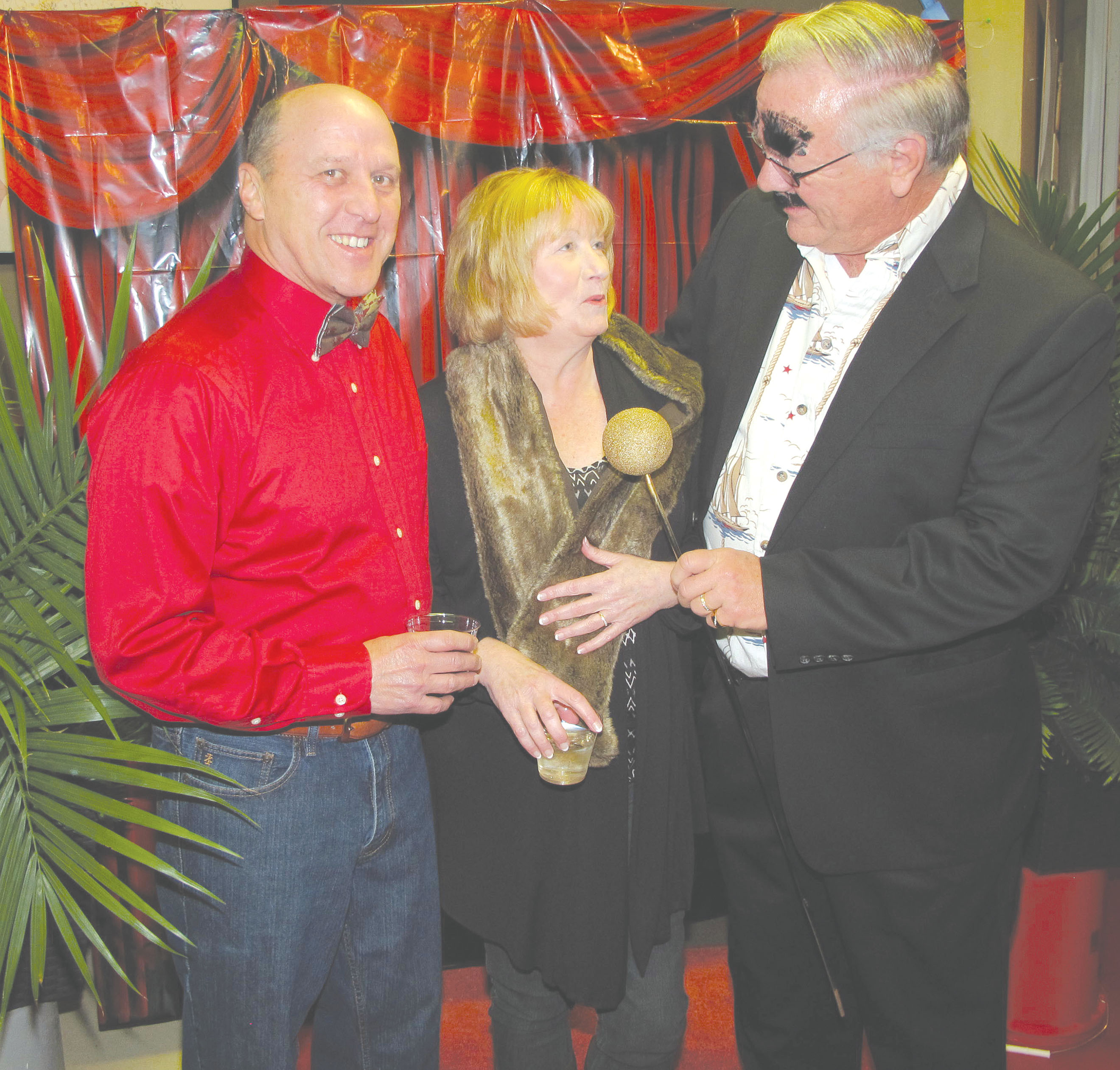
    Jim Gellar, left, mugs for the camera as he reveals his jeans were designed by Tractor Supply. His wife, Ann, proudly tells ‘Groucho’ that her husband killed the fur stole she’s wearing.
    Joan Jahnke peruses the nursing publication Scrubs, which first published the story of her rare heart condition.

    In case you weren’t invited, there was a red carpet movie screening in LongCreek Plantation last weekend at the waterfront home of Joan and Fred Jahnke. The faux, fun evening was part of Joan’s continuing effort to raise awareness about a very rare, painful and extremely serious vascular condition that presents as a heart attack (but isn’t), is difficult to diagnose and affects mainly women, including her. The ‘screening’ that evening was a segment from a show that appeared on PBS in December about Joan and her mysterious medical condition.

    Since 2005, Joan has valiantly endured what seems like a heart ailment. She repeatedly suffers episodes that feel exactly like heart attacks. While tests continued to tell doctors that she wasn’t having heart attacks, her symptoms were relieved with nitro SL, the same medication that relieves symptoms for heart attack victims. It was not until 2008 that her medical malady was diagnosed at Emory University in Atlanta. The rare condition was identified as Cardiac Endothelial Dysfunction — but even with a name, the condition remains mysterious.

    “There is no known cause,” Joan said, “and therefore, no known treatment for cure.”

    Joan’s condition is so marked by breathlessness and weakness that she and her husband, Fred, had to install a stair chair in their home. But the high-spirited former nurse didn’t let her limited mobility stop her from spreading the word to help others in her predicament.

    Her story first appeared two years ago in the online version of Scrubs, a professional journal for nurses. The focus of the article was not only to make nurses aware of the condition, but to help patients be equally aware, persistent and articulate when they notice symptoms that are consistent with heart disease.

    “I started a blog about my experiences at the urging of two of my cardiologists, Dr. Andrew Weisinger at Emory University and Dr. Daniel Bouknight at Columbia Cardiology,” she said. “They encouraged me to spread the word.”

    Her blog, which is hosted on MedHelp and can be found by googling “joanincarolina,” has proven a huge success.

    “Since 2008,” she said, “women from all over the world have contacted me through the blog looking for help and answers.”

    It wasn’t long before her blog even caught the attention of PBS producers who contacted Joan about featuring her story on an episode of the television show Second Opinion. They filmed the segment last summer and it was broadcast last December.  It is also available online at www.secondopinion-tv.org.

    “I’ve heard from the staff at PBS that it’s one of their most-watched and commented-on shows!” she said.

    As part of their continuing effort to boost women’s awareness of this condition, the Jahnkes decided to host a Hollywood-style screening of the PBS show for their friends and neighbors.

    Styled after the Academy Awards, the festivities began with each guest’s star turn along a red carpet leading into the house. Amid flashing paparazzi cameras, they were interviewed by a faux Groucho Marx who was brimming with old-style quips like ‘I went to see a judge about getting married – but I should have seen a jury!’ After a little couture chat with Groucho (Barry Hill), guests traversed a star-tiled Walk of Fame into the dining room where they nibbled on baked brie, decadent chocolate truffles, tiramisu and other culinary delights.

    The Jahnke’s lake-view party room was awash in glittering sequins, fur stoles, satin skirts, pencil jeans, bow ties, fedoras and the fabulous dazzle of entirely too much bling. As the movie popcorn and wine flowed, chatter and laughter filled the room. And, at the conclusion of the screening, the golden statue was presented to the star of the film — Joan Jahnke, who wasn’t speechless.

    While the event was lots of fun, Joan said she was especially delighted to be able to spread the word about the condition.

    “I hope this will create opportunity for our guests to help alert their own friends and family about this disease that is all the more painful if not diagnosed and treated,” Joan said as she mingled merrily among her 40 or so guests.

    “While there is no cure for this disease, by knowing what the problem is, some relief and a very fulfilling life is still out there for those of us who suffer from it. “

    And Joan Jahnke is living, fun-filled proof of that prognosis.

  • Council Seeks Additional Depot Funds

    BLYTHEWOOD – Town Council passed yet another resolution Monday night to secure funding for its now-not-so-secret “Project Booster” in the town park — this time, Council is seeking funding from the Santee Cooper Revolving Loan Fund. Last month, Council voted to seek funding made available by the Rural Economic Development Loan and Grant (REDLG) program of the U.S. Department of Agriculture. Both of these funding sources provide low interest loans to local utilities (in Blythewood’s case, through Fairfield Electric Cooperative), which, in turn, loan to local governments “for projects that will create and retain employment in rural areas.”

    Town Administrator John Perry said that the funding through Santee Cooper is much better than that provided through the REDLG, and that if the Town is able to get the Santee Cooper funding, it will not seek the REDLG funding.

    According to both resolutions, Council would use the borrowed funds to “develop, construct and own certain infrastructure projects, including site preparation for and construction of a depot building (‘Projects’), for the exclusive purpose of aiding and promoting the economic development and general welfare of the Town.”

    Perry, who was authorized by Council’s vote to work in concert with Fairfield Electric Cooperative, legal counsel and others to secure the funding, would not answer questions about how much funding is being sought or how it will be paid back by the Town.

    Perry said in February that the Town plans to use the funding provided through Fairfield Electric Cooperative to landscape the grounds around the “Projects.” A previous resolution passed by Council last August regarding constructing the depot “Projects” in the Town Hall park, referred to the park as a Business Park (‘Park’) and said the Town would like to expand the boundaries of that Business Park to include the Doko Depot “Projects.”

    While the Resolution repeatedly refers to the building as a “depot,” Perry told Council at a meeting in March that the Town was not building a depot, but he said the building that is proposed for the park has a spatial relationship to a depot. A semi-replica of the Town’s former depot was once planned for the park, but later scrapped when funding to complete the park as originally planned came up short.

    Several sources involved in the project and who have asked not to be identified, have told The Voice that “Project Booster” is the Town’s plan to build a restaurant facility in the park. The restaurant, the sources say, will have an exclusive contract with the Town to cater events held at the Doko Manor.

    In other business, Mayor J. Michael Ross presented an award from the Government Finance Officers Association to Perry for the preparation of the Town’s budget.

    “The Town’s budget is prepared by one person, the preparer of the budget, John Perry,” the Mayor said as he handed the award to Perry.

    It was announced that the Blythewood Brainery at Muller Road Middle School now has 31 enrollees. Lori Marrero, Principal of the school, said she had always envisioned the school as a community school and felt the tax payers had a right to use the school facilities.

    “I wanted us to have a place that was ours,” Marrero told Council.

    Council also voted to approve a verbal resolution for a $300 annual land lease with the Norfolk-Southern Railroad that would allow the Town to clean up and maintain a 2-mile strip of railroad right of way in the Town. Perry said this was arranged by former Councilman Jim McLean.

    During his remarks, Perry said the Town has secured 15-20 leases for the Town Hall’s Doko Manor. He also announced that Rebecca Byork, the Town’s Assistant Town Clerk, who takes minutes at Town Council and Planning Commission meetings, will be leaving her position and moving back to Washington State.

    The next Council meeting is at 7 p.m., April 20 at the Doko Manor in the town park.

  • One Arrested After Video Captures Half-Naked Man in School

    Yahya Abdul Salaam

    WINNSBORO – A Winnsboro man arrested last week on trespassing charges outside Home Movie Rental on Columbia Road had additional charges added to his name when investigators linked him to a March 12 surveillance video of a half-naked man inside Fairfield Middle School.

    Yahya Abdul Salaam, 50, of Flora Circle, was arrested outside Home Movie Rental by Fairfield County Sheriff’s deputies March 19. Salaam was seen by a surveillance camera pulling into the lot on a bicycle at approximately 11 p.m. When the camera went dead, the business owner notified the Sheriff’s Office and deputies arrested Salaam on trespassing charges.

    It was Salaam’s bicycle, which the Sheriff’s Office said had a unique color pattern and style, that led investigators to take a closer look at surveillance video from a March 12 incident at Fairfield Middle School.

    The Winnsboro Department of Public Safety responded to an alarm at the school just after midnight on March 12, but finding no sign of forced entry, cleared the scene. When School Resource Officers reviewed surveillance footage later that day, however, they saw an unidentified man inside the halls. The suspect was naked from the waist down, the Sheriff’s Office said, wearing only a sweatshirt on his torso. Additional footage showed the suspect leaving the school grounds on a bicycle, purple and sliver in color. Investigators were able to positively match the bicycle to the one Salaam had pedaled into the Home Movie Rental parking lot a week later.

    With a link established, investigators acquired a search warrant to examine the contents of a bag Salaam was carrying with him at the time of his arrest. That bad contained a computer, a hand-written list of adult Web sites and several memory storage devices. One of those storage devices was found to contain what the Sheriff’s Office said were “several pornographic images of young females, some of which appeared to be younger than 10 years of age.” Salaam’s computer has been sent to the State Law Enforcement Division’s forensics lab for complete analysis, the Sheriff’s Office said. Salaam has since been hit with additional charges of second-degree burglary and second-degree sexual exploitation of a minor (possession of child pornography). The Sheriff’s Office said Salaam has also admitted to being the pants-less individual captured on video inside Fairfield Middle School, although he has admitted to no wrongdoing beyond breaking and entering. At press time, there was no evidence that Salaam tampered with any of the school’s computers, but the incident remains under investigation.

    “The School District has been very cooperative with us during this investigation,” Fairfield County Sheriff’s Capt. Brad Douglas said. “Their IT people helped us out a great deal, and we’re very appreciative of that.”

    At press time, Salaam was being held at the Fairfield County Detention Center.

  • Council OK’s Equipment Upgrades

    WINNSBORO – Town Council kicked off Tuesday night’s meeting with a report from the Finance Committee meeting, which featured a few high-price ticket items, the first of which was the purchase of a Bobcat model mower. Bill Castles, Director of Streets and Sanitation, submitted the request as an alternative to a previous request for the purchase of a Great Dane mower, which is no longer available. Council gave the OK on the Bobcat, for a grand total of $7,799.82.

    Council also gave the green light for the Electric Department to move forward with replacing power lines and poles along the Highway 321 Bypass. The project was approved last November at an estimated cost of $190,000, but the winning bid on the project, from Pike Electric of Mt. Airy, N.C., came in at $145,000. The project was bid out on behalf of the town by Southeastern Consulting Engineers, Inc., who received seven bids on the work.

    The Electric Department also requested $78,650 to purchase a used 2006 bucket truck to replace the 1999 truck that needs upwards of $10,000 in repairs.

    After a nearly one-hour executive session, Council voted to purchase a reconditioned ammonia tank for $7,900. The tank is part of an upgrade to the Town’s water system and its changeover from chlorine to chloramine in the treatment of water. A revised contract with the City of Columbia for the purchase of an additional 1 million gallons of water per day, meanwhile, is still pending, Council said.

    The next council meeting will be on April 9, which is a change to the regular meeting time due to the April 2 municipal elections.

  • Bond at Issue with Board

    FAIRFIELD – As the $20 million bond, approved by the Fairfield County School Board last month to finance a new career center, continues to stir up questions in the community, one Fairfield County resident made some of his concerns known at Tuesday night’s Board meeting.

    Speaking before the Board in the library of the McCrorey-Liston School of Technology, Charles Stogner said he was disappointed that the District had not explored options of sharing facilities and classes with the Midlands Tech QuickJobs campus on Highway 21, directly across from the current Fairfield Career and Technology Center. That campus, he said, already offers numerous classes that are key to employment at the V.C. Summer Nuclear Station in Jenkinsville.

    “Why couldn’t some of the Midlands Tech classes be used in conjunction with the existing Career Center to avoid spending $15.6 million?” Stogner asked. “Was there any consideration given to dialogue between Midlands Tech and the School Board on how we could coordinate benefits.”

    Stogner said that, based on conversations he’s had with Midlands Tech, no such dialogue appears to have taken place.

    Before his time expired, Stogner said he would like to know how many students are currently utilizing the existing Career and Technology Center.

    Later, Stogner told The Voice that he was also concerned over recently published comments attributed to David Ferguson, Chairman of the Fairfield County Council, at Council’s March 11 meeting when Ferguson openly questioned the School District’s fiscal ability to carry a $20 million bond.

    Kevin Robinson, Director of Finance for the District, addressed Ferguson’s comments after the meeting Tuesday.

    “I would like to see the research that was done in order for him to reach that conclusion,” Robinson said. “It could be that they don’t know, or they don’t fully understand, what we’re doing and how we’re doing it.”

    Robinson said the District had hired very competent bond attorneys to thoroughly vet the matter before bringing it to a vote.

    Robinson also made one very significant clarification on the millage rate. The District’s current rate stands at 9.9 mils, he said. With the bond, that rate will go up to 34 mils for two years, after which it will drop to 24 mils for approximately 10 years. Robinson also said those numbers were not written in stone and could fluctuate by a few tenths of a percent in either direction once the deal is done.

  • FMH Seeks Additional County Aid

    FAIRFIELD – Administrators for Fairfield Memorial Hospital say they can see the light at the end of the tunnel, but added at Monday night’s joint work session with Fairfield County Council that they’re not through the tunnel just yet. And while revenue and operating expenses have remained fairly constant compared with last year, the hospital has some additional expenses on the horizon – expenses for which they are seeking assistance from County Council.

    Near the close of Monday night’s presentation, hospital CEO Mike Williams unveiled a list of “unfunded cash requirements” facing the health care facility in coming months. At the top of that list was a $500,000 line of credit, necessary to keep the hospital solvent while they transition to a new electronic medical records system, known as “Cerner.” Williams later explained that the new system will make Fairfield Memorial compatible with other larger hospitals in the exchange of medical records, including Palmetto Health Richland, with which Fairfield Memorial has a growing relationship.

    “Any time you go from one computer system to another, when you’re talking about an organization with revenues of $27 million and you’re actually collecting around $9 or $10 million of that, $11 million of that, there’s a transition period where you’re going to need cash to carry you over,” Williams said. “There’s going to be a down time. That is a concern and we need to prepare for that.”

    The total cost for implementing Cerner is $1.8 million, Williams said, half of which is covered by incentive programs. The hospital began installing the system last December and is expected to launch the new program in September. During the transition, Williams said, the hospital will require the half-million dollar line of credit to cover expenses while the new records and billing program comes online.

    In addition to the Cerner costs, Williams said the hospital is asking the County for $75,000 in start-up money for the Blue Granite Medical Center. Williams said the money will be used to hire a full-time physician, which the center must have on staff in order to qualify for state and federal grant funds. The hospital is also seeking another $75,000 to renovate their emergency room, as well as an unspecified amount to repair the facility’s aging roof.

    Pressed by Council for an estimate on the cost of the roof repair, Williams approximated that the cost could be between $200,000 and $250,000. The worst part of the roof, he added, is over the operating room, and reopening the operating room is one of the hospital’s plans for increasing future revenue. Williams said earlier in the meeting that the hospital hoped to bring general surgery, orthopedic surgery, OB/GYN procedures and colonoscopies back to Fairfield Memorial in the near future.

    Tim Mitchell, the hospital’s Chief Financial Officer, noted that the $500,000 Cerner credit line would be paid back to the County after the transition to the new records and billing system had been completed. The line of credit would have to be in place by September, before Cerner goes live. The hospital currently has a cash balance of about $50,000, Mitchell said, down from $350,000 in February 2012.

    Collections compared to last year, Mitchell said, are down from 44 cents to 39 cents on every dollar owed. Mitchell attributed that trend to the growing number of self-pay patients and the shrinking number of Medicare and Medicaid patients. Bad debts, he said, accounted for 16 cents of every dollar written off by the hospital last year. That number has increased to 25 cents.

    The hospital is also in a precarious position regarding access to emergency capital.

    “If any piece of major equipment went down,” Williams said, “it would be hard to replace it.”

    But, Williams said, he does expect the hospital’s cash flow to improve over the next nine to 12 months with expected changes to Medicaid.

    “We’ve just got to get there,” Williams said.

    Council Chairman David Ferguson said the requests would be brought to the full Council at an upcoming meeting. Just a little over one year ago, the County poured $1.2 million into the hospital.

  • ETV coming to Fairfield County schools

    Fairfield Central High School and the Magnet School for Math and Science, are coming to the “small screen” this month as part of SCETV’s educational series “In Our Schools.”

    The series will air a feature on coordinated health education programs to show how working together for good health impacts student learning as part of National Nutrition Month.

    This program, developed by the SC Department of Education’s SC Healthy Schools, will showcase the efforts of South Carolina schools and their community partners to implement best practices, programs and policies that provide students and staff with improved nutrition and more physical activity opportunities throughout the school day. Working together with their communities, these schools use a coordinated school heath approach, providing opportunities for their students to learn and practice positive health behaviors so they can be fit, healthy and ready to learn.

    In addition to the Fairfield County schools, the March 24 episode will visit schools in the Greenville County School District and the Colleton County School District.

  • Arrive for Tea Time

    The Charleston Tea Plantation: cool on the coast.

    In the South, iced tea is not just a summertime drink – it’s served year round with most meals. It is the wine of Dixie. And here in South Carolina, the connection with tea is especially strong.

    It’s the first place in the United States where tea was grown and it’s the only state that produces tea commercially. You can see the process in person during a pleasant day trip to the country’s only tea plantation, 20 miles west of Charleston on Wadmalaw Island. There you’ll find the Charleston Tea Plantation, a 127-acre working farm that’s the home of American Classic Tea.

    Wadmalaw Island (just saying that name is a pleasure) provides the perfect environment for propagating tea. With its sandy soils, sub-tropical climate and average rainfall of 52 inches per year, Wadmalaw provides idyllic conditions for Camellia Sinensis. This plant produces both black and green teas and more than 320 varieties grow on the plantation, which bills itself as ‘America’s Only Tea Garden.’

    Take the factory tour where flat-screen televisions guide you down a glass viewing area overlooking the factory. Inhale the heady aroma of fresh tea processing. Learn about the production of their American Classic Tea, the Charleston Tea Plantation’s story and tea’s colorful history. (In colonial days the British went to China to buy tea plants but the Chinese sold them camellias instead, an easy ruse since camellias and tea plants are botanical cousins. That’s how we got camellias!)

    Take the 35- to 40-minute trolley tour and enjoy a scenic ride around the 127-acre farm. William Barclay Hall, founder of American Classic Tea and world renowned Tea Taster, narrates the tour. He’ll educate you about the history of America’s tea garden while challenging your knowledge of tea. A tea bush can live 600 years, and it takes five pounds of leaves to produce a pound of tea.

    Walk the grounds. Stop by the Propagation Hut and read how the plantation selects the best quality plants for new acreage through cloning. Browse the shop where a variety of products feature tea ingredients and connections.

    Bring the family, pack a lunch and see the beautiful tea fields. The Charleston Tea Plantation offers a unique Lowcountry experience, one you’ll appreciate all summer as you sip sweet iced tea.

    Learn more about Tom Poland, a southern writer, and his work at www.tompoland.net. Email day-trip ideas to him at tompol@earthlink.net.

  • Low Scores, High Costs Follow Schlechty

    RICHLAND – At the March 12 Richland 2 School Board meeting, Board Member Melissa Anderson spoke passionately in support of the increasingly criticized Schlechty training model that was introduced to Richland 2 three years ago by Superintendent Dr. Katie Brochu shortly after she was hired by the District.

    Anderson encouraged every principal and teacher to buy into the Schlechty model of education. She further stated emphatically that she didn’t want to hear any more negative comments about the Schlechty teaching model. The Schlechty model, she said, is the right path for Richland 2. This presentation was followed by a District teacher addressing the Board to express her positive sentiments about Schlechty. Such a public show of support for the Schlechty model is something new at Richland 2 Board meetings.

    But not everyone in the District is enamored with the Schlechty model of educating students. Under the Schlechty model, Richland 2’s total professional development costs have soared to over $2 million last year alone. Yet, since Dr. Brochu was hired and introduced the Schlechty philosophy for education, the District’s SAT scores have dropped a total of 71 points — 15 points during each of the first two years and 41 points the third year. Likewise, the District’s PASS scores in elementary and middle schools have also dropped over the same three-year period while the state average has gone up. District officials say the drop in scores is merely a hiccup. But the Schlechty model has made it clear that it dismisses the importance of test scores as a measurement for learning.

    As Dr. Brochu introduced the Schlechty model to the District, she also recommended the Evergreen Study to evaluate all areas of the District. Dr. Brochu’s detractors say the Evergreen Study made recommendations in language right out of the Schlechty playbook. The Study came to be seen by some as the public document that conveniently allowed Dr. Brochu to say that rigorous professional development was needed and that the Schlechty model just happened to fit the bill. It met all the criteria of the recommendations made by the Study.

    Many in the Richland 2 community are asking why Brochu champions the Schlechty education model when it has been around for 20 years but has been incorporated into less than 1 percent of the school districts in the country. More troubling is that while the Schlechty model has seen limited success in smaller, underperforming districts, it has been considered an expensive failure to educate in other districts, according to newspaper accounts and interviews in school districts where Dr. Brochu has previously, as superintendent, introduced the Schlechty model.

    Prior to being hired by Richland 2, Dr. Brochu was Superintendent of the Whitfield County School District near Dalton, Ga. from 2005-2010. She introduced the Schlechty model for educating students to that district, quickly incorporating the Schlechty language: students became the WHO, their studies became the WORK and teachers were the DESIGNERS OF WORK, no longer the holders of knowledge, etc. The superintendent became the LEADER OF LEADERS, the School Board members became the COMMUNITY LIASONS, and the Schlechty way of educating becomes WORKING ON WORK or WOW. According to Schlechty, the work that’s created or designed by the teacher will be so inspiring that the students will engage in learning that subject to great depth on their own. The teacher will no longer ‘teach’ the student, but will be a facilitator of learning.

    According to the Dalton County Daily News in Whitfield County, Ga., the Whitfield School Board initially welcomed Dr. Brochu, but test scores failed to rise with the soaring costs of teacher development during her term of employment. Much of the public discontent with Dr. Brochu and the Schlechty model was unleashed during a Whitfield County School Board election during her final year at the district. Dr. Brochu left her post shortly before the election.

    As part of Dr. Brochu’s first and only Richland 2 evaluation last fall, the Board asked her to submit two reports. One of those reports was to be a “detailed and itemized report on professional development expenses for the 2011-12 year.” Several Board members reported that such a report was received. However, they were not able or would not produce it, and offered no information from it other than that it was a 50-page report that amounted to about $600,000.

    When a reporter for The Voice obtained the report from the District through a Freedom of Information Act request, it turned out to be a 147-page report that was so incomplete as to be of little value in determining actual expenses. It was a listing of numbers and names and charges with no connection. It totaled $2.2 million for one academic year. There were no dates with any of the conference registrations and no dates or connection to any conference for meal/baggage/mileage/car rental expenses. American Express charges were not specified to the attendee and there were no dates. Bank of America charges had no dates or connection to a conference.

    When asked directly about the expense report, Board Chairman Bill Fleming said he was fine with it and considered Dr. Brochu’s evaluation successful.

  • Hospital Survives Threat of Insurance Cancellation

    FAIRFIELD – A notice of cancellation for Fairfield Memorial Hospital’s employee insurance policy sent shock waves through the healthcare facility’s administration in January, and the hospital’s financial head has stated emphatically that the notice was both premature and unnecessarily heavy-handed.

    In a letter to hospital CEO Mike Williams dated Jan. 14, the S.C. Public Employee Benefit Authority (PEBA) said Fairfield Memorial’s policy was being canceled, effective March 1, as a result of the hospital’s failure to bring its account up to date. PEBA said Fairfield Memorial had been given “a considerable amount of time to satisfy its delinquent insurance account,” and that a notice of claim suspension for employees, effective Dec. 31, 2012, had previously been sent to the hospital.

    “We wrote them a check in January,” Tim Mitchell, the hospital’s Chief Financial Officer, said last week. “I think (PEBA) acted somewhat precipitously in sending the notice out. I think it was kind of unnecessary, and it created a lot of angst and confusion.”

    The confusion, Mitchell said, arose from a recent change in PEBA’s collection policy, which prior to the first of the year had allowed participants a 30 to 45 day window in which to pay their premiums. As of Jan. 1, the amended policy allowed only 10 days.

    “We had always run 30 to 45 days with them with no problem,” Mitchell said. “Everybody was. We were writing a check every month. We were not skipping a month.”

    The 30 to 45 day time frame, Mitchell said, allowed the portion of the premium paid by employees to accrue, making payments less painful.

    In February of 2012, Fairfield County Council dumped $1.2 million into the hospital’s bank account to help keep the facility afloat. The strings attached to that money included the hospital making good on delinquent utility bills, their contributions to the State Retirement System and employee insurance. Discussing the threat of insurance cancellation last month, Council Chairman David Ferguson said all those requirements were met, but that the hospital is not entirely out of the woods yet. Ferguson confirmed that the hospital had, after receiving PEBA’s notice, brought that account up to date.

    “We’re not behind on our state retirement, our utilities or our health insurance,” Mitchell said. “And we’re complying with the new PEBA collection policies. But when they sent these notices out, all of a sudden we had a public relations nightmare on our hands.”