Blog

  • Council OK’s Next Phase of Park Infrastructure

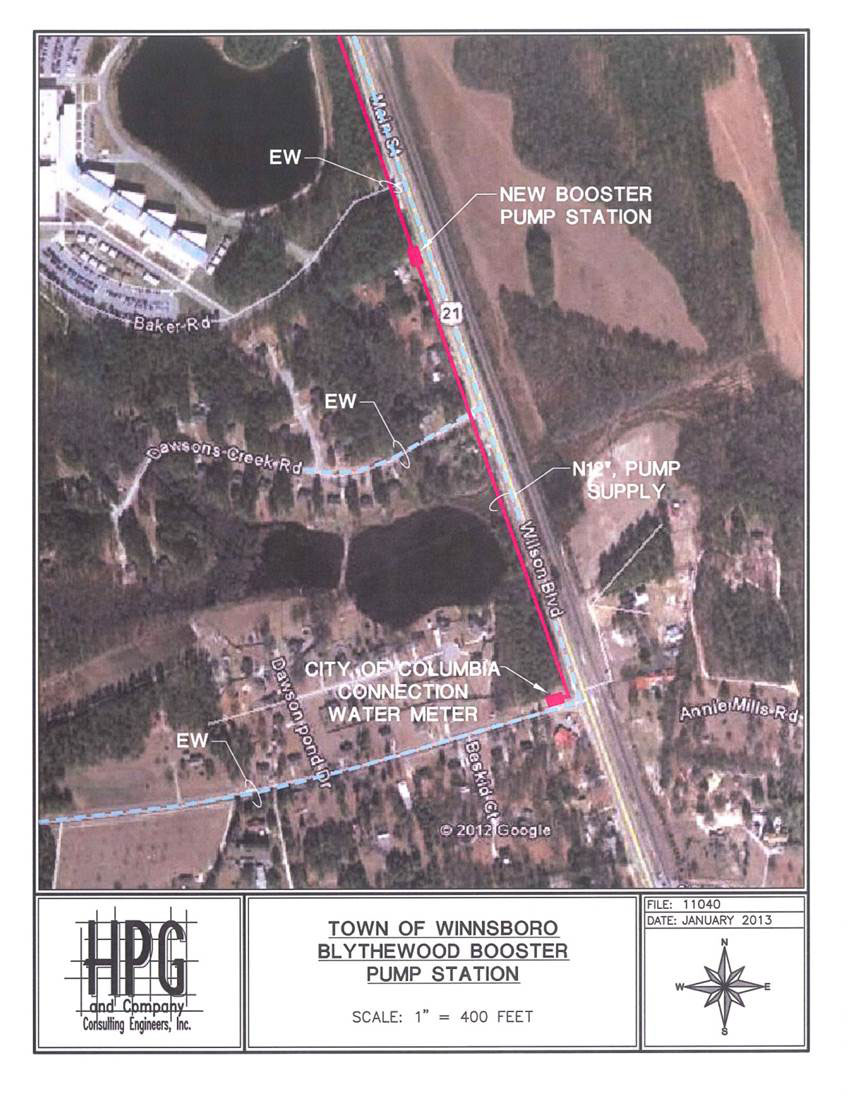
    Map showing the location of the proposed Booster Pump Station on Hwy 21/Wilson Road and the proposed dedicated booster pump suction/supply line from City of Columbia Meter Pit to the booster pump station on Blythewood High School property.
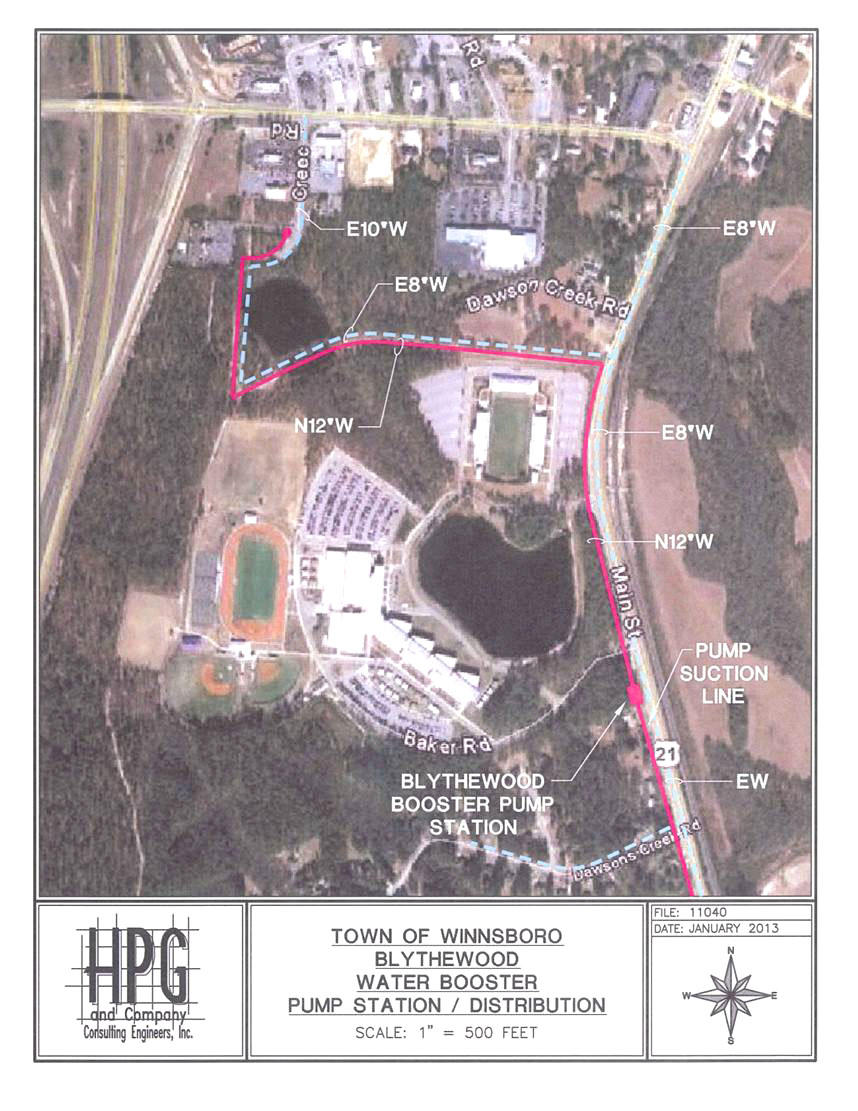
    Route of proposed distribution system improvements between Blythewood booster pump station and Creech Road to allow conveyance of the higher flows at reduced pumping head.
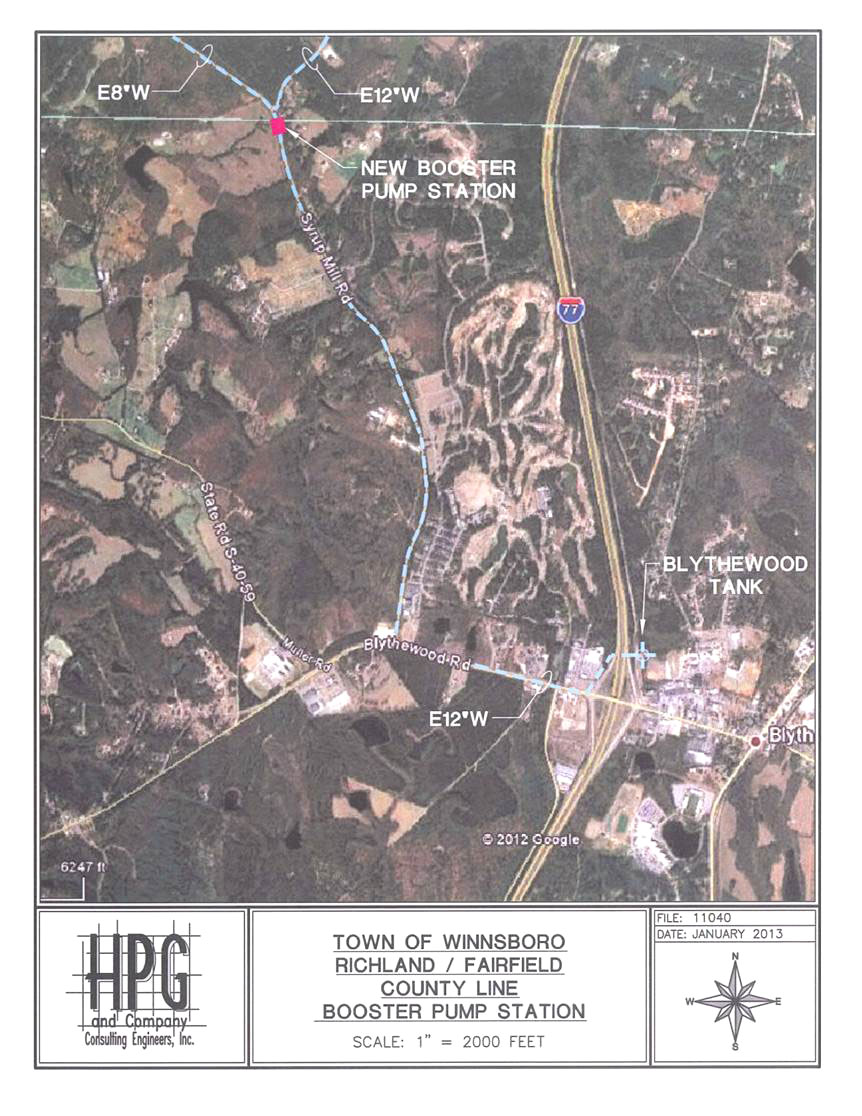
    Map showing location of proposed pump station at the Fairfield/Richland line to allow for filling of Walter Brown I Industrial Park elevated and ground storage tanks and proposed yard piping at the Walter Brown I Park tank site to allow high service pumps to fill Rite Aid tank.
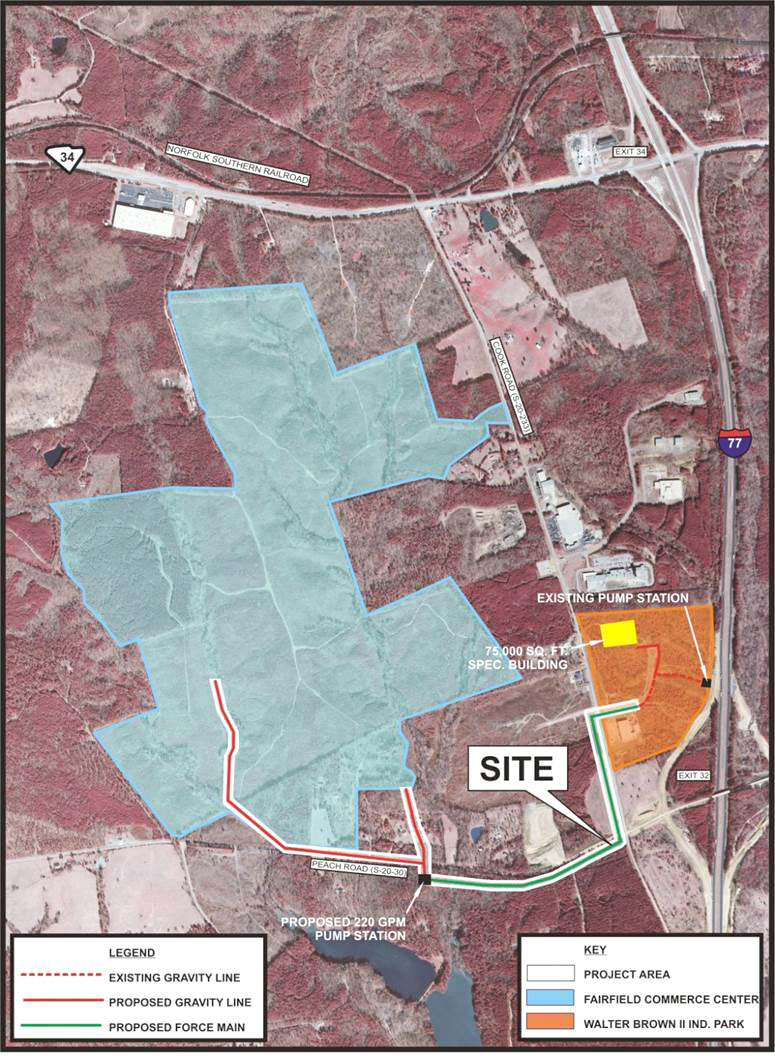
    Map showing location of proposed gravity and force mains from Fairfield Commerce Center to existing gravity line in the Walter B. Brown II Industrial Park and gravity line from the 75,000 SF Speculative Building to existing gravity line in the Walter Brown II Industrial Park.

    FAIRFIELD – With the capacity size of a proposed pumping station determined by HPG and Company engineers, County Council Monday night voted 6-0 to move on to the next phase of water infrastructure installation to serve the Fairfield Commerce Center, the County’s burgeoning industrial park off Cook and Peach roads. The next phase also includes a wastewater hookup that will serve a limited portion of Phase 1 of the park.

    The water connection will use existing lines on the Fairfield County side of the network, but will require the installation of a dedicated supply line from a meter pit off Highway 21 near N. Firetower Road in Blythewood that will wind its way into Fairfield County via Syrup Mill Road. Funding for the estimated cost of the project – $627,135 – will come from a $7 million 2009 bond issue, interim County Administrator Milton Pope told Council Monday night.

    Wastewater infrastructure to service a full build-out of the entire 684-acre park still requires several easements, which the County has not yet obtained, in order to run lines over adjacent properties. However, HPG has determined that the existing wastewater pump station at the nearby Walter Brown II Industrial Park can handle enough wastewater to service a limited number of facilities in Phase 1 of the Commerce Center. The cost for installing the necessary infrastructure – infrastructure that could be expanded to service the entire industrial corridor along I-77 – is estimated to be between $1.18 and $1.248 million, and will also come from the 2009 bond issue.

    “HPG told us we had enough sewer capacity for probably three units,” Council Chairman David Ferguson (District 5) said Monday night. “One is the spec unit we built in Walter Brown II, and that would give us two new buildings in the new industrial park. With this investment, it will get us up to three plants. At that point in time we will have to come up with an additional source of water and wastewater.”

    Council’s approval now sends the project back to the Town of Winnsboro, which will put the project out for bid. Tiffany Harrison, Director of Economic Development for Fairfield County, estimated that the system could be completed and ready for use in a year.

  • Board OK’s $1.71 Million in Expenditures

    FAIRFIELD – During their Aug. 20 meeting, the School Board voted 7-0 to approve nearly $2 million in capital expenditures for the 2013-2014 fiscal year, with the bulk of those expenditures going toward readying the Career and Technology Center for its next life.

    Much of the $1.71 million ($1.1 million) will come from the 2013-2014 $4 million general obligation bond, Kevin Robinson, Director of Finance, told the Board, with $600,000 coming from 2012-2013 bond funds. The remainder of the 2013-2014 bond, $2.9 million, will be devoted to the construction of the new Career Center. Of that $1.71 million, the Board approved $700,00 for the preparation of the current Career Center site for its future role as home of Gordon Odyssey Academy and the District’s Transportation and Maintenance departments.

    The capital expenditures also include $300,000 for technology upgrades across the District; $215,000 for school furniture and capital requests; $125,000 to replace playground equipment in schools district-wide; $110,000 to upgrade the fire and security alarm system at Fairfield Central High School; $100,000 to replace security cameras in the District; and a $160,000 contingency fund.

    Robinson said most of the expense in transitioning the existing Career Center revolves around paving the parking lot for the District’s fleet of buses.

    Work on the new Career Center, meanwhile, is progressing on schedule, according to Anthony Lawrence, executive vice president of Brownstone Design, the firm tasked with the $11.4 million project. Dale Collier, president of the company, told the Board last week that they were at or near budget for the building itself, but additional equipment for the facility could push the cost to $12 million. The site location, between the middle school and the high school, has presented particular challenges, he said, and his firm is working with the Department of Transportation on how to make the site accessible to cars and buses coming in and out from the Highway 321 Bypass. The soil on the site has also presented a challenge, and geotechnical surveys of the land have revealed that the building will need to be placed on stone pilings for structural stability. The subsurface work could add $1 million to the project.

    The Board voted 7-0 to accept Brownstone’s report and move on to the next phase of the project. The design and development phase will be completed next month, Lawrence said, with the construction documents scheduled to be completed in January. Bids for work are slated to open in February.

  • Council Nixes Move to Larger Venue

    County Council faced another full house Monday night.

    FAIRFIELD – Although County Council easily voted Monday night to move an upcoming special meeting on the Local Option Sales Tax (LOST) funds to Fairfield Central High School, two motions to relocate regular meetings to a larger venue touched off a rigorous debate, eliciting unhappy grumbles from the overflow audience before being swept away in defeat.

    Councilman David Brown (District 7), who placed the first motion on the floor to move Council’s regular meetings to a larger venue for a three-month period, said he has been hearing from voters in his district who want better access to County business.

    “We’ve got a group here that’s going to follow us wherever we go,” Brown said, indicating the capacity crowd. “I think the best thing to do is to put us in a large enough venue where everybody can have a seat. We’ve got people in the other room down there (a conference room down the hall, which was also filled). We’ve got people standing in the hall. It’s a fire hazard. If we can go to one of the schools where there’s more room, more air space, actually the Council and the people in the audience shouldn’t feel quite as heated.”

    While Councilman Kamau Marcharia (District 4) said he had also heard from voters in his district on the matter, he had bad memories of previous efforts by Council to bring the meetings to the public.

    “One of the members in my district did write me and ask me to vote yes for moving (the meetings), but that member also told me I needed to resign, so if we move the meetings I don’t know what we’d be talking about,” Marcharia said. “Eight or nine years ago we used to move Council around to fire stations and to McCrorey-Liston school and other places, and we had to call the police. We went to those meetings and folks would come there totally out of control. We had to call that off. Unless you want to wear a football helmet, I am leery about moving.”

    Councilwoman Mary Lynn Kinley (District 6) said she was opposed to the idea, although her reasoning drew grumbles from the onlookers in attendance Monday night.

    “This is our headquarters,” Kinley said. “The Town Hall is where the Town of Winnsboro meets. The School Board meets where they meet. The Senate meets where they meet. They don’t change the venue at the Senate just to accommodate the public when they want to come. It’s first come, first served. But the main reason is Miss Brown (Shryll Brown, Clerk to Council) has records in her office that we depend on greatly for things to be voted on and have correct information.”

    Chairman David Ferguson (District 5) said moving a meeting as highly anticipated as the upcoming LOST update was one thing, but to move meetings permanently was another.

    “To take Council away from chambers for three months, that’s a long time,” Ferguson said. “This is the County seat for meetings. That’s publicly known. Do we need to try one or two and see how that plays out? That might not be a bad idea. But I don’t think we need to spend a quarter of the year someplace else. I don’t think that’s feasible.”

    The motion failed, 4-2, with Brown and Councilwoman Carolyn Robinson (District 2) its only supporters.

    Brown then followed with a second motion, to move meetings on a trial basis for no longer than three months.

    “We can do it one month, if it doesn’t work, or we can give it two months or three months, but let’s give it a try,” Brown said. “If the larger venue is too large, or if this Council starts doing a great job and we lose about half these people out here, we can come back here.”

    That motion, too, failed to garner enough support to carry, dying in a 3-3 deadlock. Brown, Robinson and Marcharia voted in favor, with Ferguson, Perry and Kinley voting against. Perry then put forward the motion to move meetings, as needed, to a larger venue, causing some in the audience to cry out that it was needed now. That motion carried, 3-2, with Brown and Robinson voting against.

    “I hate to disenfranchise any constituent from any of the meetings we have,” Brown said.

  • Ruin and Recreation

    Sorry, The Shamrock Hotel is booked. But there are other great places to stay and things to do and see in Blackville.

    Drive due south 83 miles (about two hours) and you’ll find the sleepy town of Blackville. Here you’ll find Ray Miller’s Bread-Basket with his famous homemade bread and the Healing Springs, a long-time destination for people seeking natural remedies. Here too you’ll find ruins of the Shamrock Hotel and Barnwell State Park.

    A Mennonite family operates Miller’s Bread-Basket on Main Street. Ray Miller owns Miller’s Bread-Basket, a quaint charming place. Just look for the fellow who resembles Ernest Hemingway. They say the meatloaf is out of this world. You’ll relish the wonderful greens and fried chicken. Take your sweet tooth with you. Lil Stoltzfus, the Pie Lady, makes German chocolate pies, Dutch shoofly pies, pecan pies, chocolate fudge pies, apple pies and others. Try the cinnamon raisin bread. Consider the entrees here Pennsylvania Dutch with a southern touch.

    Just down the street stand the ruins of the old Shamrock. For years Miller has advocated restoring Blackville’s 100-year-old Shamrock Hotel, once a whistle-stop on the old Hamburg-Charleston railroad. In its glory days the Shamrock was a hub of activity where people played poker and pool.

    It’s haunting and beautiful. In its heyday green tiles spelled “The Shamrock” in the lobby’s white ceramic tiles near the entrance. The old hotel has long since crumbled into ruin, a reminder of days when people rode trains, not cars.

    Close by is Blackville’s Healing Springs, known as God’s Acre Healing Springs. Lute Boylston deeded the springs to God in 1944. The deed states that the owner of the land surrounding the springs is “God Almighty.” (He’s always been the owner.) A sign at the springs states, “According to tradition the Indians reverenced the water for its healing properties as a gift from the Great Spirit. They led the British wounded to their secret waters during the American Revolution and the wounded were healed. This historical property has been deeded to God for public use. Please revere God by keeping it clean.”

    Gallons gush forth every minute. Take some jugs with you. Back a ways I knew a woman who would regularly make a 120-mile roundtrip to the springs. Laden with many plastic milk jugs she came home with the therapeutic spring water and swore by it.

    Continue your day at Barnwell State Park. Built by the Civilian Conservation Corps during the Great Depression, this park has a reputation as a great place to fish. Feel like staying overnight? Arrange a stay at one of the park’s cabins.

    Blackville may be a sleepy town but you won’t go hungry and you will find plenty to do. Check out this town in the South Carolina Heritage Corridor. And if some stubborn ailment plagues you, well you just may find a cure at the end of your 83-mile drive south.

    If You Go …

    • Miller’s Bread-Basket,

    No Credit Cards Accepted

    483 Main Street

    Blackville, S.C. 29817

    803-284-3117

     • Healing Springs,

    Free

    Springs Court

    Blackville S.C. 29817

    • Barnwell State Park,

    Free

    223 State Park Road

    Blackville, S.C. 29817

    803-284-2212

    Learn more about Tom Poland, a Southern writer, and his work at www.tompoland.net. Email day-trip ideas to him at tompol@earthlink.net.

  • Runners, at Your Mark

    Blythewoodians Jim Graddick, left, and Dave Holder, on bass, entertain with fellow Barefoot-n-Reckless band members Gary Hydrick of Elgin and Hobart Trotter of Columbia. The group will perform a free concert at the Town Park amphitheater on Sunday evening, Sept. 1 prior to the Monday morning Plantation Park Run.

    Readers, your humble scribe is not a runner. You can take one look at me and deduce that. The only time I ever run on purpose is when someone is chasing me. But I understand there are those of you out there who enjoy running, who do it for . . . fun. Well, have I got a fun run for you – it’s the Fourth Annual Blythewood Labor Day Run featuring a 10K run, a 5K run and a 1-mile Kid’s Fun Run. It takes place at the Blythewood Middle School on Sept. 2. It’s hosted by the Blythewood Middle School PTO and Eggplant Events Production, said the school’s PTO President Leanne Thompson.

    But the fun actually begins the evening before, on Sunday, Sept. 1, at the Town Hall park amphitheater where the Barefoot-n-Reckless band will present a free concert for the runners and public from 5-8 p.m. Two of the four members of the band are Blythewoodians – Jim Graddick on mandolin and Dave Holder on bass. The popular new band will entertain with Americana, bluegrass, country and rock. Food vendors will be on site. And from 5-7 p.m., as the music plays on, runners can pick up their packets nearby in the park.

    Bright and early the next morning, race day packet pick-ups and race day registration begin at 6:30 a.m. in the Blythewood Middle School gym lobby. The 10k will start at 7:30 a.m., the 5k at 7:40 a.m. and the Kids’ Fun Run at 8:40 a.m. All three races start and finish at Blythewood Middle School. The 10K and 5K routes are USA Track and Field certified courses and will take runners through Longcreek Plantation, a beautiful residential area of Blythewood, as well as the rural areas surrounding Blythewood Middle School. The 10K runners will enjoy a mixture of flat areas and hills with views of Lake Columbia and the Longcreek Plantation Equestrian Center. The 5K runners will love the flat, scenic course in the historic Round Top area of Blythewood. The 1-Mile Kids’ Fun Run will take place around the gated perimeter of the middle school campus.

    Cash prizes of $50 will be awarded for male and female overall and master winners. Overall second and third male and female and first, second and third male and female in the following age groups will also receive signature Blythewood Labor Day Run awards : 10 and under; 11-14; 15-19; 20-24; 25-29; 30-34; 35-39; 40-44; 45-49; 50-54; 55-59; 60-64; 65-69; and 70+.

    “This is the largest fundraiser of the year for the middle school,” Thompson said. “Previously this was a fundraiser for the school’s orchestra. The proceeds from this year’s event will go toward a digital school sign next to the building and toward creating a field trip scholarship fund for economically disadvantaged students. This is also a great way to get the community involved. Last year we had 400 runners. We’re hoping to have 500 this year.”

    To register or for more information, visit www.BlythewoodLaborDayRun.com. Those wishing to volunteer before, after or during the race should contact the event coordinators at info@eggplantevents.com.

    All kidding about running and chasing aside, this sounds like a great event that the runners among you should enjoy. And don’t forget the free concert on Sunday, which you will enjoy whether you run or not.

  • Blythewood Schools Among R2’s Best, Worst in State Scores

    BLYTHEWOOD – When the second round of test scores for Richland 2 was released earlier this month, Blythewood High School, Blythewood Middle School, Kelly Mill Middle School and all the Blythewood area elementary schools (Lake Carolina, Bethel-Hanberry, Round Top, Bookman and Langford Road) were among the District’s top academic performers. Westwood High School and Muller Road Middle School, however, landed at the bottom of the scoring heap among the Blythewood area schools and the District. At Muller Road Middle, which feeds into Westwood High, and where the curriculum focuses on project-based learning and students receive instruction and material primarily from internet access, PASS test scores fell further behind Blythewood Middle Schools in almost all areas of testing.

    High schoolers’ academic performance is measured with the High School Assessment Program (HSAP) test, while elementary and middle schoolers in grades three through five take the Palmetto Assessment of State Standards (PASS).Meeting the minimum standards on the HSAP is a high school graduation requirement. The HSAP reflects scores of ‘non-competent’ (level 1), ‘competent’ (level 2), ‘proficient’ (level 3) and ‘exceptional’ (level 4) in the areas of English Language Arts (ELA) and math. The HSAP is first given in grade 10 and can be retaken each year until the student scores ‘competent.’

    This year 70.5 percent of Blythewood High School students scored at level 3 (proficient) or above (exceptional) in ELA, improving 9 percentage points over last year. However, Blythewood High students who scored at level 3 or above in math dropped from 62.1 percent in 2012 to 58 percent in 2013. Still, the school’s students overall score in 2013 was less than 2 percentage points behind Spring Valley High School, which was the top scoring high school in the District this year and home to the District’s strenuous Discovery magnet program for students with a strong aptitude in math and sciences.

    While Westwood High School students were not tested last year in the school’s first year of operation, their 2013 HSAP scores compare poorly with Blythewood High students’ 2013 scores. Only 51 percent of Westwood students scored at level 3 or above in ELA, almost 20 points behind Blythewood High where 70.5 percent of students scored at level 3 or above. In math, 58 percent of Blythewood High students scored at level 3 or above, compared with only 35.8 percent of Westwood students. Overall, 29.4 percent of Blythewood High students scored level 1 (failing) or level 2 (competent) At Westwood, 49.0 percent of students scored in the bottom two levels of level 1 and level 2.

    The PASS tests measure the performance of elementary school (grades 3-5) and middle school (grades 6-8) students in five areas — writing, English Language Arts (ELA), math, science and social studies. Their scores translated into ‘not met’ (failing), ‘met’ and ‘exemplary.’

    Overall, Richland 2’s middle schools performed dismally, with some students in certain subcategories consistently scoring below the state averages. On the bright side, at Blythewood Middle School, which feeds into Blythewood High School, scores were so good that they helped increase the district-wide score. In every grade in all five testing areas, more students at Blythewood Middle met or exceeded the scores of students in both the state and District. Blythewood Middle School is a school with equitable racial percentages between black and white students and has the lowest poverty rate of Richland 2 middle schools at 31 percent.

    On a more troubling note, Muller Road Middle School, which is an i-Pad school, performed poorly on the 2013 PASS. Scores reveal that 40-44 percent of the school’s students (depending on the grade) failed to meet math standards for this year. In 2012, 34-42 percent of the students (depending on the grade) failed to meet minimum standards. Not only is there no improvement for any grade in math performance from last year to this year, but there is a significant dip in performance. In a recent internet blog interview, the school’s Principal, Lori Moreno, announced that Muller Road Middle students did not use textbooks, saying that all information that students need is accessible with their I-Pads. This line of thought permeates the entire school culture and is magnified with its project-based learning magnet programs. Another interesting note is that this year’s seventh-graders at Muller, who have experienced two years of this new learning/teaching format, have experienced drops in achievements from sixth to seventh grade in math, science and social studies.

    Lake Carolina Elementary is the PASS test flagship of not just Blythewood area elementary schools, but of the District. Lake Carolina has the lowest poverty levels in the entire district as measured by the number of students receiving free or reduced lunch. Teachers report excellent turnout on parent nights. The number of students ‘not meeting’ standards — meaning failing — in subject areas are five to seven times less than the District average. In other words, Lake Carolina has a culture of success as illustrated by the largest percentage of succeeding.

    Bethel-Hanberry Elementary, Round Top Elementary and Bookman Elementary, while not as high in any of the measurements as Lake Carolina were still in the top tier in academic performance of elementary schools in the District and state.

  • County Removes Recycling Facility

    BLYTHEWOOD – Richland County has removed the recycling center that was previously was housed on the grounds of the Blythewood Community Center. The property was purchased by Sharpe Properties earlier this year and the big blue bins have been taken away and the center closed.

    According to Town Administrator John Perry, who announced the closing at a recent Town Council meeting, much of the material that was recycled in the bins, such as cardboard, paper, plastic and glass, can now be recycled in the curbside recycling containers. Those containers are available from the Richland County Department of Solid Waste and Recycling.

    Large amounts of recyclable items can be brought to Clemson’s Sandhill Research and Education Center across from The Village at Sandhill. For more information about recycling and waste disposal, go to richlandonline.com/Portals/O/TalkinTrashBrochure.pdf or call 929-6000.

  • Three File for Council Races

    BLYTHEWOOD – Three Blythewood residents have filed to run for three open seats on Town Council, according to Town Clerk Martha Weaver. Weaver said another person has turned in a partially completed filing form, but that she cannot release the name or other information until the form is completed.

    The three candidates include current Councilmen Paul Moscati and Ed Garrison who are seeking re-election to their Council seats and a new face to Blythewood politics, Bryan Franklin. Moscati and Garrison are both residents of the Lake Ashley subdivision and Franklin lives in Ashley Oaks.

    The last day to file for candidacy is Friday, Sept. 6 at noon. Candidates must file at the Town Hall, 171 Langford Road in downtown Blythewood. The Town’s general election will be held Tuesday, Nov. 5.

    Moscati’s and Garrison’s seats are both for four-year terms. The third seat, vacated when Councilman Jeff Branham resigned to move out of state in June, is for a two-year term since Branham had served almost two years.

    Citizens who want to be candidates must be qualified, registered voters within the town limits of Blythewood. The filing fee for Council is $5. For filing questions, contact Weaver at 754-0501.

    Anyone wishing to vote in Blythewood’s Nov. 5 general election must be a registered voter in the Town. Those wishing to register must do so by Oct. 5.

  • Horse Owner Faces Animal Cruelty Charges

    WINNSBORO – A Winnsboro horse owner is facing six counts of ill treatment to animals and is scheduled to face a Magistrate’s Court judge on Aug. 30 to answer those charges.

    According to a report from the Fairfield County Sheriff’s Office, Calvin D. Carver, 52, of 480 Hungry Hollow Road, was cited on July 19 for the half dozen horses that “were not being taken care of properly and needed to be fed,” the report states. The Sheriff’s Office said photographs of the horses were taken and reviewed by a Columbia veterinarian. That veterinarian, whose name the Sheriff’s Office asked to be kept anonymous, reported that, “On a scale of 1-to-10, these horses were at a 5 or below,” because of lack of adequate food and nourishment.

    The Sheriff’s Office was originally called to the Hungry Hollow pasture on July 16 after receiving an anonymous complaint about Carver’s horses. Lt. Roger L. Haney and David Brown, Director of Fairfield Animal Control, were initially shown about 10 horses by Carver and each of them appeared normal and in good health, according to the report. The report states that Carver did tell Haney and Brown that he did recently have to put one horse down after it had been bitten by a snake. Carver reportedly told Haney that the snake-bit horse had been treated by a veterinarian out of McConnells, in York County, but the horse would not eat and could not stand on the leg that had been bitten, Carver said in the report, and had to be euthanized. But Brown told The Voice last week that Carver had not properly disposed of the carcass until after Brown and Haney had visited the property.

    “He didn’t cover him up or bury him until after we went out there,” Brown said.

    After examining the 10 horses, Haney asked Carver if he had any others, according to the report. Carver said he did not.

    The next day, Haney received a second anonymous call about Carver’s horses at the address. The caller said there were at least four horses, less than a year old, that were all “in real bad shape,” the report states. When Brown and Haney returned to Hungry Hollow Road on July 18, the emaciated horses were discovered and Carver was hit with the animal cruelty charges. On July 30, Haney contacted the McConnells veterinarian whom Carver had said treated the snake-bit horse, but that vet said he had not treated any of Carver’s horses since 2010.

    As Carver awaits his day in court, Brown said he has been visiting the pasture several times a week to make sure the animals are being fed properly.

    “We’ve been going out there until the court date to make sure (Carver) has food for them, and he has complied,” Brown said. “You can already see an improvement (in the horses). He has stepped up his game.”

  • ACT Scores Dip for FCHS Students

    FAIRFIELD – Fairfield Central High School students taking the American College Testing (ACT) exam in 2013 saw their scores drop somewhat over 2012 scores, with mean scores still falling below the “College Readiness Benchmark” set by the exam.

    Composite scores fell to 15.9 in 2013, down from 16.2 in 2012. The number of students taking the exam was also down from 110 in 2012 to 76 in 2013. In 2011, 102 Fairfield Central High School students took the test.

    In the English portion of the exam, mean scores edged down to 14.2 in 2013, form 14.4 in 2012. The College Readiness Benchmark in English is 18. In mathematics, mean scores slipped to 16.5 in 2013, from 16.9 in 2012. The benchmark for mathematics is 22. Science mean scores were also down slightly, to 16.5 in 2013 from 16.6 in 2012. The science benchmark is 23. Reading scores held steady at 16.2, but were still off the benchmark of 22.

    “We have a lot of students taking the ACT who are not taking the coursework to prepare themselves to be successful,” J.R. Green, Superintendent of Fairfield County Schools said. “But we don’t discourage them from taking the test.”

    Green said the 76 students tested represent about half of the senior class, a relatively large number compared to other school districts and other states. At least nine states, Green said, test 100 percent of their seniors, and their composite scores reflect that negatively. In Mississippi, for example, all seniors are tested, and the state ranks at the bottom of the nation in composite scores. Massachusetts, meanwhile, is at the top, but only tests 23 percent of its seniors.

    The ACT is not a required test, and is an alternative to the SAT for students trying to get into a four-year college. Students who will enter a technical school, a two-year school, the military or join the workforce right out of high school would have no reason to take the ACT. But for students who are aiming for a four-year college, Green said the District will have to get them better prepared to take the exam.

    “Moving forward, we will look at doing a more effective job of getting kids prepared to take the ACT,” Green said.

    That may include adding an elective ACT/SAT prep course for Fairfield students in 2014, Green said, and ensuring that all students who are planning on taking those exams go through the course, which would include multiple sample tests. Green said the District will also encourage students to take the exam more than once in an effort to boost their scores.

    “We have a lot of students who took it one time, didn’t do well and never took it again,” Green said.

    The national composite score for the 2013 ACT was 20.9, down from 21.1 in 2012. Statewide, the composite for public school students was 20.1, up from 19.9 in 2012 (the ACT does not separate public schools from private/charter schools on national averages). National English scores were down to 20.2 in 2013, from 20.5 in 2012. State English scores were up slightly, to 19.3 in 2013 from 19.1 in 2012. Math scores were also down nationwide to 20.9 in 2013 from 21.1 in 2012. In South Carolina, math scores for public school students remained at 20.1. Reading scores were also down nationwide, to 21.1 in 2013 from 21.3 in 2012. Statewide, reading scores were up to 20.5 in 2013 from 20.1 in 2012. National science scores also fell, to 20.7 in 2013 from 20.9 in 2012, while in South Carolina, those score were up to 20.1 from 19.9 for public school students.

    “We will commit ourselves to doing a better job preparing our students,” Green said, “but if we continue to encourage everyone to take the ACT, regardless of whether or not they’ve taken the appropriate prep courses, that will continue to adversely affect our composite scores.”