Blog

  • SAT Scores Down for Second Straight Year

    FAIRFIELD – After experiencing a 78-point jump in 2011, Fairfield County SAT scores dropped for the second straight year. The average composite score for Fairfield County students taking the standardized test fell 20 points in 2013, after falling 27 points in 2012. The number of students taking the SAT grew, from 62 test takers (30 percent) in 2012 to 70 (41 percent) in 2013. In 2011, the year scores soared 78 points, only 42 students (22 percent) took the test.

    Average scores were down across the board in the tested subject areas of Critical Reading, Math and Writing. In 2013, the average score in Critical Reading was 400, down from 409 in 2012. Math scores fell from 418 in 2012 to 409 in 2013, and Writing scores were down from 395 in 2012 to 393 in 2013. The average composite score for Fairfield students fell from 1222 in 2012 to 1202 in 2013.

    The average SAT composite score for all South Carolina graduating seniors was 1436, an increase of five points from 2012. The national average for all students held constant with a score of 1498. In South Carolina, the average Critical Reading score was 484, Math was 487 and Writing was 465; compared to the national average for all schools of 496, 514 and 488.

    “Like the other college admission test ACT, the SAT is not a measure of school effectiveness,” State Superintendent of Education Mick Zais said. “However, within the student population taking the SAT is another data point confirming a troubling trend: there is a wide reading gap between South Carolina and the nation.”

  • Fate of Mt. Zion Hangs on FOMZI Proposal

    WINNSBORO – With the Mt. Zion Institute building teetering once again on the edge of demolition, Town Council met with Vickie Dodds and the Friends of the Mt. Zion Institute (FOMZI) in a public work session Tuesday night to discuss the future of the ailing landmark.

    Dodds, who said FOMZI made their first proposal to Council in 2009, said that proposal still stands, but only Council was holding it back.

    “Either you buy into it or you don’t,” Dodds said. “We’ve been ready to go since May. The only thing that has held us back has been ya’ll.”

    Ownership of the property officially returned to the Town in April, when Red Clay Development failed to live up to any of its commitments since taking control of the site in November of 2009.

    Dodds said FOMZI has raised approximately $60,000 to revitalize the building, with an additional $15-17,000 pledged. FOMZI as not, Dodds said, looking to the Town for additional funds, but for the green light to get started. With the Town holding the deed, Dodds said FOMZI is unable to put contractors to work, particularly on the roof, which she said had to be the first order of business.

    Dodds said to stabilize the roof over the classrooms and the connector to the auditorium would cost between $30-35,000. The roofing fix would be temporary, lasting 4-6 years. The roof over the gym, she said, was too far gone to patch. Once the roof was patched, and the deterioration of the building stabilized, an updated asbestos study would have to be submitted to the Department of Health and Environmental Control (DHEC). The next step would be restoring the windows, then working to remove lead paint chips from the interior.

    “This isn’t something we’re trying to do and say, ‘OK, in a year we plan to have one floor clean and the roofing done and the windows done’. We can’t do that,” Dodds said. “But we can’t not start. And it might be surprising how far we get once we get started.”

    Councilman Clyde Sanders said while FOMZI was Mt. Zion’s “last chance,” the Town couldn’t wait another five years for it to be renovated – something that would cost between $7-8 million, he said.

    “What are you risking,” Dodds asked, “if it takes five years, and we’re raising the funds and doing the work and not coming to ya’ll all the time (for money)? Three years or five years is not realistic for a project this size. I cannot figure out, for the life of me, what ya’ll have to lose by giving us a shot. We know the risks.”

    Mayor Roger Gaddy suggested a scaled-down version might be more reasonable, saving the auditorium only, an idea to which Dodds said she was not necessarily opposed.

    “No matter what decision we make, we’re going to alienate somebody,” Gaddy said. “This project is very ambitious and I think it would have more success if it were smaller.”

    Gaddy and Council asked for a lease proposal that would include some clear benchmarks for progress to be discussed at a future work session. A final decision by Council, he added – either to demolish the building or give FOMZI a shot at saving it – would be made in the coming weeks.

    “Red Clay had it for five years and nothing was done to it,” Gaddy said. “I guarantee you, we’re not going to wait another five years. We’re not going to wait another two years.”

    Dodds said benchmarks and a timetable could be included into any lease agreement; benchmarks that if not met could terminate the lease. But to not even try, she said, would be a missed opportunity for Winnsboro.

    “I won’t shed tears if it’s torn down because of the building,” Dodds said. “I will shed tears because it’s a missed opportunity.”

  • Council Ends Payout Policy

    No More Payments Without Receipts

    WINNSBORO – A long-standing and controversial policy was laid to rest Monday night as Fairfield County Council voted unanimously at their regularly scheduled meeting, held in the Fairfield Central High School auditorium, to change the way they receive monthly payments for mileage and other expenses.

    In addition to their base salary of $15,000 a year (plus an additional $4,800 for the chairmanship and an additional $3,000 for the vice chairmanship), Council has, since July of 2010, been receiving a monthly allocation of $795 for expenses. Those expenses included $195 a month for their “computer fund,” $210 a month for mileage, $125 a month for office expenses and $265 a month for a “Blackberry allowance.” Council has been under increasing public pressure in recent months to reduce what some have labeled “frivolous” and “irresponsible” spending, as well as to adopt a policy that requires Council members to produce receipts for expenses covered under the monthly allocations – something they had not been required to do under the now former policy.

    That pressure continued during the early going of Monday’s meeting as the public once again weighed in on recreation spending and urged Council members Mary Lynn Kinley (District 6), Mikel Trapp (District 3) and Chairman David Ferguson (District 5) to repay the more than $26,000 each they had received over the years in lieu of supplemental health insurance. And Beth Jenkins pressed Council to end their policy of taking $795 a month in expense allocations without having to produce a receipt.

    Monday night, it appeared as though Jenkins and others had gotten at least one of their wishes, and a roar of jubilant applause erupted in the auditorium as Milton Pope, interim County Administrator, read his recommendation to Council.

    “One of the things Council had asked me, in my capacity, to look at, was the process of our allocation process,” Pope said. “And after several weeks of looking at this, among other things in the County, I would forward you this recommendation:

    “Pursuant to the existing administration’s policy regarding expense allocations, based on several weeks of research,” Pope read, “I recommend the Council end the expense allocation policy as implemented by the former administration.”

    Pope said his staff would present a new allocation policy to Council at their next regular meeting on Oct. 14.

    “In essence, Mr. Chairman, what this would do is, those allocation expenses that were previously implemented, it is our recommendation that we should terminate that policy and implement a new policy which is strictly based upon actual reimbursement,” Pope explained.

  • Former County Offices to Anchor Farmers Market

    WINNSBORO – County Council Monday night took the first steps toward putting the fate of their former Voter Registration building into someone else’s hands, but the building at 117 E. Washington St. will not go to Christ Central Ministries, as initially suggested when the structure faced the prospects of the wrecking ball last April. Instead, Council passed first reading Monday night on an ordinance to sell the building to the Fairfield Community Development Corporation (FCDC), a local 501(c)3 dedicated to revitalizing the community.

    Terry Vickers, President of the Fairfield Chamber of Commerce, presented a proposal to Council on behalf of the FCDC during Council’s Sept. 18 work session. Vickers said the FCDC would purchase the building for $100 “and considerations,” during the work session, and the building would be remodeled to serve as the cornerstone of the next phase of the Winnsboro Farmers Market. Christ Central pulled their proposal before it ever came to full Council, Chairman David Ferguson (District 5) said Sept. 18, once they learned the FCDC was interested in the property.

    The 6,200-square-foot building, Vickers said, would be known as the Fairfield County Farmers Market Artisan Center Community Kitchen, and would be divided into three spaces:

    • 3,000-square-feet – Open area to house the farmers market and an artisans market, on a weekly basis. Fairfield County Arts Council would hold workshops here and students from the Blair College of Art would use the space to develop student-driven classes for adults and children, assisting local residents in developing personal growth and marketable skills;

    • 1,500-square-feet – Class space for 12-week courses by Farmers Entrepreneurial University, focusing on nutrition, labeling, expanded marketing for new markets and creation of demand for new jobs; and

    • 1,700 square-feet – Shared use community/commercial DHEC licensed kitchen facility, for local farmers to produce food products for market place. This space will serve as an incubator for food entrepreneurs by providing business support, and will serve the community by providing training on proper food preparation, including cooking and canning and other food related classes to increase sale and consumption of locally grown food.

    Vickers said the FCDC has received a pledge of $125,000 from three donors wishing to remain anonymous to begin refurbishing the building. The FCDC will also write a Rural Business Enterprise Grant proposal for an additional $200,000, she said. In early 2014, she said, a third phase grant through Eat Smart Move More South Carolina will be written for equipment, technical assistance, professional services, start-up operating costs and working capital. Vickers said the FCDC will insure the building at the time of purchase from the County and will have the facility fully operational by the fall of 2014.

    The farmers market is designed to be a year-round market, Vickers said, and the addition of the old Voter Registration building is key to making that happen. So is the ability of merchants in the market to accept SNAP, WIC and Senior Vouchers for the purchase of fresh foods. As of last March, Vickers said, $862,000 went to those food voucher programs in Fairfield County, and none of that money was able to be spent in the farmers market. Vickers said this week that the Winnsboro market has applied with the federal government to be eligible to accept SNAP, WIC and Senior Vouchers, and she said she expects that application to be approved within the next few weeks.

  • Council OK’s Blair Park

    WINNSBORO – Ten months after County administrators removed the final pieces of playground equipment from the Blair Community Park at 544 99 Road, Council voted 4-3 Monday night to shell out $15,000 for an alternative site, also on 99 Road, within a half mile of the former park.

    Yet the decision to replace the park was nearly as unpopular as Council’s decision to close the park, and prior to the vote, during the public comments portion of the meeting, some criticized the purchase.

    Beth Jenkins called the $15,000 price tag “exorbitant,” while Carol Turner said that the purchase of the new park property should, perhaps, fall under the County’s comprehensive recreational plan. Council put off final reading of the ordinance authorizing the purchase of the property last summer following similar public outcry. During the public hearing on the purchase on Aug. 26, Jenkins and Wanda Carnes questioned the purchase, with Carnes wanting to know where, in Blair, was property worth $15,000 an acre.

    Following the Aug. 26 public hearing, interim County Administrator Milton Pope asked that if the public had any information on alternative property in that area to please bring that information to his office. Chairman David Ferguson (District 5) reiterated that request at the close of the Aug. 26 meeting.

    During Council’s Sept. 9 meeting, Pope updated Council on the status of the new park property and said that, at that time, no one had brought forward any alternatives.

    “There was information provided at the last citizens input session (Aug. 26) that there could be the possibility of land that could be donated or provided to the County,” Pope said on Sept. 9. “I am waiting on that information. I have not received any information to date.”

    Pope added that Council member Mikel Trapp (District 3), in whose district the former park had stood since 1985, had expressed his desire to have the purchase move forward.

    The new park property is located at 118 99 Road in Blair and is being purchased by the County from Bonnie E. Goree, Dianne Eigner, Alice G. Reeder, Susan Mattison, Mary Ann Nelson and Betty Lewis. The property has a total assessed value on the County’s tax records of $15,000 — $7,500 for the property and $7,500 for a building on the property. The County said it will cost an estimated $72,000 to build out the park to completion.

    While Trapp, Ferguson, Mary Lynn Kinley (District 6) and Kamau Marcharia (District 4) voted to approve the purchase, Council members David Brown (District 7), Carolyn Robinson (District 2) and Vice Chairman Dwayne Perry (District 1) voted against. After the meeting, Perry said he was not necessarily against opening a new mini park in Blair, but wanted to see Council do more to search out less costly, perhaps even free, parcels of land. While Perry confirmed that no one in the community had come forward with land to be donated or sold at a lower price, he said Council had also not done any legwork to find alternate property.

    The County began moving off the original property at 544 99 Road last September after negotiations to purchase the less than 3-acre lot broke down. The County had been paying $1,200 a year to lease the property from Felicia Trower, personal representative with power of attorney for her mother and property owner, Nancy T. Young. When the lease expired in August of 2012, Trower upped the ante to $6,000 a year, according to County documents. When the County suggested purchasing the land, Trower told the County she wanted as much as $300,000 for the plot.

    “We couldn’t come to an amenable agreement with the landowner on a purchase price,” Davis Anderson, Deputy County Administrator, said last year. “What the landowner wanted was not anywhere near the fair market value, so it was shut down.”

    Closure of the original park, which had served the community since 1985, sparked some controversy in the county. Trower claimed the County, specifically Sheila Pickett, Director of Procurement, never negotiated with her at all for the purchase of the land, and also said that the $6,000 figure for a new lease was only a starting point.

    “She (Pickett) asked me what I wanted for it,” Trower said last November. “I said $6,000. In the past, we had always negotiated it. When I told her (Pickett) $6,000, she never got back to me. I called her back again, and she told me the County was not going to renew the lease. I threw the figure out there thinking they would negotiate. But they didn’t. No one ever got back to me.”

    Members of the Blair community turned out at Council’s Dec. 10, 2012 meeting to voice their disappointment that the park was no more. Ernest Yarborough, speaking on behalf of the Shelton Templeton Foundation, a community group organized to bring the park back to life, asked Council to delay any decision to lease new land for a replacement park until the Foundation could come back to Council with an alternative. Yarborough said then that the Foundation would attempt to raise private money, then request matching funds from Council.

    “The people here tonight have a right to be disappointed,” Yarborough said during the Dec. 10 meeting, “but instead of coming here to fuss, these people appear tonight to ask you to give them a chance to help themselves.”

    The Foundation has not, to date, made another appearance before Council.
  • A Bridge Not Too Far

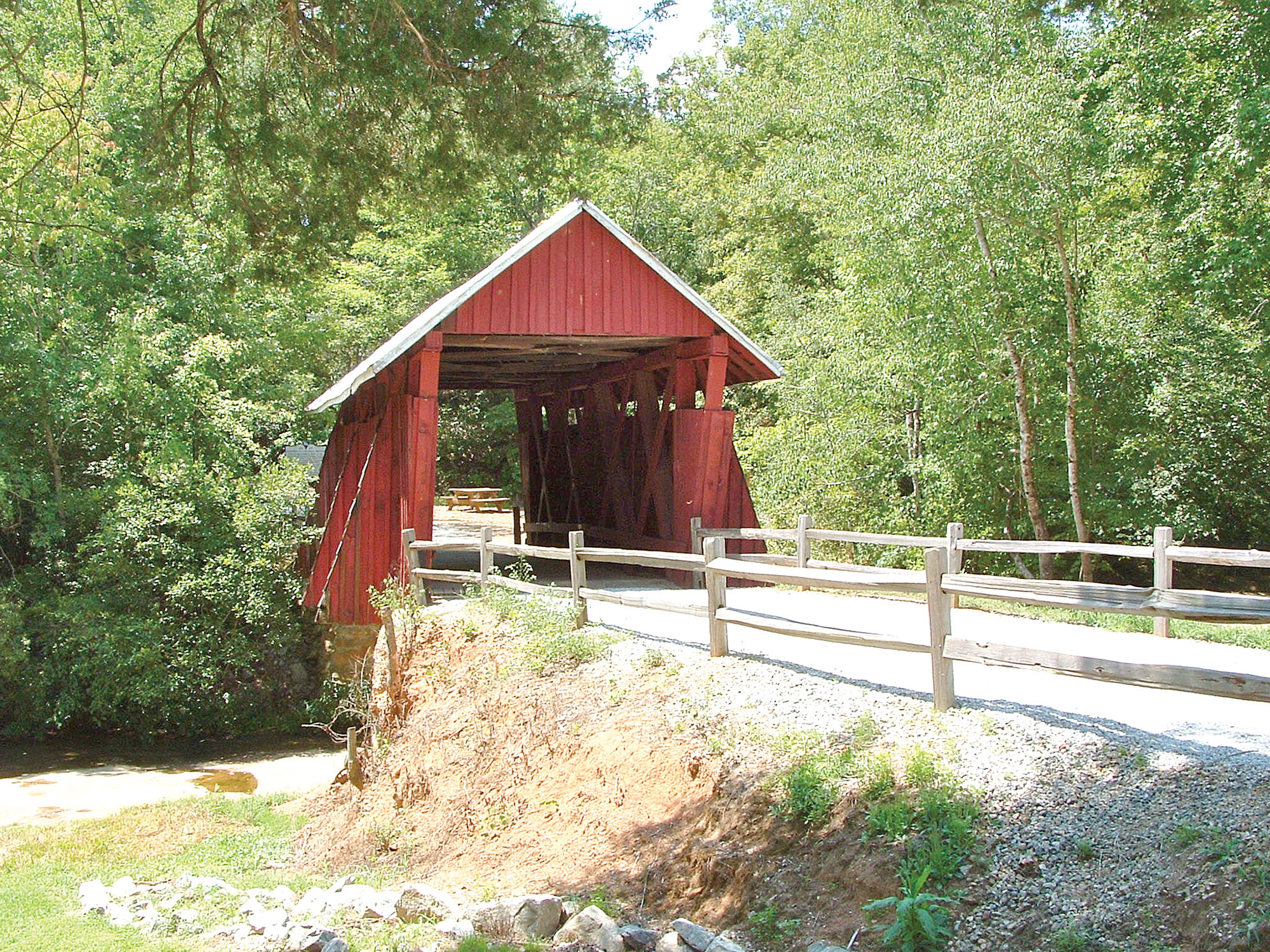
    Campbell’s Covered Bridge in Landrum: vintage Americana.

    I never saw an authentic covered bridge until Clint Eastwood directed and starred with Meryl Streep in “The Bridges of Madison County.” Genuine covered bridges in these parts are as rare as hens’ teeth. Several years ago, though, I came across the real deal: a covered bridge up in northern Greenville. It was late afternoon when sunlight comes in so low everything is gold and lustrous, and driving into it is hard. A bit blinded as I rounded a curve, I got a treat as my eyes adjusted — Campbell’s Covered Bridge.

    You can see it too. Just make a two-hour, 112-mile drive to Landrum. You’ll find the covered bridge near the small town of Gowensville. It’s South Carolina’s last remaining covered bridge and it crosses Beaverdam Creek. Greenville County owns the bridge and closed it to traffic in the early 1980s. It was added to the National Register of Historic Places on July 1, 2009. Major renovations have kept the bridge in good shape.

    In 1909, Charles Irwin Willis built the 38-foot long, 12-foot wide pine structure. The bridge was named for Lafayette Campbell, who at the time of the bridge’s construction owned 194 acres in the immediate area. Campbell owned a nearby gristmill and he let his property to be used for the bridge’s construction. Willis was no dummy. He knew area farmers could better bring their corn to his mill across the creek.

    The Greenville County Recreation District has transformed the surrounding acreage into a park where visitors can picnic, explore the foundations of the old gristmill and home site, wet their feet in Beaverdam Creek and learn about the area through interpretive signage.

    I loved the old bridge. I got out and walked inside the bridge, struck by its narrow width, just right for horse-drawn buggies. Through cracks in the wooden flooring, I saw and heard Beaverdam Creek running cold and swift over rocks below. Everything was peaceful, the air a bit chilled. I stayed there a while trying to envision the many years long ago when old cars and carts rolled through and no one gave a second thought to the bridge’s uniqueness. I’m sure it made for a nice spot for couples, once the busy day settled down, a “Bridges of Madison County” spot, so to speak, for lovers. I walked out from the bridge as darkness settled in, and just then a young couple drove up. They looked at me, a stranger, as if I didn’t belong there, and I didn’t.

    I was glad to see the old bridge still had allure, still had its pull on romantic souls. It will pull on yours too. It’s there. The bridge and surrounding area are quiet, peaceful and beautiful. Pack a picnic come fall when the leaves burst with color and visit this rare bit of Americana. Be sure you take photos of this rare covered bridge. Once you’re ready to move on you’re not far from SC Highway 11, the Cherokee Foothills Scenic Highway. Look for mountain vistas, handmade quilts, apples, apple jelly and honey for sale. Return home with great moments to remember.


    If You Go …

    • Campbell’s Covered Bridge

    171 Campbell Covered Bridge Road

    Landrum, S.C. 29356

    Learn more about Tom Poland, a Southern writer, and his work at www.tompoland.net. Email day-trip ideas to him at tompol@earthlink.net.

  • A Real Homecoming

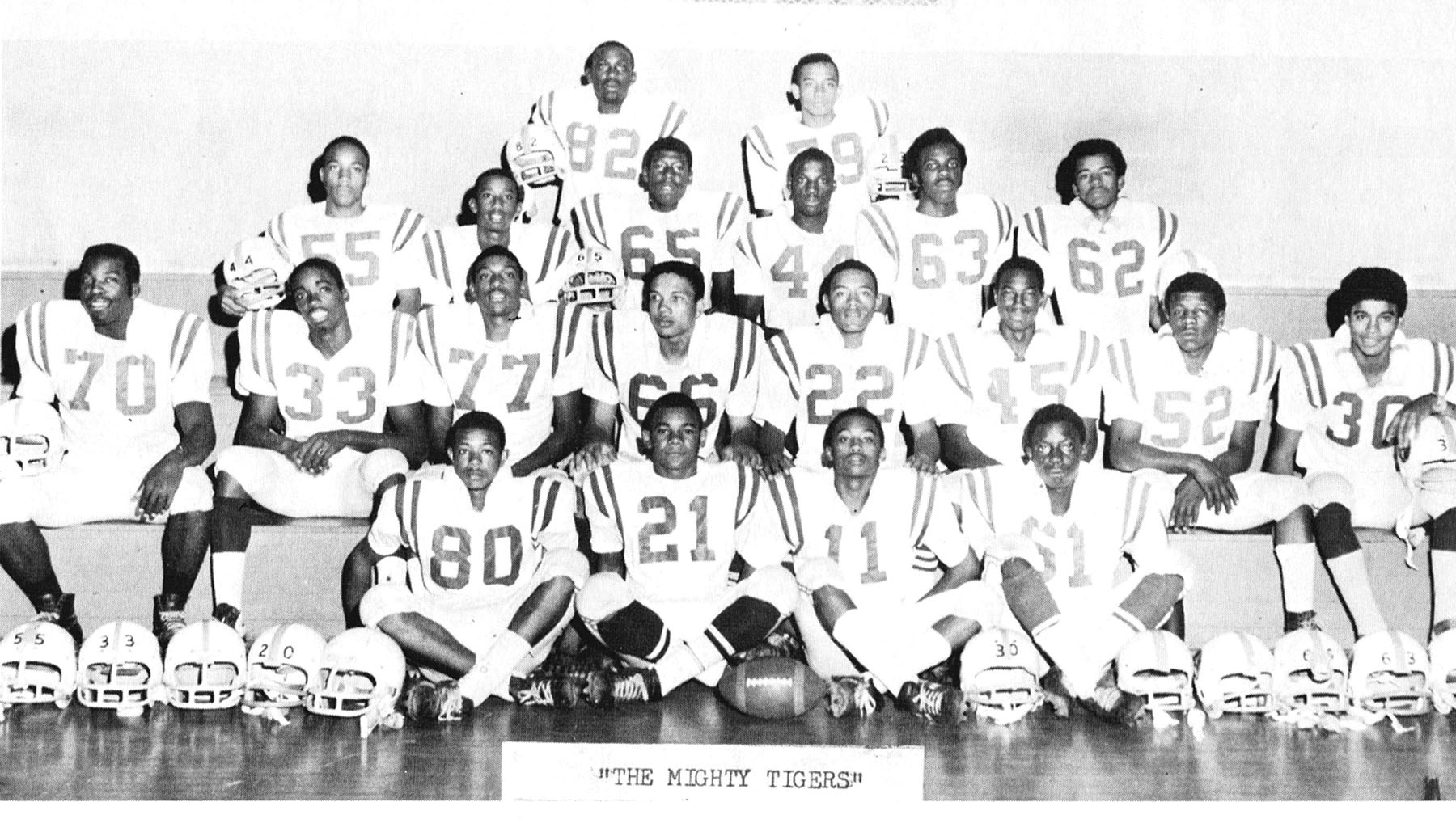
    A halftime ceremony during Friday night’s Blythewood High School football game will honor the athletes who attended Blythewood’s former Bethel High School, which closed after the 1970 school year. Show above are the members of the last Bethel Tiger football team. Front row: Bobby Cunningham (80), Dale Bell (21), Anthony Chavis (11), Larry Gilyard (51.) Second row: Olin Kelly (70), James Bright (33), James Cunningham (66), Timothy Blanding (22), Willie Belton (45) Lawrence Bolar (52), Ray Jacobs (30.) Third row: Ezell Wright (55), Larry Griffin (10), John Hagler (65), Larry Green (44), Alonzo Gilyard (63), Colzell Williams (62.) Top row: Doug Watts (82) and Franklin Fogle (79.)

    A special event will be held during halftime at Blythewood High School’s football game on Friday night. The school and Richland District 2 will honor the former athletes of Blythewood’s historic Bethel High School.

    It seems hard to believe now, but in the early 1950s and 1960s, school integration had not yet taken place and segregation was the order of the day. In Blythewood there was both a high school attended by white students, the original Blythewood High School, and a high school attended by black students, Bethel High School. Both schools had football teams, though they never played each other. Both schools were closed as high schools in the 1970s, and the students from both Bethel High School and Blythewood High School were integrated into Spring Valley High School as one unit.

    Now the District, as well as members of the Bethel-Hanberry Athletic Alumni Association (B-HAAS,) are seeking to honor those former athletes from Bethel High School.
    B-HAAS president Larry Griffin played on the Bethel High School football team in 1969 and 1970, and he was quarterback in 1970. But he graduated from the integrated Spring Valley High School. Griffin explained that the idea to honor Bethel High School came out of a movement last year to honor several closed historic schools — Bethel, Richtex, Lexington-Rosewald and Lakeview.

    “This is what you’d call a football legacy,” Griffin said. “Bethel was chosen as one of the four schools to be honored because we already had a viable and evolving athletic alumni association.”

    After Bethel High School was closed, it became a middle school, then a junior high and then Bethel-Hanberry Elementary School, which it still is today. The original Blythewood High School is now Blythewood Academy.

    Griffin has been working with his fellow B-HAAS members to locate former Bethel High School athletes. According to the B-HAAS flyer, the former athletes are invited to a pre-game tailgate Friday night from 4-7 p.m. sponsored by the Association. Bethel players will be introduced to the current Blythewood Bengals football team prior to the game and will accompany them onto the field for the pre-game warm-ups.

    This celebration is not a case of an old wound being healed, but of former players returning to their roots and showing their kids and grandkids where they came from, said Griffin.

    “The biggest thing I want to stress is that some of these guys haven’t been back (in the community), some have not been on the new BHS football field and some of these guys have never had any accolades since they left school,” he said.

    Part of the reason why the players haven’t receive the accolades they deserved was because a lot of the history of Bethel High School was lost in the transition to Spring Valley High School, and a lot of those former Bethel athletes lost touch with the community and the school that was no longer there. To them, it was a closed chapter of their lives. Griffin has worked diligently to find any and all school memorabilia, but many of the artifacts are missing and presumed thrown away.

    He has also been trying to get the word out to those Bethel athletes that are still around, he said.

    But the B-HAAS isn’t about just strolling down memory lane. The Association works to be a force for good in the Blythewood community in the here and now.

    Writes Griffin, “The Bethel-Hanberry Athletic Alumni Association has already been instrumental in providing financial assistance to both school and community. The group’s commitment toward securing the Bethel High School legacy is . . . demonstrated by their . . . annual scholarships to Richland District Two students.”

    “My hope for this weekend event is that the alumni of the school will come out to see their athletes honored,” Griffin said. “We are going to tour the former high school at noon on Friday – sort of a ‘whence you came’ thing, to where the school is right now. Then we’re going to visit Town Hall where there will be a proclamation by the Mayor. Then we’ll tour at the new high school, which is a ‘whence your kids and grandkids came’ thing.

    “About all the alumni athletes have remaining from their high school days, now, are their memories,” Griffin said. “B-HAAS plans to give them one more memory — that of standing together on the field at Blythewood Stadium as they are honored for the days when they were high school athletes.”

    Friday’s Schedule of Events for Bethel High School Athletes

    12 p.m. – Tour Bethel-Hanberry Elementary

    1 p.m. – Proclamation by Mayor at Town Hall

    2 p.m. – Presentation to Town at Doko Manor

    3 p.m. – Tour Blythewood High School

    4-7 p.m. – Tailgate at BHS Stadium

    7:30 p.m. – Game Time

    Halftime – Bethel High School Athletes honored

  • Board Paves the Way for Bank

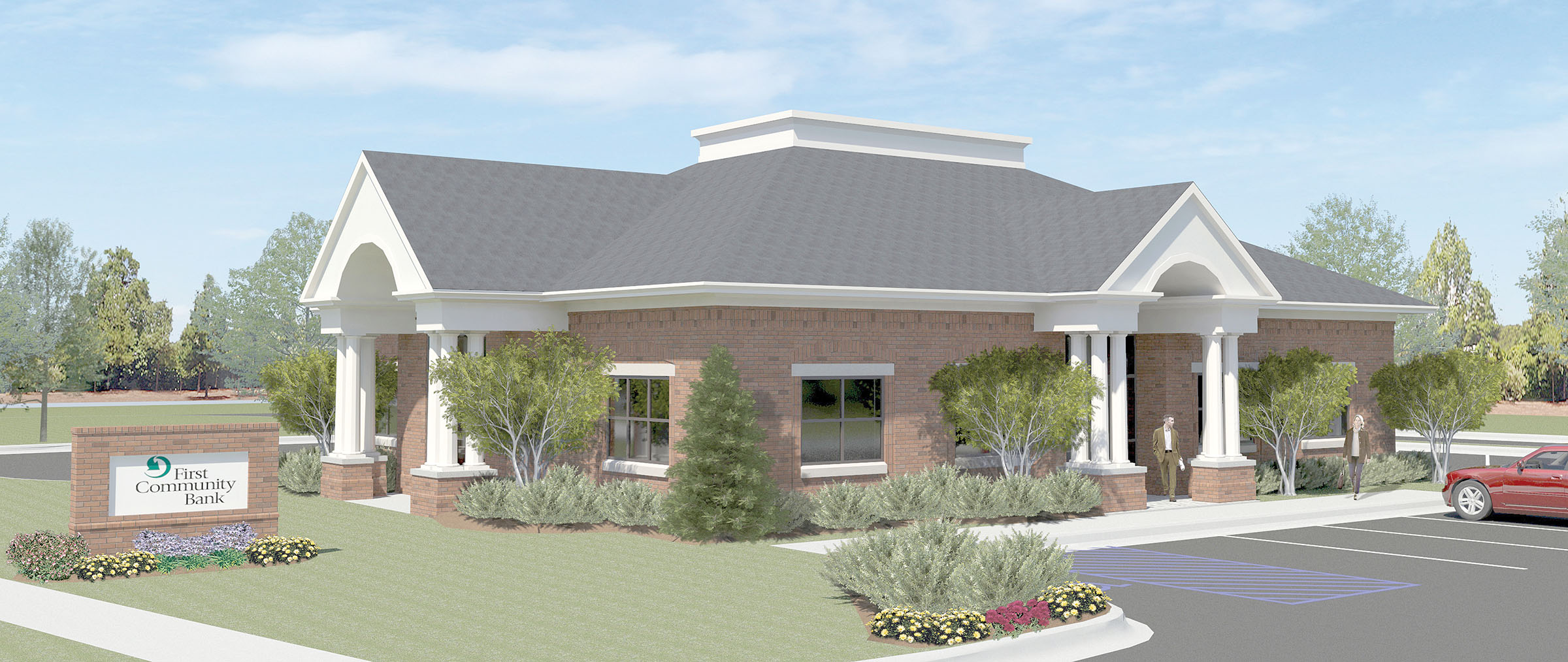
    A rendering of the First Community Bank building that is proposed for construction in downtown Blythewood.

    BLYTHEWOOD – The Town’s Architectural Review Board voted on Monday evening for conditional approval for a Certificate of Appropriateness (COA) for a building the First Community Bank plans to construct at the corner of Blythewood Road and Main Street (Highway 21) in downtown Blythewood. B & D Auto Sales currently operates on the property. The final COA is subject to approval of a landscape plan by the Town’s landscape consultant, Rick McMackin.

    Michael Crapps, President and CEO of the bank said construction on the bank should begin in about a year and should be completed around the first of 2015. Crapps told members of the BAR that Community Bank started in 1995 with two offices in Lexington and Forest Acres and is the largest community bank in the Midlands. Community Bank currently has 11 branches in a four-county area.

    “We expand into the type of communities that value local businesses and that value input and participation by citizens,” Crapps told the Board. “Our goal is to enhance the prosperity of the communities that we’re involved in. We look forward to serving the businesses and individuals in Blythewood.”

    The Board members had only positive comments to make regarding the architecture of the building as presented by Architect Cling Burdette representing Jenkins, Hancock and Sides Architects who designed the building.

    The 3,000-square-foot building will sit close to the street with parking in the rear and side according to requirements of the Town’s Master Plan. However, the building will not have to meet the height requirements of a recently passed ordinance that would require all new buildings on specific corner lots in the Town to include a simulated second story. Perry said the bank building would be 3-feet short of that requirement.

    Perry explained the exception as an improvement but not the quantum leap forward that the Town’s ordinance called for. While he stood by the Town’s aggressive plan for new construction in certain areas of the downtown, Perry blamed the economy, saying it made this a difficult time to move forward with the plan.

    “It’s better to take a half step forward and achieve an acceptable compromise,” Perry said. It [the requirement] might not be worth it for the development not to happen at all.”

  • Town Vows to Reign in ‘Renegade’ Signs

    BLYTHEWOOD – During the discussion segment of Monday night’s Architectural Review Board meeting, Town Administrator John Perry told members that he would soon suggest changes to the Town’s sign ordinance to strengthen it against what he called ‘renegade’ temporary signs.

    Perry said a couple of temporary signs had popped up at businesses in the downtown area recently that he was not proud of and that had slipped through the cracks of the Town’s sign ordinance.

    “There were no grounds [in the Code] not to approve them,” Perry told the Board, referring to two temporary black metal signs with large pink, yellow and red fluorescent letters that recently appeared on McNulty Road and Blythewood Road. Perry said the problem is that when one or two of these pop up, then others will follow.

    Town Planning Consultant Michael Criss told The Voice that the Town’s sign ordinance does not spell out the restrictions very well on temporary signs.

    “Many jurisdictions prohibit that style of a temporary sign, specifically, defining its portability with wheels and metal legs,” Criss said. “Our ordinance does not have that at this time. I think we need to look at temporary signs comprehensively because there are so many types.”

    Criss said Perry has the authority to address location, duration and to some extent the appearance of a temporary sign, “But the current Code doesn’t give him much guidance in making decisions on appearance,” Criss said. “In regard to temporary signs, Council may want to provide the Administrator with more guidance for approving these signs, and it may want to strengthen the Code itself.”

    For changes to be made to the Code, Criss explained, Council would have to ask the Planning Commission to look into the suggested Code changes. Some of those changes would also be looked at by the ARB, then the Commission would need to make a recommendation to Council which would have to give two readings to the amended Ordinance.

    “That’s going to take a little time,” Chris said. “It might be the end of the year before we could actually affect those changes.”

  • White Oak Man Killed in Crash

    WINNSBORO – A White Oak man was killed Sept. 18 when his 2000 Jeep Grand Cherokee crashed on Pumphouse Road. Quincey Ashford, of 24 Ibis Lane in White Oak, was pronounced dead at the scene, according to Fairfield County Coroner Barkley Ramsey. It was Ashford’s 24th birthday.

    Ramsey said two passengers in the Jeep were transported to Palmetto Richland Memorial Hospital following the accident and were in stable condition.

    According to the S.C. Highway Patrol, Ashford was driving south on Pumphouse Road, less than half a mile from the Winnsboro town limits, when he ran off the right side of the road, over-corrected and ran off the left side of the road at 5:40 p.m. The Jeep overturned, Ramsey said, and Ashford was ejected. Ashford was not wearing a seat belt at the time of the accident, the Highway Patrol said.

    Ramsey said the toxicology report is pending, and may take as long as 30 days to complete; but, he said alcohol and Ashford’s rate of speed are suspected as contributing factors in the accident.