Members and guests of Zion UMC in Blythewood enjoy lunch under the picnic arbor next to the historic church during its recent Homecoming celebration.
When members and visitors recently gathered to celebrate Homecoming at Zion United Methodist Church, located deep in the woods of Blythewood off Zion Road, they weren’t sure how many years they were celebrating. Records of the church are no more specific than to say it was established in a rustic log building in the late 1700s or early 1800s.
What is clear, however, is that they were celebrating more than 200 years of worship that took place there in the clearing of a quiet forest of trees in at least two different buildings, with the promise of a future on every horizon.
On this homecoming, the little white church on Zion Road was awash with remembrances. The church’s pastor, Debbie Miller, welcomed the congregation, many of whom had lived in Blythewood and gone to church together all their lives. While the building is old and the congregation is small, the church’s history lives on, not only in the families who have worshipped at Zion for decades, but in the building’s many appealing attributes – wonderfully hand-hewn walnut pews and pulpit and wide board, heart pine floors.
One of the oil lamps that illuminated the interior of the church until 1943 has been electrified and now hangs above the pulpit as a reminder of days gone by when Zion had over 100 active members.
The Oasis Choir from Trinity UMC provided music and, following the service, the members did what they’ve done for more than 200 years – gathered in the side yard of the church for ‘dinner on the ground,’ prepared by the women of the church. And until only three years ago the dinners were truly a picnic on the ground. But this homecoming dinner was not. It was spread beneath a fine picnic shelter constructed on the edge of the woods next to the historic church.
The shelter, built to accommodate activities of the current and growing membership, speaks to a church with a memorable and glorious past as well as a bright and glorious future.
The mouth of the Stumphouse Mountain tunnel – enter if you dare!
A drive to Walhalla runs about 143 miles and not quite three hours. Follow S.C. Highway 28 out of Walhalla into the Appalachian Mountains and you’ll discover a tunnel where men performed backbreaking labor pursuing a railroad dream. You’ll also see a beautiful waterfall.
I made the drive north out of Walhalla early one fall day. I visited Issaqueena Falls and its three stair-stepping cascades in the early morning. The air was cool and crisp. Approaching the falls I saw water flowing over an edge — a bit of a disappointment, but then I walked down the trail to its right and there a treat greeted me. Falling dramatically, early light glittering on a filigree of aquamarine water, I beheld Issaqueena Falls.
A short walk uphill took me to Stumphouse Mountain, where a 1,600-foot tunnel fell short of creating a railway passage from Charleston to Cincinnati. Check out Stumphouse Tunnel, the Upcountry’s black hole. Enter its hand-chipped, reverberating, dripping shaft that’s 1,617-feet long. It’s so dark in there man can’t even pipe in daylight. No bats though . . . or are there? Enter if you dare.
Irishmen chipped and drilled through though solid granite, hoping to link Charleston to the Midwest. Hard to imagine what difficulties they encountered. Stumphouse Mountain tunnel reminds us of their failed 1850’s attempt to link the port of Charleston to the cities of the Midwest by rail. After six years, the Civil War and a lack of money brought the backbreaking work to a halt. The tunnel had been excavated to a length of 1,617 feet of the planned 5,863 total feet. Some 100 years later, Clemson University used the tunnel to age blue cheese but relocated the operation to air-conditioned cheese ripening rooms where they were able to duplicate the conditions indoors, chiefly the 85 percent humidity and constant 56 degrees Fahrenheit. The tunnel measures 17-feet wide by 25-feet high. About midway in a 16 x 20-foot airshaft shoots 60 feet up to the surface. As a result, a steady breeze flows out of the tunnel. It also leads to condensation and the tunnel is generally wet.
As for Issaqueena Falls and its beautiful 200-feet cascade, legend holds that the Indian maiden, Issaqueena, rode to a nearby fort to warn of a pending Indian attack and then escaped pursuing Indians by pretending to leap over the falls, while actually hiding beneath them.
The City of Walhalla operates a park at Stumphouse Mountain Tunnel and Issaqueena Falls, which has picnic facilities and trails. It’s open daily from 10 a.m. to 5 p.m. except Christmas Day and inclement weather. Admission is free but there is a fee to reserve the large picnic shelter. The park does not have camping facilities or drinking water. Outhouse restrooms and picnic sites exist.
Camping is available at nearby Oconee State Park and other beautiful falls such as Whitewater Falls are nearby. A hiking trail is also nearby. Make the trip and see the black tunnel and glittering waterfall, studies in contrast that make the park so compelling.
If You Go …
• Stumphouse Mountain and Issaqueena Falls
www.oconeecountry.com/stumphouse.html
• 864-638-4343
Learn more about Tom Poland, a Southern writer, and his work at www.tompoland.net. Email day-trip ideas to him at tompol@earthlink.net.
The brains behind the barbecue, Pig on the Ridge organizers Henry Dixon, Tom Connor, Rufus Jones and Donald Prioleau will stay on task and on the golf cart throughout the Pig on the Ridge festivities this weekend in Ridgeway.
Round about this time every year, folks in Fairfield County, Blythewood and beyond get a strange gleam in their eyes. They tie on their napkins and head to the Town of Ridgeway where an important little to-do called Pig on the Ridge has been known to happen. This is the festival’s 15th consecutive year.
Pig on the Ridge provides a great event for the community, raising funds to support community projects. Most especially, the festival funds Christmas gifts for needy children in the community. Founding committee member Tom Connor estimates that over the years Pig on the Ridge has funneled about $130,000 into the Ridgeway community – toys for the kids, much needed equipment for the fire department, Welcome to Ridgeway signs for the town and major contributions to the restoration of the Century House.
Pig on the Ridge 2013 begins on Friday, Nov. 1 at 6:30 p.m. with the cook teams showing off their cooking skills with their best Friday night no-pork dishes until about 8:30. Fistfuls of tickets that can be exchanged for samples of these delights go on sale Friday night for $1.50 each. Many a food fan will be wandering up and down the Cotton Yard, grazing their way along the booths. The tickets can also be redeemed for barbecue on Saturday. According to Tom Connor, there will be 78 cook teams from South Carolina, North Carolina and Georgia competing during the Saturday barbecue contest.
A shag dance will be held from 7-10 p.m. over on Palmer Street and a street party from 7:30 to 11:30 p.m. will kick off on Dogwood Drive.
But let’s admit it; Pig on the Ridge is all about the ‘Que, and mighty good barbecue it is, too. On Friday night, the cook teams will receive their supplies of whole pigs and Boston butts for the next morning’s contest. They’ll begin cooking and smoking their butts and pigs that night and will probably be up all night tending to them. Connor said he anticipates about 1,100 Boston butts will be cooked and 16 butterflied whole hogs.
On Saturday, judges certified by the S.C. BBQ Association (yes, there really is one) will judge the barbecue in all its forms beginning at 9:30 a.m. Bill Rogers, one of the SCBBQA founding members and a certified judge since 2005, reckons he has judged about 30 contests around the state and is a regular guest at Pig on the Ridge.
“Pig on the Ridge is one of the oldest and most well-respected barbecue contests in the state, particularly because you have a mixture of amateur and professional cook team categories. The judges will be coming from across the state,” Rogers said.
He said there will be a good variety of types of ‘Que, including vinegar-based, mustard-based and the traditional Texas ketchup-based.
“Good barbecue is like good wine; you should eat what you like,” Rogers said, though he recommends that barbecue eaters tend to step out of their comfort zone and try different styles. He also said good barbecue will have the “bark,” the browned outside of the meat showing the cookers know what their ‘Que is all about.
On Saturday, children’s activities will also crank up and craft booths will line the streets. But what will have most folks salivatin’ and standin’ is the sale of barbecue, which will begin once the barbecue judging has been done. Folks will have a chance to load up on the best barbecue this side of Memphis. DJ Don Prioleau (one of the Pig on the Ridge organizers), along with other local talent, will provide music to buy barbecue by.
At 10 a.m. the classic/antique car display on Dogwood Drive will open to receive visitors who want to gaze at Detroit’s finest from days gone by.
But remember, this festival is all about the pig, and you’ll be reminded of that at about 12:30 noon when the hog calling contest starts. Then at 1 p.m. our brave emergency workers and public safety workers will receive a much-deserved salute and the classic cars and bikes will take part in a cruise-by and Pig on the Ridge 2013 will be capped off at 2 p.m. with the awards ceremony. After that, the barbecue that you purchased that day will be your only reminder of two great days in Ridgeway, unless you were lucky enough to take home a trophy, or some great local crafts. See you in line!
BLYTHEWOOD – At the Town Council meeting on Monday, Ashley Oaks homeowner Jeff Henry presented Council with a petition signed by 107 (or 88-1/2 percent of) Ashley Oaks residents calling on Blythewood Town Hall to reinstate its seven-year practice of paying for the street lighting in Ashley Oaks.
Henry said that about 15 years ago Ashley Oaks residents were approached by Town Hall to annex into the Town with the promise, among other things, that the Town would provide street lighting and mowing along roads in the subdivision when it came time for the developer to turn those responsibilities over to the residents of Ashley Oaks. Henry said it was a promised condition of annexation and presented a letter, signed by Lorrain Abell (Town Administrator under the Roland Ballow administration prior to 2004) encouraging Ashley Oaks residents to annex into the Town, extolling the benefits of Town residency and promising the provision of lighting and mowing to Ashley Oaks.
Henry recounted that, until 2006, the lighting and mowing for the subdivision were provided by developer Mike Shelly. After that time these services became the responsibility of the homeowners. M. B. ‘Pete’ Amoth, who was then mayor of the Town and a resident of Ashley Oaks, agreed to honor what the residents said was the Town’s agreement to take over the lighting and mowing.
But this past summer, Henry said residents began to be billed for those services.
“We didn’t get a letter or anything, just started getting a bill,” Henry said. Now the residents want the Town to keep the original agreement they say it made with them during the late 1990s.
Mayor J. Michael Ross told Henry that he, personally, had pulled the plug on the Town providing that service. “And I stand by my decision,” Ross said. “I don’t think it’s fair for the Town to pay for one subdivision’s street lighting and not the others. And the Town can’t afford to pay for them all.”
Ross said he had never heard of a subdivision’s lighting being paid for by a Town government.
“When I learned that the Town was paying for Ashley Oak’s street lighting, I couldn’t find any agreement or paperwork in that regard,” Ross said. Ross blamed any agreement on the government’s annexation representative at the time.
Henry told The Voice after the meeting, however, that he didn’t believe there was an annexation representative then, that the promise was made by the Town’s administration directly.
Henry countered that paying for street lighting in subdivisions was a common practice in other towns and called on the Town Government to pay for lighting in all the Town’s subdivisions, not just Ashley Oaks.
“The town I grew up in provided street lighting,” Henry said, suggesting that the Town use money provided through the Aid to Political Subdivisions.
Councilman Ed Garrison asked Henry how much each home has to pay for the street lights and Henry said Fairfield Electric Co-Op had agreed to charge them only what the Town had been paying — $4 per house. But he said the money amount wasn’t the issue.
“The Town made the agreement to do this if we would annex into the Town, and the Town should keep its word.”
Ross told Henry he would re-look at the issue, but felt he would probably stick with his decision that the Town should not pay for Ashley Oak’s street lighting.
BLYTHEWOOD – At its regular monthly meeting on Monday evening, Town Council passed first reading on an ordinance to lease the restaurant it plans to build across from Town Hall to Jonathan Bazinet, owner of Sam Kendall’s restaurant. The lease agreement includes a guaranty of lease payment with both Bazinet (for five years) and Red Fox Development, Inc. (for the full 10 years.)
In other business, the Town’s CPA, Kem Smith, reported that the Town’s audit is clean and that the preponderance of the information of the audit is very good. Smith also told Council they need to be aware that the Gasby 68 (Government Accounting Standards Board) is a new standard that will require the Town to start picking up its portion of the unfunded pension liability from the S.C. state retirement plan.
“While the portion our Town will have to come up with is small, it still amounts to $500,000 to $700,000 and will be due by 2015,” Smith said. “My concern is that the South Carolina retirement system is $14 billion underfunded.”
Smith said the Town would have to book a liability for that underfunded amount.
Councilman Ed Garrison said this was worrisome to him about the Town’s future.
“The requirements that government has to meet the community’s needs, has got to be looked at in terms of how we develop our revenue streams,” Garrison said. “Towns like ours that have no millage make it even more difficult.”
Town Planner Michael Criss discussed the need to reign in realtor and other signs that have been popping up along roadways and on private properties within the Town. He said he will be talking with the sign owners to ask them to remove those signs. Town Administrator John Perry said the Town will also be working with Richland County to take up unpermitted signs in the County surrounding the Town. Perry said off-premise signs are illegal in both the Town and County.
BLYTHEWOOD – After the grand opening of Doko Manor two weeks ago to rave reviews from Mayor J. Michael Ross and the Town Council, the Town’s CPA, Kem Smith, presented the sobering news to Council Monday evening that the Manor is not breaking even and is, in fact, operating at a fairly large deficit.
When asked at a park committee meeting last week for an update on the Manor’s rental revenue, Town Administrator John Perry told committee members that he did not have the demographics and metrics to answer questions about the Manor at that time.
However, Smith told the Board that, during the six months since it has opened, the Town has spent $106,000 on the Manor from the General Fund – $52,000 for furnishings and another $54,000 for operations.
“We’re going to have to stop the bleeding,” she said. “We’re averaging about $3,036 per month in rentals, which is only about half of our fixed monthly costs of between $7,500 and $8,000.”
Asked by Councilman Ed Garrison if the monthly rental incomes are increasing, Smith answered, “Not really.” She listed the monthly rental revenues as: $2,600 in June; $3,100 in July; $6,300 in August and $3,400 in September.
Smith said that she and Perry need to determine where the break-even point is for the operation of the Manor.
“The fixed costs are about as low as we can get them,” she said. “We’re only paying for utilities and a percentage of the Manor’s employees and about $500 a month for some basic supplies. There’s nowhere else to cut expenses.”
Plus, Smith told the Board that the fixed rates are down to the bare bones and do not include any kind of sinking fund that she feels is essential for big repairs down the road in five to 10 years.
“I think we’re going to have to look at increasing rental fees,” she said.
Asked by Ross if she thought the Manor should already be at a break-even point, Smith said she had two comments.
“One, as I listened at a recent Council meeting about how ‘we’ve got it booked until March 2014,’ that was disturbing because I knew what the numbers looked like,” Smith said. “Just having it booked on weekends and a couple of days a week is not what we need to be looking at. We need to be looking at the numbers.
“Second,” Smith said, “You are $54,000 in the hole. How much more money do you have? Can you borrow money? Have you saved $150,000 so you can weather the loss until you can make a profit? This is a business that has to have funding,” she emphasized. “So are you going to continue to fund it with the General Fund no matter what the losses? How long are you going to fund it like that? It’s time for you to start asking the hard questions, like ‘When are we going to run out of money?’ ‘Will we be able to get a loan?’”
Garrison suggested the Town spend the money for a marketing strategy and a marketing program to follow up. Perry said the Town hired Big Eyed Bird marketing firm recently to create branding for the Town and the Manor.
“This has been a learning experience,” Smith told Council, “but we don’t want too much more time to go by without seeing what we’re learning here. We’ve got to increase the number of rentals and the rates.”
Fairfield Central High School is offering a Fan Bus ride to the North Central High School football game Friday, Nov. 1. Departure time is 5:30 p.m. Cost is $10. Call 803-635-1441 to reserve your seat before Thursday, Oct. 31. FCHS must have at least 30 riders to make the trip.
WINNSBORO – At a town hall meeting Monday night held by State Sen. Creighton Coleman (D-17) and State Rep. MaryGail Douglas (D-41), 29 members of the public gathered in the Fairfield Central High School auditorium to discuss the future of Fairfield County. The chief topic of interest, as in past town hall meetings, was when and if three County Council members would yield to public pressure and reimburse taxpayers for more than four years’ of cash payments received in lieu of supplemental health insurance.
At Council’s Oct. 14 meeting, Douglas put Chairman David Ferguson (District 5) and Council members Mary Lynn Kinley (District 6) and Mikel Trapp (District 3) on notice that a lawsuit was pending against them if they chose not to reimburse the County for the $475 a month they had each received between 2009 and last July. An opinion from the S.C. Attorney General’s Office, solicited by Coleman and Douglas and issued last July, characterized those payouts as contrary to the state constitution. The three Council members stopped taking those payouts in the wake of the opinion, but have given no indication they would repay that money, which comes to approximately $23,000 each. Douglas said on Oct. 14 that Coleman would be handling the lawsuit, but Monday night Coleman said he would not. Coleman would not reveal which attorney would be handling the case, but said the suit would be filed within the next week. Coleman, meanwhile, said he would only be playing a supporting role of fact finding for the litigating attorney.
Kinley said near the end of the Oct. 4 Council meeting said the State Ethics Commission was reviewing the former policy of the payouts in lieu of insurance premiums.
“Once they conclude their investigation, then we’re going to make our decision,” Kinley said Oct. 14. “Once that is done, we will be responding to that.”
But Monday night, Coleman called that position absurd and said the Ethics Commission has nothing to do with the legality of a policy, only with a policy’s ethical standing.
The group also discussed the independent forensic audit of the County, being conducted by Columbia CPA, The Hobbs Group. Betty Scott Frazier Bell said the audit ran to 116 pages and covers 7,000 checks a year written by the County. She said the audit is examining how much money is going out, to whom and how often. The audit also aims to challenge the County’s official explanation of how they handled Local Option Sales Tax (LOST) funds for the last eight years.
The accounting firm of Elliott Davis, LLC, hired by the County to review its accounting procedures in regard to its handling of LOST revenue, reported at a special meeting on Sept. 30 that the County has not been unlawfully accumulating millions of dollars of LOST revenue instead of giving it back as tax credits on property tax bills, as they have been accused by some Fairfield County citizens recently. The County had not, however, used standard accounting practices to apply those credits, Elliot Davis representatives added, or keep accurate records of how much LOST funds were coming into the County each year.
Monday night, the group also discussed the possibility of enacting term limits for Council members and pondered a petition referendum to place that issue before the public in a future election. They also suggested that Council members’ pay should be commensurate with attendance.
The group also discussed fielding a slate of fresh faces to run against sitting Council members in the 2014 election, when districts 1 (Dwayne Perry), 3 (Trapp), 5 (Ferguson) and 7 (David Brown) are up for re-election.
“I’m giving serious thought to running against David Ferguson,” said Eugene Holmes, garnering a smattering of applause. Holmes said he has lived in Fairfield County for approximately five years, moving here from the Washington, D.C., area. Holmes said he has been disappointed by the amount of political apathy he has found in Fairfield County and he hopes to change that.
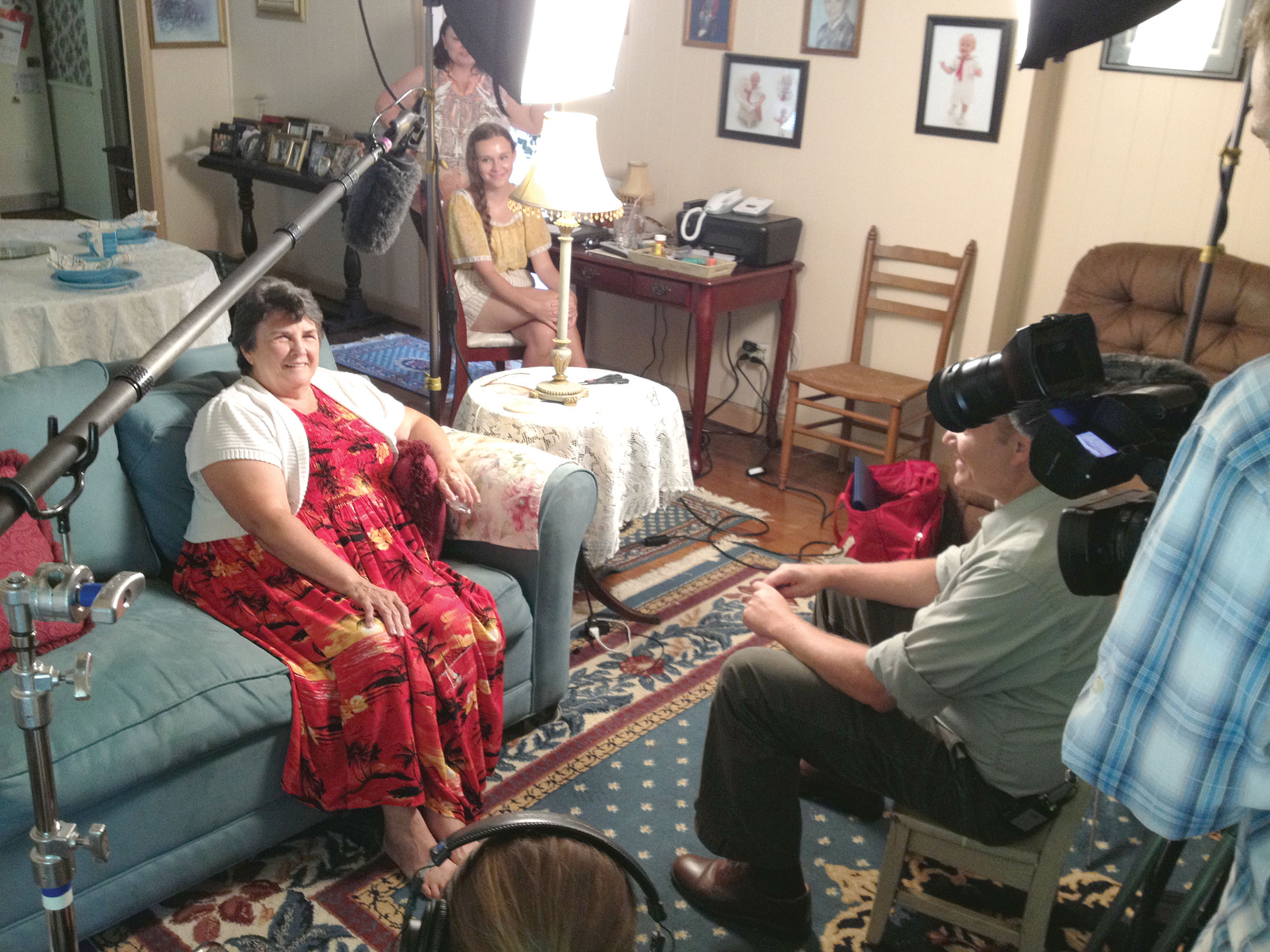
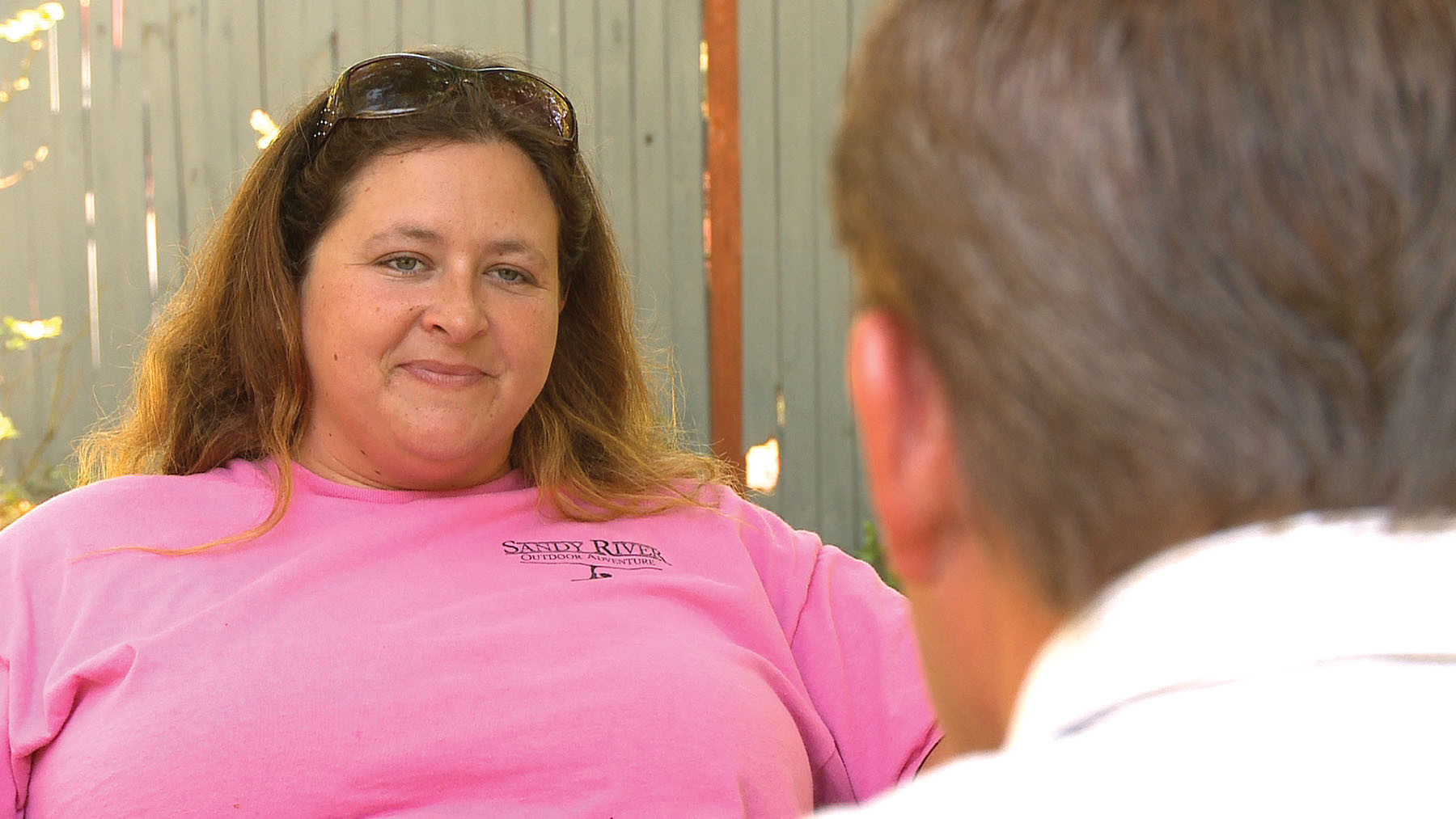
Ridgeway’s Virginia Miles (left) sits down with Todd Hansen, host of BYU-TV’s “The Story Trek.”Blythewood’s Jackie Graham with Hansen, talking about what it means to be a good mother.
BLYTHEWOOD/RIDGEWAY – Their stories are not the stuff of legend. Their tales are not tall. But their real, true-life accounts of their own personal struggles and triumphs reach a zenith of inspiration that stir the human spirit. These stories come from your friends and neighbors, right here in your own back yard; and Monday night, BYU-TV will share them with the world.
“When they knocked on my front door, I thought they were going to rob me,” said 71-year-old Virginia Miles of Ridgeway of the afternoon last August when Todd Hansen and his camera crew from The Story Trek showed up at her home on Dogwood Avenue. “You know how people try to do things to old people. I didn’t know if I should trust them or not. Then I thought they were going to hand me a check and flowers.”
Hansen, who has been taking his television crews into people’s homes for the last three years, said that reaction is typical. Many expect Hansen’s crew to be the Publisher’s Clearing House Prize patrol.
“They’re a little disappointed when they find out we’re not,” he said.
Instead of handing out prize money, Hansen and his crew are instead looking for real-life stories from real-life people. Each week, BYU-TV airs those stories on its Emmy winning program, The Story Trek. Monday night at 8, The Story Trek will feature the life stories of Miles and Blythewood’s Jackie Graham. Hansen said he found their narratives particularly moving.
“If I had to sum up their stories in one sentence, I would say they are about a mother’s love,” Hansen said. “If I am ever asked to run a special Mother’s Day episode, this is the one I would suggest.”
A mother’s love, Hansen added, in the face of great tragedy. Miles had lost a child when she was 29. Graham when she was 26. Miles lost James Richard Mattox Jr., her 10-year-old son, to a rare blood disease and Graham lost her child in a premature birth because of an ectopic (tubular) pregnancy.
“It’s like it was yesterday,” Miles said, recalling what she said she described to Hansen as the most significant event of her life. “I have a big picture of him over my bed and I still write letters to him every night in my journal, telling him how much I miss him.”
Miles said she found solace in a circle of friends who had also lost children, and the tragedy eventually strengthened her.
“When you lose a child, you can survive anything after that,” Miles said.
But what really transformed Miles’ life, and the life of her daughters Rebecca (now 47) and Judy (53), from “coping” to “moving on” was the birth of her next child, Allen.
“Having Allen made us want to live again,” Miles said.
Graham’s story, Hansen said, brushes against the supernatural.
“She had this amazing dream before her daughter was born about a girl with reddish-brown hair and blue eyes,” Hansen recalled of his sit-down with Graham. “That’s the daughter she wanted, and when she was born that’s the daughter she had!”
Graham, 33, said that, following her ectopic pregnancy back in 2006, her doctors told her she could never become pregnant again. But three years ago, they were proven wrong. And before little Kristi Mobley was even conceived, her coming was heralded by Graham’s precognitive dream. Prior to Kristi’s birth, Graham and her fiancé – Kristi’s father, Chris Mobley, 33 – were debating how the newborn’s name should be spelled, Hansen recalled. Once again, otherworldly powers appeared to be at work.
“We got a piece of junk mail one day,” Graham explained. “And it was addressed to ‘Kristi Mobley’.”
Junk mail. Addressed to a yet to be born, yet to be properly named member of the family.
“That was the name we had planned for her,” Graham said, “but how did they know?”
Apart from the unusual events surrounding Kristi’s birth, Graham said the crux of her story was about being a good mother.
“I learned it from my mother,” Graham said. “I learned right from wrong, to be respectful of other people and how to raise my baby.”
“Everything she does is for her little girl,” Hansen said. “I asked her how she became a great mother, and she said she learned it from her mother. When she described to me what made her mother great, I told her she was describing her relationship with Kristi.”
BYU-TV can be found by Dish users on channel 9043; DirectTV 374 and Time Warner 274.
BLYTHEWOOD – Details have been provided for the upcoming candidate debate to be held at 6 p.m. on Tuesday, Oct. 29 at The Manor.
Based on the number of candidates and questions, the total time will be approximately two hours.
Candidates will be given two minutes for answers and one minute for rebuttals. After one candidate answers a question, the next candidate will answer the same question and then the rotation will continue followed by the rebuttals. There will be six questions. Mike Switzer, Chairman of the Blythewood Chamber, said 50 questions for the debate were submitted via the Blythewood Chamber’s web site and that list has been narrowed down to the final six questions by Switzer and the Chamber Board members. The candidates were not given the questions in advance.
Just before the debate starts, the candidates will draw numbers from a container to determine their position. Since there are two candidates vying for one seat and four vying for two seats, we will have them separated as such at the tables and by drawing numbers. So Ernestine Middleton and Bob Mangone will draw between themselves and sit at their own table in their corresponding positions. And the same for the remainder of the candidates. This way, the audience can see the candidates seated to each other by how they are competing.
Patrick Kelly, a civics teacher at Blythewood High School, will be the official timer. Two 12th-grade civics students, Brooke Davis and Greg Huegel, from Blythewood High School will moderate.
Westwood High School’s Broadcast Journalism class was invited to participate but they declined due to a busy schedule. Richland District 2 media people have been asked to record the debate.