RIDGEWAY – A Columbia man turned himself in to the Fairfield County Sheriff’s Office this week while investigators there are still searching for at least three others after a grisly home invasion on Jan. 11 turned a residence on Rose Lane into a torture chamber.
Capt. Brad Douglas said Curtis Tyon Wright, 20, of William Hardin Road in Columbia, surrendered to deputies at the Sheriff’s Office Monday afternoon. Wright had been identified as the man seen attempting to use a debit card, stolen during the Rose Lane invasion, at an ATM on Hardscrabble and Farrow roads in Columbia shortly after the incident. Wright has been charged with kidnapping and burglary, with additional charges pending, including three more counts of kidnapping, armed robbery and assault and battery.
At 12:30 a.m. Jan. 11, according to a Sheriff’s Office report, a 37-year-old Winnsboro man answered a knock at the front door of 28 Rose Lane in Ridgeway. In the doorway was a man described as a “brown-skinned black male with a low haircut and big eyes.” The suspect pointed a gun at the face of the victim, pushed his way into the home and threw the victim to the floor. The suspect struck the victim with the handgun and kicked him in the ribs. A second victim in the home, a 39-year-old Ridgeway man, was in the living room at the time of the invasion and was also beaten and kicked by the suspect. At least two other suspects followed into the home, going into the back of the home and waking up the wife of the first victim, a 25-year-old woman, forcing her at gunpoint into the living room. The couple’s son, 7, was also in the home at the time of the invasion.
Once all the victims were rounded up in the living room, the suspects ordered them to strip off their clothes. The woman begged the suspects to let her son go back to his bedroom. The suspects complied, and once the boy was back in his room, the victims were forced to strip naked and were taped together, back-to-back, with clear packing tape.
According to the report the second male victim, the 39-year-old Ridgeway man, said the suspects were “looking for drugs and money,” and that the suspects “hung around for a long time while they searched the residence.” During that time, the report states, the suspects took turns beating the victims as they were tied together and, adding to the horror, burning the victims with a hot frying pan.
After the suspects had gathered up a little more than $200 in cash, a pair of debit cards and clothing and electronics worth $600, they left the victims tied up in the home. On their way out, one of the suspects fired a single shot into the home as a punctuation mark to the evening’s events.
The ordeal had lasted until around 4 a.m. Forty minutes later, at an AllSouth ATM on Farrow and Hardscrabble roads in Columbia, Wright tried to use one of the debit cards to withdraw cash. He was unsuccessful; however, his image was captured by the ATM’s internal surveillance camera.
At press time, Wright was being held at the Fairfield County Detention Center.
WINNSBORO – Nearly two weeks after the collapse of a 50-foot segment of a more than 500-foot retaining wall at Drawdy Park, the engineer for the project has clammed up, declining to speak with the press about what caused the failure on the nearly $328,000 endeavor. As the County looks to enforce its warranty on the construction, the S.C. Department of Labor, Licensing and Regulation (LLR) appears to have taken an interest in the collapse.
While an official spokesperson for LLR would neither confirm nor deny any official investigation into the collapse of the Drawdy Park wall, sources confirmed this week that an LLR investigator was on the scene the day after the collapse, taking photographs and examining the wreckage.
Sam Savage of S2 Engineering and Consulting, with whom Fairfield County contracted for the Drawdy Park project, appeared before County Council during Council’s Jan. 13 meeting, some 24 hours after the collapse. Savage told Council that his role in the construction of the wall was as the project’s manager, and a separate contractor, identified by the County as Four Brothers Enterprise, LLC, constructed the wall.
Four Brothers, the LLR confirmed last week, does not have a commercial contractor’s license, but instead is licensed for residential work, including drywall installation and repair and carpentry. Their projects are limited to $5,000, including labor and materials. S2, in addition to holding a Category A engineering license, also holds a general contractor’s license, to include masonry. Four Brothers could work under S2’s general contracting license as a subcontractor, the LLR said. It is standard practice, according to the LLR, for all subcontractors to be listed in the contract between the engineer and the client. No subcontractors, including Four Brother, are listed in the contract between S2 and Fairfield County.
A local general contractor who wished to remain anonymous pointed out numerous defects in the wall’s construction in the Jan. 17 edition of The Voice. The Voice attempted to contact Four Brothers, but found no telephone contact information online or with the County. Similarly, no telephone number is on file with the LLR.
WINNSBORO – The Fairfield County School Board officially accepted the resignation Tuesday night of a Fairfield Middle School math teacher and defensive coordinator for the Fairfield Central High School Griffins football team who was arrested on drug charges Dec. 6. David Nathaniel Toney’s resignation was effective Jan. 17, sources told The Voice.
“He understands that this is an unfortunate situation and he did what he felt was in the best interest of everyone involved,” J.R. Green, Superintendent of Fairfield County Schools, said.
Toney, who is facing his third charge of simple possession of marijuana since 2006, was scheduled to stand before a Magistrate’s Court judge on Jan. 9. That trial was postponed when Toney’s lawyer, Doward Keith Harvin, requested a jury trial. A new trial date had not been set at press time.
Toney was stopped by the S.C. Highway Patrol (SCHP) on Highway 34 near I-77 on Dec. 6 while en route to the state championship football game between Fairfield Central and Dillon. According to the Highway Patrol, Toney was clocked traveling 67 in the 55 MPH zone. The arresting Trooper in the case reported a “strong odor of marijuana” emanating from Toney’s 2008 Chrysler Aspen. The trooper asked Toney if there was any marijuana in the vehicle, to which Toney replied that he “hoped not,” the report states.
When the trooper asked a second time about the marijuana, Toney reportedly said that he had “a little bag,” and retrieved a clear plastic bag of marijuana from the center console of the vehicle and handed it over to the patrolman.
A search of the car turned up a marijuana cigarette inside a cup that was sitting in the center console, as well as “numerous burnt marijuana cigarettes inside the same cup,” the report states. Toney was arrested and transported to the Fairfield County Detention Center where he sat out the championship game.
During a traffic stop in Columbia on Dec. 21, 2006, a Richland County Sheriff’s deputy found a partially burned marijuana cigarette and a small bag of marijuana in Toney’s car. On May 17, 2007, Toney was stopped in Calhoun County, where a deputy also found marijuana in the car. Toney was convicted in both cases (see the Jan. 10 edition of The Voice).
“We wish Mr. Toney well in the rest of his career,” Board Chairwoman Beth Reid said Tuesday night.
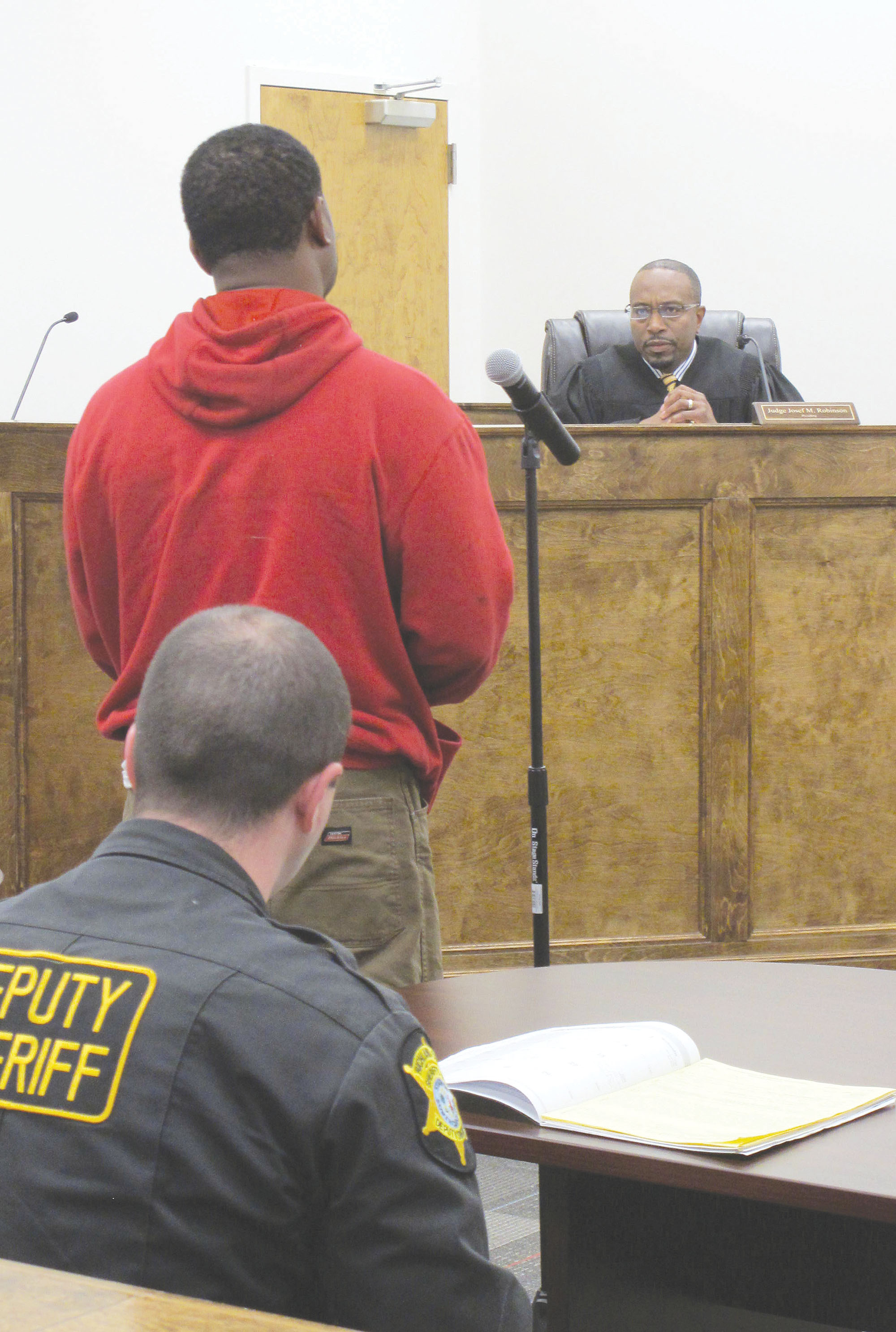
Richland County Magistrate’s Court Judge Josef Robinson hears his third case on opening day, an open container and driving under suspension violation that earned the offender a $250 fine.
BLYTHEWOOD – The new Blythewood branch of the Richland County Magistrate’s Court opened for business on McNulty Street last Friday, and already Judge Josef Robinson is doing a healthy trade. Court opened Jan. 17, taking many cases that were previously handled in the Pontiac Magistrate’s Court, and Robinson and his staff are plowing through traffic and civil cases at a rapid pace.
“I’m expecting it to be pretty busy,” Robinson said just days before court convened, “but I’ve got a very good, experienced staff. People can expect excellent customer service.”
Robinson currently holds court every Wednesday and Friday, both bench and jury trials. As the cases mount, he said, a Thursday session could soon be added.
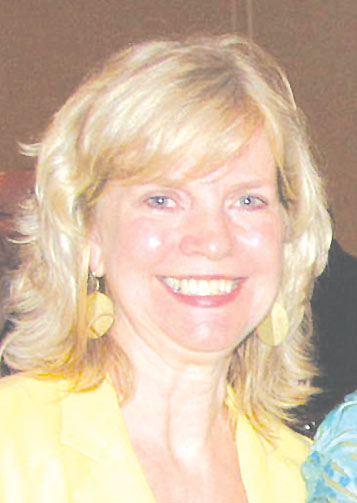
BLYTHEWOOD – The Town’s Events and Conference Center Director for the Manor, Martha Jones, has resigned that position after just a year to become the Director of Strategic Partnerships for Richland School District 2. Jones applied for the position with the District in October and the School Board voted on a consent agenda to hire her at their regular meeting on Jan. 14.
Jones, who was a teacher in the District for 15 years, was hired by Town Hall in January of 2013 to oversee special events planned by the Town and to manage rentals for The Manor. A press release from the District said she would assume her duties with Richland 2 in February and described her new job as “developing and sustaining positive community relations through strategic partnerships with civic organizations, faith-based organizations, parents and the Richland Two community.”
The District also announced the hiring of Elizabeth Roof as Executive Director of Communications to replace Ken Blackstone who left the District in October.
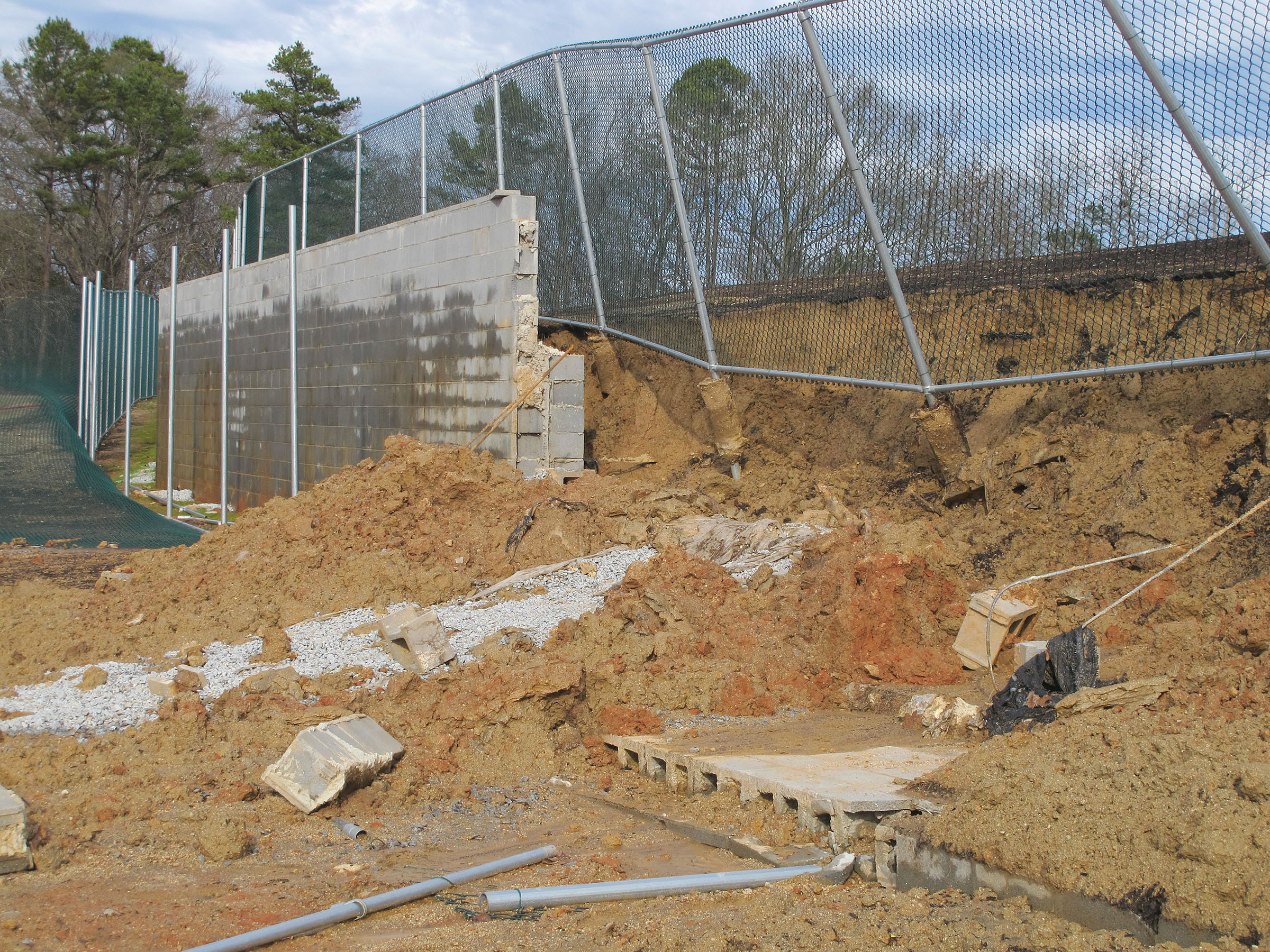
A 50-foot section of the retaining wall around the Drawdy Park football field collapsed Sunday night, spurring many County critics to say ‘I told you so.’
Contractor: Wall Poorly Constructed
WINNSBORO – In a massive stroke of dramatic irony Sunday night, the suspicions of County Council critics were confirmed when a portion of what is known in some circles as The Great Wall of Fairfield came crashing to the ground, leaving a 50-foot gap in the 525-foot long, 12-foot high retaining wall around the recently completed football field at Drawdy Park. The collapse prompted the appearance of the project’s chief engineer and sparked a public “We told you so” from one Council critic at Monday night’s County Council meeting.
While the collapse came one day after severe storms dumped more than 3 inches of rain on Winnsboro, both Sam Savage of S2 Engineering and Consulting, the firm that managed the project, and interim County Administrator Milton Pope said Monday night that it was too early to determine what caused the collapse.
“Obviously, we don’t know what happened that caused the failure,” Savage told Council. “We’re trying to look into that.”
Savage said he contacted the contractor on the project, Four Brothers Enterprise, LLC in Lexington, and brought them out to view the damage Monday morning. He said the contractor made it clear that he would honor the County’s warranty and repair the wall at no cost to the County.
Savage then left Council chambers without Council posing a single question. Pope, meanwhile, told Council that his staff would be following the progress of the repairs closely.
“There have been questions about the project ever since my arrival,” Pope noted. “Council had approved this and we want to make sure that the product we have is what the County paid for. The County will also make sure that we do our due diligence after they do a further assessment. I think it would be too premature for someone to suggest exactly what happened with the failure, because we want documentation from them to give us the confidence we need to make sure there are no additional problems with the construction there.”
But Bob Carrison, a County critic and member of Saving Fairfield, said the County should have been doing its due diligence all along, and he lambasted Council during the public comment portion of Monday night’s meeting.
“That the retaining wall was flawed is not news,” Carrison said. “No, the collapse was entirely predictable. Not a matter of if, but when. There are at least a dozen people or more in this audience that knew the project was flawed. People from this group have been trying for months to get your eyes on the project. Late summer last year we made attempts to raise red flags on this structure and we tried to sound the alarm. We saw and we heard ample evidence to convince us that the project was poorly conceived and poorly executed.”
Carrison said that when he learned in late September that no inspections had been done on the project, he went to the County’s Planning and Zoning Department to verify that.
“I was told then by Director Ron Stowers that no, there were no plans for the structure that we could view,” Carrison said. “No plans had been submitted, there had been no inspections and they didn’t need to inspect this structure.”
But Pope told The Voice Monday morning that the County did, in fact, have structural engineering drawings for the project. Furthermore, Pope added, after visiting the site of the collapse he could see that rebar and the supporting footings were in place.
A Blythewood general contractor, however, reviewed photographs of the wall for The Voice and expressed serious concerns with how the wall was constructed. The contractor, who wished to remain anonymous, has built similar structures. He said it appeared as if there had been no plan for constructing the wall, or if there had been, the plan had not been followed.
Among his concerns was the absence of adequate rebar in the construction. Photographs of the collapsed portion of the wall show rebar inserted into every eighth column of block. The Blythewood contractor said rebar should have been inserted into every column of block and should have been filled with concrete. Photographs of the collapsed section indicate that no concrete fill had been included with the rebar.
The Blythewood contractor also said the sections of the wall had not been interlocked, as they should have been, nor were the deadmen (horizontal support sections running from the wall into the earth behind the wall). Rebar had also not been properly installed into the deadmen. Soil behind the wall also should have been compacted with every 2 feet of fill, the contractor said. Photographs of the collapse indicate that it had not. Weep holes (drainage holes) also should have been drilled along the base of the wall, he said. Photographs reveal the presence of no such holes.
Carrison said Saving Fairfield did not bring their concerns directly to Council because they had “no concrete proof that the allegations of mismanagement of this project were in fact true,” and because they felt Council would not take their concerns seriously.
“We have come to the conclusion that this Council looks upon us as nothing more than troublemaking malcontents,” Carrison said.
Carrison said Saving Fairfield called in the Department of Health and Environmental Control (DHEC) to inspect the site in October in hopes they might condemn the property until testing and inspection could be done. However, all DHEC could do, Carrison said, was examine the site for proper runoff.
DHEC examined the site on Oct. 22 and gave it a “Satisfactory” rating, noting in their report that “A rough calculation of the disturbed area shows it to be less than 1 acre, which does not require an NPDES (National Pollutant Discharge Elimination System, which covers storm water drainage from construction sites) Construction General Permit to be issued.”
DHEC, County administrators clarified, was only concerned with an area at the lower end of the football field where significant amounts of earth had been displaced, and that area, they said they confirmed with DHEC, was less than 1 acre.
DHEC also noted in their report that “The area around the football field needs to be stabilized to ensure sediment does not leave the site.”
As Carrison’s allotted 3-minute time wound down, he showed no signs of letting up on Council.
“Done is done. Over a quarter of a million dollars is down the drain, literally,” Carrison said. “One question remains: How did the people of Saving Fairfield, how did we know these things and you did not? I don’t mean by that, how did Council or administration miss the red flags and the warnings. What I mean is that we knew and you did not. We were informed by people who knew what was going on.
“They did not come to you because they feared losing their jobs and their contracts,” Carrison said, raising his voice over calls from Chairman David Ferguson (District 5) for him to relent. “Please consider some strong whistleblowing protection for the employees and the contractors of this county (so they can) come talk to you and not fear reprisals and retribution. It has to be done,” Carrison shouted as a Fairfield County Sheriff’s Deputy escorted him from the microphone.
The cost for the entire project was originally capped at $280,000, according to an authorization signed by then County Administrator Phil Hinely on May 21, 2013. Late last summer, Council OK’d an additional $41,925 for fencing around the retaining wall. The County hauled away dirt from the site, at a cost of $5,737, bringing the grand total for the new Drawdy Park to $327,662.
RIDGEWAY – In a vote that hung precariously in the air for several strained moments, Town Council shot down a proposal to purchase a battery of security cameras for downtown Ridgeway during their regular meeting Jan. 9.
The motion, put on the floor by Councilman Doug Porter, nearly died for lack of a second, but was rescued by Mayor Charlene Herring who broke Council’s long silence and backed the motion herself. Porter and Herring quickly offered positive votes for the plan, but when Herring called for dissenting votes, the remaining Council members – Russ Brown, Belva Bush and Donald Prioleau – were again silent.
“You can’t ride the fence on it,” Porter urged his colleagues, and Herring, at last, polled each of the remaining Council members for their vote.
One at a time, then, Prioleau, Bush and Brown voted against the purchase of the cameras.
The vote came after an extensive debate on the issue, as well as an appeal by Ridgeway merchant Denise Jones, co-owner of the Cotton Yard Market.
“As a merchant, it is my utmost concern to operate a business in a safe and secure environment,” Jones read from a written statement at the outset of the meeting. “Just last night, as we left our Merchant’s meeting at the Cotton Yard Market, we were the only people on the street at 6:30 p.m. Often, it is just a few women who are there and leaving.
“We had requested that you provide security cameras outside to not only protect us but our customers as well,” Jones continued. “We have asked for very little and this would give us some comfort as we run our businesses.”
Council had tabled the matter during their December meeting as Prioleau said the Police Department had other more pressing needs that should be addressed before cameras are installed. Prioleau also suggested during December’s discussion that wildlife cameras may be a less expensive alternative to high-tech security cameras. But last week, Brown noted that wildlife cameras are far too easy to steal to be considered a viable alternative.
“I don’t want anybody to think I’m against cameras,” Prioleau said at last week’s meeting. “I’m not. But there are other parts of this police department that need to be brought up to standards, then do the cameras. If we had two or three officers hired, get the department computers, then it’s time for the cameras.”
But Herring, repeating a clarification she had made during the December discussion of cameras, reminded Prioleau that money to purchase cameras would have to come from the Town’s contingency fund. Funding for hiring police officers, as well as for computers – both of which have associated recurring costs – must come from the Town’s general fund budget. The contingency fund, she said, was money that could only be spent on one-time costs for capital improvements.
Bush said she was “baffled” that the Ridgeway Police Department lacked basic technology in the form of computers, and said the purchase of computers should come first. Herring countered by saying the Town had the money for both. And, Herring added, with the Dec. 27 resignation of recently hired officer Malcolm Little, cameras were a priority.
“I think we need (cameras) in order to assure safety,” Herring said, “because we’re still a ways from getting the help we need in the Police Department.”
But Brown said he had reviewed incident reports from the Ridgeway Police Department from the last three years and questioned the actual need for security cameras. Brown said the reports comprised 26 total incidents over the last three years. Nine of those, he said, occurred at businesses that have their own security camera systems. Eleven of the incidents occurred at residences that wouldn’t be covered by the proposed camera system. That leaves six incidents downtown in the last three years, Brown said.
Ridgeway received three bids in November for security camera systems – a $4,987.35 bid from Electronic Systems, a $2,570 bid from Capture It Surveillance and a $1,669.20 bid from Cor Digital Technology.
Council also put off the purchase of a computer for the Police Department, electing instead to attempt to utilize an existing computer that they said did not have the memory capacity to handle certain specific software used by law enforcement agencies. While the purchase of a computer would be a one-time cost, recurring costs for software licenses, virus protection and Internet service could run as high as $1,200 a year. If the existing computer proves inadequate, Porter stated in his motion, the Town would move forward with the purchase of a new desktop for approximately $900.
In other business, Council upped their contribution for the Big Grab cross-county yard sale to $61. This year’s event is slated for Sept. 5 and 6. Council also approved the purchase of a new chlorinator for the Water Department, estimated to cost between $1,200 and $1,400.
WINNSBORO – The trial of a Fairfield Central High School football coach, arrested and charged on Dec. 6 for simple possession of marijuana, was postponed last week after his attorney requested a jury trial.
Doward Keith Harvin, an attorney in Hemmingway representing David Nathaniel Toney, requested the jury trial prior to the scheduled Jan. 9 hearing in Fairfield County Magistrate’s Court. A new date had not been set for Toney at press time.
Toney was stopped by the S.C. Highway Patrol (SCHP) on Highway 34 near I-77 on Dec. 6 while en route to the state championship football game between Fairfield Central and Dillon. According to the Highway Patrol, Toney was clocked traveling 67 in the 55 MPH zone. The arresting Trooper in the case reported a “strong odor of marijuana” emanating from Toney’s 2008 Chrysler Aspen. The trooper asked Toney if there was any marijuana in the vehicle, to which Toney replied that he “hoped not,” the report states.
When the trooper asked a second time about the marijuana, Toney reportedly said that he had “a little bag,” and retrieved a clear plastic bag of marijuana from the center console of the vehicle and handed it over to the patrolman.
A search of the car turned up a marijuana cigarette inside a cup that was sitting in the center console, as well as “numerous burnt marijuana cigarettes inside the same cup,” the report states.
A search of public records shows this to be the third time Toney was charged with simple possession of marijuana. During a traffic stop in Columbia on Dec. 21, 2006, a Richland County Sheriff’s deputy found a partially burned marijuana cigarette and a small bag of marijuana in Toney’s car. On May 17, 2007, Toney was stopped in Calhoun County, where a deputy also found marijuana in the car. Toney was convicted in both cases (see the Jan. 10 edition of The Voice).
BLYTHEWOOD – The Westwood High School girls’ basketball team “Hoops for Pink” game is scheduled for Friday, Jan. 24, during which the Girls’ Basketball Booster Club will be presenting a check to the Breast Cancer Foundation.
This year also, the girls’ basketball players and the WHS Girls’ Booster Club have selected Sister Care as the charity for sponsorship. WHS plans to have a bucket drop (money donations) on Tuesday, Jan. 21, during morning carpool and will have containers placed in the main lobby and/or gym lobby to collect needed items (alarm clocks, baby food, board games, bath towels, etc.). WHS will close the event with a Bake Sale at the WHS-Chapin basketball game, on Jan. 24. All items and monetary donations raised will be given to Sister Care.
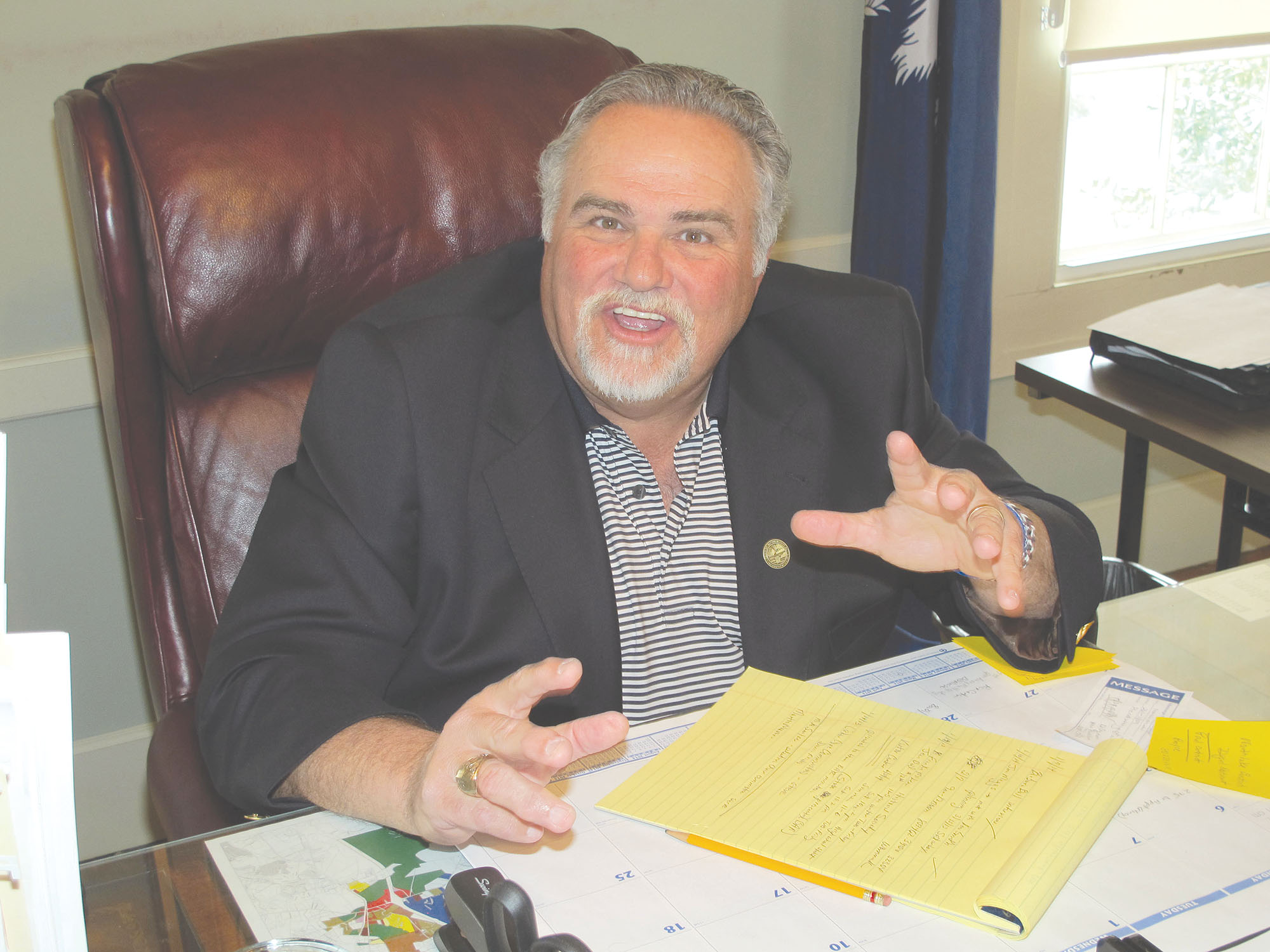
BLYTHEWOOD – Referring to himself as the CEO of the Town of Blythewood and discussing the new direction he sees for the Town, Mayor J. Michael Ross cast himself firmly in a new leadership role during an exclusive 45-minute interview with The Independent Voice last week. This is the first of several interviews planned about the town’s new direction.
The Voice: How much will the Town Attorney, Jim Meggs, be paid and how many hours will he work in his new position as the Town’s Interim Administrator?
Mayor: We have approved $75 an hour for Mr. Meggs for 20 hours a week*. He will work 8-1 Mondays, Wednesdays and Fridays. Of course with his work at his law firm, he might have to be in court some of that time. I look forward to a 20-hour-a-week Town Administrator. I think this is something Council and I need to evaluate. Does the Town of Blythewood need a 40-hour per week, $115,000 Administrator? Potentially, did we ever need that? The thing that’s exciting here is critical. After John (Perry) was no longer coming in to the office after Dec. 29, I am the CEO of the Town and the administrator works for me, but Martie, Chris, Martha, Booth, Kirk and me – we all did an admiral job running the office, basically, without a Town Administrator since Dec. 29.
(Editor’s Note: Meggs is being paid $20 more per hour than Perry was paid.)
V: Will the Town continue in the progressive direction that John Perry visioned for the Town or will there be a new direction?
Mayor: I don’t see what we have done as ‘John’s plan’. I see it as the Town’s plan. We may not be as flashy as John was, and Mr. Meggs probably won’t attend every Town meeting. He will let us, the elected officials, do that. Mr. Meggs will be more of a cut and dried administrator, doing administrative duties.
V: Was Mr. Perry not a cut and dried administrator?
Mayor: He was very progressive and an out of the box thinker. He did drive things for the Town every day, every minute, every second. There’s a lot to be said for that. But is that what people in Blythewood want? We have to be sure what the people’s vision is.
V: But after your election, you were vocal to many in the Town and to The Voice, that you had come to realize that what you read in the newspaper before your election was not true, that the community was happy with the direction the Town was going and that there were no problems in the town government, that everything was perfect. You said you found that the Town’s park and development plans were financially sound and that it was all run smoothly by Mr. Perry. What changed your mind?
Mayor: I think that when you get in there, it might take more than six months or a year or a year and a half to gain the knowledge. As I’ve gotten more hands on, I believe that for where the Town of Blythewood wants to go and the pace (the people) want to go, that John’s leaving might be a good thing. I now think it’s what the majority of the people have always said they wanted.
V: When John Perry brought many of these plans to the (town) boards, they were clearly his ideas and his to explain to the boards. Don’t you think more people, now, have come to appreciate Perry’s more progressive vision for Blythewood? You voted to carry out every one of those plans.
Mayor: This past election in November opened my eyes – the vote to remove incumbents who had been there for 8 years doing what they had done, to get voted out and a new group voted in with a more conservative view point. The people spoke and said we want these guys, not those guys. The (new members) ran on a platform that said we’re going to look at things more closely and, probably, as I saw that coming, it helped me not to worry that we could lose John Perry as our administrator. John was a brilliant guy and he loved being Town Administrator. He had a vision for the Town. The new people (on council) came in with a different approach for looking at things, to feel comfortable that the project is a safe, secure project. My mind has been changed. Now I realize that this is what the people want.
V: Where does the Town government stand with the depot/restaurant plans?
Mayor: We are gathering financial information from Mr. Bazinet and his LLC’s, from everywhere. We are continuing to work on that. But my eyes are open to re-look at it. I would not disrespect our previous council for our decisions. I guess our experience in business was enough to satisfy us, but another group has come in who might want to look at it closer. We will have a building we will have to pay $8,000 a month for. It’s like any other thing that people go in to business with, except it’s the Town going into business, and that does scare me, and it was a concern brought up by the new council members.
V: You don’t think Mr. Perry could have successfully managed the Town through to the vision?
Mayor: There was a total change in where this Town’s government and politics were headed, as was determined by the November election. The people were saying slow down and think about stuff. Maybe we don’t want all of this. John worked so closely with (former councilmen) Ed (Garrison) and Paul (Moscati) for so long and it was their vision, but the people now say they don’t want that vision any more.