Blog

  • Four File for Council Race

    RIDGEWAY – Four Ridgeway residents have announced their candidacy for three seats on the Town Council. Mayor Charlene Herring and Councilwoman Belva Bush, whose term on Council is expiring, have both filed to run for mayor. Councilman Russ Brown, whose seat is also expiring, and Rufus Jones, a former councilman and mayor of Ridgeway, are also running for Council. Because Ridgeway does not have district seats, the two council candidates with the most votes will be seated on Council.

    The election is Tuesday, April 8. Residents who want to vote in the election must be registered by March 8.

  • Board Member Questions Hire

    Manager to Oversee Career Center Build

    WINNSBORO – A vote by the Fairfield County School Board to approve the construction method for the new career and technology center raised questions from one Board member about the hire of a manager to oversee the project.

    The Board voted 5-1-1 during their Feb. 18 meeting to approve the Construction Manager at-Risk method for building the new career center, which calls for the District to employ a project manager to oversee the endeavor. The manager position is a classified position, whose hire is at the discretion of the Superintendent, J.R. Green. Andrea Harrison (District 1), who voted against the method, said she was under the impression that the Board, and not the Superintendent, would be selecting a manager for the project.

    “We already discussed this, and maybe it was a misunderstanding on my part,” Harrison said on Feb. 18. “I thought we were informed during the Board retreat (in January) that we (the Board) would have the opportunity to choose the construction manager. . . . That authority was taken out of the hands of the Board and that person will be a District employee, not a contracted worker selected by the Board to oversee the funds of this project.”

    The project manager, Green said, would be a permanent position, up for renewal each year. Once the project is completed, the Board may then elect not to renew the position for the following year. The manager would act as an intermediary between the District and the builder, Green said, to ensure that the project was progressing in accordance with the District’s wishes. Board Chairwoman Beth Reid (District 7) said the method also opens up the project to local vendors.

    “This is a method in which the contractor will be able to use local vendors to handle some of these projects, rather than sending out large bids where we have to take the (lowest) bid,” Reid said. “So the local vendors can get some of the jobs created by this project.”

    Green said Tuesday that the position, which carries a salary range of $49,000 – $77,000 a year, was filled late last week. Rick Stottlemyer will assume the duties for the District on Monday. Board member Annie McDaniel (District 4) abstained from the vote.

  • More Racism Charges Rock Council Meeting

    WINNSBORO – Allegations of vote-buying, racism and hypocrisy overshadowed any real County business conducted during Monday night’s Council meeting, leading one Council member to erupt with rage and another to double-down on statements he had made during Council’s Feb. 10 meeting, labeling some in the audience as racists.

    Addressing Council during the evening’s first public comment session, District 3 resident William Coleman scolded his representative, Mikel Trapp, for Trapp’s statement during the Feb. 10 meeting that criticism of S2 Engineering, the firm on the hot seat for the collapse of a portion of retaining wall at Drawdy Park, was motivated by race.

    “Skin color has nothing to do with all the bad workmanship and expensive costs to this county,” Coleman said. “How dare you try to turn this into a racial issue. Mr. Trapp, I am colorblind.”

    Coleman said Trapp’s play of the “race card” was nothing more than political theater staged to garner votes and shore up support in the wake of recent allegations levied at Trapp by the State Ethics Commission. Coleman said he had supported Trapp in the past, with his vote and with campaign contributions. He would not be doing so in the future, he said, adding, “I will bet you will deny me contributing to your campaign and I’ll bet that you didn’t report it either.”

    But Trapp, responding near the end of the meeting and directing his comments not only to Coleman but to the citizens group Saving Fairfield, made an explosive revelation.

    “(The) Colorblind Saving Fairfield Tea Party Republican group,” Trapp began sarcastically. After a brief pause, he continued, “You’re supposed to be colorblind. I’ve been called a n—-r (on) more than one occasion by members of this group. People have called my full-time employment trying to get me terminated. This group promotes hatred and racism and if you think you’re going to try to get me to resign, it ain’t going to happen. Like I said at the last meeting: Beat me at the ballot box.

    “I don’t need support from people who support hatred and racism,” Trapp added. “That not only goes for (Coleman), that goes for anybody from District 3 who feels that way.”

    After the meeting, Trapp would not be specific about which member of Saving Fairfield had tagged him with the racial slur, but said it was more than one member, that it happened more than one time and that it occurred in public.

    “(As they were) walking by, where nobody else could hear it, but I could hear it,” Trapp said. “This has been going on, but I’m at the limit and I ain’t taking no more junk. But it does boil down to race. We’ve got seven or eight, 10 maybe, firms – how did you pick out the one (S2) that happened to be black?”

    Trapp later conceded that perhaps not all members of Saving Fairfield were racists.

    “But my thinking is, if I’m going to deal with guys, I’m going to pick people who think like I think for who you run with,” Trapp said. “That’s mainly how you do.”

    In a written response to Trapp’s comments, Bob Carrison, a spokesman for Saving Fairfield, said the group would not tolerate the sort of racist sentiments or other shenanigans of which Trapp has accused them.

    “I can assure you that I have never heard any of our members use a racial slur, in regards to Mr. Trapp or in general,” Carrison wrote. “I am not aware of anyone contacting his employer, and if I found that someone in our group had done so I would ask them to quit their association with Saving Fairfield.

    “Our group has only one objective, that being to bring good, transparent governance to Fairfield County,” he continued. “We are a mixed-race, mixed-political affiliation organization. We regret that Mr. Trapp holds this particular opinion.”

    Trapp also responded to allegations from another District 3 resident, Carrie Matthews, that graduation gifts from Trapp were attempts to buy votes.

    “I have three daughters, and when each has graduated from high school she has received a check, a nice $50 check, congratulating her on her graduation from high school,” Matthews said. “I have not allowed my daughters to cash the checks or to accept that money, the main reason being is that it comes from an elected official that feels strongly to me like vote-buying, or encouraging people to vote for somebody. I think that’s kind of unfortunate when our children turn 18 for them to get money that is written, a personal check, written from a County representative.”

    Trapp later said that the checks were for $25, not $50, and underscored that they were personal checks, written by him from his personal account and not drawn from his County discretionary fund.

    “(Matthews) wants me to reconsider that,” Trapp said. “I’m not going to reconsider that. I give out $25 to all the graduates in my district every year and I will continue to do that as long as I’m on Council.”

    Fairfield resident Selwyn Turner, meanwhile, said during the public comments portion of the meeting that she felt as though Council members’ use of their discretionary fund had gotten out of hand. A great deal of the money, she said, was contributed to “certain churches and select organizations” without any review by the full Council to determine if these institutions had “legitimate needs.”

    “All of this smells like a violation to me of separation of church and state,” Turner said. “You need to stay out of the churches’ business with your free gifts. There appears to be an ulterior motive in the dispersal of these funds. Could it be for votes for reelection?”

    District 2 resident Beth Jenkins also suggested that Council exercise a little separation between church and state, although for different reasons. Jenkins’s comments later propelled District 4 Councilman Kamau Marcharia into an apoplectic rage.

    “Under the circumstance, the invocation being said by someone on Council I find extremely disturbing and hypocritical,” Jenkins said during the opening public comments session. “Under the circumstances, I would like to request that you just have a moment of silence and we can all have our own prayer.”

    Apparently stewing on the remarks for the entire 90-plus minutes of the regular session, Marcharia popped his cork during Council’s response time.

    “I understand what a hypocrite is. In my mind – I might be wrong – (it’s) an immoral person, a lowlife, a degenerate person,” Marcharia began. “A hypocrite certainly can’t be trusted. Morally decrepit. I’ve been called a hypocrite tonight and have been told, or suggested, that since you’re a hypocrite, don’t you dare come in here and pray to your Lord and Savior Jesus Christ. If you do it, you better do it in silence.”

    Pounding the desk before him with a fist as he rose to his feet, Marcharia continued, shouting: “Nobody is going to tell me that I can’t pray to my Lord and Savior Jesus Christ in silence or out loud! I will pray, I will continue to pray! I’m going to come in here and pray how I have to pray. Now if you want to go to court, put me in court and the government can come in and say I can’t pray. I’m going to pray. I’m tired of these kinds of attacks like this, with my religion. You tell me I can’t pray? You can forget it. I mean that and you can carve it in stone.”

    Jenkins said Tuesday afternoon that Marcharia had misunderstood the intent of her comments.

    “I was not against prayer at the meeting,” Jenkins told The Voice via email. “I was against a hypocrite with ethics charges pending saying our prayer. I would prefer a moment of silence for all to bow our heads and pray. Period.”

  • SLED Probes County

    Procurement Under Scrutiny

    WINNSBORO – The state’s highest law enforcement agency has opened a new investigation into Fairfield County government, sources confirmed this week, launching a probe into the County’s former procurement practices.

    A spokesperson for the S.C. State Law Enforcement Division (SLED) said Tuesday that their agency had indeed opened the investigation, but declined to comment on the specific nature of the case. Sources inside the County, meanwhile, said SLED agents have been on site at County offices interviewing County employees and reviewing checks and invoices from the County’s Procurement Department.

    County Council Chairman David Ferguson (District 5) said after Monday night’s Council meeting that SLED’s focus so far has been on the County’s relationship with S2 Engineering, a firm with which Fairfield County has, between December 2009 and September 2013, spent more than $8.76 million. Documents obtained by The Voice indicate that S2 projects over that time period range from improvements to the HON Building, to construction of the new Voter Registration offices, work at the County Courthouse and much more. Work also includes the recently completed football field at Drawdy Park and its retaining wall, a portion of which collapsed last month.

    While records indicate that most, if not all, of these projects were not put out for bid, Interim County Administrator Milton Pope said during Council’s Feb. 10 meeting that S2 was one of several firms on a list of firms approved for County work by then Administrator Phil Hinely. Since Pope’s arrival as Interim last summer, the County has returned to a more conventional procurement process, putting projects and purchases out for bid in accordance with County policy. Monday night, Ferguson said that while the former procurement practices may have been unusual, they were not illegal.

    “Was it best practices? It was the cheapest practice for us to get jobs accomplished,” Ferguson said. “Did we bid out every job? No. With Milton (Pope) we do. Does that cost you? Yeah, it does.”

    Ferguson confirmed that SLED agents have been reviewing checks and invoices from the Procurement Department, but added that he thinks the motivation for the investigation was not based on the legality of the County’s former practices.

    “It’s called Creighton Coleman,” Ferguson said. “You know how to spell that?”

    Reached for a response Tuesday morning, Coleman, Fairfield County’s State Senator from District 17, said he would not comment on any ongoing investigations.

  • Adjusting to Happy Captivity

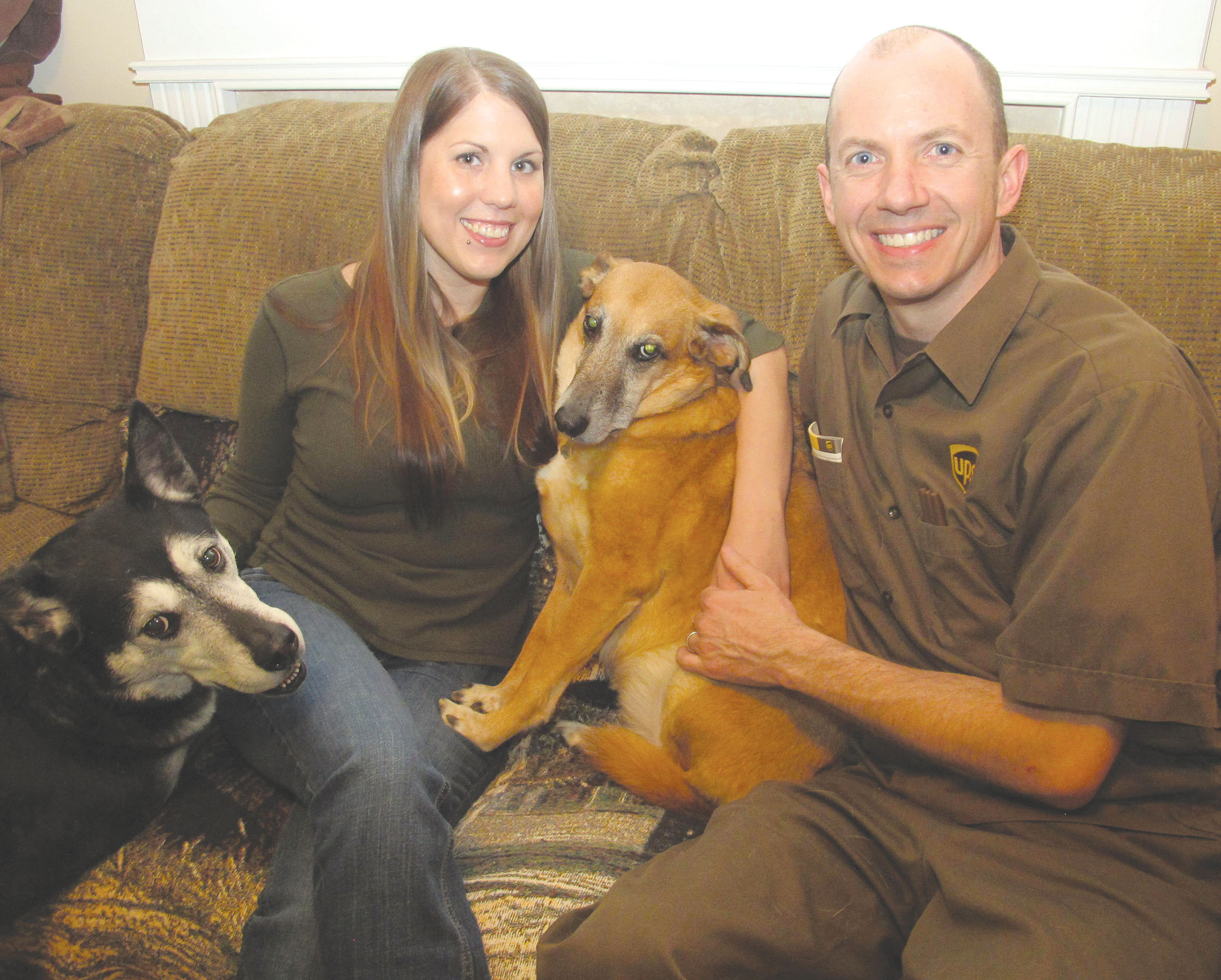
    Jason and Michelle Ellisor at home with Maya, center, formerly known in Blythewood as Mommy. At left is Bud, the family’s more recently adopted Husky-German Shepherd mix.

    Former Blythewood Stray Enjoying Comforts of New Home

    Last February, a forlorn, mixed-breed stray dog was rescued from a vacant lot in the University Village shopping area off Blythewood Road. It was such an elaborate dog-rescue that the story ended up in The Independent Voice (“It took a village to rescue this dog,” March 15, 2013.) Since then, the newspaper has received occasional inquiries as to what became of the dog who for years hung out in the vicinity of the vacant lot, subsisting on handouts from concerned strangers. So, here’s an update.

    Many caring people in the community, including employees of the dentist office next to the lot, had tried to rescue the dog they dubbed ‘Mommy.’ Fearful, she always eluded them. One of those would-be rescuers was Jason Ellisor, a UPS driver from Lexington, who always left food for Mommy when his delivery route took him to Blythewood. After the near-miraculous rescue of the elusive canine, it was Jason and his wife Michelle who took her in, changed her name to Maya and gave her a new life.

    This weekend, on the anniversary of her adoption, the Ellisors will celebrate Maya’s first year as a member of their household. It was a year of adjustment for Maya; a year that, despite jubilation over her rescue, clearly began on a low note.

    An initial veterinary examination revealed that Maya was about 10 years old, had heartworms and a painful limp caused by a previously shattered pelvis that had healed badly. Because of her poor health and age, she was not a candidate for traditional heartworm treatment. She would need an alternative treatment that might not prove successful. Pain medication was prescribed for her limp. In addition, Michelle recalls that Maya was terrified when they brought her home.

    “Being captured was probably Maya’s worst nightmare,” Michelle told The Voice in a recent interview, “so we tried to make her comfortable in her new surroundings. We put a big dog bed in a corner of the kitchen. She liked it there because it was out of the way, but she could still see everything. I spent lots of time sitting next to her, reading a book or playing on my phone, to get her accustomed to being around me.”

    The Ellisors devoted themselves to Maya’s rehabilitation and acclimation and gradually Maya responded to her new life of love, care and comfort. She eventually commandeered her own wing of the Ellisors’ L-shaped sofa and, today, Maya has a new spring in her step. She’s heartworm-free, no longer limps and is pain free with the help of medication. She has a big backyard, doting family, healthy diet and a newly adopted brother – a 7-year-old husky/shepherd mix named Bud.

    “Maya is mind-blowingly smart,” Michelle said, ticking off the dog’s attributes without being asked. “She comes when called, has never had an accident in the house, minds perfectly and doesn’t tear things up. And she’s absolutely spoiled rotten,” Michelle added, ruffling the dogs ears, “which I love! When she’s called in from the backyard, she just prances right up to the door, tail wagging and ears up! She’s very quiet, but very people friendly and social now.”

    Because of Maya’s special, time-consuming needs early on, the Ellisors had not anticipated getting a second dog. But, like many 10-year-olds, when Maya visited a Homeward Bound pet adoption event at Pet Smart with the Ellisors, she saw a dog she just had to have. His name was Bud, a handsome Husky-German Shepherd mix. The Ellisors adopted him.

    “They’re great pals,” Michelle said of the two dogs.

    The Ellisors were warned that because of her many years on the lam, Maya might stray again given the chance. But her only AWOL adventure occurred about five months after her rescue.

    “She’d been in the backyard for just a few minutes by herself, when something in the woods caught her attention,” Michelle recalled. “She leapt over the fence and was gone. We looked for her all through the woods, calling her for hours and even brought Bud along to help. We thought she was gone. Then, suddenly, Maya came trotting up, muddy and happy. She had obviously been playing in the creek, but she was happy to come home at dinner time!”

    As the Ellisors plan for Maya’s first year celebration – which includes a big yogurt-frosted dog cookie – they have a message for the people in Blythewood who helped Mommy/Maya survive all those years alone and eventually made possible her rescue.

    “We want to thank them for all they did for Maya and let them know that she is well and happy,” Michelle told The Voice as Maya hopped up on her end of the couch and stretched out. “We just love her to pieces.”

    Homeward Bound Pet Rescue provided all the funds for Maya’s hospitalization and vet care as well as a crate and other costs associated with her adoption. For information about how to support Homeward Bound’s Blythewood operation, call 803-454-9094 or go to http://www.petfinder.com/shelters/SC340.html.

  • South Carolina’s Rooftop

    I Can See My House from Here –
    The view from atop Sassafras Mountain, from which you can see four states.

    Feel like a challenge? Drive about 122 miles to Pickens County and ascend Sassafras Mountain’s 3,560 feet – by car of course. When you do, you’ve reached the highest point in South Carolina, its rooftop. Standing on Sassafras Mountain you can look over a rippling green land in spring, a darker green in summer and a color-struck land in autumn. I’d avoid it when winter’s icy grip holds the land.

    South Carolina’s rooftop attracts highpointers, people who pursue the sport of ascending the highest elevation in a given area. Thus do they come to South Carolina’s rooftop.

    I’ve made it to the top in early morning. At dawn sun glints off three lakes as the forests of four states mutate from black to olive green to jade: From Sassafras Mountain you can see the Volunteer, Tarheel, Peach and Palmetto states. Lakes Jocassee, Keowee and Hartwell look like shiny dimes from 3,564 feet and they pale silver as the sun climbs.

    In summer the rooftop grows pretty hot. Haze obscures things and the distant lakes appear ill defined. Atmospheric lines of blue, gray and white air stack along the horizon like lake sediment. One summer day all that hot air played a trick on me. It created a mirage. A freighter appeared to steam across Lake Keowee toward Jocassee. My Vortex Diamondback 8×42 glasses verified things. The freighter was there, all right, headed for mountain swells. It steamed along but got nowhere, this shimmering ship from the sea that cannot be.

    In a blink it disappeared. Gone. I looked through the glasses again and saw a small watercraft plying the lake’s veneer, a feathery wake trailing it. This Fata Morgana brought to mind Hemingway’s “True at First Light” and a mirage extraordinaire he witnessed.

    “In Africa, a thing is true at first light and a lie by noon and you have no more respect for it than the lovely, perfect weed-fringed lake you see across the sun-baked salt plain. You have walked across that plain in the morning and you know that no such lake is there. But now it is there absolutely true, beautiful and believable.”

    You needn’t worry about mirages and you surely don’t have to be a highpointer to go to Sassafras. Strike out. It’s a great place to experience other seasons. In August you can stand atop Sassafras Mountain and feel fall’s chill. On Sassafras a man can see for miles and miles and miles, as Mr. Townsend famously wrote. Standing on South Carolina’s rooftop you look over a rippling green land and smoky blue hills. As night draws nigh wine, yellow, orange and cinnamon hues prevail until shadows reign supreme.

    One final note: A recent South Carolina Geological Survey assessment downgraded Sassafras Mountain to 3,533 feet, because of grading that lowered the natural height. It still stands at least 50 feet higher than nearby Hickerynut Mountain (3,483 feet).

     If You Go …

    Sassafras Mountain

    • 1399 F. Van Clayton Memorial Highway

    Sunset, S.C. 29685

    • 864-654-1671

    • Lat/Lon: 35.06470°N / 82.7775°W

    •www.visitpickenscounty.com/vendor/124/sassafras-mountain/

    Learn more about Tom Poland, a Southern writer, and his work at www.tompoland.net. Email day-trip ideas to him at tompol@earthlink.net.

  • State Confirms Bravo Fine

    Martha Jones

    Deputy Counsel: CEO’s Report Inaccurate

    BLYTHEWOOD – As reported in the Feb. 14 issue of The Voice, Bravo Blythewood, the cultural arts arm of the Town of Blythewood, was sent a notification of fine for $2,000 from the S.C. Secretary of State’s office on Jan. 1 for continuing failure to register with and file its financial information with the agency’s Public Charities Division. The arts group was told it had 15 days to register.

    According to minutes from Bravo Blythewood’s Feb. 17 meeting, obtained by The Voice last week, Bravo Blythewood CEO Martha Jones told the group that it had not been fined and that its registration with the Secretary of State’s office was in order.

    When asked last Thursday if the matter was, indeed, settled as reported in the minutes of the meeting, Shannon Wiley, Deputy General Counsel of the Secretary of State’s office said Jones’s report was incorrect.

    “Bravo Blythewood had not registered with the Division of Public Charities prior to submitting the registration form that we received on Monday, Feb. 10, 2014,” Wiley wrote in an email to The Voice.

    “At this time, we are holding the registration at Ms. Jones’ request while she has her accountant prepare a (form) 990 EZ,” Wiley wrote. “An active charity is required to include a financial report with its registration if one has not been provided before.”

    Wiley wrote that she had spoken with Ms. Jones on Tuesday (Feb. 11) and explained that the agency would not waive the $2,000 fine for late registration entirely, but would reduce the fine to $200 for administrative costs. Wiley said that Jones had 15 days to forward the financial report (990 EZ) and the $200 fine to her attention.

    On Feb. 12, Wiley told The Voice that no financial records had been filed with the Public Charities Division for Bravo Blythewood since it was incorporated as a non-profit on Aug. 3, 2011.

    While Bravo Blythewood is registered as a non-profit corporation with the business filing division, Wiley said because it solicits money and is funded by the town government, it must also be registered with the state’s Public Charities Division and file an annual financial report and an annual registration form.

    Jones had not replied to an email request for comment from The Voice at press time.

  • Unearthing Ancestral Secrets

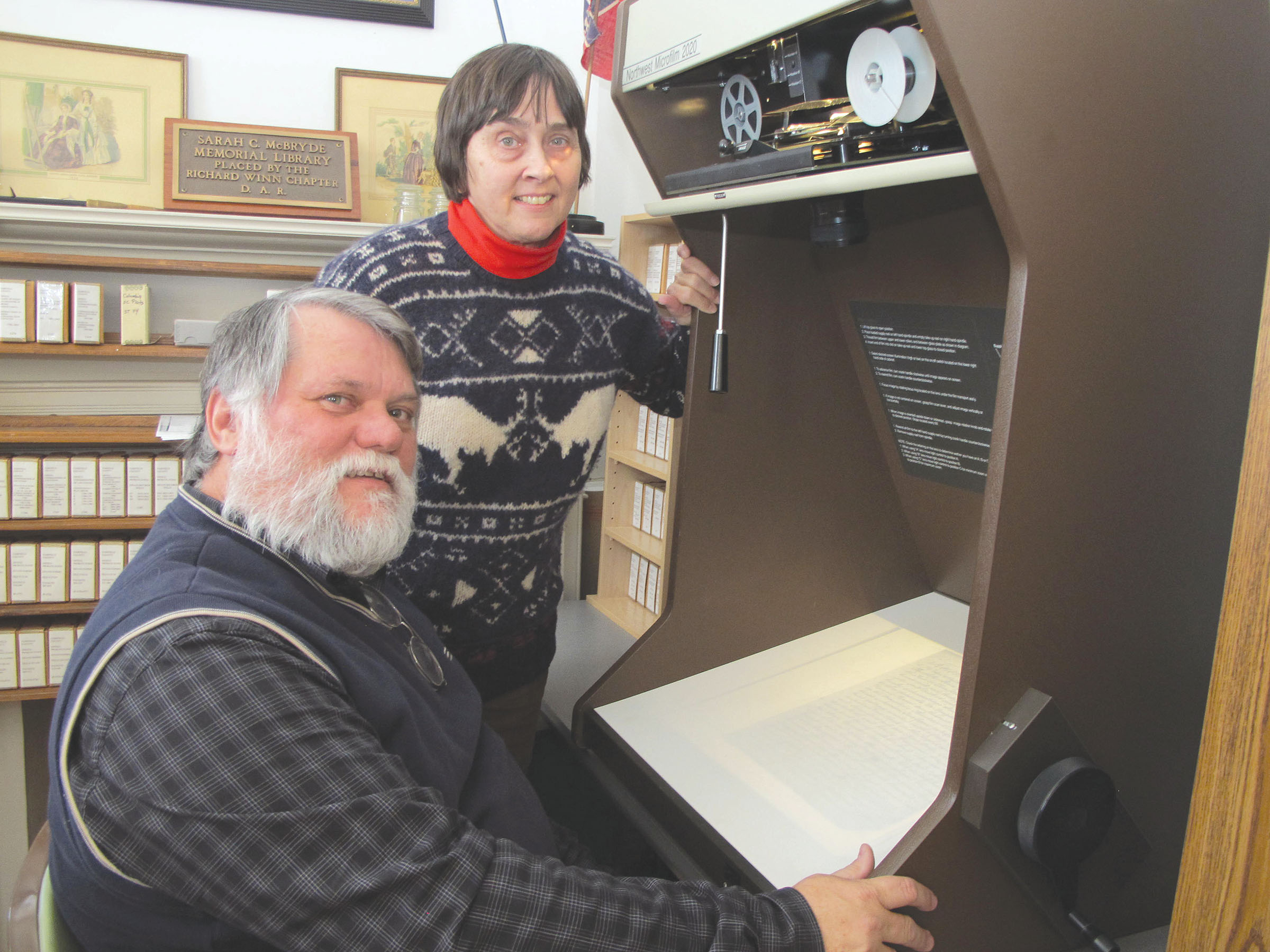
    Much of the Fairfield Museum’s earlier records are on microfilm and have been largely inaccessible by the public because of the museum’s outdated, faulty microfilm reader. Eddie Killian, the museum’s lead genealogy researcher, is show here with the museum’s Director, Pelham Lyles, showing off a ‘new’ microfilm reader recently donated to the museum by the Latter Day Saints (LDS) Church in Camden. “This will allow our patrons to more easily research old records,” Killian said.

    Volunteer Fuels Genealogy Research at County Museum

    WINNSBORO – Have you ever wondered about the stories – and secrets! – of the ancestors on your family tree? The Fairfield County Museum can be a great place to start your search.

    The museum’s genealogical research library houses a trove of historical documentation about people and places in Fairfield County dating back to the mid-eighteenth century. And it’s not just a treasure for locals. An increasing number of visitors travel to Winnsboro to research their family heritage. Part of what makes the collection so valuable is the expertise of volunteers like Eddie Killian, who has been the museum’s lead genealogy researcher for almost three years. He also serves as president of the Fairfield Chapter of the S.C. Genealogical Society, which is headquartered at the museum.

    Museum Director Pelham Lyles said that Killian, an Information Technology specialist who began his work at the museum after retiring from Blue Cross Blue Shield in 2011, is a perfect fit for managing the research library and volunteer team. He brings experience as a project manager and analyst, and has been a genealogy hobbyist for 15 years.

    “Eddie and his volunteers have done a great job figuring out what resources are available to us. He has worked extensively with local records, and understands the technology side as well. He can fix anything computer-related, can digitize complicated documents, and is constantly working to make our collection easier to access. I really didn’t think we could find anybody better able to handle all that,” she said. “And he’s such a nice guy, too!”

    Killian says that helping people dig up their family’s history is at the heart of what he does.

    “We go out of our way to make it a good experience for visitors, whether they are from around the corner or across the country,” Killian said. “It’s important for people to see southern hospitality, to know that we will go the extra mile.”

    Make that an extra several miles.

    “Genealogy research doesn’t just happen in the library and online,” he said. “It’s also about getting to the right places – and getting in touch with the right people – to find what you’re searching for. We have access to many old buildings, and have taken people on research trips to places like the Old Brick Church and Feasterville Academy.”

    A recent request from a North Carolina resident, for example, led the team through several Fairfield communities.

    “This guy came in looking for his grandmother’s story,” Killian said, “and we helped him do the research. We first took him to the family’s cemetery, then to meet a retired postmaster who was delighted to talk with him about all the people who used to live in that community. The postmaster even came with us to look at the grandmother’s old house. From the cemetery, we found out that the grandmother was a Blair, so we trekked out to Salem Crossroads in the Blair community to show the guy around and introduce him to a distant relation who was able to tell him even more about the past. It was a grand tour of this guy’s grandmother’s life.”

    Killian says great stories turn up all the time, like the visit from a researcher in New York City who is working on a project about USC football coach Steve Spurrier. The museum team is working with her and Spurrier to track down his family’s history in Fairfield County, and they’ve recently located the probable site of his great-grandfather’s farm.

    “We have located the graveyard of mostly unmarked fieldstone graves which most likely are his ancestors,” Killian said, “and we have figured out many of the names we’ll need to contact for more information. We hope to eventually have tombstone pictures and other documentation about his family’s time in Fairfield County.”

    He points out that in many ways, genealogy research can be a recreational activity.

    “Especially for seniors. It’s about getting out, visiting with people and going to historical places,” he said. “It’s good mental stimulation.”

    Killian says that what drives his interest in genealogy is the concern that histories and memories can too easily be lost to time.

    “Family dynamics have changed in the last few generations,” he said, “and we no longer sit around on the porch after dinner, telling family stories while we watch the young ones play together. A lot of family history isn’t getting passed down any more, unfortunately.”

    When he started doing his own family research in 1999, Killian came up against a lot of brick walls and dead ends while looking for information about some of his ancestors.

    “My search eventually led me to the Fairfield Museum in 2011, which is when I met Pelham and learned about volunteering at the museum.”

    Lyles recalls Killian’s elation at the huge prospect of organizing, maintaining and improving the library’s collection.

    “Eddie was like, ‘oh boy, I can do this!’” she recalled with a laugh. “He put in lots of hours, and was making an hour-long drive each way. Fortunately, within a few months I was able to use a little bit of money built into the budget and pay him minimum wage. And the County has since kicked in a little more which we are thankful for.”

    Killian is paid for 20 hours a week and often volunteers an additional 20 hours, working on projects, helping at events and updating the collection. When he works on consecutive days, he stays at a cousin’s home in Winnsboro to save on the commute from Lexington, where he lives with his wife, Loretta, an elementary school teacher.

    “The museum has a great team of volunteers, a great board and the Society is wonderful,” Killian said. “A lot of effort has gone into the last couple of years, as we’ve steadily worked through a big backlog of requests. As of this month, in fact, we are finally caught up to the point that we can work on a request the same month we receive it! As our collection becomes more accessible, public interest continues to increase.”

    “We get requests through Facebook and email, from walk-ins and from people who travel quite a distance for appointments with us,” Killian said.

    He notes that about 50 percent of genealogy visitors are from out of town, and 25 percent are from out of state.

    “That means 75 percent of our visitors are traveling to Winnsboro, where they eat, buy gas and sometimes stay overnight – all of which contributes to the local economy,” he said. “It’s the type of visit that can make people want to stay here, to buy an old house here. The economic impact can be beyond measure, if you just treat visitors right.”

    For more information about the museum and the Fairfield Chapter of the S.C. Genealogical Society, call 803-635-9811 or email fairfieldmus@truvista.net. The museum is located at 231 S. Congress St., Winnsboro and is open Tuesday – Friday from 10 a.m. – 5 p.m. (closed lunch) and Saturday, 10 a.m. – 3 p.m. Admission is free.

  • Committee Debate Resurfaces

    Fire Purchases, Building Projects Comprise Battle Lines

    WINNSBORO – A laundry list of purchases for local fire stations approved by County Council during their Feb. 10 meeting again brought to the forefront the desire by some Council members to return to a committee form of government. Council formally did away with the extensive use of committees last year, opting instead to hash over detailed County business during work sessions.

    The fire station purchases also raised questions from District 4 Councilman Kamau Marcharia, who said he felt as though the needs for the fire station in Western Fairfield were being neglected.

    “We’re purchasing new land, working on all the fire stations and purchasing trucks. Seems like our district’s been put on the back burner,” Marcharia said. “We’ve been negotiating for about 10 years to get land from SCE&G. Where are we with that? We’ve got holes in our driveway, the building is dilapidated, you can’t really hold community meetings in it. Seems like we dropped the ball on Western Fairfield.”

    Chairman David Ferguson (District 5) told Marcharia that the negotiations between the County and SCE&G were ongoing and that SCE&G needed federal approval before moving forward with placing a new fire station on land that they own.

    During the meeting, Council OK’d up to $40,000 to replace tires for the entire fleet of fire trucks, $20,000 for expansion of the fire training room and up to $300,000 for a new pumper truck for the Mitford fire station. Mitford will also get a new brush truck, a 1-ton Ford F-350, for $36,343. When Marcharia questioned whether or not the County was following protocol by purchasing two trucks for a single station, Fire Marshal Tony Hill explained that the replacement of the brush truck was a special case since the old truck blew its engine and has been out of service for more than a year. Council also approved $20,000 for the purchase of fire suppression foam for all fire departments. Council green-lighted the process to purchase 1.6 acres in Ridgeway for a new fire station there. Interim County Administrator Milton Pope said the purchase would now go through its mandatory three readings and a public hearing before the deal is done. The construction of a burn room and search and rescue training facility, which was given a $35,000 budget in the 2012-2013 fiscal year, the funds from which have been rolled over into the current fiscal year, also got Council’s OK.

    “Those (fire station purchases) came to us through the Finance Committee,” Councilman David Brown (District 7) said during the Feb. 10 meeting. “I’ve been saying this now for . . . 10 years . . . that we need to go back to our use of committees. Right now we’ve got two (Finance and Economic Development). I truly believe we need to go back to seven.”

    While Ferguson said that the former use of committees failed to keep the full Council up to speed on County business, Councilwoman Carolyn Robinson (District 2) said that even the work session format has been inadequate at keeping the entire Council up to date about a number of significant projects in the County, including the Fairfield Commerce Center.

    “I attended the announcement Wednesday (Feb. 5) on our new company (BOMAG Americas),” Robinson said. “We were in a new building down there (the Fairfield Commerce Center) that until two weeks prior to that I had no idea was there.”

    Robinson then requested minutes from the work sessions where the building and the sign at the Commerce Center were discussed, as well as the Drawdy Park project, the new spec building at the Walter Brown II Industrial Park, the new Voter Registration building, the HON building and the Probation and Parole building.

    “Who knew about any of these projects?” Robinson asked. “How is it that I missed every work session when each of these items were discussed? Could it be that there were no work sessions on any of these items?”

    Ferguson, on the other hand, said the items were part of the budget process, which was reviewed and voted on by the entire Council.

    “Yes, we voted at budget time to fund so much building,” Brown countered, “but when we did that we expected Purchasing and Finance and Building and Zoning all to be involved and all to be carrying out our policy to be sure that all that is being done right. And if all that would have been done right, if Planning and Zoning would have been inspecting walls or buildings that were being built, if Council knew that RFPs (Requests for Purchases) and contracts and solicitations for bidding for architectural services and engineering services were out there, we would have known a little bit more about it. We have not known any of that. Just because you approve a budget in June does not mean you’re supposed to know the everyday workings of the expenditure of those funds over a 365-day period if nobody’s communicating with you. Just because you approve a budget doesn’t mean one thing. All that budget says is the money is there to be spent. How it is to be spent is up to us.”

    Ferguson said that committees were less effective than work sessions in keeping Council apprised of County business. Nevertheless, he said, if the majority of Council wanted to return to committees he would accommodate that.

    “At any point in time, (if) any Council member wants to bring up that we go back to seven committees they can request that of me,” Ferguson said. “I’ll have Mr. Pope and Mrs. (Clerk to Council Shryll) Brown put it on the agenda and we’ll vote for it. If the majority of the Council wants to have seven committees, we’ll have seven committees. That’s as simple as that. But if they don’t have, what they need to do is work within the confines of what we have structured and try to do what we need to do, but not at the cost of the other Council members.”

  • Documents Reveal Growing Cost of Drawdy Park Project

    WINNSBORO – As Fairfield County prepares to dig more deeply into the circumstances leading to the Jan. 12 collapse of 50 feet of retaining wall around the Drawdy Park football field, and as the County looks to review additional projects supervised by S2 Engineering, the total costs for the project remain shrouded in mystery. Former County Administrator Phil Hinely green-lighted the project in May of 2013 with a cost limit of $280,000, but documents recently obtained by The Voice indicate the project began much earlier than that and has since soared to more than $380,000.

    Last month, The Voice submitted a FOIA request to the County for an itemized breakdown of all costs and expenses associated with the Drawdy Park project. Last week, the County answered that request, but instead of providing an itemized breakdown, only supplied The Voice with a copy of the County’s final authorization form and a “technical memorandum” from S2 to the County. Bids and invoices for the chain link fencing around the field were also included, but an itemized breakdown of S2’s work was not.

    “Staff provided to me, as far as I am aware, all the documentation we had,” interim County Administrator Milton Pope said. “There’s nothing that I am aware of that lists the itemized costs of the project.”

    The “Authorization to process on building maintenance projects assigned to S2,” signed for final approval on May 21, 2013 by Hinely, show that the Drawdy Park project was not to exceed $280,000. But the “technical memorandum” from Sam Savage of S2 Engineering & Consulting to Davis Anderson, Deputy County Administrator, dated May 15, 2013, gives a rough outline of “work to be performed and work that is near completion,” with an estimated cost of $321,200.

    While the memorandum provides a laundry list of various aspects to the project – from engineering design and site clearing to the installation of an irrigation system and the construction of the retaining wall – it does not include any line-item costs or expenses associated with each aspect. A handful of invoices and other documentation obtained by The Voice through anonymous sources, meanwhile, indicate that the County has shelled out at least $339,750 to S2 for the project since March of 2012.

    On March 8, 2012, the County paid S2 $39,750 for “architectural and engineering design layout and drawings.” Less than a month later, on April 3, 2012, the County forked over another $11,275, since S2 discovered that the “total area for the Drawdy Park Survey and Engineering study is more than twice the size that was originally given,” according to the invoice.

    But the County, Pope confirmed this week, has no drawings by S2 in its possession. Drawings inspected last month by The Voice were revealed to be merely a set of “as-built” drawings pertaining strictly to the ill-fated retaining wall – drawings dated after construction of the wall had been completed.

    Pope said after Council’s Jan. 27 meeting that he had sent a certified letter to S2 requesting any additional drawings, soil analysis and “any other documentation that they have.” Pope said that he was also looking for an explanation from S2 for why the section of wall collapsed. This week, Pope said the County still had no drawings from S2 other than the as-builts, and the explanation by S2 for why the wall failed was “not satisfactory,” Pope said.

    Council voted during their Jan. 27 meeting to hire another engineering firm to review the Drawdy Park project as well as other S2 projects performed for the County. Pope said this week that two such firms had already inspected the wall and a third was expected to have done so by the time The Voice hit newsstands.

    Documents reveal that, in addition to the County’s 2012 payments to S2 for the project, the County paid the firm $75,000 on June 5, 2013 for “site clearing and design,” as well as for “site preparation for over 800 tons of soil, 650 tons of 57 stone, felt paper addition and over 600 tons of topsoil.” On June 28, 2013, S2 was paid $92,475 for “sprinkler installation, concrete pads, sod purchase and installation.” Documents also show a payment of $61,250 on Sept. 3, 2013, but include no supporting information to indicate what this payment was for. The documents also list a balance of $51,275 due to S2 “upon completion,” but again offer no supporting data.

    Council added another $41,925 to the project last fall, albeit not to S2. The payment went to Henley’s Construction Company in Cheraw for the installation of a pair of chain-link fences – one around the field and another around the outside of the retaining wall. That expenditure came before full Council for a vote and received four bids before procurement. The addition of the fencing around the park brings the total known cost of the project to $381,675.